The Forum for Awareness
Full Index of Issues 1 thru 14
Number 12
1981
Contents
The best-seller and hit movie were based on fact—the actual case of a Maryland boy's possession and exorcism in 1949.
Until we learn the limitations of our thinking in approaching reality, we will remain mental cavemen.
Theories of trickery and self-hypnosis fail to explain how firewalkers the world around can step through hot coals without being burned. Their feat defies our concept of "reality."
They are musical virtuosi, human calculators, mechanical geniuses—and severely retarded.
A chilling tale by the famous encyclopedist of esoteric lore.
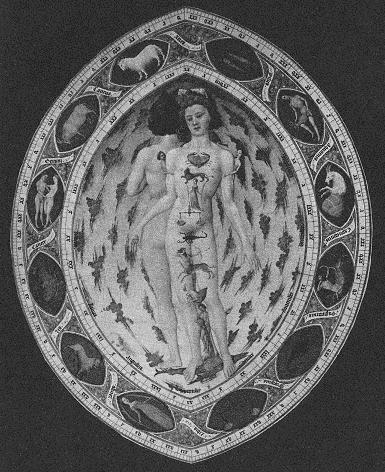
The link between planetary movements and body chemistry.
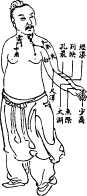
Western doctors have reluctantly admitted that acupuncture works. But can they accept the "why"?
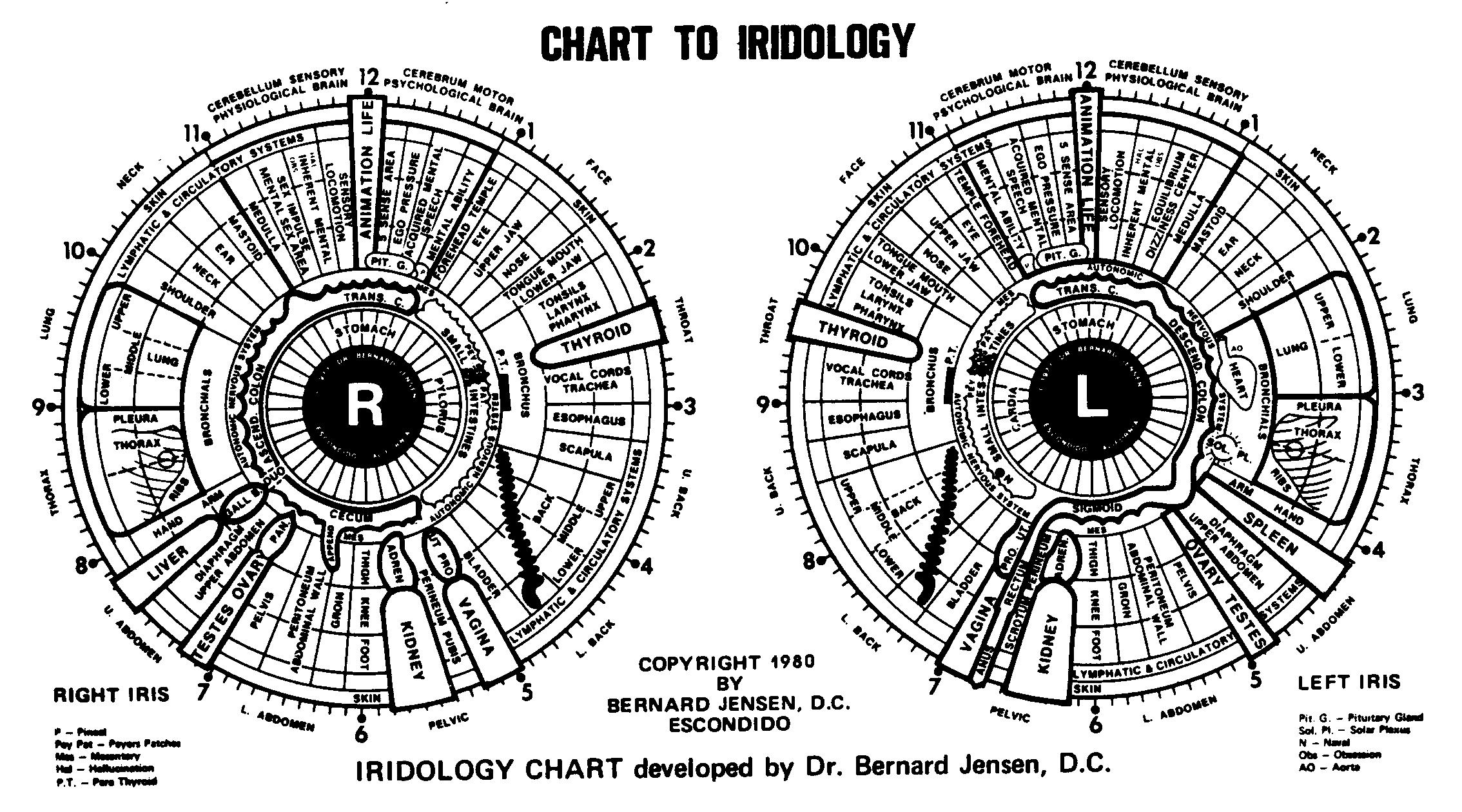
The eyes are windows of the body as well as of the soul.
Part II of How to Chart Your Own Horoscope: The Planetary Aspects.
Recent brain/mind research explains how religions begin with "right brain" visions and evolve "left brain" creeds.
Modern Life-after-death research is incomplete without a study of this ancient guide to the Bardo realm.
"I": The Story of Self by Michael J. Eastcott, Mysteries by Colin Wilson, Hypnotism and Psychic Phenomena by Simeon Edmunds, Yoga and Psychotherapy by Swami Rama, Rudolph Ballentine M.D. and Swami Ajaya (Allan Weinstock), Ph.D., and Psychology of the Observer by Richard Rose.
TAT Journal is published by the TAT Foundation, a non-profit, tax-exempt corporation, that was established to provide a forum for philosophical and spiritual inquiry, based upon the principle that cooperation with fellow inquirers expedites one's own search. The TAT Foundation supports workshops, seminars, study groups and related services. The views and opinions expressed in the TAT Journal are not necessarily those of the editors or of the TAT Foundation. Address all correspondence, including manuscripts to TAT Foundation. Manuscripts will be returned only upon request and when accompanied by a stamped, addressed envelope.
Editor: Louis Khourey;
Contributing Editor: Mark Jaqua;
Advertising: William Weimer;
Circulation: Doron Fried;
Production: Robert Cergol.
© 1981 TAT Foundation. All rights reserved.
The Truth Behind The Exorcist
by Joseph Jacobs
FEW PEOPLE ARE AWARE THAT there is a true story behind William Peter Blatty's The Exorcist. The best-seller and box-office smash left people thrilled and scared - telling themselves that it was only a fairytale, yet perhaps deep inside, feeling that there was some truth between the lines of the Hollywood fantasy. In fact, The Exorcist was based on the true story of the apparent possession of a 14-year-old Mt. Ranier, Maryland boy in 1949.
In more general terms, The Exorcist appealed to ancient fears and beliefs within us all. Mankind has believed in demon spirits and possession for untold thousands of years and it is only recently that psychology and science have scoffed at these archetypal beliefs. We may find that our psychologists can no more adequately explain possession than have ancient shamans and Catholic priests. Is possession a fact or superstition? Although it relegates possession to superstition, does psychology have a theory adequate to explain possession beyond simple denial by foot-stamping beration of "medieval nonsense"? Either possession is fact or fiction; it cannot be both.
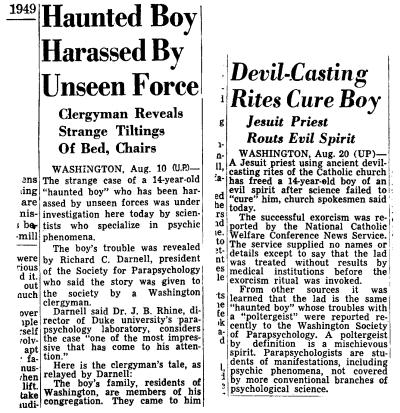
[Illustration: Wire service stories from 1949 document the possession and exorcism of "Douglas Deen" upon which Blatty based his enormously successful novel, The Exorcist.]
The case upon which The Exorcist was based concerned a young boy, Douglas Deen (pseudonym), who lived in a suburb of Washington, D.C. The phenomena began with poltergeist knocking and scratching - as accurately related in The Exorcist - shortly after the death of an aunt who was close to the boy. The Deen family was Lutheran and when the phenomena became more agitated the family pastor, Reverend Winston, agreed to take the boy into his home. During the night the phenomena intensified and the boy's bed would vibrate and move across the floor. If the boy sat in a chair it would often tip itself over. Pastor Winston said that when things moved everything moves "as a unit." Bed coverings and bed would move in unison. Winston believed the case too difficult and felt the boy needed psychiatric help, so he was sent to Georgetown University Medical Center. No improvement was realized there and an appeal was made to Catholic authorities for an exorcism. The boy was moved to St. Louis where Jesuit Father William Bowdern, pastor of Collegiate Church of St. Louis, was appointed to perform the exorcism by Archbishop Ritter.
Father Bowdern has been extremely reticent to describe what took place during the exorcism but some information has come from other persons connected with the exorcism. Numerous supernormal manifestations were reported, ranging from a host taking off and flying about the room and then landing back on its silver platter to fluent use of Latin by the boy. It is also reported that the boy reduced the Father's Roman Ritual to confetti by merely touching it with his finger. The only abnormalities Father Bowdern would publicly admit were that odd markings would often appear on the boy's chest sometimes taking the form of the word "hell."
Blatty claimed that he saw Bowdern's personal diary of the case before writing The Exorcist, but when interviewed by "Newsweek" magazine Bowdern retorted to this, "I have never talked with Blatty and never will." Bowdern was very antagonistic to the attention the case was receiving following The Exorcist and told the "Newsweek" reporter, "I have lived in dread of calls from people like you. It started with the book and then the movie, and if it keeps up some fine lives are going to be ruined. The boy in the case has grown into a fine man with a lovely wife and children."
If possession is a fact not adequately explained by other theories, then we may still not know what actually does the possessing. At present, psychology denies the reality of possession yet it has no comprehensive theory to explain it. All great theories are simple in nature and when any belief-system or paradigm gets too cumbersome it is usually time for simpler theories to surface. Early twentieth century physics was a morass of confusion until Einstein took a grand step and simplified many problems in a three-letter equation, E=MC2. Psychology is in such a shambles at present. It is likely that a person going to a dozen different psychologists will get a dozen different prescriptions for his problems. This is not truth; it is speculation and a guessing game with a person's life at stake. Psychologists cannot even agree on what is a problem and what is not. Psychology involves itself in all too superficial thinking and is easily swayed by public opinion. Materialistic-oriented public opinion denies the non-material so it becomes impossible for psychology to consider a non-material explanation for possession.
To explain possession, psychologists postulate different "selves" within the person and that one can become controlled by one or another of these "selves." It is explained as a dissociation of the personality with certain aspects breaking off and forming autonomous units with a character of their own. In Possession and Exorcism T.D. Oesterreich makes an analogy to explain this dissociation theory of possession:
The true state of things is essentially the same as when I converse mentally with someone and in imagination hear him reply, by which means a conversation may be enacted. In these circumstances the arguments of the other person may also have a character of compulsion. In the case of possession there is nothing more than an extraordinary accentuation of this phenomena... The subject loses control over a considerable number of his states, and it is this part of his personality which plays the obsessive role of a demon.
This theory, of course, does not explain phenomena such as levitation and clairvoyance which accompany some possession cases. If man has many "selves" why does he only identify with one self? Whose "will" may be motivating the other "selves"? Would the will of a separate entity possessing an aspect of the person's personality describe dissociation more adequately? If a person's will and motivation are divided up among several different selves then his "I" or self-identification should also be divided. This is not the case. The possessed feels he is doing battle with something outside himself.
THERE ARE OTHER APPARENTLY authentic cases of possession as extraordinary as the Mt. Ranier case upon which The Exorcist was based. One of these occurred in Earling, Iowa in 1928. In Robert Pelton's Confrontation With the Devil we find a direct narration of this case from Catholic priest Joseph Steiger. Steiger was present at the entire 23-day ordeal and aided Father Theophilius Riesinger who was the exorcist. In this case we have a first-hand account of real-life happenings that rival The Exorcist in their fantastic nature. We cannot determine beyond doubt that this case is true but authenticity is lent to it by the fact that Steiger relates a tale in which he does not appear in too favorable light. It seems the supposed "demon" created a negative effect in Steiger so that he was fighting exorcist Riesinger nearly as much as the demon.
At about the age of 14 the woman in question began exhibiting disturbing symptoms. She could not take communion or involve herself in church affairs without becoming agitated. Her condition became worse over the years and it was discovered she understood several languages without being schooled in them. When blessed in Latin she would fly into a rage but when non-liturgical Latin was spoken it caused no reaction. She could also unerringly discern holy water from unblessed water and was unable to eat food that had secretly been blessed by a priest. Her case came to notice of church authorities and an exorcism was approved for her at the age of 40 in 1928. Father Theophilius Riesinger asked permission to perform the exorcism at Father Steiger's parish in Earling and this was agreed to.
The woman was laid on a bed and was held down by several nuns from the adjoining convent since it was expected the subject would become violent. The woman became and remained unconscious through the first recitation of the ritual. When the second recitation began, all "hell" broke loose:
With lightning speed the possessed dislodged herself from her bed and from the hands of her guards; and her body, carried through the air, landed high above the door of the room and clung to the wall with a tenacious grip. All present were struck with a trembling fear. Father Theophilius alone kept his peace.
"Pull her down. She must be brought back to her place on the bed." Real force had to be applied to her feet to bring her down from her high position on the wall. The mystery was that she could cling to the wall at all! It was through the powers of the evil spirit, who had taken possession of her body.
Again she was resting upon the mattress. To avoid another such feat, precautions were taken and she was held down tightly by stronger hands.
The exorcism was resumed. The prayers of the Church were continued. Suddenly a loud shrill voice rent the air. The noise in the room sounded as though it were far off, somewhere in a desert. Satan howled as though he had been struck over the head with a club. Like a pack of wild beasts suddenly let loose, the terrifying noises sounded aloud as they came out of the mouth of the possessed woman. Those present were struck with a terrible fear that penetrated the very marrow of their bones.
"Silence, Satan. Keep quiet, you infamous reprobate!"
But he continued to yell and howl as one clubbed and tortured, so that despite the closed windows the noises reverberated throughout the neighborhood.
Awe-struck people came running from here and there: "What is the matter? What is up? Is there someone in the convent being murdered?"
Uncanny phenomena continued to occur. The woman could not take food and was fed intravenously, yet she continually vomited foul substances 10 to 30 times a day. The appearance of these substances ranged from "macaroni" to "tobacco leaves." Her body reportedly bloated at times until it appeared it would burst. She would also increase tremendously in weight, to such an extent that the iron legs of her bed bent to the floor. Clairvoyant abilities were also demonstrated. Pastor Steiger once hid a church relic on his person and the "demon" speaking through the woman immediately screamed for him to get the relic out of the room and related where he had it hidden.
In one incident either the "demon" caused an accident or clairvoyantly knew it had happened. Father Steiger was returning to the convent in his new car from a house call nearby. He described a "black cloud" that came between him and the road and he was caused to hit a bridge railing. When Steiger, in shaken condition, returned to the convent it was discovered that the possessed had accurately described what had happened to him and claimed credit for the accident. The "demon" said that the only reason he had not killed Steiger was because of the intervention of Steiger's patron saint, Joseph!
The pace of the exorcism quickened and Father Riesinger asked the other attendants to aid him by doing penances and fasting. Daily prayer services were held for the possessed in the church. Father Riesinger amazingly performed the last three days and nights of the exorcism non-stop without rest. He was reportedly a man of iron constitution but at completion of the exorcism had lost much weight and looked like a walking corpse. Upon recitation of the last ritual the woman was said to have suddenly raised vertically in her bed with only her heels touching the mattress. With a sudden screaming wail she fell back in her bed and the exorcism was completed.
Phenomenal aspects are not treated at all by the dissociation theory of possession. In many cases raised welts appear on the possessed's body and may take the form of words or figures. In the Mt. Ranier case the word "hell" appeared on the boy's chest. Such phenomena are explained by psychologists as a form of autohypnotic control of the body. Some skilled hypnotists are able to cause their subjects to form welts or to cause catalepsy or insensitivity to pain. Supposed examples of autohypnosis are the cases in which Christian mystics develop bleeding stigmata. These non-healing wounds on hands and feet are said to be autohypnotically produced through the mystic's complete identification with Christ.
Gradual changes in the body such as welts and sores can be explained by autohypnosis (ignoring for the moment that we actually do not know what hypnosis is!) but instantly appearing teeth marks inflicted by supposed demons can not be explained so simply. There was such a well-documented case from the Philippines in May, 1952. The case involved an adolescent girl who was taken into police custody for vagrancy. She began behaving erratically and screaming that she was being bitten by two "things." The following is an excerpt from the prison's Official Medical Report recorded by D. Mariano Lara, Professor of Legal Medicine, University of Santo Thomas, Manila:
I find it difficult and near impossible to accept anything of a supernatural character... Equipped with a magnifying lens and an unbelieving mind about this biting phenomena, I scrutinized carefully the exposed parts of her (Clarita Villanueva's) body, the arms, hands, and neck, to find out whether they had the biting impressions. I saw the reddish human-like bite marks on the arms... At that very instant, this girl in a semi-trance loudly screamed repeatedly... I saw, with my unbelieving eyes, the clear marks or impressions of human-like teeth from both the upper and lower jaws. It was a little moist in the area bitten on the dorsal aspect of the left hand, and the teeth impressions were mostly from the form of the front or incisor teeth. Seeing these with my unbelieving eyes, yet I could not understand nor explain how they were produced as her hand had all the time been held away from the reach of her mouth...
In full possession of her normal mind, I asked her (Clarita Villanueva) who was causing her to suffer from the bites. She answered that there are two who are alternately biting her; one big, black, hairy human-like fellow, very tall, with two sharp eyes, two sharp canine teeth, long beard like a Hindu, hairy extremities and chest, wearing a black garment, with a little whitish piece on the back resembling a hood. His feet are about three times the size of normal feet. The other fellow is a very small one about two or three feet tall allegedly also black, hairy and ugly.
Several accounts of the case also appeared in Manila's "The Daily Mirror" and "The Manila Chronicle." People were reportedly watching her at all times when the bites appeared and it was deemed impossible that she could have been biting herself. She was exorcised by a Christian evangelist in the area and reportedly had no more difficulties afterward. Interestingly, she had conversed with the evangelist in English, but after the exorcism she no longer understood a word of English and had to resort to an interpreter.
IS IT SO UNSCIENTIFIC TO POSTULATE that there may be creatures that live in an invisible dimension? Science deals with material objects, things that can be measured and physically observed. Science, in effect, is stating that what it cannot see or measure does not exist. We will never be able to physically measure a thought, yet we know that thoughts exist. The subtle can measure the coarse but the coarse cannot be used to investigate the subtle. We can "measure" the physical universe with our thoughts but we can never measure thoughts with physical matter or instruments. Thoughts are of a superior and more subtle substance than coarse physical matter such as instruments are made of. If entities and demons are formed of a more subtle substance than physical matter, we will never be able to measure or detect them with physical mechanisms. If demons exist, they may be composed of the same "substance" that thoughts are composed of and thus only detectable mentally through the effect they have on our minds and behavior.
A question that arises is that if demons are non-material how are they able to effect material changes such as levitation and causing objects to fly through the air? It would seem that an intermediary substance would be needed, a substance on the border of the material and non-material. Many phenomena similar to those in possession are found in spiritualism and are attributed to the use of "ectoplasm" by the discarnate entities involved. Ectoplasm is said to be extruded from the medium's or sitter's body during the séance. The medium temporarily puts herself under the control of these entities in a voluntary form of possession in which some identical phenomena are produced as in involuntary possession. Ectoplasm is regarded by spiritualists as a semi-material vital fluid of the body. The use of this vital fluid by the supposed discarnate entities during the séance usually proves very tiring to the medium. Dr. W.J. Crawford, Professor of Mechanical Engineering at Queens University, made extensive tests concerning ectoplasm from 1917 to 1920. He discovered that there was a distinct loss of weight in all participants during a séance due to loss of ectoplasm. This average loss in a sitting was approximately ten ounces per person.
Another question that might arise in considering the demon-hypothesis is just why would a demon want to possess a person? Three potential reasons come to mind: (1) enjoyment of passions and activities though the use of the host's body; (2) an energy "rake-off"; or (3) simply a diabolical nature. If discarnate humans are the source of possessions then they may wish to experience earthly pleasures or vices that can no longer be experienced in whatever nether-world they are trapped. This could be a sort of enjoyment by proxy using someone else's body.
Occultists have always claimed that spirits are attracted by human and animal life-energy. This is the rationale behind sacrifices at magical ceremonies or pagan religious rites. This life-energy would seem to serve as a food for these spirits. When an animal is killed in a sacrifice his life-energy would be liberated. The Jewish scholar Maimonides wrote that when his countrymen wished to communicate with their "departed ones" they would do so by digging a hole and filling it with fresh blood. After they did this the spirits would come to answer all their questions. It could be inferred that humans give off this vital energy at all times, perhaps in the form of the spiritualist's ectoplasm. A possessing entity would be able to feed off this vital energy of the host. The loss of weight in a spiritualistic séance would tend to support this theory.
If demons are regarded as the source of possession then there is no doubt that they are diabolical in nature. In most cases they seem to represent everything conceivable that is anti-human and anti-divine. A diabolical nature is especially demonstrated in this horrifying account related in an article by James O'Donald:
Mrs. Mary Rogers was found in her wooden cabin deep in the forests of Alaska. Police said the woman's hands were clenched to her head, her face contorted grotesquely and the cabin itself was in shambles.
In a matter of a few months, several friends said that the woman changed from a happy mother filled with life, hopes, and dreams to a haunted and unkempt shell of a human being. The friends, who live not far from her cabin which located about 200 miles from Anchorage, said she had been possessed with powers she herself did not understand. She had also told her friends that she had met the devil and that it was he that gave her those powers.
One friend, Brenda Breshahan, who visited the woman on one occasion shortly before her death, said she often spoke of death and afterlife. "Whenever she mentioned the word 'death,' the television set went on and off of its own accord, even though the cabin lights didn't flicker."
"Everything in the house was torn to shreds, as though a cyclone had hit it," said Magistrate Sheldo Sprecker who visited the scene after the body was discovered by the police. "Objects were smashed and thrown about," he said. "No human hands could have done this." Sprecker further stated that the coroner found no signs of brain disease or any evidence that the woman took her own life.
The possible existence of other-dimensional entities is not too far fetched an idea for science and psychology to consider. If the demon hypothesis is true then psychology will bury itself under ungainly, confusing and unworkable concept-structures in trying to deny it. If psychology can advance so as to develop a unified and verifiable theory explaining possession and its paranormal manifestations then the belief and practices of our ancestors will be rightfully relegated to history. A present psychology has not done this, and its multitude of theories and differing practices might provide us with little more assurance than the "superstitions" of the shaman and priest.
The Primitive Mind of Man
by George Ellis
"PRIMITIVE" YOU SAY? THE WRITER must be mad, a reader might think. But - yes - primitive for we no less than those we term "primitive" look upon thinking as true expressions of reality. They too manipulated reality as best they could according to their knowledge, thinking that their activity did then express reality. Has thinking changed so much? Do we not still hold "reality" in thought - ideas and beliefs? Did not the cave-dweller find philosophy in his own power or that of some supervening authority - God? Is not the purpose of life seen in some idea or other regardless of the mind-of-thought doing the thinking?
We are primitive because we believe that our thoughts are our touch with reality. We find reality in ideas - until disillusionment reveals as false what passed for true. Without disillusionment we believe in those cultural notions that express our society as being representative reality. We are all psychologically conditioned to beliefs - fixed ideas. We defend our meanings, supporting them with all the "evidence" of our knowledge. We live for and sometimes die for these notions even as did the very first of men.
We are primitives because we have yet to understand the limitations of our thinking as expressing reality. We live on the edge of mind in a superficial field of thought calling these interpretations drawn from knowledge - reality. However, we do not honestly believe that which we call reality is for we spend much of our time seeking confirmation that reality is what we say it is. This is primitive, for it supposes that reality is nothing more than what the mind-of-thought makes of it, that it has no majesty beyond our personalized meanings. But it must have some missing meaning or we wouldn't frequently change our ideas or become disillusioned with what we believed reality. Certainly the mind of man has never put together an ideal that passed the test as reality. And correctly so, for reality is still the mind's notion of that which is perfect and eternal unto itself while at the same time, and in time, pretending to itself that it holds a true representation of reality.
To live life in knowledge as we do, believing that our conclusions that terminate in beliefs are then reality, is to live in an illusory world of mind that defines reality to itself. The mind-of-thought has as its center self-knowledge that gives meaning to experiencing according to its own conclusions. It is in such fixed meanings as conclusions provide that we lose our touch with reality, for the mind-of-thought sees only what it has concluded, rejecting whatever challenge reality presents. As we are psychologically conditioned to repetitiously reinforce conclusions, it is only when conclusions break down in the absence of support that our error of belief is seen for what it was.
Ideas must produce a desired result or we soon find substitute ideas more to our liking. For ideas serve the believer who desires what he has not, in the idea. God is a powerful idea for those persons without power. When men achieve their own power base the idea of God loses its hold over them. Where there is power and wealth God is mocked, however lip-service is paid. Science and technology form another power base towards personal godhood. To be sure, the old ideas die a slow death in their loss of strength as we achieve personal might, but they do pass on into oblivion and if we wonder at all over them it is to ask how we could have ever held such notions.
Obviously early man went through very much the same thought processes however less complicated than our own. Such thought that seeks reality within its own knowledge must ever remain primitive, which is to say enclosed to conclusions.
Faith in knowledge is primitive for knowledge leads only to more knowledge that becomes its own end of meaning. "God" is an idea born of knowledge, characterized out of knowledge. The idea is both servant and master for such is the nature of knowledge that it provides and protects, seemingly securing us against that vast unknown. We are idolators of knowledge, with God as the crowning symbol of our heathen worship, for there is no trueness in faith in knowledge as a purposeful life. All philosophers are false prophets whose knowledge leads the blind to follow the blind, whether political, religious or sectarian. Each pretends to speak in reality's name, and each is a liar and the truth is not in them. Knowledge is knowledge and, therefore, a false reality that seduces the faithful whatever the creed. If you think that you have entered into the heart of humanity in some belief or other, you have not; if you believe that you can describe the God of Love, you see only your own mind's desire. If you seek power, (only the weak seek power), if you desire to be known as this or that, you pretend to reality giving yourself a false name; if you live in knowledge you must be unfaithful to that which is your trueness. You cannot serve two masters.
In the abstract, the primitive society of long ago differed little in its pursuit of life than today's version. True, the cave-dweller had to be preoccupied with physical survival and probably took great satisfaction with success in a world where creature devoured creature and the elements were the enemy of all. Even then life went to the strong of body, the quick of mind. And the possessive of mind who staked out territories, formed clans, created gods to supplement their own limitations.
Changing appearances is no change to a mind that understands. The ability to change this into that however utilitarian or physically beneficial is not its own absolute-reality. To think is never to create but to recreate what is into what we would then have it be. The modern cave-dweller cubicled in his highrise is not so unlike his first forbearers that drove animals from their lairs and set up housekeeping. If we have less need for defense against the ravages of nature we more than make up for this conquest in our subjugation and service to a demanding society that tortures our psyche to its own conformity. Times may change conditions in their appearances and to what seemingly is a radical move, but mankind remains the more or less obedient slave to its storehouse of knowledge. So it has ever been even up until now.
THEY SAY THAT KNOWLEDGE doubles or triples every ten years or so. For the most part this means scientific and technological knowledge that reach into the very bowels of the earth and beyond, to say nothing about examining our minute parts. But what do the professionals tell us about our mind-of-thought without which there would be no knowledge bank of tremendous information? Not much that is worth knowing. Comparatively psychology is a backwards science, if it is that. It describes and then attempts to interpret its descriptions according to norms themselves arbitrarily arrived at. The inventor of the wheel was a greater servant of mankind than all the behavioral people since Freud fathered the formal approach to psychology. In the end, what we need to understand most - the mind-of-thought - suffers from overload as the primitive processes have reached their peak of complexity reducing all of us to a channeled specialty. Yet we swill knowledge like so many hogs at a trough. We live in a verbal sea of news, information trivia, gossip and the like. Our minds center on this and that raising these subjects into importance, never even wondering why. It is enough to fix our minds on something for the pleasure or satisfaction we have learned it brings. One can only wonder whether the lesser creatures do not suffer less frustration and misery than mankind.
Surely the meaning of one's life should be more purposeful than dedication and service to some idea or other. Yet societies and cultures never rise above their own idealized notions, remaining more or less fixed in these beliefs as reality-based. The crime of it all is that each of us is from birth on psychologically conditioned to see ourselves within some subculture setting that for the most part provides us with expression - identity. We speak for and from our societal conditioning believing our teachers even as they in their childhood believed their teachers. Apparently this collective imitation of the cultural form by the members has always been the case.
And this poses the question ...can mankind rise above its primitive thought processes that so effectively are passed on from generation to generation? History says - "No." Academic psychology says, "No." What hope is there then for the Children of this World, stumbling around in the darkness of primitive thinking?
Not much. Faith in knowledge and the processes of thinking perpetuates the very system of thinking. The illusion of knowledge is that it is of or leads to a fuller reality. This, mankind has always believed. Knowledge never sees beyond knowledge believing in its own expansion, accumulation, assimilation. Knowledge always evaluates according to its own prior findings, adding to or subtracting from as the case may be. Knowledge always operates from a fixed position accepting this in such and such a context, rejecting that as meaningless. And so we live out our lives experiencing little of reality as reality but rather interpreting experience to that which is now memory's recall of what had been experienced. The mind has all kinds of meanings that claim some foothold on reality but little of reality itself.
The primitive mind-of-thought by its very nature cannot entertain reality for knowledge recreates reality to itself. Reality is and we are either one with it or in separation from it as we are when we interpret reality to our knowledge. Not to understand the limitation of our interpretation fosters upon the mind-of-thought a false reality that passes for the true because it functions as we believe reality should. We see certain "evidence" that supports findings in conclusion, accepting the results as "reality." However, appearances are deceiving no matter how wide the acceptance, how sure the "proof." The mind's eye that thinks that it reflects some clear showing of reality mirrors only its own limited conclusion based in knowledge that is always its own limited conclusion.
If this activity of the mind-of-thought concludes in reality, what then do we term that vast, unknown, seemingly infinite and eternal field of material knowledge it draws upon? Is reality then nothing more than we agree upon? Is the infinite and eternal motion of which we claim the center nothing more than raw stuff waiting for mankind's utilization? Is the mind-of-thought, then, God naming the creatures and things of this world and others?
Such a reality is the conclusion of a primitive mind that lives solely by the false light of illusory findings, a mind conditioned to primary beliefs that then seeks fulfillment in the manipulation of reality to its own end.
The primitive mind is characterized by insecurity and seeks to insure its safety in defensive conclusions. Which is why the primitive mind reflects an illusory world rather than reality. Because it is motivated out of fear of the unknown the primitive mind must perpetuate the known - knowledge. Knowledge then is "reality" and we all spend the better part of our waking lives reinforcing our knowledge that creates an illusion of reality. Only serious disillusionments dispel our false beliefs of reality; and then only long enough until we provide ourselves with some substitute belief... such is our faith in knowledge as a reflection of reality. Mankind has never learned that it has always served a false god - knowledge.
No one lives that does not mourn within himself some great loss, as the mind-of-thought out of touch with reality must silently cry, "Surely there is more to life than this!" Yes, it is the press of reality upon us forces us to question our most sacred beliefs, become dissatisfied with limited pleasures and satisfactions that once pleased some idea or other. Life lived in our ideas is never enough as each of us who has suffered disillusionment well knows. It is only in learning the lesson that life is its own true motion and not the activity of ideas that we more fully express reality. But a few persons ever graduate from their psychological-me: knowledge personified. We all have faith in what we know as a first line of defense. We all believe that knowledge is our savior, that we can be redeemed if only we can achieve a desirable pattern of knowledge. It should be plain enough to see: Faith in knowledge is our downfall as it is misguiding as an approach to reality. Knowledge must ever stand between us and reality for it pretends to be what is. To understand the limitations of knowledge is to understand your thought processes that lead to conclusions. This is the beginning of awareness that reality is other than what we think; this is the beginning of dissolvement of ideas and beliefs that see themselves in separation to reality; this is the beginning of the end to the primitive mind of man.
The Mystery of Firewalking
by Alan Fitzpatrick
MANY OF US ARE fascinated by that which we cannot explain. Though the awe for the unknown we experience as children may have been tempered with maturity, when an event occurs such as a premonition, an ESP experience, or a vivid dream that defies our sense of reasonableness, we are intrigued by what appears to be the incredible, or supernatural, if we don't deny the experience altogether. Such is the case with firewalking, one of the most dramatic and mysterious of paranormal phenomena that has been witnessed by man and recorded throughout history.
Firewalking is the ability of some individuals to be able to walk barefoot over the hot coals of a fire. What makes this phenomenon so unusual and separates it from the pathological cases of self-immolation is that successful firewalkers perform such feats without being burned. The lack of evidence of any burns defies logic and common sense and has made firewalking the object of a great deal of speculation and study in recent years. In the past, firewalking attracted little scientific interest because it was believed by westerners to be nothing more than clever trickery. Most who observed it in far eastern countries were either local religious adepts and their followers, or those spectators with overly morbid inclinations who felt that they were about to witness pagan sacrifice.
The unquestionable belief by the skeptical that the firewalker was about to be severely burned could hardly be called unreasonable in view of the basic law of nature which states that fire burns flesh when the two come in contact. Yet documented accounts exist that show some firewalkers can, in fact, walk hot coals without any burns. To add to the credibility of these accounts are cases of several uninitiated firewalkers who attempted to duplicate the previous successes and were subsequently severely burned. Of those from the west who have been witness to the incredible phenomenon of firewalking around the world, none have been able to find a suitable explanation for that which they have seen.
Many have proposed theories along physical, psychological, religious and metaphysical lines to attempt to unravel the mystery and answer the disturbing questions that they all ask. Why are some firewalkers not burned? Are the mechanics of successful firewalking simply trickery or are there hidden factors known only to the practitioner? These questions and many more that are raised by firewalking are haunting for us all, for at the heart of such inquiry is the realization that the unexplainable challenges our belief in an orderly view of the world, by being the exceptional case that science has been unable to dissect into factors of cause and effect. As such, understanding firewalking may tell us a great deal about the true nature of reality itself, rather than just satisfying our curiosity about the mysterious.
WHERE AND HOW the practice of firewalking originated is historically obscure though many firewalkers believe that the practice probably began in Central Asia, one of the ancient cradles of civilization. Firewalking is known to have been wide-spread in all ages, usually practiced in conjunction with religious ceremonies. Firewalking survives today in India, Greece, Spain, Japan, China, Bulgaria, Ceylon, Thailand, Fiji, and Tibet. It is mentioned as a practice in many early historical records. Pliny the Elder, a Roman (A.D. 23-79), traced firewalking to an ancient Roman family, the Hirpi, and tells us that "at the yearly sacrifice to Apollo performed on Mount Soracle (they) walk over a charred pile of logs without being scorched." Other early writers such as Virgil and Strabo made reference to firewalking as part of a religious rite.
The earliest documented account of firewalking is the biblical reference found in Daniel 3:23-27 that many of us are familiar with. Three religious zealots, Shadrach, Meschach, and Abednego were accused by Nebuchadnezzar, the king of Babylon, of refusing to worship him, the gods, and golden images that he had decreed all his constituents must worship or face the penalty of death. When questioned by the king for the grounds of their heresy, they replied that they worshiped their own god, who would protect them from the king's destruction. In anger, the king ordered his furnace heated to seven times its normal temperature and commanded his men to bind the three heretics and cast them into it. Because the fire was exceedingly hot, several of the men who cast the three into the fire perished themselves. To the astonishment of the king, Shadrach, Meschach and Abednego rose to their feet and began walking about soon after they were thrown into the furnace. "Lo I see four men loose, walking in the midst of the fire, and they have no hurt." When they were called to come out of the furnace by the king, the three were examined for burns (the fourth was said to look like an angel though it disappeared and could not be verified). "And the princes, governors, and captains and the king's counselors being gathered together saw these men upon whose bodies the fire had no power, nor was an hair of the head singed, neither were their coats changed, nor the smell of fire had passed them." Asked how they were able to do so they answered that it was due to their faith in their god. Nebuchadnezzar then released the three and was converted to their god, who apparently was more powerful than his own.
A more recent account of firewalking is reported by Dr. Krechmal in "Firewalkers of Greece" (Travel, October 1957). Dr. Krechmal had been in Greece several months as a Fulbright professor when he heard stories of a village in northern Greece where the people, nominally members of the Greek Orthodox church, still practiced firewalking as a ritual celebration passed down from their Macedonian ancestors of two or three thousand years before, who were said to worship the sun and fire.
Out of curiosity, Dr. Krechmal traveled to the village Langedah to observe the ceremony which was held for three days in the spring. In the town square he found a large area that had been enclosed with wire. Men in the center of this arena fired a large stack of logs in a pit. When the fire had burned down to coals a procession of musicians entered the enclosure. Behind them followed a group of boys carrying candles and then several barefooted villagers holding icons. The villagers began dancing, and soon several of them ventured into the burning pit and shuffled across. Krechmal says "the first villager to walk through the burning embers, and they were burning, was a gaunt man of about thirty-five, who seemed to be the leader of the active firewalking participants. His eyes appeared glazed, and he seemed to be in the throes of a form of the religious hysteria or ecstasy reported from time to time in some journals."
Krechmal photographed several of the firewalkers while in their trance-like state. Unsure of the reality of what he was seeing, Krechmal checked the fire. "I tested the embers and found them to be unbearably hot to my hand, although the performers seemed completely unaffected by them." He was awed by the spectacle, and concluded it to be a strange and ancient religious ritual, where adherents were not burned from firewalking.
A more detailed account and discussion of firewalking was reported by Dr. Leonard Feinberg in his article "Firewalking in Ceylon" (Atlantic Monthly, May 1959). Feinberg, as a professor at the University of Ceylon in 1956-57 had an opportunity to study directly the religious ceremonies of the island, including the firewalking ritual. Feinberg had previously witnessed firewalks at two private occasions, but not on the scale of the mass firewalk that he attended in honor of the Hindu god Kataragama, held at a local temple in a jungle settlement in southeast Ceylon. Kataragama, to many Ceylonese, is officially the god of war and revenge and, according to Feinberg, was probably more fervently worshiped and feared than any other god in Ceylon by Buddhist and Hindu alike. Devotees petitioned Kataragama for assistance in their personal lives in exchange for vows to walk the fire. As much as three months prior to the ceremony, amateur firewalkers began their preparations, not by practicing firewalking, but by vows of sexual abstinence, vegetarian diet, and daily prayer, to achieve the proper state of mind for their walk which would be a test of faith.
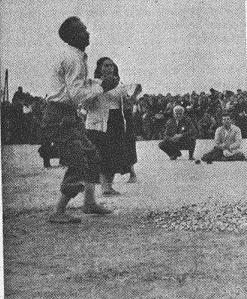
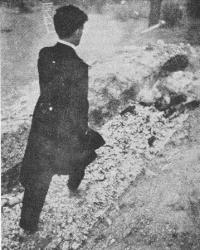
[Illustration: A Greek firewalker in a trance-like state, photographed by Dr. Krechmal in the Macedonian village of Langedah.]

[Illustration: While kerosene-drenched logs burn to coals, village musicians play for firewalkers and onlookers.]
On the night of the firewalk, Feinberg described the crowd of spectators gathered as "feverishly tense" by midnight. The fire in the twenty by six-foot pit has been burning down from logs for four hours. The crowd, according to Feinberg, "surged away from the pit slowly and steadily... slowly because every inch of the temple grounds had been packed for hours, and steadily because the heat from the pit was becoming unbearable." At about two a.m. the crowd parted to make room for two women to pass through. One carried in her bare hands a clay pot full of burning coconut husks. The other carried a pot of burning husks on her head, native-style. Neither showed any signs of burns or scorching on their hands or hair, when Feinberg examined them. He noted that neither woman seemed to be feeling any pain, but appeared to be abnormally excited and staggered through the crowd, as if in a trance. Next, a long procession of firewalkers and religious adepts led by a priest arrived next to the pit. Feinberg says that the fire, by this time, had "stopped spurting flames and the pit consisted of a red hot mass of burning wood, which attendants were leveling with long branches. The heat of the fire was still intense; within ten feet of the pit it was difficult to breathe." Feinberg witnessed eighty persons walk the fire including women. Some skipped lightly through, some danced, others shuffled or strolled. "One man stumbled suddenly and the crowd gasped; he fell forward, hung for a ghastly moment on the coals, then straightened up and stumbled on." After the firewalk, the performers went to a spot near the temple where ashes from the fire were smeared on their foreheads by the priests. Several of the walkers displayed no signs of burns whatsoever. Yet of the large group that Feinberg observed, twelve people were burned badly enough to go to a hospital, and one of them died. The successful walkers claimed their success to be due to complete, absolute faith in Kataragama, and they felt that the failure of the others was due to either inadequate religious preparation or lack of faith. One of the failures was known to be a Protestant minister who reasoned that the faith of a Christian was at least as strong as that of a Hindu. When he volunteered to walk the fire to prove his point he was severely burned and doctors barely managed to save his life. Feinberg discussed various theories concerning firewalking but could come to no conclusions himself for the successes.
An even more spectacular account of firewalking and religious preparations for it appeared in the National Geographic magazine issue of April, 1966 in "Ceylon," written by Senior Assistant Editor Gilbert Grosvenor and his wife. They had been traveling Ceylon, and by chance heard of a firewalking ceremony to be held in a nearby village. The ceremonies were held in the private courtyard of a local villager named Mohotty who had vowed to the god Kataragama to walk the fire yearly in exchange for fulfillment of his prayers that murder charges against his father be dropped. The ceremonies began with dancers rubbing themselves with sacred ash and then, as the Grosvenors observed, "as they stared with glazed half closed eyes, they forced steel skewers through each others cheeks." When the skewers were later removed, no sign of blood or a wound could be found. The devout Mohotty then submitted himself to various spikes, lashings, and meat hooks applied to various parts of his body that when removed left no marks or blood.
The fire pit was begun in the early evening. By midnight, it was a mass of red hot embers, which Ed Lark, a member of the Geographic team, measured with an optical pyrometer and found to be 1,328°F. Chanting native dancers then arrived at the fire and circled the embers, preparing for a firewalk. The first firewalker was a young man who danced across the coals, digging his feet into the embers. Another walker stopped to scoop up handfuls of coals and throw them over his shoulder. The Grosvenors watched twenty people in all participate, including men, women and children. Mohotty crossed the fire pit four times, twice with his own young son on his shoulders. Afterwards, Mohotty willingly allowed his feet to be examined and photographed by the Grosvenors, and no signs of any burns or blisters were to be found. When Mohotty was asked for his "secret" he answered, "Faith, total faith in my gods." Grosvenor, a pragmatic individual, wrote that he couldn't sleep after the "incredible sights" that he had seen. "What we saw was real, as real as the faith upon which these believers base their immunity from pain of steel or flame." He was unable to explain the performances by hypnosis, drugs, tricks or gimmicks.
THESE ACCOUNTS OF firewalking give perhaps the best impression of the nature of the actual phenomenon, of when it occurs and why. If accepted at face value, they are bewildering, for we find that some firewalkers are not burned, and yet they base their success simply on faith. Many skeptics of firewalking deny that a religious explanation of firewalking is needed. They claim that the phenomenon can be explained as a result of trickery on the part of the firewalker combined with his intimate knowledge of some simple conductive properties of heat.
Many investigators believe that the soles of the feet of most firewalkers are extremely tough and thick due to the fact that most of them live in Southeast Asia where they are accustomed to walking barefoot daily, often on hot surfaces due to the equatorial sun. Feinberg verifies this fact and says that Orientals have been known to "put out cigarette butts with their toes and when marching in parades, step on burning husks which have fallen out of torchbearers' fires." Thus, the thick skin on their feet, like leather, prevents them from being burned in firewalking.
In conjunction with the thick skin on their feet, many believe that firewalkers utilize perspiration from their feet, moisture applied, or an ability to induce their feet to perspire heavily, prior to the firewalk. This layer of perspiration insulates the soles of their feet further, and as the researchers of "Firewalking Figured Out" (Human Behavior, September 1978) believe, "acts as a buffer between the hot coals and the soles of the feet."
Still others, while admitting these theories to be true, believe that the real factor is that firewalkers treat their feet with special ointments that not only toughen the skin but insulate it with fire retardant non-heat conducting properties, much like asbestos. Victor Perera, in his article "The Firewalkers of Udappawa" (Harpers, May 1971) interviewed reputable sources prior to a firewalk. One claimed that the secret was that "they rub eucalyptus oil on their feet in order to insulate them." Many skeptics agree that the issue of these religious rites are not always left up to the gods. Albertus Magnus, philosopher and magician, formulated a recipe for the purpose of protection from fire. Powdered lime was made into paste with the white of an egg and then mixed with radish juice, juice of the marsh mallow, and the seeds of the fleabane. A first coat of this mixture would be applied and allowed to dry. When a second coat was applied, the area was to be moistened with diluted sulphuric acid to make it impervious to heat and burn.
A mechanical explanation is offered from another source by Feinberg. He quotes Joseph Dunninger, a well-acquainted observer of firewalks in Japan. Dunninger asserts that the trick used by firewalking Shinto priests in Japan consists of making the fuel in the trench shallow in the center and deep on the sides, and starting the fire in the center. By the time the walking begins, the fire has burned out in the center while still blazing at the edges. The priests simply step out on the cool ashes on the center. Feinberg does not tell us how Dunninger obtained his information and if he tried the fire out for himself.
Another variation of this theory is that the firewalkers make the fire shallow in the center and then wait until a layer of ash forms on the surface. This, they say, explains why most firewalkers delay until the "right" moment. Perera quotes a source at the firewalking that he observed who believed that "the layer of ash on the surface shields them from any coals." Thus, the success of the walker would depend on his timing and a clever knowledge of the fire.
Perhaps the most popular mechanistic theory of all is the "poor heat conductor theory" supported by many researchers and, oddly enough, by Mayen Coe, an American firewalker, who is said to have traversed fiery pits thirty feet long and eight inches deep, and sometimes taken sixty strides over the pits burning at 1,200°F. Coe rejects the "perspiration" theory and says that "iron and molten metals are producing only radiant heat" which would explain why fire eaters at carnivals are able to lick red hot metal pokers. In those cases, a layer of perspiration or moisture would insulate the flesh from the heat. "But red hot coals are generating heat by oxidation," says Coe. "Due to the gases formed, it is unlikely that a film of perspiration can form a vapor cushion as a protection in firewalking." He believes that moist flesh would stick to coals rather than being insulated from them. Coe does believe, however, that the coals of the fire reach a point where only pure carbon is left, which is burning fiercely hot. At that point, if air is excluded, the charcoal is immediately extinguished. Coe says, "walking on coals in this condition cuts off oxygen at the point of contact and momentarily extinguishes the radiant glow. It is important that the coals be raked and tamped down slightly so that only the soles of the feet make contact." This, Coe feels, is the secret to firewalking.
IN ATTEMPTING TO substantiate and test many of the physical and mechanistic theories of firewalking, in 1935 and 1936 the London Council for Psychical Investigation arranged two series of fire walks at Surrey, England to test hypotheses under scientific conditions. The Council invited a number of physicians, chemists, physicists, and Oxford professors to examine every stage of the proceedings, beginning with the fire pit arrangement. At the first Surrey test a Hindu named Kuda Bux walked uninjured through a fire pit measured at 430°C. or about 800°F. on the surface, and 1,400°F. in the interior. In the 1936 test, Ahmed Hussain walked over a fire pit that was slightly hotter than the previous. Both Bux and Hussain insisted that their secret was "faith" and Hussain claimed that he could convey immunity to anyone who would walk the fire with him. A professor in attendance shed his shoes and by holding Hussain's hand, was able to walk the fire without injury, though several other volunteers, who walked the fire behind Hussain out of contact with him, were burned.
The results of the Surrey tests were conflicting. The scientists had filled the fire pit evenly and maintained a controlled temperature, thus disputing the belief that the secret was due only to a clever preparation of shallow coals in the center path of the firewalker. Also, the ash layer theory as the primary factor was proved false. Furthermore, the physicians and chemists who examined Bux and Hussain prior to the walk had washed their feet and maintained close supervision to affirm that no chemicals were applied to the feet prior to the walk, thus being responsible for the phenomenon. And just prior to the walk, their feet were checked and dried so that no moisture on the surface could account for any vapor protection.
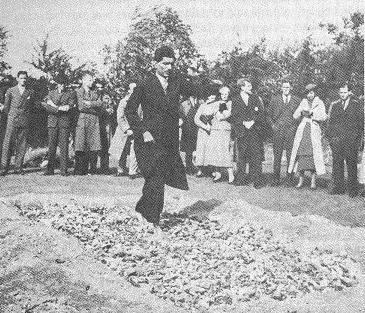
[Illustration: Kuda Bux walking through a fire pit on September 17, 1935 during the test organized by the London Council for Psychical Investigation.]
To the many skeptics who held that the secret was due to the thick, tough skin on the feet of the firewalkers, the physicians who examined Bux and Hussain described, in their official report, that their feet were very soft and not calloused at all.
The Council at Surrey could not come to any unanimous clear conclusions. Some scientists agreed that firewalking could be explained in terms of certain physical facts. They theorized that firewalking could be a gymnastic feat operating on a principle that a limited number of steps on a poor conductor of heat, being wood coals, might not result in the burning of flesh, if the time on contact was very short. The time of such contact could not be more than half a second per step. They conceded, though, that "successive contacts cause an accumulation of heat sufficient to cause injury and with fires whose temperature is 500°C. or more, only two foot contacts can be made with each foot without erthema or blistering," as stated in the official report. Their findings were jeopardized since both firewalkers at Surrey had taken more than two steps per foot without the slightest sign of blistering or burn. Further doubt on the Council's theory of a limited number of steps was cast by independent observers of different firewalks. Dr. Krechmal, in northern Greece, noted that several of the firewalkers he observed "shuffled through the coals" thus giving the impression that they took many prolonged steps rather than a few skips over the fire, without burns resulting from the extended contact with the heat. The Grosvenors observed similar shuffling of some of the firewalkers, including Mohotty who made four crosses of the long 1,378°F. pit, twice with added weight on his shoulders, thus taking many steps, with an accumulation of heat conducted, and yet without even the slightest burn or blister. Coe's belief that the fire was hottest on the exterior and would be extinguished when cut off from oxygen from the contact of a step was challenged by the Surrey researchers who found the fire to be hottest below the surface. The Grosvenors had observed one of the firewalkers dig his feet into the fire and stir the flame, thus creating more heat rather than extinguishing it, without suffering burns. Perera, in his account, noted that the villagers filed across the pit, often "loitering" on the coals until they are pushed ahead from behind. With the temperatures of most fire pits, hot as they are, it would seem unlikely that sufficient heat would not be conducted after a period of time even if the surface had been momentarily cooled by the step contact to cause burns or blistering on those who take their time. In the case of Mohotty not even the slightest trace could be found.
In addition to the complete lack of burns on the feet of some firewalkers, other interesting evidence of fire immunity at the ceremonies displaces any heat conductivity theory altogether. Feinberg observed, much to his disbelief, two women who carried red-hot pots of burning embers, one in her hands, and the other on her head in Ceylonese fashion. The prolonged contact with flesh on the hands of the one woman should have left blisters and burns. The other woman, who had a great deal of heat conducted to the flesh and hair on her head from the pot, showed no sign of scorching on either. Feinberg could not explain it. The Grosvenors observed a similar type of fire immunity when one of the firewalkers, while crossing the pit, scooped up coals with his hands to throw them over his shoulder, without burns. And in addition, they witnessed Mohotty defy blood, pain and wound marks when he pulled a cart attached to hooks piercing the skin of his back, while walking in spiked sandals and metal skewers piercing his cheeks - all with no blood flowing, nor any sign of marks from wounds when spikes and hooks were withdrawn.
PAUL BREWSTER, A RETIRED professor who has studied firewalking and looked for an explanation of fire immunity, found that Thracian firewalkers sometimes kneel down in prayer in the center of the hot coals for several minutes without burns during their celebration of the miracle of St. Constantine, who was believed to have walked fire to save the sacred icons from a burning church in A.D. 1250. He noted that the physical theories do not begin to explain the strange cases of fire immunity such as how fresh flowers that some firewalkers carry with them over the fire also emerge unscorched.
Such strange incidences of fire immunity are not always connected to firewalking alone. History records many unusual but obscure events that are well known to Christians and occultists alike. St. Francis of Paula in 1508 is said to have held red hot cinders in his hands and said to amazed spectators that "all creatures obey those who serve God with a perfect heart." L. Claris, a Camisard leader during the rise of the Huguenots against Louis XIV of France, while in a state of undetermined possession and in front of six hundred men, is said to have put himself on top of a burning pyre. The flames rose above his head but he continued to speak, and didn't stop until the fire burned down. He was examined by Col. Cavalier and found to be unhurt without any marks of burns.
In the works Convulsionnaires of St. Medard - Histoire des Miracles by P.F. Mathieu, he records a Marie Sonet, called the Salamander, who on several occasions stretched herself out on chairs over a blazing fire and remained there for half an hour, with neither herself nor her clothing being burned. On one occasion she thrust her booted feet into a fire until the soles of both boots and stockings were reduced to ashes, though her feet unhurt, thus demonstrating some sort of control over the fire immunity. Lord Adare, in his Experiences With Spiritualism observed the medium and psychic D.D. Home put himself into a trance and then hold his face into the flames of a bright coal fire, stirring the embers with his hands and moving his face about the coals as though he were bathing in water, without any signs of burns.
A spectacular case of fire immunity was reported in the New York Herald in its September 7, 1871 edition which documented that a fifty-eight year old Negro blacksmith named Nathan Coker, in the presence of a committee of people, placed a white hot iron shovel upon the soles of his feet and kept it there until the shovel became black. With it heated red-hot again, he laid it on his face and licked it with his tongue until it cooled, without any injury to his flesh. This unusual incidence of fire immunity, and the others like it, if taken at face value and considered real, could not be explained by any physical or mechanistic theories alone. Such baffling cases forced Paul Brewster to conclude that there are "no easy answers" to firewalking, if conventional avenues of investigation are to be pursued.
MANY OBSERVERS OF firewalking have noticed peculiar facial expressions on the participants which they have arbitrarily called trance-like gazes or looks. Mohotty remained "expressionless" when pierced by hooks and later when walking the fire. Feinberg noticed the women carrying fire pots to act strangely and stagger about "as if abnormally excited." Perera noted that "the expression of the firewalkers range from trance-like ecstasy of their leader to stoical indifference." Krechmal reported that of the first man to step on the firepot, "his eyes appeared glazed." Such observations have suggested to psychologists that firewalkers induce hypnotic trance states or have them induced by priests to give them indifference from pain and remove the fire entirely from their conscious minds. This would occur by the priest or leader inducing hypnosis through suggestive or mechanical techniques. Psychologists consider this likely since they point to the fact that many observers such as Perera notice that some firewalkers' eyes roll up in their heads just prior to the walk, and this would indicate that such a person might have been hypnotized by a fixation of the eyes upon an object, a technique which is common in hypnosis. They also notice that most firewalkers have a waiting period prior to their performance when they are separate from the spectators and devote themselves to prayer, song, or dance, in the company of the priest. This, psychologists feel, is important to the firewalk since it is the time of last minute instructions when the priest induces or strengthens hypnosis. Depending upon the suggestibility of the subject and the type of suggestion used, the firewalker may or may not know that he is in trance, or even where he is, or what he is about to do. He may be operating under the belief that he is about to walk over a bed of flower blossoms, as suggested by Perera, when he interviewed a firewalker after his performance who commented that the fire felt "like warm red flowers." After the performance, when the priest puts a mark of holy ash upon the firewalker's forehead, he might be breaking hypnosis and returning the fellow to his normal consciousness. Psychologists maintain that this would explain why most firewalkers are unable to explain in any detail how they walked the fire, but simply respond with "total faith," a logical answer from someone whose conscious memory had been "blocked" during the hypnotic state; the subject is now left with the feeling that he was under the influence of something, which he has been told is the power of a god.
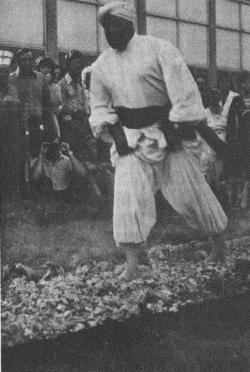
[Illustration: Komar (Vernon E. Craig) who performed the hottest firewalk ever recorded in 1976. According to the Guinness Book of World Records, the firepot temperature was 1,494°F.]
To Vernon E. Craig, known as Komar the firewalker, his own ability is a mystery. Though he was able to endure the hottest recorded firewalk of 1,494°F. without any burns at the International Festival of Yoga and Esoteric Sciences, held at Maidenhead, England in 1976 and reported in the Guinness Book of World Records, he admits privately that he doesn't know how he is able to do it, but acquired the strange ability by accident. According to psychologists, Komar would be using a hypnotic state, that could have been learned from someone else, could be self-induced, or might actually be an accidental ability for him to slip into hypnotic trance at certain times.
Hypnosis would also explain why some firewalkers are failures. They obviously would not be under complete hypnotic trance, and by coming out of hypnosis, or by never having been deeply under it, would be unable to walk without pain. The Protestant minister would have confused his religious faith with that of the firewalker, who was only calling an actual hypnotic state his "total faith."
The hypnosis theory of firewalking seems plausible to explain how the firewalker would be able to walk fire without experiencing pain, but could hypnosis prevent physical burns too? Controlled studies with self-relaxation techniques and hypnosis show that, through suggestion and post-hypnotic suggestions, a person is able to heighten the perceiving quality of the senses, gain or lose control of voluntary muscles in the body, influence involuntary muscular, vascular, and nervous systems such as slowing down the heartbeat or calming the brain waves, and become impervious to pain, so that operations, childbirth, and dental work can be done on a patient without anesthesia. Simeon Edmunds, in his book Hypnotism and Psychic Phenomena maintains that the ability of hypnosis to affect the body may be greater than we think:
It is possible not only to inhibit pain by hypnosis but, by means of suggestion, to cause it. Thus, if a hypnotized subject were touched on the arm with a lighted cigarette, if told that it was not alight he would feel no pain, but if told that an unlighted one was alight and would burn him he would react exactly as if he were being burnt by it. Many authorities claim that in this way it is possible for an imaginary burn to produce a severe blistering, whilst a real one leaves practically no mark.
Edmunds doesn't support his statement that "a real one leaves practically no mark" with any research evidence that would prove that the hypnotic state is the complete secret to the lack of burns in firewalking. Practically no mark is not the same as the evidence of no marks whatsoever as photographed on the feet of Mohotty the firewalker, by the Grosvenors. Many hypnotists agree that while hypnosis can produce wonderful physiological effects in the body of the subject, it still operates within a set of physical laws, so that while hypnosis can slow minor bleeding through suggestion, it cannot regrow new limbs when the originals are severed in accidents, nor can it prevent death by suggestions to prolong life processes. Though hypnosis could be used to convince a subject that a body that he was plunging a knife into was only a "sack of potatoes" and thus to commit murder, the person stabbed would not be able to prevent his injury by using hypnosis on himself to believe that the knife was only made of rubber, or by hypnotizing the man with the knife to believe that the knife was rubber. Hypnosis cannot change steel to rubber nor prevent steel from piercing flesh when it is thrust, and these seem to be the extent of the laws upon which hypnosis operates. If a type of mental trance or hypnotic state were being used by firewalkers, it would have to be a type of "super" hypnosis to prevent burns.
AT THE SURREY TESTS, the two firewalkers did not have the advantage of religious ceremonies or priests to prepare for their firewalks, thus precluding hypnosis induced from external sources would be necessary for success. Of course many believe that self-suggestion or autosuggestion is possible and that the firewalker may have his own intimate prearranged set of mental associations or fixation techniques to be able to put himself into trance prior to his firewalk. States of hypnosis induced by autosuggestion could explain how fakirs of the east are able to lie on beds of nails maintain a single posture for days, or slow their bodily functions down to appear "corpse-like." Some occultists believe that through a profound state of concentration attained by autosuggestion, a person is able to separate his consciousness from his body and leave it like a vacant shell, until returning his conscious or "astral" form. This might be what firewalkers do. Such a theory may be possible although "leaving the body" a vacant shell would not necessarily protect it while one was gone. Even a dead body will burn.
Some hypnotists believe that it is not the firewalker at all that is hypnotized but the crowd or spectators, into believing, through mass hypnosis, that the firewalkers are doing so. True mass hypnotism would be a simultaneous induction of hypnosis in a group of people by the priests. Edmunds contends that such an occurrence is possible when he says that "it is true that the emotional atmosphere of the political meeting or of the revivalist gathering is conducive to a state of heightened suggestibility, in which the politician or preacher is able to "put across" ideas which, under normal circumstances, his audience would be far less likely to accept." Edmunds believes that the hypnotist at stage demonstrations deliberately strives to build a "belief state" atmosphere in his audience about the fact that he is a hypnotist and that "hypnotism" is about to occur, so as to make his performance more impressive. Edmunds says that mass hypnotism is often put forward as the explanation of the famous Indian rope trick, the suggestion being that the "fakir" hypnotizes the entire audience and then suggests the vision to them of a boy climbing up a rope and disappearing. Thus the audience only believes that they have seen an astonishing phenomenon as in firewalking.
But the odds against any casual audience being composed entirely of people sufficiently suggestible to enable a mass hypnotism and suggestion to be induced is almost impossible. The natives and villagers who had witnessed the event before could possibly have been previously hypnotized. In none of the accounts of firewalking presented by westerners do we hear evidence of a ritual involving them that we could presuppose was an induction of mass hypnosis. Most of the westerners were unfamiliar with the language or the religions of the natives to be able to comprehend any "suggestions" of firewalking immunity made by the audience or priests. All would have to speak English or all speak the native language for such a subtle conviction to be conveyed. Of course, one could say that the real believers were hypnotized, along with the crowd, and that skeptics were not. But could hypnosis fool a mechanical instrument that a fire was 1,328°F. when it was not, or deceive a camera that a man's feet were not burned when in fact they were? If the audience were only hypnotized to believe that firewalkers were walking over a fire when they actually were not, then why would, as Feinberg tells us, several of the walkers be severely burned, one to the point of death? With such evidence it is improbable that mass hypnosis is used in firewalking, although there is no doubt that a degree of hypnotic belief is evident in some of the audience and participants as well.
A strictly religious appraisal of firewalking as a "total belief in god," as the walkers tell us themselves, does not give us a great deal of insight into what they mean. When firewalkers say that their success is due to total faith in god, they do not mean a god in a universal sense. For some believe in the god Kataragama, some the god Skanda, and others, as Freeman found in southern India, believe in the god Kali. Yet not any arbitrary god to have faith in will do, as Feinberg noted in the failure of the Protestant minister's faith in his god as equal to the native's god in protecting him from injury. Some firewalkers have faith not in gods but in saints, such as the firewalkers of Greece and Thrace as reported by Krechmal and Brewster, and in spirits of the wind, such as the firewalkers of Tahiti as reported by G. Feigen in his article Bucky Fuller and the Firewalk. The hint is that the act of "total faith or total belief" is more significant than the particular god that such belief is devoted to.
In his account, "Trial by Fire," (Natural History, January 1974) James Freeman witnessed a magician who was feared by the villagers in the southern Indian village, pre-empt the regular annual firewalkers during the firewalking ceremonies and, to the disbelief of priests, walk the fire successfully without burns. When the regulars attempted to walk the fire that they had completed successfully in previous years, they were unable to do so without getting burned. Freeman concluded that the "faith" of the magician had either been stronger than that of the regulars and priests, or that his unprecedented success shook or shattered the faith of the regulars and thus lessened their ability. The implications are that some sort of formula of "absolute faith" creates a mental belief state in the firewalker that enables him to alter reality, if only momentarily, in a mind-over-matter sense, not unlike the occasional cases that appear in newspapers where a person of average physical build is able to lift the weight of an automobile off a victim in an accident to save his life. Such altering of reality by lifting incredible weight in a moment of intense stress of belief-desire to save a life is similar to the firewalker's ability to induce fire immunity for himself and his immediate surroundings as some evidence shows. Such a "super belief state" would not be the same as a person's emotional belief or identification with his god, conviction in himself, or states of hypnosis that are able to evoke fire immunity, where flesh has a possibility of not being burned.
COLIN WILSON, WHO researched paranormal phenomena associated with "gifted" individuals in his book The Occult believes that a subjective appraisal of altered mental states is the only way to approach the unexplained. The trouble with humanity, Wilson says, is that man suffers from a narrowness of consciousness that lulls him into a state of permanent drowsiness, so that he never attempts to stretch his powers to the limit. To Wilson, the factor "X" or the occult factor is the tool that is necessary to extend one's mind, a power that only five per cent of humanity uses. But attaining "super" states of mind is not necessarily the same as possessing and using psychic powers that only alter one's existing consciousness. William James, philosopher and psychologist, believed that different states of consciousness may exist, rather than just extensions or alterations of our normal one. He said that "our normal waking consciousness is but one special type of consciousness, whilst all about it, parted from it by the filmiest of screens, there lie potential forms of consciousness entirely different." So that the possibility of a "super" state of consciousness would have to admit that a relationship exists between what we think is reality and what we experience as being reality. Only then could a theory, where the mind alters reality by changing one's world view in a way that supersedes the laws of nature, plausibly explain how someone could lift a car momentarily, or walk fire.
A psychologist, Robert Ornstein has restated this theme that reality is not a fixed entity and is only what we believe it to be, in his book The Psychology of Consciousness. Ornstein contends that the way we look at things through our everyday consciousness determines and limits how we think and what we see. He holds that every person has two modes of consciousness, one linear and rational, one arational and intuitive. We tend to live in a world that emphasizes the rational mode and works on a specific set of assumptions called cause and effect. Our minds screen out possibilities from a chaos of input, and excludes seeming impossibilities, thus building an agreed-upon fabric of belief with our fellow man, necessary for survival.
We all know that red means stop and green go, and convey our faith in this fact to our children. Such social beliefs about the world are only one part of a far more pervasive belief system about life itself. Ornstein believes that our ideas that result from rational modes of consciousness "act as barriers to real understanding." What we do not see as a possibility cannot exist, and we screen out far more than we accept. Yet such assumptions may only be tentative and change with time, such as the case of many discoveries in scientific fields that overthrow previously entrenched beliefs. At one time physicists held that there were only ninety-two elements in the universe and proclaimed that no more could "possibly" be found. A common belief was that the four minute mile was the limit of a man's capabilities in footrunning, and that he would never surpass such a record.
Such beliefs become "paradigms," according to Thomas Kuhn. A paradigm is the shared conception of what is possible, the boundaries of acceptable inquiry, the limiting cases. Abraham Maslow illustrates the limit of paradigms when he says that "if the only tool you have is a hammer, you tend to treat everything as if it were a nail." It is only when new discovery and evidence emerge that the paradigm changes to incorporate that now accepted belief, as in the case of someone breaking the four minute mile and making it a possibility. But to hold that knowledge is or can be exclusively rational is foolish since most of the real discoveries in science come from theorists and inventors using the arational mode of thinking. It is only that we agree to call the way in which we "see" things as scientific because we can identify cause and effect operating in events around us. The fact that we "see" in our world view that fire burns flesh does not mean that it holds in all cases. Its predictability is due to the way in which we see it.
Jerome Bruner, of Harvard's Center of Cognitive Studies, doubts that the scientific mode is the only way of seeing the world. He believes that the tenet of science that the world operates in a scheme of uniform causality is only a paradigm that has grown out of agreement from man's reasoning abilities. Bruner feels that logic and reason to the mind are only the tip of the iceberg. Scientists mistake it for being all that there is, and then deduce the only assumptions that logic can make, as hot water with colored dye in it will color everything that it touches with the same hue. Our minds see reality like the dyed water, coloring everything we see, including our thoughts, with a coat of rationality. We screen and interpret according to this mold, and rarely experience the arational side. Like darkly colored sunglasses that shade certain colors and forms from our perception, so is the mind about the nature of reality. If we are always looking through the lens of the rational mode, Bruner asks, do we ever look purely with the naked innocent eye? The only way out of this dilemma, he believes, is a leap, so to speak, from the rational mode. In his Essay for the Left Hand Bruner contends that one must replace the conventional with new constructs. This leap from logic would be a leap away from the mind, as we know it. For Bruner, real discovery occurs outside the rational mode, outside the paradigm, where the mind, which is a part of the paradigm, "becomes" rather than "analyzes." This "freedom to be dominated by the object" that Bruner speaks of is a breakthrough of consciousness by transcendence.
THE FIREWALKER UNDERGOES a transformation of mind that temporarily sidesteps ordinary cause and effect reality that makes up the kind of world that we know. The firewalker knows that fire burns flesh beforehand. He is able to firewalk without burns because he sees fire not burning himself as a possibility through an "alliance with his god," according to Joseph Chilton Pearce, the author of The Crack in the Cosmic Egg. When he walks fire he is "seized by his god and changed" so that the notion that fire burns flesh, that he normally carries with him as an idea and an experience, is replaced with a non-ordinary event such as communion or becoming one with his god. His ordinary notions concerning fire that originate for him within his mind and are projected out upon the external world that includes his body, are suspended for a moment, and causality is reversed. Thus such a nonordinary event as fire not burning flesh takes place, as Pearce maintains, "in the external world through the same reality function by which all events take place." For a moment the firewalker has changed the nature of reality, his own reality, by transcending it. He loses his self in his "total absolute faith" in his god. To Pearce, this experience is "profound beyond all objective truth and logical thinking."
The idea that a person can "break with reality" as we know it to be, is not new. Psychologists and psychiatrists agree that such a break can occur and they call it one's descending into madness. Their efforts are devoted to bringing such individuals back to their selves and the world.
On the other hand, mystics feel that such breaks are an embrace with Reality, through a transcending of the world of illusion. There is no doubt that such a non-ordinary theory to explain the unexplainable defies proof. We can only know for sure the real nature of "total faith" if we experience it directly, and verify a subjective answer to a subjective problem. As long as schizophrenia, autism, extraordinary strength, miraculous cures, lack of wound marks, and fire immunity persist as exceptions to the case that science cannot explain, we will not find any easy answers. Our inquiry into the mysterious may be stimulating, to the point that we discover new and more perfect tools along the way. As the physicist Max Planck believed, "these margins of error will prove to be for us passports to new areas of thought."
[Illustration: "Blind Tom" Bethune, the young slave who had a piano repertoire of 5000 pieces.]
The Uncanny Abilities of Idiot Savants
by Donald K. Snyder
THERE ARE MANY STRANGE THINGS in this world and among the strangest are the people known as idiot savants. Idiot savants are subnormal in all mental abilities with the exception of one area in which they are extremely talented. In this one area the idiot savant can actually be said to be a genius, such as being a human calculating machine, having a photographic memory, being a concert-playing virtuoso, or inventing and designing machinery.
Most idiot savants are not idiots as defined in psychological terminology. Idiot is the lowest category on the mental scale and refers to those who may not be able to take care of themselves in any manner. Most idiot savants would be psychologically classified as either imbeciles (the next level in ability up from idiot) or as the less deficient moron who can function in society. Savant means wise in French and no idiot savant can truly be said to be wise. They seem to possess computer-like abilities which they personally understand not in the least. Percy, a "human calculator" with an IQ of 58, was asked by a learned professor just what his "method" was for making his amazing calculations. Percy stared dumbly, became uneasy, and then asked the professor, "What does it mean, method, doctor?" Percy had just finished calculating in eight seconds what day of the week fell on January 17, 1601!
The idiot savant most recently brought to public attention is Leslie Lemke of Pewaukee, Wisconsin. In December, 1980 he was seen by millions of viewers on the national news playing piano and singing "The Impossible Dream" in a deep and moving voice. He is very good. He is also severely retarded, blind, and has cerebral palsy. Leslie is barely able to walk and must be led slowly to the piano where he is seemingly transformed into another person. He has given numerous concerts and can play or sing perfectly any song he hears only one time. He can play classical music, ballads, rock or jazz and leads his audiences from tears to wild cheers. He even sings in four different languages: English, German, Italian, and Chinese!
Despite his musical abilities Leslie is so severely retarded that he was unable to stand on his feet until he was thirteen and did not utter his first sounds until he was sixteen. Other than his music, at age twenty-six he has probably reached his peak mental development consisting of a total vocabulary of two words - a garbled "Yes" and "No." An infection when he was an infant required the removal of both Leslie's eyes and caused him to be immersed into the world of sound as his only major stimulus. Leslie "discovered" his musical abilities one night when he was sixteen. His mother awakened to someone playing on the piano. She walked downstairs to discover Leslie playing Tchaikovsky's Piano Concerto No. 1. He played the piece from start to finish without a mistake and has been playing ever since.
Two retarded identical twins, George and Charles, became known as the "Human Calendars" during the 1960's and received much attention from the press and scientific world. George and Charles were inmates of Letchworth Village in New York and had measured IQ's in the 60 range. In a demonstration of their abilities a psychiatrist asked them to add 2 + 2. Several minutes passed and the brothers could not come up with the answer. The psychiatrist then asked the twins, "Perhaps you can tell us what months in the year 2002 will start on Friday?" The brothers brightened up and instantly replied in unison, "March, February and November"!
The brothers can perform this feat for any date that is asked. George, who is better at it than Charles, can calculate dates up to at least the year 7000 A.D.
When George was six he discovered a perpetual calendar in an almanac and developed a tremendous fascination for it, staring at it for days on end. Although he could not read or write he somehow deciphered it and committed it to memory. It became a game at his house to ask him dates from the almanac. It is said that he never made a mistake. He became so good at it that his aunt, who worked as a clerk at the courthouse, would call him on the telephone to verify dates. Complete memorization of a perpetual calendar does not fully explain George's ability. There is no perpetual calendar published that goes beyond the year 2400 A.D. and George can calculate far beyond this.

[Illustration: Retarded, blind and afflicted with cerebral palsy, Leslie Lemke plays all styles of piano music perfectly and sings in four languages.]
Like almost all idiot savants, George and Charles have no ability for abstraction. They cannot subtract simple figures but if they are told they are subtracting apples, then they can do at least minor calculations. It is unclear what function determines what they can and can't do. The twins can tell you that George Washington would be 249 years old if he were alive today, yet they can't solve the abstract equation 2 + 2. It seems the logical part of their minds is singularly focused on only one area-calendar dates.
The most amazing of all musically talented idiot savants was Thomas Bethune. Bethune was a severely retarded and blind slave who grew up on the Bethune plantation in Georgia in the 1850's. When young he was utterly fascinated by any type of sound. He would listen to rain on the roof or even a corn grinder for hours at a time. He was especially fond of listening to Colonel Bethune's daughter play on the piano. Colonel Bethune first became aware of Tom's abilities one night when Tom was only four years old. He was awakened to someone playing the piano in his parlor and discovered young, blind Tom flawlessly playing a Mozart sonata. The Colonel began cultivating Tom's abilities, even hiring musicians to play for him. Tom could play perfectly any piece he heard only once. When Tom was only seven years old the Colonel took him on concert tour and was received by sell-out crowds. It is said the Colonel made over $100,000 in his first year promoting Tom.
Tom was different from most idiot savants in that he seemed to possess a degree of creativity. He could improvise on a song once he heard it. If he heard a song once, he could repeat it, but he would also correct any mistakes made by the pianist. The Colonel kept a list of songs Tom committed to memory but the list soon reached 2,000 and he no longer bothered to keep count. Tom knew literally every piece of music available in that day, including Beethoven, Mendelssohn, Bach, Chopin, Verdi, Rossini, Donizetti, Gounod, and Meyerbeer. It was estimated that he eventually developed a repertoire of 5,000 songs.
Tom had a perfect memory for any type of sound, yet he was so mentally deficient that he could only learn a few words with which to express himself. A newspaper account of him at the time read:
Blind Tom seated himself at last before the piano, a full half-yard distant, stretching out his arms full length, like an ape clawing his food; his feet when not on the pedals twisted incessantly; he answered some jokes of his master's with a loud Yha! Yha!... The head fell further back, the claws began to work, and those of the composer's harmonies which you could have chosen as the purest exponents of passion began to float through the room. Selections from Weber, Beethoven and others whom I have forgotten followed. At the close of each piece, Tom, without waiting for the audience, would applaud himself violently, kicking, pounding his hands together, turning always to his master for the approving pat on the head.
Tom's most brilliant achievement probably occurred in Virginia in 1862. He had been playing for hours and was very tired when a man jumped on the stage waving the script of an original composition. He said that if Tom were truly a genius he could play a duet with him from his own unpublished manuscript. Since Tom could not read music it would be an almost impossible task. Colonel Bethune refused to have Tom submitted to such a test but upon insistence from the audience agreed to let him have a go of it. Tom was to play "secondo" to the composer's lead. Amazingly, Tom played his part perfectly even though he had never heard the music before. He became so enthralled that he shoved the composer from the bench and played both parts of the duet, playing the composer's part better than the composer himself! This was heralded as an act of creation and not just rote learning.
PSYCHOLOGISTS ADMIT THAT there is no comprehensive theory to explain the abilities of the idiot savant. Limited theories seem to explain some, but not all, of the phenomena. Dr. Horowitz, head of the team of scientists that investigated the human calendar twins, George and Charles, states that there are at least three possible explanations:
A computer-like ability or sheer memorization does not explain the ability of some idiot savants such as Tom Bethune, or that of an imbecile named Gottfried Mind who lived in Switzerland in the eighteenth century. Gottfried was so physically deformed that children would run screaming from him, yet he had an uncanny ability to draw cats. He became known as "The Cat's Raphael" and even had a private showing of his works arranged by King George of England. Artistic and creative abilities are shown by idiot savants as well as the computer-like functions. It seems that their minds focus on something to the exclusion of all else, and this subject can be artistic or mechanical. No computer can draw cats or improvise music but a computer can calculate calendar dates.
How does the idiot savant focus so intensely on just one subject? Perhaps the "idiot genius" does not have a damaged mind internally, but in some manner his thinking brain (cerebrum) is completely isolated from the outside world with the exception of one single area or "window." If sensory channels in his brain are damaged with the exception of one area - sound for instance - then his mind would be totally occupied with sound and thus develop genius in this area. We devote our minds to a thousand different objects each day. It would be safe to say that if we were occupied with only one area, we would become a genius in it. This could be the case with the idiot savant. His thinking mind may be damaged in such a way that it can only "see" the outside world through one "window."
This theory would not apply to the idiot savant's entire brain, since he can function normally in some aspects. It could apply to a portion of his brain that is sealed off from the outside world except through the window of music or numbers. Many mentally normal persons also have certain super-abilities like idiot savants. A portion of their brains could similarly be specialized. Charles Canser, a black lawyer from Knoxville, could instantly give squares of numbers in the millions and beat the best mechanical calculators of his day. Jedidiah Buxton of eighteenth century England could calculate the number of words in a church sermon just by listening to it. Buxton also once squared a 39-digit number in his head. A recent psychological study was performed on a mentally normal "lightning calculator" who can add a series of twelve 4-digit numbers in his head in five seconds. Super-abilities are not limited to idiot savants but are potentials that the normal and retarded share alike.
A unique case of an idiot savant with great inventive genius is that of J.H. Pullen who lived in an institution in England in the nineteenth century. Pullen was outwardly severely retarded and did not learn a single word until he was seven years old. He only learned a dozen or so intelligible words during his whole life. In the institution carpentry shop, however, he was able to make exquisitely designed tables, chairs, desks, picture frames and much else. When someone would come to look at his creations he would stand by, pat himself on the head, and say "Very clever"!
Pullen's greatest achievement was the design of a ten-foot model steamship which became known as the "Great Eastern." It was complete in every detail from ropes and pulleys to copper paddles, brass anchors, and minuscule furniture in all the cabins. The boards on the hull were fastened to the ribs of the ship by over a million tiny pegs. Pullen even invented a machine to make these pegs. Before building his ship he made detailed drawings of every aspect - a remarkable feat considering that he could not read or write. The "Great Eastern" was shown at several exhibitions and almost always stole the show.
J.H. Pullen also had a devious turn to his nature. He once designed a complex mechanism to drop a guillotine over a doorway, with which he tried to chop a disliked orderly in half! When Pullen died at the old age of eighty-one, an autopsy was performed. His brain was found to resemble that of an ape more than a man's. Whatever caused his abilities couldn't be detected. No clue was discovered to explain his uncanny aptitude.
Despite many theories we simply do not know what causes the astounding abilities of the idiot savant. Brain processes are too complex for us to determine what thinking is, let alone the special type of thinking these idiot geniuses perform. We cannot, as yet, isolate it in any special convolutions or chemicals in the brain. The idiot savant seems to develop his ability almost instantaneously and doesn't improve much over the remainder of his life. Perhaps if we could learn some "trick" of concentration from idiot savants, we too could develop such abilities by an effort. It might be possible that a person could even create such an ability in several different areas. Until such a "trick" or mechanism is discovered, however, perhaps the best explanation is that given by the two Human Calendars. "It's in my head," said George. "I just know," says Charles.
The Cave of the Echoes
A Strange But True Story
by H.P. Blavatsky
This story is taken from a little-known volume by Madame Blavatsky called Nightmare Tales, completed during the last few months of her life. The co-founder of the Theosophical Society known chiefly for her monumental works of occultism, Isis Unveiled and The Secret Doctrine, she threw these stories off "in her lighter moments" for "amusement and relaxation," according to the foreword by Annie Besant. If this chilling tale was considered "light" by Mrs. Besant, she must have known well the weightier thought with which H.P.B. was burdened in her final days. - Ed.
IN ONE OF THE DISTANT governments of the Russian empire, in a small town on the borders of Siberia, a mysterious tragedy occurred more than thirty years ago. About six versts from the little town of P---, famous for the wild beauty of its scenery, and for the wealth of its inhabitants - generally proprietors of mines and of iron foundries - stood an aristocratic mansion. Its household consisted of the master, a rich old bachelor and his brother, who was a widower and the father of two sons and three daughters. It was known that the proprietor, Mr. Izvertzoff, had adopted his brother's children, and, having formed an especial attachment for his eldest nephew, Nicolas, he had made him the sole heir of his numerous estates.
Time rolled on. The uncle was getting old, the nephew was coming of age. Days and years had passed in monotonous serenity, when, on the hitherto clear horizon of the quiet family, appeared a cloud. On an unlucky day one of the nieces took it into her head to study the zither. The instrument being of purely Teutonic origin, and no teacher of it residing in the neighborhood, the indulgent uncle sent to St. Petersburg for both. After diligent search only one Professor could be found willing to trust himself in such close proximity to Siberia. It was an old German artist, who, sharing his affections equally between his instrument and a pretty blonde daughter, would part with neither. And thus it came to pass that, one fine morning, the old Professor arrived at the mansion, with his music box under one arm and his fair Munchen leaning on the other.
From that day the little cloud began growing rapidly; for every vibration of the melodious instrument found a responsive echo in the old bachelor's heart. Music awakens love, they say, and the work begun by the zither was completed by Munchen's blue eyes. At the expiration of six months the niece had become an expert zither player, and the uncle was desperately in love.
One morning, gathering his adopted family around him, he embraced them all very tenderly, promised to remember them in his will, and wound up by declaring his unalterable resolution to marry the blue-eyed Munchen. After this he fell upon their necks, and wept in silent rapture. The family, understanding that they were cheated out of the inheritance, also wept; but it was for another cause. Having thus wept, they consoled themselves and tried to rejoice, for the old gentleman was sincerely loved by all. Not all of them rejoiced, though. Nicolas, who had himself been smitten to the heart by the pretty German, and who found himself defrauded at once of his belle and of his uncle's money, neither rejoiced nor consoled himself, but disappeared for a whole day.
Meanwhile, Mr. Izvertzoff had given orders to prepare his traveling carriage on the following day, and it was whispered that he was going to the chief town of the district, at some distance from his home, with the intention of altering his will. Though very wealthy, he had no superintendent on his estate, but kept his books himself. The same evening after supper, he was heard in his room, angrily scolding his servant, who had been in his service for over thirty years. This man, Ivan, was a native of northern Asia, from Kamchatka; he had been brought up by the family in the Christian religion, and was thought to be very much attached to his master. A few days later, when the first tragic circumstance I am about to relate had brought all the police force to the spot, it was remembered that on that night Ivan was drunk; that his master, who had a horror of this vice, had paternally thrashed him, and turned him out of his room, and that Ivan had been seen reeling out of the door, and had been heard to mutter threats.
On the vast domain of Mr. Izvertzoff there was a curious cavern, which excited the curiosity of all who visited it. It exists to this day, and is well known to every inhabitant of P---. A pine forest, commencing a few feet from the garden gate, climbs in steep terraces up a long range of rocky hills, which it covers with a broad belt of impenetrable vegetation. The grotto leading into the cavern, which is known as the "Cave of the Echoes," is situated about half a mile from the site of the mansion, from which it appears as a small excavation in the hillside, almost hidden by luxuriant plants, but not so completely as to prevent any person entering it from being readily seen from the terrace in front of the house. Entering the grotto, the explorer finds at the rear a narrow cleft; having passed through which he emerges into a lofty cavern, feebly lighted through fissures in the vaulted roof, fifty feet from the ground. The cavern itself is immense, and would easily hold between two and three thousand people. A part of it, in the days of Mr. Izvertzoff, was paved with flagstones, and was often used in the summer as a ball-room by picnic parties. Of an irregular oval, it gradually narrows into a broad corridor, which runs for several miles underground, opening here and there into other chambers, as large and lofty as the ball-room, but, unlike this, impassable otherwise than in a boat, as they are always full of water. These natural basins have the reputation of being unfathomable.
On the margin of the first of these is a small platform, with several mossy rustic seats arranged on it, and it is from this spot that the phenomenal echoes, which give the cavern its name, are heard in all their weirdness. A word pronounced in a whisper, or even a sigh, is caught up by endless mocking voices, and instead of diminishing in volume, as honest echoes do, the sound grows louder and louder at every successive repetition, until at last it bursts forth like the repercussion of a pistol shot, and recedes in a plaintive wail down the corridor.
On the day in question, Mr. Izvertzoff had mentioned his intention of having a dancing party in this cave on his wedding day, which he had fixed for an early date. On the following morning, while preparing for his drive, he was seen by his family entering the grotto, accompanied only by his Siberian servant. Half-an-hour later, Ivan returned to the mansion for a snuff-box, which his master had forgotten in his room, and went back with it to the cave. An hour later the whole house was startled by his loud cries. Pale and dripping with water, Ivan rushed in like a madman, and declared that Mr. Izvertzoff was nowhere to be found in the cave. Thinking he had fallen in to the lake, he had dived into the first basin in search of him and was nearly drowned himself.
The day passed in vain attempts to find the body. The police filled the house, and louder than the rest in his despair was Nicolas, the nephew, who had returned home only to meet the sad tidings.
A dark suspicion fell upon Ivan, the Siberian. He had been struck by his master the night before, and had been heard to swear revenge. He had accompanied him alone to the cave, and when his room was searched, a box full of rich family jewelry, known to have been carefully kept in Mr. Izvertzoff's apartment, was found under Ivan's bedding. Vainly did the serf call God to witness that the box had been given to him in charge by his master himself, just before they proceeded to the cave; that it was the latter's purpose to have the jewelry reset, as he intended it for a wedding present to his bride; and that he, Ivan would willingly give his own life to recall that of his master, if he knew him to be dead. No heed was paid to him, however, and he was arrested and thrown into prison upon a charge of murder. There he was left, for under Russian law a criminal cannot - at any rate, he could not in those days - be sentenced for a crime, however conclusive the circumstantial evidence, unless he confessed his guilt.
After a week had passed in useless search, the family arrayed themselves in deep mourning; and, as the will as originally drawn remained without a codicil, the whole of the property passed into the hands of the nephew. The old teacher and his daughter bore this sudden reverse of fortune with true German phlegm, and prepared to depart. Taking again his zither under one arm, the old man was about to lead away his Munchen by the other, when the nephew stopped him by offering himself as the fair damsel's husband in the place of his departed uncle. The change was found to be an agreeable one, and, without much ado, the young people were married.
TEN YEARS ROLLED AWAY, and we meet the happy family once more at the beginning of 1859. The fair Munchen had grown fat and vulgar. From the day of the old man's disappearance, Nicolas had become morose and retired in his habits, and many wondered at the change in him, for now he was never seen to smile. It seemed as if his only aim in life were to find out his uncle's murderer, or rather to bring Ivan to confess his guilt. But the man still persisted that he was innocent.
An only son had been born to the young couple, and a strange child it was. Small, delicate, and ever ailing, his frail life seemed to hang by a thread. When his features were in repose, his resemblance to his uncle was so striking that the members of the family often shrank from him in terror. It was the pale shriveled face of a man of sixty upon the shoulders of a child of nine years old. He was never seen either to laugh or to play, but, perched in his high chair, would gravely sit there, folding his arms in a way peculiar to the late Mr. Izvertzoff; and thus he would remain for hours, drowsy and motionless. His nurses were often seen furtively crossing themselves at night, upon approaching him, and not one of them would consent to sleep alone with him in the nursery. His father's behavior towards him was still more strange. He seemed to love him passionately, and at the same time to hate him bitterly. He seldom embraced or caressed the child, but, with livid cheek and staring eye, he would pass long hours watching him, as the child sat quietly in his corner, in his goblin-like, old-fashioned way.
The child had never left the estate, and few outside the family knew of his existence.
About the middle of July, a tall Hungarian traveler, preceded by a great reputation for eccentricity, wealth and mysterious powers, arrived at the town of P--- from the North, where, it was said, he had resided for many years. He settled in the little town, in company with a Shaman or South Siberian magician, on whom he was said to make mesmeric experiments. He gave dinners and parties, and invariably exhibited his Shaman, of whom he felt very proud, for the amusement of his guests. One day the notables of P--- made an unexpected invasion of the domains of Nicolas Izvertzoff, and requested the loan of his cave for an evening entertainment. Nicolas consented with great reluctance, and only after still greater hesitancy was he prevailed upon to join the party.
The first cavern and the platform beside the bottomless lake glittered with lights. Hundreds of flickering candles and torches, stuck in the clefts of the rocks, illuminated the place and drove the shadows from the mossy nooks and corners, where they had crouched undisturbed for many years. The stalactites on the walls sparkled brightly, and the sleeping echoes were suddenly awakened by a joyous confusion of laughter and conversation. The Shaman, who was never lost sight of by his friend and patron, sat in a corner, entranced as usual. Crouched on a projecting rock, about midway between the entrance and the water, with his lemon-yellow, wrinkled face, flat nose, and thin beard, he looked more like an ugly stone idol than a human being. Many of the company pressed around him and received correct answers to their questions, the Hungarian cheerfully submitting his mesmerized "subject" to cross-examination.
Suddenly one of the party, a lady, remarked that it was in that very cave that old Mr. Izvertzoff had so unaccountably disappeared ten years before. The foreigner appeared interested, and desired to learn more of the circumstances, so Nicolas was sought amid the crowd and led before the eager group. He was the host and he found it impossible to refuse the demanded narrative. He repeated the sad tale in a trembling voice, with a pallid cheek, and tears were seen glittering in his feverish eyes. The company were greatly affected, and encomiums upon the behavior of the loving nephew in honouring the memory of his uncle and benefactor were freely circulating in whispers, when suddenly the voice of Nicolas became choked, his eyes started from their sockets, and, with a suppressed groan, he staggered back. Every eye in the crowd followed with curiosity his haggard look, as it fell and remained riveted upon a wizened little face, that peeped from behind the back of the Hungarian.
"Where do you come from? Who brought you here, child?" gasped out Nicolas, as pale as death.
"I was in bed, papa; this man came to me, and brought me here in his arms," answered the boy simply, pointing to the Shaman, beside whom he stood upon the rock, and who, with his eyes closed, kept swaying himself to and fro like a living pendulum.
"That is very strange," remarked one of the guests, "for the man has never moved from his place."
"Good God! What an extraordinary resemblance!" muttered an old resident of the town, a friend of the lost man.
"You lie child!" fiercely exclaimed the father. "Go to bed; this is no place for you."
"Come, come," interposed the Hungarian, with a strange expression on his face, and encircling with his arm the slender childish figure; "the little fellow has seen the double of my Shaman, which roams sometimes far away from his body, and has mistaken the phantom for the man himself. Let him remain with us for a while."
At these strange words the guests stared at each other in mute surprise, while some piously made the sign of the cross, spitting aside, presumably at the devil and all his works.
"By-the-bye," continued the Hungarian with a peculiar firmness of accent, and addressing the company rather than any one in particular; "why should we not try, with the help of my Shaman, to unravel the mystery hanging over the tragedy? Is the suspected party still lying in prison? What? He has not confessed up to now? This is surely very strange. But now we will learn the truth in a few minutes! Let all keep silent!"
He then approached the Tehuktchene, and immediately began his performance without so much as asking the consent of the master of the place. The latter stood rooted to the spot, as if petrified with horror, and unable to articulate a word. The suggestion met with general approbation, save from him; and the police inspector, Col. S---, especially approved of the idea.
"Ladies and gentlemen," said the mesmerizer in soft tones, "allow me for this once to proceed otherwise than in my general fashion. I will employ the method of native magic. It is more appropriate to this wild place, and far more effective as you will find, than our European method of mesmerization."
Without waiting for an answer, he drew from a bag that never left his person, first a small drum, and then two little phials - one full of fluid, the other empty. With the contents of the former he sprinkled the Shaman, who fell to trembling and nodding more violently than ever. The air was filled with the perfume of spicy odours, and the atmosphere itself seemed to become clearer. Then, to the horror of those present, he approached the Tibetan, and taking a miniature stiletto from his pocket, he plunged the sharp steel into the man's forearm, and drew blood from it, which he caught in the empty phial. When it was half filled, he pressed the orifice of the wound with his thumb, and stopped the flow of blood as easily as if he had corked a bottle, after which he sprinkled the blood over the little boy's head. He then suspended the drum from his neck, and, with two ivory drum-sticks, which were covered with magic signs and letters, he began beating a sort of reveille, to drum up the spirits, as he said.
The bystanders, half-shocked and half-terrified by these extraordinary proceedings, eagerly crowded round him, and for a few moments a dead silence reigned throughout the lofty cavern. Nicolas, with his face livid and corpse-like, stood speechless as before. The mesmerizer had placed himself between the Shaman and the platform, when he began slowly drumming. The first notes were muffled, and vibrated so softly in the air that they awakened no echo, but the Shaman quickened his pendulum-like motion and the child became restless. The drummer then began a slow chant, low, impressive and solemn.
As the unknown words issued from his lips, the flames of the candles and torches wavered and flickered, until they began dancing in rhythm with the chant. A cold wind came wheezing from the dark corridors beyond the water, leaving a plaintive echo in its trail. Then a sort of nebulous vapour, seeming to ooze from the rocky ground and walls, gathered about the Shaman and the boy. Around the latter the aura was silvery and transparent, but the cloud which enveloped the former was red and sinister. Approaching nearer to the platform the magician beat a louder roll upon the drum, and this time the echo caught it up with terrific effect! It reverberated near and far in incessant peals; one wail followed another, louder and louder, until the thundering roar seemed the chorus of a thousand demon voices rising from the fathomless depths of the lake. The water itself, whose surface, illuminated by many lights, had previously been smooth as a sheet of glass, became suddenly agitated, as if a powerful gust of wind had swept over its unruffled face.
Another chant, and a roll of the drum, and the mountain trembled to its foundation with the cannon-like peals which rolled through the dark and distant corridors. The Shaman's body rose two yards in the air, and nodding and swaying, sat, self-suspended like an apparition. But the transformation which now occurred in the boy chilled everyone, as they speechlessly watched the scene. The silvery cloud about the boy now seemed to lift him, too, into the air; but, unlike the Shaman, his feet never left the ground. The child began to grow, as though the work of years was miraculously accomplished in a few seconds. He became tall and large, and his senile features grew older with the ageing of his body. A few more seconds, and the youthful form had entirely disappeared. It was totally absorbed in another individuality, and, to the horror of those present who had been familiar with his appearance, this individuality was that of old Mr. Izvertzoff, and on his temple was a large gaping wound, from which trickled great drops of blood.
This phantom moved towards Nicolas, till it stood directly in front of him, while he, with his hair standing erect, with the look of a madman gazed at his own son, transformed into his uncle. The sepulchral silence was broken by the Hungarian, who, addressing the child phantom, asked him, in solemn voice:
"In the name of the great Master, of Him who has all power, answer the truth, and nothing but the truth. Restless spirit, hast thou been lost by accident, or foully murdered?"
The spectre's lips moved, but it was the echo which answered for them in lugubrious shouts: "Murdered! Murdered!! Mur-der-ed!!!"
"Where? How? By whom?" asked the conjuror.
The apparition pointed a finger at Nicolas and, without removing its gaze or lowering its arm, retreated backwards slowly towards the lake. At every step it took, the younger Izvertzoff, as if compelled by some irresistible fascination, advanced a step towards it, until the phantom reached the lake, and the next moment was seen gliding on its surface. It was a fearful, ghostly scene!
When he had come within two steps of the brink of the watery abyss, a violent convulsion ran through the frame of the guilty man. Flinging himself upon his knees, he clung to one of the rustic seats with a desperate clutch, and staring wildly, uttered a long piercing cry of agony. The phantom now remained motionless on the water, and bending its extended finger, slowly beckoned him to come. Crouched in abject terror, the wretched man shrieked until the cavern rang again and again: "I did not... No, I did not murder you!"
Then came a splash, and now it was the boy who was in the dark water, struggling for his life, in the middle of the lake, with the same motionless stern apparition brooding over him.
"Papa! Papa! Save me... I am drowning!" cried a piteous little voice amid the uproar of the mocking echoes.
"My boy!" shrieked Nicolas, in the accents of a maniac, springing to his feet. "My boy! Save him! Oh, save him!... Yes, I confess.. I am the murderer... It is I who killed him!"
Another splash, and the phantom disappeared. With a cry of horror the company rushed towards the platform; but their feet were suddenly rooted to the ground, as they saw amid the swirling eddies a whitish shapeless mass holding the murderer and the boy in tight embrace, and slowly sinking into the bottomless lake...
On the morning after these occurrences, when, after a sleepless night, some of the party visited the residence of the Hungarian gentleman, they found it closed and deserted. He and the Shaman had disappeared. Many are among the old inhabitants of P--- who remember him; the Police Inspector, Col. S---, dying a few years ago in the full assurance that the noble traveler was the devil. To add to the general consternation the Izvertzoff mansion took fire on that same night and was completely destroyed. The Archbishop performed the ceremony of exorcism, but the locality is considered accursed to this day. The Government investigated the facts, and - ordered silence.
The Potential of Medical Astrology
by Robert C. Jansky
TO PUT THE WORDS MEDICAL and astrology together within the same term will be thought by many, especially by scientists and most American medical doctors to be nothing short of "heresy." This is due in large measure to the public's misconception of what astrology is really all about. Yet, to call this heresy is to deny that historically modern medical practice had its beginnings in astrology. Every medical doctor swears allegiance, or at least gives lip service, to the Oath of Hippocrates before being admitted to medical practice. Yet how many of these same doctors are aware that their "patron saint" once clearly admonished would-be practitioners of the medical arts that, "A physician without a knowledge of astrology has no right to call himself a physician"?
Which came first? Did medical astrology originate from astrology itself, or vice versa? The true answer will probably never be known. It is lost in the mists of time. Whichever did come first, the symbolism of these two bodies of knowledge is intimately entwined. For example, the Aries quality of leadership, its need to control and direct, or to regulate, stems directly from Aries symbolic relationship to the head and brain. The Capricorn quality and need for structuring the environment relates directly to Capricorn's rulership over the skeleton (which structures the body), and Saturn's protective qualities relate directly to its rulership of the skin.
A favorite debate among astrologers today is whether astrology is an art, or as some would prefer to have it accepted as, a science. As I see it, astrology is really neither of these two. Rather, I see astrology as a technology. Just as the engineer takes the science of physics and chemistry and puts these sciences to practical use, so also does the astrologer take the sciences of astronomy and astrophysics in an attempt to put these sciences to practical use in solving man's problems. That is what a technology really is. And, despite our highly sophisticated methods today for dealing intelligently with our environment, disease is still one of the major problems facing mankind. To what better or higher use can astrology be put than to attempt to aid medicine in identifying potential medical problems before they manifest in the clinical symptoms of disease. Can medical astrology provide the healer with such valuable diagnostic information? I believe that it can; however, organized science and medicine have never even given medical astrology a chance to prove its diagnostic value!
During its transit of Scorpio, Uranus (symbolic of the search for Truth) has brought into our consciousness the present shortcomings of medical practice (which is ruled by Scorpio). Within less than a decade, Pluto will follow Uranus through Scorpio, and I believe that we will see sweeping changes in the current practice of medicine. Old methods will be rejected and destroyed to be replaced with newer and better methods (in the typical manner by which Pluto causes change to occur). The current "drug and cut" therapies will be replaced by techniques that identify and prevent the onset of disease long before its clinical symptoms have a chance to manifest. Medical astrology can, and I hope will, provide us with one method of identifying potential medical problems. I remain optimistic that this will happen.
IS THIS JUST THE POLLYANNA attitude of the author, or is there some evidence that medical astrology does have an important role to play in the future practice of medicine? Let's look at some of the evidence.
First, I think that there is little doubt that the American public is beginning to show its dissatisfaction with certain present medical practices. Let us assume, by analogy, that you own a home that is protected by a fire-alarm system (just as pain protects our body and warns of trouble). If, one day, your home did catch fire, and the fire department arrived only to turn off the alarm without putting out the fire, wouldn't you be mightily upset!? Is this not what happens far too often when you go to your doctor with a medical problem? When we are tense, nervous and overwrought, does a prescription for Valium solve the cause for the tension, or does it merely turn off the body's "fire alarm"?
The American public is becoming more consumer conscious. With the skyrocketing cost of medical care today, the patient is demanding greater value for each medical dollar spent. Many are starting to seek out alternative methods of therapy when the medical establishment is unable to provide answers as to the cause of their medical problems. The Laetrile controversy (whether it is truly effective or not in the treatment of cancer) is just one indicator of the public's dissatisfaction with current therapies as well as its distrust of the medical establishment and the Food and Drug Administration.
Do all scientists condemn astrology as being mere superstitious nonsense? Not by a long shot! It is just that those who do see potential value in medical astrology as a diagnostic tool have just not as yet become as vocal as those who oppose astrology, partly in fear of criticism by their peers. As a biochemist and a bacteriologist who has spent over a decade in so-called "legitimate" medical research for several U.S. Government research institutions, I can assure you that I am far from alone in seeing the potential of medical astrology. I correspond almost daily with certain of my peers who share my interest and my optimism.
Psychologists and psychiatrists (though still representing a small minority of their fellows) are near the forefront in recognizing the potential of astrology for getting at the root cause of psychological problems - not so much in solving or curing them, but rather in identifying their causes. I presently work in a consulting capacity to several of them who are discovering astrology's value as a diagnostic tool. Therefore, I would not be at all surprised that, before 1990, unless astrology and astrologers firmly establish astrology's integrity within the healing arts, no one who is not licensed as a psychologist will legally be able to counsel clients astrologically!
Astrological information, once considered by doctors to be mere superstitious nonsense, is today beginning to be reported in scholarly medical literature (after scientific verification) as fact! Perhaps the most striking example of this to come along within the last few years was Claudius Ptolemy's ancient admonition not to perform surgery upon the body at the time of the Full Moon. Fluid physics has now firmly established that the surface tension of water varies with the phases of the Moon. Physiologists have shown that fluid pressure within the body increases each lunar month with the approach of the Full Moon, when it is at its greatest. Such increased pressure might logically be expected to increase the danger of hemorrhage and swelling from surgery, and recent reports in the medical literature confirm this increased potential during tonsillectomies and in the case of perforated ulcers (Utrata, J., Post-operative Hemorrhages Related to Atmospheric Changes. AMA Archives of Otolaryngology 67:215-218, February 1958).
This increase in fluid pressure also manifests interestingly at the time of the Full Moon by an influx of births as the amniotic fluid pressure within the birth sac rises, the sac bursting to start the birth process. The medical literature of the 1960's and 1970's is filled with later reports of how the weather (which clearly is affected by conditions within our solar system) affects recovery from disease as well as the onset of certain problems.
As early as 1938, the experiments of Dr. Maki Takata at Toho University in Japan established a direct link between celestial (especially solar) activity and protein activity (protein being the only substance capable of life). Takata showed that the time of year influenced the rate at which certain proteins coagulate. Other experiments clearly established some type of link between celestial activity and hormonal activity within the body. And, as any first-year student of medicine quickly learns, hormonal activity is mighty indeed in its effect upon behavior patterns.
The classical experiments of Dr. J.H. Nelson ("Cosmic Patterns: Their Influence Upon Man and His Communication," A.F.A., 1974) clearly establish how the planets and their aspects one to another influence the quality of radio communication through their effect upon the earth's electromagnetic field. Our personal sense of "ease" or "disease" depends in large measure upon the state of our nervous system. Our nervous system, being an electrical network within the body, generates its own electromagnetic field about the body, which in turn is influenced by the greater magnetic field surrounding the Earth. Any objective survey of scientific knowledge today clearly establishes an irrefutable link between what is happening within our solar system and how our nervous system is functioning in response to environmental changes. A scientific "As above; So below"!
You can test this for yourself. Since the earth's lines of magnetic force flow from north to south, any body movement within this field influences the body's electrical circuitry, by aligning your bed with a compass with the head placed due north and its foot due south, any movement you make in your sleep will cut through less lines of magnetic force, and thus you will sleep much more restfully in a bed aligned exactly in this manner. This by contrast to a bed oriented exactly east and west in which during sleep your body in moving cuts through a maximum number of magnetic lines of force and sleep becomes more fitful and less restful. Try it out for yourself. It works!
THE "WEAK LINK" IN THIS CHAIN, yet-to-be-clearly established scientifically, is that somehow the condition of the solar system at the moment of birth leaves a life-long "imprint" upon our behavior and basic personality. It is at this point that astrology is most vulnerable to attack by the scientist, and the medical doctors give us no help here at all because most of them pay little attention to the exact moment of birth and its recording. We're our own worst enemies here too, because astrologers themselves have yet to carefully define exactly what constitutes the "exact moment of birth." Is it when the crown of the head first emerges? When the baby takes its first breath? When the umbilicus is severed? Or, when? While we insist on "exact birth data" we have never yet carefully defined what the exact birth moment is!
While Mother Nature appears at times to yield up her secrets rather reluctantly, still yield them up she does. And to those whose minds are unfettered by the limitations that certain bodies of learning, or religious belief systems, place upon really free thinking come these new breakthroughs in Truth and knowledge. Too much learning can also be dangerous in determining the Truth. Remember that, according to science, it is impossible for the bumblebee to fly, but the bee not knowing this, flies anyway!
Acceptance of new breakthroughs is often painfully slow, because it upsets a lot of established tradition. But Truth cannot be denied. The traditionalists place all kinds of barriers in the way because it means they must give up some cherished portion of their basic belief system. Look, for example, how medicine of that time fought the discovery that blood flows through the body, or that bacteria and viruses cause disease, instead of ill humours.
Mother Nature has adapted man's body for survival under a wide variety of conditions that are much less sophisticated or protective than the environment into which babies are born today in the U.S. Certainly it is no strain of our common sense to observe that a baby born in the midst of winter has certain immediate survival needs that are far different than those of a baby born in the heat of summer. The winter (Capricorn) baby must conserve its physical energy in order to maintain proper body temperature - which is why astrology assigns this basic conservative quality to Capricorn. The summer (Cancer) baby is by contrast concerned with protecting the body from overheating and excessive water loss, which is why Cancer is depicted as withdrawing into its shell for shade. This form of reasoning makes good sense and can be followed to explain other sign characteristics as well.
It then follows that babies born at different times of the year also tend to be characteristically faced with different problems in preserving bodily health. Flu, which reaches its peak under the signs of Sagittarius and Capricorn, is basically a respiratory disease. If medical investigators would invest sufficient time and resources to investigate which sun sign persons are more susceptible to flu, I believe it likely that they would discover that Sagittarians probably have the highest resistance and lowest susceptibility to it! We astrologers certainly have already observed that Sagittarius' opposite number - Gemini - is as a group probably more highly susceptible to respiratory problems than those born under any other sign. How many colds have you had in June? The Gemini's body is much more concerned with protecting itself from the more common early summer diseases, like polio.
There is a growing body of biochemical research now that tends to support these astrological observations. Hormonal studies have shown that the body produces a powerful regulator called monoamine oxidase (or MAO for short). It has been demonstrated that MAO levels in the blood vary significantly with the time of year, and that MAO is intimately related to the body's immunochemistry as well as hormonal production and balance. Further, there is little doubt now that body hormones tremendously influence human behavior. Is it then possible that MAO, or some substance like it, does in fact chemically imprint upon the individual certain characteristics that the body carries with it for life? Not such a far-fetched possibility after all, is it?
There is also some research to suggest that during the birth process, with the first emergence of the crown of the baby's skull, light striking this soft "fontanelle" tissue penetrates deeply enough to influence the Pineal Body located there. This, in turn, triggers the Pineal Body to secrete into the bloodstream powerful chemical messengers that tell every part of the body to prepare for independent existence apart from the mother - and again MAO is very much involved in this process, too. Could this be the definition astrology has been seeking for the "exact birth moment?" - the instant that light first strikes the fontanelle? It is certainly an instant in time that is well defined and one that all could agree upon. Occultists have been telling us for years that the Pineal Body (whose functions are still not fully understood) intimately affects behavior and perhaps psychic ability too!
But, we're not done with MAO yet - for another very interesting phenomenon occurs with MAO too - in concert it appears with the Lunar Cycle of 28+ days! For a very brief time every lunar month there is suddenly a very sharp increase in the blood level of MAO, which in the female triggers ovulation. Why this sudden "spike" in MAO production occurs is highly individualistic; however, if the exact birth time and date are known, the time this monthly MAO spike will occur can be accurately predicted (whether one believes in astrology or not)! The link between this MAO monthly spike and your Moon's sign and location in relationship to the Sun in the natal chart (and all that this portends astrologically) can thus be rationally established. However, because this so smacks of "astrology" to the medical scientists, they have been loath to investigate this phenomenon for fear of peer criticism. Certainly it should be investigated further.
Within our common folklore farmers have for years planted their seeds, and done their weeding, tilling and harvesting in accordance with the Moon's phases and astrological sign, which changes every 2 days. Witness the popularity of the various farmer's almanacs with their Moon tables, even today. But it took Dr. F.W. Brown, Jr. at Northwestern University to test and prove out the validity of this belief. In his book, Rhythmic Nature of Animals and Plants, Brown explores how, for example, bulbs and tubers placed in total darkness will begin to sprout only at their proper planting time - which shows the Sun's involvement in stimulating the basic life forces in living things. Biologists knew that bulbs breathe continually during storage, but it took Brown to measure their rate of respiration and to note that this rate increases at planting time. Why? And, this, even when they are completely shielded from the Sun and maintained in total darkness.
THERE IS A LOT OF ADDITIONAL evidence available in scientific literature upon which I could continue to draw. That there exists a relationship between celestial conditions and life here on earth seems abundantly clear to all who would look for it. The main problem remains that too many of us still seem to think that man is somehow magically exempt from natural laws. What arrogance! And yet, every time we violate one of these laws, we must pay the price. Witness the growing pollution of the earth's environment. We had better start to observe these laws more carefully over the next few decades, or there will be none of us left to observe them.
Please understand that it is not my contention here that medical astrology somehow contains within itself the magic panacea for curing all disease. This too would be a form of arrogance. Certainly, no one body of knowledge has all the answers to anything. However, I do contend that to overlook such a potentially powerful tool as medical astrology, and to reject serious investigation of its potential because of scientific or religious bias, is ludicrous. Medical science has to date rejected medical astrology out-of-hand without ever investigating it seriously.
In fairness to the scientists, however, I do not wish to lay all of the blame at their feet. For some of this blame lies at the feet of us astrologers as well! We have allowed far too much mythology and unproven observation to creep into our horoscopic delineations. Because we read something in a book, we are properly impressed by it and accept it as truth without testing it out first for ourselves. We have unquestioningly accepted as "fact" the pronouncements of certain astrological writers, past and present, whom we revere as somehow being "slightly less than God" in the same manner that society reveres "the old country doctor" who somehow knew how to cure everything. Great for the ego, and a fun place to be for some, but it sidetracks us from our search for Truth.
If we astrologers are ever going to impress others with the real value of our 4,000-year-old technology, we must first "clean up our own act." We must also school ourselves in medicine and learn to speak its language with familiarity and some fluency. Far too few medical astrologers, or those who aspire to do what they think to be "medical research" in astrology, have gained sufficient training in current medical, anatomical, and physiological knowledge to do, or even understand, adequate research in this area. I still observe in far too many cases an attitude of "you've rejected me so I'll reject you, and what you have to say, in return." Very unproductive - and very childish. If this attitude is allowed to continue, neither "side" will ever get together in any kind of meaningful dialogue, from which all can learn and benefit.
In summary, I might quote Blaise Pascal's aphorism that, "The entire ocean is affected by a pebble." To reject this principle is to reject reality. Astrology is, and whether one believes that it is or not, it still is. It does not require belief. Astrology lies, like some ancient treasure lost many years ago, just waiting to be rediscovered by those inquiring minds with the curiosity and patience to find this treasure. Let us hope that mankind discovers it soon, before it is too late and there is no one remaining on our earth to discover it!
[Illustration: Arm Greater Yin Meridian (Lungs)]
Acupuncture: Does it get your Yin-Yang going?
by Mary Robinson
ACUPUNCTURE IS A MEDICAL technique about which too little is known in this country and too much imagined.
In the Orient, the treatment has been practiced for more than 7000 years. Chinese medical journals continue to report on its success. They quote statistics, such as 1202 cases of appendicitis with a 92.3 per cent rate of cure, 39 asthma cases with a 100 percent cure.
To a Western mind the treatment borders on witchcraft, a form of voodoo. Many members of the medical profession view acupuncture as a mystic art, like the practice of alchemy in medieval times. Statements are made that since it is probably based on auto-suggestion and hypnosis and not on scientific facts, it cannot have validity. They insist that if it cures, it can only be effective in psychosomatic illnesses, meaning that the illness does not exist except in the patient's mind.
On the other hand, Dr. Felix Mann, a London physician trained at Cambridge University and Westminister Hospital who has written several books on the subject, says, "I practice acupuncture exclusively about 90 per cent of my time, and I would not do so if I did not achieve better results than in practicing Western medicine in the appropriate type of disease or dysfunction."
The Food and Drug Administration, concerned that the treatment does not fall into the category of "Quackupuncture" emphasizes the dangers in a faddist approach to the ancient healing practice. The agency states that the technique should be given the opportunity, through valid scientific research conducted by competent trained investigators, to produce evidence of its effectiveness.
To overcome skepticism and to dispel certain myths concerning acupuncture, we need to have an understanding of the philosophy upon which it is based. We also need to know more about why it is effective in many cases and why Chinese doctors and European physicians continue practicing it.
What is Acupuncture?
Acupuncture (acu, needle; pungere, to puncture) is not only a technique for the alleviation of pain but a treatment for many types of disorders, ranging from arthritis, high blood pressure, anemia and asthma, to frigidity and impotence. Chinese doctors do not treat communicable diseases such as the plague or smallpox by acupuncture.
The acupuncturist inserts very fine, sharp needles into the skin for a few millimeters at different points in the body, piercing only those skin areas having a vital connection with a diseased organ.
For different effects, the needles are then twirled and withdrawn. The length of time they remain in place depends upon the nature of the ailment and the patient's reaction. One treatment may result in an instantaneous cure, or it may be continued for months, especially in chronic cases.
Acupuncture causes no pain, except when needles are thrust into the fingers. Occasionally it produces a sensation of heaviness at the point of insertion or numbness in the limbs. There may also be a feeling of warmth throughout the body.
What is the Philosophy Behind Acupuncture?
Chinese traditional medicine follows the Taoist philosophy which teaches that physical, mental and spiritual health depend upon the tranquility of the soul, mind and body. Illness cannot occur in a human organism tuned in perfect rhythm to the outside world (the universe) and the inside world (the body). "Man should live in harmony with heaven and earth for, while his feet rest always on the earth, the mind can reach upward beyond the farthest star."
Oriental philosophy stresses the close relationship between man and nature. The basic block of nature is energy, called Ch'i. Ch'i enters the body at birth and leaves at death. Since energy functions in the universe according to certain laws and since man is an integral part of the universe, he is subject to these laws.
[Illustrations, from left to right: {1} Leg Absolute Yin Meridian (Liver) {2} Arm Sunlight Yang Meridian (Large Intestine) {3} Arm Absolute Yin Meridian (Circulation-Sex) {4} Arm Greater Yang Meridian (Small Intestine)]
It is to be noted that Chinese doctors in the past had little knowledge of anatomy as we know it today. Because of veneration of ancestors, dissection and post-mortem examinations were prohibited. A physician's concern was not so much with the physical structure as with the motivating force behind life that animates a human being.
Ch'i theory is not at variance with modern scientific thought. Present-day medical studies reveal definite signs that the body is not only a physical structure but an electrical entity possessing electrochemical and electromagnetic forces.
Dr. Leon T. Tan in his book, Acupuncture Therapy, writes, "The Chinese had fairly precise ideas about the movement of Ch'i, the spirit of energy of life, and the blood. It seems that from several centuries before our era, the movement was visualized as a circulation taking place at a rate of about sixty times slower than blood circulation.
"The network of channels distributing the vital essence throughout the body interconnects with the vascular and neurological system. Furthermore, the network is subject to seasonal, lunar, annual and circadian cycles."
According to Orientals, Ch'i is controlled and directed by two opposing forces called Yin and Yang. Yin, the female, consists of negative qualities - night, cold and dark. Yang, the male, is made up of positive qualities - day, warmth and light.
These dual forces keep the universe in harmony - the dawn of day and the fall of evening, the flow and ebb of the tide, the growth of crops and their decay back to earth, and finally the birth and death of man. When nature is thrown out of balance chaotic conditions result: earthquakes, storms and volcano eruptions.
Yin-Yang interplay exerts the same force in man, pulsating in perfect rhythm for good health, fluctuating unevenly for disease. The body is out of balance when it is in a state of disequilibrium.
The antithetical forces cause energy flow throughout twelve channels in the body. These are not physical passages, such as arteries, veins or capillaries, but invisible ducts, known in Western medicine as meridians.
Many theories have developed from experiments conducted in Russia, Germany and other European countries concerning meridians but the exact manner in which they function has not yet been determined.
At this point a Western doctor may say to his Chinese colleague, "Here is a cadaver. You say energy channels exist. Show me where they are."
With an enigmatic smile the Oriental physician may well answer, "Yes, and here is the brain. Show me thoughts, and dreams and hopes. They do exist, do they not?"
In any case, acupuncture is based on the theory that hypothetical meridians distribute life's force throughout the human anatomy from head to toe in specific order, coming up to touch the skin at certain sensitive points known as loci. The loci, 365 in all, about one tenth of an inch in diameter, are the acupuncture points.
Dr. Felix Mann writes, "In all diseases whether physical or mental, there are tender areas at certain points on the surface of the body, which disappear when the illness is cured. These are the so-called acupuncture points.
"The points can serve a dual purpose, to help in diagnosis and conversely for treatment."
Piercing the channels at these points is believed to correct the flow of energy, restore balance in the organs, and set the body mechanism in motion to combat disease. In a sense, acupuncture, by aiding the human organism to regain physical harmony, allows the body to overcome its own illness.
The Acupuncturist
The acupuncturist diagnoses the illness, inserts the needles in the proper loci and gets Yin-Yang going to re-establish Ch'i flow in a steady, natural pattern.
This may appear to be a simple procedure: the doctor listens to the symptoms, reviews the meridian and loci charts, locates them on the patient's body, pierces the skin and - presto! - the patient is cured. It is not that easy. Since traditional Chinese medicine does not depend upon laboratory tests, drug therapy, or instruments other than needles, the acupuncturist must rely upon his five senses to discover the nature of the ailment. With experience he becomes extremely perceptive, intuitive and understanding. He comes close to his patient, physically and emotionally, with the result that a bond of trust develops between them, a very important factor in a cure.
By following the Oriental medical theory that emphasizes "the seeing of the eyes, the hearing of the ear, the speaking of the mouth, the movement of the limbs and body, and the consciousness of activity of the mind," he discovers the outer and inner influences affecting the patient. While questioning the patient in great detail concerning diet, poisons, environment and heredity factors, he observes the person's physical condition, beginning with the color and texture of the skin. Are the eyes watery, dull, or unusually bright? Is the tongue coated or swollen? Does the patient have speech difficulties? Is his voice strong or weak? Is his breathing spasmodic, regular, deep or light? Are there any unusual odors of the skin or breath?
Next, he considers the patient's emotional state. Have destructive feelings been kept within normal limits? Chinese doctors know that irreparable damage may sometimes be caused by violent and obsessive emotions - the liver can be injured by anger, the spleen by worry, the lungs by anguish and the kidneys by trauma or fear.
Then the doctor turns to the serious study of the pulse. It is not unusual for an acupuncturist to concentrate on the pulse 20 or 30 minutes to assess the rate, strength and depth. Symptoms of a disorder may appear in the pulse long before they show up in any other part of the body.
| Meridian | Organ |
|---|---|
| Arm Sunlight Yang | Large intestine |
| Leg Sunlight Yang | Stomach |
| Arm Greater Yin | Lungs |
| Leg Greater Yin | Spleen |
| Arm Lesser Yang | Triple Warmer |
| Leg Lesser Yang | Gall Bladder |
| Arm Absolute Yin | Circulation-Sex |
| Leg Absolute Yin | Liver |
| Arm Greater Yang | Small intestine |
| Leg Greater Yang | Bladder |
| Arm Lesser Yin | Heart |
| Leg Lesser Yin | Kidneys |
The body contains twelve principal meridians, each of which is related to an organ or organs. Each meridian is found in duplicate on opposite sides of the body. (The Triple Warmer is not recognized by Western medicine and is defined not by its structure, but by its function or circulating nervous energy and warmth.)
After diagnosis, he selects the proper needle. Needles come in many types and sizes, ranging from a fraction of an inch to 7 inches, one seven thousandth to one-eighteen thousandth of an inch in diameter. In the past, they were made of bamboo, wood, gold or silver but today they are usually stainless steel.
Insertion is then made in the loci having a vital connection with the disease. They may be far from the site of the ailment on the opposite end of the body, or even on the opposite side from where the pain occurs.
This procedure is not as odd as it seems, for Western doctors know that a person with gall bladder disorder, for instance, will sometimes suffer discomfort, not in the region of the affected organ but in the back, near the right shoulder. Or a patient with liver malfunction may feel tenderness along the back of the leg. These symptoms are known as Head's zones because the discovery was made by Sir Henry Head, a British nerve specialist.
The acupuncturist must also decide whether the insertion will be rapid with a slow withdrawal, or a slow thrust with a quick withdrawal, whether the needle will be twirled for stimulation or sedation and how long it will be allowed to remain in place.
Acupuncture and Modern Medicine
In China, doctors are not discarding acupuncture for Western medicine; on the contrary new methods serve to refine traditional Oriental healing. Acupuncture may be ages old in that country but it is undergoing a renaissance with the injection of scientific knowledge.
For instance, a Chinese-made electrical apparatus, an ohmmeter, locates the loci in the body and stimulates the needles once the insertion is made.
A new, exciting aspect of acupuncture is its use in the field of anesthesia which permits patients to undergo surgery without pain, while completely conscious. How can puncturing the skin around the neck area and the hands remove all sensation of pain in the body? Today medical research reveals that the brain can supply morphine-like endorphins, a natural anesthetic that lessens acute distress. Needles piercing the meridians of the nervous system activate this pain-killing substance.
Unlike conventional anesthesia it does not have an effect on blood pressure or breathing, nor does it have post-operative ill effects such as nausea or hang-over.
Dr. Tan says, "Analgesia-inducing acupuncture has been admitted and successfully applied in numerous clinics, universities, and other hospitals, here and abroad, especially in cardio-vascular and thoracic surgery performed in Germany."
Dr. Burnell R. Brown, Jr., Professor and Head, Anesthesiology, of the University of Arizona writes: "The pain clinic that we run is a multidisciplinary one which encompasses a wide variety of disciplines from the psychic through the somatic. We have been using acupuncture, lo, almost a decade now, with both European and Chinese-trained acupuncturists."
"I have used it for treatment of chronic pain, and for anesthesia for minor surgical procedures. At times it works; at times it does not. My own feeling about it is that it is an extremely powerful placebo, as noted by some studies which we have conducted. Now that is not to knock placebos, because if they work, and they do not produce side effects, I think that they are probably worthwhile. Thus, we are continuing to use acupuncture in certain select cases. However, as a mode of therapy, I really do not think it can hold a candle to most Western forms of treatment with the exception that the side effects, of course, are far more benign."
Does Acupuncture Have a Future in This Country?
The attitude of government health agencies in this country may be summed up with these words: "Acupuncture is an experimental technique whose safety and efficacy has not been established."
As for the Western medical community, since the knowledge of the interconnection between the skin and the internal organs is the unique discovery of Chinese medicine and since it has been practiced in Oriental countries for thousands of years, it is quite possible that doctors view the treatment as solely an Oriental technique. Acupuncture is not a cure-all but neither is drug therapy. Until physicians and health agencies in the U.S. view it as a universal method of healing, until they work toward a fusion of modern scientific medicine with acupuncture there will be little progress.
As Stephen Palos says in his book, The Chinese Art of Healing, "Traditional Chinese medical discoveries require examination and assessment by present-day methods. There is no doubt that the traditional Chinese healing still conceals much of immense value."
The day may yet come when Yin-Yang achieves a balance between Oriental and Western medical thought.
Iridology
by Jonathon David Miller
AS A BOY, IGNATZ VON PECZELY, a Hungarian, caught an owl which then clawed him. He accidentally broke its leg in trying to free himself. Staring into the owl's eyes, von Peczely noticed the immediate separating of fibers in the owl's iris on the same side of its body as the broken leg. He bandaged the leg and as it healed, crooked white lines formed in the eye eventually filling the separation except for a small spot.
Thus began a life-long study of the irises of the eyes by "The Father of Iridology." Although the practice of iridology is probably thousands of years old, it began as a Western science about 150 years ago. Von Peczely became a physician. Working in a hospital provided numerous cases that he could observe in charting the key areas in the irises as they correspond to the parts of the body.
It is interesting to note that almost simultaneously, a Swede, Rev. Nils Liljequist, was making similar discoveries independently. His work focused on discoloration of the irises due to drug settlements in the body.
The charts of von Peczely and Liljequist, published in their respective books, were crude compared to the refined work of subsequent researchers. Dr. Bernard Jensen is the pioneer of iridology in the United States. Today's leading iridologist, Jensen is the author of the principal textbook, The Science and Practice of Iridology. His chart is the most accurate available. Jensen is the founder of Iridologists International, an organization to further research, development and communication among iridologists.
Iridology is the science and practice of detecting the condition of the body in the irises of the eyes. It reveals inherent weakness, toxic inflammation and stress in the body and to what degree these are manifest. Nerve impulses from all over the body are telegraphed to the brain and televised in the irises. The eyes are an extension of the brain with thousands of nerve endings. Each iris serves as a computer read-out of the condition of its side of the body, including any significant changes that take place. The eyes are the windows of the body as well as the soul.
The Chart
Iridology charts are maps of the irises. Jensen's "Chart to Iridology" employs a clock face for getting one's bearings in reading the irises since it is a way of dividing a circle we are all used to. The chart is very detailed with over ninety areas in each iris, including even the smallest organs and glands. It is based on over fifty years of research by Dr. Jensen and shows the representation of a normal body in the irises. The irises of certain individuals may vary slightly from the chart.
Notice that the right and left irises nearly mirror each other in their arrangement. The major differences are that the cecum, ascending colon and first half of the transverse colon, the liver, gallbladder and pancreas all appear in the right iris. The second half of the transverse colon, the descending colon, sigmoid, rectum and anus, the spleen, the solar plexus and the heart all appear in the left iris.
Each iris in the chart is divided into seven zones. Immediately next to the pupil is the stomach area. Next is the intestinal zone. The intestines are bordered by the autonomic nerve wreath which reflects our unconscious "involuntary" nerve functions. The autonomic nerves are principally responsible for controlling digestion, respiration and circulation. The digestive tract is mainly between the wreath and the pupil. Among those third zone organs sitting right on the wreath are the pancreas and gallbladder (right iris) which are key digestive organs, the adrenal glands and the heart (left iris). The bronchials and bronchi border the wreath as do the pituitary and pineal glands. Other glands and organs are found in the third, fourth and fifth zones, some of them spanning all three, and a few extending through the sixth and seventh zones to the very edge. The sixth zone shows the circulatory system, the lymphatic system, and the muscles and motor nerves. The seventh zone is that of the skin and sensory nerves.
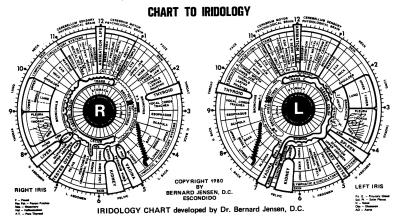
[Illustration: Chart to Iridology]
Click here for a larger image
Iris Texture and Lesions
The first things the iridologist notices in examining the iris are texture and color. These indicate general conditions. A tight straight fiber construction indicates an inherently strong constitution - a good ability to hold nutrients and eliminate wastes, thus the ability to respond well to cleansing and rebuilding. Gaps and holes in the iris texture are weaknesses. A person with a great deal of weakness is more susceptible to toxic build-up, nutritional deficiency and illness. If such a person takes care, there can still be good health. A degenerative lifestyle, however, will undermine even the strong constitution eventually.
Openings and holes in the iris fibers are called lesions. These indicate weak spots in the body. An open lesion has one side open, suggesting that there is some inflow of nutrients and outflow of wastes although less than there should be. A closed lesion or "lacunae" reflects tissue which has been cut off from most of its nutrition and elimination. The darker and deeper the hole, the more toxic and chronic the condition. A deep dark "crypt" is a small closed lesion. Very dark lesions show that tissue is being severely damaged.
Iris Color
There are only two true basic eye colors: blue and brown, each with various shades. The blue iris is easier to read as its fibers are more obvious and any discolorations show up clearly. Brown eyes are more dense. Many people who think they have brown eyes and anyone with hazel or green eyes actually have blue eyes. The toxicity level in these people is higher the farther from blue their eyes are. Yellowish mucus congestion in a blue eye will cast a green appearance. Brown in the center of the iris, indicating a heavily constipated bowel, often extends into other areas of the iris as the blood spreads toxins in the body. Thus it is the yellowish and brownish tinges of toxicity that cause many blue eyes to appear green, hazel and even brown. White in the iris is the sign of acute inflammation, mucus and possibly pain or discomfort. Cleansing the bowel and blood is the first priority, then we can start to pull the mucus toxins from the rest of the body.
Chemicals
Often we find colored spots in the iris. These are indications of chemical accumulations from two basic sources: parents and the environment. "Psoric itch spots" or "psora" are very dark. These are inherited genetically from ancestors and possibly cannot be eliminated. The strengthening of the tissue involved, however, will benefit the next generation. Chemical deposits show up lighter than psora and are usually red, orange or yellow. Frequently these will be peppered around in the iris.
Chemicals come into the body from taking drugs and inorganic mineral supplements; drinking hard water; eating chemically-treated foods, salt-laden foods and highly cooked foods; and breathing polluted air. Our bodies are designed to best utilize organic minerals (bound in a plant molecule) from uncooked plant sources. Distilled water and appropriate herbs will help to draw deposited minerals out of tissues.
Sodium / Cholesterol Ring
Salt, soda, monosodium glutamate and cooked high-fat foods all contribute to circulatory problems as evidenced by a sodium ring or cholesterol ring in the iris. Hardening of the arteries and high blood pressure are usually indicated by this white ring at or near the edge of the iris. Inorganic salt (including sea salt) forms deposits in the blood vessels and in various tissues. Overamounts of cholesterol and triglycerides (fats) also build up on artery walls. These conditions restrict the flow of blood and upset the metabolism of the body. Even eye doctors often detect such a ring in the iris and suggest that the patient is developing hardened arteries.
High quality, well-cleaned kelp or dulse can replace salt as a seasoning and pull inorganic sodium from the body. Meat and pasteurized dairy products should be minimized. We would be much healthier eating soaked seeds and nuts as our key protein and fat sources. Lecithin and garlic both help loosen cholesterol deposits.
Circulation
Similar to the sodium or cholesterol ring is the indication of poor circulation to the extremities - a fuzzy fading of the color at the edge of the iris. Brain anemia is reflected in what is called "arcus senilis," the arc of senility. This is an arc of faded cloudiness at the very top of the iris in the brain area. Even young people are showing this condition today.
Vigorous exercise and deep breathing to improve circulation and oxygenation are crucial. Kneeling with the head down or standing on the head can help improve circulation to the brain. Anemia implies lack of oxygen whether or not this involves iron deficiency. Blessed thistle is an herb which helps move oxygen to the brain and gotu kola is known as a brain food. Yellow dock root is very rich in iron. Capsicum (or cayenne) and ginger root stimulate circulation, but they should be avoided or balanced with a relaxant herb like lobelia by people with hypertension. The B vitamins, especially niacin, B-12 and B-15, and vitamins C and E are important to good circulation. Foot massage, barefoot walking in the wet grass, and hot and cold foot baths can all help. Hot baths and saunas and brief exposure to cold promote circulation. Generally keeping warm and relaxing improve circulation. Cleansing the body of congestion is very important.
Lymphatic Rosary
When there is an overload of wastes in the lymphatic system, it will be sluggish and congestion will build. This is shown in the iris by a circular formation of cotton ball-like spots which remind one of a necklace or rosary. When the tufts are white the congestion is relatively acute, but when they are yellow or brownish, toxicity has settled in considerably.
The lymphatic system is important in the breaking down and elimination of toxic waste through the skin, lungs, kidneys and bowels. When it is not functioning properly, there is a backlog of toxins in the tissues and in the lymph nodes.
Lymph is a fluid which cleanses wastes from the tissues and draws them back into the lymph vessels. The fluid moves along through the vessels encountering periodic check valves which prevent the fluid from flowing backwards should things come to a halt.
The only way to cleanse the tissues and move this lymph along is through vigorous exercise. A certain pressure (negative 6) is required to draw the fluid, much as when one sucks on a straw. The "lymphatic heart" is a bulge in the lymph vessel near the spine behind the blood heart. It needs to be pumped to create this pressure by exercise and deep breathing. Exercise also contracts muscles, squeezing the lymph along. Blue flag is an herb which can help to cleanse a congested lymph system. Echinacea is good for infections in the lymph glands. Exercise and cleansing should be undertaken gradually. One may feel ill if too much is brought out at once.
Scurf Rim
A darkness around the outside border of the iris is a scurf rim. It indicates poor elimination through the skin and the building of toxic congestion due to this. The thicker it is, the scurf rim shows more toxicity in the organ where it is located.
The skin should function as a "third kidney." It is the largest organ of the body and is important in elimination as well as absorption from the environment. Most of us go around bundled up in clothes most of the time, especially in colder climates, and we don't get enough exposure of our skin to the elements. Synthetic clothing and chemicals that come in contact with the skin contribute to toxic congestion.
Massaging the skin with a dry, natural vegetable fiber brush removes dead skin and helps to open pores. Natural aromatic essential oils such as lavender and eucalyptus can be prepared for application to the skin by using a base such as almond oil or apricot oil. "Body oils" like lavender penetrate the skin and remove waste, unclogging the pores. Exercise, steam baths and herbs like sarsaparilla and yarrow that promote perspiration are valuable.
Nerve Rings
Nerve rings or "stress rings" appear as creases in the iris fibers. This crimping forms concentric circles and/or semicircles which may be light and on the surface or deeply grooved, dark and chronic. In a toxic blue eye that appears hazel or brown, nerve rings may appear greenish in color serving as an indication that this is really a blue eye. In a true brown eye, such rings will appear yellow.
Nerve rings are a sign of stress and nervousness being stored as tension in the tissues of the body. Physical, mental and emotional irritations from the daily grind all contribute to this buildup of stress if we do not learn to deal with life disturbances clearly and cleanly and to relax. For the most part, this type of stress is at or just under the conscious level, and therefore much of it can be successfully addressed in a good stress management program.
The tissues affected by this nervous tension include all those areas the nerve rings pass through in the iris, and especially those where rings begin. A complete nerve ring signifies that a complete pattern of stress has been established. One or two partial rings is very common. A person with three or four complete rings is extremely nervous, perhaps on the verge of a breakdown.
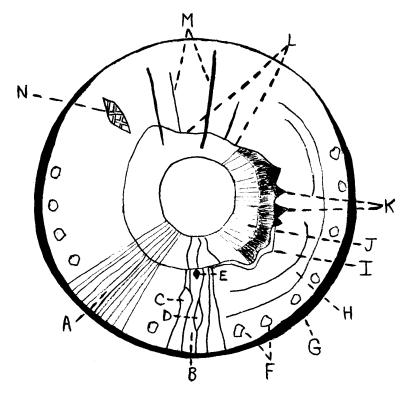 |
|
Autonomic Nerve Wreath
The more unconscious type of nerve tension is reflected in a toxic congested autonomic wreath. Beginning with the vital shock of birth, usually accompanied with unfavorable circumstances, trauma is stored in these unconscious "gut" nerves. Further layers of tension are added around the core "dis-ease" which is the sense of separateness and the fear that this generates. This tension impairs digestion, circulation and respiration, the functions controlled by the autonomic nerves. Malnutrition, lack of oxygen and life energy, and toxic irritation from spoiled food substances in the bowel all contribute to further tension and congestion in the autonomic nerves. This is the proverbial "vicious circle."
A thick raised nerve wreath is the mark of a significantly congested autonomic system. The body has a priority on protecting this sensitive nerve tissue. Toxins leeching from a constipated bowel inflame the autonomic nerves stimulating excessive mucus production in the area. The body will even draw calcium out of bones and muscles to help buffer the acidic irritation of these nerves. Glue-like foods, i.e. dairy products, meat and grains (especially refined) and inorganic minerals contribute to the building of a defensive wall in the autonomic nervous system.
A raised white wreath suggests that the person may be irritable. It may be like walking on eggshells when you are around this person. Further, his or her bowel movements and other functions may be spastic. A thick dark wreath shows a chronic inflammation of the nerves and a sluggishness of autonomic functions. Again the person may have a great deal of stored anger which may erupt occasionally. Unconscious tension will create circumstances of stress in our daily lives and feed itself.
When there is a lack of definition of the autonomic nerve wreath, there may be weakness and lack of clarity in autonomic functions. The wreath should appear as a pencil-thin line running smoothly but irregularly. The area inside should appear to gradually descend to the pupil, much like a bird's-eye view of a stadium.
Improved breathing; deep relaxation; calmer circumstances; exercise; a clean mild diet high in B and C vitamins, organic calcium, phosphorus and sodium; relaxant herbs like hops, valerian root, scullcap, passion flower and peppermint; and bowel cleansing herbs like psyllium and cascara sagrada will all help detoxify and release tension from the various nerve tissues. Avoid daily crises (including coffee and sugar intake) which set off the "fight or flight" mechanism (the sympathetic portion of the autonomic nerves). People who have burnt out their adrenal glands with low blood sugar and/or by pressing the panic button too often can stabilize blood sugar and feed the adrenals with licorice root.
The Digestive System
The digestive area includes approximately one-third of the iris. This indicates its level of importance in the overall health of the body.
The stomach is depicted from the pupil to about half-way to the wreath. If this area stands out as a visible wide ring, there is an acid imbalance in the stomach. Whiteness in the stomach area shows overacidity. A subacid stomach will appear light, but not really white. Orange or brown in the stomach zone indicates a chronic stomach, especially bad if there are also little dark grooves.
Imbalances in hydrochloric acid (HCl) and digestive enzyme secretion are common. This means poor digestion, especially of protein foods.
Substances such as drugs, tobacco, coffee, black and pekoe tea, soda pop, refined and chemically-treated foods, even orange juice burn out the stomach lining. (Commercial oranges are often picked green and the juice is a glass of acid.) Poor food combinations such as meat and pasteurized, homogenized dairy products demand a lot of the stomach. A high level of consumption of heavy protein foods evokes excessive production of HCl, eventually depleting its secretion.
A mild diet and alkalinizing herbs such as alfalfa, dandelion and safflowers can help to heal the stomach lining.
The intestines are found in the iris between the stomach and the autonomic nerve wreath. The wreath is the border of the intestines. Any juts outward are distensions of the intestinal wall; incursions inward suggest strictures in the bowel. Dark pointed jags in the bowel line are pockets where toxic matter has accumulated. Diverticula are small pouches or finger-like projections of the bowel wall which contain matter so toxic that if we were to eat it we might die on the spot from poisoning. Bowel pockets pressure and toxify the autonomic nerves as well as the organs to which they point in the iris. A sinking down at the top of the nerve wreath indicates prolapsus of the transverse colon which pressures organs below such as the bladder and the uterus or prostate.
The colon is generally the most toxic area of the body. Nearly all of us have a backlog and some pocketing there. The intestinal walls have been weakened from the gas pressure of spoiling foods which have not digested properly. We do not move our bowels frequently enough because of tension in the gut, because we have often ignored the signal to go, and/or because of a lack of roughage in the diet. Toxic fecal wastes build up in the pouches that form. The types, combinations and amounts of foods that we eat ensure that this will happen.
Radii Solaris
If the bowel is toxic, so is the blood and the rest of the body. Radii solaris are grooves in the iris emanating from the bowel area like the spokes of a wheel. They can be thought of as representing channels of toxicity. A spoke from the bowel to a given organ area means that tissue is being inundated with toxins. The deeper and darker the spoke, the more waste is being funneled. Most often parasites will colonize in the kind of toxic situation indicated by radii solaris. In the upper part of the body including the brain, which often has spokes entering it from the transverse colon area, bacteria and viruses of various kinds may be involved. Worms and such are more likely in the bowel itself and the lower part of the abdomen.
Reading the Eyes
A magnifying lens, a penlight and an iridology chart are the basic tools of the iridologist. The penlight is directed across the eye from the side and can be moved as needed for better illumination. The procedure I follow in examining irises is to first notice the constitution and the toxicity level. Then the first area I look at is the heart, for if a person has a weak heart, you should be careful not to shock them too greatly in what you say. Next I take a further overall look, noticing those things which draw my attention most readily. I then read the digestive zone and autonomic nerve wreath for these tell much of the story. Finally I proceed around the iris clockwise charting the specifics.
Healing
Cleansing the bowel and blood is the beginning of healing. Then toxic mucus can be pulled from the tissues. Fenugreek and thyme, for example, draw catarrh out of the head area, whereas fenugreek and comfrey move mucus out of the lungs.
"Cleansing crises" may arise during this process as conditions that may have been tucked away and held in the body for many years are brought out. A cleansing program requires a positive attitude and dedication.
Healing occurs from the inside out, from the head down and in reverse order from the way the conditions came into the body/mind (Hering's Law of Cure). Specific weak areas when cleaned and strengthened with proper nutrients and other forms of healing energy will begin to show "healing lines" in their iris lesions. These white lines form a lacework, filling in the lesions as healing progresses. At a certain point, tissues will pass back through the acute phase. This "healing crisis" will show white in the iris, and the person will perhaps relive a long ago illness. This will probably be brief, perhaps mild and it will occur at a time of high energy. A person may feel just great one day and have a healing crisis the next day. When the crisis is through, the tissue involved will be restored to good order. The body has its own wisdom in this process and should be trusted.
Selected Bibliography
Jonathon David Miller is a holistic counselor and growth guide. He holds an M.A. in religion with emphasis in psychology and a Master of Divinity specialized in counseling. He is the founder of The Circle of Life, an organization of people providing creative health and growth services. A monthly newsletter called FRUIT is available.
Jonathon is the author of Nutrition, Health and Harmony: A Handbook of Natural Health which is available for $3.50 at bookstores or from Lifecircle Supplies, 333 Crain Avenue, Kent, Ohio 44240. Other books, tapes and information about seminars and workshops on holistic natural health and growth are available also. Send a self-addressed, stamped, business-sized envelope for free information.
This article is a condensed excerpt from Jonathon's forthcoming book; Herbs, Iridology and Holistic Health.
Thinking Astrology
How to Chart Your Own Horoscope, Part II—The Planetary Aspects
by Michael Whitely
Part I (TAT Journal No. 11) gave the instructions for setting up your basic horoscope chart with the planets placed on the wheel of the houses. This second part completes the basic natal chart by adding the planetary angles called Aspects. If you have completed the first section you can add the aspects to get a full understanding of the significance of the planets in the chart. If you do not have a chart you can also benefit by using one of the computerized services which erect a chart from your birth data for about $3.00 (no interpretation) and apply this new information to your own chart.
AN ASPECT IS AN ANGLE LINKING two or more planets in the chart and is formed by the division of the circle. When the 360° of the circle are divided by 3 and its multiples 6 and 12, the angles of 120°, 60°, and 30° result. These angles are considered harmonious because planets found in these combine in a positive manner and bring luck, opportunity, and growth. Angles formed from division by 4, 8, and 2 are 90°, 45°, and 180° and they are considered adverse because planets found at these angles bring obstacles, friction and conflict.
Many other angles or aspects are possible and in use by astrologers, but for our purposes we will only include angles formed at 150° and at 0°. These two are considered neutral. The most powerful or major aspects are at 0°, called a conjunction, at 120° called a trine, at 90° called a square, at 60° called a sextile and at 180° called an opposition. The less powerful or minor aspects that we are interested in are the semi-square at 45°, the semi-sextile at 30° and the quincux at 150°, (also called an inconjunct).
An aspect will exert 100% of its influence when forming a perfect angle and the influence lessens each degree away from exactness. This allowable variation in degrees is called the "orb of influence" and defines the limits of effectiveness of an aspect. The major aspects can have an orb of 9° while the minor aspects have a smaller orb of 4°. Orbs for aspects involving the Sun or Moon can be extended two or three degrees because of their great influence in the chart.
An aspect with Mars in Aries at 10° would form a square to Uranus in Cancer at 10°. The 9° orb allows the angle to be a square from 1° Cancer to 19° Cancer. The wider the orb, the weaker the aspect.
| Harmonious | Opposition | Neutral |
|---|---|---|
| 120° Trine | 60° Sextile | 30° Semisextile |
| 180° Opposition | 90° Square | 45° Semisquare |
| 0° Conjunction | 150° Quincux |
The aspects are meaningful angles of separation between planets in the chart. So far we have only touched on their broad meaning and now we must examine each separately, because each has its own character and effect.
The function of the aspects in astrology can be seen clearly by making a quick comparison with the roles of the planets, signs, and houses which form them. It has been said that the planets in the signs tell you "what": what are the drives, impulses, and energies that move you? The houses tell you "where": where will the effects of the planets be felt in your life? The aspects of the planets give them their final significance, for they tell you "how": how are your strengths best used, how can your conflicts be resolved, and how should your life be shaped to accomplish this? The whole point of astrology is to learn this and do something about it!
To become familiar with the nature of the individual aspects, we will examine and keyword each, outline how to interpret it, and use it in an example chart.
Individual Aspects
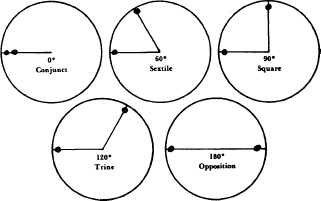
CONJUNCTION:
![[Symbol]](tat_journal-12-images/20-1-conjunction.jpg) 0° (Orb - 9°); two planets close together.
0° (Orb - 9°); two planets close together.
Keyword: PROMINENCE
This aspect makes the planets involved intensified. It combines the two to energize the area indicated by the blend of the planets and the house. How well it can be expressed varies with the compatibility of the planets. A very strong aspect.
SEXTILE:
![[Symbol]](tat_journal-12-images/20-2-sextile.jpg) 60° (Orb - 9°); two signs apart.
60° (Orb - 9°); two signs apart.
Keyword: OPPORTUNITY
Planets involved complement each other and present the opportunity to use talents and abilities. While the benefits are available, work is required to gain.
SQUARE:
![[Symbol]](tat_journal-12-images/20-3-square.jpg) 90° (Orb - 9°); three signs apart.
90° (Orb - 9°); three signs apart.
Keyword: OBSTACLES
Squares describe internal conflicts between particular needs and desires. They indicate tension areas in your life and present challenges. There is energy with tension and the manner of reacting to the square will decide whether you rise to the challenge and grow or carry an unresolved conflict. A dynamic aspect.
TRINE:
![[Symbol]](tat_journal-12-images/20-4-trine.jpg) 120° (Orb - 9°); four signs apart.
120° (Orb - 9°); four signs apart.
Keyword: LUCK
Trines can be the most fortunate aspects as they allow the planet energies to flow and ease the benefits your way. These are talents and abilities that come without effort. Too many trines may result in laziness and a lack of ability to rise to challenges.
OPPOSITIONS:
![[Symbol]](tat_journal-12-images/20-5-opposition.jpg) 180° (Orb - 9°); six signs apart.
180° (Orb - 9°); six signs apart.
Keyword: CONFLICT
This very strong aspect has two planets working directly opposite of each other. This is felt as trauma but it also produces an awareness of both facets of life. The contradictions and mixed motives are apparent and the need is to balance this area.
SEMI-SEXTILE:
![[Symbol]](tat_journal-12-images/20-6-semi_sextile.jpg) 30° (Orb - 4°); one sign apart.
30° (Orb - 4°); one sign apart.
Keyword: GROWTH
This situation shows a potential to develop, there is opportunity like a sextile but it is not so available and must be worked for. A moderately easy aspect.
SEMI- SQUARE:
![[Symbol]](tat_journal-12-images/20-7-semi_square.jpg) 45° (Orb - 4°); one and one-half signs apart.
45° (Orb - 4°); one and one-half signs apart.
Keyword: FRICTION
This is a frustration aspect, a difficult time. The planets involved do not work smoothly and produce problems in the area indicated.
QUINCUX:
![[Symbol]](tat_journal-12-images/20-8-quincux.jpg) 150° (Orb - 4°); five signs apart.
150° (Orb - 4°); five signs apart.
Keyword: EXPANSION
This is a stressful aspect. It produces an imbalance in the two planets, causing reversals and surprises. It is an uncomfortable situation or feeling. A difficult aspect.
SYNTHESIS IS THE ACT OF FINDING the person in the astrological chart. To distill the bits of insight and information gleaned from the positions of the planets, signs and houses into a portrait of the person is an art which requires time to master. The first step on the road to this end is to apply basic rules to the chart and learn to find the essentials that reveal their meaning.
The activities of the planets are at the heart of it, but these energies are not freely expressed in all signs. The houses also modify the meanings and the aspect and its orb must be considered. In this way you can find the real power, tension, and motivation reflected in the chart.
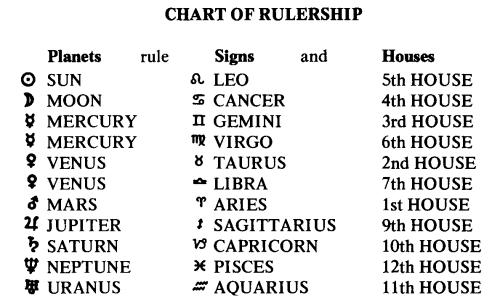
The influence of a planet varies for a number of reasons so here are a few ground rules to consider.
A planet is a strong influence when:
A planet has more influence in houses 1, 4, 7 and 10, the angular houses, (formed by the horizontal and vertical poles of the chart).
It is suggested by Zipporah Dobyns, in Finding the Person in the Horoscope, that the ten planets are the basic letters of astrology and the signs and houses are expansions of these same ten. So Mars, Aries, and the first house all are basically the same "flavor," in three different things. Mars is the energy and individuality, Aries is the energetic and individual way of acting and the first house is the self and its energy as it contacts the environment. Dobyns points out that Mars in Libra is basically similar to a Mars/Venus aspect, or Mars in the seventh house (of Libra and Venus). This concept may help to simplify the function of the planets in the signs and houses.
Locating the Aspects
The basic procedure for finding the aspects in the chart is to start with the Sun's position and look in the appropriate chart areas to locate each aspect. Then repeat with the Moon, and each remaining planet. These are the guidelines you can use to locate each type of aspect. Remember, aspects are measured in degrees and counted by signs, (each sign has 30°), not houses.
How to Measure the Aspects
(from The Horoscope, the Road, and Its Travellers, Alan Oken, Bantam Books, New York, 1974)
Jot down the aspects as you find them and note the number of degrees of orb away from the exact angle. You can use the Aspect Chart which has the planets written across the top and down the left hand side. You can then use it like a graph to check each 2-planet combination. If there is an aspect, you enter the symbol and orb; if not, leave it blank. You can also make your own on paper and write in the words for other aspects. If you found the Sun at 16° Leo trine Moon 14° Aries you have a trine with a 2° orb. In astrological shorthand you have...

On your chart you would enter under Sun and next to Moon, , indicating
a trine aspect with a 2-degree orb.
, indicating
a trine aspect with a 2-degree orb.
If you are doing your own chart continue until all planets have been checked. To illustrate the method to locate the aspects, we will use an example chart.
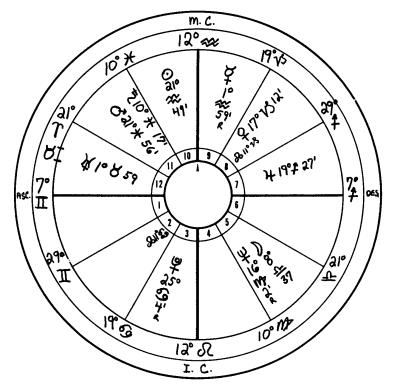
[Chart: Burt Reynolds birth chart; February 11, 1936; 12:10 p.m., EST; Lansing, MI.]
Looking at the example chart for Burt Reynolds, we begin with the Sun in the
10th house. First we check for conjunctions. Are there any planets within a few
degrees, on either side of the Sun? No. So we check for semi-sextiles 30° and
one sign to each side of the Sun. Thirty degrees to the right would be 21°
Capricorn and there we find Venus at 17° Capricorn forming a sextile with a 4°
orb (the angle is 34°). We add this to our aspect table and move on. To the left
of the sun, one sign over we find Saturn at 10° Pisces and Mars at 21° Pisces.
The angle from Saturn to the Sun is too small but the angle from the Sun to Mars
is exact and will be prominent in the chart. We add it to the aspect table under
the Sun, next to Mars by writing,, the
symbol for a semi-sextile. Continuing, we look 2 signs to
each side. At the left we find no planets in Aries. To the right we find
Jupiter at 19° Sagittarius forming a sextile with a 2° orb because the angle is
62°, 2 over the exact 60° of a sextile. Squares are 3 signs apart and to the
left we find Uranus at 1° Taurus forming no aspect and to the right, we find no
planets in Scorpio. Trines are 4 signs apart and looking to the left we see no
planets in Gemini and no aspect to the Ascendant in Gemini. To the right of the
Sun we find the Moon at 8° Libra forming no aspect. Looking to the left 5 signs
we see Pluto at 25° Cancer forming a Quincux at 153° or 3° orb. We list this on
our aspect table. Looking five signs to the right we find Neptune at 16° Virgo
forming a narrow Quincux at 145°. This calls for a 5° orb, which we will allow
because it is an aspect to the Sun. There are no planets in Leo, so that will be
all of the aspects to the Sun.
As you can see it really is not difficult to find the aspects and with practice you will find them at a glance. Continue this process for the Moon and each remaining planet. It gets shorter each time because you eliminate one planet each time you do it.
The Aspect Table has Burt's finished aspects and we will use these to demonstrate how to decode the aspects.
Decoding the Aspects
Each sign, planet, house, and aspect is an exact bit of information. How they are arranged gives each chart its uniqueness and exact meaning, but it must be remembered that the meanings of the planets are modified by sign and house placement and that aspects modify each other. So there are basically two larger units of information we will need: the modified planet in its sign and house and any aspects to it.
At this point it is necessary to have a basic understanding of the language of astrological meanings, the alphabet. At the very least make yourself familiar with the Keywords for planets, signs, houses, and aspects so that you can plug them into the analysis where needed. Astrology requires a blending of thinking and feeling, of exact calculations and developed intuition. The analysis of the aspects is a perfect example of this need because each has a formula and a constant meaning but each application to an individual chart can be unique.
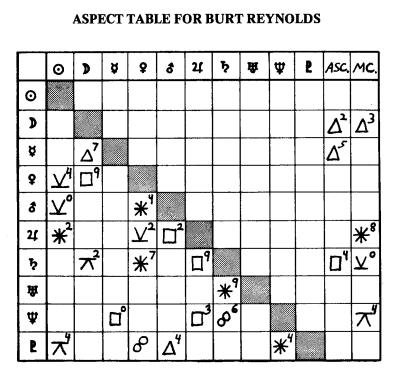
[Illustration: Aspect table for Burt Reynolds]
The method of decoding the message of the aspect is quite simple:
Let's examine one of the aspects in Burt Reynolds' chart.
Sun in Aquarius, 10th house - sextile - Jupiter in Sagittarius, 7th house.
The Sun position in Aquarius, indicates the need to have contacts in wide
circles and to be unconventional, ( ), also
to engage in a profession before the public in an ambitious manner, (
), also
to engage in a profession before the public in an ambitious manner, ( , in 10th).
Jupiter is in Sagittarius in the 7th house of partnerships indicating that his ability to expand his influence could result
from beneficial partnerships, (
, in 10th).
Jupiter is in Sagittarius in the 7th house of partnerships indicating that his ability to expand his influence could result
from beneficial partnerships, ( , in the 7th),
and an enthusiastic manner. The combination of the two planets positions is saying
that his need to reach a wide circle of people through ambitiously pursuing a career
before the public is enhanced and expanded through the opportunity to form
beneficial partnerships among people with standing. The combination of the Sun
and Jupiter has the potential for luck or excess.
, in the 7th),
and an enthusiastic manner. The combination of the two planets positions is saying
that his need to reach a wide circle of people through ambitiously pursuing a career
before the public is enhanced and expanded through the opportunity to form
beneficial partnerships among people with standing. The combination of the Sun
and Jupiter has the potential for luck or excess.
While this was only one of several aspects to the Sun, and also allowing for its very mechanical and general nature, it still has something important to say about the man. The modified planets indicate a trait, a tendency, a specific need, the aspects demonstrate the manner in which the separate, often contradictory, parts are wired together.
There is one factor that can not be reflected in the symbols of your chart and that is your level, the degree of conscious effort you bring to your life, your state of being. The aspects can detail the situations and conditions you may have to work with but not your response. It actually makes little difference whether your aspects are harmonious or adverse because the best of "luck" can be squandered and lost, and many times adversity is the catalyst that brings growth and success. The aspects show potential patterns but it is up to you to bring out the best within you.
[Illustration: The "left brain" rational philosophy of Aristotle contributed to the development of creeds and doctrines in Christianity, eventually dominating the "right brain" inspiration and vision of Jesus himself.]
Right Brain / Left Brain Religion
by Gabe L. Campbell, Ph.D.
(From Looking Beyond the Donkey, copyright 1980 by Gabe L. Campbell, Ph.D.)
WHY DID THE OLD TESTAMENT prophets have visions while the New Testament writers report facts and instruct the faithful on specific matters of church life? Of course there are codes and regulations recorded in the Old Testament, but the prophetic utterances and the visions of God reported by the Hebrews are the heart of the Old Testament message. Did God stop appearing to people, or were people perceiving differently? Did the cosmos change, or did the culture create other responses to the divine power?
Recent brain/mind research indicates that the effect of the Greek culture and Aristotle's teachings altered the ways in which the God force was perceived. In 1888 Edwin Hatch, an Oxford University professor and Anglican clergyman, delivered the Hibbert Lectures at Oxford in which he discussed "Greek Influence on Christianity." Hatch began his first lecture with the statement that, "It is impossible for anyone, whether he be a student of history or not, to fail to notice a difference of both form and content between the Sermon on the Mount and the Nicene Creed." He pointed out that over a period of three hundred years the Greek concept of education which influenced the entire civilized western world had caused religious leaders to begin to formulate creeds and doctrines based on rational thinking rather than simply responding to the metaphoric images created by the Sermon on the Mount and by prophetic utterances.
The human brain contains two major hemispheres and both the left and right hemispheres have been found to have their own specialized forms of processing information. The left is highly verbal and mathematical, using analytic symbols and processing information sequentially and logically. The right is intuitive and visual, processing information in pictures and metaphor. We seem to have a preference for one hemisphere over the other and so we tend to be either right or left brain dominant. Left brain dominant people usually read at an early age, perform sequential tasks very well, fit into identifiable categories in school, write reports, diagram sentences and arrange things in an orderly fashion. Right brain dominant thinkers often daydream, see pictures in their heads, ask questions that do not fit into the teacher's lesson plan for the day, take hunches seriously, excel in art, music and drama, and use the imagination. Right brain thinkers seem to utilize peripheral vision more than left brain dominant thinkers, and there are some indications that superior athletes tend to function in the right hemisphere and respond intuitively or instinctively to situations.
What does this have to do with religion and religious response to life? A management consultant researching the left/right brain patterns of employees had a sudden intuitive "flash" and said to his audience, "People do not have religious visions or ecstatic experiences in the left brain, because they don't think it is logical." Marshall McLuhan pointed out some twenty years ago in The Medium is the Message, that cultures which do not utilize reading and writing have different perceptions of the world than do those which value reading and writing as the highest academic achievements. When Alex Haley searched for his roots in Africa he met the tribal Girot who kept the history of the tribe in his head and could repeat it orally while having no knowledge of reading or writing. McLuhan ventured to say that with the advent of radio and television along with the computer we may be living in an age in which reading has become too slow as a medium of communication. He said that the electronic media have created a global village in which we are once again communicating face-to-face rather than through the printed word.
This face-to face communication considerably alters one's response to the message. Before the Vietnamese conflict, wars were reported through the printed media with still photos and written stories. This kind of reporting was processed in the logical hemisphere of the brain and evaluated rationally. The Vietnamese battles were covered in living color and sound and broadcast back into the homes of Americans. The electronic media appeal to the intuitive, feeling, visual processing of the right hemisphere and the response is quite different than to the print media. McLuhan understood the essential difference between the printed and electronic messages. In the pre-literary world people communicated in person, and feelings, emotions, nuances of meaning were "felt" and included as part of the experience. People knew how the other person "felt" and many non-verbal signals were exchanged. In the cultures which developed a linear kind of thinking based upon the lines written on a page, the intuitive dimension was not evident and the words on the page became the central focus of attention. As people began to arrange their thinking patterns to conform with the linear patterns of written language there was a shift in human awareness from the personal to the rational. In the western educational systems this emphasis became so powerful that logic was valued and intuition denigrated. It became almost embarrassing to be intuitive, while logic was rewarded with good grades and high praise.
McLuhan pointed out that the electronic age has brought us back into balance and awareness that we are both logical and intuitive. We can be "whole brain thinkers" utilizing the abilities present in both hemispheres of the brain. In religion this means that we can begin to appreciate the visions as well as the doctrines of religious life. It may be no accident that along with the new age of electronics we are witnessing the new age of meditative prayer, exploring the spiritual dimensions of existence, and teaching that silence may be even more important than verbalization. Persons seem to be searching for the inner stirrings and aware that there is more than deductive reasoning involved in a search for the divine relationship.
ANTON BOISEN, ONE OF THE FATHERS of religion and psychology as an academic discipline, and a professor at Chicago Theological Seminary in the 1930's, perceived that churches have a unique pattern of growth which may reflect the needs of the members. In a survey of churches in the Midwest he noted that religious groups begin as the result of a personal religious experience or vision by an individual or group. As years pass these visions and experiences are expressed in written creeds and statements of faith. These creeds have little meaning for those who have not experienced them and the words gradually become less significant. After a time some of the members grow uneasy with the words and seek the experience. Some quietly attend meetings in Pentecostal churches where the singing is more responsive and less sophisticated. Some give up church and search in other areas, others begin to be critics of the church and focus attention on details of behavior and practice which create controversy, substituting this for real religious expression. Boisen felt that churches began to grow more rigid in creed and doctrine as they grew further apart from the original experience upon which they were founded.
Left brain thinkers tend to rely on written words, doctrines and histories, while right brain thinkers seek the experience. Left brain thinkers seem to deal in "proof" and "belief" while right brain thinkers often speak of "knowing" and "responding." These kinds of responses can create real problems in families, relationships and churches. It may be difficult for a left brain dominant parent to understand why a right brain dominant child will not accept the belief system which is so "reasonable" or "proved." The Christian faith was heavily influenced, if not absolutely dominated, by the Greek concept of learning. Aristotle was the father of syllogistic logic which proceeded from one valid premise to another and reached a logical conclusion. The church became involved in the same kind of reasoning system, building the rationale for the faith rather than responding to the experience.
Experiential religion and rational religion do not have to be at swords' points. As we begin to comprehend the modes of processing information we can begin to be sympathetic to the needs of individuals. Some persons are in touch with the metaphoric imagery in the right hemisphere which opens them to experiences beyond the rational. These are valid religious experiences, as anyone who has journeyed in that dimension of consciousness is aware. These are not the same as the rational, sequential development of faith necessary for the left brain dominant thinker. The rational individual needs to examine each premise before continuing to the next in building the foundation of belief. Quite often the conflict comes from the intuitive thinker's response to an inner voice, while the rational thinker doubts that the voice exists. The intuitive thinker may not see the need for the rational thinker to take the time to build a foundation based on reasonable deductions when the experience appears so available as to negate the need for step-by-step building.
The Old Testament came from an oral tradition of stories told around the campfire, sung by a psalmist, and codes of behavior repeated from generation to generation. The words were not put into written form until they had been spoken for generations and had been subjected to the face-to-face encounters between teller and listener. The prophets were not part of a left brain culture which declared that visions were not real. They did not put their words on paper and carefully examine the clarity and sentence structure. They declared what they had experienced and shared what they knew.
The New Testament was written, for the most part, for a world in which Greek was the language of the scholar, and the rules for writing were part of the heritage of the writers. The rational approach of the great Greek philosophers was part of this culture. The Gospels of Matthew, Mark and Luke appear to have been based upon a now lost source for their central message, while John appears to write either from another source or from experience. But the form of the Gospels conforms to the rules for writing and connecting sentences in the narrative. The Epistles are written rather than spoken, and indicate feelings, but also begin to indicate the rational basis for concerns and advice.
BRAIN/MIND RESEARCH MAY BE helping us understand why some persons have personal revelations while others are attracted to liturgies, creeds or doctrinal statements. At the dedication of the Werner von Braun Chair of Physical Science for the Institute of Noetic Science, Werner von Braun stated that Jesus was the finest quantum physicist the world had seen, but science was only now beginning to be able to comprehend what Jesus was talking about. He made the comment that "the second coming is already here, but since it wasn't on a donkey you missed it." Those who are looking with the logical hemisphere may be waiting for the donkey, while those who perceive with the right may be experiencing the new age. As we become more aware of the way in which our brain perceives reality, we too are better able to comprehend the insight of the quantum physicist's statement about Jesus.
If, as some researchers believe, the brain perceives the energy field of the human body as a hologram in three dimensions, while sub-atomic particles are able to pass through the body as we do the atmosphere, we are indeed limiting our perceptions to the five physical senses. But as we begin to explore the potential of the brain to process information beyond the limits of the physical senses we may begin to approach a new dimension of inner space research. Spiritual teachers and mystics have taught that we can go beyond the ordinary awareness of self by learning to listen to the inner guidance system. The Belgian physical chemist, Ilya Prigogine, who won the Nobel Prize for Chemistry in 1977, developed a theory of Dissipative Structures, which posits conditions that it holds are general for change in all types and kinds of systems, whether chemical or cultural. Prigogine feels that because connections between parts of a system, whether physical or social, can only be sustained by a flow of energy, the system is always changing. The key to his theory is that the dissipation of energy creates the potential for sudden reordering. Aharon Katchalsky, also a physical chemist who had been studying the dynamic patterns of brain function for many years, believed that the brain was a perfect example of a dissipative structure. With only two percent of body weight the brain consumes twenty per cent of available oxygen. The brain is capable of sudden change, of quick insight, and is sensitive to being perturbed. In 1977 he organized a group of scientists to meet at M.I.T. to introduce Prigogine's theory to neuroscience saying, "The restructuring of an individual personality may take sudden form, as in flashes of understanding, learning a new skill, falling in love, or the conversion experience of St. Paul." During this session at M.I.T., Vernon Rowland of Case Western Reserve University, predicted that this approach to the brain would penetrate the old mystery: the difference that makes a whole more that the sum of its parts. Cooperation seems to be a key; the more complex a system, the greater its potential for self-transcendence.
In almost two thousand years since the Sermon on the Mount, we may have come full circle. We have limited our western culture to the Greek system of education in which logic, for its own sake, has been the basis of learning. In this new age we seem to be responding to that inner force, that internal guidance system, which enables us to use the logical hemisphere of the brain, but also to move beyond the limitations of the physical senses into the spiritual dimensions of consciousness, which are revealed through intuitive response. Perhaps we can begin to look beyond the donkey.
Understanding The Tibetan Book of the Dead
by Mark Jaqua
ONE OF THE MOST ESOTERIC and least understood manuals of occult lore available today is The Tibetan Book of the Dead. This book was first made available to the western world in 1927 through the editing of W.Y. Evans-Wentz and translated from the Tibetan by Lama Kazi Dawa-Samdup. Mystery still surrounds The Book of the Dead even though Evans-Wentz's edition is composed of a full three-fourths of commentary. Many buy the book because its arcane title looks so good on their bookshelves, but beyond the shock value of its title lies a profound philosophy which is surpassed by few other books. The Tibetan Book of the Dead is basically a manual to be read to a person on his deathbed and to be continued to be read to his corpse after he has died. If the dying person is able to heed the advice given, it will result at the point of death in spiritual liberation or enlightenment - the state of man's supreme achievement through experiencing Ultimate Reality. If the person is not able to achieve enlightenment, then at least, he will realize safe passage through the "Bardos" or after-death states and reincarnate for his next life in the best of circumstances.
The Tibetan "Bar-do" means "between two" and this term is used in reference to the state of existence between death and rebirth. (The Tibetans believe in reincarnation.) The Book of the Dead is known in Tibet as Bardo Thodol which means roughly "liberation through hearing in the after-death plane." Bardo-Thodol represented an oral tradition until it was first committed to writing in the seventh century - at least 1200 years ago. It is meant as a guide for the living as well as a death-bed manual. It contains a complete but sometimes "between the lines" philosophy for the living along with its more obvious instructions on what to expect in the after-life.
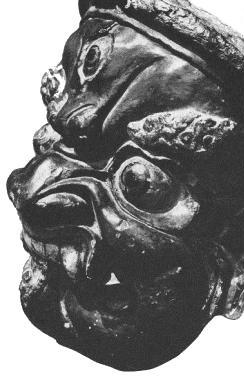
Bardo Thodol is divided into sections covering each of the "49 days" of Bardo life. The 49 days is actually only a symbolic number and the actual length of Bardo life will differ with each individuality. Shortly after death very many wonderful experiences are had and one encounters the "52 peaceful deities." The intensity of these higher realms can be overwhelming. If one can overcome his fears he will spend his Bardo life in one of the paradise realms until it is his time to reincarnate. If he cannot overcome his fears he will progressively descend into coarser and coarser spheres until attracted by "copulating men and women" to become "trapped" in a womb and born again. Methods are also given to avoid being born again at all but to remain in worlds superior and with less suffering than Earth.
Bardo Thodol divides the after-death states into three major sections: the Chikhai Bardo, the Chonyid Bardo and the Sidpa Bardo. The Chikhai Bardo is the most elevated and is entered immediately upon death. It is the "clear light" mentioned in many of the clinical death cases researched by Kubler-Ross and Raymond Moody. During this time "the mentality of a person dying momentarily enjoys a condition of balance, or perfect equilibrium, and of oneness." If a person can maintain this very fragile state of balance it will result in complete liberation and realization of the highest spiritual experience. It is claimed to be so difficult to achieve this that Tibetan Lamas have compared it to a needle balanced and set rolling on a thread. Paradoxically, the Lamas also claim that a person can easily attain liberation at any point in the Bardos if he can maintain his aspirations directed to this highest goal. All these conditions of the Bardos are said to be teachings of Lamas who have experienced them and reincarnated consciously without losing memory, as the normal person does.
If one can't maintain his state in the "clear light" then he descends into the Chonyid Bardo which is the realm of the "52 peaceful and 58 wrathful deities." The 52 peaceful deities are represented by brilliant lights which attempt to "hook" the Bardo being and bring him into one of the unimaginably wondrous paradise realms. Through egoism and "bad karma" most are fearful of these brilliant realms and flee them, resulting in a descent into the denser realms of the "58 wrathful deities." The peaceful deities are said to stem from the "heart" while the wrathful deities come from the "brain." The wrathful deities are described in detail in Bardo Thodol and are as frightening as anything ever met in an earthly nightmare. In an earthly nightmare we can awaken and return to the physical body but in the Chonyid Bardo we have no earthly body to return to. A typical description is that of the Buddha-Heruka met on the eighth day of the Chonyid Bardo:
"... dark brown of color; with three heads, six hands, and four feet firmly postured; the right (face) being white, the left, red, the central, dark-brown; the body emitting flames of radiance; the nine eyes widely opened, in terrifying gaze; the eyebrows quivering like lightening; the protruding teeth glistening and set over one another; giving vent to sonorous utterances of 'a-la-la' and 'ha-ha', and piercing whistling sounds; the hair of a reddish-yellow colour, standing on end, and emitting radiance; the heads adorned with dried (human) skulls, and the (symbols of the) sun and moon; black serpents and raw (human) heads forming a garland for the body;... will come forth from thy own brain and shine vividly upon thee. Fear that not. Be not awed. Know it to be the embodiment of thine own intellect."
The last sentences of this description illustrate the most important teaching of the Bardo Thodol. All the experiences of the Bardo are only subjective experiences, they do not represent an objective reality outside the person's own imagination. Each of the encounters in the Bardo is actually an encounter of the person with his own mind. Whatever a person meets in the Bardo will be his own mental creation. If religious visions are seen, a Christian will see Christian figures and saints while the Buddhist will see Buddhist religious figures. Each person's experiences will be different according to his own beliefs and psychological foundations. It may be that an atheist and materialist will experience nothing but the black void he expects. Evans-Wentz writes regarding this:
"It is not necessary to suppose that all the dead in the Intermediate State experience the same phenomena, any more than all the living do in the human world, or in dreams. The Bardo Thodol is merely typical and suggestive of all after-death experiences. It merely describes in detail what is assumed will be the Bardo visualizations of the consciousness-content of the ordinary devotee of the Red Hat School of Padma Sambhava (Buddhism)."
In the Chonyid Bardo the positive and negative aspects of a person's complexes and general psychology are played out as projections and visualizations. This process on a coarser scale is played out in the Sidpa Bardo. The Sidpa Bardo is the rebirth Bardo and the person begins to be attracted by the passions that affected him during his earthly life. The person is said to hover about the Earth in the Sidpa Bardo and be attracted by all his old haunts. Eventually sexual desire emerges and he becomes "trapped" in a woman's womb and thus ensouls a new body.
The comparison is often made in Wentz's Book of the Dead between the reality of the Bardo state and the reality we experience in our dreams while living. Possibly the two states are actually identical rather than just similar. In both the Bardo and the dream state we are immersed in our own subjective consciousness. In both we experience blissful states as well as nightmarish scenes. Karmic influences condition what is experienced in the Bardo and we can see this same function in our dreams - often labeled as "compensation" by psychologists. If, in our waking lives, we hold an undue sadistic attitude towards others, for example, then our dreams will be filled with scenes in which we are being treated sadistically. This is exactly what would be expected due to karmic adjustment in the Bardo state. One esoteric teacher has described this process by saying that we build up a "balloon" during earthlife composed of all our actions and thoughts. During the Bardo state this "balloon" is what our experiences will be.
Psychiatrist C.G. Jung also agrees that the peaceful and wrathful deities met in the Bardo are merely projections of one's unconscious. Just what these contents consist of is determined by one's karma and what Jung has labeled our "psychic heredity." Understanding Bardo Thodol is made easier by an understanding of the Eastern concept of karma and Jung's psychic heredity. These concepts overlap to a degree, with karma dealing with more personal aspects compared to Jung's psychic heredity which deals with the more universal aspects of the collective unconscious shared by all.
Karma is often simplistically thought of as "punishment" for all a person's negative acts. If a person is dishonest in business dealings, for instance, then according to the karma-concept he will suffer at some time this same dishonesty from the hands of another. Actually, no one-to-one relationship is involved, but he will receive an appropriate reaction from the environment in some manner. An old colloquialism, "What goes out, comes back," expresses this same principle. Karmic effects are in no way a retribution from a higher power in the same way the Christian concept of sin and punishment is thought of. Karma expresses the law of equal and opposite reactions. It also expresses the reality that what you think and do is what you become. If you continually think spiteful thoughts, in time you become a spiteful person. In the Bardo this inner spite and hate would be dealt with in the form of a wrathful deity projected outside oneself and experienced as an external reality. The essence of this monster would be spite and hate. The karma we bring into the Bardo consists of the positive and negative aspects of character we have developed during a lifetime.
Jung's psychic heredity deals with psychological characteristics we have inherited from our family ancestors and also general characteristics from our race as a whole. This includes our psychological type and even, as some postulate, the very encoding of our ancestor's life experiences on our genetic matter. The deepest part of our psyche is what Jung calls the "archetypes" or the "organs of pre-rational psyche." Jung explains further:
"These are the universal dispositions of the mind, and they are to be understood as analogous to Plato's forms ('eidola'), in accordance with which the mind organizes its contents. One could also describe these forms as categories everywhere present as the basic postulates of reason. Only in the case of our 'forms', we are not dealing with categories of reason but with categories of the imagination."
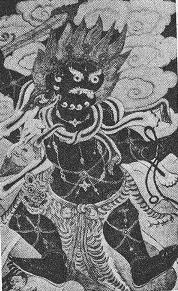
[Illustration: A Tibetan "Temple Door Demon" and a Christian devil from a 14th century Italian painting of The Last judgment. There are striking similarities between Eastern and Western accounts of what the soul encounters after death.]
The archetypes determine the forms we have to work with in our thinking. They are the building blocks we have to work with in all levels of consciousness - in waking consciousness, dream consciousness and Bardo consciousness. The content of these forms are determined by our individual karma and racial culture. Sir Galahad may represent the same archetype in the West as the Bhagavad-Gita's Krishna does in the East. The archetypes cause a continuity in the nature of consciousness through waking, dream and Bardo experience. The "peaceful and wrathful deities" of the Tibetans are representative of these archetypes within the Tibetan culture.
Western culture also has its instructive books in the art of dying and what to expect in the after-life - although none are as philosophically abstract as Bardo Thodol. In the medieval Christian book The Book of the Craft of Dying we find the Tibetan "peaceful deities" in Western guise:
"When the soul passeth out of thy body, (may) glorious companies of angels come against thee: the victorious host, worthy judges, and senators of the holy apostles meet with thee: the fair, white, shining company of holy confessors, with the victorious number of glorious martyrs, come about thee: the joyful company of holy virgins receive thee: and the worthy fellowship of holy patriarchs open to thee the place of rest and joy, and deem thee to be among them that they be among, everlastingly."
There are as many Bardos as there are states of mind since a Bardo is a "place" in the mental dimension which is created by a particular combination of thought and desire. Anger in the Bardo is supposed to cause a person to sink like a "stone" into one of the hell-worlds where people are consumed by their own malice until their karma is exhausted or they are able to rise above their state through detachment. We become in rapport with this same hell-world in this life when we allow ourselves to be consumed and tormented by our own anger. In some dreams we may enter a Bardo to the same degree as in the after-death state. Many people have profound religious experiences in dreams and awaken with a partial memory and conviction that something extraordinary has occurred. These experiences could be described as occurring in a higher-order Bardo. Doreal cites such an experience in his pamphlet "Bardo, or the Journey of the Soul After Death.":
"I want to give you an example, an example that I know of personally. A few weeks ago a certain student, one who has been my student for a number of years, had a transcendental experience and came to me and told me of this experience. He had been in a glorious place; there was nothing but absolute harmony and peace. In the background he could hear beautiful music playing constantly and it seemed as if everything he wished would instantly materialize. He seemed to be in that place not for moments and hours but for weeks and weeks. He said to me, 'Have I made attunement with the Divine?' I said, 'No, you have risen to the realm of your desire in the Bardo State.' The Bardo State is a realm of life between this material world and the transcendental state which is beyond and above all illusion."
The "transcendental state which is beyond and above all illusion" which Doreal refers to is also called the "Absolute" in many philosophies. It is the state beyond all relative existence as we know it. According to Eastern philosophy all relative and individual existence is the creation of mind and in the final analysis is as illusory as a picture-show. What seems to be a physical reality is actually a projection outwards of mental contents - just as our apparent physical environment in a dream is only an unreal creation of our dreaming mind. According to Bardo Thodol, all Bardo states, including our physical world, are only the creation of a sort of dream. The supreme aim of the Bardo Thodol is liberation from all relative existence though knowledge and realization of the final and Absolute state transcending all Bardos and worlds.
"I": The Story of Self by Michael J. Eastcott. Quest Books, Theosophical Publishing House, Wheaton, Illinois. 1980, 201 pp.
Men go abroad to wonder at the height of mountains, at the huge waves of the sea, at the long courses of the rivers, at the vast compass of the ocean, at the circular motion of the stars; and they pass by themselves without wondering.
—St Augustine
Eastcott's "I" is one of the best books I've read in some time. Hundreds of books are written on abstract cosmologies and philosophies but few bring our questioning back on "dead center" to the fundamental question "Who am I?" This is our fundamental spiritual and even existential problem; all other philosophy is ornamentation on its edifice.
As has been discovered in Eastern philosophy, you cannot state directly just what the "I" is. It is something that is beyond any type of description. You can state what it is not. Eastcott states that the "I" is not the body, is not the emotions and is not the mind. These are all "Clamours" which the "I" experiences, but they are not the "I" itself. Eastcott says that they are the "I's" "Vehicles." They are more or less the tools the "I" can use or become a victim of. Each of these vehicles has desires and a "will" of its own and to separate them from the I we must learn to observe them objectively and gain control over them. To be controlled by them would be like a rider being controlled by his horse rather than vice versa.
Among much else Eastcott gives a short and sensible treatment of reincarnation which dispels some of the romantic notions usually surrounding it. Many like to imagine themselves as formerly being a Pharoah, a member of King Arthur's Court or some other majestic person. She writes, "The truth is that previous lives are more likely to have been on humbler levels than our present one, and spent in learning simpler lessons; we may well have made grosser errors than we would today and acted in ways we would now shun with revulsion."
Eastcott's whole viewpoint is contained within the belief that we are gradually evolving into higher states of existence but her understanding of this common concept is refreshingly unpollyannic. Many "new age" philosophies seem to hold that we are on a wonderful and effortless journey up a "spiral staircase" to enlightenment. The Way is not without its difficulties and we will all probably enter St. John of the Cross' "Dark Night of the Soul" at some point. Eastcott muses that, "It may well be that in the long run we mount far more rapidly upon our humiliations than upon our triumphs." An ancient saying puts it, "We mount upon the slain self."
Eastcott's book is full of quotes from our greatest philosophers and sages concerning the essential question of "Who am I?" She treats this question comprehensively from several directions and provides much valuable theorizing and method to aid each of us in some manner on our individual quests.
Mysteries by Colin Wilson. G.P. Putnam's Sons, New York, 1978. 667pp.
In his book, Strange Powers, Colin Wilson wrote: "The occult has not yet qualified for recognition as a science." In the present volume he goes on to say: "The occult like any other subject deserves to be approached with a rational and logical frame of mind." Mysteries puts to rest the initial statement and applies the latter. It is a comprehensive, step-by-step journey through the occult, including the psychological factors that it involves.
Drawing from his own experiences, Wilson sets the stage for his inquiry into the hidden realities. He also uses the experiences and investigations of such men as Tom Lethbridge, J.G. Bennett and Robert Monroe to tie together an enormous amount of evidence for an unseen reality that may have a direct bearing on our lives - a reality that, except in rare cases, science and psychology have yet to reach any conclusions about.
Wilson begins by relating his experiences of "panic attacks" suffered in 1973. He says that the anxiety was so great that all "certainty had vanished," as he had described in his science fiction novel, The Mind Parasites. These events and his subsequent control of them corroborated many of the intuitions he had come upon during the previous two decades concerning the human psyche. He believes that man is not composed of just one self, but of a "ladder of selves," upon which consciousness moves up or down, depending on which self it has become identified with. The ladder of selves is shaped like a triangle. The narrower, top rungs are inhabited by those with higher levels of awareness and perspective who lead purposeful lives, while the greater portion of humanity occupies the lower rungs and appears to live in a state of boredom, without goals and meaning.
To complete his groundwork, Wilson introduces the work of Tom Lethbridge. Lethbridge was a retired archaeologist with no interest in the occult. He had planned to retire quietly with his wife in the English countryside, but fate had different plans for him. He was soon exposed to a series of strange experiences that eventually led him to write nine books on his speculations and investigations on such subjects as ghosts, ghouls, life after death, ancient myths and UFO phenomena.
By far the most fascinating, however, is the investigation Lethbridge made of pendulums. He found that the pendulum would react consistently to certain objects, and react differently to different materials such as gold and silver. He also produced some striking evidence that points to an after-death dimension. Because of the depth of his research and his evident credibility as a scientist, Lethbridge does the occult an enormous service by transcending the cheapness and charlatanism that seem to permeate the field.
Colin Wilson goes on to point out that there has been much opposition to occult research in recent times and throughout history. He writes of attacks by the Church and of the effect of personal bias in the scientific community against those who wish to pursue the unexplained. For example, if a person wished to believe that all apples were red, he might write a paper expounding his theory, ignoring evidence to the contrary. Should the writer occupy a position of power or authority, he might use it to eliminate those who disagree. Interestingly, the case of the Catholic Church versus Galileo that Wilson uses as an example, has been recently reopened by the Church for re-examination.
Along with paranormal research, dowsing, the evidence for evil powers, ley lines and astral realms, there runs a parallel, psychological theme - the relationship of the mind to all aspects of the occult reality. Wilson writes of the function of the will, the use of imagination and the creative focus of the attention. He dips into alchemical psychology and the work of Jung and Gurdjieff. He speculates on religious and occult experiences, and those of poets who observe reality from a different angle. He writes about the correspondence of human vital energy to the functioning of the psyche. Wilson's hope is to provide so much material that all of these subjects can no longer be shrugged off, but openly questioned and probed.
The ladder of selves is his framework. Wilson poses an interesting theory of the effects of Original Sin, one that can be pondered and worked on rather than eternally lamented about. He says that man is under the burden of the "habitual robot" that always and only functions automatically. The robot is man's obstacle to growth but, Wilson contends, with extensive effort the robot can be made to be an ally instead of an antagonist.
Colin Wilson is a kindred spirit to those who question and seek to understand life's mysteries. Mysteries, more than Wilson's work of ten years ago, The Occult, displays a living reality in the mind dimension. One may not agree with all of his conclusions or methods, but the material that Wilson provides will stir anyone with an open mind to re-evaluate his world-view. This book is not for those who are content to say, "I accept reality the way I see it," or, "Most people believe this is true, so why shouldn't l?"
Hypnotism and Psychic Phenomena by Simeon Edmunds. Wilshire Book Company, 1977, 179pp.
This is the second-best book I've come across on hypnotism, next to Santanelli's The Law of Suggestion. Hypnotism itself should be classified as a psychic phenomenon since we do not understand its nature. Simeon Edmunds covers hypnotism from every conceivable aspect, from medical and psychological use to many astonishing case-studies of induced telepathy, hyper-sensitivity and clairvoyance. Edmunds provides a wealth of these amazing case studies, many of which can not be found elsewhere.
Edmunds provides a short history of the theory and practice of mesmerism and hypnosis and also describes at least twenty different methods of hypnotic induction used by prominent hypnotists. The most valuable aspect of this book, however, is the case studies. In one series of experiments the famous psychologist Janet was able to induce hypnosis in a subject from a distance. He achieved this at distances of up to a mile. In one instance he "willed" the subject to come to him from her house a mile distant, which she immediately did. He also succeeded in giving this subject "mental suggestions" by pressing his forehead to hers and thinking of what he wished her to do. This is apparently accomplished by a "rapport" between hypnotist and subject in which they are in mental contact beyond mere verbal communication.
Many "direct mind" phenomena occur in hypnosis. Dr. Osgood Mason reported a case in which a girl was hypnotized, blindfolded, and could play any piece of music on the piano by merely holding it a while in her hands. In another of Mason's cases, a woman was able to travel mentally while in hypnosis and accurately describe what was taking place in her home 300 miles away.
Greatly heightened sensitivity is also found in some individuals during hypnosis. The French philosopher Henri Bergson did some hypnotic experiments in thought transference and discovered his subject could identify words he read silently from a book. By further experimentation it was discovered that the subject was actually reading the reflection of the words in Bergson's eyes, a reflection only 1/250th of an inch high! The senses of touch, hearing and smell can also become very acute in hypnosis. In one experiment by Braid a blindfolded subject was able to identify any person he knew merely by the sense of smell. This extended to articles of clothing and personal possessions as well. When his nostrils were plugged he was unable to perform this feat.
Edmunds also dispels the myths that a person cannot be hypnotized against his wishes or perform actions contrary to his normal character. He cites one case in which hypnosis was used for criminal activity and states that the person who does not wish to be hypnotized is often more susceptible than most, especially to a hypnotist with a strong and charismatic personality. A person can be placed hypnotically in a situation in which he will act contrary to his normal character. If given a knife and told that a person is a "sack of potatoes," he may stab the person thinking he is stabbing potatoes. I am reminded of a 1950's CIA experiment in which a mild-mannered secretary was caused to fire a gun at a man. (She falsely believed the gun to be loaded.)
Simeon Edmunds' Hypnotism and Psychic Phenomena is extremely interesting reading and I recommend it as one of the most valuable among the plethora of books on psychic phenomena.
Yoga and Psychotherapy by Swami Rama, Rudolph Ballentine M.D. and Swami Ajaya (Allan Weinstock), Ph.D. Himalayan International Institute, Honesdale, Pennsylvania.
Yoga and Psychotherapy is an attempt to bridge the gap between what the authors call "Yoga science" and modern Psychology. The authors consider the latter to be a hodgepodge of tangential theories and doubtful techniques, lacking unity and failing to answer those questions most important in its domain - those concerning the nature of mind. After all, how can the therapy of the psyche be successful if the nature of the psyche is either denied or unknown? While admitting that there can often be heard echoes of the ancient Yoga Psychology in modern psychotherapeutic systems, the authors propose that the older Yoga Psychology is far more complete in its approach to psychotherapy and mind science in general. The authors expound an intricately detailed Psychology whose origins are lost in history but which presents an alternative to behavior-oriented modern psychotherapy.
The title of the book indicates that the authors view Yoga to be equally germane to the study of the mind for purposes of Realization and as a therapy. This is borne out in the book. As a therapy, the authors outline a progressive system by which a troubled person may gain control of first the body, then the mind. Yoga Psychotherapy is seen as a gradual hierarchy of control. The asanas, or postures and breathing exercises are seen as a means to an end, a first step in helping a traumatized individual calm the wild and confused thinking processes that plague him. This contrasts with the current overrating of simple techniques, such as T.M., which are supposed to lead the practitioner all the way from muddled robotdom to the seventh heaven. Hatha Yoga is seen in perspective as being more like a prerequisite step, or a foundation for a later introspection and subsequent understanding.
The authors definitely seethe connection between the depletion of a person's vital energy and psychic troubles. Consequently they view the conservation of energy as being critical in psychotherapy - something which may be expedited by Hatha Yoga but without which postures and exercises are meaningless:
"Certain persons seem to tolerate poorly a buildup of energy and the resulting 'tension.' Such people, finding this state of heightened energy unpleasant will frantically search for the closest available outlet for discharge. Emotional outbursts and random sexual activity are frequent methods of releasing this energy and reducing tension to a level that can be tolerated. This may interfere with therapy to the extent that this device serves to reduce tension and make one comfortable, he may lose his motivation for finding a new psychological organization. Such an erratic discharge of energy also makes it difficult to pursue the discipline of Yoga, since one does not have at his disposal adequate energy with which to work."
Concerning the study of the mind for purposes of Realization the authors have this to say:
"The mind is seen by the practitioner of Yoga as not only an obstacle to the consciousness he seeks, but also as the bridge over which he may reach that consciousness. From this perspective he calls the mind a 'bag of tricks.' He regards it warily, yet studies it devotedly. Yoga Psychology is a tool for this study provided by those who have already crossed the bridge and viewed the mind from a vantage point beyond."
The authors take an ecumenical approach towards the field of Yoga. They have tried to present all sides of a subject that is exceptionally diverse, even to the extent of presenting Tantrism as a valid "discipline" on a par with other "right-handed" schools of Yoga. The word Yoga, like the word God, means something different to everyone. To the man on the street it conjures up images of fakirs performing stunts. To the Bhakti, or devotional yogi it may mean a peculiar form of guru adulation. To the Raj-Yogi it means something quite different, something more akin to Zen, meaning an attempt to apprehend directly one's real nature, through introspection. Two of the authors, having received extensive training in western Psychology as well as in Yoga, are in a position to present the various points of correlation and divergence of the many western schools of thought and that of Yoga. This they have done in a readable and concise manner.
Psychology of the Observer by Richard Rose. Pyramid Press, Benwood, West Virginia, 1979, 96pp.
"And the robot forgot his curiosity about his Designer, and projected phantoms of false hope, and monsters of desire. And darkness was projected as light."
So begins a journey into a strange and intense area of psychology, and also our own minds, when we open Richard Rose's second book, Psychology of the Observer. In a mere 96 pages, he manages to take the reader back through his own mind, and eventually to the Source of all thought and Awareness.
There is a definite train of thought here: the man is not groping or postulating unnecessarily. There is conviction in every page, and a strong coherence between each idea. I get a picture of a determined individual, writing because he has to, rather than for monetary gain, or fame.
In the first section, titled "Psychological Directions" we are presented with an in-depth evaluation of modern psychology, and its failure to function as a true "science of the psyche." Rose flatly states that psychology is inadequate, if we really wish to understand the mind. It is, however, somewhat effective at maintaining herd organization, through the judicious use of needles, pills and scalpels.
The following chapters, "Delusions" and "Defining the Self" take the reader systematically through his own mental mechanisms. Visualization, and hence, delusion, are two of the mind's main attributes. "Visualization occurs with every perception, at the time of perception," he states. We have fantasies and desires, or perhaps they have us, instead. However, if we can observe them from within, they may in reality not be us, but merely excess baggage attached to us. Their purpose might be to insure propagation of the species, or simple maintenance of the body.
Rose coins a new word, or rather uses an old word in a new way. The "Umpire," he states, "is chiefly a somatic mind, the bridge between the material, external world and the anterior mind, meaning the observer of the Umpire. It is the rational mind. In the animal it decides which food to eat, when to rest and when to flee. In the human it makes those same decisions, and perhaps many more..." Some religions and schools of thought have called this same part of man his "conscience."
It is at this point that Rose begins to depart from the current views on the mind and mental processes. We have been taught for ages that, ultimately, there exists a bridge between right and wrong, and "God," or at least between what we do, and what we would like to do, or be. We are constantly choosing a path to tread, the choice lying between good and evil. To make matters worse, the "Umpire" is not infallible, it seems. It (or we?) does make mistakes. Sometimes these mistakes are fatal, to the body.
Rose holds that there are levels of mental functioning, or existence, and this vacillation between right and wrong is on the bottom level. He proposes a system of triangulation to show how progress can be made. Progress is the result of struggle, or tension between polar opposites (such as good and evil). This triangulation is the same method used by surveyors to determine an unknown height.
These different levels are related in a diagram aptly named "Jacob's Ladder." We begin to wonder just how deep and intense is this "psychology" of the "Observer." Is it not just another theory to pile next to the myriad other psychological ideas, not really of any practical use? Or could it possibly be an actual blueprint for real action? It shows an actual path one could travel (mentally), back along his own mind, culminating with Absolute Awareness. These higher levels have been pointed to by other writers, but this is the first time I have seen it put so logically and simply.
We, as observers, are capable of traveling up this ladder, and consequently seeing more and more of our selves. The process observer "is the mind in its maximum ability to observe the individual and its complexities. It constitutes all of the mind, with all of the abilities of that mind, especially coming from one itself, but there is something about the subtle undercurrent running through the entire book that does not make the statement seem unfounded, or outrageous. He seems to know exactly what he is talking about. The book has gone from a simple expose of the shortcomings of current psychological theories, to a system of thinking which can lead to a maximum realization. In as few words as possible, Rose adequately outlines a method with which we can actually observe (or meditate on) our inner selves, without resorting to exotic mantras or formulas.
The latter section of the book, titled "The Practical Approach," follows through where most other writers on these lofty, abstract matters fall short. This writer has gone to the trouble to present a way to actually make use of the previous ideas. Right where you are, and right now. No clinics to attend, or money to spend. We are taken by the hand, as it were, and led step-by-step into the unplowed ground of our own minds, up to the point from which we must proceed ourselves. There is definite advice given on how to control the thoughts, and to apply the mind to studying itself. This alone is priceless information. Tips are given to help us avoid pitfalls and obstacles during our journey up this "Jacob's Ladder." Tips, I feel, that were only formulated by the author after traveling the path himself.
I am much impressed by this man's direct, sincere approach to such an abstract subject, and by his scope and depth of thought and analysis. The writing is straightforward and in everyday language. The book, however, is not to be taken lightly. These are serious ideas, and are worthy of only a complete effort if one wants to realize the maximum. Anything less than this would no doubt result in great disappointment.
The TAT Forum is reserved for our readers. If you want to comment on an article you have read, or submit a short essay on a subject that you feel is interesting or thought-provoking, write to: Forum Editor, TAT Journal.
Helping the Living and the Dead
I was helping Nan locate and release mental causes (recordings in her "subconscious" mind) for her emotional difficulties, which had brought her to the brink of suicide.
At one point, she was unable to respond to a question. Instead, she said, "I keep seeing a face in the flame." I was not aware of a flame, as we were working by phone, so I asked, "What flame?" Then Nan explained that she had lit a candle, and was watching it as I worked with her.
"Okay," I said, "Maybe it's a discarnate entity seeking help. Is it anyone you know?" "I don't know. It comes and goes, but I can't get a clear look at it." "All right. Let's assume it's someone in need of help. Let's allow God's love to flow from us and through us to give whatever help is needed - from God's point of view."
Nan agreed. We let the love flow, and shortly the face stopped appearing in the flame.
We resumed our work, and soon Nan told me about a nightmare which had been terrifying her for years. Questioning Nan revealed that her nightmare was not really a nightmare - if you define a nightmare as a frightening dream. Instead, she would be suddenly awakened from a sound sleep by the figure of a faceless man at the foot of her bed. Not a dream. Not imagination. Not hallucination. A real and terrifying experience - repeated many times.
After we had released the emotional charge (recording) from the series of "nightmare" incidents, and Nan felt confident she would not be frightened by future appearances of the faceless specter, we let God's love flow from us and through us to give the ghost whatever he needed - from God's point of view.
Then, as we looked for other causes of her emotional problems, Nan found an incident which occurred when she was about three years old. Her favorite uncle had done something which had terrified her, and sent her away screaming.
After releasing the emotional charge on this last incident, we let God's love flow from us and through us to give Nan's uncle whatever help he might need (after all, there must be some need for improvement in the thinking of a man who would deliberately do something to terrify a small child) - from God's point of view.
This discussion followed: "Okay. Look at the flame. Do you see the face now?" "Yes." "Do you see it clearly?" "Yes." "Is it your uncle?" "Yes." "Did he leave the body several years ago?" "Yes." "Did your nightmares start after his death?" "Yes." "Okay. Since he passed over, he has realized his error, and has been seeking your forgiveness for whatever it was he did that frightened you so much when you were about three years old. He could get your attention only when you were sound asleep. This would waken you. Your terror at seeing the faceless figure made it impossible for him to communicate with you. What we have done for him tonight has helped him to the point where he can now face you - thus he has let you see his face clearly, so you could identify him. He is facing you now, with all his guilt and shame, and is asking your forgiveness. Can you forgive him?" "Yes." "Do you forgive him?" "Yes." "Okay. Tell him you forgive him."
As of six months later, Nan had no further recurrence of her "nightmare." Ditto four and a half years later.
Further experience, including considerable research, has shown repeatedly, and conclusively, that "God's love" was our own love, and that "God's point of view" was our own loving and ethical point of view.
This technique of releasing causes (from whatever mind, record bank, or consciousness contains them - record bank being a more appropriate, term for what is frequently called "subconscious mind") has resolved all manner of problems - mental, physical, emotional, financial. We have even been successful in "exorcising" demons with love and logic, and release of causes of the discarnate entities acting demoniacally.
With our present understanding, we see - gods, angels, beings of light, spirit guides and teachers, poltergeists, devils and demons, etc. - as part of a vast spiritual hierarchy - knowingly or as dupes.
It is their duty to keep us here (living life after life in body after body, with no real memory or knowledge of ourselves as spiritual beings - except during between-life periods; and with no real memory or knowledge of who we are, what we are, where we came from, how we got here, why we are here, or how long we've been here) as prisoners, and to see that we find no means of escape. It appears that they have been permitted to dream up and play any kind of games (using us as pawns) they care to - so long as they have nothing to do with anything more than keeping them entertained - for, you see, they seem to be prisoners too. Some of their "games" are quite deadly and devastating to the various forms of physical life - the degree of, and almost infinite variations of, suffering, agony, and confusion (including ignorance) being so vast that adjectives like fantastic and incredible are not sufficient to describe them.
Such games include all the religions (and their numerous quibbling factions), metaphysical schools and organizations, mystical schools and organizations, yoga, Subud, astrology, numerology, palmistry, iridology, psychology (and all the other 'ologies having nothing to do with restoring any of us - including most of the hierarchical beings playing god, angel, etc. to us - to sanity and freedom). The games include birth, disease, illness, suffering, and death. They also include - especially - war, dictatorships, and all manner of manipulation of the masses. The games include drugs (including nicotine and alcohol), crime, and sex. Yes, sex! In a state of ignorance as to who and what he is, a human being can be made so addicted to sex (with or without any or all of the pervasive, perversive ramifications) - that, alone, can keep him from ever becoming curious about himself as a spiritual being, much less working toward becoming a sane, free spiritual being.
If this material should be read by someone who is a Christian, and who is satisfied with the promises of his Bible - believing that he will, one day, indeed be free, let him ponder Psalms 37:29:
The righteous shall inherit the land, and dwell therein forever.
Forever seems to me much too long a time to dwell in "the land." I want to be free to explore the universe.
So Why Can't I Break Into My Full Awareness?
In the hectic lives of many persons, there eventually comes a time when the chaotic roads of life seem a little pointless and there is an inward yearning for true awareness. Because there are a number of persons who have obviously tapped into states of awareness beyond what is normal for the majority, we tend to think this a good answer for us. For most of us dedicated "seekers," the road to enlightenment will lead down many paths and include a great many cracked illusions and discarded gurus and dogmas. When we do actually find a person who has gained the higher levels of awareness we almost invariably find him dependent on no one but himself. If there is such a thing then, as a first rule of finding the answers, I suspect it would be: "Depend upon yourself for your answers." To bring this idea into better perspective we might examine what is really meant by "yourself." Few people ever stop to consider that the part of them reading this or thinking, is actually only one part of the composite we like to call a "human." What we all see before us is a body and an enclosed brain. Yet the brain is only a switchbox for a number of components that are acting beyond the limitations of the material. In the majority of persons on this planet there are at least four such components functioning continuously. In a few cases there may be up to a dozen anti-matter components functioning.
The most recognized component is what we often call the soul. It is the component that adapts us to whatever circumstances our body finds itself in. If our body finds itself in a wolf den shortly after birth it is the soul that programs our body to live like a wolf - to survive. Throughout our lives we constantly survive through the knowledge stored away in the DNA memory banks of this component. We have a long line of ancestors who have provided us with this priceless knowledge. Yet such knowledge and awareness is not complete enough to answer our innermost questions and desires.
What component will? Actually the answer lies in learning to master the co-operation and control of a number of components. What we unthinkingly term the "mind" is actually a number of such components running on various levels. When a particular pattern of thoughts arrives in the "switchbox" there is absolutely no way to differentiate between the thoughts except by their content - or testing. The testing of course can be on a machine or can come from methods beyond the scope of this article. The great obstacle to awareness for most persons simply exists in failing to be in control of these components. In the majority of persons I have dealt with in such areas, there is a poor balance. There is one component that is "running the show" the majority of time. What is even more surprising is the fact that this component can actually block attempts to have itself "exposed." For example, you might read this last paragraph and utterly fail to comprehend it. Your eyes (science has located the censorship grids) may see the data but the brain may not receive the thoughts involved. You may need a friend to read the data to you to allow the data to pass (beyond the censorship grids of the ears) the data to your comprehension levels.
To tap into the higher levels of awareness then, requires that there be unobstructed access to the majority of components. If the "priority" seeking component stays in power, the amazing abilities of the brain-body complex will be blocked. Even the most ignorant "primitive" usually has a great deal more instinctual and "natural" ability than the mind-blocked and brainwashed "intellectual." Occasionally a "civilized" person will use the inherent superstrength or ability in an emergency. The soul will simply bypass and block the controlling component for survival or humanitarian reasons. A classic example is when the bypasser lifts an auto off a trapped victim.
What many awareness systems do, is simply use some pattern to place the human in a particular component dwell. This is done through drugs, certain breathing patterns or though pattern repetitions and such. Getting into such patterns is all well and good if there is some needed gain. Yet none of the many systems I discarded down the "path" gave me the keys to instantly switch to any dwell I chose.
The most aware individuals on this planet can switch components at will. They can send one component across the globe to return with some required information. They can be sitting with you in any particular dwell you happen to be in at the time. They seldom need followers and students unless they are still limited in their component usage. Once they learn to use the lower level components they have an open door to higher level components that bring greater ability potential. The problem that arises to block the majority of persons from such awareness is responsibility. Few persons wish any more responsibility and I suppose the second rule in finding answers is "be responsible."
If you inwardly wish answers and act to get them, you will get them. If you fail to use the answers and be responsible for the results, you will lose what you acquired.
In the next few years this planet will be awash with the component bearing bodies in need of a final education just prior to choice-making time. For the seekers of awareness the answers will be provided if the paths and actions are carefully chosen. Want to meet ahead?
The TAT Foundation
TAT is a non-profit, tax-exempt organization founded in 1973 for the purpose of providing a forum and meeting place for inquirers into the mystery of ourselves; Where do we come from? Who are we? Where are we going? TAT welcomes all inquirers, adventurers of the mind, laymen in search of truth, seekers of knowledge, the self and the unknown to meet others of like interest. Philosophers, psychologists and scientists, both professional and laymen, are on equal ground at TAT.
TAT is non-sectarian and non-denominational; there are no secret oaths, dogmas or rituals in TAT. Its membership, open to all of serious intent, from all walks of life, is united in the friendship of dialogue and fellowship of human spirit.
TAT believes that you can expedite and intensify your investigation of life's mysteries by working with others who are exploring, perhaps down a different road, so that you may share your discoveries, exchange ideas and "compare notes" in order to come to a better understanding of yourself and others. It is for this reason that TAT provides a unique mountain retreat where its members can meet informally, a Journal as a forum for readers and writers of esoteric subjects, symposia, as well as small open-forum study groups in several cities. Your TAT Membership helps support these functions and gives you access to friends you might not otherwise have contact with.
There are two types of TAT membership: participating and associate. The annual fee for participating members is $20.00, entitling them to attend the four quarterly meetings at the TAT Farm Mountain Retreat in West Virginia, and to obtain a 50% discount on the prices of all TAT-sponsored events, including the two summer Chautauquas. Associate membership is $10.00 per year and its for those who wish to support the work of TAT but who are unable to come to the meetings or to take advantage of the available discounts. Requests for memberships or further information should be sent to: The TAT Foundation, c/o TAT Journal, P.O. Box _______.
© 1981 TAT Foundation. All rights reserved.