The Forum for Awareness
Full Index of Issues 1 thru 14
Number 11
1981
Contents
How to heal your own inner divisions.
Science often rejects what it cannot understand, including some amazing inventions that might have prevented our energy problems.
A psychiatrist's remarkable account of Hadad, the convict who could hypnotize, disappear and rise from the dead - among other occult powers.
Analyze Handwriting Immediately by Joseph Zmuda, The New Celibacy by Gabrielle Brown, and The Secrets of Spirulina by Christopher Hills.
Why dreaming is essential for your mental health.
The renowned biochemist and medical astrologer, tells how to give your body's cells the raw materials that they need.
Will how you die say something about how you lived?
Everything you need to know to chart your own horoscope.
The evolution of a super mental faculty in the human race.
The story of a man's spiritual illumination and the work it engendered.
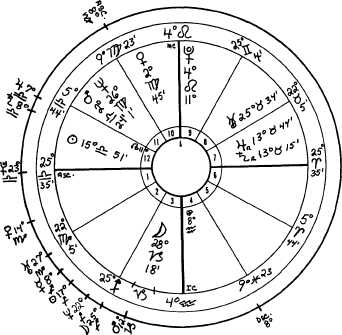
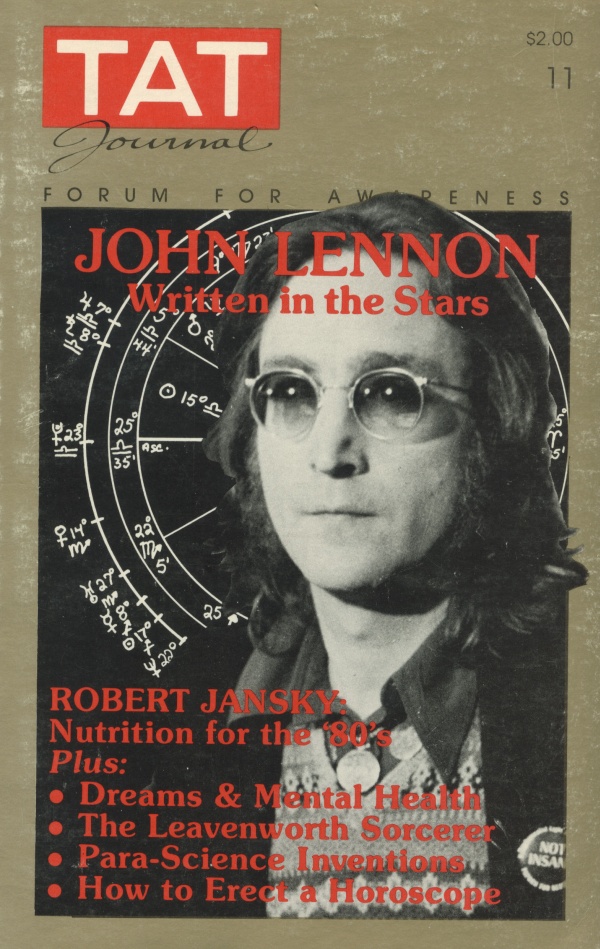
A revealing look at John Lennon's horoscope and the dream that died with him.
TAT Journal is published by the TAT Foundation, a non-profit, tax-exempt corporation, that was established to provide a forum for philosophical and spiritual inquiry, based upon the principle that cooperation with fellow inquirers expedites one's own search. The TAT Foundation supports workshops, seminars, study groups and related services. The views and opinions expressed in the TAT Journal are not necessarily those of the editors or of the TAT Foundation. Address all correspondence, including manuscripts, to: TAT Journal, P.O. Box __________. Manuscripts will be returned only upon request and when accompanied by a stamped, addressed envelope.
Editor: Louis Khourey;
Contributing Editor: Mark Jaqua;
Advertising: William Weimer;
Circulation: Doron Fried;
Production: Robert Cergol.
© 1981 TAT Foundation. All rights reserved.
The TAT Forum is reserved for our readers. If you want to comment on an article you have read, or submit a short essay on a subject that you feel is interesting or thought-provoking, write to: Forum Editor, TAT Journal.
One Final Escape
To look back forty years and see that, after all, you are the very same person as when a boy of fourteen, is not just the mind's trick of the moment skipping the intervening years, making a knowledgeable comparison within itself. At least it was not for me, one memorable occasion eight years ago, when this seeming erasure of the years left me with the understanding that, in actuality, there were no years except as the mind was trained in the recognition of time. This was less a fact than an insight, less a conclusion of evidence supporting an idea than a presence of mind that came as its own unknown action. There was a spontaneous awareness, a wordless wonder of meaning, a movement upon the mind that did not originate out of memory, out of knowledge. This had the effect of showing time as its own illusory presentment of things known, as we do in personalized thought processes. There was an influence upon knowledge, an understanding that worked upon knowledge that was then seen in its own vast ignorance, its own limitation confined to what was known.
This came to me in an instant like a lesson quickly learned that was effortless in the learning, its own truth of meaning that held no lingering doubt. There was nothing to question, no missing meanings as when we add to our theories and speculations. For the first time in my life I fully understood the mind's false picturings of life to itself, picturings that passed for their own truth of reality and of ourselves playing with stuffy knowledge, even as children pretend. For all the years I was still that boy, and the living that had been mine little more than a story read one lonely night. For all of that I was scarcely different and the years ran together compressing into a meaningless episode. Experience then, for all of its personalized drama, was just so many snapshots saved in an album, seen by an audience of one whose cast of characters we presumed to be playing, performing for himself.
I clearly understood that we took some center of mind as a seat from which we gave meaning to this and that movement, movement that took its own direction regardless the meaning for us; that all motion was one Motion, parts of which we appropriated for a time and purpose. And there I was - and am - still the boy staring at the same movements, understanding that experience as knowledge can never explain the movement and is only some meaning of mine that attaches for awhile. The beginning of truth was in understanding the untruth of knowledge that passed for its own final truth, the false as true.
I now understood that truth is never disappointing, that disillusionment always is. Disillusionment was the mind's refusal to accept understanding in the hope of restoring belief, any belief, to take up the void of meaning. Truth could not leave us with remorse or regret for in truth nothing could ever be lost, only found. In truth nothing was possessed; it was only in our presumed expectations that we were disappointed in this, disillusioned in that, that the present was wasted in daily renewal of the past.
And for me it had been - for forty years. Reunion with the boy I had been was not a retreat in time but a revelation, its own timeless action that left no vacuum as when knowledge experiences loss. The ghosts of bygone days had lost their dwelling place, no longer to tease the mind with their struggle for resurrection. Life was now more its own, moment by moment, experiencing more correctly its own action rather than a reaction based on past picturings once experienced.
At last I was together, no longer spread out over time repeating the past that gave false life to the present and shaped the future. There were no more questions to ask, no answers to seek, no path to follow, no mountain to climb. There was nowhere to go. It was all here - now.
And I was here, now, understanding that one's endless activity was the mind-of-thought's excuse for being, not necessarily reality's. Ours was a fabrication out of reality, not the real thing. We each had our illusory worldview, however common these agreements, formed for the most part by imitating the meanings of others. We were all caught in the press of cultural continuity that mapped us to itself, however imperfectly. Life was a copied conditioning in kind, not an original expression of reality. Culture was a counterfeit that most everyone accepted as real coin, biting it gently lest the truth of its falseness be known.
It was easy enough to liken the mind-of-thought to a city whose streets and alleyways led nowhere, except into each other, a town peopled by stray ideas of this and that, thoughts that just happened by and got stuck in the self. And this we term Knowledge, its own declared sovereignty ever accumulating to itself, always expanding, developing, maintaining, manicuring the mind's field of awareness as being some final expression of reality. And never quite succeeding. Understandably so.
Reality then was not understood in the sum of our knowledge. Who but a fool would measure the distance between the witless and the wise, or even suggest which was which. Certainly reality was not more revealed to the one or the other, each necessarily separated from reality through interpretation. To think was to err in the measurement of reality which does not lend itself to measurement; and so it mattered little whether the thoughts were simple or sublime.
And then it seemed to me that we were each an island mentality that viewed the ocean of the Unknown as nothing and ourselves as so many sparks flinting from some divine design that gave reality to whatever we touched. Did we not always bless with our own meanings that which we could regulate, rejecting the rest to some area out of mind, confirmed in the remainder by the approval of others who received as much from us. Why else did we group together if not to give credence to our beliefs as mirrored back in those persons who were no less enclosed in our mutual sameness of mind. After all, whose core of mind did not spin out of some cultural conditioning, an imitative identity one pretended was his very own? Individuality then was not such a mystique as we made it out to be... nothing more than the mind's mistakings through interpretation. Was it not a fact that we were always changing our minds, our conclusions of belief? And if so, then wasn't such former believing its own self-deceiving when we traded the latter fixed idea for the former?
Ours was a too-serious game of many presumptions, elevated to the status of beliefs that possessed us that we might more abundantly possess life as we knew it. And we knew life in separation to Life-Reality - giving priority to this and then that idea, that in turn gave appetite to desire, that gave activity to behavior. Possessed by ideas of life's meaning, life became unbearable if we could not possessively hold to ourselves that which was seen in idea as life itself.
What were grief and misery but some idea denied that we felt entitled to, deserving of some condition as we saw it, some possession or relationship missed? Did not all sorrow begin with the mind's claim as its own that which, in actuality, was appropriated in the power of one's own thought? What in life can ever meet or always keep to the level of our expectations? Who were we to take to ourselves that which became for us an extension of ourselves whose meaning was never more than self-serving? Yes, if we loved it, dearly we loved it for what it meant to us, not for what it was. For we did not understand what it was aside from our desire of it. Could such attachment that saw only the value we gave it out of ignorance of Reality actually be termed love? Was love then only what we said that it was - some idea limited to anticipated rewards?
To think thoughts of love was no love at all except that the mind envisioned ideal love to and for itself. But the ideal always rejects the less than ideal favoring this over that, excluding as much of reality as was accepted. Surely love - which is our expression in reality - has a perfect understanding seeing everything for what it is, not for what we would have it be. Personal desire must ever be personal desire, expressing as it does a limited notion in relationships. On the other hand, LOVE is its own end, not ours. Not to understand this experiencing was then to write your own definition for LOVE never translated into the mind's view of love. Experiencing can never be known in the thought experienced even as the living is never understood by the lifeless. To witness to the lifeless as living is to miss life. A young man once said, "Leave the dead to bury the dead." This is what he meant. Not to understand this meaning is to distort the living-reality - by screening life to our dead pictures of it.
There was much more to this initial experiencing, more than I will ever know. But it is not in what one knows that life is fully lived but in what one truly understands. These have been my understandings, they can never be yours in the very same way that they are mine. If you understand them, they were yours all along and are only reflected in what I say. If you do not understand me you are applying what I say to your field of knowledge which has no understanding of its own and which then denies you what is already yours - understanding. It is your faith in knowledge that deprives you of understanding, while faith in understanding is our one final escape from a belief in knowledge.
Coming Face to Face - Part 2
by Alan Fitzpatrick
Any discussion of self help hinges on method. Although you can entertain any theory you wish concerning the nature of the mind and the problems that afflict it, some theories lend themselves more closely to truth than do others. The method of any psychology can be judged by what it produces.
That no psychotherapeutic method exists today that works any better than factors such as placebo effects, positive suggestion and faith in the system (as reported by Martin Gross in his book, The Psychological Society), testifies that modern psychology, for all its scientific regimen, does not have ways and means for solving mental problems, because it does not know the mind. Instead, modern psychology has, over the years, endorsed a hodgepodge of diverse therapies as valid, acceptable approaches to solving mental problems; each is given an authority status a priori until the layman can prove otherwise. By such tolerant and broad-minded condonation of such fundamentally different theoretical directions, psychology admits a confusing, contradictory and absurd definition of the mind; it can be voted upon and legislated when popular thinking demands that the definition be changed to include a new therapy, or sanity be revised to sanction a certain social trend. This approach is apparent in the actions of the American Psychiatric Association which, in 1972, voted to change the definition of mental illness to exclude homosexuality as a deviation, because of pressure exerted by homosexual lobbyists. A definition of the mind that is dependent upon the bell curve or majority thinking will never produce a method that works because such a definition is not the result of a true examination of the mind and a discovery of factors that influence it. That people can and do cure themselves of mental problems, by sorting their heads out in a method that psychology skeptically dismisses as "chance spontaneous remissions," tells us that there is a true definition of the mind with ways and means that work.
IN THE FIRST PART of this article on self-help, ("Coming Face to Face," TAT Journal number 10) a formula exists for approaching sanity that is simple, direct, and effective. This formula is the result of an investigation into the cases of individuals who cured themselves of their mental problems, and thus embodies a unique system of psychology that goes directly within the mind of an individual, thus abridging years of speculative analysis and "trial and error" psychotherapy that may be tangential or ineffective because the real problem is never realized. It is a system with pragmatic ways and means that work to bring about change through a process that can be said to purge and purify the mind of its problems rather than compound them by additive methods. Most importantly, it is a system that is available to anyone at any time who wishes real change in his life and is determined to take action to free himself from the problems that afflict him.
The formula and system it entails are not something new nor original. Anyone who has brought himself out of the abyss of insanity, obsession, addiction or uncertainty, to clarity and peace of mind has, in some way utilized these universal methods. Many of the techniques can be found today in therapeutic orientations such as Alcoholics Anonymous, Synanon, East Ridge, and Direct Mind Science. For the hundreds of people who have found a way out of their problems through such a system no other endorsement is needed.
THE FIRST STEP to take when beset by mental trouble is to come face to face with yourself. The purpose of such an act is just to see who you are and who it is that is troubled.
Yet such a simple task of self-observation and evaluation may be more difficult than it seems. First, you must be able to make a very important admission to yourself; you may find that your mind is prone to indulging in a variety of mental obstacles such as rationalization, procrastination, and wishful thinking that prevent you from facing the truth. You must admit that you are troubled, if that is the picture you see or sense in the mirror. Each individual finds his own way or doesn't. And this is dependent upon time and the degree of desperation that a person is faced with. If you are troubled but don't know it then nothing is lost, for the future still holds a promise that you may come to a realization of your condition. But if you are troubled and yet cannot or will not admit this fact to yourself, then little hope exists for progress.
Why? Because in admitting to yourself that you are troubled or have a problem that is bigger than you is an act of being honest with yourself. Honesty is essential for any ways and means to work and begins when you acknowledge to yourself the facts and the truth of your situation. This is difficult to do. Pride and vanity concerning your self-image may get in the way if the person that you believe yourself to be cannot include a picture of instability, lack of control and confusion. This is why many people who are troubled are unable to listen to others who are offering help. The conclusion of the need for help must come first within.
Such an admission reinforces, for the first time, that part inside that wishes to be whole and desires sanity, rather than just being an agonizing part of a fractured personality. When you can admit the truth about yourself to yourself, it negates the power that a particular problem has over you, or over that part of you that desires to be whole. You may find that you are not a whole, unified person, but rather a composite of different selves, voices, urges or desires with which you are identified and which are often at odds with one another. You need only watch the thoughts and moods of your mind when you are troubled to see that the conflict is in part due to a battle going on within you between opposing forces. The voice, desire, or urge to be whole or seek sanity and peace of mind may only be one of many voices that speak.
The first small taste of inner freedom may come when you can admit the truth, and consciously identify yourself with that part of you that seeks freedom. Sometimes it is helpful to admit your problems to others, such as friends, so that you can get the truth out in the open where you can see it, hear yourself speak it, and understand your situation better, if you find that you have difficulty approaching such an admission by yourself. An admission automatically lessens the identification with those parts of yourself that are the root, cause or reaction to your troubles. It is like you have been watching a dramatic movie on TV and have become involved with the characters and plot so that you are moved emotionally. When you turn the sound off for a moment, you are reminded that you are just watching a movie and thus get a clearer perspective of your previous identifications.
Let's take another example. In the case of a drug addict, his addiction holds a great deal of power over his entire personality to sustain his habit. He can no longer quit if he wishes to, and in fact does not wish to. Why? His physical addiction, the effects of the drug upon his mind, and the personality aspects relating to his drug use, keep him from getting an objective picture of himself. The addict is slowly destroying himself. Yet he can have many people tell him so, but he will not believe this to be true. He can only discover the truth when he somehow comes to realize his condition himself, and is momentarily not identified with it, so that he sees a drug addict in the mirror. In such a moment when the drug and his drug personality are weakened, he may come to identify with that part of him that wishes to survive and he will see not only drugs but his obsessive personality and his appetite for drugs as something destructive. When such thinking results, he has a chance to free himself.
IT'S EASY TO SEE that many people don't take the first step because they are blocked. But why do many people who are able to do so and thus have an inkling of their condition never go any further and do something about what they see and can admit? Take the statistics of Alcoholics Anonymous, for example. They express a cure rate of only ten per cent though most participants are lifetime members. A fellow in his fifties that I talked with a year ago told me that he was an alcoholic and had attended meetings throughout the greater part of his life, though he told me that he had only been drink-free for six months. He had struggled with it for years, with periods of abstinence followed by recurring alcoholism, without conclusive success. Many people with similar problems such as drug addicts, sexual compulsives, manic depressives, the fear and anxiety ridden, concur that pitifully few are ever definitively cured. Yet most of these people are well aware of their problems and suffer from the acknowledgement of their enslavement. In spite of having taken step one and often tried out a variety of therapeutic approaches, they don't seem to be able to solve their problems. If we could analyze the cases of each of these individuals to look for common denominators that might give us an insight into their failures, and then compare it with others with similar problems who were able to free themselves, I think one overriding factor would emerge.
Most people fail in their efforts to help themselves overcome their problems because they are unable to make a commitment to themselves to solve their problem and stick to this task until it is accomplished. Most people who realize that they are troubled would like to do something about it, but for whatever reason, their resolution to work at their problem with consistent effort seems to miss the mark. They vacillate - between moods of indulgence, inertia, recrimination and despair. And in their rare moments of clarity they make a half-hearted resolution to seek help. Such efforts are like those of a man who seeks God by attending church for an hour every Sunday. The way he lives his life the rest of the week is going to have a profound effect upon his religious pursuits if he spends his time elsewhere.
The point is that one's search for sanity is a task like any other human endeavor. Success is dependent on how much energy you put into it. If you want to make a million dollars, you may have to put all your time and effort into the project to get results, and eliminate any pursuits that may get in the way. Likewise, if you are intent on solving your mental problems, then you must not only desire it, but live the project as if it were the most important thing in your life, or you may receive less than satisfactory results.
If you sit and think about your troubles or watch your mind when it is troubled, it is apparent that your problems are a part of you, interwoven somehow into the things you think, believe and do. This abstract and subjective arena often becomes more of a battlefield between opposing forces or voices that divide the mentality. You may see and hear one voice that seeks unity, another moderation, a voice that desires or wants, another that demands importance or recognition. The mind is a battlefield where one side seeks cure and another, the voice of conflict, is resistant to change. Richard Burton described his bout with alcoholism as a constant battle between himself and booze. He likened it to being in a boxing match where you are always fighting and evading the opponent, who is booze. The temptation is always with him, and at the end of a day of struggle he could only count on beating the boxer for another day.
Although you may not be aware of the source of your resistance, you can notice, in retrospect, that without concerted effort to keep your mind constantly on the problem before you, it will drift into resistance, avoidance, fear, or rationalizing, whenever you do begin to think about your problems. For some reason the mind is diverted, so that in the long run, nothing is accomplished because you can never get down to doing anything serious about changing your condition.
Nowhere is this more clear than with the alcoholic. Most spend years on and off the wagon without appreciable results. If we could intimately examine his mentality for a moment we might be able to see why he drifts and the importance of a commitment. Following a drinking binge, an alcoholic may admit that he's drunk, and depending upon the severity of his hangover, he might say that he would really like to quit. He may even come to the conclusion that he is going to do so this time, once and for all, for the sake of his health, his survival, his finances, and his anguished loved ones. But twelve hours later an amazing transformation occurs in him. We find that he has adopted a new philosophy and discarded the old. Now he doesn't believe that he has a drinking problem, and just to show himself and everybody that he is in control and able to handle his liquor in moderation, he will have just one drink. He justifies his new philosophy as new reasonableness and might tell us that his former belief that he was an alcoholic was spoken because he was in a mood of depression, and was ill at the time. The new voice that comes from his lips and the mentality behind it is manifestly no longer the voice of survival, but the voice of alcohol that is matched by a personality that can argue the merits of drinking in moderation, and that Alcoholics Anonymous is only for alcoholics who cannot control their liquor. What happens? After one drink, he is satisfied with himself and feels good, so he has another and another. Eventually, he drinks himself into oblivion, and some time later, in a post-drinking funk, returns to the realization that he was outwitted by himself. The survival voice returns momentarily, and the cycle is repeated, for the alcoholic is not only a hopeless victim of a physical addiction rooted in physical craving, but he is deluded by powerful mental forces within him that voice his cravings for booze in subtle ways; the voice that desires survival and freedom has only a small say.
WE SENSE THE resistance within us to change, and our powerlessness to control the situation. Thus, we must find a way of making a binding commitment to ourselves to work at this project of self-change despite the obstacles and the odds. Making a commitment to ourselves means that we already have a pretty good picture of our troubled situation and feel that we cannot live with ourselves, unchanged, any longer. Our survival, our mentality, and our success in life are at stake.
COMMON SENSE TELLS us that many therapies fail because their diagnosis of a person's problem may have been incorrect, or because the ability of the therapy to diagnose was hampered if the therapists were prone to using ink-blot tests and MMPI profiles. You have to find a way, even in your unclear and troubled position, of learning what your problem is. Paradoxically, I think you are in the best position to do so because you live intimately with yourself and are able to witness your own mind, whereas the psychiatrist, who is unable to enter the mind as a doctor is able to enter the body, is working from an objective perspective with second-hand information, and is likely to view your problems from a symptomatic rather than causal point of view.
Through self-observation techniques, you can prove to yourself that the problem you find is the real problem, and not based on mere speculation or delusion.
You can begin by watching what is going on inside your head when you are troubled. Don't attempt to try and change anything that you might see, at this point. Just watch your moods and thoughts and collect some data as to the nature and source of your troubles, so that you can eliminate them rather than indulge in them. While doing this, you can review the memories of your past to try and see when and where your problems began, and recall a time when you had peace of mind and were not troubled. This is good because if you can identify a time in your life when you were able to think clearly, you may be able to see what happened, in the form of trauma or shock that changed your way of thinking. This will help to clear some of the confusion away because you will be able to see your problem as the onset of an external affliction that can be taken away or reversed.
So watch yourself when the trouble hits. We know what these moments are because we feel uncertain, unclear mentally, outside of our usual selves, like strangers. We may feel driven or compelled by violent, fearful, or sexual urges that cause tremendous conflict within. Or the troubled moment may be more subtle in that the moods we are in or the things we are saying are alienating us from friends, families, mates, or business contacts so that we find ourselves alone, feeling out of touch, and wondering what it is about us that turns others away. These times are the most difficult in which to observe ourselves, and yet the most valuable from a psychological point of view.
MODERN PSYCHOLOGY would treat most people who are in troubled moods with sedation. But these moments are important for us to observe and study because our problems are at the surface. Like taking our car to a mechanic to fix a problem that only manifests itself when the car is doing forty m.p.h. going up a hill, it will do us little good to search for our problems entirely when we are in quiet moments because many of the clues can only be found when we are troubled, and these clues will make the difference in our assessment and subsequent actions. Common sense says that, although the study of the past is important in terms of understanding ourselves, the past cannot be changed. What change can be effected will happen in the present. For the alcoholic, no amount of study of his history of problems that led to his drinking or the study of his drinking patterns, is going to change him, as long as he continues drinking. If he is to be cured, he will have to put down the bottle.
When you are troubled, you change within. Your personality changes, your mood, thoughts, and inner voice. One hour you can be thinking or feeling a certain way, perhaps working at a project that fills you with motivation, fulfillment, or peace of mind. And an hour later you become moody, or sullen, and soon find yourself in the grips of a new mood of fear, despair, depression, or anxiety. The change is subtle, but its effects have been pervasive. You don't feel like the same person. The new mood overwhelms even your sense of self so that everything you think, feel, see, or do is in some way affected by this change.
When you are changed, you hear yourself say that you decided to change your mind, but no decision was ever pondered. You see in retrospect that your mind was moved from mood A to mood B by unknown factors that you cannot control; the troubled mood may last for several hours, days or weeks until you return to your original mood. This is a key.
When you return from mood B to mood A you see that mood A and B exist within you. In mood A your self desires to be whole or complete. It is working for the well-being of your entire organism. You could say that self A is all that is left of a former sanity. But you can see now that mood B, C or D exist within as a part of the picture that you call yourself. When you change from mood A to B, you can see that B is not interested in solving anything. Rather, you are swept away with the new mood, and if it is depression, for example, you will find everything, including self-help to be depressing, and nothing will shake you from this conviction until mood B passes and you return to A. But mood B can be destructive too. Depression may lead to thoughts of suicide. Or mood C or D could be the desire to drink which compels one to drink until drunk, or to indulge in perverted sex, or to attack others. From the perspective of mood A, the other moods are not interested in the good of the self, and do not work for the benefit of your general sanity. They are ultimately destructive as there is no end to such a mood, once indulged in. For they consume more and more time and energy.
There are many ways to demonstrate this inner division to ourselves. For example, when troubled, you could record in a journal your exact feelings and thoughts of the moment. At a later date, when in mood A, you can review the thoughts that you wrote down, to see if they are consistent with your current convictions. If they are not, then such information may tell you that you were identified with a different mood. You might find that your mood changes are subject to time, and if you record the onset you may find a predictability on a calendar. Or you may see that you were thinking the same thoughts before every mood change. By keeping a record or talking to others when you are troubled you will get a better picture of what your moods are and be able to describe or even name them.
WHY IS IT THAT WE become troubled? Is it only the result of perceiving the destructive trends of our "Mr. Hydes"? Or is the mind only troubled when we are in mood A and thinking about our problems? We can see that we feel most troubled or at odds with ourselves when the change from mood A to mood B is actually occurring. Even while depressed, angry or anxious, something gives us the feeling that we are not ourselves, even though the thoughts at the moment can find justification for the new mood and new actions. The lingering memory of the former self and mood creates conflict, or we would not feel troubled at all when we change from mood A to B. The conflict shows that mood A is the original mood or self, by its faint presence throughout the clamor of voices that we experience. Mood A or self A, with its desire for wholeness, survival, and sanity for the self, is the cause of the troubled mind, or we would automatically change moods without conflict or disturbance, and blindly embrace whatever comes along. The fact that our change from A to B causes us deep consternation can only mean that that consternation, like bodily pain from injury, is a warning signal. That the presence of mood A and its subsequent loss can have such a terrible effect upon us can only mean that mood A is very important and more real than all the others. Mood A, our voice of survival, is the real self among the many voices and thus is our link to a true, complete and unified self that we associate with sanity, and that we wish to regain. Self A is the key to our mental freedom.
Therapies that advocate talking out your problems will not, alone, bring about change nor remove the trouble. Neither will analysis of the past straighten out the present. The real problem is the inner division. There cannot be many voices ruling one house, as many modern therapies, such as Gestalt, would have us believe. The conflicting urges and directions will tear us apart, and ultimately, lead in the direction of insanity. One voice must rule, one mood must be dominant, if there is to be a wholeness and peace of mind. We are troubled because other moods and selves exist with which we are identified, and over which our survival voice, self A, is no longer able to exert any influence or control.
So take a look at the different moods or selves from the point of view of mood A, which has the most sobering perspective. Mood or self A is all that we have that holds promise for sanity. It is the most real of all selves, so we are going to bet on the existence and growth of our voice of survival. We then have to consider all other voices, moods, trends, and urges as unreal and dangerous to our survival, for we are going to live for our survival only, rather than destructive indulgence in anything else. All other selves are not us. If we can observe them from the perspective of mood A and the results of the actions committed while under the influence of these moods, they become observable phenomena. As observable phenomena, they are no longer subjective states that we identify with, but objective facts that self A can study, outside of itself. Because they are extraneous selves outside the real or true self, we negate them. These selves are only error, untruth, and falseness that we wish to remove and free ourselves from, rather than identify with and give life to.
We retreat from the error of indulging in many selves in the same way that one stops the hand from burning once it is in the fire. The process can be reversed, the hand removed, and the many selves reduced in the same way that they were gradually accumulated. We have learned from our self-study that many of our false moods or selves are predictable, in that they have a pattern of mental events and associations that bring about change. So we can alert ourselves to events that might sound the arrival of a new mood and herald mental confusion and upheaval. Like the guard at the gate who must cause an alert before the enemy enters the castle, so we must catch the mood before it gains a foothold, and prevent, through whatever means that works for us, the change of our minds from mood A to B. Many individuals have found that prayer or vocal chanting helps at this point. Others point to the help of a friend.
Whatever mental regimen we follow, we know from our observations of the workings of the mind, that we can only think one thought at a time, with another following on its heels. Two thoughts or two moods cannot co-exist, so we need only maintain our mood A and shut out any other, or thoughts that are associated with the onset of a new mood, to maintain ourselves. This mental technique is most apparent in the alcoholic who begins by putting down the bottle and then physically moves himself away from booze. But he must also guard himself from the lines of thinking which will creep over him with temptation for another drink, and a new mood that will encourage drinking. His worst enemy is his own mind, which will play tricks on him. Through a mental, as well as physical discipline, he can constantly remind himself of why he is quitting drinking and encourage thoughts that will forestall mental reverie. In this way he may hold off the torrent of suggestion, and gradually take away his desire to drink, which in the final analysis, is not his real self or "his" desire anyway.
We can apply similar mental abstention techniques to all our problems. Whether it be depression, lust, anger, anxiety, fear, or prideful conceit, moods, urges, voices and selves can be avoided or delayed, to the point that we are able to subtract these obstacles from our thought processes, and our mentality. By encouraging the self to discover ways and means peculiar to itself of avoiding lines of thinking that take us down the road to division, we no longer give any other self an audience, before which to manifest. The inner struggle may not end overnight, and momentary failure may propel us back into a temporary mood, but with sustained effort, common sense which will protect us from making any further mistakes that might revive or create new divisions, and a belief in our right to be one and whole, we can arrive at mental freedom and become whole and clear-thinking for the rest of our lives.
Para-Science Inventions
by Douglass Hardesty
WE LIVE IN A WORLD of mechanical gadgets. We use them every day in our homes, automobiles and occupations. Most of us have only a vague idea of how our car, electric mixer or radio works - but all continue working nonetheless. We believe the reason our gadgets work is because they are based on mechanical principles or laws as concrete as the physical world itself. It is paradoxical that these "immutable physical laws" are created after the fact of finding some principle that works. Electricity was originally thought to be on the same level as voodoo and magic, but after it was continually proven to be a predictable force it entered the world of science and physical law.
Our physical laws and principles are established after proving that a new force or power "works" and is predictable. Thomas Edison refused to work with Nikola Tesla on his alternating current system because he thought it was impossible that such a system could operate. Tesla proved it did work, contrary to theory, and today Tesla's system is used in all the electric power generating systems in the world. Theories were formed to adequately explain it after it was discovered to work. One hundred and fifty years ago chemists were successfully predicting and carrying out experiments even though today we have proven that their basic premises were completely false. How were they able to have successful results when they were operating according to erroneous theories? There may be a super-principle at work here that we are not aware of.
Hendershot's Fuel-less Motor
In the back pages of newspapers and magazines through the years we can find scores of claimed discoveries of new forces and inventions of motors that work on no known principle. These stories generally find a place in someone's scrapbook and then are heard of no more. On February 28, 1928 Lester Hendershot made front-page headlines across the nation with his invention of a "fuel-less motor." Hendershot claimed to develop power with his device by cutting the earth's magnetic field as our normal generator cuts its own magnetic field. The story was in the papers for ten days until a small notice indicated that Hendershot was in the hospital recovering from a 2000-volt shock he received while demonstrating his device to some investors. The Pittsburgh Press claimed that he had been taken in for a mental examination.
Hendershot's machine was not actually a motor but a generator. It developed electricity which could power another motor but did not produce any usable motion itself. The idea for the generator first came to him in a dream in his early twenties. He forgot the idea for several years and supposedly was motivated to start working on it to replace the broken motor in his child's toy airplane. His first working model was created out of the parts of a worn-out radio and would only operate when lined up north and south. After two years more work he was able to develop a model that worked facing any direction.
Word traveled quickly that Hendershot had developed an unusual invention and he was invited by Air Corps Commander Lamphier to demonstrate his model at Selfridge Field in Detroit. Lamphier was greatly impressed and immediately had technical crews begin developing a larger model. Charles Lindbergh observed the machine in operation and also was very impressed. William Mayo, chief engineer of Ford Motor Company, and William Stout, developer of the three-motor design of airplanes popular in the `20's and `30's, also investigated the device in operation and pronounced it genuine. The model developed at Selfridge Field was able to light two 100-watt light bulbs or power a small sewing machine. Pilots and technicians at the Field praised it as the "greatest invention of the age."
Hendershot's model consisted of some basket-woven coils of wire, stainless steel rings about three inches in diameter and some Anico magnets. It weighed less than ten pounds and any fraud could be easily observed. Hendershot said that the trick was to get just the right proportion of each of the materials. Wrong proportions resulted in it quickly "burning out." It was pre-set when made to turn at a certain speed and put out a certain power.
It would seem that a great discovery had been made. Reputable men sang the praises of the machine and, beyond any doubt, it had proved to be a workable invention - even though it operated on no known principle. About this time some very curious things began to happen. For some unknown reason a distinguished scientist, Professor Hoffstetter of Pittsburgh, rushed to New York and rented at his own expense a large lecture hall to deliver a speech to "debunk the fraud of the Hendershot motor." He declared, among much other rhetoric, that if this invention were accepted it would "destroy faith in science for one thousand years." He said that he had found a small carbon battery in one of the models and that this was the source of its power. Newspapers accepted Hoffstetter's claims and soon no more was heard of the motor - despite the fact that there had been no solid evidence whatsoever to prove the motor a fraud.
It was also curious that Hendershot became paralyzed from a 2000 volt bolt of electricity from a machine he had been working on and grown familiar with for several years. If his machine could develop 2000 volts it would seem to validate his claims rather than prove any fraud. After the supposed accident, Hendershot was paralyzed in arms and legs and palate (so he could talk to no one?). In Wild Talents Charles Fort postulated: "What I pick up, is that there must have been an alarm that was no ordinary alarm somewhere." F.D. Fleming in a 1950 Fate Magazine article suggested that Hendershot was bought off and his invention relegated to oblivion by big business which had much at stake in coal and oil technology.
The Hubbard Energy Transformer
A 1919 front-page headline reported that Alfred Hubbard had developed an amazing machine that could transform radioactive emissions directly into electric power. This is impossible according to modern theory yet Hubbard made a public demonstration of the "Hubbard Energy Transformer" with no trickery or fraud ever discovered. The headline of the December 17, 1919 Seattle Post-Intelligencer reads, "Hubbard's New Energy Device No Fake, Says Seattle College Man." The "college man" was Professor of Physics Dr. William Smith who told the newspapers, "I unhesitantly say that Hubbard's invention is destined to take the place of existing power generators, and that within a few years it will have advanced the whole theory and practice of electricity beyond the dreams of present day scientists."
In a public demonstration Hubbard connected his transformer in a boat to a 35-horsepower electric motor. The small 11-inch diameter by 14-inches in length transformer was able to power the boat at a good speed around Seattle's Pratage Bay for several hours. Fraud was impossible since enough batteries to power the boat for that period of time could not be concealed on board. The impossibility of fraud was undoubtedly why Hubbard chose to conduct his exhibition using a boat.
Gaston Burridge gives a rough description of Hubbard's device. At the center was a hollow non-magnetic tube wrapped in copper wire.

[Illustration: This photograph of Alfred Hubbard demonstrating his "energy transformer" appeared in the Seattle Post-Intelligencer in 1919.]
Within the hollow tube was series of small magnetic rods packed in a radioactive material so that none of the rods made contact with each other. Around this tube were eight coils of wire wrapped upon what seemed to be eight cores of magnetic iron. From the windings Burridge said that the device seemed to be a "step-up" transformer rather than the "step-down" type. There were four lead-out wires and the whole device was encased in a dense material to prevent radiation leakage. It resembled a giant spool and made no noise when in operation.
Shortly after this public demonstration Hubbard was employed by the Radium Chemical Company of Pittsburgh to develop his invention. Several years later he quit the company when they demanded 75% rights from any of his developments. Hubbard more or less disappeared; at least there is no known information as to what happened to him.
Gaston Burridge inquired at the Radium Chemical Company in 1950 for information on Hubbard's work and was told that, "There is no information on the device you mention."
Anti-Gravity Discs
One of the most unusual para-science inventions is Townsend Brown's "anti-gravity discs." For over thirty years Brown would demonstrate his discs to anyone who wished to see them. His usual demonstration was to tie them to a pole with a tether and allow them to fly round and round in a circle under their own power. They made a slight humming noise and gave off a light lavender glow in the dark. Scientists who observed them generally refused to admit what they had seen or accredited the phenomenon to simple and known principles. Brown was largely ignored in the United States but was asked in the 1950's by the French government to run some tests under the auspices of Air-France. In one of these tests a disc was flown in a vacuum, thus eliminating any "lighter-than-air" explanations and the like.
The principle of the discs, according to Brown, is based on the little-known "Biefeld-Brown effect" which is easily demonstrated. If a two-plate direct current condenser is balanced on a balance beam with an equal weight, and then given a charge - the condenser will actually rise into the air with a seeming loss of weight. This will only occur if the positive pole of the condenser is placed upwards. Charging the condenser will result in a movement in the direction of the positive pole. (It is obvious that the most efficient form of this type of condenser is the same disc-shape "flying saucer!")
Of the three basic forces in Nature - electricity, magnetism and gravity - we know the relationship between electricity and magnetism but are still in the dark about the interaction of electricity and gravity. Brown's discs may hold a key here since they demonstrate practically something we have no theoretical understanding of. As of 1958 there were at least nineteen patents being worked on covering different aspects of the Biefeld-Brown phenomenon.
Deland's Magnetic Frost Guard
Many unusual inventions employ magnetism in one way or another. In the 1930's John Deland developed a magnetic device that could prevent frost damage in fruit crops. At one time this device was being used on several hundred acres of trees in California. It has no moving parts but through the use of wires and magnets it seems to set up a force-field which prevents freezing when the temperature drops below 32°F. In one demonstration a thermometer inserted into the middle of an unfrozen orange registered 20°F. In the fall orchards protected by the device do not turn brown until several weeks after nearby trees.
Deland's construction consists of a vertical galvanized tower about twelve feet high with seven copper wires coming from a plywood plate at its top to the concrete footer at bottom. The copper wires pass through the concrete and are radiated at 51° angles in 18-inch trenches 144 feet long. One of the trenches must be pointed directly toward magnetic north. At the end of each wire is an Alnico magnet. The wire passes through this magnet to the surface and is pointed toward the top of the tower.
Deland first got his idea for his invention when passing on dog sled through the Chilkoot Pass in the Klondike during the 1897 gold rush. He witnessed a spectacular display of the Aurora Borealis and was inspired that the powerful magnetic forces that caused the beautiful display could somehow be put to practical use. In this unusual experience Deland claimed that he could actually hear the Aurora Borealis as well as see it. The forces present were so strong that his dog's hair was caused to stand on end. Deland never claimed to be a genius but only a hard-working inventor who had spent seventeen years perfecting his invention. Earlier and similar devices to Deland's were worked on in Switzerland and Germany but were never developed to the point where they were used commercially.
Para-Science and Occultism
Static electricity has been employed in some strange inventions, especially in the fields of medicine and psychology. Dr. Carl Wickland, an avowed spiritualist, developed a machine which he believed removed obsessive entities from neurotics and psychotics. He subjected his patients to a powerful static charge which caused the troubling entities to leave the person and temporarily enter his wife, who was a medium. A discussion was held with the entity through the voice of his wife and it was persuaded to leave the person and go to its proper place in a higher sphere. Most of these entities were believed to be people who had died and did not realize they were dead yet. Others were forcing their will upon the troubled person in order to enjoy different passions through them. Wickland must have realized some success in this method since he practiced it for thirty years until the death of his wife.
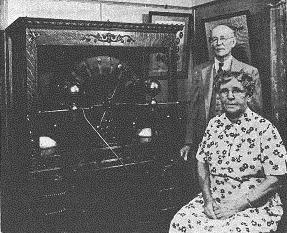
[Illustration: Spiritualist, Carl Wickland, and his wife display his "static machine" which he used to drive obsessive entities from troubled persons into Mrs. Wickland, a medium.]
The fringes of science and occultism blend into each other imperceptibly. In 1851 wealthy German industrialist Baron Reichenbach claimed he had found an all-pervasive fluidic force with various distinct properties. He called the fluid Od or Odyle, named after the German god Odin and symbolizing an omnipresent power. In this century German psychiatrist Wilhelm Reich claimed to have found a similar force which he labeled the Orgone. Reich built an impressive set of theories and developed many instruments which demonstrated and used this force. His most impressive was the "cloud buster" with which he claimed to be able to control the weather.
The most dramatic effect of this machine was the supposed dissipation of clouds wherever it was aimed. It consisted of a row or rows of hollow metal pipes with one end aimed upward and supported by a rack and the other end grounded in water. Orgone has an affinity for water and by aiming the cloud buster at a cloud, Orgone was drawn from the cloud into the water. If the cloud buster had seven pipes then seven holes would appear in the cloud it was aimed at. Weather was manipulated by changing the Orgone potential of the atmosphere wherever the cloud buster was aimed. The Orgone instruments were some of the last developments of Reich's career and one may wonder if his brilliant mind hadn't grown unstable at this time - since he claimed his cloud buster created a hurricane and attracted flying saucers, among other things.
We like to believe that we have a "handle" on the physical universe, that we understand how things work, and that soon most mysteries will be solved. This view is rapidly becoming outmoded. Science, especially physics, is establishing that our "concrete" physical laws and principles form a shakier foundation than we formerly believed. One physicist has even stated that before we thought of them, there were no such things as atoms! Many inventions on the borders of science have been demonstrated beyond any doubt to actually work even though they contradict accepted laws or enter new territory where we have no guiding theories. Charles Fort claimed that some of these inventors have a "wild talent" of being able to will a machine or principle to work contrary to accepted notions. Some claim that electricity, automobiles and telephones work because we all "will together" and believe they will work. Modern physicists have discovered that the world of atoms and sub-atomic particles exists as much in the mind of the physicist as it does anywhere "out there" in a concrete, physical dimension. Perhaps this key to the microcosmic sub-atomic world also applies to our macrocosmic everyday life.
The Magician of Leavenworth
by Donald Wilson
Editor's Introduction
The story of Hadad, a black Senegalese prison inmate of Fort Leavenworth Prison in Kansas, must be one of the strangest accounts in American literature. In three separate penitentiaries he was reported to have successfully committed suicide only to arise from the dead after being placed in the morgue. He claimed to have attended the universities of Carthage and Oxford and, by profession to be a Haitian Zombi priest. His hypnotic powers were astounding and he could influence guards to hand him their belts for his suicide attempts. He could control seizures of epileptics from a distance and cause the figures of the zodiac to rise in welts on his body. Seemingly, he could escape maximum security precautions whenever he wished. He would simply disappear en route from the back of a paddy wagon and appear again later knocking at the front door of the prison asking for admittance. Hadad's story is doubly valuable since it comes from a conventional psychiatrist with no disposition towards the occult and supernatural. Donald Powell Wilson was psychiatrist in the late 1940's at Fort Leavenworth and his My Six Convicts is an interesting account of his experiences at the prison. This short account of Hadad, taken from the book, is distinctive because it describes a phenomenal person with powers we know so very little about. My Six Convicts was originally published in 1951 by Rinehart and Company.
EVERY SOLITARY CELL contains endemic drama. I learned this one Friday afternoon as my last year was rounding out. Gordon and I had completed our rounds of the psychopathic wards in the cell block, and went below into The Hole to see one of the prisoners, a Negro called Hadad. Thompson and Red, the guards on solitary row, reported that Hadad was acting up again; there had been nothing in his bucket for a week.
I commented that there could not be much from a piece of bread and a gill of water a day. Gordon agreed. But Thompson, he said, just didn't like a man who wouldn't urinate. "'It ain't regular,' he says."
Gordon had seen him the previous day. "He was in the pink. When I asked him about the empty bucket, he said in that damned Oxford accent of his that his guidance had been contrariwise. 'But a thousand pardons,' he said, 'if I have inconvenienced you by my spiritual ascendency.'"
The hospital staff was interested in this psychopathic convict. He was a character right out of Sax Rohmer's inkpot. Weird tales surrounded his origin and history, as is always true of these prophets of magic. He claimed to be a Chaldean astrologer with direct lineage reaching back to 400 B.C. He also claimed to have been educated at the universities of Carthage and Oxford, and that by profession he was a Zombi priest from Haiti. Rumor connected him with voodoo rites and devil worship. He fed these rumors by refusing to deny them and offering his own embellishments. His few intimates informed us that he was part Hindu and part Senegalese. He looked like the latter, large and magnificent in bearing. He was strikingly handsome in a statuesque way.
He had an enviable reputation in some of the large penitentiaries in the country for magic, hypnotism and escape artistry. He claimed friendship with Houdini. To the edification of the prisoners and the mystification of the guards, he was able to escape from handcuffs, strait jackets and cells almost at will.
A warden felt it was an ill wind that brought him Hadad. He completely disrupted the morale of prisons and as often as not left the wardens distrusting their own five senses. How could they be sure when he stood before them whether they were in the presence of his corporeal permeability or his spiritual extenuation? to use Hadad's own fine words.
There were no such things as authentic records on Hadad. They were always disappearing or changing, especially when under his frequent sentences he was in transit from one institution to another.
He himself had been known to be lost in transit between penitentiaries. It was never a matter of his eluding capture. He was most cooperative. He simply would not be in the paddy wagon when it arrived. He would turn up anon, knocking on the main gate for admission, explaining that he had "gotten lost" on the way, or had been detained on business. He never announced his departures, but no one missed his arrivals. He had been seen by some of our staff in the foyer of a Kansas City theater at the close of a concert. In explanation he said, "It has been some time since I have been to a concert, and I felt it would be such a shame not to go. After all, I am just a short distance from the city."
The warden shouted that his sentence did not include theater privileges.
"But sir, I came back, as I always do," Hadad reasoned. "I have no intention of avoiding my sentence. Whom did I harm in doing this? No one even knew I was gone."
For this last impertinence the warden slapped him in solitary for fifteen days.
AS GORDON AND I DESCENDED the stairs to solitary row, Thompson the guard, met us with relief. Hadad was a hot potato for any guard. We went directly to Hadad's cell. There was no response to our queries. Thompson opened the steel door and his flashlight revealed a black body hanging against the bars of the cell gate.
"Cut him down," ordered Gordon, "and get the lights on!" Thompson summoned Red, the relief guard, to help him, and when the latter joined us Gordon gave him a quick look.
"What's holding your pants these days, Red?" Gordon asked. Red's hands flew to his waist. Then he relaxed.
"You had me scared for a minute, Doc," he said. "I'm too old a hand to pass my belt around in solitary."
Thompson stared at Red. "Ain't that your belt around our late friend's neck?" he asked in a kind of croak.
Red looked at the corpse. "What do you mean, belt?" he demanded of Thompson. "Can't you tell a piece of rope from a belt?"
I looked at Gordon, and Gordon looked at me.
"Anyways, what do you mean, my belt?" continued Red. My belt's right here! Can't you see it?" He tapped his waist.
We all looked. He was hallucinating a belt which definitely was not there. Thompson lost his color, but not his tongue.
"The guy's nuts!" he screeched.
"I'm crazy!" Red was losing his patience. "How do you like that, Doc? Who's crazy around here, I ask you?"
"Tell you later," Gordon replied.
We did, when we brought him out of Hadad's post-hypnotic influence. Even then he remembered nothing except Hadad's getting his attention on his first round early that morning. He recognized his belt, of course. He was badly shaken by the fact that he could not remember being hypnotized. Later, when he learned the denouement of the whole affair, Red requested transfer from solitary row, if not from the penitentiary itself.
Upon superficial examination of the corpse Gordon pronounced Hadad dead.
"How long?" I asked.
"Only a few hours," he said. He told Thompson to put Hadad on ice, and as we left the basement he observed that the belt was not pulled tight enough to cause strangulation. "We'll see what the autopsy shows," he said.
With his background, Hadad was a psychiatric curiosity. His autopsy would be quite an event. It was delayed until Sunday when a consulting neurologist could be present to assist Doctor Fellows.
Sunday morning Fellows, the visiting neurologist, Gordon and I met in the morgue and gathered around the majestic body for the final disposition. Fellows and the neurologist agreed upon Fellows making the abdominal incision to excise the lungs and heart, and the neurologist's removing the cap of the skull to get at the brain. The two surgeons put on their gloves, and Fellows was picking up the knife from the instrument table when we heard the soughing sound of a breath. Involuntarily we all looked at the corpse - and saw the ripple of Hadad's gleaming black muscles. He stirred, and slowly rose to a sitting position on the slab, as if he were propelled by invisible gears. He opened his eyes, and in his impeccable Oxford accent said, "Gentlemen, I would rather not, if you don't mind."
Nobody moved. Nobody could.
The knife slipped out of Fellows' limp grasp and clattered upon the concrete floor. Hadad slipped from the slab, stooped down, picked up the knife, laid it on the instrument table, sat on the edge of the slab, and asked for a drink of water.
"Holy Mary, Mother of God!" murmured Fellows, crossing himself quickly.
The neurologist tried to hide his shock, but he choked on a nervous cough. Gordon sucked in a startled breath and swore sharply. I began to breathe again at the sound of Gordon's voice.
There was not a man around the table who had not had some experience, either in his practice or in medical school, with catatonic trances, and who did not have some knowledge of Hadad's corporeal heterodoxy. Nevertheless, in spite of our scientific smugness, none of us were prepared for what had just happened. We had all thought Hadad was respectably dead.
Gordon committed Hadad to an unwilling guard with instructions that he be taken to the psychopathic ward for observation, and we men sat around in the morgue talking among ourselves. We did not feel like going back to Sunday golf. We reviewed our experiences with catalepsy mysticism, and extrasensory perception. Fellows, the religionist, made it quite plain that Hadad was my boy from that moment. That was how I wanted it; he would be an interesting study.
Catatonic trances lasting several days are not uncommon in institutions for the insane, in psychological and medical records, and in East Indian magic lore, in the latter of which it is always given an occult complexion. The laws of many states demand that the undertaker embalm a corpse to avoid burial alive, and because of the too-frequent spectacle of a corpse reviving in time to climb out of the coffin and disrupt his own funeral service. Literature is full of tales of a corpse being committed to the family burial vault, and of having the grieving cortege find that the bones of the last interred member of the family were no longer in his crypt, but in a pathetic heap at the vault door. These tales all have their counterpart in fact. It was not very long ago that an undertaker found himself in serious trouble when a ten-year-old boy who had not been embalmed, resuscitated himself during his last rites.
We all agreed that Hadad's three-day trance was not uncommon, but the fact that he had retained consciousness and memory during the trance, so that he could terminate it before Fellows incision was made, put him in select psychological company.
On Monday morning Gordon and I had Hadad brought to my office. One would have thought it was he who summoned us. He addressed us as if we were precocious school boys, saving us the banalities of questions.
"You are, of course, interested in the phenomena of the weekend. It was nothing. I did it only as a means of coming to your learned attention."
He paused to study Gordon's and my expressions.
"I can see," he resumed, "that, being scientists, you are naturally skeptics, that you must have proof. Very well. Gentlemen," he said, "you will concur with me that among the epileptics in the psychopathic ward there are several hopeless cases with severe brain deterioration, who suffer seizures daily?"
This was true.
And was it not true, he asked, that even with the use of drugs we still could not delay the seizure of a deteriorated epileptic for as long as three consecutive days?
This was true also. Delay for even a few hours was problematical among such cases.
He straightened in his chair and fixed his black eyes on us. His voice was quiet, intense.
"Gentlemen, as a demonstration of the use of mental telepathy in healing at a distance, I will delay all seizures in the psychopathic ward, including these deteriorated cases, from this hour, until the same hour on Thursday. For three days and three nights. As further proof of my control," he continued, "the seizures will resume on Thursday morning, beginning at this hour."
He looked from Gordon to me, and waited.
What he was proposing to do would be spectacular. He was committing himself to two phenomena: the abrupt cessation of seizures at one hour on one day, and the abrupt resuming of them at the same hour on another day.
"What about you, Hadad?" asked the practical Gordon. "Where will you spend the time between now and Thursday afternoon? You have a history of being A.W.O.L. on several occasions, you know."
Hadad smiled at the dig. "I will stay wherever you wish, sir. In my solitary cell, perhaps?"
"'Perhaps' is right," murmured Gordon, "What do you say, Wilson?"
I said I would be willing to let him launch his experiment with the epileptics, that even a three-day respite would be something for them. Hadad inclined his head in thanks. "It is gratifying to find you two gentlemen accessible to the influence of the stars," he murmured. "I can teach you healing, mental telepathy, and psychic control of the body, even at a distance. I can teach you the mysteries of astrology. Not the astrology of the common Hindu and East Indian fakir, but cosmic-somatic astrology."
Neither Gordon nor I spoke, a fact which Hadad may have interpreted as skepticism. I was not interested in hocus-pocus, but if underneath his hocus-pocus the man had integrity and altruism, and could add anything to the existing resources of hypnotic therapy, I would go with him as far as I could.
He soon resumed. "You will ask for proof again. My teaching credentials, if you will," he said, bowing to me. "Very well: in a few moments I shall again return to the astral plane. You learned men will call it a trance, catatonia, or even death. But I shall at all times be completely in possession of all my faculties. Gentlemen, I will cause the signs of the zodiac to appear on my body!"
He rose, removed his hospital robe and stood before us naked. "You will find Aries appearing on my forehead, Cancer on my breast, Sagittarius on the thighs," he said. "All twelve signs of the Zodiac will appear on my body at the appropriate places."
He moved two desks together, lay down on them, and threw himself into rigidity and convulsions. The whole process took only a few minutes.
We bent over his body. It was difficult to establish erythema (red blotching or flushing of the skin) on a body so black, but unmistakable dermagraphia (raised, hive-like patches) began to appear. The wheals and welts assumed a shade that could, with a little latitude, be called red. Then, while we watched there appeared on forehead, breast and thighs the three signs he had mentioned, and elsewhere on his body the outlines of three others. The remaining six areas, even with generous Gestalt, could not honestly be called the signs of the Zodiac. The phenomenon, however, lay in the fact that without external irritation of the skin, and at will, he had produced localized, controlled dermagraphia.
Gordon checked the quiet black body, and for the second time in three days pronounced him dead by all tests. There was no stethoscopic heart sound, no breath on the mirror, no corneal reflex.
"Let's see if he will bleed." For this test Gordon punctured one of the veins in Hadad's wrist. As in death, there was not sufficient blood pressure to cause a flow of blood.
"There's everything here but putrefaction," Gordon said, without further conjecture about the state of things in Denmark. "What about these other signs, Professor?"
"I can't honestly say they look like signs of the Zodiac," I said. At that moment Hadad relaxed his convulsive posture and resumed his precise and patient speech. Our untutored eyes, he said, would properly envision the appropriate astral signs in detail, if we would obtain a large magnifying glass.
This was no ordinary trance or simple suspended animation. It was beyond the usual psychotic catatonia or catalepsy. This was the second time Hadad had retained both consciousness and memory while in a trance, and had terminated it at will. It was not a statistical accident.
While Gordon went for the glass Hadad again induced rigidity, which he maintained until the séance was over. The glass brought out two more signs of reasonable credibility.
Later I asked Hadad how he could remain conscious to the extent of knowing what was taking place, and of speaking to us when he was in such deep trance as to be considered medically dead.
"Suspended animation, Doctor; it is simple," he said.
But it wasn't. The best exponents of the occult cannot, or will not, iterate their own powers. His explanation trailed off into gibberish and superstition.
We watched the epileptics closely night and day in the next seventy-two hours. It was as Hadad had said it would be. There were no seizures in the ward, even among the cases of deterioration. Hadad was kept in his solitary cell, and paid no detectable visits to the psychopathic ward. On Thursday morning the tragic hell of the epileptic broke upon the ward.
Hadad had called this a demonstration of mental telepathy. But inasmuch as he had spent the twenty-four hours from Sunday morning to Monday morning in the psychopathic ward, it was much more probable that the delay of seizures was the result of post-hypnotic suggestion given by Hadad while he was still with the patients from Sunday to Monday. It would have been simple for a hypnotist of Hadad's skill to hypnotize the patients during those twenty-four hours, giving them post-hypnotic amnesia, so that they would not remember being hypnotized. But it demanded hypnosis of a very superior order.
Gordon and I admitted to ourselves that, though science might explain much of Hadad's magic in terms of psychological phenomenon, science was not reproducing it on Hadad's scale. We might explain what his magic was, but, with all our training and knowledge, we could not yet interrupt a deteriorated epileptic's seizures.
We were struck with the incongruity of the fact that here was modern science epitomized in a research hospital with the last word in equipment, and with the best consultants in the country only five telephone minutes away. But no x-ray machine could penetrate, no microscope reveal, nor surgery excise, no cosmic ray illuminate, no test tube break down the rationale of a black man in a dungeon five hundred feet away, quietly working the ancient mysteries of the world outside the body and the senses, quietly reflecting the ancient philosophic victory of mind in the impingement of the unknown and feared upon the known.
We hoped that Hadad might be a man of sufficient character and integrity to work with us in illuminating the unknown and the feared in the "No Man's Land" of the mind. We listened in the weeks that followed for some sign of integrity while he engaged us in dissertations on hypnosis, yogiism, telekinesthesia, mental telepathy and occultism in general. He knew most of the authentic literature in these fields. He made quite a point of the symbolism of his three-day death and resurrection, which he repeated at our request. He explicitly pointed out that from his Friday afternoon suicide to the Sunday morning autopsy was, as the Orientals reckon, three days. The implication was clearly that Christ had nothing on him.
We were not learning much, beyond his strong sense of his own destiny. He was greater than Mohammed, greater than Christ. One day when we began to weary of his egoism, I asked him why, with all his powers of escape and healing, he found himself in penitentiary. "Thank you, Doctor. I have been waiting for you to ask. You see, gentlemen, I am here on a mission. It is, in fact, a dual mission. Both are good, although one is a mission of death and the other of life." Here it comes, I thought. Gordon and I offered him only our combined acute silence, so he continued.
"I am destined to wander throughout the world seeking two excessively evil and malign spirits, and to relieve them of their corporeal anatomy."
Gordon glanced at me with raised brows. Hadad smiled amusedly. "No, no, gentlemen, not you. I have, in fact, already found one of those spirits, and he is not."
Murder in the name of God. I was sorry to hear it.
"The other mission is to find two men upon whom I can bestow my mantle of therapy, the like of which has not been known since Christ. It has been revealed to me that you two gentlemen are the worthy successors."
That was one time Gordon and I didn't look at each other. We both looked at Hadad.
IN ADDITION TO OUR OWN observations and our conferences with Hadad, we conducted some investigations into his past. Reports from two penitentiaries confirmed his boasts that in each he had committed suicide and that all recognized tests for death had been positive. The doctors, always willing to admit new evidence, had quickly revised their diagnosis to schizophrenic catatonia when on one occasion a watchman in the morgue found the stiff flexing his muscles.
We also found verification of a murder charge, but it was not the murder of which he had told us, or those on which he later elaborated. One stubborn piece of data stood on record. At one time, perhaps when he was in search of one of the two malign spirits, he had been a member of a famous gang that was terrorizing the Southwest. He was inside the turtleback of a car when the police closed in and riddled it with machine gun bullets. It careened into a cornfield, and Hadad was extracted from the sieve unharmed.
His time was not yet, Hadad explained to us. "I found it expedient to deflect the bullets from the anatomical headquarters of my spirit."
"What do you make of Hadad's anatomical headquarters?" Cordon asked me later.
"I don't know," I said lamely, "I wasn't there."
As the days passed Hadad became increasingly aware that we were more curious than convinced, and he began to press the matter of our succession to The Mantle.
"Since my cosmic mission is almost completed," he said, "and I shall soon depart this sphere, I wish to impart to you these priceless therapeutic secrets in an initiation, a blood rite."
He told us that according to his Order, the rite must take place at astral midnight, which was two o'clock in the morning according to our time, and in the solitary cell which had been the scene of his "death."
Gordon and I wondered between ourselves whose blood would be used for this rite, and exactly how much? and if something beside his mantle would descend on us at astral midnight?
In his last appeal, Hadad assured us that after the initiation we would never be the same again. We would be, among other things, ageless and timeless.
This we could believe.
The prospect of the midnight rite brought to my mind Gordon's words on my first day at the penitentiary. "A little honest fear's a good thing around here."
Hadad was many times a murderer. His activities as the "fingerman" of the terrorizing gang meant that he had used his occult skills nefariously to draw the gang's victims out of hiding, whereupon he liquidated them.
Further, although he was a superior exponent of his profession, he was also a small-time showman. With his lofty sense of personal destiny, it seemed incongruous that he should spend his time turning up missing for the amusement and consternation of credulous prison populations.
Although in his personal relation to Gordon and me he was always cooperative, deferential and charming, he was all these almost to a fault. However charming he was, he lost me when I learned of his murder mission, and when he invited us to a blood rite. I had too much respect for his ability as a hypnotist to put myself under his influence. Hadad was not above seeking added prestige by discrediting medicine and psychology in a practical joke. Had we placed ourselves in his charge, he could have left us hypnotized in the dungeon, to wake at the morning cell count unable to explain our stuporous presence to the guards or the administration. Or, having hypnotized us, he could have incapacitated us physically or crippled us neurologically. He could have left us mentally dissociated. We could have awakened from the trance insane. He could have given us amnesia for our scientific background and training, and left us wild-eyed exponents of the occult. We had no way of knowing what he might do. He might have killed us.
When Gordon and I declined the Mantle, and when there was no further apparent value in studying his case, Hadad went cooperatively back to the psychopathic ward, and was finally absorbed again into the general prison population.
As has been said, Hadad's parapsychology can hardly be posed as rare in the annals of medicine and psychosomatics. However, the following phenomena in his case were unusual:
In explanation of Hadad's metapsychics, psychology would say that his catatonic trances were induced by autohypnosis; and that his disappearances from paddy wagons and cells, his presence at the concert, and his getting Red's belt to effect a fake suicide were accomplished by his generous endowment in escape artistry and contortionism, and by hypnotizing whoever stood between him and freedom at any given time: a keeper, a guard, an attendant; giving them amnesia for the incident in post-hypnotic suggestion.
He was a magnificent hypnotist. Gordon and I were only sorry he could not have passed on to us his skills in some other way that in a blood rite at astral midnight in a dungeon.
Regarding his corporeal impermeability when he was fired upon in the turtleback, I have no further light. I don't know, I wasn't there.
I hope it will be something more spectacular than the common cold that finally successfully invades Hadad's charming anatomical headquarters. As I remember, he did have a highly susceptible upper respiratory tract. . . .
Analyze Handwriting Immediately by Joseph Zmuda, Z-Graphic Publications, San Francisco, 1980, 88pp.
Handwriting analysis has always fascinated me because it seems consistent with common sense to look for a connection between someone's personality and his writing, while at the same time, the logic of that connection is elusive. It seems obvious that a person's mental and emotional traits should affect what his hand puts down on paper, but why should the written results be anything but random, and establish patterns that can be applied to everyone?
I have yet to read a book on handwriting analysis that even attempts to answer this question, perhaps because no answer exists. But if handwriting analysis remains a science without a theory, it is sufficient if it works. Joseph Zmuda's Analyze Handwriting Immediately is a workbook that enables the reader to decide for himself if the method works, because it is designed to take one step-by-step through a complete analysis of a handwriting sample without the need for any prior training.
The book is divided into eighty-six steps that relate a handwriting feature to a particular personality trait. As you go from page to page, you examine your handwriting sample and, after deciding whether or not a particular feature can be found in it, you make an appropriate notation on a worksheet that is provided. The system is ingenious and very easy to follow, especially because Zmuda provides copious and clear examples with which to compare the sample on which you are working.
The final result of the analysis is a completed worksheet that provides a profile of 137 personality factors in nine different categories: depth of feeling, temperament, mental habits, basic personality, interpersonal factors, work habits, success drive, integrity factors, fears, hostilities and major risk factors (e.g. insincerity and neurotic conflicts). Zmuda's text not only describes what handwriting features to look for, but he elaborates on the mental characteristics, helping the reader to construct a comprehensive picture of the subject's personality. In this, he shows a great depth of understanding of psychology as well as a mastery of handwriting analysis. For example, he states that excessively tall t's and d's indicate vanity, and goes on to explain: "Psychologically, vanity begins in one of two ways during childhood: the writers were constantly praised until they began to expect praise as their due even for inconsequential actions. Or the writers were not praised at all: in order to boost up their self-esteem and value for such imagined fears as self-consciousness or sensitiveness to criticism, they gave themselves a superior self-image."
Analyze Handwriting Immediately was originally conceived as a tool for medical professionals to evaluate staff and to gain insight into patients. Its focus is for the professional or employer who must make decisions relating to hiring or who, for some other reason, needs to know "about the motivation, sincerity, bias, probable behavior and inner problems of other people." But Zmuda points out that you can, as well, analyze handwriting in an effort to gain deeper knowledge about yourself, your family and friends. Using the book in this way serves as an enjoyable and fascinating exercise in the study of human nature; continued use would undoubtedly sharpen one's intuition about the character of the people we encounter daily, while conveying the basic principles of handwriting analysis.
The New Celibacy by Gabrielle Brown, McGraw-Hill, New York, 1980, 200pp.
Brown's The New Celibacy is oriented toward the group that has "tried it all" in the sexual sphere and now may be looking for a new orientation in terms of celibacy. Much of the book is a rehash and mild critique of the various "liberation" philosophies and "pop" psychologies of the last fifteen years. Brown believes that most people involved in the "sexual revolution" have not found the fulfillment they were seeking, but instead succeeded in reducing sex to a mere bodily function instead of the expression of love and intimacy it should be. This is the only book on the subject of celibacy that has been published in the United States, to my knowledge. The New Celibacy is a rudimentary treatment compared to what can be found in some Eastern treatises, but still it opens a door to what may be a more comprehensive treatment in the future. With every extreme movement, such as the "sexual revolution," there is an inclination for a reactionary trend following shortly after.
Brown's basic premise is that a new and higher type of love can develop between people who aren't concentrating and expending their energies in physical and sexual "love." She writes:
"There seems to be a kind of personal strength and charisma that celibate men manifest. A celibate man who has freely chosen to be celibate and is comfortable with it offers other people the chance to see themselves reflected in his eyes and heart in other than sexual ways. It's a great gift to 'see' and 'be seen' without the imposition of the dominating sexual viewpoint."
Although her basic theme is that new types of human interrelations can develop through celibacy, she also suggests that celibacy can reap mental and spiritual rewards. Conserved sexual energy can find its way into new areas and increase progress in whatever area it is directed. She quotes Thoreau: "Chastity is the flowering of man; and what are called Genius, Heroism, Holiness and the like are but various fruits which succeed it." From a negative aspect Balzac put the same very bluntly: "If you sleep with a woman, you leave your novel on her bed." Newton, Immanual Kant, William Pitt, Luther, Beethoven, Freud and George Shaw as well as many other geniuses were celibate all or much of their lives. In the spiritual sphere, St. Augustine said that, for the celibate, God can become "the spouse of the soul" and one's aspirations can be directed toward spiritual goals rather than sexual ones.
One point on which Brown is in error (although she doesn't treat it directly) is that true celibacy involves no form of masturbation or other conscious sexual activity. The historic purpose of celibacy is basically the conservation of the sexual energy which is most dramatically lost in orgasm. Masturbation expends at least as much energy as male-female intercourse, and so defeats the whole purpose. Occultists claim that even more energy is lost in masturbation because in male-female sex a degree of energy is exchanged as well as expended.
Brown's book is directed primarily to the victims or exponents of the sexual revolution since "Americans easily participate in what not so long ago they considered the most unnatural of acts -- and which is now often considered correct dating procedure." She explores many of the myths of the sexual revolution such as that permanent satisfaction can ever be found sexually, that masculinity is a function of sexual prowess, and that a sexual outlet is necessary for health reasons. She points out that in the past men were revered for their ability to control themselves sexually while presently everything has been reversed and reverence has been reserved for those with the highest number of "scores." The New Celibacy is somewhat simplistic in approach and loosely knit, but it is to be praised in that it is the only book available on this strangely taboo subject in our "liberated" society.
The Secrets of Spirulina by Christopher Hills, University of the Trees Press, 1980, 218pp.
The Secrets of Spirulina is an excellent collection of seventeen papers by Japanese scientists, doctors and journalists on the seemingly miraculous properties of the new food and medicinal product, spirulina. With some additional material by editor Christopher Hills The Secrets of Spirulina is an English translation from the Japanese original. Spirulina is actually an ancient food product that is currently being rediscovered by scientists and nutritionists the world over. It is a micro-organism or algae which appears naturally in salt lakes and springs in Mexico, Kenya, Ethiopia, and Australia. It has a protein content of from 69-71% and thus, amazingly, contains three and a half times the protein of eggs, beef or fish! It additionally has many unique properties which has caused it to be regarded as a medicinal product for which it has been extensively tested in Japan. From all available evidence at present, Spirulina appears to be a vastly superior food-source and possible solution in obtaining nourishment for the world's exponentially growing population.
Spirulina is a Latin-derived word and literally means "little spiral." An individual Spirulina is barely detectable to the naked eye but under magnification can be seen as a perfectly symmetrical coiled strand of almost pure protein. Its spiral form is uncanny and mysterious when considering that this same shape is found throughout nature from the DNA molecule to galaxies and nebulae. It is indeed almost a magical food since, as well as being perhaps the highest protein food available in nature, it is also the most potent source of vitamin B12 of any food. It is also easily grown in its pure form since no other micro-organisms can survive in the unique alkaline conditions it thrives in. In ancient times, and in some cultures today, it is simply skimmed from the surface of the lake with a woven basket, dried and then ready for consumption or storage.
Japanese scientists have done much research in the use of Spirulina as a medical product and have found positive results in the treatment of numerous diseases and deficiencies. Dr. Tadaya Takeuchi has found it has beneficial effects on those suffering from anemia, diabetes and liver diseases. Positive effects have also been found in treating pancreatitis and hepatitis, and in many cases it has been demonstrated to be more effective than previous medications. It has been found effective in treating cataracts and glaucoma, and in one study by Dr. Yoshito Yamazaki it was found to produce improvement in 90% of 480 cases of geriatric cataracts. Possibly much of the medicinal value of spirulina can be attributed to its immense health value as a food. Only eight grams of Spirulina is equivalent in protein, mineral and vitamin quantity to one hundred grams of the popular health food tofu. Some regard Spirulina as a completely sufficient food in itself. The eighty-five year-old Japanese philosopher Toru Matsui has been living in excellent health solely on spirulina for over fifteen years!
At present the world production of spirulina is one thousand tons per annum, most being produced in Mexico at an amazing spiral-shaped artificial lake two miles in diameter owned by the Sosa Texcoco Company. Initially this facility was designed to extract caustic soda from the potent waters of the vicinity but it was discovered that spirulina could be commercially grown at the same site. The Mexican and Japanese equivalents of our FDA have approved spirulina as a food source and there are plans to incorporate 150 tons per year in the school lunch program in the Mexico City school district. The rediscovery of spirulina could provide us with a food source unequaled in nutritive value and, as well, be a large step forward in solving world problems of malnutrition and starvation in a growing population.
Christopher Hills has also published two other books on Spirulina, Food From Sunlight and Rejuvenating the Body. Dr. Hills is a man of rare abilities and exhibits expertise in areas ranging from science and nutrition to economics and esoteric philosophy. He has authored and edited numerous other books including Nuclear Evolution, Creative Conflict, and Rise of the Phoenix.
[Illustration: Hypnos, Greek god of sleep. Moulding our Inner and Outer Lives - from Birth to Death....]
The Dream Intention
by Linda J. Houlahan
You were born and you will one day die. In between these two absolutes you have in common with all human beings since the beginning of our creation one other experience - you dream. The amount of time you will spend in a dreaming state during your lifetime far exceeds the time you will spend eating your quota of daily meals - an activity recognized as necessary for physical survival - yet how aware are you of the physical, mental, and emotional necessity to dream?
Dream Beginnings in the Lab
Investigations of the dream state, commonly known as REM (rapid eye movement), or paradoxical sleep, began in 1952 in the University of Chicago sleep laboratory of Dr. Nathaniel Kleitman. While routinely monitoring the EEG patterns of sleeping subjects, Kleitman's research assistant, Eugene Aserinski, became intrigued with the sudden frantic storm of alpha wave activity that periodically broke into the tracings of the sleeper's brain waves. He noted that simultaneous eyeball movements occurred in seeming orchestration with these erratic cycles. Upon being awakened and questioned the sleepers reported having had vivid dreams prior to being awakened. The REM dream state had been discovered, sleep research took a monumental turn in its history, and the dreaming state began to claim its place in the future work of researchers. When REM was found to be the rule, and not the exception in the sleep patterns of all normal people, speculation about dreams was inevitable.
Because of an apparent correlation between the sidewise and/or up and down movements of the eyeballs and the reported visual imagery in the dream scene (such as climbing stairs, watching a tennis match, etc.), it was at first believed that the REM's were "acting out" dream actions. The supposition dissolved upon the discovery that even the congenitally blind showed these eye movements. The blind report dreams of an auditory and/or tactile nature - they feel and hear instead of "seeing" their dreams.
These eye movements can easily be observed in infants also, leading to conjecture of what babies could possibly have to dream about. Years ago, before the studies with babies came to my attention, I watched one of my little ones dreaming and was prompted to write:
"Does my child dream when gentle sleep closes sunlit eyes?
Do visions of the world he left drift across his brow?
So close to the borderlands where Spirit makes Its choice.
The babe must still remember - a world apart.
In time, the scenes must fade, replaced by images of Now,
And new experience will erase the shadows of that Other Place."
Perhaps one day deeper research will be done, possibly with the new techniques available in regression hypnosis, and we will have a clearer picture of the dreams of the very young.
THE UNALTERABLE FACT remains that dreams do occur, not only from birth onward to death, but also in utero! One school of thought, which is well supported by research findings, holds that there is a correlation between REM sleep and the maturing processes of the nervous system, as well as the physical growth of the brain's cerebral cortex.
It is postulated that in intra-uterine life and early infancy REM sleep facilitates the physical processes which enable a child to develop motor coordination, visual and spatial awareness, etc. Later, it appears to help unite other sensory-fed integrative processes associated with cognitive learning and social development.
Witness the fact that a three-week premature infant will spend approximately 75% of his total sleep time in REM during the first three weeks of exo-uterine life. At the end of three weeks the ratio falls to that of all normal full-term babies, which is 50%. In that period much development is occurring which would have been accomplished in the womb, particularly regarding growth of the central nervous system. The 50% ratio of full-term babies remains fairly constant for the first five years of life, during which time the nervous system is completing its maturation and the child is acquiring motor and sensory capabilities that will carry him through his entire life. At age five the ratio of REM to other sleep stages falls to the 25% level and remains there through adulthood.
Dream content - visual symbols - develop gradually during the child's early years as he learns and assimilates new experiences. It appears that somewhere in the first few months or years of life the REM dreams become less a physical manifestation of the brain, and more an expression of the developing mind. By the time cognitive processes reach their peak, the dream material has begun to perform the functions of assimilating, correlating, and re-presenting new experiences of a social, emotional, and mental nature. As the evidence gathers force it becomes more and more apparent that we all must dream in order to grow, develop and survive.
Taking Our Dreams Away
So strong is the need to dream that attempts to deprive people of their dreams, through awakenings spaced at the onset of REM phases, will lead to some surprising reactions. In one evening's series of awakenings a typical subject may go from mildly irritated during the first few interruptions to downright surly as the night progresses. Toward morning his "internal dream producers" are attempting to pop out dreams with increasing frequency, and the researchers may have to be on their toes to prevent one from sneaking into the sleep pattern. In the meantime our dreamer has reached a point of exasperation. After several more nights of dream deprivation, (all other sleep phases are allowed - only REM is prevented) the subject's mental and emotional condition becomes increasingly precarious. Some people exhibit marked paranoiac reactions, but all note escalating irritability and tenseness, inability to concentrate and a decrease in other mental functions such as simple mathematical problem-solving, along with heightened sexual tension and an increase in appetite.
The degree to which a person may suffer these various symptoms seems to be congruent with his basic emotional and mental stability under normal circumstances. Those who handle stress well and have a positive outlook on life in general may exhibit only mild neurotic responses, while the less mentally stable person may become greatly disturbed. One young man literally "ran off" after several nights of dream interruption, never to be heard from again. Youth and good physical health are important variables which help to offset the more severe reactions.
Experiments in REM deprivation in humans have not gone much beyond four or five nights in any given series for obvious reasons. Once a subject is allowed to return to unbroken sleep he then experiences the phenomenon known as REM Rebound, an acceleration of total dreaming time that is two to three times more than his norm. Normal REM being 25%-rebound dreaming can go upwards of 60%. Rebound appears to be the system's way of "making up" for lost dreams. Once we have recouped the losses, so to speak, the rebound effect slacks off to a normal ratio again.
Drugs and Pills Affect the Dreams
There are other, less controlled methods of forestalling the REM dreams than those which take place in the relatively safe confines of a sleep laboratory. Two of them are so common in our society as to go unnoticed as dangerous to our dreaming minds. They are the consumption of alcohol and reliance on sleeping pills! Let's talk about alcohol first.
Alcohol in any quantity can short-circuit the REM cycle for a single night (depending on one's tolerance for alcohol), but in the case of chronic alcoholism there is a much more serious threat. Since alcohol is REM-inhibiting and has a cumulative effect on the dreaming process, it invariably leads to the terrifying waking reality of delirium tremens - an all too real nightmare provided by a mind too long restrained from its normal mode of expression. The alcoholic who is attempting to "dry out" goes through the hellish process of a form of REM Rebound unlike anything faced by the fellows who volunteer for sleep research REM deprivation. When you consider the various pressures which bring people to a state of chronic alcoholism, the pain and heartache it causes, the guilt and feelings of inadequacy, the loss of self-esteem, etc. and then add to that the devastating after-effects of his attempts to go "on the wagon," you can perhaps understand the alcoholic's plight.
Many drugs, mostly those listed as "psychoactive," "hypnotics," "barbiturates," even some of the more common tranquilizers, as well as the "over-the-counter" sleeping pills turn out to have some side-effects that few physicians suspect. They steal our dreams. Ironically, the so-called "sleeping aids" which are intended to facilitate restful sleep for the sufferer of an occasional "insomniac attack" become the chief catalysts in a vicious cycle of further sleep disturbance. They contain a basic chemical ingredient, which in certain dosages prevent the REM cycle from occurring.

[Illustration: "Queen Katherine's Dream" by William Blake.]
The unwary insomniac resorts to the O.T.C. (over-the-counter) sleeping pill, or gets a prescription from his family doctor - which probably contains the same chemical in stronger form - and goes home looking forward to some relief from his problem. That night he drifts off into a dreamless sleep, and may awaken in the morning to find himself somewhat irritable and tense. The next night he feels edgy enough to justify another pill, and before very long he is on the merry-go-round - very similar to what the dream deprived man in the lab experiences. Dreamless sleep produces tension and tension makes the daily problems seem more difficult to handle as physical and mental stress build, leading to "pill-popping" in the hope that where one failed, two might do the trick. As increased dosages are frantically resorted to, the cycle spins toward more and more severe repercussions.
Unless the cycle is broken it can lead to extremely serious consequences. Once the pills are finally stopped the worst is yet to come. Now the person goes through the REM Rebound phase, which after only one week of dream deprivation can be a scary experience. These rebound dreams usually take the form of nightmares of a repetitive nature. For a person already suffering abnormal sleep patterns the rebound can only add more fuel to the "psychic fire." Not a very fair price to pay for a few nights of sleep - our insomniac might be better off to cooperate with his insomnia by using the wee-small hours to catch up on his reading. Just as an aside: new information is surfacing now that indicates that material which is read and then "slept on" is more easily learned - if we dream after reading it!
So, what does all this prove? That if we don't dream we are likely to go crazy? Well... although it may seem a logical conclusion, it may not necessarily be so. Who would care to test the hypothesis to its fullest extent? For now, it seems enough to examine what is known about the dreaming process and its functions in our internal environment. We know some of the things that happen when we are not given free rein to dream, and from this information can now turn to examine a few of the positive aspects of the subject of dreams as they occur naturally, as the universal expression of human consciousness.
The Unbidden Dream
Why do we dream with such regularity and persistence four to six times (average) each night? It has been proven that we all do it, regardless of whether we remember it. What is happening inside our mental and emotional selves? The most recent research causes the experts to amend their first statements that dreams are the sole property of the REM cycle. It appears that some form of "mentation" occurs in all sleep stages (cycles are labeled 1 through 4): thought in the so-called "unconscious" state of sleep exists as it does consciously, as a continuum. The dreams we recall when we spontaneously awaken usually come out of the REM stage. They differ in tone, vividness, color, detail, and content from those of other sleep states (and memory of them is more accessible). More often than not they are rich in emotional material. Some are so emotionally charged that we find it difficult to "shake" them. Others are full of symbolic puns, or just interestingly funny. Some seem like pure wish-fulfillment, but most recalled dreams appear a meaningless jumble of vague and disconnected images with no apparent bearing on anything remotely connected to us, our lives, or the situations we are in. They are a mystery, and until a real "block buster" comes along we remain content to view them as curiosities and let it go at that. But we shouldn't be so eager to dismiss the hodge-podge of our dreams; chances are that the dream you had last night served a very good purpose, and may have further beneficial effects for you. More about these effects a little later.
The Theories Abound
The earliest theories about dreaming, specifically Freud's psychoanalytical ones, regarded them as mechanisms for the expression of repressed sexual and/or aggressive urges as, indeed, some may be. We must caution that any theory should be considered within the framework of the times and the bias of the theorist who produces it. Freud postulated his doctrines during the Victorian Age of sexual denial and suppression. He based his ideas upon the dreams of a limited number of people as well as his own. His patients had serious emotional problems, and Freud himself may have had a few wrinkles in his mental shirt.*
*Read Why Freud Fainted by Samuel Rosenburg (Dobbs-Merrill Co. 1978).
This is not meant as an indictment against Freud - certainly his contribution to the understanding of the unconscious, the workings of the libido, the mechanics of repression and suppression, his discovery of "wish-fulfillment" in our dreams are invaluable, and the serious student of dreams would be short-changing himself if he were to dismiss them without thoughtful consideration. It is only meant to offer perspective in the hopes that the dream student will not swallow these ideas before chewing them first.
Later, Carl Jung came along with his insights into the nature of the "collective unconscious," the repository of the archetypal images that appear in dreams. He saw the dreaming mind as striving to blend the mythos of humankind into the reality of daily life - a kind of upward movement of consciousness toward a unified whole. Where Freud viewed dreams at the level of libido (below the belt, so to speak), Jung raised them into realms of higher expression, assigning them to the spiritual nature of man, broadening their scope.
Both Freud and Jung constructed the basic foundations upon which others have continued to build. Dozens of additional views about the nature of dream meanings have been added by theorists and practitioners since Freud published The Interpretation of Dreams in 1900, from Erich Fromm to existentialists such as Medard Bass, to Perls and Gestalt Therapy; the list goes on ad infinitum.
The problem with all these differing approaches (and some are so contradictory as to cause total confusion to the student), is one of "who do you trust?" In his recently published, and excellent work Working With Dreams, Montague Ullman comments on the dilemma: "The images that appear in dreams are... influenced so that sexual symbols appear more often in the dreams of patients being analyzed by Freudians and archetypal images in the case of Jungians." The dream symbol interpretations "are influenced by the predilections of the therapist." We should keep in mind that the majority of us will hopefully never have the need to go into any therapeutic analysis for our problems. We may, however, wish to read and study, for our own personal enlightenment, the various ideas of the professionals in the field. Then we should strive to retain objectivity, and to avoid reliance on any one method to the exclusion of all others. There is no one unified and totally complete or right method of dream interpretation that everyone can use effectively. Each offers something, but none offer everything.
In reviewing the available sources (and new information is being published in a steady stream, just check your local bookstore), you will find that for the average person who wants to learn from his dreams there is no better interpreter than the self. This is really the bottom line; you and you alone are the final judge of the true meaning of your own dreams. They are the expression of your "internal psychiatrist" - the dream is the dreamer, and vice-versa. Theories can give you techniques to help you understand, but the final analysis is and must be, your personal subjective decision - the gut-level response that says "Aha, that's it!"
Those "Right-Brain" Solutions
Earlier I said that even the dreams we choose to ignore or do not recall may have their beneficial effects. Have you ever had the answer to some plaguing question pop into your head out of nowhere? Have you ever experienced going to bed in a worried state due to a particular problem, and waking the next morning with a curious feeling of optimism and lack of tension about the problem? What about suddenly remembering a forgotten piece of information you had been searching for? Have you occasionally risen after a night's sleep to find that yesterday's stressful situation isn't causing you so much concern today, even though you have done nothing concrete to ease it?
If so, you have probably come to terms with yourself and the worry, problem, or situation during the night's work. While you were asleep and your conscious rational mind was set aside, the controls were taken over by your "right-brained intuitive self." The term "unconscious mind" simply is not valid here, as it implies a lack of awareness, which certainly is not the case of the dreaming mind. When we give over control of the thinking processes of our conscious, waking minds during sleep, we allow the highly efficient right-brain (the brain is divided into two halves, each with its specific functions), to "do its thing" for us. The result can be, and usually is, the beneficent flow of positive and uplifting enlightenment known as "creative thought."
From the new studies of hemispheric brain dominance it is now believed that our dreams, as well as our imagination, conceptualizing, and other creative and intuitive talents are the domain of the right side of the brain. During the waking state we rely more often on the logical, linear-thinking left half of the brain, which is good for balancing the checkbook, but can't help us "dream up" a solution for getting it out of the red - for this we need the right-brain. Because the "silent right side" does not contain our verbal skills, it makes itself known with pictures - visual symbols - it gives us visions of the infinite possibilities within us in the only way it can, and masks its message in order to protect our sleep. (It also literally causes a form of physical paralysis during REM so that we can't "act-out" dream actions).
This "dreaming mind" has as its principal objective the well-being of the dreamer. It consistently strives to bring unresolved conflicts to a state of equilibrium, and to maintain mental and physical balance in our systems. It ruminates on suppressed and repressed emotional material and gives it back to us in forms we can deal with consciously. We have the potential to deal with anything that comes through in dreams - even the upsetting ones - if we would just learn how to use them. The dreaming mind also sorts into order the disconnected fragments of thinking we have engaged in while awake, although it takes some work with dreams to realize this. For those who habitually utilize the "Scarlett O'Hara" approach to their problems it responds with, "No, you won't think about that tomorrow, you'll dream about it tonight," thus foiling our procrastination. When the situation requires that it would be a disservice to bring things to the surface, the wise dreaming mind will put it on the back burner until we are ready to face it. Most important of all, it deals with our stresses, particularly the ones we are unaware of while in a waking state. Conflicts, life's inconsistencies, moral dilemmas, all the internal and external factors that affect our physical, emotional, mental and spiritual selves, are reviewed and transformed in our dreams. This transformative quality is the basic tool with which dream mind builds our sense of self-esteem - always giving us what is needed at the time.
The Importance of Feelings
Though our dreams are valuable in helping us deal with stresses, they truly excel in another area - that of feelings and emotions. Internally we live in a world dominated by them, and we choose how we respond to the things happening to us for various reasons and in differing ways, some healthy, some not. We use such defense mechanisms as transference, compensation, rationalization, sublimation, and repression to varying degrees at different times in our lives. For instance, when things start to build up inside us to an uncomfortable head we may choose to suppress our feelings to avoid the psychic pain they may cause. At other times, we simply will not take the time to get in touch with our feelings - we fill our lives with work, hobbies, clubs, etc. and live so close to the clock that by day's end we fall in to bed totally exhausted. Our external rushing around leaves us no quiet moments in which to become aware of our internal lives. The less we experience ourselves emotionally during the day, the more grist we provide for the dream mill. Through my own experience I discovered the error of doing this.
Several years ago an incident occurred one afternoon which put my young son in physical danger. After making sure that he was alright I went back to my hectic schedule, without even batting an eye about the situation. Actually, I felt that I had handled myself quite well in not giving way to my feelings of anger, fear, and dread of what might have been, and in not becoming a typical hysterical mother. This was a bit of egotistic pride that caused me much pain for the following three nights. Nightmares are not my usual mode of dreaming, but each succeeding night they occurred, becoming more frightening with each one. In all of them I pictured my son in peril of his life - with me standing by not doing anything about it. On the third night the final dream was so devastating that I awoke in tears of anguish. I crept downstairs so as to avoid disturbing my husband's sleep, and allowed the sobs and tears to flow out. I never had the nightmares again - and learned a valuable lesson - that we must feel, recognize what we feel, and allow ourselves the expression of it. Whatever we fail to deal with consciously, the dream must handle for us in order to "clear the circuits" so that we can continue to function effectively from day to day. The subconscious doesn't like loose-ends and will tie them up for us very dynamically.
When we are able to work in cooperation with the dreams by giving them our attention, other facets of dream functioning begin to come to light. Psychic abilities often emerge as we learn to "tune-in" to higher dimensions of ourselves. Problem-solving becomes more creative and operates on an intuitional level. Spiritual guidance is available from the "higher self" within all of us as we begin to reach out to the healing and comforting wisdom from within.
I HAVE WORKED WITH my own dreams and those of others in small study groups, in classroom situations, and on a one-to-one basis with my students for many years. I have also gone for months at a time ignoring my own dreams, as we all occasionally do. There have been times when I felt overwhelmed and saturated to the point of mental exhaustion listening to dreams, my own and those of others. At those times I would withdraw and seek refuge in pursuits of a less "esoteric" nature, what I call excursions to diversions. During the self-imposed retreat times I noticed a definite difference in the quality of my inner and even outer life. There was a lessening of the overall enjoyment of life, a blunting of emotional responsiveness and general inability to cope with stress in healthy ways. This would have all gone unnoticed had I not been able to compare these times with those periods when I was actively involved in dream work.
Yes, you can live your whole life through and not listen to your inner self and you will certainly still survive. You will cope and grow and learn, because life has a way of forcing these processes on us. How much better coping, learning, and growing can be when we have help along the way.
This is the dream intention - to lift us to dimensions beyond our limited vision, and to show us how to enrich our experience in very practical ways. We all possess this inner guidance system so beautifully equipped to aid, support, teach, comfort and heal. We have only to allow it to work for us, to listen to the still small voice within, and to enjoy the fruits of our labor.
The research in the labs goes on, while we also may be conducting our own research in the laboratories of our minds and bodies. We, like the scientists, may find that for every question answered another one appears. Like the convoluted brain that houses the dreaming mind, there are twists and turns, and folds not yet suspected - corridors within corridors of an endless maze - like the images of an intricate dream being woven from the fabric of life. The product of our dreams is a mirror image we can hold up and see ourselves reflected in. For those who are willing to look, the visions we see may take us both inward and upward, to a land of boundless discoveries beyond the outer limits that our minds can conceive.
Recommended Reading
Symbolism
Research
Linda Houlahan is a teacher, lecturer, and "student forever" of the paranormal. Her knowledge ranges from reincarnation to dreams, and includes a little ESP, numerology, meditation, healing, etc. "They all become interrelated somewhere along the way, and it's impossible to teach any of these subjects without having to delve into some of the others," she says.
A resident of the Cleveland area, she conducts her classes at Cuyahoga Community College's "Lifelong Learning Institute" in Parma, Ohio, as well as for several other adult education branches of school systems in the Cleveland area. She has been lecturing for clubs and organizations as well as schools since 1969, and has made several appearances on local television and radio programs.
Even as a teenager she was fascinated by the workings of the mind, and its effect on behavior. "I read Freud and Jung at age thirteen, and wasn't really satisfied. Then came Edgar Cayce, and Bridey Murphy, and J.B. Rhine who got me rolling on parapsychology. I delved into metaphysics and the occult, and studied spiritualism; there wasn't anything I wanted to miss learning about. By the time I began working in publicity and public relations for the Cleveland A.R.E. the paranormal had become such a part of my life that I doubt if I will ever be able to get it out of my system." No longer officially associated with the A.R.E., Mrs. Houlahan still gives credit to the Edgar Cayce "training" for much of her background. She is married, and the mother of three children.
The Knot
Between the haunted and his haunts
There suddenly occurs a dream,
Where now, devoid of fear and wants,
Things are finally what they seem.
No longer need the mind project
Upon each person, hopeless lies.
No longer need the mind protect
From hopes that can't materialize.
The image he mistook for self
Evaporates, and in its place,
(Removed from ego's sturdy shelf)
He breathes the void of empty space.
And now a part of all that Is,
He marvels at the games he played.
And now apart from all he was
He marvels at how long he stayed.
Loosed from life's unloving spell,
Fearing not what that portends,
Free from death's resounding knell
He whispers towards the Final end.
Till just one breath, alone, remains,
To bind him to illusion's grasp.
He smothers it, or so he feigns.
Does he dare unhook the hasp?
Can he sever that one knot
That fetters him to death and birth?
The battle being this far fought,
Does he now undo the girth?
Beneath the haunted and his haunts
A vision comes, or so it came.
But as with dreams, it only taunts,
And we awaken, just the same.
Planning A Sensible Program of Nutrition For the 1980's
by Robert C. Jansky
WE ALL LIVE TODAY in a world that is growing increasingly complex, one in which the War of Ideas, waged in the mass media, affects us all. It is a war of the so-called experts, each of whom holds strong opinions as to their own rightness as well as to the wrongness of all others who disagree with them. We find this war being waged in many fields, not the least of these being in the field of Human Nutrition. Everyday we are exposed to these so-called experts in the print media as well as on the radio and TV.
The decade of the 1970's has made us all aware of the vital role that nutrition plays in the maintenance of good health and in increasing longevity. Most of us want to preserve our health and youthful vigor, prevent the onset of disease, and slow down the inevitable process of aging. With so many claims and counter-claims as to how best this can be accomplished, what is the layman to believe?
Even as a biochemist/nutritionist, I too am confused, for biochemistry certainly has not yet found all of the answers to these problems. Nutrition is still an "infant" science, still no more than about forty years old and still in its "early teens" when compared to the older sciences of biology and chemistry. Vitamins are, for example, a 20th century discovery. However, though youthful, nutritional studies have begun to yield some vital principles. It is these principles I want to discuss in this article in order to provide a kind of guidebook through this maze of claims.
TO SUPPLEMENT, OR NOT supplement, the diet - that is the question, at least in part. However, dietary supplements can never atone for other dietary sins. For example, B-complex tablets may help to cure a hangover, but they will never nullify the insult to the body caused by excessive ingestion of large quantities of alcohol. Nor will large quantities of Vitamin C and zinc atone for the insult to the body from cigarette smoking. The first and most important principle - one with which practically no nutritional expert would disagree - is that the selection of the food that we choose to put into our bodies is the cornerstone of good health or the lack of it. Indeed, we are what we eat. Dietary supplements can help to supply certain essential substances that might otherwise be supplied in insufficient quantity from the diet, but the elimination of certain food substances from the diet as well can be of equal importance.
Hypertension is at least one of the major contributory causes to many disease problems for it suppresses the body's immune system, which helps the body ward off disease. Recent experiments have shown rather conclusively that by eliminating "CATS" from the diet - not the common household variety of cats but rather Caffeine, Alcohol, Tobacco and refined Sugar - in and of itself will often significantly reduce this hypertension, help to restore the health, and increase vigor and vitality.
Why Bother?
Does this question sound rather inane? Well it isn't! The answer comes from your basic philosophy of life. The emphasis of the '70's has been on increasing the quantity of years in a lifetime - upon longevity - with far less emphasis placed upon its quality and how these added years will be spent. There are certainly those among us who will say that longevity is of far less concern to them than getting the most out of the years that are available to them, enjoying them to the maximum. There are those who enjoy drinking six to ten cups of coffee per day, smoking two packs of cigarettes, drinking a quart of vodka, and/or consuming a lot of sweet junk foods. It's their body; it's their life, and in the end they will have to pay the consequences of their decisions. I am the very last person who would seek to preach to them the benefits of good nutrition. For, after all, we (each of us) are the keepers of our own physical bodies. If forty to fifty years of indulgence seems more worthwhile than seventy to ninety years of more restrained and disciplined longevity, who are any of us to argue with this philosophy? Jogging two to three hours a day may help to increase longevity, as long as one has nothing more useful, enjoyable or productive to use this time on. Nutrition, like all of the other things that occupy our daily attention, has its particular place (or the lack of such place) in each of our lives. And time, like money, is a commodity to be spent as each of us sees fit.
My purpose in writing this article is merely to help my readers make these choices with a greater degree of intelligence and understanding of how to best insure greater longevity and health, minimize potential disease problems, and extend their potential for achieving these goals.
It's Really A Question of Your Cells
In the simplest of terms, the physical body is constructed of millions of fundamental building blocks or bricks, called cells, which not only operate independently of one another (as individuals) but also in concert with one another in community to support each other and ensure the life of the total organism. Thus, to maintain a healthy body, each of the individual cells must remain healthy to perform its individual function.
There are a number of factors involved in keeping each cell healthy. Each cell may be thought of as a factory with its individual production line of chemical reactions that occur in chain-like fashion, each dependent upon some process that precedes it to provide the raw materials for the next step in the process. Break this production line anywhere in the process and the whole process ceases to function properly - and the cell goes from health or ease to dis-ease.

[Illustration: A human cell.]
Thus, the question to be considered now becomes - What are the various factors that cause this production line to break down?
LACK OF SUFFICIENT ENERGY. To run the production line requires power or energy. This is supplied by the burning of glucose (oxidation of glucose) within each cell, which releases energy in the process. This requires oxygen, supplied to the cells by the red corpuscles in the blood. This energy is used up in reacting the necessary raw materials together in the cell.
LACK OF ADEQUATE RAW MATERIALS. If the basic raw materials for this chemical factory are lacking, or in inadequate supply, the production line will slow down or stop. These raw materials are glucose, from carbohydrate / protein / fat, amino acids from protein, fatty acids and oxygen.
THE ACCUMULATION OF WASTE MATERIALS [TOXINS]. Just as in any factory, the by-products of the manufacturing process must be eliminated, which is normally accomplished by the red corpuscles (which remove carbon dioxide) and the blood fluid which eliminates the rest of this junk generated in the production process. If this junk is allowed to accumulate, and is not removed promptly, production again slows down and eventually stops the process completely.
LACK OF SUFFICIENT "PRODUCTION PERSONNEL." Just as in a factory, for it to be efficient it must be staffed with sufficient production personnel. In the cell these personnel are in the form of enzymes. Enzymes get the proper raw materials together in proper amount and condition to react with each other. Like any production-line worker they each perform their individual job without becoming a part of the end-product themselves. And also, they too wear out after awhile and must be replaced or retired. The absence of any of these workers (enzymes) interferes with the entire output of the factory, and if absent long enough can shut down production entirely.
LACK OF SUFFICIENT "MANAGEMENT CAPABILITY." Every factory to function smoothly must be managed well and efficiently. In the cell it is the nucleus that controls and manages the cell's output, production and ultimate health (life or death). This nucleus controls hiring and firing, replacement of the worker enzymes when they no longer function efficiently with new workers of equal ability. The nucleus also controls expansion of facilities - cell division. When cell management breaks down, or an intruder from outside sneaks in to the management organization (like a virus), production goes amuck and disease (like cancer) results.
But it doesn't stop here, because all of these cell factories also depend upon one another for raw materials and interdependent control of one another. Malfunction in one group of factories - tissue or organ - eventually affects the function of other groups of factories as well. And correcting the management of this group will not necessarily always immediately correct resulting problems in other groups. For good health, all of the factory groups must function well, and if one does get temporarily out of whack all must be treated to restore proper function again. This, very simplistically, is what we today call Holistic Medicine. Modern medical practice in the U.S. has, in the past, sought to correct the management of the offending group without looking at the problems resulting therefrom in other groups as well. Additionally, it has paid little attention to preventing such problems before they become serious and planning the prevention of same. With the advent of the 1980's, this is changing as Preventive Medicine gains added importance and attention, and nutrition helps us to do future planning to ensure that adequate raw materials are constantly on hand.
LACK OF ADEQUATE SECURITY AND PROTECTION. A well functioning factory is secure from outside intervention, attack or subversion from within. The body's immune system provides this resource through the blood, lymphatic system and the skin. Adequate security requires prevention of loss of vital raw materials (as the skin prevents excessive water loss.) It also requires the identification, destruction and removal of intruders that seek to harm the factory - the immune system provides this defense.
LACK OF COMMUNICATION BETWEEN UNITS. The cells communicate with each other basically in two ways - electrically, through the nervous system, and chemically, through the hormonal system. These systems balance cell output to keep the total organism under efficient control. To prevent underproduction or overproduction by certain cell groups. To control orderly growth and expansion. When communication breaks down, or when the wrong messages are sent out, disease is again the result.
LACK OF TIMELY REPLACEMENT OF MALFUNCTIONING UNITS. This malfunction is called aging! Eventually various units begin to wear out more quickly than there are total resources or capability to replace them - and slowly but surely the whole organism begins to wear out, slow down, and eventually stop when one or more of the essential unit groups, like the heart, breaks down completely, resulting in death.
THIS RATHER SIMPLISTIC analogy to a factory and its effect upon an entire industry helps, I feel, to understand the whole life process a little better. And, just as government seeks to correct these deficiencies, so we too can correct them, once we understand the underlying principles. Some of these functions are difficult to control - management, security, replacement, and communication are largely a function of heredity. However, we can control in large measure the supply of raw material, the supply of energy, and the timely replacement of production "personnel" (enzymes), as well as the elimination of by-products (toxins). This in turn gives the hereditary factors an environment of maximum efficiency in which to operate with whatever inherent capabilities they possess.
Ensuring an Adequate Supply of Raw Materials
The basic raw materials for normal body function are carbohydrates (starches and sugars), protein (the only chemical substance capable of life), fats and oxygen. Most of us get them all in our daily diet - the secret is to get them in the proper proportion, and in sufficient quantity. The big disagreement today is over what is sufficient, and what this proportion ought to be. The U.S. Government has set up figures to indicate what is sufficient - called the RDA (Recommended Daily Allowance). The trouble with these quantities is that
They are not optimal - because it is so difficult to define what is optimal for everyone. Your heredity is different than mine - thus, the proper minimum amount and optimal amount differs quite widely from individual to individual.
Until better understanding and standards of determining what the optimal amount should be can be determined by nutritional scientists, your only real yardstick is to get more in tune with your body and the signals it sends you after a meal. Hypertension and nervousness may mean you're eating too much carbohydrate (or too much refined sugar and/or carbohydrate). Too much fat may result in indigestion or gall bladder discomfort. Too much protein may cause intestinal gas and/or discomfort of the lower digestive tract and kidney problems. Such problems should not be overlooked or go unattended - they should be discussed with your personal medical practitioner, who has more knowledge than you do about such problems - or should have!
Often, these problems can be successfully dealt with by supplementing the diet with digestive enzyme supplements - the least understood dietary supplements on the market today. Some very simple expedients are available without resorting to the use of prescription drugs.
The basic function of what we laymen call "digestion" is to convert the foods that we take into our bodies from complex chemical substances that our bodies cannot use in their original forms to much simpler substances that the body uses for raw materials, i.e., carbohydrates into simple sugars, fats into fatty acids, and protein into amino acids. The digestive enzymes are charged with this job. When the job is complete, these raw materials are absorbed through the walls of the small intestine and enter the bloodstream for distribution to the cells.
The final raw material, oxygen, is absorbed through the lungs into the blood. Anything or any substance which interferes with this process decreases and depletes the supply of oxygen available to the cells. The major offenders here are smoking and other lung irritants, toxic substances that destroy the red blood cells and a lack of sufficient red blood cells to meet the oxygen demand of the cells. Or, a lack of sufficient oxygen in the environment itself, such as might occur in a small room occupied by many persons, which causes drowsiness.
THE QUESTION OF the ratio of sugars to fats to proteins in the diet is, with our present state of knowledge, best managed by eating a "balanced diet" containing some of each substance, in smaller proportions than most of us Americans are used to. A safe set of rules to follow in "balancing this diet," that most of us can live with without undue hardship probably ought to include:
TWO OTHER WEIRD SUGGESTIONS, ALSO: Eat an apple ten minutes before each meal. It stimulates enzyme production and reduces the desire to overeat. Eat your salad after the main course (not before), in the European tradition. Salads also wash essential enzymes from the stomach when they are most needed (if eaten before the main course), even though your host or waiter may look askance at so doing.
A goodly percentage of the American public still seems preoccupied with getting their three square meals a day! Ensuring an adequate supply of raw materials thus must include some consideration of how often (how frequently) delivery of raw material must be made to the system. And this differs from person to person. Diabetics are perhaps more aware of this fact than anyone else. It is very easy to fall into the trap of family routine where everyone must eat at the same time, regardless of whether they are hungry or not. This is perhaps one of the major reasons why so many Americans are overweight - they eat when the family schedule or the office rules say it's time to eat, whether they are really hungry or not. For me, this was a very difficult habit to break; but when I did learn to break it, I discovered that it was one of my greatest assets in keeping my own weight under control. This means, listen to your own body, get more in tune with what it's trying to tell you, and most importantly - eat only when you are hungry, when your appetite is signaling the need for additional raw material.
For some individuals this will occur five to six times per day, for others only two to three times. If you are one of those five to six timers, eat, but keep the portions smaller. While there is still some disagreement among nutritionists as to whether eating a good breakfast is good for everybody, especially a big breakfast, few nutritionists I think would disagree that one ought to eat something (besides coffee and a doughnut) nutritious within one to two hours of arising in the morning, even if it is just a piece of fresh fruit or a glass of whole milk.
Keeping the "Production Line" Going
Assuming here that you are doing everything possible to ensure an adequate supply of raw materials on a timely basis, let's turn our attention now to keeping the production line flowing smoothly. We'll be paying particular attention to those production line personnel (mentioned earlier), which we call "enzymes." You'll recall that they are there to each perform a specific function; that they are not a part of the process itself but merely make it happen by mixing the raw ingredients in the right proportion and applying sufficient energy; that the failure of one or more of these enzymes will slow, and sometimes stop completely, the production line; and that these worker enzymes eventually age, wear out, and must be replaced. Let's look at how this replacement process occurs.
Unlike a large manufacturing company, your body cannot "hire" new workers from the outside - it must manufacture the replacements within the cell factory. This means that each cell must have a kind of template from which new worker enzymes must also be manufactured. The cell's "management personnel" - the genes and chromosomes in the cell's nucleus, comprised of a complex protein - like substance called DNA for short - produce this template, called RNA (another complex protein).
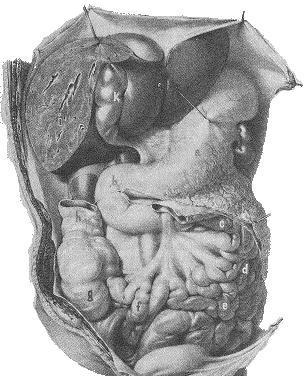
[Illustration: The organs of digestion: (a) stomach; (b) duodenum; (c,d,e,f) small intestine; (g) coecum; (h) large intestine; (I) liver; (k) gall bladder.]
To reproduce the worker enzymes requires three distinct raw materials - amino acids from protein digestion, a mineral component, and a vitamin component. Lacking any one of these, the enzyme cannot be reproduced. And there is no substitution allowed! Each of the hundreds of enzymes the body needs each requires certain of about twenty amino acids in the right combination, a specific mineral (like iron or zinc), and a specific vitamin (like vitamin B-1 or vitamin C). Of course, if there is a hereditary defect in the genes, resulting in a loss of the RNA template, we have another problem completely in which a certain enzyme never does get produced by the body, and of course that causes trouble throughout the lifetime of that individual.
The implication here then is very clear. The vitamins, minerals and amino acids must constantly be present in adequate supply to replace worn-out enzymes, to keep production up and flowing smoothly. And a corollary to this is the fact that while you may have a sufficient supply, for example, of amino acids and the specific vitamin present, they are of no help unless the specific mineral is also there. Lacking any one component - the enzyme cannot be remanufactured. This is why, if you plan to supplement your diet with added vitamins, you also need sufficient minerals with them. Both are of equal importance. Those persons who elect to use the biochemic cell salts in supplementation are providing their body with certain essential minerals in readily available amount for enzyme replacement; however, this does not preclude the need for sufficient vitamins as well. The so-called "trace minerals" - like selenium, chromium, copper and iodine - though not required in large quantity are still essential in replacing those enzymes that require this trace metal as their unique, specific metal component. And in soils that have been planted time and again over the years, the supply of these trace metals has been depleted. Thus, either the farmer must replace them in his soil, or you must supplement your diet with them. One of the reasons why alfalfa (in its various forms as in sprouts) is considered a particularly nutritious food is because its roots penetrate the soil much more deeply then other plants and thus tap into soil trace minerals that other plant roots are not able to reach.
Nature, in its infinite mystery, has designed plants with roots that absorb from the soil all that it contains in soluble form, whether the plant needs this material or not. What it does not need the plant discards as waste - mainly in its leaves. When the leaf drops off the plant, it eliminates this material. When you eat the leaf, you ingest all of the leaf's contents into your body, including its trace mineral content. As far as we know, plants don't have much use for he trace mineral cobalt - but cattle do, and they get their cobalt from the plants that absorb it. Lacking cobalt in their diet, the cattle get sickly and cannot be marketed profitably. This can work against health too, however. Certain plants, especially in the Great Plains have the habit of concentrating large amounts of selenium in their leaves. Selenium in large amounts is quite poisonous, and cattle and sheep that eat them can be poisoned and die. Some plants also produce in their leaves, as the result of their particular metabolism, substances (called alkaloids) which are toxic or poisonous to the animal body. This, of course, means that we as humans must be selective in the plants that we choose to ingest and NOW, THIS BRINGS US TO a very "neat" point in our discussion. For you see, all of our worker enzymes do not just wear out and "die of old age" - we (all of us) either intentionally or unintentionally poison them and kill some of them off in their prime! And much of this enzyme genocide is accomplished by three groups of substances - alcohol, alkaloids (like nicotine, THC, heroine, atropine, belladonna and many, many more), and certain so-called "heavy" metals (principally lead, mercury, cadmium, arsenic and nickel). There is also another "killer" - certain substances that the biochemist refers to as "free radicals," which are produced in many ways, not the least of which is the subjection of the cell to high doses of radiation.
When the source of such poisoning is removed, the body will recover if the poisoning is not too massive. There are certain steps that we can take, of course, to minimize (but not completely eliminate) these sources of poisoning. Many of them are obvious, like not using drugs or tobacco or alcohol. These days it's almost impossible to eliminate trace amounts of the heavy metals (gasoline contains lead, certain seafoods contain mercury, solid cooking fats sometimes contain nickel, cadmium is used as a coloring pigment [yellow], for example.) There are also certain nutritional steps that help. Adequate amounts of zinc in the diet help to flush the poisonous heavy metals from the system. Adequate amounts of the anti-oxidant vitamins and minerals - Vitamin C, Vitamin E and selenium - chase the free radicals. And, incidentally, these same substances also help to keep unsaturated fats "unsaturated" (fats have a tendency to oxidize [saturate] during the digestive process). But, there is still more help available.
The Guys on the Loading Dock
Before raw materials enter our bodily factory they have to pass the inspection of "the guys on the loading dock." And a vital function indeed do they perform. These "guys" are the cells of the liver.
The vast majority of the raw materials that enter our bodies from the process of digestion are first collected in tiny capillaries, which feed into the "hepatic portal vein," which in turn passes through the liver before entering the general blood circulation of the body. The liver is our watchman, our sentry, and a very vital part of the body's "security system." It performs literally hundreds of functions, and (after the heart) is probably the most vital organ of the body. It is vital that we keep the liver healthy if we are to keep the body healthy - which is why hepatitis and other liver diseases are so serious.
Through the process of evolution the liver has developed certain special enzymes which "detoxify" otherwise poisonous substances that could interfere with normal enzyme function. If these enzymes are not "overpowered" by too much of the poison at once, they convert the poison into a harmless substance through the kidneys. The liver doesn't have an "antidote" for all of these poisons, but it is well equipped (when healthy) to deal with many of the more "natural" ones that we simply cannot avoid in our diets. Let's take a couple of examples.
Benzoic acid is a poison found in many plants in trace quantity. Cranberries contain benzoic acid, for example. Do you know anyone who has been poisoned by eating cranberry sauce or juice - I don't. This is because the liver is equipped to convert this benzoic acid into hippuric acid and eliminate it through the kidneys.
Grain alcohol [ethanol] is the product of the natural fermentation of all plant substances, and it is impossible to completely prevent some fermentation of plant substances that we eat during digestion. But, the body is equipped to deal with ethanol (in small quantities). The liver has an enzyme called ethylase which quickly converts ethanol into a harmless substance, unless we overpower the liver by consuming more than about an ounce an hour of this substance - through drinking. Ethylase contains as its vitamin component Vitamin B-1 (Thiamine), which is why this vitamin is included in most hang-over remedies.
We don't naturally eat wood - nature leaves wood to the termites. And the body has no way at all of dealing with wood alcohol (methanol). This is why methanol is so deadly to the body, and why its ingestion causes blindness and death. The body just cannot deal with it. Likewise the poisons - nicotine, THC, "angel dust," LHD, etc. These latter substances are not a part of natural food intake and nutrition.
THERE ARE ALSO TIMES when certain enzyme systems in the body get out of control, for a variety of reasons, e.g. bacterial and viral infections can cause this. Modern medical practice in the U.S. has for a number of years followed the theory that by purposely inactivating (poisoning) certain enzyme systems through the use of specific drugs (alkaloids and derivatives thereof) in controlled amount so as to not destroy the enzyme system completely, the symptoms of this disease can be controlled. An example of this would be the use of atropine and certain antihistamines in relieving cold symptoms. Or the use of certain chemotherapeutic agents to treat cancerous cells, where the cell management system has broken down to produce "killer cells." Or the use of certain poisonous heavy metals to treat such diseases as syphilis. We can credit this mixed blessing to Paracelsus, who first fathered this idea. For several centuries now medicine has accepted the idea that bacteria and viruses cause disease. It would seem almost "heresy" to challenge this belief. Yet, it is being challenged today. The alternative theory is that bacteria and viruses can only live and multiply in cell tissue that is deficient in adequate nutrition. In other words, bacteria and viruses are the result - not the cause. The cause is inadequate nutrition! And inadequate nutrition lowers the body's defensive and security system - thus giving entree to the invading organism. A really "neat" idea to ponder - no?
But let's give credit to where credit is really due. To those enzyme guys on the "loading dock" - the liver - those guys who quickly identify the threat and the danger of foreign substances and do their best to protect the millions of cells that comprise the rest of the body. They certainly deserve our cheers and support.
And, how best can we support them? By ensuring that they get the very best in raw materials - vitamins and minerals (from whatever source) to produce all of the enzymes that they need to do their job adequately. Treat your liver well. It's better insurance, and the best guarantee, of a long and healthy life. Don't overload your liver with fat. Make sure that it gets adequate amounts of the B-complex, Vitamin A and Vitamin D. Ensure that it is supplied with adequate amounts of iron, magnesium, zinc and the trace elements. Don't overload it with sugar. Don't force the liver to its breaking point - with such substances as alcohol, THC, LHD, caffeine, excessive drug use, and organic substances (like carbon tetrachloride, organic solvents, and heavy metals). Protect your liver - and it will protect you.
Getting Rid of the Junk
Despite our best efforts, a certain amount of "junk" does manage to accumulate in our lives. We become the slave of certain habit patterns. Cells do die, and the residue must be eliminated from the body lest it contaminate the healthy cells. The role of the large intestine, its flora and fauna and the chemical reactions that occur there, are only now just beginning to be appreciated. For example, it was long thought that, in the process of evolution, the human body had sacrificed its ability to produce Vitamin C naturally, as other animals less evolved are more capable of doing than humans. Now, we are not so sure! A healthy flora and fauna in our own large intestine does manage to supply the body with controlled amounts of Vitamin C - naturally. But, the environment of the large intestine is largely influenced by proper diet. Antibiotics do influence this environment - and, in some cases, quite negatively. On the other hand, such a bacterium as acidophilus is now thought to exercise a very positive effect. Too much protein causes a negative effect; alkaline substances, like fruits, are thought to exercise a positive, neutralizing on excessive acid-forming product (protein).
WHAT ABOUT FASTING? Its advocates are as numerous these days as its opponents. Fasting is a hot nutritional issue! In deciding for yourself whether to include fasting in your own nutritional program, there are several issues to be considered.
First, it is to be clearly understood that it takes a certain portion of the body's energy supply just to digest food, and protein requires the most energy. It takes about a day-and-a-half for protein to completely traverse the digestive tract. If you feel that you want to give your digestive tract a rest periodically, fasting will provide this rest.
However, contrary to common belief, fasting of itself will not cleanse the system of toxins. What toxic material exists in the large intestine is likely to remain there during this "shutdown period" unless an enema or some other device is used to help eliminate it.
Prolonged periods of fasting, of course, deprive the body of essential raw materials, in much the manner as does starvation wherein the body begins to tear itself down to get the needed raw material. Water is essential during fasting for many reasons, not the least of which is that cells continue to die and protein continues to be digested, and the end product must continue to be eliminated principally as urea through the kidneys in liquid solution.
MEDICAL SCIENCE is just now beginning to really investigate and appreciate the chemistry of the environment within the large intestine - especially within its first two-thirds. Some doctors now feel that an unhealthy environment here may in large measure either cause or contribute significantly to disease conditions all over the body. As a nation we Americans tend to have a high protein diet, and when the end products of protein digestion are allowed to linger too long within the convoluted folds of the large bowel, putrefaction with toxin formation results. These toxins are subsequently absorbed by the body through the intestinal walls, and get distributed about the body. While still in the large intestine these toxins also poison a number of friendly bacterial systems there that help to maintain proper health through the production of such substances as Vitamin C and prevent putrefaction (one major symptom of which is flatulence).
As regards the amount of protein we eat there is also another factor often overlooked in many "popularized" articles on nutrition. The pancreas produces a digestive enzyme called pancreatin which it releases into the upper small intestine in the pancreatic juice. One of the functions of this enzyme is to complete the final digestive steps in protein digestion. Normally, what pancreatin is left over is reabsorbed by the body in the large intestine and carried by the blood to all parts of the body. Pancreatin acts as a "scavenger" to rid the body of dead (protein) cell material. However, if this pancreatin gets all used up in the process of protein digestion in the intestines, there is none left to be reabsorbed resulting in the collection of toxic material in the body itself due to the lack of this scavenger. Thus, it is evident that too much protein in the diet blocks this vital process. For most individuals, four ounces of protein maximum will insure adequate surplus pancreatin to do its internal job too. If you must eat larger portions than this, then you ought to seriously consider supplementing your diet (as pointed out previously) with added pancreatin.
HIGH COLONIC ENEMAS. This is another controversial issue among medical scientists. A high colonic enema has the effect of removing collected toxins and putrefied protein from the upper portion of the large intestine, something that a simple enema just cannot accomplish because it does not penetrate beyond the lower quarter of the large intestine. For a person in good health, when the high colonic is administered by a trained medical practitioner (not by yourself), this probably can be beneficial. However, it does remove friendly bacteria as well. And it takes a few days to reestablish the healthy ecology of the large intestine. Unpasteurized yogurt, or acidophilus milk can be a great aid in doing so. A properly balanced diet, however, especially one in which excessive protein intake is eliminated seems a sensible middle-of-the-road course to follow in order to prevent the need for periodic high colonics. Prevention is still a wiser course than curing nutritional sins after they occur.
The Body Under Siege
When a country, or a city, is held under a constant state of siege for a prolonged period of time, its defenders grow weary. They cannot remain on "red alert" forever. So too with the body's defensive and security system. Or, if the defense is inadequate to resist the onslaught of the attackers. In the world in which we live today the body has many enemies, and the defenders grow weary in their defense when they are not constantly resupplied and encouraged in their task.
The body's security and defense system does a yeomanlike job, given a good hereditary start, but it still needs conscious support. Constant stress is its greatest enemy; rest and good nutrition plus some form of daily exercise is its greatest ally. With our present state of knowledge, a program of inoculation against certain forms of bacterial and viral attack still seems to be a rather wise course to follow in a good health program, especially when it comes to childhood diseases. A properly maintained schedule of inoculation against the diseases polio, measles, tetanus, and mumps seems advisable. We will undoubtedly see the development of newer vaccines during the 1980's - perhaps even against various forms of cancer - and these should be evaluated based upon the best evidence that is available. Influenza vaccination remains a ??? at this time.
There are many books written today on various methods of reducing stress upon the body. The complete reduction of stress seems either impossible or inadvisable, because we still need a reason for being, and that invariably produces certain stresses. The solution here seems either impossible or inadvisable, because we still need a reason for being, and that invariably produces certain stresses. The solution here seems to be the management and control of stress to within manageable limits. There are far too many examples in each of our lives of persons who, upon retirement, die "prematurely" when this stress component in our life is changed radically. Stress is an inescapable component of living; its management seems a vital part of the longevity process.
Some Summary Remarks
I have tried to cover here some rather general observations in the management of our nutrition. The analogy of the body to a nation of manufacturing units, each dependent upon the other yet independent as well, may seem like an oversimplified analogy. Yet, this analogy does hold up remarkably well as an educational tool in greater self-understanding of our physical body. In this age of enlightenment it is remarkable how much we do not understand about the function of our own bodies, despite our general desire to function well and live to a ripe and productive old age.
The 1980's will, undoubtedly, change to some measure the rules to be followed to ensure a healthy and vigorous physical body. However, I suspect that few of the general principles discussed here will change radically. They seem founded upon rather rigorously investigated experimentation.
Some of the changes that I do expect to see will probably include:
These changes will not come easy. There will be a lot of opposition to changing the medical status quo; however, this change seems inevitable.
I also believe that, in this inevitable process of change, the role of astrology will at last be recognized to the extent that the natal horoscope points up the specific needs of each individual for special amounts of certain nutrients in the diet - from whatever source the individual chooses to derive them - through the diet or through supplementation of it by added amounts of certain nutrients.
As a professional astrologer, I fervently hope that astrology's proper role in evaluating specialized nutritional requirements will gain proper recognition; however, I am not nearly so optimistic here, as I am about the other expectations as stated above, that this last "hope" will gain recognition. Astrology continues, through the 1980's, to struggle for the just recognition that I truly feel it rightfully deserves.
Robert Carl Jansky is a recognized authority in the field of medical astrology. From 1955 to 1961 he was engaged in biochemical and bacteriological research at the National Institutes of Health, the National Institute for Arthritis and Metabolic Diseases, and at the National Naval Medical Center. During this period he authored ten medical papers on the physiology of sex hormones and the treatment of blood poisoning resulting from burns. He was a member of the Mercury and Apollo space programs, assisting in the design of control rockets, and he has participated in research for polymer plastics that can be safely implanted in the body. The author of several textbooks on medical and nutritional astrology, Mr. Jansky is now employed as a senior marketing specialist with Xerox Corporation. Mr. Jansky is available for lecturing and can be contacted at ____.
[Illustration: "Death and the Maiden" woodcut by Hans Beham]
Deathstyles
by Joseph Jacobs
THE THOUGHT FARTHEST from all our minds is death. We are intent on living, achieving our goals, solving problems, concerned with pleasures, pains and all the rest. A thousand casualties may happen on the highways each day but somehow there is a block in our thinking and feeling which prevents realization that something could happen to us. Something will happen to each of us - sooner or later. We will all die though our time and "style" will be different. How will we react when death's time comes to each of us? How will you react? Will you surrender to the inevitable and perhaps attain the great calm and peace seen in many persons? Perhaps you may grasp and cling to the life that is quickly leaving you.
We may be able to learn something valuable about life and what even can be "achieved" at death by investigating how great personalities in the past have died. When a man accepts his imminent death he seems to concurrently gain a great deal of wisdom and perspective on what his individual life and life in general are all about. He becomes detached from all this earthly turmoil and confusion and seems to be able to see things as they actually are. He no longer has anything to gain or lose in life and can come to some truly objective insights into life's values, purpose and meaning. The "dust" of involvement has been taken from his mirror. A great man's extraordinary inner strength and deep personal philosophy are often shown at the time of death.
Alexander the Great died at the age of only thirty-two in as warrior-like a style as he lived. After creating his empire he decided to establish his capital in Babylon since it was nearly in the middle of his vast territory. He began immediately in the project of draining the disease-causing swamps that surround the city. Many bad omens began to appear in Alexander's life and these omens were taken seriously by those around him. First, his closest friend died and then, while away for a short time, a demented man somehow caused an uprising and seized his throne in Babylon. He then lost his golden crown while sailing at sea. Shortly after these events he developed a mild fever but refused to alter his active life. Within a number of days his fever turned for the worse and he had to be carried on a litter. Alexander then suffered a stroke and was unable to talk except in a whisper. It was generally known that he was dying and his men raised a great ruckus and demanded to see their commander. He agreed to see them and somehow raised himself up in bed and greeted each man as he came into his chamber. Death was imminent and his generals asked him who was to be the next commander. To this he replied "Hoti to kratisto." - "To the strongest and best."
THE GREAT PSYCHIATRIST, Sigmund Freud, developed an obsession with death. He became convinced that he was to die at certain ages even though each of these years came and went without his death. Freud lived to be eighty-three but his last years were spent in a great deal of physical pain and psychological misery. His home in Germany was raided by the Nazis and all his savings were taken. He was able to escape Germany in time to save his life but his four elderly sisters were all imprisoned and killed. He had also developed cancer of the jaw and was in continual pain despite two operations. He refused to take pain-killers because they dulled his mind. He did take radium treatments and wrote to a friend that, "The radium has once more begun to eat in, with pain and toxic effects and my world is again what it was before - a little island of pain floating in a sea of indifference." On his eightieth birthday Freud remarked to a friend that, "There is an old saying that there is no virtue in youth. But it is just the opposite which is true. Young people are the only ones with virtue. The older you get, the worse you become. Women are especially awful in old age, but men are not much better!" No after-life was believed in by Freud. Shortly before his death from old-age and cancer he wrote to his close friend Marie Bonaparte: "I hope you will soon console yourself over my death and let me go on living in your friendly recollections - the only type of limited immortality I recognize!"
IN INDIA IN THE SEVENTEENTH century the last of the great Moghul warrior-kings, Aurangzeb, continued raging wars far and wide even in to his eighty-seventh year. His nation was sick of war and he was driving it to bankruptcy. He was aware of his people's unrest but replied to them that, "So long as a single breath remains in this mortal life there is no release from labor." He was obviously made of very strong "stuff" and had caused untold thousands to be killed in wars. He himself had attained power by imprisoning his father and killing his two brothers. In his final and eighty-eighth year he became entirely contemplative and came to greatly regret the life he had lived. He wrote to his son:
"I came alone and I go as a stranger. I do not know who I am, nor what I have been doing. The instant which has passed in power has left only sorrow behind it. I have not been the guardian and protector of the empire. Life, so valuable, has been squandered in vain. God was in my heart, but I could not see Him. Life is transient, the past is gone and there is no hope for the future."
Aurangzeb fell into a trance state one morning and seemed to be compulsively praying on his Moslem rosary. He died while in this state of intense prayer.
SIR THOMAS MORE EXHIBITED great strength when facing his death. He was charged with treason (punishable by death) and was brought before the sixteenth century English Court. In his defense he said that:
"You must understand, sir, that in things touching conscience, every true and good subject is more bound to have respect for his conscience and to his soul than to any other thing in all the world besides. I do nobody any harm. I say no harm. I think no harm, but wish everyone well. And if this be not enough to keep a man alive in good faith, then I long not to live!"
It was not enough and Sir Thomas was sentenced to be beheaded. When mounting the scaffold he joked and asked the guard to "see me safely up. As for my coming, down, let me shift for myself." When his head was placed on the block he asked the executioner to put his long beard outside the blade - saying that his beard had certainly committed no treason so as to be unceremoniously cut off!
WHEN NEARING DEATH many become very detached and even enter a humorous mood. It seems as if they gain a different perspective of life and see a certain comedy in the toil and seriousness they are leaving behind. It is also possible that they have an intuition of a much greater life they are about to begin which dwarfs worldly concerns to insignificance. When Socrates was sentenced to death in 399 B.C. for "impiety and corrupting the young" he joked that he should actually be given free room and board in the town hall instead for making so many people happy! He also remarked, "Now it is time to go, I to die and you to live; but who of us goes to a better thing is unknown to all but God." When the hemlock poison was given to him he quipped: "Can I share a bit of it with the gods?" and also said that "poison has no power to kill a sage, for a sage lives in reality, and reality is eternal."
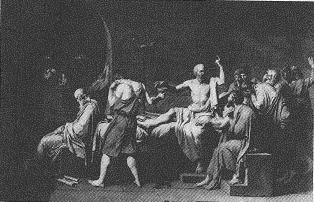
[Illustration: "The Death of Socrates" by Jacques Louis David.]
A GOOD DEAL OF HUMOR and courage was also shown by Voltaire on his deathbed. A well-meaning Catholic priest attempted to convert him in his last days since he had been well known as a life-long detester of the Church. After the man had unsuccessfully gone away Voltaire referred to him as a "good fool." Another clergyman tried the same thing a few days later. Voltaire asked him:
"From who do you come M. l'Abbe?"
"From God himself," answered the priest.
Voltaire replied, "Well, well, sir, and your credentials?"
ALBERT EINSTEIN WAS TOLD by his doctors when he was seventy that he must stop working so hard because he had an aneurism in an artery and it could burst at any time. He loudly retorted to them "Let it burst!" and kept up his normal pace. Later when he was told that he must have an operation to save his life he refused and remarked that "The end comes some time; does it matter when?" Even when he was in the hospital and knew his death was at hand he kept joking with the nurses and ignoring the physical pain he was experiencing. He said that all the doctors were waiting for his death like it was some sort of special "natural phenomenon." Einstein seemingly transcended the fear of death as he had transcended all science before his time.
BEETHOVEN, WHOM SOME think composed his greatest music after he was deaf, also had a transcendent view of the world. He seemed to regard it as a tremendous play or drama. In his last will and testament he signed: "Applaud, my friends, the comedy is finished!" While unconscious on his deathbed there began a crashing thunderstorm. At a flash of lightening and resounding boom, Beethoven sat up in his bed and raised his hand to the heavens - a friend described it as a "general giving orders to an army!" Beethoven's arm lowered and he fell back dead into his bed.
IN THE EAST AMONG SAGES and holy men there is supposedly an ability that can be developed in which a man can die at any time he wishes by simply "leaving his body." In 1902 the Indian sage Vivekananda apparently did just this. For several months he informed his followers that he was likely to die shortly. One evening his followers assembled, he had words with each of them, then he went into his quarters, laid down and died within an hour. A slight trickle of blood came from his nose and mouth and his eyes were found focused between the eyebrows - all symptoms said to occur with this intentional form of death. Among the Hindus this is not seen as suicide but the act of a superior man choosing his proper time of death rather than leaving it to the whim of Nature.
Vivekananda seemingly chose to leave this life; while many others did not purposely choose to leave the world, when their time came they were manifestly elated to do so. Saint Francis of Assisi was blind and suffering from dropsy and bleeding stigmata when he was told he only had a month to live. He became overjoyed, raised his hands to heaven and cried: "Welcome, Sister Death!" He said of "Sister Death" that "She will open for me the door of life."
SOME OF OUR GREAT POETS were glad to be dying and leaving the earth. Their sensitive natures seemed to be entirely dismayed and revolted by the world's sordidness. John Keats died when he was only twenty-six and wrote in a letter to Robert Browning: "...is there another life? Shall I awake and find this all a dream? There must be. We cannot be created for this suffering." Hemorrhaging interiorly and coughing blood he lost interest in life and even left unopened letters from his fiancé and family. He died upon calling to a friend: "Lift me up for I am dying. Thank God it has come!"
In his youth, poet George Gordon, Lord Byron was told by a soothsayer that he should beware of his thirty-seventh year. It so happened that this was prophetic and he did die at the age of only thirty-seven. When told by doctors that he must live a quiet life to save his health and life he replied: "Do you suppose that I wish for life? I have grown heartily sick of it and shall welcome the hour to depart...", and also: "There are things which make the world dear to me. For the rest, I am content to die!" He spent his last year in Greece and on his death there was raised a tremendous thunderstorm, the fiercest that had been known in the area. Natives claimed it was sign that a superior man had died.
The poet Shelley at age twenty-nine seemingly committed suicide. He was in a terrifying storm at sea in a small boat and had no hope of surviving the gale without sinking. A large ship spotted him and his crew and tried to take them aboard. Shelley refused to abandon his ship and would not even take down his sails which insured he would be upturned by the high winds. The boat sank and Shelley's decomposed body was found washed upon a beach. His only identification was that he had a copy of Keats' poetry in his breast pocket.
SYMBOLIC NATURAL phenomena, strange coincidences and psychic manifestations have accompanied the deaths of many of our great. President Abraham Lincoln had a prophetic dream of his assassination only days before it actually occurred. In the dream he was wandering from room to room in the White House and in each room he found people weeping and mourning. In the final room he found people surrounding a corpse wrapped in cloth. When he asked what the commotion was about he was told that the president had been assassinated! Both president John Adams and Thomas Jefferson symbolically died on July 4th, 1826 - the fiftieth anniversary of the nation they helped found. Adams' last words were: "Thomas Jefferson still survives!" but unknown to him Jefferson had died earlier the same day.
Each of us will go through a gate at the end of life that may lead to anywhere from nothingness to an empyreal heaven or possibly even to a vision or union with God. In the extensive studies of clinical death experiences (most notably Elisabeth Kubler-Ross and Raymond Moody) over ninety-nine per cent of the persons undergoing the "after-death" experiences report a positive or rewarding adventure. If these reports are actually valid accounts of where we may go when we die, then, as poets claim, this life may certainly be called a "vale of tears" in comparison. None of us will know until his time comes.
The historical anecdotes in this article, along with many more, can be found in Philosophy of Death and Dying by M.V. Kamath (Himalayan International Institute, 1978).
Thinking Astrology—What It Is: The Birth Chart or Horoscope
by Michael Whitely
THE ASTROLOGICAL BIRTH Chart is your basic ticket and roadmap. With it you can enter into a fascinating study of mind (yours and other's), Man (in our collective life), and Universe (as our collective environment). It doesn't matter if you are a skeptic, a "true believer," or a curious reader, because this is an attempt to broaden your mental perspective and enhance your self-knowledge. The very act of study and investigation brings its own benefits. You are what you do, and if you find a pearl in the process, good. If not, then at least you have sharpened your mental and intuitive tools for the next challenge ahead.
When your astrological goal is wealth, guidance, or inner development, it all begins with an accurate chart of the positions of the planets at birth.
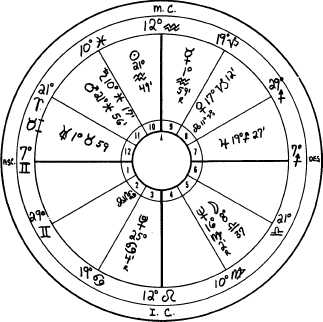
[Illustration: Figure 1 - Burt Reynolds' birth chart; February 11, 1936; 12:10 p.m., EST; Lansing, MI.]
The chart has four basic parts:
THE EARTH: Place of birth and focus of the chart at the center.
THE PLANETS: Each has an astrological meaning modified by their central angles to the Earth and to each other at birth.
THE ZODIAC SIGNS: A 12-part cycle of characteristics; each sign covers 30°; they encircle the Earth and give expression to the Planets.
THE ASTROLOGICAL HOUSES: A 12-part cycle of the affairs and activities of life. The Zodiac overlaps the Houses and Sign on each House cusp (line beginning each pie shaped wedge) affects the affairs of that house. (See figure 1.)
What You Need to Erect Your Chart
ACCURATE BIRTH DATA - You must have the accurate time and city of birth. Do not guess. Do not rely on your mother's memory. Use the certificate of birth, call the Bureau of Records, call the hospital.
EPHEMERIS FOR YEAR OF BIRTH - This reference book lists the positions of the planets for each day. Some list the positions for 12 noon and others list them for midnight. We will use a noon edition. They are available in one-year units for about $2.00, ten-year units for about $6.00, and other sizes and types. Examples here are from the Simplified Scientific Ephemeris, 1950-1959, a noon edition published by the Rosicrucian Fellowship.
TABLE OF HOUSES - This book gives you the positions of the Signs on the House cusps at varying latitudes (north/south measurement). Many good ones are available and, unlike the Ephemeris, one table will last a lifetime. If you don't care to get an atlas to find the location of the birth city, you can get a Table of Houses with a gazetteer included. This is a list of cities with the location in longitude and latitude. We must have this location to find the correct planetary positions.
BOOK OF TIME CHANGES - Because of the irregular use of artificial time systems such as Daylight Savings Time and War Time, it is important to know what kind of time was in use during the birth. Doanes' Time Changes in the U.S. is the standard and lists where and when Standard Time has been altered. About $10.00 and worth it if you plan to do many charts. If not, you might consider visiting your local astrology bookstore and ask them to check. You must be sure.
HOROSCOPE BLANKS - You can make your own or buy pads or printed forms. I recommend getting the forms with a large wheel and a calculation sheet which has an organized outline to record your information.
PENCILS, PENS - and plenty of scratch paper.
FREE, UNDISTRACTED TIME and a quiet place.
IN CHARTING THE HOROSCOPE you are making a diagram of the solar system as if seen at the time of and from the place of birth. To make it accurate and exact involves measurements of time in hours and minutes, as well as circular measurements of the Earth's surface in degrees (360 to the circle), minutes (60 to the degree), and seconds of arc (60 seconds to the minute). Before we begin, I would like to review the measurement of time and distance to make its use clear.
Notes on Measurements
During 1884 at the Greenwich Observatory in England, an international council established the Standard Time Zone system of global time. We are all familiar with the United States Standard Time Zones; Eastern, Central, Mountain, and Pacific standard time; now we can examine how they work.
The circular measurement of the Earth includes 360 degrees. When we divide that by the 24 hours of clock time we get 15 degrees of distance for each hour. As a marker, Greenwich, England was assigned 0 degrees on the map and each 15 degrees east or west marked a new Standard Time Zone. The east/west measurement is called longitude and goes from 0 degrees to 180 degrees east and to 180 degrees west. The north/south Earth measurement is called latitude and starts on the equator at 0 degrees and measures 90 degrees north to the pole and 90 degrees south to the pole. We use this system to pinpoint the city of birth from a good map, an atlas, or a gazetteer listing. Example: Washington, D.C. is at 39° north lat. by 77° west long.
| Time Zone | Longitude | Hrs. Behind Greenwich |
|---|---|---|
| Eastern | 75° west of Greenwich | 5 hours behind (New York) |
| Central | 90° west of Greenwich | 6 hours behind (Chicago) |
| Mountain | 105° west of Greenwich | 7 hours behind (Denver) |
| Pacific | 120° west of Greenwich | 8 hours behind (Los Angeles) |
We now have several ways to make time seem more complex and our initial work in setting up the chart will consist of converting and correcting these different ways of saying the same thing.
We will encounter these terms:
The ephemeris has the places of the planets for each day recorded for 12:00 noon. If it so happens that you were born at 12:00 noon at Greenwich, England, just open the book to the correct day and you've got it made. If not, follow me ....
Setting Up the Birth Chart
(NOTE: Do the calculations on one sheet of paper and record the results on a pre-printed worksheet or a separate sheet of paper.)
STEP 1: CONVERT GIVEN TIME OF BIRTH INTO LOCAL MEAN TIME
Start by writing the given time of birth on your worksheet. Next determine if Daylight Saving Time (DST) was in effect. If it was, subtract one hour from the given time of birth.
Because of the Standard Time Centers or Zones, where you were born affects when you were born. So we make a correction for the distance the birth occurred from the nearest Time Zone Center (75°, 90°, 105°, 120° west). Write the longitude for the city of birth on your worksheet. Calculate the difference from the number of degrees for the nearest Time Zone Center. Multiply this difference by 4 minutes (remember, one hour of clock = 15° of distance so 4 minutes = 1°). If birth occurred west of the TZC add this amount of minutes to the given birth time. If the birth occurred to the east, subtract. The result is Local Mean Time.
Example: To Find Local Mean Time.
Burt Reynolds, actor
February 11, 1936; 12:10 p.m. EST
Lansing, Michigan; 42° N. lat., 84° W. long.
STEP 2: FIND SIGN ON THE ASCENDANT AND THE HOUSE CUSPS.
To locate the degree of the ascendant or 1st house cusp and the signs on the other house cusps we will use Sidereal Time, latitude of birth and the Table of Houses.
In your ephemeris locate the proper page for the month of birth. Under the column marked S.T. (Sidereal Time), move down the left of the page to the day of birth. Record the Sidereal Time found there in hours, minutes and seconds on both your calculations sheet and your results sheets. Be sure to label them, i.e. Sidereal Time 21:21:31, or ST for short.
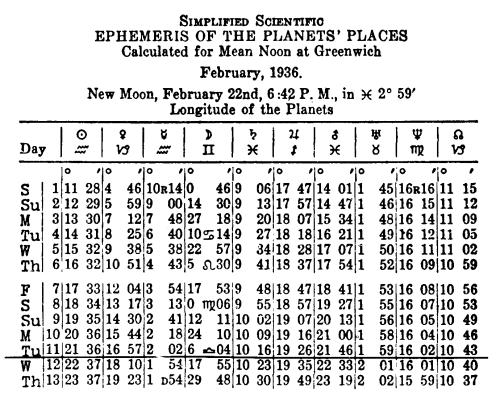
[Chart: Simplified Scientific EPHEMERIS OF THE PLANETS' PLACES]
Sidereal Time in the ephemeris is listed for each day at noon, so before we can find the house cusps we must adjust it until we have the actual Sidereal Time at birth, or the Local Sidereal Time.
Example: To Calculate Local Sidereal Time.
FINDING AND PLACING THE HOUSE CUSPS. In your Table of Houses turn to the page with the latitude of birth at the top. Below is a copy of the page for Burt Reynolds, our sample chart at 42° N. lat. Examine the left edge of the page under the column marked Sidereal Time and find the time there closest to your calculated sidereal time. Looking to the right, record the number of degrees in the first column under 42° lat., then move straight up and add the sign you meet first. The house cusp number where this sign and degree belong is found at the very top of each column. As you move along that same line to the next column to the right, be careful when adding the sign to only use the first sign directly above the degree number, because over time the Signs will change and will be different from the sign at the top.
[Chart: Simplified Scientific TABLES OF HOUSES]
To add the signs to the wheel you simply write the number of degrees and the sign's symbol just outside of the large circle at the cusp or spoke of the wheel as numbered. Starting with the 10th house you add the signs counterclockwise in sequence, i.e. 10th, 11th, 12th, 1st or Ascendant, 2nd, 3rd, etc. The table lists the signs for 6 of the 12 house cusps. To fill in the others you place the opposite sign (giving it the same degree), on the opposite house cusp. For opposite signs see the chart. Also see figure 1 of the completed chart for sign placement on the wheel.
You may find, when you finish placing the signs around the wheel, that two or more are repeated on two house cusps. This can happen at some latitudes. If this happens, write in the missing signs around the wheel between the signs where they fall. These are called intercepted signs (note Taurus in Fig. 1).
STEP 3: FIND PLACES OF PLANETS AND ADD TO THE CHART.
Now we can prepare to add the planets to the chart. The degree and sign positions of each of the planets is listed in your Ephemeris for 12:00 noon Greenwich Mean Time. The birthtime we have been using so far has been Local Mean Time so we must convert LMT into its equivalent GMT of birth.
Example: To Convert Local Mean Time Into Greenwich Mean Time.
Local clocktime in the U.S.A. is behind Greenwich clocktime one hour for each time zone (15°) west of Greenwich or 4 minutes behind each degree, so...
Using this local GMT of birth you can correct the planets' positions as listed in the noon Ephemeris. Although the noon positions are given, the planets are always in motion. Our task now is to find out how much they have moved in the period between noon GMT and birth GMT. We will then add or subtract that degree of motion from the noon positions to arrive at the accurate positions at birth.
CORRECTING THE PLANETS POSITIONS. Instead of multiplying fractions to find each planet's movement we will use the Table of Proportional Logarithms found in the front or back of your ephemeris. The Rosicrucian edition has a table at the end of each yearly section. Although at first glance this table looks rather imposing, with its columns of numbers, you will find it quite easy to use and a big help. This section from the Table of Logarithms is used in our sample chart for Burt Reynolds.
At the top of the table are numerals 0 through 23, one at the head of a column. These can be hours of time or degrees of arc, depending on our use. Along the left edge, minutes are numbered. The minutes can be for time or minutes of arc used with the degrees. Our first use of the table will be to find the logarithm (or log for short) of the interval between noon GMT and birth GMT.
FINDING THE LOG OF THE INTERVAL OR THE CONSTANT LOG.
[Chart: TABLE OF PROPORTIONAL LOGARITHMS]
Each planet (including the Sun and the Moon) moves at a different rate of speed. The Sun stays in the same sign approximately 30 days. The Moon changes signs every two or three days. Each planet is different. The Ephemeris freezes this furious motion and displays each planet's position for 12:00 noon GMT.
CALCULATING THE PLANETS' POSITIONS. In your Ephemeris, on the page for the month and year of birth, locate the Day column and move down until you reach the date of birth. This partial Ephemeris shown is for our sample case.
[Chart: SIMPLIFIED SCIENTIFIC EPHEMERIS OF THE PLANETS' PLACES]
Using a straight edge to mark the day of birth, look to the top of the first column, the Sun's column. On your work sheet, put the symbol for the Sun. You will note a zodiac sign directly beneath it. This may be the correct sign on the birth day or the sign may change before the birthday, so follow the column down to the birth day, keeping an eye out for a change of sign. If you encounter a sign on the way down, the closest sign before the birthday is the one to use. Record each planet in this manner. The position for Pluto is found at the bottom of the page. At the far right, in the last column, you will see an upside-down horseshoe, called a dragon's head or the Moon's north node. Record it too.
To correct the positions of the faster moving planets, starting with the Sun, we must find the amount of motion they made in the 24 hours previous to noon GMT of birth and then add or subtract the amount of motion during the interval from noon to birth. So...
Write from your Ephemeris the Sun's position on the day of birth. Subtract the Sun's position for the previous day. In order to subtract we may need to shift a minute, (sixty secs.), to the seconds column and one degree (sixty minutes), to the minutes column.
(birth day) 2l° 36' minus (previous day) 20° 36' = 1°
The result is the daily motion of the sun. In our case here, it is 1 degree, 00 minutes and 00 seconds of motion. Turning to the table of logs we find the log for 1 degree and 0 minutes by locating the 1 degree at the top of the table and moving down to the 0 minute line. The number at the intersection is the log for the daily motion of the Sun, in our example: 1.3802. After finding the log for the Sun's motion in your case, add the log of the Sun's motion with the constant log from your record sheet.
In our sample:
(Constant log) 6670 plus (Log of Sun's 24 hr. motion) 1.3802
= (Combined log) 2.0472
Locate this combined log on the table, or the closest number to it. You then find the equivalent degrees, at the top, and the minutes at the left. I found 0 degrees, 13 minutes. For a PM GMT birth, add this amount to the original Sun position on the day of birth:
(Sun in Aquarius) 21° 36' plus (minutes of motion interval) 13'
= (Sun's position at birth) 21° 49' Aquarius.
Our GMT is PM here. For an AM birth, subtract degrees of motion/interval from the original noon position.
Next the Moon:
(birth day at noon) 6° 4' Libra plus (previous day noon) 24° 10' Virgo
Notice that the Moon has changed signs over night from the previous day. In this case, since each sign lasts 30 degrees, we will subtract the previous day's position from 30 degrees and add this to the Moon position for the birth noon. So...
(birth day at noon) 6° 4' Libra 30° or 29° 60' minus (previous day) 24° 10' Virgo =5° 50' 6° 4' Libra plus 5° 50' = (motion in 24 hours) 11° 54'
Finding the log for 11° 54' to be 3047, we add the constant log: 6670 to get the combined log: 9717. Converting this log back into degrees, we get 2 degrees, 34 minutes. Since this example is a PM chart, we add this amount of degrees to the birth position for the Moon at noon GMT:
6° 4' Libra plus 2° 34' motion = 8° 38' Libra (Moon's corrected position for birth.)
This process of correction is only necessary with the faster moving planets: the Sun, Moon, Mercury, Mars, and Venus. The other five slower moving planets - Saturn, Jupiter, Uranus, Neptune, and Pluto - can be taken as they are in the Ephemeris. No correction needed. So repeat the correction procedure for the other faster moving planets and then list all final planet positions on your result sheet. Here is a summary of the correction procedure:
CORRECTING THE PLANETS' POSITIONS
Place the planets on the chart by matching the sign and degree of the planet with the sign and degree of the house cusps. The houses are numbered, with one at the far left at the 9 o'clock position. The house starts with the degree of the sign on its cusp and this determines which house a planet belongs in. The corrected Sun position in the example was 21° 49' Aquarius. Aquarius is on the tenth house cusp, starting at 12°, so the Sun would be placed in the tenth house, not near the house cusp, because it falls at 21°. If the Sun were at 15° Aquarius, it would fall near the cusp of the house. Examine Figure 1 to see how the planets should be written in the chart.
The Moon in the sample chart falls at 8° 38' Libra. Libra is at the 6th house cusp at 21°, so we write the Moon in behind the cusp. It is in the 5th house however. The Moon's North Node is added just like a planet and written a little closer to the center of the chart. The Moon's South Node is then added in the opposite house and sign, but using the same degree.
Well, the hard part is over and now you can begin to get the rewards for your effort. This basic astrological chart is lacking only the planetary aspects to make it complete and we will work with those later. As it is, this chart is worthy of your further study. You can begin to get an idea of just what you have by working with the keywords for the planet / sign / house combinations. We will continue with the aspects and interpretation of the chart in future sections or there are many fine books available to help you on your way. A short list is included.
Bibliography
Oken; Alan, As Above, So Below, Bantam Books, NY, NY. 1973.
Oken Alan, The Horoscope, The Road, and Its Travelers, Bantam, NY, NY, 1974.
Davison, Ronald C., Astrology. Bell Publishing Co., NY, NY, 1963.
Carter, C.E.O., The Principles of Astrology, The Theosophical Pub., Wheaton, IL, 1962 Sehested, Ove H., The Basics of Astrology, Vols. 1 & 2, Uranus Pub. Co., Woodland Hills, CA 1973.
Cosmic Consciousness
by Richard M. Bucke
Richard M. Bucke, a Canadian psychiatrist, coined the term cosmic consciousness with the publication of his book of the same name in 1901. Bucke was a pioneer in his efforts to explain the transcendent experiences described by poets and religious figures in a scientific manner, pointing out the common features and eliminating a reliance on dogma. The following selections set forth Bucke's essential theory. Cosmic Consciousness, available through the TAT Book Service, also includes numerous case studies of historical figures whom Bucke believed to be possessed of the super faculty.
WHAT IS COSMIC CONSCIOUSNESS? The present volume is an attempt to answer this question; but notwithstanding it seems well to make a short prefatory statement in as plain language as possible so as to open the door, as it were, for the more elaborate exposition to be attempted in the body of the work. Cosmic Consciousness, then, is a higher form of consciousness than that possessed by the ordinary man. This last is called Self Consciousness and is that faculty upon which rests all of our life (both subjective and objective) which is not common to us and the higher animals, except that small part of it which is derived from the few individuals who have had the higher consciousness above named. To make the matter clear it must be understood that there are three forms or grades of consciousness. (1) Simple Consciousness, which is possessed by say the upper half of the animal kingdom. By means of this faculty a dog or a horse is just as conscious of the things about him as a man is; he is also conscious of his own limbs and body and he knows that these are a part of himself. (2) Over and above this Simple Consciousness, which is possessed by man as by animals, man has another which is called Self Consciousness. By virtue of this faculty man is not only conscious of trees, rocks, waters, his own limbs and body, but he becomes conscious of himself as a distinct entity apart from all the rest of the universe. It is as good as certain that no animal can realize himself in that way. Further, by means of self consciousness, man (who knows as the animal knows) becomes capable of treating his own mental states as objects of consciousness. The animal is, as it were, immersed in his consciousness as a fish in the sea, he cannot, even in imagination, get outside of it for one moment so as to realize it. But man by virtue of self consciousness can step aside, as it were, from himself and think: "Yes, that thought that I had about that matter is true; I know it is true and I know that I know it is true." The writer has been asked: "How do you know that animals cannot think in the same manner?" The answer is simple and conclusive - it is: There is no evidence that any animal can so think, but if they could we should soon know it. Between two creatures living together as dogs or horses and men and each self conscious, it would be the simplest matter in the world to open up communication. Even as it is, diverse as is our Psychology, we do, by watching his acts, enter into the dog's mind pretty freely - we see what is going on there - we know that the dog sees and hears, smells and tastes - we know that he has intelligence - adapts means to ends - that he reasons. If he was self conscious we must have learned it long ago. We have not learned it and it is as good as certain that no dog, horse, elephant or ape ever was self conscious. Another thing: On man's self consciousness is built everything in and about us distinctively human. Language is the objective of which self consciousness is the subjective. Self consciousness and language (two in one, for they are two halves of the same thing) are the sine qua non of human social life, of manners, of institutions, of industries of all kinds, of all arts useful and fine. If any animal possessed self consciousness it seems certain that it would upon that master faculty build (as man has done) a superstructure of language, of reasoned out customs, industries, arts. But no animal has done this, therefore we infer that no animal has self consciousness.
The possession of self consciousness and language (its other self) by man creates an enormous gap between him and the highest creature possessing simple consciousness merely.
Cosmic Consciousness is a third form which is as far above Self Consciousness as is that above Simple Consciousness. With this form, of course, both simple and self consciousness persist (as simple consciousness persists when self consciousness is acquired), but added to them is the new faculty so often named and to be named in this volume. The prime characteristic of cosmic consciousness is, as its name implies, a consciousness of the cosmos, that is, of the life and order of the universe. What these words mean cannot be touched upon here; it is the business of this volume to throw some light upon them. There are many elements belonging to the cosmic sense besides the central fact just alluded to. Of these a few may be mentioned. Along with the consciousness of the cosmos there occurs an intellectual enlightenment or illumination which alone would place the individual on a new plane of existence - would make him almost a member of a new species. To this is added a state of moral exaltation, an indescribable feeling of elevation, elation and joyousness, and a quickening of the moral sense, which is fully as striking and more important both to the individual and to the race than is the enhanced intellectual power. With these come, what may be called, a sense of immortality, a consciousness of eternal life, not a conviction that he shall have this, but the consciousness that he has it already....
AS THE FACULTIES REFERRED to in the last division of this volume, and many more, came into existence in the race, each in its own time, when the race was ready for it, let us assume, as we must, that growth, evolution, development, or whatever we choose to call it has (as thus exemplified) always gone on, is going on now, and (as far as we can tell) will always go on. If we are right in such an assumption new faculties will from time to time arise in the mind as, in the past, new faculties have arisen. This being granted, let us assume that what in this book is called Cosmic Consciousness is such a nascent, such a werdende, faculty. And now let us see what we know about this new sense, state, faculty, or whatever it may be called. And, first, it may be noted that the new sense does not appear by chance in this man or that. It is necessary for its appearance that an exalted human personality should exist and supply the pre-conditions for its birth. In the great cases especially is there an exceptional development of some or all of the ordinary human faculties. Note particularly, since that case is unmistakably known to us, the singular perfection of the intellectual and moral faculties and of the special senses in Walt Whitman. It is probable than an approximation to this evolutionary excellence is necessary in all cases. Then certainly in some, probably in all, cases the person has an exceptional physique - exceptional beauty of build and carriage, exceptionally handsome features, exceptional health, exceptional sweetness of temper, exceptional magnetism.
The faculty itself has many names, but they have not been understood or recognised. It will be well to give some of them here. They will be better understood as we advance. Either Gautama himself, or some one of his early disciples, called it "Nirvana" because of the "extinction" of certain lower mental faculties (such as the sense of sin, fear of death, desire of wealth, etc., etc.) which is directly incident upon its birth. This subjugation of the old personality along with the birth of the new is, in fact, almost equivalent to the annihilation of the old and the creation of a new self. The word Nirvana is defined as "the state to which the Buddhist saint is to aspire as the highest aim and highest good." Jesus called the new condition "the Kingdom of God" or the "Kingdom of Heaven," because of the peace and happiness which belong to it and which are perhaps its most characteristic features. Paul called it "Christ." He speaks of himself as "a man in Christ," of "them that are in Christ." He also calls it "the Spirit" and "the Spirit of God." After Paul had entered Cosmic Consciousness he knew that Jesus had possessed the cosmic sense and that he was living (as it were) the life of Jesus - that another individuality, another self, lived in him. This second self he called Christ (the divinely sent deliverer), identifying it not so much with the man Jesus, as with the deliverer which was to be sent and which had been sent in his person, who was both Jesus (the ordinary self conscious man) and Messiah (the herald and exemplar of the new, higher race). The duplex personality of men having cosmic consciousness will appear many times as we proceed and will be seen to be a constant and prominent phenomenon. Mohammed called the cosmic sense "Gabriel," and seems to have looked upon it as a distinctly separate person who lived in him and spoke to him. Dante called it "Beatrice" ("Making Happy"), a name almost or quite equivalent to "Kingdom of Heaven." Balzac called the new man a "Specialist" and the new condition "Specialism." Whitman called cosmic consciousness "My Soul," but spoke of it as if it were another person, for instance:
O soul repressless, I with thee and thou with me...
We too take ship O soul...
With laugh and many a kiss...
O soul thou pleasest me, I thee.
Bacon (in the Sonnets)* has treated the cosmic sense so emphatically as a distinct person that the world for three hundred years has taken him at his word and has agreed that the "person" in question (whatever his name may have been) was a young friend of the poet's!
* It was Bucke's opinion that the plays and sonnets of Shakespeare were written by Sir Francis Bacon. -Ed.
To illustrate the objectification of this purely subjective phenomenon (though it must be remembered that to the person with cosmic consciousness the terms objective and subjective lose their old meaning - and "objects gross" and the "unseen soul" become "one"), it will not be amiss to quote a passage from a poet who, though he is a case of cosmic consciousness, is not included in the present volume for the reason that the present writer has not been able to obtain the details necessary for that purpose.
So mused a traveler on the earthly plane
Being in himself a type of all mankind.
IT MUST BE CLEARLY understood that all cases of Cosmic Consciousness are not on the same plane. Or, if we speak of Simple Consciousness, Self Consciousness and Cosmic Consciousness as each occupying a plane, then, as the range of Self Consciousness on its plane (where one man may be an Aristotle, a Caesar, a Newton, or a Comte, while his neighbor on the next street may be intellectually and morally, to all appearance, little if at all above the animal in his stable) is far greater than the range of Simple Consciousness in any given species on its plane, so we must suppose that the range of Cosmic Consciousness (given millions of cases, as on the other planes), is greater than that of Self Consciousness, and it probably is in fact very much greater both in kind and degree: that is to say, given a world peopled with men having Cosmic Consciousness, they would vary both in the way of greater and less intellectual ability, and greater and less moral and spiritual elevation, and also in the way of variety of character, more than would the inhabitants of a planet on the plane of Self Consciousness. Within the plane of Cosmic Consciousness one man shall be a god while another shall not be, to casual observation, lifted so very much above ordinary humanity, however much his inward life may be exalted, strengthened and purified by the new sense. But, as the Self Conscious man (however degraded) is in fact almost infinitely above the animal with merely simple consciousness, so any man permanently endowed with the Cosmic Sense would be almost infinitely higher and nobler than any man who is Self Conscious merely. And not only so, but the man who has had the Cosmic Sense for even a few moments only will probably never again descend to the spiritual level of the merely self conscious man, but twenty or forty years afterwards he will still feel within him the purifying, strengthening and exalting effect of that divine illumination, and many of those about him will recognise that his spiritual stature is above that of the average man.
AS HAS BEEN EITHER said or implied already, in order that a man may enter into Cosmic Consciousness he must belong (so to speak) to the top layer of the world of Self Consciousness. Not that he need have an extraordinary intellect (this faculty is rated usually far above its real value and does not seem nearly so important, from this point of view, as do some others) though he must not be deficient in this respect, either. He must have a good physique, good health, but above all he must have an exalted moral nature, strong sympathies, a warm heart, courage, strong and earnest religious feeling. All these being granted, and the man having reached the age necessary to bring him to the top of the self conscious mental stratum, some day he enters Cosmic Consciousness. What is his experience? Details must be given with diffidence, as they are only known to the writer in a few cases, and doubtless the phenomena are varied and diverse. What is said here, however, may be depended on as far as it goes. It is true of certain cases, and certainly touches upon the full truth in certain other cases, so that it may be looked upon as being provisionally correct.
[Illustration: Richard M. Bucke]
Richard Maurice Bucke
by Norman Reed
THE THOUGHTS PEOPLE in the west usually conjure up when hearing words like meditation, yoga, higher consciousness, cosmic consciousness, or Kundalini energy, are of some ancient eastern mystic, a typical modern self-styled guru from the east or some bizarre eastern spiritual practice. It is unfortunate that many people in the western world, are not aware of or recognize that certain highly gifted poets and writers of the west have also introduced and explored concepts like higher consciousness and the existence of a divine evolutionary energy in man. One such individual who was a pioneer in the western science of the human mind was Dr. Richard Maurice Bucke, a Canadian who wrote a book called Cosmic Consciousness in 1901. Bucke stands as an excellent example of a scientific genius who had a deeply personal concept of human existence, God and the universe and expressed these to the world.
From a brief personal experience of illumination, Bucke was inspired to spend thirty years of his life writing a book which is a study of all those people Bucke felt had reached a state of Cosmic Consciousness (either permanently or temporarily) at some point in their lives. Among these people he included such individuals as Moses, Jesus, Buddha, Roger Bacon, Thoreau and Walt Whitman. Bucke considered cosmic consciousness to have both a spiritual and physical source and that it was an evolutionary trait just beginning to appear in the race (i.e. during the last few thousand years).
It would seem strange to most North Americans that such a book would be the product of a western mind that had grown up in the pioneering spirit of a new society like the Canada of the 1800's. Bucke grew up in a society that, for the most part, had its spiritual basis in modern western religion, not a long history of mystical lore about things like cosmic consciousness such as one finds in the east. It would be reasonable to say that the North American society of the 1800's had little time for contemplative philosophy or scientific research and hence would not be expected to produce individuals with great spiritual insight. Bucke and the people he wrote about are truly an example that such knowledge about cosmic consciousness and the evolutionary energy in man is universal. It proves that such knowledge is not limited to the great spiritual masters of the past and present who inspired the world's major religions and who lived in societies possessing a long history of spiritual contemplation.
The story of Bucke's life is a story of a dynamic, energetic and highly gifted intellectual. His youth was marked by many of the characteristics that have been associated with those highly evolved individuals who are considered to be close to attaining higher consciousness. As a nine-year-old farm boy in London, Ontario, Canada in the 1840's, Bucke began involving his mind in thoughts of universal brotherhood and concepts of God.
"He never, even as a child accepted the doctrines of the Christian church; but as soon as he was old enough to dwell on such themes, conceived that Jesus was a man - great and good, no doubt, but a man - that no one would be condemned to everlasting pain; that if a conscious God existed he was the supreme master and meant well in the end to all... He was subject, at times, to a sort of ecstasy of curiosity and hope." (1)
The period of his early life was marked by many remarkable and unique experiences which no doubt provided the correct environment that helped him develop his great understanding of the human experience. Bucke's parents came to Canada from England when he was only one year old. Bucke never attended school. His father taught him several languages and then he educated himself by reading from his father's library which consisted of several thousand volumes. At the age of seventeen he left the family farm and traveled south to the United States. For three years Bucke traveled through the country and earned his way by taking on many jobs. He traveled with settlers to the western prairies and then on to the western mountain range. On several occasions he was involved in situations where he lost everything but his life, and at the end of his three-year adventure he ran into tragedy. Bucke was the sole survivor of four men who were caught in the mountains in winter. By the time he reached a mining camp, both his feet were frozen; one was amputated and the other badly crippled. Thus at twenty-one Bucke became severely handicapped and was never free from pain for more than a few hours at a time for the remaining forty years of his life.
Though still a young man, Bucke had gained experience and an insight into the nature of life and his fellow man that few people gain in a lifetime. Despite his handicap Bucke proceeded to show himself a man of brilliant intellect, outstanding humanitarianism and later, divine inspiration. On returning to Canada, Bucke, in spite of his lack of formal education, applied and was accepted for the McGill University Medical School in Montreal. Four years later, in 1862, he graduated at the top of his class. From McGill he proceeded to Europe for post-graduate work in England and France. It was during this period of time that Bucke developed an avid interest in reading poetry and books that he thought would enlighten him more about the basic questions related to man's place in the universe.
BUCKE RETURNED TO Canada in 1864 and started a private practice in Sarnia. Bucke's actions and achievements in his professional career were outstanding and indeed pointed to a man of genius with a deep understanding of the need to love one's fellow man. Bucke came to believe that there was a great need for scientific help in the field of mental medicine and felt strongly that new attitudes were necessary in treating the mentally ill and of the urgent need for more knowledge in this area. After some years of private practice, he was appointed superintendent of the largest mental hospital in Ontario in the city of London. Bucke immediately began to put to work his humane ideas in the treatment of the mentally ill, very rare and revolutionary ideas in the year 1877. Bucke established three tremendous innovations in the London Asylum which were met with great opposition from his more conservative colleagues:
Bucke's achievements in these areas show that he was man who understood that the law of love is as effective in dealing with the mentally ill as with the rest of humanity.
What was the source of these revolutionary ideas Bucke had developed and put into practice in the humane treatment of the insane? It began with the vast appetite for literary culture Bucke had developed as a child and continued after he had settled into his small town practice as a physician. Despite the exacting and time-consuming demands of his profession, he demonstrated great mental energy, resolution, and intellectual ability in keeping up with the great writers of his time who were concerning themselves with thoughts about the human experience. Among the works he studied deeply were those of Buckle, Darwin, Tyndall, Comte, Francis Bacon, Shelley, Tennyson and Shakespeare. He regarded Shakespeare's works, for example as:
"probably the noblest expression of genius in any language, while his sonnets, to my mind, reach a spiritual level as high as has ever been attained by man - as high as that attained by St. John or by the author of the 'Divine Law,' the Bhagavad Gita." (2)
This indicates that not only was Bucke an exacting, gifted scientist, but he was also a spiritual mystic, a combination characteristic of a highly evolved individual.
The development of Bucke's mental evolution was climaxed by one event in his life that was to guide him directly into starting what he himself considered his most important life-work - the writing of his book Cosmic Consciousness. In 1867 Bucke heard for the first time some verses of Walt Whitman and from this point onward Bucke was largely influenced by Whitman's personality and his writings.
THE EVENT WHICH CHANGED Bucke's life occurred during the early spring of 1872, while he was in England. Bucke passed a through a brief experience of illumination which is described as follows:
"He and two friends had spent the evening reading Wordsworth, Shelley, Keats, Browning, and especially Whitman. They parted at midnight and he had a long drive in a hansom. His mind, deeply under the influence of the ideas, images and emotions called up by the reading and talk of the evening, was calm and peaceful. He was in a state of quiet, almost passive enjoyment. All at once, without warning of any kind, he found himself wrapped around as it were by a flame-coloured cloud. For an instant he thought of fire, some sudden conflagration in the great city; the next he knew the light was within himself. Directly afterwards came upon him a sense of exultation, of immense joyousness, accompanied or immediately followed by an intellectual illumination quite impossible to describe. Into his brain streamed one momentary lightning flash of the Brahmic splendour which has ever since lightened his life, upon his heart fell one drop of Brahmic Bliss, leaving thenceforward for always an aftertaste of heaven." (3)
For Bucke all that had gone on in his life to this point contributed to his attaining a state of mental and physical preparation that allowed him for one brief moment to experience cosmic or higher consciousness. Notice the reference to the fact that his mind had been dwelling on the writings of a number of authors. After his own experience, Bucke recognized the fact that some of them had had one or more experiences of cosmic consciousness. It is only natural then that a deep study and contemplation of the literary expression of these men would go a long way in preparing Bucke's mind for understanding the knowledge provided by his own experience of illumination.
"Among other things, he did not come to believe; he SAW and KNEW that the cosmos is not dead matter but a living Presence, that the soul of man is immortal, that the universe is so built and ordered that without any peradventure all things work together for the good of each and all, that the foundation principle of the world is what we call love, and that the happiness of every one is in the long run absolutely certain. He claims that he learned more within the few seconds during which the illumination lasted than in previous months or even years of study, and that he learned much that no study could ever have taught." (4)
Besides Bucke's outstanding achievements in his scientific profession that followed his experience, it is obvious from his writings that his attitudes about life, man and the universe became the classic characteristics of someone who was highly evolved or had actually experienced cosmic consciousness. One could consider Bucke's written works after his experience to be expressions of divine knowledge. He no longer feared death and always talked of the unity of man, nature and the universe. Bucke expresses the idea that knowledge came from a source beyond the intellect. In Bucke this divine energy produced a scientific genius who expressed a deep inner feeling for the presence of a higher intelligence in the universe.
After his brief illumination Bucke developed a single-minded life goal - to write about one particular aspect of universal truth. He set out to indicate to man that the attainment of cosmic consciousness is, in fact, the evolutionary goal of the entire race. Bucke's efforts are mainly summarized in his book Cosmic Consciousness, A Study of the Evolution of the Human Mind, a work that took him thirty years to complete. It is obvious from what has already been described that Bucke also possessed other characteristics normally associated with a divinely inspired genius. He had a great concern for the welfare of people, and he at no point in his life gave any consideration to the distorted concepts of spirituality that have been passed down through the last few thousand years by the numerous religious dogmas. The effect of men like Walt Whitman on Bucke, who like himself had experienced cosmic consciousness, was enormous. He wrote these words concerning an interview between himself and Whitman in 1894:
"A sort of spiritual intoxication set in which did not reach its culmination for some weeks, and which, after continuing some months, very gradually, in the course of the next few years faded out... it is certain that the hours spent that day with the poet (Whitman) was the turning point of my life. The upshot of it all was the placing of my spiritual existence on a higher plane." (5)
BUCKE FELT THAT evolution will always go on and that one of its products, cosmic consciousness, has been called many names, some of which have not always been recognized or understood (e.g. Jesus called the new condition the "Kingdom of God" or the "Kingdom of Heaven"). Bucke also recognized that the faculty of cosmic consciousness is normally acquired when the specimen of the race is at full maturity and that over the last few thousand years the frequency of individuals experiencing cosmic consciousness has been increasing. Bucke pointed out that these individuals have been recognized in the past and will be recognized in the future.
"... the great majority of civilized men and women in all countries today bow down before teachers who possessed the cosmic sense. And not only does the world at large look up with reverence to these men, but perhaps it would be nothing more than the simple truth to say that all uninspired teachers derive the lessons which they transmit directly or indirectly from the few who have been illumined ...the man who has had the Cosmic Sense for even a few moments only will probably never again descend to the spiritual level of the merely self conscious man, but twenty, thirty or forty years afterwards he will still feel within him the purifying, strengthening and exalting effect of that divine illumination, and many of those about him will recognise that his spiritual stature is above that of the average man."
Bucke mentions the fact that often people who have the experience at first think they are going insane, but points out that if this were true, then the highest religions of the world would be based on delusion. Bucke also understood that those with cosmic consciousness are not infallible because on their own higher plane they are relatively like children who begin to explore self-consciousness when they first reach it in early life.
Bucke is indeed an excellent example of an individual who, for at least one brief moment, experienced cosmic consciousness and then proceeded to display the characteristics of a person who has had an overwhelming insight into the workings of the universe. Even before his experience, Bucke demonstrated a brilliant intellect, a highly moral nature and an amazing physical and mental endurance, all of which are characteristics of those close to attaining the next evolutionary jump in consciousness. Bucke recognized others who had had such an experience and further recognized a need for a highly moral nature and love of one's fellow man as part of the mode of life required for correct evolutionary development. This Bucke expresses best in his own words:
"Hate and fear are dying out. The argument is that their total extinction is justified. Faith and love are increasing. Infinite faith and love are justified... the highest moral nature is nearest in accord with the truth of things. This then is the end, the conclusion of the whole matter: Love all things - not because it is your duty to do so, but because all things are worthy of your love. Hate nothing. Fear nothing. Have absolute faith. Who so will do this is wise; he is more than wise - he is happy."
[Illustration: John Lennon's chart. Inner circle-birth chart; outer circle-transits at death.]
John Lennon: Written in the Stars
THE BIRTH CHART CAN BE likened to a personal snapshot taken at birth and, while it reflects the newborn, there is much more to life than the image seen in that framework. The moment of birth is quickly followed by the next moment. When we pop into the world as infants the stage is already set, the world is in motion, and we become a part of that.
The planets are locked into the cycles of their orbits yet are constantly changing position relative to each other. An astrological understanding of these changes reveals a web of energies at work in Nature and we experience this change as the cycles of the seasons, life passages, economic tides, mood shifts, and in many other ways.
The transits or daily changes in the positions of the planets, are the astrological tools we can use to trace the relationship of the individual, as reflected in the chart, to the ever-changing world. These transiting positions are read from the Ephemeris and when examined in light of the birth positions reveal the changes in the forces acting on you and how you may act or react to them. As each planet orbits through the Zodiac at a different rate of speed, opportunities appear, situations develop, life directions shift and we change even as the world around us. The transits are not causing the changes any more than a thermometer causes temperature changes and yet a reading of either offers valuable information.
Occultists and spiritual teachers have always maintained that there is a plan to life and that for each person there are lessons to learn. The nature of the Plan, its final goal, and the nature of the Designer have been the topics of centuries of argument and bloody conflict. It is apparent that our lives are interconnected and even through the chaos and conflict Nature's cycles tick away.
A sudden loss or setback in our personal lives leaves us stunned, asking, "Why?" The probability of Fate, Destiny, and Free Will playing a part in a single life becomes an urgent question. The death of John Lennon touched millions worldwide and again raises these questions. Astrology can not answer the Why of life for you; it remains for each to learn the lessons. But through examining the transits at the time of his death perhaps we can glimpse the influences surrounding this event as they unfolded.
LOOKING TO JOHN LENNON'S Natal Chart (data from Lois Rodden's American Book of Charts) two very prominent factors jump out at first glance: Pluto is on the Medium Coeli (Midheaven or 10th house cusp) in Leo and there is a Jupiter/Saturn conjunction at 13° Taurus.

[Illustration: Mark David Chapman's birth chart. May 10, 1955; midnight (birth time unknown); Fort Worth, Texas.]
Pluto, the planet of renewal, regeneration and compulsion, usually indicates a drastic change in life as a result of unseen factors and signifies the ending of one phase of life to begin another. The Plutonian aspect dramatically depicts the revolutionary changes his career wrought on both the world of music and fashion; personally it drastically changed the man's financial state through Scorpio on the 2nd cusp (Scorpio rules his 2nd House of Possessions). This placement also accurately describes the sexual hysteria called Beatlemania that accompanied the early concerts. It also gives some hint of the nature of his final demise, for transiting Pluto was conjunct, (at the same zodiac degree) his Ascendant (House of the self) at the time of his death.
Lennon has reacted strongly to Jupiter/Saturn cycles all of his life. This aspect occurs every twenty-one years and many individuals with this in their charts are greatly concerned with social (Jupiter) and moral (Saturn) issues. The Beatles were formed under this aspect and this aspect occurred at the time of his death - right on the 12th House cusp - the "House of Hidden Enemies."
In Lennon's birth chart the Jupiter/Saturn aspect occurred in the sign of Taurus; by the time of his death it had orbited around the zodiac to 8° Libra. These two positions are in an angle of 144° (a biquintile) to each other, showing the most negative possible side of this erratic and revolutionary but creative and social aspect. This Grand Mutation being retrograde took away as much as it gave in Lennon's remarkable life: he made millions but lost millions through exploitation and mismanagement, legal battles and heavy British taxes; his and his wife's divorces were messy, with custody fights which both ultimately lost.
Uranus, the planet of awakening, sudden change and erratic behavior, requires 84 years to orbit 360° around the zodiac and return to its original position at birth. As one would expect, in Lennon's chart Uranus is very active having completed half of its orbit, coming to an opposition (180° angle) to his natal Uranus in Taurus. The opposition attracts other people and Uranus rules both fanatics and the electronic media, which in his killing accurately reflects both aspects of the Uranian character. Uranus, ruling the Imum Coeli (the lowest point in the Sun's circular path and the 4th House cusp) also showed the place where it happened: in front of his home.
Venus, planet of the arts, romance, and social life is the ruler of Lennon's Sun/self (Libra), Ascendant/life role (Libra), the 8th House/death (Taurus), and 12th House/hidden enemies (Libra). At his death, Venus was transiting the 1st House in Scorpio on a mid-point axis between natal Uranus and the Jupiter/Saturn conjunction. It is at these planetary mid-points that energy is released and activity triggered.
Transiting Moon (indicating the physical/emotional tone of the day) and Mars were in Capricorn. Transiting Neptune, ruler of the 5th House of Fame and Fatherhood was on the 3rd House cusp, square (a 90° tension-producing angle) to natal Jupiter in the 11th House.
Just when he was starting to be in the news again (a 3rd House activity), he was slain by a fanatic (11th House), as he was getting out of his car (3rd House). Neptune is the indicator of our vulnerabilities, (many of which are self-inflicted), but also is the ruler of musicians.
This article is based on one that appeared in the December, 1980 issue of The Atlanta Astrologer, written by Moon Moore. That newsletter is published by the Metropolitan Atlanta Astrological Society, P.O. Box 12075, Atlanta, Georgia 30305, which also holds monthly meetings and publishes an annual astrological journal.
"THE DREAM IS OVER: so what can I say?" These words from one of John Lennon's songs were echoed in the minds of millions of his fans all over the world when hearing of his death by murder on December 8, 1980. Something had died, a part of us, not just a man. Was it the innocence - or rather naïveté - of our youth? The peace, love flowers and dope myth of the Woodstock Generation seemed to be buried with him. One fan called his death "the last nail in the coffin of the '60's." Perhaps so.
But what really died? A symbol from our adolescence; the "beat" accompanying our own growing up; the joyous promise that seemed our future. "I'd love to turn you on..." Well, the future is now, our adolescence is over, and we have grown up - to be rudely confronted with our mortality. One who was larger than life, now reduced to dust. A dead Beatle, the one who sang "All you need is love" and "Give peace a chance" - the absurd irony of it was numbing. The world became that much less a children's storybook land and a little more horrible; people became that much less a family of man and a little more ugly and unholy. A world without Beatles. Even the memory of an illusion was taken from us.
But it wasn't just the music, the persona, the hair, and the wit. The Beatles were artistic prophets telling us what time it is set to music, mirrors reflecting the revolutionary Zeitgeist of the swinging '60's; and John Lennon was their spokesman, a role he continued into the sick '70's. The periodic rumors of a legendary Beatles reunion continued up to the day Lennon died. But the base cause was not just to hear some middle-aged "yeah, yeah, yeah" one more time. It was the desire to again get a glimpse of the hope and magic behind that joyous noise that pointed towards the happier world free of the "blue meanies," possible tomorrow with just a little help from all our friends. But tomorrow is today now and soon to be yesterday, and we are a little older for it, if not much wiser. The revolution didn't quite work out. That promise is as yet unfulfilled.
Fulfillment: that was the dream! As Paul turned toward romantic pop, George toward devotional mysticism, and Ringo toward nostalgic good-times, John was the restless, iconoclastic seeker. From a lonely, almost orphaned childhood, to the salvation of teenage rock 'n roll, to the trauma of his mother's death, to the self-protective arrogance of his early Beatle days, to the psychedelic spirituality of the Sgt. Pepper phase, to experiments with the Maharishi's Transcendental Meditation and Janov's Primal Scream, to the showy political activism and pseudosocialism of his post-Beatle period, to his final redemption in his eyes through Yoko Ono ("Yoko is my guru") and their son and home, he remained a seeker after some elusive contentment and belonging that he seemed to find only during the last five reclusive years before he died. His Magical Mystery Tour through himself, set to music by the Beatles, was ours also. "I am he as you are he as you are me and we are all together."
Despite the exaggerated sentimental eulogies by his fans - "John Lennon is Love" - he was not a saint and would be the first to admit it. His journey took him through periods of heavy dissipation with booze, drugs, groupies, violence, and sexual excess. He had largely forsaken his first son, as he had always felt his parents had forsaken him. The gruesome and cruel black humor of the Paul McCartney "Death Hoax" of 1969 was most likely masterminded by Lennon, as was the ugly sarcasm of the infamous "Butcher" album cover of 1966. Some of what he considered love may have been weakness and dependency; some of his art, self-indulgence; some of his philosophy, drug-induced sophomoric cosmic delirium.
One of his favorite lines in his last days was, "Everything is the opposite of what it is." His quest and being a spokesman for peace, love, and self-hood was apparently a compensation for what he felt lacking inside. His socio-political concerns on behalf of mankind were likewise outer projections for the security, stability, and well-being he craved inside for himself. "Just give me some truth, now; all I want is the truth."
Why was he killed? Some would say this was his fate, his karma. But who is to assess the metaphysical factors behind the scenes? Did he "deserve" it? Unlikely. Did his own pent-up anger and frustration finally return to him in the form of bullets? More plausible, but still unlikely. It cannot even be accurately said that rock killed him, as it has so many who reached its peaks and then fell off. In fact, he was one of the few survivors who overcame the insanity, debauchery, and suicidal narcissism that is pop stardom - and broke free.
Much of the answer he finally found in his last five years were the traditional values, so obvious as to be taken for granted by most who have them and who instead wish for the glory and fame of the superstars: home... spouse ... children ... fidelity ... health ... work ... time ... self-respect ... solitude. Life. The basics. Maybe the forces that create superstars and feed off their self-consuming excesses put an end to him to silence his truly revolutionary - for today - message. Or maybe he was to play the role of martyr to the causes he lived for; his violent death emphasizing by contrast the meaning of his life to others. Or maybe, just maybe - he was finished. His maze was worked through, his race was run, his answer and home were found. Resolution. A difficult "graduation ceremony." No more was he capable of attaining this time and he was written out of the script, to affect us by his absence. Time for rest. Maybe...
Sean, his five-year-old son, said afterwards, "Now daddy is part of God. I guess when you die you become much bigger because you're part of everything." Maybe John found his home, his larger self, at last.
Those who mourned his passing - not just as the loss of a dear old companion from one's youth, but as the symbol he was - never really understood his message, but only clung to his echo. "You say goodbye, I say hello."
What some call the search for God, he called the search for himself. At his crisis point, during an 18-month separation from his life-line named Yoko, he faced "the stark reality of my aloneness," and through that confrontation, became reacquainted with a long-lost sense of raw self-hood. Like finding "Hey, I'm me! I've been me all along and I always will be!" The odyssey to that discovery was not without trauma, as he wrote in a song: "God is a concept by which we measure our pain."
The finger that pointed crookedly but sincerely at the moon in the '60's and '70's is now gone, but the moon remains as the goal in the '80's for all travelers who care to make the trip. But this time we'll have to go our own way in silence, without the Beatles' music as accompaniment. "You just have to carry on..."
The one who sang to us "The dream is over," what parting words in summation did he offer us? "You have to produce your own dream." We are the dream. Simple as that. "You have to do it yourself. No one can provide it for you." Not even a Beatle in Pepperland. Maybe the finger had to be taken away so that we could - or would be forced to - see the moon more clearly, alone.
"It's fear of the unknown that keeps us from facing this and makes us chase illusions," said John. "Accept that it's unknown and it's plain sailing; you're ahead of the game. That's what it is." John Lennon evidently found his own little piece of reality finally with Yoko and Sean. Imperfect and brittle, perhaps, but all his. Now it's our turn.
The TAT Foundation
TAT is a non-profit, tax-exempt organization founded in 1973 with the express purpose of providing a forum and meeting place for inquirers into the mystery of ourselves; Where do we come from? Who are we? Where are we going? TAT welcomes all inquirers, adventurers of the mind, laymen in search of truth, seekers of knowledge, the self and the unknown to meet others of like interest. Philosophers, psychologists and scientists, both professional and laymen, are on equal ground at TAT.
TAT is non-sectarian and non-denominational; there are no secret oaths, dogmas or rituals in TAT. Its membership, open to all of serious intent, from all walks of life, is united in friendship of dialogue and fellowship of human spirit.
TAT believes that you can expedite and intensify your investigation of life's mysteries by working with others who are exploring, perhaps down a different road, so that you may share your discoveries, exchange ideas and "compare notes" in order to come to a better understanding of yourself and others. It is for this reason that TAT provides a unique mountain retreat where its members can meet informally, a Journal as a forum for readers and writers of esoteric subjects, symposia, as well as small open-forum study groups in several cities. Your TAT Membership helps support these functions and gives you access to friends you might not otherwise have contact with.
There are two types of TAT membership: participating and associate. The annual fee for participating members is $20.00, entitling them to attend the four quarterly meetings at the TAT Farm Mountain Retreat in West Virginia, and to obtain a 50% discount on the prices of all TAT-sponsored events, including the two summer Chautauquas. Associate membership is $10.00 per year and is for those who wish to support the work of TAT but who are unable to come to the meetings or to take advantage of the available discounts. Requests for memberships or further information should be sent to: The TAT Foundation, c/o TAT Journal, P.O. Box _______.
© 1981 TAT Foundation. All rights reserved.