



Jacob's Ladder: A Direct Going Within
by Paul Constant
A presentation delivered at the TAT Foundation Open House
Wheeling, WV, April 13, 2008
Our whole life is in a relative dimension... We wallow eternally between the positives and the negatives, between masculinity and femininity, between concepts of goodness or bad, propitiousness or unpropitiousness, light and darkness.
—Richard Rose
In his book, Psychology of the Observer, Richard Rose illustrates a retreat from the mind's frailties through Jacob's Ladder. In this presentation, we'll look at Rose's methods for going within, discovering a unitive sanity, and finding our way back to our Source.

Will anything of "me" survive death?
Depending on how long you've been a seeker, you may be asking yourself questions about the spiritual path. What do I really want out of life? What drives me to find answers, including the Ultimate Answer? What am I, truly—a thinker in a body or mind, a watcher of thoughts, or just awareness? Will anything of "me" survive death?
Richard Rose assembled a diagram to help guide the seeker within. Although he knew that no diagram was all-encompassing, and that the proper interpretation requires an understanding that transcends all symbols, he spent most of his life helping spiritual seekers in expediting their own search for Truth. He outlined a path that, upon reaching an endpoint, will answer all of the above questions—and more.
I offer a bit of a caveat along with today's presentation. The material is light on the inspirational side and heavy on the logical side, which runs counter to my convictions that feeling and intuition are far better conduits to Truth. However, I hope that you take away something today that will cause you to stew over the implications in the weeks and months ahead. That stewing may bring true insights when your logic drops its guard and allows intuition through the door...
Definitions
Before diving into the Jacob's Ladder diagram, I want to clarify some of the terms I'll be using today. On the Web and in various books, I've noticed terms that are used interchangeably. Two that are particularly important are "consciousness" and "awareness." Neither definition is the de facto standard, per se, but here's how I define the words for today's presentation:
Consciousness versus Awareness (from Bob Cergol's February 2004 TAT Forum article entitled "Going Within":
Consciousness is personal and temporary; awareness is impersonal and timeless. Consciousness is the experience of individuality, and awareness is that which powers it. The "experience of individuality" is motion on a background of immobility—a whisper that cannot alter or penetrate the silence. Consciousness is a point. Consciousness is the point at which the un-manifested intersects the manifested. Awareness is boundless. Awareness is consciousness without an object, unless you wish to say that awareness is its own object.
Ego is another word that is frequently used in connection with spiritual work. From Art Ticknor's February 2005 TAT Forum article, entitled "The Ego":
The ego is not: pride, selfishness, narcissism, or something to perfect or kill off. The ego is a belief planted in us by what created us—a belief that we're something (some thing). The ego is the individuality-sense itself. It is the "I am" that identifies with certain forms, feelings, and constructs.
To Art's definition, I would add that in relation to the spiritual search, the ego is a necessary but erroneous quality of the mind. The ego is not evil. We can, however, overcome ego-errors by shining the Light of Awareness on them. We can defeat ego by facing it repeatedly.
The Umpire and the Tension of Life
You'll note that Jacob's Ladder consists of three triangles—Body, Mind, and Essence (Figure 1). Let's look at the bottom triangle and line A-B. It is quite possible to live out our entire existence whereby we never gain a higher perspective. As Rose says, we may wallow here without ever conceiving of opportunities to rise above the relative nature of good and evil. We think that everything that happens to us is within our control or of our own doing. We want to add qualities that build our sense of individuality. For example, we belittle others, spread gossip, or attack friends and coworkers, tearing them down in an attempt to build ourselves up (read A New Earth by Eckhart Tolle). Alternatively, we fear any situations that diminish us. For some, the only other choice is a life of total despair. However, a bit of introspection takes us to a vantage point called somatic awareness, or the Umpire in Rose's terms. Somatic is defined in the dictionary as: of, relating to, or affecting the body, especially as distinguished from a body part, the mind, or the environment. From here, we realize the tenuous (relative) nature of the line below.
Figure 1. Jacob's Ladder in the Albigen System
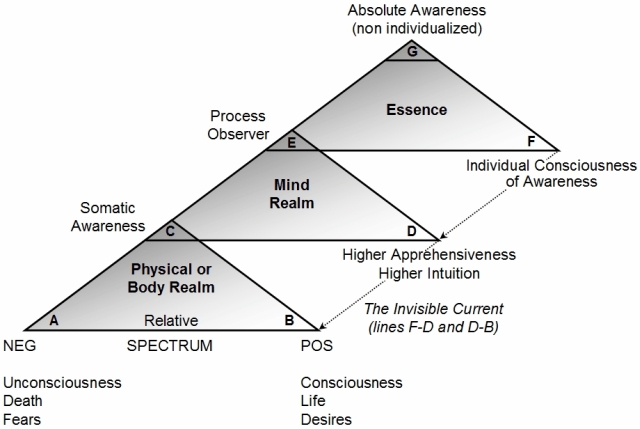
In his book The Supreme Doctrine, Hubert Benoit describes a concept called "The Conciliatory Principle." Often, when describing Jacob's Ladder and his system of tension, Rose referenced Benoit's ideas on conciliation of opposites, or triangulation. Life is created as a result of tension between two opposites. In life, we seemingly correct a problem by choosing an opposite thinking pattern or corrective action. However, the result is usually temporary. Through triangulation, we "rise above" or detach ourselves somewhat from the Fear-Desire situation in Jacob's Ladder. This detachment normally comes about slowly and incompletely, by retreating from the dilemma we face combined with an intense desire to rise above the fray. Or, the tension of life—created by tremendous conflict between opposites—causes a sudden leap to a new perspective that was heretofore never considered. This leap isn't necessarily spiritual per se. However, we have just climbed our first rung on the ladder, which is more of a retreat from error on line A-B rather than a movement toward a concept of a superior faculty. We are not adding ego qualities; we are subtracting error or "untruth."
 Let's go back to the Umpire. It is the rational mind—maybe Christianity's
idea of a conscience—that serves the best interest of the body but also begins
to grasp other, higher possibilities. For instance, we may join the spiritual
search because of the possibility of eternal soul survival. The Umpire is
nature's programming, a self-preservation faculty implanted in us. It is far
from infallible. In Rose's words from the Psychology of the Observer:
Let's go back to the Umpire. It is the rational mind—maybe Christianity's
idea of a conscience—that serves the best interest of the body but also begins
to grasp other, higher possibilities. For instance, we may join the spiritual
search because of the possibility of eternal soul survival. The Umpire is
nature's programming, a self-preservation faculty implanted in us. It is far
from infallible. In Rose's words from the Psychology of the Observer:
The line A-B is a line of unending struggle until the individual is conscious of the Umpire. He no more than becomes conscious of the Umpire than line C-D becomes the new point of reference. He wants to trust his rational mind and he may follow a physical and mental discipline that will insure for him (supposedly) the greatest safety in society, the best health, plus the conviction that he is reproducing properly. However, his (or her) relationship with the spouse may flounder from factors unknown to all experts, his health may slip seriously, and society may turn its back upon him abruptly. It is then that he becomes aware that there are factors beyond the control of the Umpire.
On the spiritual path, the Umpire makes poor judgments unless it incorporates the benefits of a superior sensing/feeling faculty. It is prone to rationalizing because of a profound pull "outward"—the body's attention to pleasure and comfort; procreation; nerve titillation through entertainment, sex, alcohol, and drugs; power and acquisition; fear; pride, and others. Thus, the ego is a core part of consciousness and the Umpire. We as seekers strive to "reprogram" the robot-Umpire to become a spiritual vector.
The Umpire is a portal between the body and the mind. It monitors the events and patterns in its view—line A-B. In his books, lectures, and conversations, Rose vigorously attacked behaviors on line A-B, hoping to prompt the seeker to look inward. He was a powerful and masterful psychologist in this regard (read the first four chapters of The Albigen Papers). Still, even if Rose didn't help us to look within, life will force our hand, as we are sure to get harshly rebuffed through the trauma that life often throws at us.
Such is the body realm of Jacob's Ladder...
Higher Intuition
The Umpire doesn't automatically see its opposite, which is Higher Intuition on the line C-D. For most of us, intuition develops into a recognizable mind faculty as we remember to watch our thoughts and feelings with determination. The intuitive side is less tangible to most people. Here's a few examples—from people I know—that do not fit within the construct of the rational mind:
 You know who is at the front door at your home immediately before the
doorbell rings, even though the visitor was unexpected.
You know who is at the front door at your home immediately before the
doorbell rings, even though the visitor was unexpected.
You think about someone. A few seconds later, you hear your phone and that
very same person is the caller.
You are riding in a car with someone and a thought crosses your mind. This
thought is unrelated to previous discussions. Yet, a few seconds before you
attempt to discuss it, the other person chimes in and starts talking about the
same topic.
Before opening an envelop addressed to you, you are overwhelmed with
inexplicable anger. Upon reading the letter inside, you learn that a friend has
written an uncharacteristic note of outrage directed at you.
You walk past someone in an office hallway, knowing with absolute certainty
that they thought poorly (or highly) of you.
Intuitive thoughts seemingly arrive out of nowhere—they arrive and "you" are the witness. They are often more accurate, especially as you grow to trust them despite not knowing the reason for the conclusion until sometime later.
I want to pause here to do a little card trick. In my hand, I have 13 playing cards—ace through king—from a normal deck. They are all suited as hearts. I'm going to draw one of the cards and look at it, and then you will make a silent note to yourself as you guess the card. Hold your tongue until I say it's okay to speak.
[Paul draws a card and thinks about what he sees. After a minute, he asks a few people in the audience to guess what he's looking at.]
We just went through a short exercise in intuition. But what I really want to ask is this: how many of you can tell me the details about the thoughts that crossed your mind when I pulled out the card? Did you witness a game of sorts, where you thought about one card immediately, and then you talked yourself out of your original selection?
Let's try again. [Paul repeats the exercise.]
Although it's a nice bonus to guess the card correctly, we will be far better off if we are able to watch the thoughts in front of us, and watch whether we are fooling our self or rationalizing as the thoughts stream out over the passing moments. If you watched this small drama play out, who is the watcher? Rose often repeated the phrase, "the view is not the viewer."
How does intuition apply to the spiritual search? Here's some instances where intuition is critical for the spiritual search: choosing the right book from among thousands, or finding a teacher who is trustworthy and helpful. Furthermore, when we surround ourselves with spiritual friends and spiritually-oriented books, audio, or video, we are placed in a conducive environment that most likely forces us to honestly look inward. Intuition tends to operate and help the seeker in a compatible mode with the rational mind. Throw enough information in the human computer, and the answers might arrive through intuition. In this regard, Rose encouraged many of the seekers he encountered—especially males—to practice celibacy, which improves both the rational and intuitive faculties of the mind.
Process Observer
Just like line A-B, we may be caught on line C-D until we gain a superior reference point. As the seeker becomes more determined to watch thought, a dichotomy occurs—the truer essential "you" becomes the watcher. Thoughts and feelings become the observed material, the consciousness. This watcher is, in Rose's terms, the Process Observer (point E) and seemingly the "viewer."
We have just climbed our second rung on the ladder, which again is more of a retreat from error on line C-D rather than a movement toward a pre-conceived faculty. The mind is now bending on itself; the mind is studying the mind. The constant attempt to watch opposites—the logical/reasoning side (point C) and the feeling/intuitive side (point D)—causes the seeker to be more grounded in the Observer. You know or become the Process Observer based on experience rather than struggling to grasp a vague concept.
The Process Observer is a portal between the mind and our true Essence. It monitors the events and patterns in its view—line C-D. We may not be immediately cognizant of the fact that the mind fools itself. In fact, the outer mind fools the inner, more essential self. This is a key aspect of Rose's teachings. We watch from the perspective of the Process Observer, and we can see ourselves rationalizing energy or opportunity away from the spiritual path. The robot indeed weaves a complex tale to maintain a self-imposed grip on the mind.
In Rose's words:
When he begins to study the Umpire and the phenomena of higher intuition as well, he automatically rises to a position of Anterior Observer to both, or that which I have named the Process Observer, or point E.
The Process Observer for a while imagines that it is the true consciousness. It observes the frailties of the Umpire, and the subliminal, unclear nature of readings from the data that comes directly to the mind without the senses, via intuition.
Nearly all psychologists are crippled Process Observers. They cannot help notice the limitations of the somatic balances or Umpire, but their reluctance to admit the vast ocean of probable mental experiences and other dimensional relationships brings them to deliberately deny an important faculty. They cannot proceed, and admit that their awareness is centered anywhere but in reflexive nerves.
Looking with fresh eyes on intuition seems to improve sensitivity, and watching thoughts will quiet down the reasoning side of the equation. We become increasingly in tune with the intuition as it "bubbles up" without the mental activity that so often suppresses our feeling side. The idea here is to avoid a preconceived notion of intuition and just allow it to arise by watching thought and not allowing ourselves to easily discount seemingly irrational messages from within.
The entire mind realm is filled with unsolvable paradoxes, and so it is limited. We apply the mind's maximum capabilities in the spiritual search, yet the mind cannot go with us in the final leg of the journey to our Source. Likewise, mystics say that the mind is an illusion, yet if we are foolish enough to test the illusion, four crushing tires will quickly end the argument if we step in front of a speeding automobile. Additionally, in Psychology of the Observer, Rose describes the six different forms of perceiving, detailing the implications of imagination, the limited nature of our sensory apparatus, and the implications of direct-mind communications that affect us profoundly. We operate in a mind realm that involves poor perception mechanisms, DNA programming, moods and states of mind, projection, and reactions upon memories accumulated through life. Thus, with the mind alone we will never obtain a perspective on life that is 100 percent accurate.
Such is the mind realm of Jacob's Ladder...
Awareness
Up until now, we've been describing the individual consciousness, the "dust storm of the mind," the reflected ghost. Watching the mind with the mind—over time and with enough effort—causes an accidental discovery of an "opposite," which is awareness (point F). Much like our situation described earlier, where intuition is less tangible relative to the Umpire, likewise awareness is less tangible compared to the Process Observer. Awareness is undifferentiated, unmanifested non-mind. At first, you might recognize it as the spaces between thoughts. The separation between ego-mind stuff and the essential "you" becomes evident, and we become aware of the awareness. Yet, we are still unable to identify the source of the awareness. Point F is seemingly God in the individual. According to Rose, it is sensed through the synapses, which is an imperfect, cloudy nerve-chemical interface.
A conviction remains that this individualistic awareness is an awareness-entity that will survive death. We hear about the analogy of the drop of water entering the ocean, and we think, "Some part of me—that drop, or molecules of that drop—will be floating around in a larger pool of the Absolute." This is the false conviction that stops us from Becoming.

Kabīr really said...
A drop
Melting into the sea,
Everyone can see.
But the sea
Absorbed
In a drop —
A rare one
can follow!
Rose encouraged us to become. We know awareness, yet it still isn't evident what we become. In reality, nothing of the individual Becomes. As Bart Marshall says, "We're trying to maneuver the mind into a position where it disappears." And when it disappears, when all thoughts and every aspect of your individuality is subtracted, all that remains is the Real.
I want to pause here and point out that the lines at the bottom of each triangle are by no means a black-or-white proposition. As one example, many shades of gray blend reason with intuition. In his book, The Direct-Mind Experience, Rose said that the exact half-way point is where miracles occur. For instance, we can conceive of "thought" and "no thought," but at the point where neither occur and yet both occur, the biggest miracle of all will strike—Enlightenment.
Such is the Essence of Jacob's Ladder...
The Absolute
A few minutes ago, I said that individualized awareness was seemingly God in the individual. By contrast, the Absolute is God in Himself. Or a better description might be God unreflected, a boundless No Thing. It is the highest reference point on Jacob's Ladder but paradoxically, it isn't a point at all, but more like a culminating Realization that blasts open a final Becoming, a Knowing of our Source. Afterwards, as we return to our daily affairs, Jacob's Ladder more or less collapses—no Umpire, no Process Observer, no "awareness watching awareness"—just awareness stretching to infinity on one end and a reflection on the other. Of course, in Truth, there are no "ends."
In Rose's words:
The Process Observer (E) cannot study itself. We may become aware of observing processes, and the polar point F becomes awareness. It is for this reason that the observation position does not go on indefinitely in regard to the mind's observing itself. The Process Observer is the mind in its maximum ability to observe the individual and its complexities. It constitutes the all of the mind, with all of the abilities of that mind in all dimensions.
But something is watching it. The mind (Process Observer) felt that there was nothing beyond or superior to it. It conceived itself to be the all of consciousness. However the fact that we are aware of this, and can look backward at the Umpire and see that previously it too thought that it was the maximum conscious aspect of man, leaves us forever uncertain that anything conceived by the mind can be the final point of observation.
But mind has a polarity which is non-mind, but which is simultaneously awareness.
At this point, we become aware of the mind as being external to our awareness. "We" are now observing all from a point of undifferentiated awareness. The mind still does not stand still but continues its labor of sorting and studying the processes of the mind. It simultaneously becomes aware of its own potential for awareness.
The final throes of the mind are like the intense but hopeless motions of a beheaded chicken, struggling to be eternally aware of the awareness that it witnesses.
It is for this reason that those who go through the experience of transcending the mind, recognize in it and describe it as being the experience of death. The mind does not die easily, and when the personality is gone, we find that we are still aware. Not only are we aware, but we are infinitely more aware than ever before.
Such is the nature of Is-ness...
Other Aspects of Jacob's Ladder
You'll note that Jacob's Ladder includes a dashed line that flows from points
F-D-B. The Invisible Current is the Light that flows from Essence, to mind, to
body. Our True Nature is expressed in a manner according to our capacity to
understand. The seeker who starts on the path understands "positive," then comes
to know the Umpire, the Process Observer, and awareness. But it all originates
from the same Light. And after a Realization, we understand the Source of that
Light flowing downward.
As we climb Jacob's Ladder, it is quite rare for someone to have a leap of understanding without substantial effort to go within. Those who are intuitive have better opportunities, because the feeling side of the equation expedites the trip home to our Source. No amount of thinking or mind mechanics will carry us through to our final objective. Rose said, "The closest that you get to God is that some changes occur within yourself and then you see the infinite possibilities. Some part of you knows who you are."
In today's presentation, you'll note that I frequently used Richard Rose's terms. And like Rose, I avoided a specific one-size-fits-all prescription that will enable all seekers to find their Source. Rose fastidiously avoided rituals, doctrines, or dogmas. We are not adding qualities to our ego persona that make us better seekers, we are subtracting errors through better choices along the path. And it is very much an individual path upon which we all embark. As seekers, we employ a reverse vector away from "untruth"—the errors of our body and mind faculties. The vector is, as Rose describes it, an erosion of ignorance. Thus, Jacob's Ladder and Rose's encouragement to go within apply to all walks of life.
I want to close this part of the presentation by pointing out something that seekers often forget. Jacob's Ladder contains a dark corner in the lower left part of the diagram. Without knowing your True Source, death is but an ominous mystery.
I've just walked through Richard Rose's diagram, hoping to improve your understanding of the body, mind, and Essence. Again, I hope that you'll stew over some aspects of Jacob's Ladder in the weeks ahead. We reach these new perspectives on the Ladder by constantly applying energy to the search, not through one or two bursts of energetic application. The desire and the struggle to know may reveal a profound personal discovery for you.
Now I'll play a short audio clip from a Rose lecture titled, Going Within from the mid-1970's [Paul ends the presentation by playing a segment from track 6 of the audio CD].
» Gain more insight by reading an excerpt from Psychology of the Observer.

© 2003-2026 SearchWithin.org All rights reserved.