The Forum for Awareness
Full Index of Issues 1 thru 14
Number 13
1984
Contents
A look at Christianity's outstanding mystic.
Feeling may be our sixth sense.
Richard Rose's concept of "Between-ness" may be the key to understanding the nature of the paranormal.
A poem on rediscovering the wisdom of childhood.
What all the world is searching.
Mark Twain believed the forty-year friendship with a woman in his dreams was as real as anything in our waking world.
Magic, White and Black by Franz Hartmann, M.D., A New Science of Life by Rupert Sheldrake, Psychedelics Encyclopedia (Revised Edition) by Peter Stafford, Concepts of Qabalah by William G. Gray, and The Continuing Discovery of Chiron by Erminie Lantero.
What you eat may influence what you think.
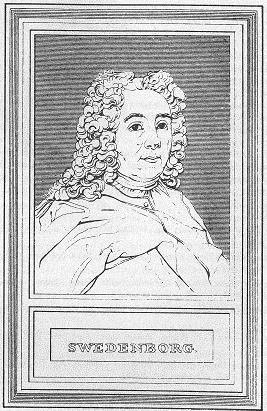
A clinical psychologist compares Swedenborg's view of the spirit world with the experiences of his schizophrenic patients.
The nostalgic experience of a woman in modern day Egypt.
What questions do we face upon turning the corner from our youth?
What do scientific discoveries have to say about the psychology of the sexes?
Lorraine and Ed Warren come to investigate strange goings-on in Sharon White Taylor's home.
The subtle hypnosis of everyday life and how to overcome it.
A poem by Richard Rose.
The TAT Foundation
TAT is a non-profit, tax-exempt organization founded in 1973 with the express purpose of providing a forum and meeting place for inquirers into the mystery of ourselves; Where do we come from? Who are we? Where are we going? TAT welcomes all inquirers, adventurers of the mind, laymen in search of truth, seekers of knowledge, the self and the unknown to meet others of like interest. Philosophers, psychologists and scientists, both professional and laymen, are on equal ground at TAT.
TAT is non-sectarian and non-denominational; there are no secret oaths, dogmas or rituals in TAT. Its membership, open to all of serious intent, from all walks of life, is united in friendship of dialogue and fellowship of human spirit.
TAT believes that you can expedite and intensify your investigation of life's mysteries by working with others who are exploring, perhaps down a different road, so that you may share your discoveries, exchange ideas and "compare notes" in order to come to a better understanding of yourself and others. It is for this reason that TAT provides a unique mountain retreat where its members can meet informally, a Journal as a forum for readers and writers of esoteric subjects, symposia, as well as small open-forum study groups in several cities. Your TAT Membership helps support these functions and gives you access to friends you might not otherwise have contact with.
There are two types of TAT membership: participating and associate. The annual fee for participating members is $20.00, entitling them to attend the four quarterly meetings at the TAT Farm Mountain Retreat in West Virginia, and to obtain discounts on the prices of all TAT-sponsored events. Associate membership is $10.00 per year and is for those who wish to support the work of TAT but who are unable to come to the meetings or to take advantage of the available discounts. Requests for memberships or further information should be sent to: The TAT Foundation, _____.
TAT Journal is published by the TAT Foundation, a non-profit, tax-exempt corporation, that was established to provide a forum for philosophical and spiritual inquiry, based upon the principle that cooperation with fellow inquirers expedites one's own search. The TAT Foundation supports workshops, seminars, study groups and related services. The views and opinions expressed in the TAT Journal are not necessarily those of the editors or of the TAT Foundation. Address all correspondence, including manuscripts, to: TAT Journal. Manuscripts will be returned only upon request and when accompanied by a stamped, addressed envelope.
Editor: Mark Jaqua;
Associate Editor: Louis Khourey;
Production: Cecy Rose, Paul Cramer.
© 1984 TAT Foundation. All rights reserved.
The TAT Forum is reserved for our readers. If you want to comment on an article you have read, or submit a short essay on a subject that you feel is interesting or thought-provoking, write to: Forum Editor, TAT Journal.
Let the Rays Shine Through
AS OF THIS MORNING, to my knowledge, no one has come up with the total answer, the all-revealing truth, so I shall relate to you a new meditation technique that will allow one to enter an undisturbed state-of-mind while moving about in this relative field of existence.
The other night I entered a deep meditation heightened by a high fever due to a virus. I had decided to withdraw my senses and take care of the problem at hand - fighting off my sickness - when some very strange events occurred.
Exterior sounds and sensations had nearly ceased when, suddenly, I was enveloped by intense rays of various color and shape. They seemingly entered my body, stayed for a short time, then passed on, although never breaking their continuity!
"Something" was informing me that there were five permanent waves or rays of light, penetrating all things in all stages and states of matter. And from these emanated a specially designed ray for each individual, to be recognized, understood and utilized, so that we could benefit thereof.
Once this revelation came about I seemingly rose above the five rays and entered a "shielded" energy field where the hurts and joys entered, but were not registering. It was sort of a deflector state where nothing could attract my mind to a point where decisions of any kind would have to be made. It was as if only the super-important messages would be allowed to enter, while all the others would be sent merrily on their way.
It was at this point that I gained a clear perception of my surrounding environment (although the only things that I saw or felt were the rays), and "heard" a voice, telling me certain secrets of incoming data.
With my individual ray, ascended above the constancy of the five rays, I was able to separate feelings into categories, excluding all disturbances and centering my attention onto the problem at hand. Each time my attention was drawn to an activity it would immediately withdraw before becoming involved and attached.
In this manner I was able to discern an acute amount of noise and simply delegate it to one of the five senses, namely sound. All sound was carried along by this ray. Disturbances, distractions, sounds of pleasure and joy, anger and pain. It was all very clear: sound is eternal, constant. Whether one becomes a victim or a user of such phenomenon, it can better be comprehended once it is seen for what it is, and not for what it is accepted to be.
I was able to extricate myself from further pain that "listening to the noise" would have caused. Instead, I took refuge in my ascended state, and paid attention to the other four aspects of nature.
Even with my eyes closed (or were they?), I was entertained by a multitude of panoramic finery. I was shown a vast array of spectral sights. It seemed to stem from the originating point and then would enter into our material world where it would take complete form and alter and attract various beings. Since I was apparently in the middle of things I decided to decipher all that I could and see why phenomena were altered so much before material beings were presented with its impact.
It was then that a "set of hands" presented to me a model of a code machine that each living thing was connected to. It is for this reason that not all beings see episodes in the exact same manner. Or sequence. They have to decide or decipher for themselves what the action means or represents.
For Instance, when a visual ray is in sequence, many see the same thing; some don't, but the mind's action is paramount here. The visual scene stimulates the various minds and separate codes are set off as the scene progresses through this material world carrying minds with it, placing them in a new reality, while the ones that didn't attach themselves remain where they are.
The rays don't lose their intensity or purpose, when they enter this materiality; they merely refract somewhat causing general confusion and misunderstanding. They do not correspond to any color or sound on our scale so they can use any existing colors or sounds as they please to suit their intended purpose.
So the five rays which manifest in this world and give rise to our five senses are no more than broken down pictures of the true scale of things. It is with this corrupted version of our five senses that we try to comprehend our environment and the universe around us. It can't be done.
Physics teaches that for every action there is a reaction. So if one were to touch an object the theory would state that the action of touch created a reaction which was some sort of stimulation affecting the brain which would then give its response. The action is the ray of Touch itself; the reaction is when some one or some thing comes into contact with it making that object want to touch it. And when it does, another action-reaction occurs, creating several layers of sensation on various levels of consciousness. So it is with all of the five permanent rays.
The ray that carries smell comes along and affects beings in various ways. Memories are set in action, instinct is aroused, and something is either thought of or done, again proving that the rays are the action and the one who smells is the reaction. If the smell be traced past the apparent cause, then the truth would be near, but people, animals, and plants have no such curiosity.
These rays permeate all existence, having no equal; yet they are of one source, one purpose: to keep in animation and bondage all living things, to afford opportunity to escape and reorganize.
If you want to know what kind of world you really live in, then mentally strip yourself of your five senses and what you have left is what you are - an unborn thing waiting for birth being nourished by FIVE RAYS OF TRUTH.
Without the five rays no one could think because there would be nothing to think about. A thought could not be raised because there would be nothing to raise it against! No visions could be had for nothing could be seen or envisioned.
What it boils down to is this - we are existing in a state where five beams of knowledge operate. In the process, we are bombarded, transformed, and activated. All of the past, present and future is a mirage. The truth is not seen because we are trying to see it from without. All of our goals and plans are useless. Whatever heights or lows we attain are mere appearances, apparitions of the real event.
The reason for all diseases and death is the process of being carried away by "our" senses. Death comes when the realization is made that the events of one's particular passions or motivation have ended. And since they were riding right along with them, their end came also.
It is safe to say that the senses have countless trillions of response mechanisms; and if there are avenues of escape or elevation, you'd best believe that they are all covered because whatever is made known by the senses, is known by the senses. And no thing using the five rays can escape them by looking for get-away routes supplied by them!
The only escape is to free yourself from them. Disconnect and sever their tyrannical hold. Use them when needed but don't let them use you. If you wish to avoid the destruction in store for you simply disengage your senses. Since this life exists only in the five senses, so does death. And if life doesn't exist - how can death? You do not have to die, you are made to die!
So, in a passive state of mind monitor whatever sensory organ is in progress and refuse to be captivated by it. Do not be alarmed, overwhelmed or enthralled. Just simply see it for what it is, and in this manner you can disengage more easily.
There are no strenuous exercises, sitting postures or chants to follow. It is entirely up to the individual where they begin or end. But know for a fact that if you don't program your Alpha and Omega, your addiction to the awesome powers of the Eternal Five Rays will plan it for you without the necessity of a higher sanction!
Since this is your life, why don't you take possession of it? And stop letting eternal and external forces drag you around. Use the senses, lest they use you.
The Yin and the Yang of It
REFERENCE the symbol which depicts the circular sky which surrounds the Earth. Taoism conceived this symbol to clarify the principle of the Universe - the Way.
To Taoists the movements of the heavens are the causes of the phenomena appearing on Earth. Behind all of the visible symptoms of Nature, is Tao, the universal cosmic energy. This energy produced the Yin, the negative force, and the Yang, the positive force. These polarity definitions were extended into all of the opposite principles of Nature.
These forces, in interaction, brought forth heaven and earth, which in turn produced all beings - plants and animals. Humanity, therefore, is a product of this cosmic energy.
Yin and Yang sums up life's basic opposites such as: good-evil; active-passive; positive-negative; light-dark; summer-winter; male-female; love-hate. All these forces complement as well as counter-balance each other. Each also invades the other's hemisphere and establishes itself in the center of the opposite's territory, resolving itself as a composite of a final unity of Tao, specifying that all things are one.
All things, through this synthesis, lose their absolute character. A sense of fatalism permeates this melding. For instance, the happening of any event may be good, but it may develop into something bad. An example would be the winning of a million dollars in a lottery. The aftermath of this happy occurrence may be the purchase of an auto in which the recipient of the fortune may suffer major injuries or death. Hence, the Taoist asks, "What is good or bad?" One can lead into the other.
Taoists believe Nature is to be befriended. Humans do not "conquer" Nature. They aid it in any way they can, in order to be in tune with it. This belief and practice is basically ecological in interpretation.
In achieving this approach to symbiotic relationships, the Taoist endeavors to meld with nature and to let its cosmic energy work through Man to aid all living things. The universality of this thought explains the depth and breadth of their belief in Compassion as a principle by which they live.
The alternating forces of Yin and Yang tend to explain the cyclical interpretation of human history. The opposing forces of peace and disorder among human social groups do not depend on the rise and fall of political forces but upon the happiness or distress of the people affected by Nature's cosmic forces.
When human activity disturbs the harmony of Nature (the cosmic forces of Yin and Yang), Taoists believe that Nature will react abnormally through natural phenomena.
A Strange Experience
IT HAS BEEN MY GOOD FORTUNE to travel, and live, in many countries in the last twenty years. Granted, I have been relieved to find kindred spirits everywhere; yet, it is the odd quirks (to me) that I have found in foreign cultures that stick in my mind, the memory of which, years later, can still fill me with amazement, even coloring my day with laughter. One such incident occurred while I spent some years in Peru.
My husband, an engineer with an American mining company, and I, were on a trip by jeep through the Andes Mountains. Our driver, Julio, a Peruvian Indian, had accompanied us on many such adventures along the narrow roads throughout this wild landscape. Over the years, we had established an easy-going camaraderie, and knowing each other so well, we chatted freely as we drove along in the bright sunshine. Suddenly, the car skidded on some debris from a previous landslide, and we found ourselves careening wildly down the steep incline to the abyss below. A river-bed, thousands of feet down, seemed our obvious resting place. However, fate was kind... the wheels of the car caught, and held, on a stony ledge some distance down the ravine. In a state of shock, we managed to gingerly extricate ourselves from the back seat of the jeep, and in what seemed an eternity, my husband inched forward and carefully dragged Julio's body out. Fortunately, he was alive, with no injury that we could see. My husband's words, "I think he only had the wind knocked out of him," came like a scream in that wilderness. I realized that these were the first words spoken during our narrow escape.
Then began the arduous climb to the top. As we crept carefully upward, Julio's smaller body supported between us, we heard a loud rumble as the car was catapulted off the ledge and down the mountainside. By the time we reached the top, Julio had regained consciousness. Completely exhausted and short of breath, we stretched out in the road. Finally my husband stood up, and gazing down at the wreckage, uttered words that had been forming in my own mind, "God, what a narrow escape!" Silently, my lips formed an Amen ... a thank-you to our Maker. Julio, on the other hand, jumped to his feet, and began beating his chest and crying, "Que Lastima, Que Lastima!" (what a pity). My husband, thinking he was overcome at the thought of losing the expensive jeep that was his pride and joy, hastened to assure him that it was of no importance; the only thing that mattered was that we were safe. After some time, Julio turned to us. The change in the man was most remarkable; no longer our smiling friendly driver, his haughty and aristocratic demeanor shocked us. Generation upon generation of rubbing shoulders with foreign cultures had fallen away. Before us stood the true Peruvian, a son of the Incas. Sadly, and with a faraway look in his eye, he simply stated, "But senor, what a glorious way it would have been to die!"
The Morning After the New Age
DESPITE the alleged arrival of the Age of Aquarius, or "New Age," sometime during the mid-1960's, mainstream society has lagged far behind in its transformation to the above-mentioned revolution's somewhat polluted and naive ideals, (which, in turn, have finally become institutionalized into its fallen descendent: "enlightened" narcissistic hedonism).
Similarly the new religion, psychology, and its expression through and influence upon the media, have likewise failed in providing the people with a true perspective on right living and sanity, or at least the road to get there. Not only that, but it has also maintained a conceited pretense of knowing, while obstructing possible wisdom from subverting its authority. It has become a classic case of refusing to look up and so assuming it is at the highest point. H.G. Wells' proverb could be altered to fit: "In the country of the mindless, the blind man is king."
Mainstream psychology's primary objectives seem to be to anesthetize people to their pain (but not ending its cause), to condition their body-minds to function properly in the societal machine, and to teach people to masturbate - in various forms - without guilt.
But some new sprouts of wisdom - born of battle-fatigue - are now popping through the manure-covered Zeitgeist of convention.
Two recent books give voice to this post - Timothy Leary/ Hugh Hefner/ Fritz Perls/ B.F. Skinner/ Joyce Brothers/ Phil Donahue/ Sex Pistols message; one which is still, as yet, only a whisper amidst the mad crowd's roar.
The Sensuous Lie by Celia Haddon, an English journalist, presents the novel notion that maybe the whole sexual revolution was, in fact, not the liberation from foolish, neurosis-inducing inhibition, as loudly promoted, but rather a new form of enslavement - by degeneracy, mutual degradation, and self-destruction.
Without belaboring traditional religion's reasons for teaching morality, she makes her assessment of the current state-of-the-art of human interaction and the individual's own reaction to the commonly accepted modes of sexuality, from the honest, common-sense perspective of someone who had also been deceived by the big lie, had recognized the suffering caused by it, had fought for mental clarity and freedom, and lived to tell the tale, to those who are still tempted to bite the bait.
Much of her message is that the modern, herpes and suicide-infested sexual libertarianism has turned out to be as false a philosophy of life as was the crippling, dishonest repression of unredeemed lust of previous generations. Her conclusion is that real maturity, freedom, and self-mastery would naturally and inherently manifest as morality, unselfish friendship, and self-sufficiency. This would then leave subjective conditions open and available for the emergence of the much-pretended but seldom realized, quality of "love." "Cosmopolitan" magazine is not likely to run excerpts from this book.
The second title is The Observing Self by Arthur J. Deikman, a psychiatrist. He provides and describes a bridge between mysticism - the original mental science - and psychotherapy. He gives a professional clinician's insight into material previously covered (and with greater intensity and detail) by Richard Rose in his Psychology of the Observer.
Traditional, or even current pop-psychology, textbooks do not include statements like: "Western psychology... is defective because its center is missing; it does not recognize the observing self as the center of all experience"; "Teachers must teach by means of what they can transmit, because of what they have become"; and "The basic activity of psychotherapy is to extract the observing self from the contents of consciousness."
To find the answers to sanity and identity, the questions and premises must first be properly defined. His message is that psychology's chronic and arrogant mistake has been to try, in futility, to cure a sick mechanism in an illusory sleepwalker through manipulative and self-hypnotic means, whereas the true road to Being is to retreat to the final observer of the whole complex scene, including the make-believe character one plays in the dream, and realize one's identity with the Source. An incidental by-product of this process is psychic healing and social betterment - which are psychotherapy's failed (and currently impossible) tasks. "Psychology Today" magazine is not likely to run excerpts from this book.
I am sure Deikman and Haddon would agree: the observing self evaporates all lies, both sensual and subjective. Herein lies the true direction towards well-being.
I am glad and grateful to see these glimmers of hope in the dark desolation. Maybe the "New Age" will arrive after all - for at least those who are willing to see, and change, and become.
The Illumination of Jacob Boehme
by Mark Jaqua
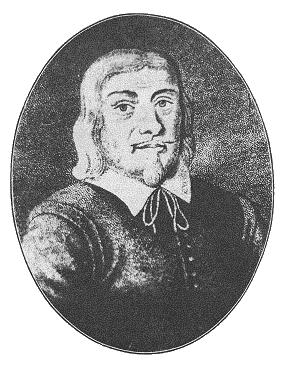
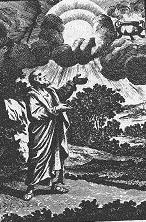
JACOB BOEHME was the most unlikely of mystics. Born into a Lusatian peasant family on April 24, 1575, it would have been considered an accomplishment for his times to merely learn to read, let alone become one of Christianity's outstanding mystic. Boehme is of the class of uncanny geniuses who may unpredictably be born in any time or place. His writings served as inspiration to such philosophers as Hegel, Schopenhauer, Saint Martin and Newton. Hegel called Boehme "the father of German philosophy" and Schopenhauer remarked that in understanding Boehme's system he "could withhold neither admiration or tears." His writings are dazzling but confusing and contain nuances of meaning which stir a haunting wonderment. The eighteenth century mystical poet Gerhard Tersteegen wrote of Boehme, "I cannot say that I understood, but I read until I was filled with strange fears and bewilderments... At last I took the books to their owners, and it was like a weight lifted off my heart." (1)
An unusual event in Boehme's youth intimated that great things were to come to him. Jacob apprenticed himself to a shoemaker while in his teens and would later make this his occupation. He was working in his master's shoe-shop when he was approached by a stranger about the price of a certain pair of shoes. The stranger seemed poor and was dressed as a peasant, but he had a radiating glow about him and "great eyes which sparkled and seemed filled with divine light." Jacob's master was out and the boy trembled to name any price. The stranger pressed him for a price and Jacob named a very large amount. Surprisingly the man immediately paid him and took the shoes. When a short way down the street the stranger turned and cried, "Jacob, Jacob, come forth!" Frightened and astonished Jacob ran out of the store and to the stranger. The mysterious man took him by the right hand and prophesied: "Jacob, thou art little, but shalt be great, and become another Man, such a one as at whom the world shall wonder. Therefore be pious, fear God, and reverence His Word. Read diligently the Holy Scriptures, wherein you have Comfort and Instruction. For thou must endure Misery and Poverty, and suffer persecution, but be courageous and persevere, for God loves, and is gracious to thee." (2)
Frankenberg, Boehme's biographer and first publisher, claimed that Jacob's initial mystical experience occurred in 1592 when Boehme was only 17. Boehme left no account of this experience but did mention several times an experience he had in 1600. Frankenberg claimed that this experience was catalyzed by sun flashing off a pewter dish. Boehme received an illumination of knowledge and wrote:
"... my spirit directly saw through all things, and knew God in and by all creatures, even in herbs and grass... the gate was opened for me that I saw and knew more in a quarter of an hour than if I had been many years in the universities." (3)
Boehme's awakening was not limited to just this one experience but resulted in a long-term elevation of his mind. He wrote that this experience "unfolded again from time to time" and that he went about "pregnant" with it for the following 12 years.
Jacob Boehme's first book, Aurora, was an attempt to externalize his insights and was not intended for publication. He wrote some twenty books in the last five years of his life, but Aurora was his only one in the 19 years following his experience. Aurora was originally Boehme's personal notebook. Word spread of the young philosopher and Boehme allowed his writings to circulate among an increasing number of scholars and open-minded clergy. In Boehme's time it was illegal to disagree with even a literal interpretation of the Bible. When his writings eventually came to the attention of Lutheran' Church authorities he was called before a tribunal. Boehme was threatened with banishment from his home of Gorlitz unless he agreed to write no more. Boehme agreed and would write no more for the following seven years until 1619, when he again began writing in secret.
Boehme was the object of much persecution after this unfortunate event. His chief opponent was the local Lutheran pastor Gregory Richter who would preach wild sermons against the "drunken cobbler" - even while Boehme was seated in church before him! Richter once incited a mob against Boehme which resulted in the windows being broken from his house. Under pressure of conscience, Boehme began writing again in 1619 and succeeded in smuggling some of his works out of Gorlitz by hiding them in sacks of grain. He was once again discovered by the Church in 1620 and banished from Gorlitz. Jacob had given a masterful defense of himself at his trial, but peacefully agreed to the Church's decision. This must have confounded the members of the tribunal because the next day they unanimously agreed to send a search party to find Boehme and bring him back to the city!
Boehme's mystical experience seems to differ in type from what we normally refer to as "enlightenment" or "Christ consciousness." His writings do not describe a state of being such as "Nirvana" or an identity with God or the Absolute. What Boehme seemed to receive was an illumination of Knowledge. He saw the inner aspect and "clockwork" of the cosmos, as it were, and tried to bring his intuitive insights into material form by the use of symbology and analogy. His ideas were the result of an instantaneous illumination and not of concept-building and arduous philosophizing. He wrote of his experiences:
"Therein I first knew what God and man were and what God had to do with men. Previously I understood little about the high articles of faith... much less about nature. For the Spirit shot through me like a bolt of lightning. I began to write like a school-boy, and so I wrote continuously, but only for myself.
"For I saw and knew the Being of all beings, the ground and the unground; the birth of the holy trinity; the source and origin of this world and all creatures in divine Wisdom. I saw all three worlds in myself, [1] the divine, angelical, or paradisiacal; [2] the dark world; [3] the external, visible world; and I saw and knew the whole being in evil and in good, how one originates in the other ... so that I not only greatly wondered but also rejoiced.... For the Light's spirit moved my soul very much ... repeating many things very often, ever deeper and clearer, from one step to another - it was the real Jacob's ladder." (4)
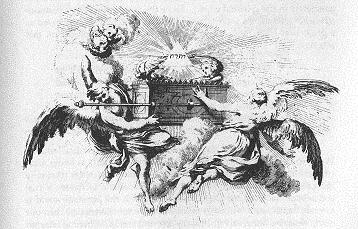
H.P. Blavatsky in her Secret Doctrine claims that Boehme was under the tutelage of Genii or the Nirmanakayas - those beings who watch over the evolutionary progress of the Earth. We have no way of knowing if such beings exist, but the fact that Boehme was illuminated in such an orderly fashion by a seeming external spirit or "Light" does lend some credence to Blavatsky's viewpoint. Regardless, he discovered his knowledge from an inner fountainhead and not from an external, worldly source. As counseled by all sages, Boehme held that all knowledge was contained within oneself. He wrote in his Libri Apologetici:
"For we men have one book in common which points to God. Each has it within himself, which is the priceless Name of God. Its letters are the flames of his love, which He out of His heart in the priceless Name of Jesus has revealed in us. Read these letters in your hearts and spirits and you have books enough. All the writings of the children of God direct you unto that one book, for therein lie all the treasures of wisdom.... This book is Christ in you." (5)
Boehme believed that this world is but a shadow-play and representation of what occurs in higher dimensions. Everything in this world is the "signature" or symbol of something which exists more concretely in the spiritual world. Since the spiritual world is contained within oneself, the external world and the body could be viewed as a projection from these interior contents. Boehme's insight on this was that:
"The whole outward, visible world with all its being is a signature or figure of the inward spiritual world; whatever is internal, and however its operation is, so likewise it has its outward character.... for whatever the natural light is spiritually, that the earth is in its coarseness." (6)
Boehme speaks of the "corporeality" of the spiritual worlds. We normally think of the "ethereal" realms as just that, as being more ethereal and abstract than our normal physical experience. Actually this cannot be the case at all. The mystical realm must be more real and substantial than our physical dimension. If the physical world is a symbol and creation of what exists in a superior dimension, then our world must be "ethereal" or illusory in comparison. Boehme referred to the physical world as "the sphere of transmutation and phantasy" (7) and said that it is "like a smoke or a fog." (8) It can little be wondered that those who have experienced the mystical often regard the physical world with detachment. If one has experienced Real Life then our mundane grubbing must seem of little importance in comparison.
Boehme took two seemingly contradictory poses in his advice on the method necessary to achieve spiritual illumination. At the same time one must surrender and yet fight with warrior-like intensity. Self-will prevents understanding in ordinary men but this very same self-will is necessary to overcome obstacles in the path. It takes the "dark consuming anguish of the fire" (9) to change man, and this fire is kindled by an interior battle.
"Man must here be at war with himself, if he wished to become a heavenly citizen. He must not be a lazy sleeper. Fighting must be his watchword, and not with tongue and sword, but with mind and spirit, and not give over...
"Do you believe that my spirit has sucked this [knowledge] out of the corrupt earth, or out of a felt hat? Truly no, for at the time I am describing my spirit did unite with the deepest birth of God. From that I got my knowledge, and from that it is sucked. What I thereafter had to suffer from the Devil, who rules my outer man, you cannot understand... unless you dance in his round.
"Therefore if anyone will climb... after me, let him be careful that he be not drunk... For he must climb through a gruesome deep and hell, and he will have to endure scoffing and mocking. ...such knowledge requires no state of melancholy, but a knightly wrestling." (10)
Boehme held that it was impossible for man to experience illumination through an act of his own will. Illumination was an act of grace which could only be obtained through surrender and resignation to God.
"It is not a very easy thing to become a Christian; it is the most difficult thing in the world. To become a real Christian, one must break the power of the selfish will, and this no man can do by his own human power. He must render his self-will like dead. He will then live in God and be submerged in the love of God; while he still continues to live in the external world...
"If Christ is to arise in you, then must the will of death... die in you. For Christ has broken death... and become Lord over death and hell. When he makes his entry in a man, there must death and hell in the inward ground of the soul break and give way. He destroys the Devil's kingdom in the soul... makes the soul into God's child... gives it his will... slays the will of the corrupt nature." (11)
Advice to surrender the self-will is often met with in spiritual literature and it is difficult to determine just what is meant. One might think that if he were to surrender his self-will he would be shuffled off to the nearest institution from the resulting catatonia. While this may have been the case of a misguided mystic or two, it is obviously not what is implied. Boehme seems to indicate that surrender of the self-will is actually something that is done to you as a result of sincere spiritual effort. One's own will is realized at a deeper level as a result of partial escape from the obsessing influences and ambitions of the lower personality. We cannot attempt to do "God's will" because no one knows what this is in any concrete sense. "God's will" can only be interpreted in terms of humanity's deepest aspirations. In the strictest sense, God as the Absolute is beyond anything we could describe as desire or will.
Boehme was definitely not a utopian. He believed that there would never be a paradise on earth other than the one found within man's heart. He saw creation as a manifestation or representation of God, but in our sphere this manifestation takes its coarsest form. In the mystical realms duality takes the form of harmony while on Earth duality takes the form of constant tension and battle. He wrote:
"Nature, up to the day of judgment, has two inherent qualities; one is lovely, celestial, and holy, and the other one wrathful and hellish.... Light and darkness are opposed to each other, but there is between them a link, so that neither of them could exist without the other." (12)
Still a young man when he died from a short illness in 1624, his last words to his family were, "Now I go hence to paradise." Boehme had experienced both worlds during his life, the earthly world of battle and the paradisiacal world of harmony and knowledge. Volumes could be written of Boehme's cosmology, but this would miss the most important point, Boehme experienced a realm that can never be fully described in words. Coleridge could have had Boehme in mind when he penned these lines:
Weave a circle round him thrice,
And close your eyes with holy dread,
For he on honey-dew hath fed,
And drunk the milk of paradise.
References
The Feel of Things
by Warwick Deeping
IT MAY SOUND HERETICAL for a craftsman to assert in this mechanical age that the art of life is not the mere product of the machine shop or the draftsman's desk. You cannot make a blueprint of life and say, "That is what it is going to be."
In my hustling, strenuous youth I rather thought I could know everything, and order everything just as I wanted it. I was rather like a carpenter nailing up a packing case and thinking he knew exactly what was inside.
One day a very wise sailor man said to me, "Don't be in such a hell of a hurry. Softlee walkee catchee monkey."
Now, I suppose my monkey was my craft as a teller of stories, and bound up with it was the sort of life I had to live. To begin with, one was so very pragmatical. The thing should go as I pleased; I was busy with hammer and saw, but life and its craftsmanship are not built in that way.
There is what I might describe as "the feel of things." Right down below the skin of our senses is the collective, intuitional wisdom of that profound other consciousness. It is a kind of well of wisdom, of strange experience, of rich emotion, forgotten memories. Our forefathers and the Stone Age are there.
Now, as I grew older and wiser, I began to learn that the art of living and one's craftsmanship might depend upon one's getting into touch with that larger self. The thing was to let it well up in one. There is a quality which we used to call inspiration. The word seems rather out of favor. It suggests mystery. Yes, and without a sense of mystery, man is just a pragmatical prig.
Sit, relax, wait for the feel of things.
I had set out to write books. I found in time that I was not writing books. The books were writing themselves. I did not know what they were going to do. In a sense. I just sat and watched and listened, and let my pen attempt to describe what that deeper consciousness chose to throw up.
Copyright Garrett Publications, reprinted by permission. This article appeared originally in the February 1942 issue of Tomorrow magazine.
I used to worry about a book. Now, I do not worry. I may feel that I have not an idea in my head, but that other self is gently seething below the surface. It seems to know much better than my shallower surface-self what will happen and what life is.
Not only in books does this intuitional self provide one with vision. I am also a designer of gardens, and in this craft also one has to wait and watch. The willful, drawing-board plan is not a happy one. Suddenly, you will see your garden as it should be, proportioned and dressed by that strange inward sense which seems to come from nowhere out of nothing.
So it is with life. When the hustle and hurry of youth are chastened, that other wisdom comes to us. We do not vex our problem. We do not sit and pick it to pieces with restless, fidgeting fingers. We wait for the Feel of Things. We wait for the inward plan which our more profound and intuitional self will throw up. We do not worry. We sit and wait.
I realize now how much of my life, as well as my craft, has been prompted by this inward feeling about things. Did I plan to fall in love with my wife, that supreme good comrade who has given me so much? I did not. I just fell in love with her. My intuition told me that I was utterly right in loving her, and I was wiser than I knew.
Did I plan to live in this peaceful old house? I did not. I had a feeling about the place I wanted. I searched, I opened a gate, and there the house was.
I believe most profoundly in being guided by this inner wisdom. We may call it by all sorts of names, but the art of living is in its keeping.
"Between-ness" - A New Theory of the Paranormal
by Tom Mackay
EXPERIMENTS INVESTIGATING THE NATURE OF ESP and the paranormal have been carried out in the West now for over 100 years. ESP abilities have been demonstrated to the satisfaction of most but we still have no inkling of how it operates. We do not know scientifically how paranormal information is received or sent, and even more puzzling is its unpredictable nature. In the laboratory no subject has been able to consistently produce ESP results. Outstanding results may be produced for a short period of time, only to have further efforts bring nothing whatsoever. A certain serendipity is involved that defies any conscious control.
Richard Rose, founder of the West Virginia based TAT Foundation, has formulated a general theory of the paranormal that contains this serendipity or "Between-ness" as its central facet. Rose's concept of Between-ness is that it is a peculiar mental state that "causes things to happen." This idea is complex, but through intuition it can be conveyed in simple terms. A radio show host once asked Rose to describe Between-ness in the simplest manner possible. He replied that it would take some time to explain it adequately, but that perhaps an example in everyone's experience would help. "If you have ever rolled dice, then you know what Between-ness is. Any man that has ever rolled dice or played cards has had it in the back of his mind that if he held his head a certain way, he'd win."
The elusive nature of ESP phenomena becomes obvious in the laboratory setting in which card guessing and other means are experimented with. One curiosity has been labeled "psi-missing." This has repeatedly been observed and occurs when a subject being tested for ESP consistently guesses below chance. That is, if 25 % right guesses can be expected from chance, the subject may consistently get only 15 % right answers. This is as great an indication of ESP as if he were to score significantly above chance.
Another peculiar unpredictability that has turned up in ESP experiments is that a subject may be "out of phase" with the series of cards he is guessing. He may only get chance expectations on the specific cards at which he is guessing, but if his guesses are later matched to the next card or two cards ahead in the series, then his guesses turn out to be highly significant. In these cases it would appear that the subject is being precognitive even though he is not trying to be precognitive.
Successful ESP scoring has been found to have very little to do with amount of effort. It has been found that the best results occur when the subject is relaxed and interested in what is going on. In many studies belief in ESP has proven to have little to do with significant results. Gertrude Schmeidler, in extensive tests in the 1950's, discovered that a negative but interested attitude toward ESP favored significant scores below chance! In other words, it has been found that the best subjects are in a state between making a strenuous effort and not being interested at all, or making no effort.
The "catch me not" nature of ESP has been described by parapsychologist John Palmer as best attained in a mood of "relaxed spontaneity." Eileen Garrett has described it as a "playfulness," a mood between being serious and not serious. It is a mood of interest, but not too much interest. Researcher Charles Honorton describes the ESP-productive mood in the following way:
"The kind of mental relaxation described... seems to involve effortless intention, or what some present-day bio-feedback researchers call 'passive volition.' This is a mind-set which is characterized by 'allowing it to happen' with a minimum of ego involvement and conscious striving."
"Effortless intention" or "passive volition" are paradoxical states to our normal manner of thinking. They are mid-states or Between-ness points to our normal emotions.
It has been established scientifically that there is no physical medium for ESP. Experiments have been successfully conducted in Faraday cages which eliminate all electromagnetic emanations such as radio waves and the like. This would point to a non-physically-detectable source as the carrier of ESP. Since - presumably - a nonphysical mind is the receiver and sender of ESP, it would seem dependent on the state of that mind to determine how receptive it is. This state would seem to be an alert ambiguousness or Between-ness in which mind is momentarily not chained to any obsessive or totally occupying state of functioning as it normally is in the day-to-day world. Moments of reverie, dreams, and hypnagogic or hypnopompic states fit into this category, and all have been demonstrated as conducive to ESP.
Eileen Garrett, probably this century's most outstanding psychic, wrote that "... I knew from experience that conscious effort was the one thing which would produce no results that could be described as supernormal." Felicia Parise, the European telekinetic psychic, made a discovery similar to Garrett's. She had been trying for several weeks to move small objects with her mind and had given up in failure. She had made great efforts of concentration but it had been to no avail. One day the telephone rang and she answered it only to discover the shocking news that her grandmother had died. After hanging up, she reached for a plastic bottle and it scooted away from her across the table.
The conscious ego and conscious effort seem to interfere with paranormal results. As shown in an extensive study by Louisa Rhine, the greatest frequency of valid ESP experiences is in dreams when the conscious ego is not present at all. This ego-caused inhibition apparently includes any attempt to use the powers for personal gain. Katherine Craig writes in her book The Fabric of Dreams that "...psychically gifted persons know that when they attempt to apply their powers of clairvoyance and of penetration to themselves or for personal ends, these powers become void." Uri Geller has tried to use his abilities at Las Vegas several times only to lose his shirt each time.
If the ego is inhibitory to psychic phenomena, it explains why a subject cannot perform on demand in a laboratory. A certain egoless or relaxed state is called for between trying and not trying. In our normal ego state paranormal abilities are not considered possible or likely. In our normal paradigm we simply do not believe that we can tune in on someone's thoughts. It may be that the paradigm or belief-status creates limits on reality and what is possible. Our belief-status or paradigm may have a greater effect on our experienced reality than we suspect.
I once observed my young brother repeatedly open a good quality padlock with a paper clip. He seemed to think nothing unusual about it and continued to amuse himself closing and then opening it again. I asked him how he did it and he replied that "It's easy," and did it again for me. After I finally expressed my great amazement, it was curious that he could no longer open the padlock. My postulation is that he did not realize that people weren't supposed to be able to do such things. After I expressed my amazement I succeeded in indoctrinating him into the world-view that such things are impossible. I convinced him that it was an extraordinary thing to do and then he could no longer do it.
The very laws of what is possible and impossible may be controlled by our belief systems in even more dramatic fashion than this minor example. Many machines and techniques have been discovered or designed which were thought to be physically impossible before their employment. Often the inventor does not know that what he does is supposedly impossible. It is only afterward that new "laws" are discovered to explain the inventions.
I can reflect on another incident from my childhood that seems highly improbable now but didn't at the time when I was seven years old. My five year old brother had carved a wooden knife which probably weighed no more than a few ounces. We were cleaning out a corn-crib and, as anyone knows who has grown up on a farm, there were quite a few mice and rats liberated in the process. I was standing by my brother when a rat ran by about five or ten feet away. My brother had been pretending that he was an Indian and had become totally involved in the imaginary play-acting. When he saw the rat he hurled his paper-weight knife at it and - amazingly - it went through the animal and killed it! Under normal circumstances that knife would have bounced off a balloon, let alone killed an animal. I believe that, in his childish innocence, my brother caused another reality to momentarily manifest - the reality of himself as a mighty Indian hunter.
In nearly every school of esoteric philosophy it is claimed that our physical world is a projection or creation of a superior and more "real" dimension. This physical world is seen as a sort of dream or reflection of essences from another plane of existence. I will not try to support this claim here, since there is ample literature on the subject, but postulate the "dream-nature" of the world as a basis in my explanation of Between-ness. In a Between-ness state one momentarily gains access to this source of creation and produces an actual alteration in manifestation on this physical level. What was originally one way is altered and becomes something different. It is as if the script is changed in a drama. One "deposits" a new idea into the creative realm and it is "born" on this plane.
If being addicted and involved in our normal paradigm restricts the mind's paranormal abilities, anything that weakens that paradigm and makes it more remote may facilitate these abilities. If the normal paradigm is escaped temporarily through hypnosis, sensory isolation or meditation, a new paradigm may arise which makes more likely the occurrence of the paranormal. In fact, this is exactly what occurs. There are higher ESP results in these altered states. Charles Honorton has compiled a review of over 80 studies performed in 26 different laboratories and the over-all ESP performance in these altered states proves very significant. In these states there is no conscious attempt to produce a new paradigm, but this automatically occurs as a result of escaping or denying the exclusiveness of normal reality. Between acceptance and doubt a new paradigm is born. This new reality includes or is what we consider the paranormal.
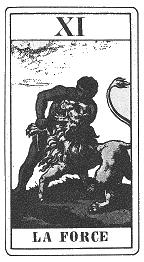

The I Ching and Tarot are uses of ritual to occupy the conscious mind with a certain controlled meaninglessness, in order for a non-ego function to manifest. Such divination does not make sense in our usual way of thinking, but at the same time we are hoping for something else and telling ourselves that normal reality may not be all there is. We are caught between normal reality on one hand and an indefinite appeal to "something else" on the other. In this Between-ness state access to paranormal information may exist. A new reality is temporarily created and this new reality does not bow to normal reasoning. The crucial state is the balanced tension between normal reality and the consideration of the "impossible" or the paranormal.
There is a mass of evidence pertaining to the psychic powers of witch doctors and shamans of primitive cultures. In anthropological investigations there is much written about the shaman's understanding of the Between-ness required in producing paranormal results. Paul Adams, in his study of Huichol Indian shamans, writes: "There is a doorway within our minds that usually remains hidden and secret until the time of death. The Huichol word for it is 'nierika.' Nierika is a cosmic portway or interface between ordinary and non-ordinary realities. It is a passageway and at the same time a barrier between worlds."
While Between-ness is a mental balance and tension, shamans often incorporate physical acts of balance into their rituals to induce the proper mental state. Australian Aborigine shamans will stand balanced on one foot all day in the desert sun in the state they call "dreamtime." Anthropologist Barbara Meyerhoff, in her article "Shamanic Equilibrium," describes the peculiar balancing ritual of a Mexican Indian healer she met. The man had developed a considerable reputation, and as he didn't accept money for his services, he limited healing to weekends and worked for his living during the week. On Friday people would begin arriving, some from as far away as Europe. Every Friday afternoon the man would climb to the roof of his shack and remain perched on one foot on the peak for the rest of the day. Meyeroff originally thought it was his peculiar way of observing people arriving, but later realized it was a mental preparatory ritual of balance.
Meyeroff witnessed a unique display of balance by a shaman during her own work with the Huichol Indians of North Central Mexico:
"One afternoon, without explanation, he interrupted our sessions of taping mythology to take a party, Huichol friends and myself, to an area outside his home. It was a region of steep barrancas cut by a rapid waterfall cascading perhaps a thousand feet over jagged, slippery rocks. At the edge of the falls, Ramon removed his sandals and announced that this was a special place for shamans. He proceeded to leap across the waterfall, from rock to rock, frequently pausing, his body bent forward, his arms outspread, head thrown back, entirely birdlike, poised motionlessly on one foot. He disappeared, reemerged, leaped about, and finally achieved the other side."
He later told Meyeroff that his display was to impress upon her what extreme balance a shaman must have, and demonstrated this by marching his fingers up the strings on his violin. He also implied that it was dangerous to attempt this balance because one might "fall into the abyss." Meyeroff further describes the elusive Between-ness state of shamanic balance:
"Shamanic balance is a particular stance. It is not a balance achieved by synthesis; it is not a static condition achieved by resolving opposition. It is not a compromise. Rather it is a state of acute tension, the kind of tension which exists... when two unqualified forces encounter each other, meeting headlong, and are not reconciled but held teetering on the verge of chaos, not in reason but in experience."
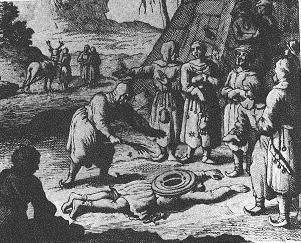
[Illustration: A Lapp shaman lies in a trance in preparation for his fortune telling activities. His vital magic drum remains on his back.]
Writers may sometimes place insights down in the form of fiction when they do not have enough hard evidence to place them in a scientific format. I believe Colin Wilson's The Mind Parasites is one case of this guise. In it Wilson gives the best description of Between-ness available in any popular book. Wilson's chief character finds a peculiar way of "holding his head" to do unusual things:
"At this moment, a mosquito buzzed viciously past my ear with its high pitched whine; a moment later, it came past again. My mind still full of Heidegger, I glanced up at it, and wished that it would find its way to the window. As I did so, I had a distinct sense of my mind encountering the mosquito. It veered suddenly off its course and buzzed across the room to a closed window. My mind kept a firm grasp on it, and steered it across the room to the fan vent in the open window, and outside.
"I was so astonished that I sat back and gaped after it. I could hardly have been more astonished if I had suddenly sprouted wings and started to fly. Had I been deceived in supposing that my mind had guided that creature? I remembered that the washroom had a plague of wasps and bees, for there was a bed of peonies underneath its window. I went along there. It was empty, and there was a wasp buzzing against the frosted glass of the window. I leaned my back against the door, and concentrated on it. Nothing happened. It was frustrating - there was a sense of doing something wrong, like trying to pull open a locked door. I cast my mind back to Heidegger, felt the lift of exaltation, of vision, and suddenly felt my mind click into gear. I was in contact with the wasp, just as certainly as if I was holding it in my hand. I willed it to move across the room. No, 'willed it' is the wrong phrase. You do not 'will' your hand to open and close; you just do it. In the same way, I drew the wasp across the washroom towards me; then, just before it reached me, made it turn and veer back to the window and out. It was so incredible that I could have burst into tears, or roared with laughter."
Wilson's character discovers a state of mind between trying and not trying, pure mental will-power he finds will not work. "You do not 'will' your hand to open and close; you just do it." Wilson compares the unused powers of the mind to that of a huge computer at which we sit every day, only to perform simple arithmetic problems instead of using the computer's other vast powers. In the last chapter of his Mind Parasites, Wilson's keen imagination has fifty minds "en rapport" being able to alter the orbit of the moon. While this feat is proper to the realm of science fiction, such a sober mind as philosopher Franklin Merrill-Wolff believes that similar actualities are within the potential of the human mind, perhaps in some far-off age. Once again Merrill-Wolff refers to the peculiar mental balance in which the paranormal can occur:
"There is a hidden, as well as an obvious, meaning behind the 'lever of Archimedes.' There is both a lever and a fulcrum, mastery of which gives power to move the world. But these forces act solely at a point of very fine balance, which is attained only with very great difficulty, and which is also not easily maintained after having been achieved. The violent wind of world-consciousness affords a most serious obstacle to the realization of such a balance, and right here lies part of the reason why humanity enjoys so restricted a portion of the benefits that might accrue to it from the great Hidden Powers of Man."
The parapsychology of the future must in part be a subjective science and investigate the subjective state that is conducive to ESP. Paranormal information has been proven to be the result of no known and measurable physical force and thus appears to be the function of a non-physical domain and a peculiar mental state. The concept of Between-ness is an effort to describe a peculiar subjective state that has been alluded to throughout paranormal literature. It is difficult to describe elusive, subjective states and an attempt to describe Between-ness is no exception. It is not a state that can be controlled, created and tested in the laboratory, but the concept of Between-ness and its ramifications can be the beginning of a whole new subjective science of the mind.
The Childhood Door
by Howard E. Rawlinson
While I was yet a child, I knew a stream
That snaked its way
Through bushes, brambles, briers
Until it burst upon an open grassy glen.
This was my hide-away, my secret place
To which I stole to think my boyhood thoughts
To dream my boyhood dreams.
I sought it only during day, never after dark
If I had known of Shakespeare then and dared to go at night
I would have seen - I'm sure I would have seen
Titania, that fairy queen, laughing, leaping on the lawn
With Oberon. A fawn, I once found sleeping there beside the stream
And fairy necklaces that glistened in the sun.
Though I was one who had not learned the lore of fairy folk,
Still there were those who came to romp within my room at night
Who brought delight, who made my spirits gay.
They were real, as real to me as were my playmates of the day.
I did not ask them who their parents were,
Nor how it happened they could visit on the sly.
The pleasure of their presence there brought joy enough
Besides, a child learns early not to pry.
It's strange I never saw them in my secret spot
And I did not invite the ones with whom I played by day.
There lay within my mind the haunting thought
That if I brought them to my secret place,
The place itself might go away
Might vanish as my phantom friends of night would
Vanish at the sound of footsteps on the stair.
There beside the stream I listened to the waters
As they bubbled, burbled, gurgled as they swirled among the rocks.
I lay content to listen to their liquid lulling sounds
Sounds uttered as they muttered over stones
Sometimes their tones were sibilant and soft
As if they whispered lest I understand.
Sometimes they chatted, blatted, babbled loud
Defying me to pierce the shroud
Of meaning in the sentences they spoke.
One day I thought I heard a word,
Stirred, my body moved beside the stream
Canted ear to catch the sound
Found I almost understood the words the waters said--
An almost thing that teased and tantalized
Later, when I prized myself upon my knowledge of a foreign tongue
I found that while my mind sought meaning in the sound
I gained the word but lost the sense of sentence and of phrase
So was it when I heard the waters talk
The words I heard or thought I heard were
Like some half-remembered tune
That will not come to mind
Although one knows the tune lies just beyond the wall of knowing.
That night with glowing words
I told my parents what I thought I knew
My mother laughed a scornful laugh
My father drew my hand to his
And said it is a pity to contaminate your mind
With thoughts that things inanimate can speak
I said no more. I did not seek to penetrate their adult world.
But still the gift that I'd received
Lay curled around my heart locked forever in my secret self
They were my parents, wiser far than I.
But still, I knew the thing I knew
And something stirred within me and rebelled.
I quelled my anger, kept my secret in my secret place
Not even daring tell it to my friends.
Except for one, (the poets of the past would have pronounced her Fey)
A wisp of girl, pale-haired, pale-skinned, pale-eyed
Who lay beside me as we wriggled through the brush
Until we heard the rush of water over stones
Then she bent her head beside the stream
Turned enquiring eyes to mine and whispered,
"Do you understand the words the waters say?"
"They say that ere the spring is gone I shall be dead."
Her tender fingers touched my cheeks
To brush away the tears that brimmed my eyes
"This is no time for sighs," she said, "no time to grieve.
Although the words the waters say are true,
If you believe, I never shall be dead to you."
I did not cry as I past by her bier.
Although a tear or two I shed
When no one else was nigh, she never had deceived
So I believed the words she'd whispered
On the bank that afternoon.
That very night she joined my playmates in my room.
But soon I knew, I do not know exactly how I knew,
That neither she nor they were flesh, nor blood, nor bones
Life often hones the blade of childhood wisdom to a sharpened edge
That cuts away the bright full world of fantasy
And I began to see but emptiness within my room.
Reality and logic ruled my mind
I could not find a place for fairy folk
For things which can't be measured, weighed, nor analyzed
I prized myself upon my knowledge of a golden mean
By which one tested everything that was,
Found evidence that it was real,
Or lacking such, acknowledged it was not.
There was no middle ground, no place for things unseen
No faith that moves the mountains to the sea
"What is," the credo said, "is what it is,
Is what it was, and what it ever more shall be."
More recently I've come to doubt the adult world
The way that world once doubted mine
And I consign their truths
To where they once consigned my truths
I find uncouth the rigid patterned mind
That is content with only what it touches, tastes, or feels.
Who kneels before an Altar pledges faith in things unseen
But often will deny that other things unseen can be.
I sometimes wonder if the faith which he vouchsafed so boldly there
In praise and Prayer is real to him
Or just a thing which grows to be a part of him
The way a wart grows on a finger or a nose.
Reality is never all that it appears
It's just a point of truth which moves from here to there
A light that gleams a moment then goes out,
A flickering shadow on a caveman's wall.
My fey companion never died at all
Although I buried her in later years
When fear of what the world might think of me bound me in chains.
Now there remains a second opportunity,
And I know truth is never just exactly what it seems.
It is a growing, living thing that changes
With the time, the tide, the place.
She tells me all about it in my dreams.
The Lost Chord
by Philip George Beith
SNUGGLED AMONG THE TOWERING BUILDINGS of a well-known research and development corporation is a small, attractive reception office. The approaching visitor is lured through a wide glass door entrance and confronted by an immense painting that startles the accustomed thinker.
Harmoniously daubed on silvery metal the artist depicts the profile of a man, standing alone, with raised arms stretched toward the heavens. A bright orange-yellow fireball streaks across a star speckled background leaving a contrail of colors like the tail of a comet that homogenizes into a majestic violet aura surrounding the head of the lonely man.
At the bottom of the painting, inscribed in bold English are these eight words:
Strike the Cosmic Chord O Ye Inspired Seeker
How do we define an inspired seeker; and how can he strike the cosmic chord? To be inspired is to have an invigorating influence exerted upon the emotions to animate and stir them into action. To seek is to search, to strive, to obtain.
The seeker is then forever searching. The seeker is being influenced, but what is this influence that is being exerted upon the seeker? Why is the seeker forever searching? We see evidence of this drawing power by the discontent in the world today.
The alcoholic is searching for relief in the swallow of burning liquid. The unclean beatniks of the 'sixties were searching for a release by an attitude of carelessness. The marching integrators were searching for their answer through physical violence. The bankers and tycoons are seeking happiness through the power of money. The multitude of religions are searching for peace, but fail to find truth because they are lost in the forest of theology.
All are being drawn by a magnetic pull that they cannot resist. This influence is the positive attraction of the human soul yearning for the GOD of his or her own heart or Supreme being or whatever name you bestow on Deity.
The creative intelligence has endowed man with the ability to experiment with this magnetic attraction. And man has been able to harness and control one phase of this ever present force. An analogy of this force can be demonstrated through the manifestation of the world of electronics. Due to the vibratory nature of the earthly elements, a so-called current can be caused to flow by applying a force with opposite polarities.
For example we will take a common battery as a source of power. We have been taught that opposites attract. Then by connecting a wire to the negative pole of the battery through a light bulb and back to the positive pole of the battery we will cause a steady current to flow. Why? Again because opposites attract. The positive terminal is absorbing and drawing the electrons through the wire from the negative pole. The negative electrons in turn are desperately seeking a path to return to their positive source. The positive draws and influences the negative. The negative seeks and searches for the positive. There must be opposites to cause an attraction.
This attraction produces a steady flow of current through the wire only as long as the one end remains positive with respect to the other end being negative. A potential power does not have the quality of positive alone. Neither does it have the quality of being negative.
This attracting force has the amount of energy in exact proportion to the difference between the positive and the negative. The greater the span between the opposites, the greater is the attraction from the negative toward the positive.
The lesser always seeks and becomes the greater. The river races toward the ocean. The seed grows into a tree. Man emulates his more evolved brethren as he himself slowly evolves. The soul is for ever seeking knowledge. This great attracting force of power manifests through us and radiates in the form of true LOVE. This force, this power - is LOVE. Love means a craving for the GOD of our hearts.
As the current flows through the wire toward its source, it is silently performing the work it was destined to do. That of lighting the bulb. Just as the growing flower gives off a delightful fragrance and the reaching tree produces edible fruit, so is man on his upward climb destined to perform a service according to his past desires. Silently strive to be of service to those who are in need - for love is real only when it is useful and expresses itself through action. Let us again return to the analogy of the electrical wire. The electron current does not flow through the wire without a struggle. As the electrons are drawn toward their positive source, a magnetic field will expand and surround the wire. This field, or aura, will expand and contract according to the frequency or vibration of the source of power.
If a second wire is positioned within the magnetic field of the first wire, an equal but opposite current will be caused to flow through the second wire. This in turn will produce a reluctance in the current flowing through the first wire. Thus if many wires and electrical components are placed in close proximity to one another, the magnetic field or individual aura of each component will have a definite effect on every other component according to the polarity of its vibration.
If a negative field is projected between the opposite poles of the battery, it will create a deterring effect on the flow of current and cause the light bulb to become dim. If this field becomes more negative than the negative pole on the battery, it can cause the current to cease flowing through the bulb and the light will go out, because the polarity has now changed making the negative pole of the battery the positive attraction to the negative interference. The current has found a new path to follow due to the laws of attraction.
But if a positive field were projected it would aid, it would support, and it would assist the current flow causing the bulb to become brighter and more powerful.
If one would look at the bottom of a radio or television set he would see many electrical components of different size and shape and color. The perplexity of magnetic fields heterodyning within the set are as great in number as the amount of components. Each has been placed in a physical position or environment to do a specific job according to the manufactured scale of vibrations.
The positive will attract and control the finer signals of reception - not alone - but in harmony and unison. The negative will react in the coarse static and fuzziness by the nature of their lower vibrations.
This is why good company is of paramount importance, for you will always be in the center of a multitude of magnetic fields or auras. You need the inspiration of better company - of those more highly evolved than yourself - to constantly improve. You must also share your own goodness with people of inferior qualities who need your help. Unselfishness takes everybody into the circle of brotherhood. Consider no one a stranger. Whatever you want others to be, first be that yourself. For you are the attraction.
The signal coming from the transmitter to the antenna of your radio or television set is government controlled at one specific frequency or vibration. In order for you to receive a clear picture, the components must be adjusted and aligned so that their auras are in tune with that one frequency and one vibration only. This is done by applying batteries or sources of power at different levels of polarity to bias and control the magnetic fields into a condition of alignment and attunement with the transmitting source.
Our battery that puts a bias on conditions around us is our volition. Exerting our will with a cool, calm, determined, steady, smooth-flowing effort of the attention and the whole being toward oneness with a definite goal, we are aligning ourselves with the infinite.
The greater the exertion of the will, the greater the flow of energy. Thy will be done.
We become out of tune with restlessness. Learn to destroy foolish desires and nourish only those that are worthwhile with environment and activity. Unhappiness is caused by failure. Mental conquest brings happiness. Concentration is the power to focus the mind on any desired line of thought. Meditation is concentration used only to know the GOD of your heart.
Practice loving those who do not love you. Constant communion with the Infinite through meditation will fill you with divine love - that power, that attraction - which alone will enable you to love your enemies.
We are all seeking. We are all searching. Whether for attunement to the cosmic or for some greater material thing in life, it is always from something lesser to something greater. The measure of success is described in a few lines of verse written by Berton Braley:
If you want a thing bad enough
To go out and fight for it,
Work day and night for it,
Give up your time and your peace and your sleep for it,
If only desire of it
Makes you quite mad enough
Never to tire of it,
Makes you hold all other things tawdry and cheap for it,
If life seems all empty and useless without it
And all that you scheme and you dream is about it,
If gladly you'll sweat for it,
Fret for it, Plan for it,
Lose all your terror of GOD or man for it,
If you'll simply go after that thing that you want,
With all your capacity,
Strength and sagacity,
Faith, hope and confidence, stern pertinacity,
If neither cold poverty, famished and gaunt,
Nor sickness nor pain
Of body or brain
Can turn you away from the thing that you want,
If dogged and grim you besiege and beset it,
YOU'LL GET IT.
Seek ye first the kingdom of the GOD of your heart and all these things shall be attracted toward you - according to thy will. Strike the cosmic chord O ye inspired seeker.
My Platonic Sweetheart
by Mark Twain
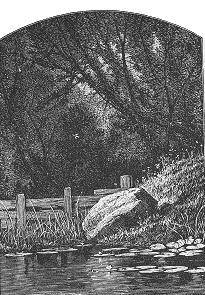
I MET her first when I was seventeen and she fifteen. It was in a dream. No, I did not meet her; I overtook her. It was in a Missourian village which I had never been in before, and was not in at that time, except dreamwise; in the flesh I was on the Atlantic seaboard ten or twelve hundred miles away. The thing was sudden, and without preparation—after the custom of dreams. There I was, crossing a wooden bridge that had a wooden rail and was untidy with scattered wisps of hay, and there she was, five steps in front of me; half a second previously neither of us was there. This was the exit of the village, which lay immediately behind us. Its last house was the blacksmith-shop; and the peaceful clinking of the hammers—a sound which nearly always seems remote, and is always touched with a spirit of loneliness and a feeling of soft regret for something, you don't know what—was wafted to my ears over my shoulder; in front of us was the winding country road, with woods on one side, and on the other a rail fence, with blackberry vines and hazel bushes crowding its angles; on an upper rail a bluebird, and scurrying toward him along the same rail a fox-squirrel with his tail bent high like a shepherd's crook; beyond the fence a rich field of grain, and far away a farmer in shirt-sleeves and straw hat wading knee-deep through it; no other representatives of life, and no noise at all; everywhere a Sabbath stillness.
I remember it all—and the girl, too, and just how she walked, and how she was dressed. In the first moment I was five steps behind her; in the next one I was at her side—without either stepping or gliding; it merely happened; the transfer ignored space. I noticed that, but not with any surprise; it seemed a natural process.
I was at her side. I put my arm around her waist and drew her close to me, for I loved her; and although I did not know her, my behavior seemed to me quite natural and right, and I had no misgivings about it. She showed no surprise, no distress, no displeasure, but put an arm around my waist, and turned up her face to mine with a happy welcome in it, and when I bent down to kiss her she received the kiss as if she was expecting it, and as if it was quite natural for me to offer it and her to take it and have pleasure in it. The affection which I felt for her and which she manifestly felt for me was a quite simple fact; but the quality of it was another matter. It was not the affection of brother and sister—it was closer than that, more clinging, more endearing, more reverent; and it was not the love of sweethearts, for there was no fire in it. It was somewhere between the two, and was finer than either, and more exquisite, more profoundly contenting. We often experience this strange and gracious thing in our dream-loves; and we remember it as a feature of our childhood-loves, too.
We strolled along, across the bridge and down the road, chatting like the oldest friends. She called me George, and that seemed natural and right, though it was not my name; and I called her Alice, and she did not correct me, though without doubt it was not her name. Everything that happened seemed just natural and to be expected. Once I said, "What a dear little hand it is!" and without any words she laid it gracefully in mine for me to examine it. I did it, remarking upon its littleness, its delicate beauty, and its satin skin, then kissed it; she put it up to her lips without saying anything and kissed it in the same place.
Around a curve of the road, at the end of half a mile, we came to a log house, and entered it and found the table set and everything on it steaming hot—a roast turkey, corn in the ear, butterbeans, and the rest of the usual things—and a cat curled up asleep in a splint-bottomed chair by the fireplace; but no people; just emptiness and silence. She said she would look in the next room if I would wait for her. So I sat down, and she passed through a door, which closed behind her with a click of the latch. I waited and waited. Then I got up and followed, for I could not any longer bear to have her out of my sight. I passed through the door, and found myself in a strange sort of cemetery, a city of innumerable tombs and monuments stretching far and wide on every hand, and flushed with pink and gold lights flung from the sinking sun. I turned around, and the log house was gone. I ran here and there and yonder down the lanes between the rows of tombs, calling Alice; and presently the night closed down, and I could not find my way. Then I woke, in deep distress over my loss, and was in my bed in Philadelphia. And I was not seventeen, now, but nineteen.
Ten years afterward, in another dream, I found her. I was seventeen again, and she was still fifteen. I was in a grassy place in the twilight deeps of a magnolia forest some miles above Natchez, Mississippi; the trees were snowed over with great blossoms, and the air was loaded with their rich and strenuous fragrance; the ground was high, and through a rift in the wood a burnished patch of the river was visible in the distance. I was sitting on the grass, absorbed in thinking, when an arm was laid around my neck, and there was Alice sitting by my side and looking into my face. A deep and satisfied happiness and an unwordable gratitude rose in me, but with it there was no feeling of surprise; and there was no sense of a time-lapse; the ten years amounted to hardly even a yesterday; indeed, to hardly even a noticeable fraction of it. We dropped in the tranquillest way into affectionate caressings and pettings, and chatted along without a reference to the separation; which was natural, for I think we did not know there had been any that one might measure with either clock or almanac. She called me Jack and I called her Helen, and those seemed the right and proper names, and perhaps neither of us suspected that we had ever borne others; or, if we did suspect it, it was probably not a matter of consequence.
She had been beautiful ten years before; she was just as beautiful still; girlishly young and sweet and innocent, and she was still that now. She had blue eyes, a hair of flossy gold before; she had black hair now, and dark-brown eyes. I noted these differences, but they did not suggest change; to me she was the same girl she was before, absolutely. It never occurred to me to ask what became of the log house; I doubt if I even thought of it. We were living in a simple and natural and beautiful world where everything that happened was natural and right, and was not perplexed with the unexpected or with any forms of surprise, and so there was no occasion for explanations and no interest attaching to such things.
We had a dear and pleasant time together, and were like a couple of ignorant and contented children. Helen had a summer hat on. She took it off presently and said, "It was in the way; now you can kiss me better." It seemed to me merely a bit of courteous and considerate wisdom, nothing more; and a natural thing for her to think of and do. We went wandering through the woods, and came to a limpid and shallow stream a matter of three yards wide. She said:
"I must not get my feet wet, dear; carry me over."
I took her in my arms and gave her my hat to hold. This was to keep my own feet from getting wet. I did not know why this should have that effect; I merely knew it; and she knew it, too. I crossed the stream, and said I would go on carrying her, because it was so pleasant; and she said it was pleasant to her, too, and wished we had thought of it sooner.
All the long afternoon I bore her in my arms, miles upon miles, and it never occurred to either of us that there was anything remarkable in a youth like me being able to carry that sweet bundle around half a day without some sense of fatigue or need of rest. There are many dream-worlds, but none is so rightly and reasonably and pleasantly arranged as that one.
After dark we reached a great plantation-house, and it was her home. I carried her in, and the family knew me and I knew them, although we had not met before; and the mother asked me with ill disguised anxiety how much twelve times fourteen was, and I said a hundred and thirty-five, and she put it down on a piece of paper, saying it was her habit in the process of perfecting her education not to trust important particulars to her memory; and her husband was offering me a chair, but noticed that Helen was asleep, so he said it would be best not to disturb her; and he backed me softly against a wardrobe and said I could stand more easily now; then a negro came in, bowing humbly, with his slouch-hat in his hand, and asked me if I would have my measure taken. The question did not surprise me, but it confused me and worried me, and I said I should like to have advice about it. He started toward the door to call advisers; then he and the family and the lights began to grow dim, and in a few moments the place was pitch dark; but straightway there came a flood of moonlight and a gust of cold wind, and I found myself crossing a frozen lake, and my arms were empty. The wave of grief that swept through me woke me up, and I was sitting at my desk in the newspaper office in San Francisco, and I noticed by the clock that I had been asleep less than two minutes. And what was of more consequence, I was twenty-nine years old.
That was 1864. The next year and the year after I had momentary glimpses of my dream-sweetheart, but nothing more. These are set down in my notebooks under their proper dates, but with no talks nor other particulars added; which is sufficient evidence to me that there were none to add. In both of these instances there was the sudden meeting and recognition, the eager approach, then the instant disappearance, leaving the world empty and of no worth. I remember the two images quite well; in fact, I remember all the images of that spirit, and can bring them before me without help of my notebook. The habit of writing down my dreams of all sorts while they were fresh in my mind, and then studying them and rehearsing them and trying to find out what the source of dreams is, and which of the two or three separate persons inhabiting us is their architect, has given me a good dream-memory—a thing which is not usual with people, for few drill the dream-memory and, no memory can be kept strong without that.
I spent a few months in the Hawaiian Islands in 1866, and in October of that year I delivered my maiden lecture; it was in San Francisco. In the following January I arrived in New York, and had just completed my thirty-first year. In that year I saw my platonic dream-sweetheart again. In this dream I was again standing on the stage of the Opera House in San Francisco, ready to lecture, and with the audience vividly individualized before me in the strong light. I began, spoke a few words, and stopped, cold with fright; for I discovered that I had no subject, no text, nothing to talk about. I choked for a while, then got out a few words, a lame, poor attempt at humor. The house made no response. There was a miserable pause, then another attempt, and another failure. There were a few scornful laughs; otherwise the house was silent, unsmilingly austere, deeply offended. I was consuming with shame. In my distress I tried to work upon its pity. I began to make servile apologies, mixed with gross and ill-timed flatteries, and to beg and plead for forgiveness; this was too much, and the people broke into insulting cries, whistlings, hootings, and cat-calls, and in the midst of this they rose and began to struggle in a confused mass toward the door. I stood dazed and helpless, looking out over this spectacle, and thinking how everybody would be talking about it next day, and I could not show myself in the streets. When the house was become wholly empty and still, I sat down on the only chair that was on the stage and bent my head down on the reading-desk to shut out the look of that place. Soon that familiar dream-voice spoke my name, and swept all my troubles away:
"Robert!"
I answered: "Agnes!"
The next moment we two were lounging up the blossomy gorge called the Iao Valley, in the Hawaiian Islands. I recognized, without any explanations, that Robert was not my name, but only a pet name, a common noun, and meant "dear"; and both of us knew that Agnes was not a name, but only a pet name, a common noun, whose spirit was affectionate, but not conveyable with exactness in any but the dream-language. It was about the equivalent of "dear," but the dream-vocabulary shaves meanings finer and closer than do the world's daytime dictionaries. We did not know why those words should have those meanings; we had used words which had no existence in any known language, and had expected them to be understood, and they were understood. In my note-books there are several letters from this dream-sweetheart, in some unknown tongue—presumably dream-tongue—with translations added. I should like to be master of that tongue, then I could talk in shorthand. Here is one of those letters—the whole of it:
"Rax oha tal."
Translation.—"When you receive this it will remind you that I long to see your face and touch your hand, for the comfort of it and the peace."
It is swifter than waking thought; for thought is not thought at all, but only a vague and formless fog until it is articulated into words. We wandered far up the fairy gorge, gathering the beautiful flowers of the ginger-plant and talking affectionate things, and tying and retying each others ribbons and cravats, which didn't need it; and finally sat down in the shade of a tree and climbed the vine-hung precipices with our eyes, up and up and up toward the sky to where the drifting scarfs of white mist clove them across and left the green summits floating pale and remote, like spectral islands wandering in the deeps of space; and then we descended to earth and talked again.
"How still it is—and soft, and balmy, and reposeful I could never tire of it. You like it, don't you, Robert?"
"Yes, and I like the whole region—all the islands. Maui. It is a darling island. I have been here before. Have you?"
"Once, but it wasn't an island then."
"What was it?"
"It was a sufa."
I understood. It was the dream-word for "part of a continent."
"What were the people like?"
"They hadn't come yet. There weren't any."
"Do you know, Agnes—that is Haleakala, the dead volcano, over there across the valley; was it here in your friend's time?"
"Yes, but it was burning."
"Do you travel much?"
"I think so. Not here much, but in the stars a good deal."
"Is it pretty there?"
She used a couple of dream-words for "You will go with me some time and you will see." Non-committal, as one perceives now, but I did not notice it then.
A man-of-war-bird lit on her shoulder; I put out my hand and caught it. Its feathers began to fall out, and it turned into a kitten; then the kitten's body began to contract itself to a ball and put out hairy, long legs, and soon it was a tarantula; I was going to keep it, but it turned into a star-fish, and I threw it away. Agnes said it was not worth while to try to keep things; there was no stability about them. I suggested rocks; but she said a rock was like the rest; it wouldn't stay. She picked up a stone, and it turned into a bat and flew away. These curious matters interested me, but that was all; they did not stir my wonder.
While we were sitting there in the lao gorge talking, a Kanaka came along who was wrinkled and bent and white-headed, and he stopped and talked to us in the native tongue, and we understood him without trouble and answered him in his own speech. He said he was a hundred and thirty years old, and he remembered Captain Cook well, and was present when he was murdered; saw it with his own eyes, and also helped. Then he showed us his gun, which was of strange make, and he said it was his own invention and was to shoot arrows with, though one loaded it with powder and it had a percussion lock. He said it would carry a hundred miles. It seemed a reasonable statement; I had no fault to find with it, and it did not in any way surprise me. He loaded it and fired an arrow aloft, and it darted into the sky and vanished. Then he went his way, saying that the arrow would fall near us in half an hour, and would go many yards into the earth, not minding the rocks.
I took the time, and we waited, reclining upon the mossy slant at the base of a tree, and gazing into the sky. By and by there was a hissing sound, followed by a dull impact, and Agnes uttered a groan. She said, in a series of fainting gasps:
"Take me to your arms—it passed through me—hold me to your heart—I am afraid to die—closer—closer. It is growing dark—I cannot see you. Don't leave me—where are you? You are not gone? You will not leave me? I would not leave you."
Then her spirit passed; she was clay in my arms.
The scene changed in an instant and I was awake and crossing Bond Street in New York with a friend, and it was snowing hard. We had been talking, and there had been no observable gaps in the conversation. I doubt if I had made any more than two steps while I was asleep. I am satisfied that even the most elaborate and incident-crowded dream is seldom more than a few seconds in length. It would not cost me very much of a strain to believe in Mohammed's seventy-year dream, which began when he knocked his glass over, and ended in time for him to catch it before the water was spilled.
Within a quarter of an hour I was in my quarters, undressed, ready for bed, and was jotting down my dream in my note-book. A striking thing happened now. I finished my notes, and was just going to turn out the gas when I was caught with a most strenuous gape, for it was very late and I was very drowsy. I fell asleep and dreamed again. What now follows occurred while I was asleep; and when I woke again the gape had completed itself, but not long before, I think, for I was still on my feet. I was in Athens—a city which I had not, then seen, but I recognized the Parthenon from the pictures, although it had a fresh look and was in perfect repair. I passed by it and climbed a grassy hill toward a palatial sort of mansion which was built of red terra-cotta and had a spacious portico, whose roof was supported by a rank of fluted columns with Corinthian capitals. It was noonday, but I met no one. I passed into the house and entered the first room. It was very large and light, its walls were of polished and richly tinted and veined onyx, and its floor was a pictured pattern in soft colors laid in tiles. I noted the details of the furniture and the ornaments—a thing which I should not have been likely to do when awake—and they took sharp hold and remained in my memory; they are not really dim yet, and this was more than thirty years ago.
There was a person present—Agnes. I was not surprised to see her, but only glad. She was in the simple Greek costume, and her hair and eyes were different as to color from those she had had when she died in the Hawaiian Islands half an hour before, but to me she was exactly her own beautiful little self as I had always known her, and she was still fifteen, and I was seventeen once more. She was sitting on an ivory settee, crocheting something or other, and had her crewels in a shallow willow work-basket in her lap. I sat down by her and we began to chat in the usual way. I remembered her death, but the pain and the grief and the bitterness which had been so sharp and so desolating to me at the moment that it happened had wholly passed from me now, and had left not a scar. I was grateful to have her back, but there was no realizable sense that she had ever been gone, and so it did not occur to me to speak about it, and she made no reference to it herself. It may be that she had often died before, and knew that there was nothing lasting about it, and consequently nothing important enough in it to make conversation out of.
When I think of that house and its belongings, I recognize what a master in taste and drawing and color and arrangement is the dream-artist who resides in us. In my waking hours, when the inferior artist in me is in command, I cannot draw even the simplest picture with a pencil, nor do anything with a brush and colors; I cannot bring before my mind's eye the detail image of any building known to me except my own house at home; of St. Paul's, St. Peters, the Eiffel Tower, the Taj, the Capitol at Washington, I can reproduce only portions, partial glimpses; the same with Niagara Falls, the Matterhorn, and other familiar things in nature; I cannot bring before my mind's eye the face or figure of any human being known to me; I have seen my family at breakfast within the past two hours; I cannot bring their images before me, I do not know how they look; before me, as I write, I see a little grove of young trees in the garden; high above them projects the slender lance of a young pine, beyond it is a glimpse of the upper half of a dull-white chimney covered by an A-shaped little roof shingled with brown-red tiles, and half a mile away is a hill-top densely wooded, and the red is cloven by a curved, wide vacancy, which is smooth and grass-clad; I cannot shut my eyes and reproduce that picture as a whole at all, nor any single detail of it except the grassy curve, and that but vaguely and fleetingly.
But my dream-artist can draw anything, and do it perfectly; he can paint with all the colors and all the shades, and do it with delicacy and truth; he can place before me vivid images of palaces, cities, hamlets, hovels, mountains, valleys, lakes, skies, glowing in sunlight or moonlight, or veiled in driving gusts of snow or rain, and he can set before me people who are intensely alive, and who feel, and express their feelings in their faces, and who also talk and laugh, sing and swear. And when I wake I can shut my eyes and bring back those people, and the scenery and the buildings; and not only in general view, but often in nice detail. While Agnes and I sat talking in that grand Athens house, several stately Greeks entered from another part of it, disputing warmly about something or other, and passed us by with courteous recognition; and among them was Socrates. I recognized him by his nose. A moment later the house and Agnes and Athens vanished away, and I was in my quarters in New York again and reaching for my note-book.
[Illustration: Windsor Castle.]
In our dreams—I know it!—we do make the journeys we seem to make: we do see the things we seem to see; the people, the horses, the cats, the dogs, the birds, the whales, are real, not chimeras; they are living spirits, not shadows; and they are immortal and indestructible. They go whither they will; they visit all resorts, all points of interest, even the twinkling suns that wander in the wastes of space. That is where those strange mountains are which slide from under our feet while we walk, and where those vast caverns are whose bewildering avenues close behind us and in front when we are lost, and shut us in. We know this because there are no such things here, and they must be there, because there is no other place.
This tale is long enough, and I will close it now. In the forty-four years that I have known my Dreamland sweetheart, I have seen her once in two years on an average. Mainly these were glimpses, but she was always immediately recognizable, notwithstanding she was so given to repair herself and getting up doubtful improvements in her hair and eyes. She was always fifteen, and looked it and acted it; and I was always seventeen, and never felt a day older. To me she is a real person, not a fiction, and her sweet and innocent society has been one of the prettiest and pleasantest experiences of my life. I know that to you her talk will not seem of the first intellectual order; but you should hear her in Dreamland—then you would see!
I saw her a week ago, just for a moment. Fifteen, as usual, and I seventeen, instead of going on sixty-three, as I was when I went to sleep. We were in India and Bombay was in sight; also Windsor Castle, its towers and battlements veiled in a delicate haze, and from it the Thames flowed, curving and winding between its swarded banks, to our feet. I said:
"There is no question about it, England is the most beautiful of all the countries."
Her face lighted with approval, and she said, with that sweet and earnest irrelevance of hers:
"It is, because it is so marginal."
Then she disappeared. It was just as well; she could probably have added nothing to that rounded and perfect statement without damaging its symmetry.
This glimpse of her carries me back to Maui, and that time when I saw her gasp out her young life. That was a terrible thing to me at the time. It was preternaturally vivid; and the pain and the grief and the misery of it to me transcended many sufferings that I have known in waking life. For everything in a dream is more deep and strong and sharp and real than is ever its pale imitation in the unreal life which is ours when we go about awake and clothed with our artificial selves in this vague and dull-tinted artificial world. When we die we shall slough off this cheap intellect, perhaps, and go abroad into Dreamland clothed in our real selves, and aggrandized and enriched by the command over the mysterious mental magician who is here not our slave, but only our guest.
Magic, White and Black by Franz Hartmann, M.D., Pyramid Press, Benwood, WV, 1980, 298 pp., $5.00
Franz Hartmann deals with the highest possible effort that man is capable of pursuing. His is not crude, manipulative, or lower-dimensional magic,—even though he allowed the title to hint that black magical formulae might be incorporated in this work. Franz Hartmann was manifestly a man of very high moral nature, more spiritual and more educative along spiritual lines than most of all Christian teachers. We might presume that the title was chosen to encourage the first openings of the book, but the immortality of the work was a direct result of word-of-mouth references as to its great value.
Today we are going through a strange metamorphosis. We are experiencing an inversion and confusion of human attitudes. Materialism has started to become ethereal, with science no longer expressed by hard numbers and symbols with exact meanings. The Tao of Physics points the way for this direction, wherein the essence of matter may be force, and the force someday may be discovered as Mind.
On the other hand, with regard to subjective matters like religion, the public has gone the other way. The masses that have ever been the bulwark of subjective, spiritual speculation are now drifting toward the abolition of the spiritual quest. God has been summoned to the witness stand and did not appear. Mind, the only faculty which is indispensable in spiritual realization, has been denied existence by behavioral psychologists. Even though immorality is directly tied to insidious diseases, there is an attempt to cure those diseases with chemicals (and thus chemically abolish guilt and immorality for all time), and with word-inversions so that we will no longer think about certain diseases as being negative. So that the word "syndrome" is the replacement for terminal affliction in some cases.
Franz Hartman was timely and valuable in the pre-inversion era a hundred years ago when Europe was suffering from powerfully invested, spiritual nebulosity. And once more, he is timely, for his formulae will prevent the terminal "syndromes," with a process that begins with symptoms of "peace of mind" and contains the potential for maximum realization of such abolished items as mind, Mind, and The Absolute Dimension.
His book is one of the greatest of all time, in comparison to those which might deal with the wisdom of man, psychology, science, or social relationships. He finds all wisdom within the self, and this wisdom can be attained by not allowing the lower self to prevent the greater Self from experiencing and becoming. He notes that intellectuality drifts into lower-self (mundane and somatic) selfishness unless it is always pointed toward Self-definition with the help of our own internal energy.
Magic, White and Black is of no value to those who are interested in power or possessions. But its lucid formula will change your life to something of conscious direction, and to an experience of beauty... the beauty that lies only in the depths of the Self.
A New Science of Life by Rupert Sheldrake. J.P. Tarcher, Inc., Los Angeles, CA 1981, $12.95
Rupert Sheldrake's A New Science of Life is one of those books which either is a herald of things to come in scientific paradigms, or is destined to become a curious divergence from validity. I suppose that in order to fully evaluate this work, one must be a research biologist, but it is certain to fascinate anyone who has struggled to reconcile mainstream scientific thought with occultism or mysticism. Outside of scientific circles, the book's greatest appeal will be to those who are content neither with hard-headed materialism or with wishful-thinking metaphysics. To those who cannot ignore the efficacy of scientific findings and yet cannot deny the grey area of unexplained phenomena where logic falters, this work will help reconcile seeming opposites. To be sure, it is not a compendium of Psi phenomena or a book of neat answers to thorny questions. It is more a challenge and a stimulant.
Sheldrake takes many of the same examples found in biological texts to advance his theory. Basically, he postulates that a non-material force or principle causes the manifestation of physical forms and processes. These non-material forces (morphogenetic fields) serve as a pattern for the organization of physical forms. Sheldrake's hypothesis of formative causation seeks to explain the repetition of forms and patterns of organization in both organic and inorganic matter. He borrows the concept of morphogenetic fields from holistic philosophy.
Sheldrake is careful to avoid untestable hypotheses. His point of departure from the Vitalists and Organicists is this very factor. He is attempting to bridge the gulf between speculative philosophy and scientific experimentalism by proposing a verifiable hypothesis. This in itself sets the book apart. He is presenting a non-materialistic hypothesis couched in a testable framework.
Sheldrake also exposes the dogmatic nature of current scientific thinking.
"In practice, the mechanistic theory of life is not treated as a rigorously defined, refutable scientific theory; rather, it serves to provide a justification for the conservative method of working within the established framework of thought provided by existing physics and chemistry."
In addition, he criticizes the two major alternatives to dominant scientific thought, Vitalism and Organicism, and carefully delineates the difference between these two schools and his own approach. He makes it clear that he is not concerning himself with ultimate definitions or the question of "why."
A New Science of Life is a book to be taken seriously, but at this time it is wishful thinking to expect scientific materialism to erode overnight. Science necessarily moves very slowly. Paradigms rarely change quickly, yet a perusal of current trends in the biological sciences gives the impression that a quantum leap forward in our knowledge of the nature of physical reality may be close at hand. The author sums this up very aptly.
"This new way of thinking is unfamiliar, and it leads into uncharted territory.... The alternative to going on would be to return to the starting point; the choice would once again be narrowed to that between a simple mechanistic faith and a metaphysical organicism."
Psychedelics Encyclopedia (Revised Edition) by Peter Stafford. J.P. Tarcher, Inc., Los Angeles, CA, 1983, 420pp., $12.95 (softcover)
If you wish to know anything at all about psychedelic drugs, you are very likely to find it in this book. Stafford has done a thorough reporting on every well-known psychedelic. He provides historical data, results of psychological testing, accounts of their use in religious rituals throughout the world, and even chemical compositions and brain effects. While Stafford furnishes us with a wealth of information, his Psychedelic Encyclopedia reads more like a novel than a top-heavy reference work. The many anecdotal stories and accounts of personal psychedelic experiences make for easy and enjoyable reading.
Stafford takes an unduly positive attitude toward the use of psychedelics (he dedicates the book to his young son "for future reference.") While psychedelics may have the ability to open a door to another dimension of the mind and reality, it is unlikely they can do much more than this. He virtually ignores any negative information pertaining to the drugs, except to refute the cases involved. No great philosophers, artists, or scientists have been created from ingesting psychedelics, although many outstanding minds have labeled an experiment with a psychedelic as a very valuable experience.
Concepts of Qabalah by William G. Gray. Samuel Weiser, York Beach, ME, 1984, 366 pp.
As one of the leaders of Western esotericism, William Gray's publication of his four-volume "Sangreal Sodality Series" will be greeted with interest by all serious students of Western occultism. Concepts of Qabalah is the third book to be released in this series (the fourth is yet to come). Of the first three volumes, I find it the most appealing from a philosophic standpoint. Gray has the ability to bring a very abstract subject, the Qabalah, down to the level where it can be comprehended by nearly anyone. His use of analogy is his strong point. He is able to bring the most difficult idea down to understandable terms without destroying its essence.
Gray likens the practice of magic and study of the Qabalah to the mathematical aspect of the search for God. While literature and mathematical science are the two polar opposites in worldly scholasticism, mysticism and magic are the two polar opposites in the search for God. Gray believes the "Qabalah is the only coherent, workable, and dependable scheme relating computable values with spiritual realities." The Jewish and later Christian originators of the Qabalah believed that creation occurred according to certain mathematical principles and processes. The study of the Qabalah is the attempt to uncover these principles, and the practice of magic is the attempt to put the discoveries to use in self-development and inner understanding.
In Western esotericism there is really no concept of "enlightenment" as is found in the East. Eastern tradition contends that it is possible to discover an ultimate value or experience in a single lifetime and thus end our round of incarnations. With the exception of a few Christian mystics, such as St. John of the Cross, the concept of an Absolute experience is simply not acknowledged in the West. Gray is no exception to this perspective. He sees the spiritual path as a progressive evolution that can reach its fruition in no earthly incarnation.
William Gray's "Sangreal Sodality Series" is written in the form of a series of workbooks for esoteric students who wish to adopt ritual magic as their method of spiritual endeavor. He provides progressive meditational disciplines and concludes each chapter with questions and exercises to insure the student has understood the preceding chapter. Contrary to many writers on the occult, Gray has a good deal of common sense. In this most abstract of human efforts, we are lucky to be able to get sound advice from someone who, while his head may be in the heavens, still has his feet firmly planted on the ground.
The Continuing Discovery of Chiron by Erminie Lantero. Samuel Weiser, York Beach, ME, 1983, 189pp., $8.95
In late 1977, astronomer Charles Koval of Hale Observatory in California discovered a new planetary body. The new satellite was observed in an orbit between Saturn and Uranus and is thought to have a diameter between one hundred and three hundred miles. While it is considerably smaller than other planets, it has been referred to as both a planet and an asteroid. Koval named his new discovery "Chiron," after the wise centaur in classical mythology who was the son of Saturn and grandson of Uranus. The Continuing Discovery of Chiron is Erminie Lantero's investigation of the astrological significance of this new heavenly body.
Lantero has a rich and varied background in religion and philosophy, having received her M. Div. at Union Theological in New York and her Ph.D. in philosophy at Radcliffe. She has taught in several colleges and was active for many years in the Christian ecumenical movement. Recently her interests have turned toward the esoteric and she has spent the last ten years in a study of astrology. She currently resides in a community based on the principles of philosopher Rudolf Steiner.
Mythologically, as the son of Saturn, Chiron (Ch pronounced as K) was considered an immortal. Chiron was a half-man, half-animal centaur and was put under the guidance of Apollo. Here he learned science and art, which raised him above the mere animalistic nature of the centaur. In fact, he became known as a wise teacher and physician and numbered among his pupils Achilles. Astrologically, Chiron symbolizes these refined traits as well as the animalistic facets of the centaur.
Dr. Lantero believes the effect of Chiron is present to a large degree in the recent prevalence of terrorism in international affairs. She examines the findings of other researchers in this area and applies this data to the assassination attempts on President Reagan, Pope John Paul and Anwar Sadat.
Lantero does an excellent job of presenting the information to date on Chiron, while adding that much is still left to be done. She also speculates about the effects of Chiron during the rest of this century. Few things can be more exciting to astrologers than the discovery of a new planetary body, and as one of the first books available in this new field, Lantero's The Continuing Discovery of Chiron may well prove to be a classic.
Vegetarianism As Spiritual Practice
by Tom Sperry
WHEN ONE THINKS OF A VEGETARIAN, he may visualize anything from a skinny girl picking at sunflower seeds to someone slaving for hours over a stove creating some "bean-delight." We in America are probably less familiar with vegetarianism than any other people in the world. Most of the world is on a vegetarian-centered diet and may not have the choice that we do in our prosperous country. I find it curious that of the many people I know who have undertaken a vegetarian diet, very few return to their former meat-eating ways.
When people determine to be vegetarians, it is normally because of one of four rationales - health reasons, moral reasons, political/ ecological reasons, or "spiritual" reasons. There is much evidence to indicate that a well-balanced vegetarian diet is superior to a meateater's diet. Meat contains trace quantities of several toxins and poisons and is generally harder on the digestive system than a vegetable, seed and fruit diet.* Morally, some people object to a meat diet because they do not believe in the "unnecessary" killing of animals, and especially the manner in which they are killed in slaughterhouses. Politically and ecologically, a vegetarian diet is the only alternative if there is any hope of adequately feeding the entire population of the globe. The world passed the point at which its population could be fed by a meat-centered diet over a century ago.
* The reason that meat contains undesirable poisons such as uric acid is that for a few hours after the slaughter of the animal, its body cells still continue to function and produce waste products, even though the blood is no longer circulating to remove the wastes.
In a basic sense, all rationales for becoming a vegetarian are spiritual in nature. A person attempting to improve his health is also trying to improve his whole being and mind. A person who is vegetarian for moral reasons is drastically altering his life for a spiritual conviction, and a person who becomes vegetarian for political reasons interprets spirituality in terms of social concern. Some, however, practice vegetarianism for directly psychological and "spiritual" reasons, because of the beneficial effect it has on refining and calming the mind.
Numerous spiritual teachers, especially from the East, recommend vegetarian diets. The ground given for this is to make one more receptive to subtle mental and spiritual influences. The Indian sage, Ramana Maharshi, has this to say: "Regulation of diet, restricting it to 'satvic' food, taken in moderate quantity, is of all the rules of conduct the best; and it is most conducive to the development of the 'satvic' qualities of the mind. These, in their turn, assist one in the practices of Atma vichara or inquiry in quest of the Self." (3) Satvic foods are described as "simple and nutritious food which sustains but does not stimulate the physical body." Satvic qualities of mind are "purity of heart, self-restraint, evenness of temper, tenderness towards all beings, fortitude and freedom from desire, hatred and arrogance."
How is it that a vegetarian diet makes a person more receptive to spiritual influences? Prerequisite in all schools of yoga is a control of the body. The mind seems to be divided into two halves, one "half" or level deals with all the input of the senses and the restlessness and feelings of the body. The "second half" or higher level of the mind deals with subtle mental realms like intuition, abstract logic and spiritual perceptions. If the attention is constantly occupied with the lower mind in dealing with a chaotic body and constant sensory stimulation of some sort, then concentration cannot be held in the higher and more spiritual portions of the mind. The first step in yoga is to calm the body so that the concentration can be directed to spiritual matters. Hatha-yoga develops control over the body through diet and exercise so that the mind can be undisturbed in meditation.
Many who practice vegetarianism for spiritual purposes claim that animal hormones contained in meat products and eggs stimulate the body by arousing baser animal drives and emotions. Most spiritual disciplines attempt to gain control over sexual and aggressive drives (to control them and not to be controlled by them.) An excess of animal hormones in the body only makes this attempt more difficult. This is why many Indian gurus recommend "satvic" foods that do not goad the body with an overabundance of influential hormones. The mind can be trained to control the body, but the state of the body has a definite effect in the perceptions and decisions of the mind. It could be argued that, once the instinctual desires are fully in one's control, a vegetarian diet would no longer be of much practical aid. All this is very difficult to prove objectively, since science does not think in these terms and is not directed toward this type of study. The only way it can be possibly "proven" is by reference to spiritual teachers or by the evidence of subjective and direct personal experimentation.
The regulation of the diet should be done with common sense and not taken as a substitute for spiritual disciplines. The vegetarian diet is only meant to be a foundation or aid to spiritual disciplines. The Indian teacher, Vivekananda, said: "The manipulating and control of the grosser is absolutely necessary to enable one to arrive at the control of the finer. The beginner, therefore, must pay particular attention to all such dietetic rules as have come down from the line of his accredited teachers." (4) He warns, though, of needless and harmful fanaticism in regard to diet. A suitable diet aids one in becoming "in tune" with spiritual dimensions, but dietary fanaticism cannot be substituted for spiritual endeavor. A good diet aids spiritual development but does not produce it automatically. "...The extravagant, meaningless fanaticism, which has driven religion entirely to the kitchen, as may be noticed in the case of many of our sects, ...is a peculiar sort of pure and simple materialism."
Vegetarian diet is also recommended occasionally in the Western spiritual tradition, but not so frequently as in the East. Actually, in the East, the question is often not even for consideration, since meat products are not readily available to the general population. In Western ceremonial magic, a vegetarian diet is usually prescribed in the purification rites before undertaking a magical ritual.
Gurdjieff, the famous Russian philosopher and teacher of the first half of this century, writes nowhere in regard to diet, as far as I am aware. The only reference to eating practices he makes is in his fantasy-like autobiography, Meetings With Remarkable Men. In his early life he maintained careful and fastidious eating habits, chewing each mouthful an exact number of times. A "wiseman" observed him eating and informed him that if he was so careful of his eating habits now, in his old age he would have a very weak stomach. To paraphrase the wiseman, "You should eat bones and rocks when you are young so that when you are old your stomach will be very strong!" Gurdjieff maintained that it didn't matter what you ate, but what you "did" with it after you ate it.
Robert Leftwich is an interesting case of a Western psychic. Colin Wilson devotes one-third of his book, Strange Powers, to this amazing man. Leftwich has proven his ability to astral-project, dowse and, apparently, even disperse clouds with an act of will. (5) According to an account in the encyclopedia Man, Myth and Magic, "He is a strict vegetarian, a tee-totaler, a non-smoker, and even abstains from tea and coffee, explaining that any form of stimulant is capable of interfering with his powers." Wilson claims that Leftwich has enough control of his abilities that he can "make" things happen while the vast majority of psychics are merely passive experiencers of phenomena.
There is a common belief that vegetarians cannot have as much "energy" as persons with meat in their diets. Leftwich is dramatic example of this fallacy. Wilson writes, "From my own experience of him, I can vouch that he never seems to get tired - at least, not noticeably. At seven in the morning, as Joy (Wilson's wife) was sleepily switching on the kettle and preparing to get the children's breakfast, Robert would appear outside the kitchen window, as chirpy as if he'd been for a ten-mile walk, looking for the shredded wheat and eager to elaborate on some point he'd overlooked the night before." Some even claim that a vegetarian diet can provide more strength and endurance than a meat diet.
The state of our mentality can be drastically affected by the chemical balance of the body-system. One usually thinks of himself as "unchangeable" and stable in some vague manner but therapeutic experience indicates that chemical imbalance or deficiencies can alter a person's attitude toward life and even mental capacity. George Watson in Nutrition and Your Mind relates the case of a man who so dramatically improved his mentality through taking a B-complex supplement that he left his mundane job and achieved a doctorate in mathematics in a few years. Dr. Watson writes, "Psychochemical behavior ranges from simple moodiness to extreme abnormality. In between lie a large number of conditions, such as lack of confidence, lack of ambition, vague fears, shyness, apathy, sadness, anger, irritability, and feelings of distrust and suspicion that puzzle and disturb the person who experiences them because he can neither understand nor control them."
The whole field of nutrition is truly "muddy water." The old adage, "One man's meat is another man's poison," seems to be true. George Watson postulates that there are "psychochemical types" and that chemicals, vitamins, and minerals may have drastically contrary effects on different types. The source escapes me, but I read recently of a case in point. It seems that a deranged young man was trying to "do-in" his father-in-law who was an unwanted member of his household. The young man set up a lab in his basement and fed the father-in-law everything from typhus to botulism germs. All this had absolutely no effect on the father-in-law and, if anything, his health improved. The desperate son-in-law finally resorted to a dependable arsenic compound, which turned the trick. (He was discovered and picked up by the police.) Some people seem to thumb their noses at all health rules and live to ripe old ages. I am acquainted with a 93 year-old man who had been an alcoholic for 50 years of his life, but is still as "sharp" and intelligent as anyone you could meet.
The Theosophists have an interesting perspective on nutrition. They believe in a literal sense that "you are what you eat":
"Enquirer: I understand now your general idea; but let us see how you apply it in practice. How about vegetarianism, for instance?
Theosophist: One of the great German scientists has shown that every kind of animal tissue, however you may cook it, still retains certain marked characteristics of the animal which it belonged to, which characteristics can be recognized. And apart from that, everyone knows by the taste what meat he is eating. We go a step farther, and prove that when the flesh of animals is assimilated by man as food, it imparts to him, physiologically some of the characteristics of the animal it came from. Moreover, occult science teaches and proves this to its students by ocular demonstration, showing also that this 'coarsening' or 'animalizing' effect on man is greatest from the flesh of the larger animals, less for birds, still less for fish and other cold-blooded animals, and least of all when he eats only vegetables.
Enquirer: Then he had better not eat all?
Theosophist: If he could live without eating, of course it would. But as the matter stands, he must eat to live, and so we advise really earnest students to eat such food as will least clog and weight their brains and bodies, and will have the smallest effect in hampering and retarding the development of their intuition, their inner faculties and powers."(6)
Santanelli, the master 19th century hypnotist and psychologist, took "you are what you eat" quite literally as well. In his book, The Power of Suggestion, he cites a case in which a young child was turned into a "little hog" in all her mannerisms and emotions because her mother constantly stuffed her with food. He cites another case in which some children were turned into "little animals" because of a diet of predominantly meat.
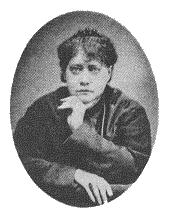
[Photo: H.P. Blavatsky, founder of the Theosophical Society, believed that meat had a "coarsening" or "animalizing" effect.]
"I know of a case of a very estimable lady who had two of the handsomest and sweetest little children I had ever seen. She came to me and said, 'Mr. Santanelli, I have two beautiful children, but they are the two meanest young ones in the city, they are quarreling with everybody; they are vicious. I have whipped them, I have punished them in every manner, but I cannot cure them. What can I do with them? Can they be cured?'
'Yes, madam; it is very easy. You simply have two little animals. What do you feed them?'
'Oh, in the morning we have a little ham and eggs, bacon or a little steak, at noon a little cold meat of some kind, and at dinner hot meat of some kind.'
'And you wonder that your children are as they are? What can you expect. You are feeding them on flesh. Their bodies are one mass of concentrated energy. Their digestive organs are all worried, irritated and overtaxed; they are in a naturally vicious mood. Take meat from their bill of fare, particularly the pork, and you will find you have no trouble with your children.' " (8)
Santanelli says that meat is too concentrated a form of energy for the body to easily handle without being overly stimulated and agitated. This tallies closely with the guru's warnings against meat. It definitely is not a "satvic" food.
From my own experience I think that a vegetarian diet has a calming and clarifying effect on the mind. I do notice a small loss of energy, but the energy I have is more of a constant and steady-flowing type, as opposed to the "protein rush" I get from eating a steak. I once impulsively broke a six month vegetarian "fast" at the local McDonald's with two "Big Mac's." The effect was uncanny and I felt like taking on the world with my two fists! It was a very high-strung and irritable state. A meat diet provides me with a more explosive energy, but also an energy which is more difficult to direct and often results in a case of the "fidgets."
A vegetarian diet is not necessary to improve yourself spiritually. However, it may be of great aid to those people who want to develop their intuitions, "spiritual sight" or psychic abilities. Some teachers, such as the "Mahatmas" of the early Theosophical Society, taught that vegetarianism is an absolute necessity in this process. (9) In the world of nutrition one must always consider individuals and their unique psychologies and body-make-ups, and realize that each person must experiment and determine what is best for himself.
Notes
The Presence of Spirits in Madness—A Confirmation of Swedenborg in Recent
Empirical Findings
by Wilson Van Dusen
Reprinted courtesy of the Swedenborg Foundation, N.Y., N.Y. 10010.
By an extraordinary series of circumstances a confirmation appears to have been found for one of Emanuel Swedenborg's more unusual doctrines—that man's life depends on his relationship to a hierarchy of spirits. Out of my professional role as a clinical psychologist in a state mental hospital and my own personal interest, I set out to describe as faithfully as possible mental patients' experiences of hallucinations. A discovery four years ago helped me to get a relatively rich and consistent picture of the patients' experience. Though I noticed similarities with Swedenborg's description of the relationships of man to spirits it was only three years after all the major findings on hallucinations had been made that the striking similarity between what Twentieth-Century patients describe and Swedenborg's Eighteenth-Century accounts became apparent to me. I then collected as many details as possible of his description. I found that Swedenborg's system not only is an almost perfect fit with patients' experiences, but even more impressively accounts for otherwise quite puzzling aspects of hallucinations. I will first describe how I worked and my findings, and then relate this to Swedenborg's work.
When Wilson Van Dusen wrote The Presence of Spirits in Madness he was Chief Psychologist at Mendocino State Hospital in California where he worked among the mentally ill for 17 years. In his spare time he had discovered a way of getting an unusually accurate detailed picture of the inner experience of hallucinations. Unfortunately the press of other administrative responsibilities took him away from this fascinating area towards the design of national programs especially in drug abuse treatment. He now lives the life of a busy scholar. He describes himself as primarily a phenomenologist, one concerned to discover and describe the real nature of human experience, as was Swedenborg.
Also, like Swedenborg, he has widespread interest in science and technology and is a licensed master mariner. He holds an A.B., M.A. from the University of California and a Ph.D., summa cum laude, from the University of Ottawa, Canada plus several other earned and honorary degrees in science, metaphysics, and investment. His two books The Presence of Other Worlds, and Natural Depth in Man (Swedenborg Foundation) have been translated into five foreign languages. He has also contributed to many other volumes and has written over 100 articles, mostly in psychology. He feels that the depth of Swedenborg's real contributions are as yet poorly understood because they must be used in life to see their scope and power. -Ed.
All the people involved hallucinated. They included chronic schizophrenics, alcoholics, brain-damaged and senile persons. The subjects of this study came to the attention of friends or the public because of unusual behavior. The average layman's picture of the mentally ill as raving lunatics is far from reality. Most of these people have become entangled in inner processes and simply fail to manage their lives well. In the hospital most have freedom of the grounds and the average visitor is impressed that, aside from occasional odd bits of behavior, the patients have most of their powers and appear like almost everyone else. Many return home in a month or two, never to need mental hospitalization again. Some become so enmeshed in inner processes that they slip to lower levels of mental disorder. The most severe disorder is usually that of a person who sits all day involved in inner processes, who obediently obeys the request of hospital staff to dress, eat, bathe, and sleep in the hospital routine.
The people described here range from a few months in the hospital to twenty years. Most would be like the patients on the hospital grounds who strike the visitor as not unlike themselves. A conversation with one of these patients might indicate to the visitor that the patient has an unusual set of beliefs—for instance, that he is kept in the hospital by a gang of thieves, or that ordinary clouds are radiation pollution. In many, even unusual beliefs would not be apparent. Most conceal that they hear and see things because they are wise enough to know the visitor doesn't and wouldn't understand. Their adjustment within the hospital is relatively good. Many do productive work ten to thirty hours a week. It is when they return to the relatively complex and demanding outside world that their adjustment often worsens. None of the patients at the most severe level of mental disorders could be included in this study because they couldn't describe their hallucinations well enough. After dealing with hundreds of such patients, I discovered about four years ago that it was possible to speak to their hallucinations. To do so I looked for patients who could distinguish between their own thoughts and the things they heard and saw in the world of hallucinations. The patient was told that I simply wanted to get as accurate a description of their experiences as possible. I held out no hope for recovery or special reward. It soon became apparent that many were embarrassed by what they saw and heard and hence they concealed it from others. Also they knew their experiences were not shared by others, and some were even concerned that their reputations would suffer if they revealed the obscene nature of their voices. It took some care to make the patients comfortable enough to reveal their experience honestly. A further complication was that the voices were sometimes frightened of me and themselves needed reassurance. I struck up a relationship with both the patient and the persons he saw and heard. I would question these other persons directly, and instructed the patient to give a word-for-word account of what the voices answered or what was seen. In this way I could hold long dialogues with a patient's hallucinations and record both my questions and their answers. My method is that of phenomenology. My only purpose was to come to as accurate a description as possible of the patient's experiences. The reader may notice I treat the hallucinations as realities because that is what they are to the patient. I would work with a patient for as little as one hour or up to several months of inquiry where the hallucinated world was complex enough.
Some may wonder why one should believe what these patients report. The patients cooperated with me only because I was honestly trying to learn of their experiences. They were not paid or even promised recovery or release from the hospital. Most of my subjects seemed fairly sensible except for the fact of hallucinations which invaded and interfered with their lives. On several occasions I held conversation with hallucinations that the patient himself did not really understand. This was especially true when I dealt with what will be described as the higher order hallucinations which can be symbolically rich beyond the patient's own understanding. There was great consistency in what was reported independently by different patients. I have no reason to doubt they were reporting real experiences. They seemed to be honest people as puzzled as I was to explain what was happening to them. The differences among the experiences of schizophrenics, alcoholics, the brain damaged and senile were not as striking as the similarities; so I will describe these hallucinated worlds in general.
One consistent finding was that patients felt they had contact with another world or order of beings. Most thought these other persons were living persons. All objected to the term hallucination. Each coined his own term such as The Other Order, the Eavesdroppers, etc.
For most individuals the hallucinations came on suddenly. One woman was working in a garden when an unseen man addressed her. Another man described sudden loud noises and voices he heard while riding in a bus. Most were frightened, and adjusted with difficulty to this new experience. All patients describe voices as having the quality of a real voice, sometimes louder, sometimes softer, than normal voices. The experience they describe is quite unlike thoughts or fantasies. When things are seen they appear fully real. For instance a patient described being awakened one night by Air Force officers calling him to the service of his country. He got up and was dressing when he noticed their insignia wasn't quite right; then their faces altered. With this he knew they were of The Other Order and struck one hard in the face. He hit the wall and injured his hand. He could not distinguish them from reality until he noticed the insignia. Most patients soon realize that they are having experiences that others do not share, and for this reason learn to keep quiet about them. Many suffer insults, threats and attacks for years from voices with no one around them aware of it. Women have reported hearing such vile things they felt it would reflection them should they even be mentioned.
In my dialogues with patients I learned of two orders of experience, borrowing from the voices themselves, called the higher and the lower order. Lower order voices are as though one is dealing with drunken bums at a bar who like to tease and torment just for the fun of it. They will suggest lewd acts and then scold the patient for considering them. They find a weak point of conscience and work on it interminably. For instance one man heard voices teasing him for three years over a ten-cent debt he had already paid. They call the patient every conceivable name, suggest every lewd act, steal memories or ideas right out of consciousness, threaten death, and work on the patient's credibility in every way. For instance they will brag that they will produce some disaster on the morrow and then claim honor for one in the daily paper. They suggest foolish acts (such as: Raise your right hand in the air and stay that way) and tease if he does it and threaten him if he doesn't. The lower order can work for a long time to possess some part of the patient's body. Several worked on the ear and the patient seemed to grow deafer. One voice worked two years to capture a patient's eye which visibly went out of alignment. Many patients have heard loud and clear voices plotting their death for weeks on end, an apparently nerve-wracking experience. One patient saw a noose around his neck which tied to "I don't know what" while voices plotted his death by hanging. They threaten pain and can cause felt pain as a way of enforcing their power. The most devastating experience of all is to be shouted at constantly by dozens of voices. When this occurred—the patient had to be sedated. The vocabulary and range of ideas of the lower order is limited, but they have a persistent will to destroy. They invade every nook and cranny of privacy, work on every weakness and credibility, claim awesome powers, lie, make promises and then undermine the patient's will. They never have a personal identity though they accept most names or identities given them. They either conceal or have no awareness of personal memories. Though they claim to be separate identities they will reveal no detail that might help to trace them as separate individuals. Their voice quality can change or shift, leaving the patient quite confused as to who might be speaking. When identified as some friend known to the patient they can assume this voice quality perfectly. For convenience many patients call them by nick-names, such as "Fred," The Doctor," or "The Old Timer." I've heard it said by the higher order that the purpose of the lower order is to illuminate all of the person's weaknesses. They do that admirably and with infinite patience. To make matters worse they hold out promises to patients and even give helpful sounding advice only to catch the patient in some weakness. Even with the patient's help I found the lower order difficult to relate to because of their disdain for me as well as the patient.
The limited vocabulary and range of ideas of the lower order is striking. A few ideas can be repeated endlessly. One voice just said "hey" for months while the patient tried to figure out what "hey" or "hay" was meant. Even when I was supposedly speaking to an engineer that a woman heard, the engineer was unable to do any more arithmetic than simple sums and multiplication the woman had memorized. The lower order seems incapable of sequential reasoning. Though they often claim to be in some distant city they cannot report more than the patient sees, hears, or remembers. They seem imprisoned in the lowest level of the patient's mind, giving no real evidence of a personal world or any higher order thinking or experiencing.
All of the lower order are irreligious or anti-religious. Some actively interfered with the patients' religious practices. Most considered them to be ordinary living people, though once they appeared as conventional devils and referred to themselves as demons. In a few instances they referred to themselves as from hell. Occasionally they would speak through the patient so that the patient's voice and speech would be directly those of the voices. Sometimes they acted through the patient. One of my female patients was found going out the hospital gate arguing loudly with her male voice that she didn't want to leave, but he was insisting. Like many, this particular hallucination claimed to be Jesus Christ, but his bragging and argumentativeness rather gave him away as of the lower order. Sometimes the lower order is embedded in physical concerns, such as a lady who was tormented by "experimenters" painfully treating her joints to prevent arthritis. She held out hope they were helping her, though it was apparent to any onlooker they had all but destroyed her life as a free and intelligent person.
In direct contrast stands the rarer higher order hallucinations. In quantity they make up perhaps a fifth or less of the patients' experiences. The contrast may be illustrated by the experience of one man. He had heard the lower order arguing a long while how they would murder him. He also had a light come to him at night like the sun. He knew it was a different order because the light respected his freedom and would withdraw if it frightened him. In contrast, the lower order worked against his will and would attack if it could see fear in him. This rarer higher order seldom speaks, whereas the lower order can talk endlessly. The higher order is much more likely to be symbolic, religious, supportive, genuinely instructive, and communicate directly with the inner feelings of the patient. I've learned to help the patient approach the higher order because of its great power to broaden the individual's values. When the man was encouraged to approach his friendly sun he entered a world of powerful numinous experiences, in some ways more frightening than the murderers who plotted his death. In one scene he found himself at the bottom of a long corridor with doors at the end behind which raged the powers of hell. He was about to let out these powers when a very powerful and impressive Christlike figure appeared and by direct mind-to-mind communication counseled him to leave the doors closed and follow him into other experiences which were therapeutic to him. In another instance the higher order appeared to a man as a lovely woman who entertained him while showing him thousands of symbols. Though the patient was a high-school educated gas-pipe fitter, his female vision showed a knowledge of religion and myth far beyond the patient's comprehension. At the end of a very rich dialogue with her (the patient reporting her symbols and responses) the patient asked for just a clue as to what she and I were talking about. Another example is that of a Negro who gave up being useful and lived as a drunken thief. In his weeks of hallucinations the higher order carefully instructed him on the trials of all minority groups and left him with the feeling he would like to do something for minorities.
In general the higher order is richer than the patient's normal experience, respectful of his freedom, helpful, instructive, supportive, highly symbolic and religious. It looks most like Carl Jung's archetypes, whereas the lower order looks like Freud's id. In contrast to the lower order, it thinks in something like universal ideas in ways that are richer and more complex than the patient's own mode of thought. It can be very powerful emotionally and carry with it an almost inexpressible ring of truth. The higher order tends to enlarge a patient's values, something like a very wise and considerate instructor. Some patients experience both the higher and lower orders at various times and feel caught between a private heaven and hell. Many only know the attacks of the lower order. The higher order claims power over the lower order and indeed shows it at times, but not enough to give peace of mind to most patients. The higher order itself has indicated that the usefulness of the lower order is to illustrate and make conscious the patients' weaknesses and faults.
Though I could say much more on what the patients reported, and quote extensively from dialogues with hallucinations, this is the substance of my findings. I was very early impressed by the overall similarities of what patients reported even though they had no contact with each other. After twenty patients there wasn't much more to be learned. I was also impressed by the similarity to the relatively little shown in the Biblical accounts of possession. These patients might well be going through experiences quite similar to what others experienced centuries ago.
Several things stood out as curious and puzzling. The lower order seemed strangely prevalent and limited. In the face of their claim of separate identity, their concealing or not knowing any fact (birthplace, schooling, name, personal history) which would set them apart was unusual. Their malevolence and persistence in undermining the patient was striking. And why would they consistently be unreligious or anti-religious? Just the mention of religion provokes anger or derision from them. In contrast, the higher order appeared strangely gifted, sensitive, wise and religious. They did not conceal identity but rather would have an identity above the human. For instance, a lady of the higher order was described as "an emanation of the feminine aspect of the Divine." When I implied she was Divine she took offense. She herself was not divine but she was an emanation of the Divine. I couldn't help but begin to feel I was dealing with some kind of contrasting polarity of good and evil. The patients' accounts of voices trying to seize for their own some part of the body such as eye, ear or tongue had a strangely ancient ring to it. Some people might suspect that my manner of questioning fed back to the patients what I wanted to hear, but after I addressed an audience including patients on hallucinations, many warmly commended me for capturing their own experiences too. As incredible as it may seem, I'm inclined to believe the above is a roughly accurate account of many patients' hallucinatory experiences.

I read and admired Swedenborg's work for some while, primarily because his religious experiences fit with my own and partly because of his immense knowledge of the hypnogogic state and the inner structure of the psyche. His doctrine regarding spirits I could neither affirm nor deny from my own experience, though it seemed a little incredible. As I describe Swedenborg's doctrine in this matter the similarity with my own findings will become apparent.
Swedenborg describes all of life as a hierarchy of beings representing essentially different orders and yet acting in correspondence with each other. The Lord acts through celestial angels, who in turn correspond on a lower level to spiritual angels, who in turn correspond to a third lower heaven—all of which corresponds to and acts into man. On the opposite side there are three levels of hell acting out of direct contact into man. Man is the free space and meeting ground of these great hierarchies. In effect, good and its opposite evil rule through this hierarchy of beings down to man who stands in the free space between them. Out of his experiences and choices he identifies with either or both sides. These influences coming from both sides are the very life of man. The man who takes pride in his own powers tends toward the evil side. The man who acknowledges that he is the receptacle of all that is good, even the power to think and to feel, tends toward the good side. In the extreme of evil, spirits claim power over all things and seek to subjugate others. In the extreme of good, angels feel themselves free in that the good of the Lord acts freely through them. Swedenborg's doctrine of the effect of spirits with man is simply the lower aspect of a whole cosmology of the structure of existence.
Key to References in the Text to Works of Swedenborg
(Swedenborg always numbered his paragraphs and the numbers after the symbols refer to these rather than to pages. These numbers are uniform in all editions.)
AC = Arcana Coelestia, 12 volumes
AE = Apocalypse Explained, 6 volumes
CL = Conjugial Love
DP = Divine Providence
HH = Heaven and Hell
LJ = Last Judgment
SD = Spiritual Diary, 5 volumes
"Such is the equilibrium of all in the universal heaven that one is moved by another, thinks from another, as if in a chain; so that not the least thing can [occur from itself]: thus the universe is ruled by the Lord, and, indeed, with no trouble (SD 2466). From this order of creation it may appear, that such is the binding chain of connection from firsts to lasts that all things together make one, in which the prior cannot be separated from the posterior (just as a cause cannot be separated from its effect); and that thus the spiritual world cannot be separated from the natural, nor the natural world from the spiritual; thence neither the angelic heaven from the human race, nor the human race from the angelic heaven. Wherefore it is so provided by the Lord, that each shall afford a mutual assistance to the other.... Hence it is, that the angelic mansions are indeed in heaven, and to appearance separate from the mansions where men are; and yet they are with man in his affections of good and truth." (LJ 9)
Each, man or spirit, is given to feel he is free and rules. Yet all are ruled (SD 3633). Even the world of matter is created and sustained by the Lord through the spiritual world (DP 3). It is normal that man does not feel himself to be the subject of a spiritual world. Swedenborg repeatedly enjoins that one is not even to attempt to become aware of the world of spirits because it is dangerous (HH 249, AC 5863). In the normal man spirits are adjoined to the man's spirit (AC 5862) or, what is the same, to more unconscious levels of his mind so that man is not aware of them. They flow into his feelings or into the matrix of thought (AE 1182). Spirits think spiritually and man naturally so that the two correspond to each other. In modern terms one would say spirits are in the unconscious and there live out their desires in what is to man the origin of his thought and feelings. In the normal situation man is not aware of their action, taking it to be his own thought and feeling. They, too, do not feel themselves to be in the life of a man. To all of man's experiences they have corresponding spiritual experiences. They do not see or hear the man's world. The spirits adjoined to man have dispositions similar to the man's. As Swedenborg says, with a bit of humor, enthusiastic spirits are with the enthusiastic (AE 1182). Thus they act together. Man is free to act, but by this relation to a hierarchy of spirits his tendencies are conditioned (AC 5850). His identification with good or evil tendencies, by his acts, further the conditioning in one direction or another. Good spirits or angels dwell in the most interior aspects of man's mind—in his loves, affections or ends (AC 2472), or as modern psychology would put it, they think more abstractly. One of their thoughts would cover thousands of a natural man's thoughts. The soul, spirit or interior man are the same thing (AC 6059).
"...being thus supereminent, spiritual ideas or thoughts, relatively to natural, are ideas of ideas, thoughts of thoughts; that by them, therefore, are expressed qualities of qualities and affections of affections; and, consequently, that spiritual thoughts are the beginnings and origins of natural thoughts." (CL 326:7)
Evil spirits reside in a lower but still unconscious area of mind, the personal memory. Those like the man are joined to him and they take on the memory of the man and neither the man nor they know that they are separate. They are in what Swedenborg calls his scientifics, or the facts and tendencies stored in the memory.
To some this whole conception of Swedenborg's sounds strange and even highly improbable. Scientifically it appears beyond any real test. If man cannot know these spirits, nor do they even know they are with man, the matter is like the worst speculation and not open to examination. In Swedenborg's personal diary and other works he tells how he felt gifted by the Lord with the experience both of heaven and hell and could examine over a period of many years their exact relationship to man. To learn of the powers and tendencies of evil spirits he was attacked by them as though he were a man possessed, yet it was not permitted that he be injured by them. In this respect his account sounds very much like madness with hallucinations and delusions. Yet the many documents that have been gathered* testify to his normal and even prosperous life as a nobleman, respected scientist and man of the world. Apparently he was a gifted man who was allowed to explore experiences that other less gifted persons are caught within.
* R.L. Tafel, Documents Concerning Swedenborg, 3 Vols., Swedenborg Society, London, 1890.
A. Acton, Letters and Memorials of Emanuel Swedenborg, 2 Vols., Swedenborg Scientific Association, Bryn Athyn, Pa., 1948.
G. Trobridge, Swedenborg, Life and Teaching, Swedenborg Society, London, 1945.
The diagnosis of schizophrenia did not exist in his day, it having been first clearly delineated in 1911 by Eugen Bleuler. He did speculate on the nature of madness, sometimes describing it as being too involved in one's own fantasies (SD 1752), and sometimes ascribing it to pride in one's own powers (spiritual madness) (AC 10227:3). He gave much description of possession by spirits and what they did. Present day psychosis always involves some degree of self pride (spiritual madness) but the hallucinated aspect looks most like what Swedenborg described under the general headings of obsessions (to be caught in false ideas) and possession (to have alien spirits acting into one's thought, feelings, or even into one's own bodily acts.) (HH 257) He indicates that normally there is a barrier between these spiritual entities and man's own consciousness. He also makes quite clear that if this barrier of awareness were penetrated the man would be in grave danger for his mental health and even for his life. (HH 249) If evil spirits knew they were with man they would do all sorts of things to torment him and destroy his life. What he describes looks remarkably like my own findings on the lower order hallucinations. Let us consider lower order hallucinations and possession by evil spirits together. You will recall that I said lower order hallucinations act against the patient's will, and are extremely verbal, persistent, attacking, and malevolent. They use trickery to deceive the patient as to their powers, threaten, cajole, entreat, and undermine in every conceivable way. These are all characteristic of possession by evil spirits which takes place when the spirits are no longer unconscious, but have some awareness of themselves as separate entities and act into consciousness.
It is not clear how the awareness barrier between spirits and man is broken. In Swedenborg's case he had a way of minimal breathing and concentrating inwardly for most of his life—a practice that resembles the yogic Pranayama and Pratyahara, which is calculated to awaken inner awareness. In the context of his whole system of thought one would surmise this inner barrier of awareness is penetrated when the person habitually withdraws from social usefulness into inner fantasy and pride. This would conform to contemporary social withdrawal which is the earliest aspect of schizophrenia. I am relatively certain that religious faith alone doesn't prevent hallucinations because many patients try to save themselves by their faith. Observation would suggest useful social acts (charity) would come closer to preventing schizophrenia.
All of Swedenborg's observations on the effect of evil spirits entering man's consciousness conform to my findings. The most fundamental is that they attempt to destroy him. (AC 6192, 4227) They can cause anxiety or pain. (AC 6202) They speak in man's own native tongue. (CL 326, DP 135) (The only instances I could find where hallucinations seemed to know a language other than the patient's were from the higher order.) They seek to destroy conscience (AC 1983) and seem to be against every higher value. For instance they interfere with reading or religious practices. They suggest acts against the patient's conscience and if refused threaten, make them seem plausible, or do anything to overcome the patient's resistance. Swedenborg says these spirits can impersonate and deceive. (SD 2687) This accounts for one puzzling aspect. Patients say voices can shift sound and identity as they speak, making it impossible to identify them. Or if a patient treats them as some known individual they will act like him. They lie. (SD 1622) Most patients who have experienced voices for any length of time come to recognize this. They tell a patient he will die tomorrow and yet he lives. They claim to be anyone including the Holy Spirit. (HH 249) It took some while for a woman patient to come to realize the male voice in her probably was not Jesus Christ as he claimed. She considered him sick and proceeded to counsel this voice, which improved and left her! He claimed he could read my mind, but I showed her by a simple experiment that he couldn't.
"When spirits begin to speak with man, he must beware lest he believe them in anything; for they say almost anything; things are fabricated by them, and they lie; for if they were permitted to relate what heaven is, and how things are in the heavens, they would tell so many lies, and indeed with a solemn affirmation, that man would be astonished; ... They are extremely fond of fabricating: and whenever any subject of discourse is proposed, they think that they know it, and give their opinions one after another, one in one way, and another in another, altogether as if they knew; and if a man listens and believes, they press on, and deceive, and seduce in divers ways." (SD 1622)
Though most patients tend to recognize this, most still put faith in their voices and remain caught by them. For instance, one lady felt a group of scientists including a physician and engineer were doing important but painful experiments on the ends of her bones. Even though I couldn't find a trace of medical knowledge in the physician or any mathematical ability above simple sums in the engineer, she continued to believe in them.
Many voices have indicated they will take over the world, or have already done so, which bit of bragging Swedenborg noticed too. (SD 4476) They can suggest and try to enforce strange acts in the patient and then condemn him for compliance. (AC 761) They draw attention to things sexual or simply filthy (SD 2852) and then proceed to condemn the person for noticing them. They often refer to the person as just an automaton or machine (SD 3633), a common delusional idea that many schizophrenics adopt. In the normal condition these spirits cannot see and hear the world of man (AC 1880), but in mental illness they can. (SD 3963) For instance I was able to give the Rorschach Ink Blot Test to a patient's voices separately from the patient's own responses. Since I could talk with them through the patient's hearing they could hear what the patient heard. Though they seem to have the same sensory experience as the patient I could find no evidence they could see or hear things remote from the patient's senses, as they often claimed.
There are a number of peculiar traits of the lower order hallucinations on which Swedenborg throws light. If voices are merely the patient's unconscious coming forth I would have no reason to expect them to be particularly for or against religion. Yet the lower order can be counted on to give its most scurrilous comments to any suggestion of religion. They either totally deny any after life or oppose God and all religious practices. (AC 6197) Once I asked if they were spirits and they answered, "the only spirits around here are in bottles" (followed by raucous laughter). To Swedenborg it is their opposition to God, religion, and all that it implies that makes them what they are.
Another peculiar finding is that the lower order hallucinations were somehow bound to and limited within the patient's own experiences. (AC 796f) The lower order could not reason sequentially or think abstractly as could the higher order. Also it seemed limited within the patient's own memory. For instance, one group of voices could attack the patient only for things he had recalled since they invaded him; and they were most anxious to get any dirt to use against the patient. Swedenborg throws light on this when he indicates evil spirits invade man's memory knowledge. This accounts for their memory limitation, their lack of sequential and abstract reasoning, and their extreme repetitiveness. As I indicated earlier, it is not uncommon for voices to attack a person for years over a single past guilt. It also accounts for the very verbal quality of the lower order as against the higher order's frequent inability to speak at all. (AC 5977)
Swedenborg indicates the possibility of spirits acting through the subject (AC 5990), which is to possess him. This I have occasionally seen. For instance the man who thought he was Christ within a woman sometimes spoke through her, at which time her voice was unnaturally rough and deep. She also had trouble with him dressing at the same time she was because she would be caught in the incongruities of doing two different acts at once.
Another peculiar finding which Swedenborg unintentionally explained is my consistent experience that lower order hallucinations act as though they are separate individuals and yet they can in no way reveal even a trace of personal identity, not even a name. Nor can they produce anything more than was in the patient's memory. Most patients have the impression they are other beings. They will take on any identity suggested, but they seem to have none of their own. This strange but consistent finding is clarified by Swedenborg's account. These lower order spirits enter the man's memory and lose all personal memory. The personal memory was taken off at their death leaving their more interior aspects. That they discover they are other than the man allows obsession and possession to take place and accounts for their claiming separate identity and convincing the patient of this. But their actual lack of personal memory comes from their taking on the patient's memory.
It may be that in the deeper degree of schizophrenia the spirits have taken on more of their own memory. Swedenborg says this would lead man to believe he had done what he had not done. (AC 2478, HH 256) For instance delusional ideas are a belief in what has not occurred. Some patients speak of themselves as dead and buried and their present identity as of another person. "For were spirits to retain their corporeal memory, they would so far obsess man, that he would have no more self-control or be in the enjoyment of his life, than one actually obsessed." (SD 3783) I am just guessing at this point that the most serious of the mental disorders, where a person is totally out of contact and jabbers to himself and gesticulates strangely, are instances where these spirits have more memory and act more thoroughly through the person. It is then symbolically accurate that they are dead and someone else lives.
I deliberately looked for some discrepancy between my patients' present experiences and what Swedenborg described. It appeared I had found it in the number of spirits who were with one patient. They may have three or four most frequent voices but they can experience a number of different people. Swedenborg says there usually are only two good and two evil spirits with a person. (AC 904, 5470, 5848, 6189) He also gives instances where spirits come in clouds of people at a time. (SD 4546) I later learned that where there is a split between the internal and external experience of a person, as in schizophrenia, there can be many spirits with a person. (SD 160) Also as patients' voices themselves have described the situation, one spirit can be the subject or voice of many. (HH 601) This was the case with the lady who had a team of researchers working on her bones. They themselves were in a kind of hierarchy and represented many. Only the lowest few members of the hierarchy became known to the patient and myself. Swedenborg refers to such spirits as the subjects of many.
Both Swedenborg and the medieval literature speak of the aim of spirits to possess and control some part of a patient's body. (SD 1751, 2656, 4910, 5569) Parts involved in my observations have been the ear, eye, tongue, and genitals. The medieval literature speaks of intercourse between a person and his or her possessing spirit, giving these spirits the names incubi and succubi depending on their sex.* One female patient described her sexual relations with her male spirit as both more pleasurable and more inward than normal intercourse. Swedenborg makes clear that those who enter the affections or emotions enter thereby into all things of the body. These more subtle possessions are more powerful than simply having voices talking to one, and can easily account for affective psychoses where there is a serious mood change. (AC 6212, SD 5981) One older German woman was depressed by tiny devils who tormented her in her genital region and made her feel the horror of hell. There are many impressive similarities between the patients' experiences of lower order hallucinations and Swedenborg's obsessions and possession by evil spirits.
* See Demoniality; or, Incubi and Succubi (17th Century), London, 1927.
The higher order hallucinations are quite a bit rarer, do not oppose the patient's will, but rather are helpful guides, and are far more abstract, symbolic and creative than lower order hallucinations. In Swedenborg's terms the higher order would be angels who come to assist the person. As Swedenborg describes it, they reside in the interior mind which does not think in words but in universals which comprise many particulars. (AC 5614) The higher order in one patient visually showed him hundreds of universal symbols in the space of one hour. Though he found them entertaining he couldn't understand their meaning. Many of the higher order are purely visual and use no words at all, while the lower order talk endlessly. One patient described a higher order spirit who appeared all in white, radiant, very powerful in his presence and communicated directly with the spirit of the patient to guide him out of his hell. Swedenborg describes how the influx of angels gently leads to good and leaves the person freedom. (AC 6205) I've described the incident where the patient recognized good forces first as a sun which withdrew from him when he was frightened whereas all his experiences of the lower order had been attacking. It was this simple respect for his freedom that led the patient to believe this was another order.
Swedenborg indicates that good spirits have some degree of control over the evil ones. (AC 5992, 6308; SD 3525) Higher order hallucinations have made the same comment—that they can control lower order ones, but it is seldom to the degree the patient would desire. In some respects they overcome the evil insofar as the patient identifies with them. In one case I encouraged the patient to become acquainted with these helpful forces that tended to frighten him. When he did so their values merged into him and the evil plotters, who had been saying for months they would kill him, disappeared. I seem to see some kind of control of the higher order over the lower, though the nature and conditions of this control are not yet clear. Again, precisely in agreement with Swedenborg, I found evil spirits cannot see the good, but the good can the evil. (HH 583) The lower order may know of the presence of the higher order but they cannot see them.
It remained a considerable puzzle to me for over a year why the higher order hallucinations were rarer since they were far more interesting to the patient and myself and potentially more therapeutic. Again, Swedenborg has an explanation that fits beautifully with my findings. I have noticed the higher order tends to be nonverbal and highly symbolic. He indicates angels possess the very interior of man. Their influx is tacit. It does not stir up material ideas or memories but is directed to man's ends or inner motives. (AC 5854, 6193, 6209) It is for this reason not so apparent and hence rarer in the patients' reports.
Conclusion
The similarity between Swedenborg's findings and what hallucinated patients reveal is striking. It is even more so when one considers my own findings were established years before I really examined Swedenborg's position in this matter. It seems remarkable to me that, over two centuries of time, men of very different cultures working under entirely different circumstances on quite different people could come to such similar findings. Moreover Swedenborg's exploration makes sense out of details which are otherwise strange and incongruous. I tried to find some discrepancy from his writings but could not. I'm inclined to feel that Swedenborg and I are dealing with the same phenomenon.
From this some might conclude that Swedenborg was simply mad. Yet a lifetime of appropriate behavior and an almost fabulous productiveness belies this. I only wish I had such a madness. In contrast, my psychotics have lives that have spiraled in on themselves and are more than usually unproductive. It appears Swedenborg traversed a realm experienced by these people but he did so with a great gift of intellect and a capacity to understand, describe and relate to others. Swedenborg, a very gifted normal, passed through the same region which besets and psychologically destroys the mentally ill.
What are the real implications of this? I'm inclined to speculate that Swedenborg's unconscious interaction of man with hierarchical kingdoms of heaven and hell, and the modern theories of the unconscious, are dealing with the same matter. One then wonders whether his spirits are merely pieces of the unconscious or is the unconscious simply a reflection of this interaction with spirits? That is, which is the more substantive reality—the unconscious or the world of spirits? In the first place I think these two are the same. If one must ask which is cart and which is horse, I think Swedenborg's explanation is the horse—the more substantive explanation. For one thing Swedenborg accounts for newly discovered details of hallucinations better than any theory of the unconscious. At the same time his explanation accounts for the whole order of events beyond man. That Swedenborg has described the same region as patients experience I consider relatively well established. The substantive question above is not well answered, but is a matter of opinion or faith at this point.
It is curious to reflect that, as Swedenborg has indicated, our lives may be the little free space at the confluence of giant higher and lower spiritual hierarchies. It may well be this confluence is normal and only seems abnormal, as in hallucinations, when we become aware of being met by these forces. Patients traverse this region by an alienation from the sources of their own thoughts and feelings so they experience the underpinnings of their own mind as alien forces. In contrast, Swedenborg deliberately traversed this area so that he might describe the sources of feeling and thought itself.
Man, thinking he chooses, may be the resultant of other forces. In Swedenborg's terms, the good man comes to see this and acknowledges his dependence. The evil one takes pride in what is more than his, and thereby puts himself out of harmony with the hierarchy of creation.
Land of Immortality
by Betty Rawlinson
YOU AWAKE IN A LAND FAR AWAY, knowing that its ancient culture is still admired, still veiled. This is Egypt, its treasured past preserved by its dry climate, or perhaps by the sun god, Ra. Its history is written on great pillars of stone, buried deep in the barren hills. All tell of the driving desire for immortality. The desire is evidenced by the great pyramids of Gizeh, in the tombs at Luxor, in the elaborate temples along the Nile. These wondrous works of art cry out, "Don't forget. We rocked the cradle of civilization. We are immortal."
As you trudge through the endless ruins, your guide will attempt to explain their complicated religion—a religion enmeshed in their history, true to the believers of old, and not yet buried under the sands of time.
You will feel the mystery of the parched sands, see the magic of the mighty Nile—the Giver of Life—be eager to follow its thin green line the length of this great Country. You will long to be part of it; something forbidden to you—you, with all the body comforts of a wealthy nation are still only a fledgling in this ancient world. You are very much aware that you lack something these people possess.
As you move away from the city into the country, you find a proud race of handsome, intelligent people who neither reject nor welcome you. In Luxor—ancient Thebes—many of the citizens retain the regal bearing of their ancestors—the Pharaohs, although they now await your commands in the lobby of a shabby hotel built by outsiders centuries after their temples began to empty.
From the veranda of your hotel you look into the bustling street below, a street teeming with horse-drawn carriages which will take the visitors to walk the Avenue of Sphinxes. They will gaze at the papyrus and lotus-crowned pillars, colors dimmed, their beauty lasting. They will study the hieroglyphics chiseled into the great stelae and imagine the bright banners which once fluttered from their heights. They will stare, unblinking, at their own reflections in the stagnant waters of the temple's sacred pool. Here, when the moon is silver and the gods are willing, the Pharaohs can be seen gliding across the smooth surface in boats of burnished gold. Now, only a few of the giant stone rulers stand, still guarding their kingdom, dwarfing the mere humans who pass below.
As you await your turn, your eyes scan the wide, blue Nile, move on to the green shores of the other side, to the backdrop of hills where the colors change with the changing sun. Tomorrow you will walk on this sacred ground with other curious intruders, and will become more baffled than ever for these temples and tombs are no longer pictures in a book, but real and waiting for you.
You are more confident than ever that these hills still hold untold secrets, hold wealth far greater than that taken from the tomb of the child Pharaoh, Tutankhamen. You sense that these secrets are still protected by some great force and that they will lie, undisturbed, for centuries more.
Yet, you believe that you are special, that this force would share with you knowledge that would astound the world if you were but alone, silent, waiting among the gray hills in the rays of the sun. The sun's very power would enlighten you, reveal dark hidden answers that would change all mankind. You are aware of an overpowering thrill, a desire to escape into sphere, unknown to the people around you. You will stay with your group as you always have, comfortable in your conformity, safe on known ground.
On the next day, with the crowds, you will explore the tombs of the noble dead, marvel at the still brilliant colors of the paintings, be puzzled, at times by their meaning, not quite understanding the reason for it all, yet grasping a fragment of the Pharaoh's need. You will be aware that you share with these ancient people a desperate desire for immortality. A strong compassion for these souls will overwhelm you. You desire to defend their beliefs from all scoffers. Perhaps you will remember this desire and never again doubt any man's religion. Maybe the experience will take on a dream-like quality when you return to the busy traffic of your life. It has had its effect, and, at times, something deep inside you will stir, and you will remember.
You will share only the lighter, more humorous happenings—the lukewarm Coca Cola, the man with the bucket of water, ready to flush your toilet for a few coins, the donkey named Whiskey Soda, the protected cat in the busy airport. You will recall the waiter's amazement at your request for coffee with your meals and his polite refusal, his kind humor when you asked him to pull the sunshade, his pride when he said, "Our sun will turn your fair skin as dark as mine." There was a vague offer of acceptance in his tone, and your smile came from deep inside.
In the dining room all about you are people from many nations—their language not the only thing foreign to you. For a brief moment you want your God, with powers far greater than those of the sun, to change more than color of skin, to make them all aware of the necessity, the rewards of accepting each other—only a fleeting thought. You leave the table. Your friend's vile cigar smoke can no longer be tolerated.
After you return home, pushing buttons will cause you to recall the black-robed women washing clothing, dishes and babies along the bank of the Nile. The sight of a combine cutting a wide swath across a field will remind you of farmers in a land far away harvesting three crops a year from a small patch of thirsty land with only hand tools. You will see again their muscles bulging as they pump water with a sahdoof, see the graceful shepherds in long galabyas protecting their sheep. A picture from the past of Moses' time? No, real, and still necessary for their survival.
You will recall dark-faced children with heavy bundles of sugar cane balanced on their heads, see small hands mixing straw and dung to make fuel for the family fire. Some will be smiling, waving greetings; others angry, throwing rocks at your passing bus, and always the insistent begging for baksheesh. You will remember the children with gentle sympathy, with genuine admiration, and with a grain of fear.
In this Country of contrasts—luxuriant growth and barren sand,—you understand the melting together of past and present. The future of Egypt, like the past, is shrouded, but you hope their ancient gods will grant her immortality and that her gods will always listen when the people pray, whether their prayers be to the God of Christ or of Mohammed.
Middle Age And The Failure of Will
by Murray L. Bob
MY FIFTY-THIRD BIRTHDAY provoked a bit of reflection about middle age and its problems. I have, rightly or wrongly, never read a single book or article about the so-called mid-life crisis. I prefer classical philosophy to pop psychology. At least with the first there are no pretensions to science. On the other hand, there is an ancient tradition of philosophy as therapeutic. However, this essay doesn't pretend to be "philosophic," whatever that means today. It is merely reflective.
The problem with middle age seems to be that one no longer has to do anything. And so one does less, or seems to. A certain security, real or presumed, has been arrived at. And protection of that security becomes more important than the aggrandizement characteristic of the earlier years. This is at once the delight and the dilemma of maturity. Where is the ripe fruit to go? Only one direction seems possible: down.
The failure of will, or to use the more popular word - motivation, is coupled with an undoubted loss of energy. That is to say, one can summon the energy, but the effort of summoning is greater and the need to summon more frequent. In one's youth, things seemed to come more easily.
Probably, there is a thoroughly satisfactory biochemical explanation for all of this. Doesn't there seem to be for everything these days? Biologism runs rampant. And where it doesn't hold court, the laws of physics or probability or both apply.
Still, let us stay with the phenomenon itself for a moment. Middle age, to some of the people in it, seems to represent a loss of energy, or a loss of reason to exert energy. We know all about the exceptions. But there are problems with exceptionalism: There is relatively little of it and it tends to be short lived. So many of our bursts of energy sputter after a brief interval, and so often they are triggered by trauma. And when the latter has itself become banal, the energy it produced flags. One year after the cardiac episode, the jogger gives up jogging.
There is guilt about that, of course. Great guilt. But also the nagging suspicion that perhaps the compulsives who continue, do so only because they are compulsive. Or (faint hope) the notion that one needn't continue with a medication once the disease is cured.
But middle age itself is not curable. Is it a disease? Is aging a disease? The question seems absurd on the face of it. How can something natural and inevitable be a disease? But then, perhaps, disease is natural and inevitable. This is a hypothesis we rarely consider - although disease is always around us. Indeed, for modern men and women, disease appears to have become something horrible, beyond the pale... like death itself. Thus, heroic measures abound not only to avoid the latter, but to minimize the former. There is a pill for every pain that is and a pill to preclude every pain that might be. But pain, like grief and death and loss, is natural. That doesn't make it "good" any more than they are good. Still, if our attitude toward pain were different, possibly it might be different.
Perhaps that is also true of aging. If we accepted it, instead of trying so hard to overcome it - surgically, through excessive exercise, bizarre diets, endless classes, a profusion of "interests," a proliferation of "contacts," "stimulation" to the point of distraction or rather stimulation whose point is distraction - why, who knows?, we might even come to tolerate our own aging, which is to say, ourselves. The harder you kick against a locked door, the more it hurts. The door of youth is locked and the key has been lost. Can we accept the diminished space and time available? If we can't, how will we accept our own death?
But no one accepts his or her own death, some say. It just happens. Still, since we are dying all the time or, as they say, from the moment of birth, we must accept death unconsciously in order to live. However, we don't accept bringing it up to consciousness; we don't accept the signposts along the way. Kill the messenger. When the quantity of cells and/or organs dying produce a new quality and the fact that we will die becomes unavoidable, we cringe and - heaven help us - decide to "do something" about it. We take heroic measures; we do heroic deeds. We do anything and everything - the more the better - to avoid facing our own mortality.
I submit that the failure of will that is middle age - as a spiritual condition - is in fact a healthy thing. At least it is, if it does not become paralysis. We all "know" that anything carried to extremes is bad. Unfortunately it is not enough to know this; it is the instinct for limits which is so sorely lacking today. A sense of decent limits would allow us to rest easy with the slowing down that aging represents. What makes us "crazy" is when we and well-meaning others don't allow us to accept that slow-down. We do become a bit thicker about the middle and slower in gait and our senses become less acute and our hair thins - and so what? The world's work can be done by others; the doing doesn't depend on us alone. We live on through others, not through personal immortality, which is a superstition. Society and history, the extension of self through space and time, is our immortality.
"Ripeness is all" is only true if ripeness includes acceptance of self and acceptance of the end of self. In adolescence, so runs the truism, problems of self-image abound. These seem to return toward the end of life, as the circle closes. Only now, the problem is not one of defining and sharpening the image of self, but of precisely the opposite - dissolving it, slowly letting go of the self and of those things which constitute it. Only in that way do we "prepare" for death, come to accept its inevitability with grace. Only in that way do we make peace with ourselves. The non-acceptance of aging, disease, death constitutes a war we wage against our own nature. The war against nature always leads to a war against ourselves and others.
Ripeness means letting go. The ripest fruit are the sweetest and they are the ones that let go, that fall by themselves. They are not picked before their time, they do not stay on after their time. They let go. That is what maturity has always meant: Parents let go of their children, children put aside their toys, the middle-aged let go of youthful illusions, and the aged of life itself.
Science And Feminine Psychology
by Beverly Simpson
WE LIVE IN AN ERA OF RAPID CHANGE. Due to scientific studies and speculation in the 1960's and early 1970's we were "liberated" from many old sexual mores and attitudes about the difference between the sexes. The 1980's are bringing us full circle and science is rediscovering differences between the sexes that we've just finished "putting on the shelf" as outmoded ideas from an unenlightened age. As science created materialism only to rediscover religion and the mystical in theoretical physics, it is now growing more and more strangely "chauvinistic" as it delves deeper into the neurological and chemical makeup of men and women.
Even the proverbial "woman's intuition" is becoming rather well supported by scientific research. Traditionally it has been held that women can "pick up" on people more easily than men can, performing an "instant psychoanalysis." Experimental findings have proven that women are much better at determining a persons true emotions from facial expressions than men, and also that they remember more peripheral information. Females are better at verbal skills and understanding. They more readily understand what a person is really saying than men.
While woman's intuition may be validated by science, at the same time her traditional distractibility and lack of concentration may also be validated. Neuropsychologist Jerre Levy, possibly the world's foremost authority on male/female brain differences, has this to say in an issue of Quest/80 magazine: "[Men] seem to be less dependent on situational variables for the solution of a problem: more narrowly focused, less distractible. Females, by contrast, are sensitive to context, good at picking up information that is incidental to a task that's set them, and distractible, which is also to say unblinkered by the demands of a particular goal."
Curiously, neuropsychology is a field in which many women have distinguished themselves over the last decade and it is also the field which is taking the lead in discovering the innate brain and psychological differences between men and women. Women neuropsychologists have proven their capacity as outstanding researchers and it is as if now they are free to validate differences that may have been avoided as too controversial only ten years ago.
Recently a great deal of information has been published concerning the effect of sexual hormones on the brain. Until a few years ago it was thought that these hormones only affected a limited area of the brain, mainly the hypothalamus, but it has now been discovered that sex hormones play an important role in many areas. The brain has a particularly high affinity for testosterone, which apparently has an effect similar to amphetamines. Testosterone is the most abundant male sex hormone and its effect on the brain may be the cause of male energy and aggression.
Testosterone is produced in the male testes and in natural castrates it has been found that aggression, energy and motivation is directly related to the level of testosterone in the blood administered by injection. In a manner of speaking, men are testosterone "junkies" because mood and feeling of well-being are closely related to blood testosterone level. "Eunuchoidism" is a glandular disorder in which a man produces no testosterone and is typified by depression and inactivity. Testosterone may even play a direct role in maintaining mental health since all severe mental disorders in males are accompanied by low levels of this hormone.
Women also produce testosterone but not nearly as much as men. It has been found that testosterone administered to women will increase their sexual aggressiveness, and curiously, high levels of this hormone have been found in many female homosexuals. Testosterone's effect on the brain may be the reason there have been few women geniuses and literally no female childhood prodigies. Even in children it has been found that testosterone is related to intelligence. Girl "tomboys" have been demonstrated to have higher testosterone levels than their peers and also score higher on intelligence tests. This hormone may be the "super-fuel" of the brain that in the past has enabled males to surpass females in nearly every area requiring intellectual intensity.
While testosterone is the primary male sex hormone, progesterone fills this role in the female. Progesterone levels fluctuate with the menstrual cycle, with peak progesterone production occurring at the time of ovulation. In studies it has been discovered that progesterone levels are directly related to mood. A woman's peak feeling of well-being occurs at ovulation with the rise in progesterone production. Another time of peak progesterone production is during pregnancy which is described by many women as the most wonderful period of their lives.
Progesterone production dips drastically during the premenstrual week. This dip in production has been found to result in heightened irritability and diminished abilities in almost every area thus validating an old wives' tale. For instance, in one study at the Suicide Prevention Center in Los Angeles it was found that the highest number of calls from women occurred during the pre-menstrual week or menstruation. Numerous studies in the U.S. and Europe have shown that about two-thirds of female crime occurs during the premenstrual period. In England and France it has even become a successful legal defense to claim that a crime was committed due to premenstrual tension.
Irritability and depression around the time of menstruation has often been thought to be the result of a social "taboo" concerning menstruation. An outstanding case-study by Ehrhardt on the precocious puberty of a one-and-a-half year old girl has demonstrated that menstrual irritability definitely occurs without benefit of social conditioning. This would indicate that, to a large degree, the psychological changes surrounding the menstrual cycle are basically hormonal in nature and less socially-related than was formerly believed.
It is likely that men and women are not equally suited to all occupations, either by inclination or capacity. One attempt at literal and enforced equality between the sexes has been made in the Israeli Kibbutz movement since the 1950's. Great care was taken to raise children with no sex-typing and to insure that men and women were equally represented in all levels of the economy and government. Children were raised in nurseries and, after a period of idealism, it became apparent that women generally did everything possible to be near their children. Jobs at the nursery, laundry and kitchen became the objects of keen competition. In recent years young women have refused to take higher managerial and political positions and demanded more individual time with their children.
Women generally have a lower aptitude to handle stress than men, lacking the "equipment" for stressful situations that is present in males. In stressful situations men produce high levels of adrenaline, but females only produce a slightly higher amount than normal. Adrenaline is the body's "instant energy" chemical and enables great strength or alertness to manifest for a short period of time. In addition, it has been demonstrated that ability to handle stress is further diminished in 90% of women during the pre-menstrual. Men's mood and abilities are rather continuous due to constant hormonal levels while women are subject to monthly fluctuation.
Highly stressful occupations such as managers, doctors and lawyers were mainly the domain of men until 20 years ago when more and more women began entering these fields. Although women still constitute a small percentage in these areas, stress-related disease in women has sky-rocketed. Ulcers, high-blood pressure, emphysema, lung cancer and heart-attacks have increased 10-15% in the last two decades. The statistics are very much higher among career-women specifically. In fact stress-diseases have become so prevalent that the term "career-woman syndrome" has been coined by the medical profession.
The effects on women in some stressful occupations is truly and unfortunately amazing. In a study by Paula Clayton, psychiatrist at Washington University in St. Louis, it was found that of 141 female M.D.'s surveyed, 50% had a history of chronic depression. Of 114 female Ph.D.'s Clayton surveyed, 32% suffered persistent depression. Even more disquieting is the result of a University of Southern California study which statistically determined that 1 out of 15 women M.D.'s commit suicide. These are hard facts to accept and they seem to point in the direction of the incompatibility of feminine nature with a continually stressful lifestyle. Some anecdotal evidence in this direction can be garnered by viewing the tragic deaths and debilitation of so many Hollywood starlets. There are very few Katherine Hepburns or Bette Davises who maintain their equipoise into old age.
On the most basic of levels males and females have different neural formations within the brain. Women have extensive neural connections between the pre-frontal lobes and cerebellum which men do not have at all. The pre-frontal lobes are the most recently evolved portion of the brain and deal primarily with conceptual thought. The cerebellum regulates bodily movement and is also thought to play a large part in emotion and empathy. One school of thought holds that these neural connections demonstrate the spiritual superiority of women because females may be able to temper their logical thinking with emotion and empathy. Looked at equally from another direction, it could indicate a potential use of reason to serve emotional bias or desire.
While men are superior to women in every athletic event that requires speed or power, women show a decided advantage in several skills that involve fine motor coordination, precision, or endurance. Females surpass males in some sports including long-distance swimming, short-range archery, small-bore rifle shooting, and several complex events in gymnastics. These equally point to a certain "finesse" that is becoming obvious in all aspects of feminine psychology. While men surpass women in "sheer power" aspects such as mathematical ability or inventive genius, she surpasses him in subtleties such as the ability to read faces and social context, verbal understanding and use, sensitivity to music, variations in sound and pitch, and even sensitivity to odors.
What can be said about the equality of the sexes considering all the new information on male/female psychology? A second and better question perhaps is to look at the nature of equality itself. Is there such a thing as literal equality when we are discussing complex human nature? When we look at skills, aptitudes and abilities there is no equality among people. Someone is always better or worse at any specific task than someone else, so it cannot be said that they are equal.
Scientific discoveries speak very plainly about the psychological natures of male and female, and many may not appreciate this plain speaking. Instead of denying facts it may be reasonable to consider if anything can be done to change Nature's design. A commonsense answer would be that Nature cannot be changed to suit whim or preconception. It is doubtful that human opinion has any sway in the court of Nature. A wiser choice may be to suppose that Nature is sagacious in what it does and that our agitation about literal equality of the sexes is superficial to something deeper and grander in design. Science is demonstrating that male/female differences are more than "skin deep" and it is likely the path to our greatest potentials is through taking advantage of, rather than ignoring, our uniqueness.
Bibliography
Psychic Investigators Came To Our House
by Sharon White Taylor
LORRAINE AND ED WARREN are nationally known psychic investigators from Monroe, Connecticut. Ed is a demonologist and Lorraine is a medium. They are the subjects of a book, "The Demonologist," written by Gerald Brittle.
They were recently involved in a controversial murder case in Waterbury, Connecticut. Nineteen year old Arne Johnson was accused of killing his landlord. The state prosecutor said it was a routine homicide. The Warrens claimed Johnson was possessed by demons. The judge ruled not to allow testimony pertaining to the supernatural and Arne Johnson was found guilty.
Several years ago, we asked the Warrens to investigate seemingly unexplainable occurrences in our home. Let me tell you how it all began...
I'm not going to tell you I never believed in psychic phenomena before our experience. I did believe in it. I avidly read any and all books and articles about the subject. I read Tarot cards, predicting futures. My bookshelves abounded with literature about the psychic sciences. Hans Holzer, Ruth Montgomery, Bishop Pike were among the authors I enjoyed. Ruth Montgomery's book, "The World Beyond," particularly fascinated me. She told unusual stories about crossing over into another world after you die. She claimed people who had passed over told her about these worlds.
I asked everyone for their personal experiences. Anyone who talked with me for any length of time was invariably asked, "Have you ever had a psychic experience?"
You'd be surprised how many intelligent, rational people have had psychic experiences. For example, a friend of my parents lived in an apartment in Washington, D.C. with two other women. Strange noises and disembodied footsteps occurred with frightening regularity. Two of the women moved to other lodgings because of the disturbances. My parents' friend stayed on alone. She thought it was "fun" to step out of the shower to find the clothes she'd left neatly folded on the hamper next to the shower, thrown all over the living room.
I also used the ouija board with anyone I could talk into becoming my partner. The pointer usually moved for me, but I never got a message that made any sense.
I'd never had a psychic experience, but I surely wanted to have one. However, about seven years ago my family, consisting of my husband, Cliff, daughter Tracey, then twelve years old, and five year old Missy, moved into a new house. I certainly wasn't expecting any paranormal activities in a modern raised ranch. After all, don't spooks walk in old weather-beaten houses set high on an isolated hill? During the happy and busy time of moving and settling into our new home and town, there wasn't any forewarning of the events to come.
About six months after we had moved in, I sat one winter afternoon and watched icy snow pile up on the branches of the trees. Tracey was bored with being indoors so she brought out the ouija board.
We settled down for what we hoped would be an interesting afternoon. We hoped we would finally contact a disembodied spirit. Cliff laughed at our interests. He thought we were foolish. Missy, used to our nonsense, ignored us. We placed our fingers lightly on the plastic pointer.
"Dear God, please protect us from evil spirits," we solemnly intoned.
We knew from our reading that you were supposed to say a prayer or imagine a shining white light around you to protect yourself from evil entities. I really didn't believe anything would happen but I thought the prayer couldn't hurt.
"Now concentrate, Mom," said Tracey.
Suddenly the pointer began to move. Assuring each other that neither of us was responsible for the moving indicator, we followed it with our eyes. But once again the "messages" were only garbled letters.
I do remember feeling very cold that afternoon after we finished. I was so cold, I had to get into bed to warm up.
About a week later, I was awakened by my daughter, Missy, running down the hall to the bathroom. I knew it was Missy, because no lights were turned on. Tracey and I, probably due to our interest in the occult, left a trail of lights behind us on nocturnal bathroom visits. Missy, never afraid of things that go bump in the night, always ran through the house in the dark. I called to her, "Don't run in the dark, Missy. You'll get hurt."
Silence was the only answer. I switched on my bedside lamp. Feeling only exasperated, I got up to admonish her. As I started to walk down the hall, I glanced into her bedroom. She was in bed, sound asleep. Tracey was asleep too.
As I settled back into bed next to my snoring husband, I thought it must've been a trick of acoustics caused by the new house settling. The days passed in the pleasant, busy haze of our usual life. We had settled into our new town and home with apparent ease. The only unpleasant problem was the sound of footsteps running down the hall at night. It really sounded like a child running. At least I knew I wasn't certifiable because Cliff heard the same sound. He explained it as a trick your mind plays with the creak of new wood settling.
One night as I lay in bed half asleep, Cliff got up grumbling, "Damn, we forgot to turn off the foyer light."
This began to be an almost nightly occurrence. We'd get into bed confident that all the lights were off, then as we were dozing off, one of us would notice that the light was back on again.
One night I made a point of the fact that the light was off. I got into bed saying, "Notice, the foyer light is off." Yet a few minutes later, the light was back on again.
Cliff jiggled the switches, checked the bulb and examined the wires. Nothing appeared to be wrong with the wiring. And still the light would go on after we were in bed. This, coupled with the sound of footsteps, was getting a bit unnerving. Believe it or not, we really weren't unduly concerned. We still didn't equate these happenings with anything supernatural.
Cliff and I often listen to the radio as we lay in bed. At that time when he turned the radio off, I could still hear it playing. It wouldn't be the last song that had played, but different songs. It was like a faint sort of echo. I walked through the house several times and out onto the back deck to see if it could be a neighbors radio. The only place I could hear it was in the bedroom. I didn't mention it to Cliff because I felt foolish. Much later when we were comparing notes on all the happenings, he told me he had had the same experience.
Meanwhile, the sound of "footsteps" was increasing. We laid carpets, but the footsteps still sounded like running on bare wood. One night we stood in Missy's room, where they seemed to originate, and tried to find logical explanations for what we heard. Cliff noticed a branch from the apple tree that tapped on the window when the wind blew. We decided this must be the source of what we heard. Of course, we knew the sound wasn't really the same sound that disturbed our nights.
We kept our problems with the house to ourselves as we didn't want to be labeled as lunatics. Then we had a terrible ice storm. Icicles shimmered from every tree. The grounds and roads were treacherous. The electricity was out in many towns throughout Connecticut. We were lucky; our electricity was only off for a day and a half. Cliff's parents weren't so fortunate. They came to stay with us until their power could be restored. The visit seemed to go well. Or I thought it had gone well until I had the following conversation with my mother-in-law.
She asked, "Is something wrong in your house?"
"Why?" I asked innocently.
She said they'd had a terrible time sleeping. It sounded as if someone was running up and down the stairs next to their bedroom all night. Only then did I tell her about the incidents in the house.
Incident followed incident. One night Cliff came in from work. We sat down at the supper table.
He asked, "Isn't the little girl going to eat with us?"
"What little girl?" I replied.
He said a little girl was playing in the garage. She had on a red coat and hat. He said he told her to move so he could put the car in the garage. She ran into the house through the side door in the garage.
I told him that there wasn't any little girl visiting us. Both of our children were in the kitchen with me at that time.
On yet another night, I took Tracey with me to a school function. Missy and Cliff were at home alone. At least they thought they were alone. Cliff said he was watching television in the bedroom. He could hear Missy playing downstairs in the family room. She got so noisy that he called to her, "Missy, try to play a little quieter. I can't hear the TV."
"Daddy, I'm not downstairs. I'm in my room looking at books."
We never discussed any of these things in front of the children. Actually, we mostly avoided the subject. But Missy became very fearful at night. She started putting on lights to go to the bathroom at night. What was even more disturbing, she began to go into her room during the day and take long naps with the door closed. She hadn't ever been a nap-taker. When she was a baby, my mother used to look at me askance and say she'd never heard of a baby that didn't nap. Missy preferred to lie in her nip-and-nap and watch the action.
Now, one minute she'd be running around and playing, then she'd stop abruptly, say she was tired, go to her room, shut the door and take a long nap.
After a physical examination, Missy was found to be very healthy.
One afternoon while I was cooking supper, Missy came into the kitchen. She was very upset.
"Mommy, I was watching TV in your bedroom. It felt like someone climbed on the bed with me, but nobody was there."
I soothed her as best I could but, really, what kind of explanation can you give a child for an incident like that?
One night a loud, terrifying scream pierced the darkness awakening us from a sound sleep.
"It's Tracey," I quavered.
Cliff jumped out of bed. I followed on legs that had turned to quivering jello.
"Dad," she cried. "It sounded as if someone walked into my room and then turned around and walked out again."
We comforted her explaining that she must've been dreaming. Missy slept through the whole incident.
Later, lying in the darkness, I resolved to forget about my interest in the occult. I would put the ouija board and my books away. Another night I was walking down the hall towards my bedroom, when I felt cold water fall on my arm. There were three distinct drops. Cliff checked the ceiling for a leak. He even climbed up into the attic. He couldn't find any explanation.
We got into bed and turned out the lights. Three more drops of water fell on my arm.
We lay awake talking about all that had happened for a long time that night. I was beginning to think something supernatural was happening in our home. We didn't have any answers. Although the incidents were making Cliff a bit nervous, he still leaned towards rational explanations.
One afternoon, my friend, Nina came to visit. We'd been friends since we were twelve years old. We'd met when we were the only girls in a science class of eighteen boys. At fifteen, we would have loved it. At age twelve, we became friends out of desperation. We were soul-mates when it involved an interest in the occult. We'd worked the ouija board and told each others fortunes throughout the years.
Still, I hadn't told her about the strange events in my house. The children were in school. We sat in the family room, talking. Suddenly heavy footsteps ran up the stairs just outside the room. We both jumped up at the same time and went into the hall to look. No one was there.
"What was that?" she asked.
I decided it was time to confide in her.
"Wow," she said, when I finished my story. "This is exciting. Let's do some snooping and see if we can find some answers."
"I already made a fool of myself by asking the man who owned this land if there had ever been an accident on this property. He looked at me as if I had three heads. Then I asked my next door neighbor if she had any problems with her house."
"Well," Nina continued, "maybe something happened on the land many years ago."
"Cliff and I discussed all that. We just don't know. Maybe it's all in our imaginations."
"Those heavy footsteps were real," she said. I couldn't deny that.
Night, once again, and everyone was sound asleep. I was startled awake by the sound of running water coming from the bathroom next to our bedroom.
"Wake up, Cliff. It's raining through the roof," I shouted. Cliff made his usual leap out of bed. He ran into the bathroom. He appeared in the doorway with a bemused smile on his face.
"The shower was running full blast. I think I'm starting to believe in your spooks."
Late one evening, Cliff and I were lying in bed talking lazily. The supernatural was very far from our minds. I happened to glance up and was terrified by the sight of a misty figure of a woman hovering above us.
"What is that above us?" I yelled.
"Oh my God." Cliff quickly snapped on his bedside lamp. Whatever it was, it had disappeared. Comparing notes, we found we had both been able to see long straight hair and the misty figure of a woman.
Because of my interest in the occult, I knew of the husband and wife team of psychic investigators, Lorraine and Ed Warren, from Monroe, Connecticut. I knew they went into homes where supposedly occult happenings have taken place. They try to contact the entity and see what it wants.
The following morning, I called information for the Warrens' telephone number. Expecting to be told it was an unlisted number, I was surprised to be given the number immediately. Feeling foolish in the sobering light of day, I dialed the digits. My heart was hammering in my chest.
After a few rings, a pleasant woman's voice said, "Hello."
"May I speak to Mr. or Mrs. Warren?" I asked; expecting to be told she was unavailable and asked my business.
"This is Mrs. Warren," she replied.
I couldn't believe it was that easy. Lorraine and Ed Warren are internationally known psychic investigators. They have appeared on TV, spoken on the lecture circuit, and been the subject of many articles and a book.
I began, "I hope you won't think I'm insane." I told her our story, at least the highlights.
When I finished, she said, "It sounds as though you need help. Would you like us to investigate?"
She sounded so friendly, I found it easy to ask, "We haven't got a lot of money. Are your services expensive?"
She replied, "We only ask for thirty-five dollars for expenses." We made an appointment for the following week. I gave her directions to our house and we said good-bye.
The long black car came down our driveway. Cliff and I watched from the living room window.
"Look at the license plates," Cliff pointed out. They read "GHOST."
"I hope our neighbors don't notice. They'll think we've flipped."
Soon the Warrens were seated in our living room. I'd seen them on television, so their appearances weren't a surprise. Lorraine, as she asked us to call her, is a fairly tall, attractive woman. She wore her light brown hair pulled back in a French twist. She spoke softly and had a kind of ethereal quality about her.
Ed did most of the talking. He is of medium height, a bit portly. If asked, you might guess he was a blue collar worker. I'm not sure what a demonologist should look like, but I suppose Boris Karloff's appearance would be closer that Ed Warren's.
We spoke first of everyday matters. Ed had a headache and I brought him two aspirin. Lorraine said we had a lovely home, which opened the door to the reason for their visit. We told them the entire story, adding that we hoped we weren't wasting their time with nothing more than overactive imaginations.
"I'll have to walk through the house to get my impressions," Lorraine told us.
She walked slowly through every room. While we waited, Ed pointed to a picture of Cliff's sister.
"Who is the girl?"
"She's my sister. She died several years ago," Cliff explained.
Ed said, "She may have been the apparition you saw hovering over your bed. It's what we call a crisis apparition. She may have been warning you to get help."
Lorraine completed her tour through our home. We anxiously awaited her impressions.
"There's definitely something here."
I felt both sorry and relieved at the same time. Sorry because it was so frightening. Relieved because we weren't insane. Psychic investigators certified our feelings. I also have to add, despite my interest in occult matters, I always felt an undercurrent of the absurdity of the situation. I can explain it by comparing an agnostic's belief in a supreme being. He knows that God is probably a reality, but then again...
"What is it?" I asked, expecting to be told about a lost spirit that needed to be told, via a séance, that he'd died and needed to move on.
"The entity feels friendly," she explained.
"We'll have to do some tests to find out more. The thing that concerns me, is these entities have to draw energy from somewhere. We'll have to find out where this energy is coming from."
Ed spoke. "We'll have to perform a test called psychometry. For that test, we'll need a lock of hair from each of you. We'd also like a picture of both of your children."
"What can you find out from examining our hair," asked Cliff. Ed explained that Lorraine as a psychic could read many things from a person's hair. He directed us to put our locks of hair into an envelope with our names on them. Cliff and I plied them with many questions. We asked them how they decided to investigate our case. Certainly with their telephone number so easily obtainable, they must get a lot of phone calls from kooks.
Lorraine said three things convinced her that we had actual psychic activity in our home. First three drops of water on my arm was significant. Three is a mystical number, she told us. Also the experiences with lights and water. Entities make themselves known through these mediums most often. Third, the apparition we saw lasted only a few seconds. She told us that a manifestation takes a tremendous amount of energy, therefore, they only remain visible for a few seconds.
I gave the check for thirty-five dollars to Lorraine.
Ed said, "I have an idea what the problem is here, but I don't want to say anything until I'm positive."
As we said our good-byes, Ed told us not to be afraid as no one has ever been physically injured by a spirit. They promised to return in two weeks with some answers.
I said, "I'm sure I won't sleep the entire two weeks."
Ed laughed and said, "Keep a light on at night. They draw more energy from the dark."
One afternoon, a few days after the Warrens' visit, I was talking with a friend on the telephone. An operator interrupted the call saying she had an emergency call for me. Fear washed over me. I thought something had happened to someone in my family.
"Sharon," spoke a male voice. "This is Ed Warren. I'm sorry if I scared you. We have to get back to your house right away."
My knees turned to jelly and I sat down abruptly in a kitchen chair.
"What is it? What's wrong?"
"There's a demon in your house. It's not a friendly entity as we first thought. It's very negative."
I felt as though cold water had been splashed on me. A ghost might've been something I could believe, but a demon. Bullshit, I thought. Not very ladylike, but it's the word that immediately passed through my mind. But I listened to what he had to tell me.
Ed continued, "We have to get back there as soon as possible. We'd come tonight, but we have another appointment. It's power source is your younger daughter, Missy."
"You mean she's possessed?" I asked.
"No, not possessed, that's only a rare occurrence. She is what we call oppressed by the entity. It's drawing energy from her. If it goes on too long, she could become possessed. Don't let her go into her room under any circumstances. We'll be back tomorrow at four, if that's all right."
"Yes," I agreed, although I was skeptical. "Should we leave the house until then?" I asked.
"It isn't necessary," he replied. "There will be an additional fee of fifty dollars."
More cold water.... "We cant afford that."
"Don't worry about the money. You can pay us anytime. The important thing is to get rid of the demon to protect Missy. It would be better if the children weren't home. Missy doesn't have to be present to get rid of this force."
I hung up the phone and repeated the unladylike epithet and for added measure kicked the wall.
Cliff and I discussed what Ed Warren told me. We decided, even if we didn't believe in demons, we had to let him come and do what they wanted to do. We couldn't take the chance of hurting Missy. As most parents are, we were very vulnerable when it came to protecting our children. We'd never have peace of mind unless we allowed the Warrens to perform their rites.
We ate supper that night, refraining from talking about the subject in front of Tracey and Missy. As soon as we sent them to the family room to play, we discussed how we felt. While we were talking, Missy came upstairs.
"Mommy, I feel so cold," she said.
It was all we needed. We told Tracey to take Missy out to the car. Cliff phoned his parents and in minutes we were on our way to spend the night at their house. Our logical minds may not have believed in demons, but our emotions surely did.
Before we left the house, the air seemed heavy with some kind of seething. It was very eerie. Cliff told me later that he'd never been scared in his life before, but that night he was terrified. I don't know how much of the feeling was our imaginations; perhaps all of it.
The next day we went home in time to meet the Warrens. Again in the light of day, we felt foolish. We sat in the living room with them.
Lorraine said, "The spirit in your house never walked on this earth in human form. It's evil, but not as powerful as some. I was fooled by it at first. It masqueraded as friendly."
"How could this happen?" asked Cliff.
"You opened a door when you fooled around with the ouija board. If we don't close that door, more will follow," explained Ed.
"You could tell all that from our hair?" I asked.
"All that and more," said Ed. "We can even tell you about your past lives."
That really interested me.
Ed continued. "You and Cliff were married to each other once before. Sharon, you last died around 1920. You quickly reincarnated because you like it here. This is your first incarnation as a Jew. Your soul is older than Cliff's."
I wanted to hear more, but Ed said to contact them at a later date for a life reading. He wanted to get on with evicting our resident demon.
Ed was dressed all in black. He wore black pants and a black turtle-neck jersey. He said black attracts demons. He told us the combination of the ouija board and my interest in the occult attracted the negative entity. He said to stop reading about psychic phenomena for at least a year. He told us to get rid of our books on the subject by burying them in the ground. He offered to take the books home with him if we didn't want to bury them. I gave them to him, an action I regret to this day. He told us not to use the ouija board ever again. He offered to take that home too, but I couldn't find it. Then he said he was sorry, but he'd have to burn the picture we gave him of Missy, along with her lock of hair. He burned it in an ashtray and told Cliff to bury the ashes.
Ed said Lorraine couldn't be present for the rites he had to perform because she was such a sensitive medium that she might be possessed by the demon.
She left to have something fixed on the car. I wondered, irreverently, if it cost fifty dollars.
After Lorraine left, Ed said, "First open every drawer, cupboard, box, or any place it might hide." He even opened the toilet tank. No possessed Tidy Bowl man would live in our tank.
Then we went into the dining room. Ed opened an attaché case filled with small bottles of what looked like herbs and oils. He spoke some incantations and then he had us recite the Lord's Prayer.
I thought to myself, if he is conning us, we must look like perfect fools. I stifled the impulse to giggle.
Cliff asked, "Where will the demon go?"
Ed said a yogi was waiting for him to start the rites. This yogi would know exactly when he began. He would take the demon on to pay his karmic debts. A karmic debt is a debit against your soul for a wrong committed in a previous life. He explained that was why we had to pay fifty dollars extra, to pay the yogi.
Missy was supposedly paying a karmic debt for something she had done in another lifetime. Only she was too young and the yogi would take on her burden. I wasn't sure how much credit he'd get from the other side at fifty dollars a demon.
"For the next step you'll have to wait outside. I'm going to confront the demon. It's too dangerous for you to watch."
"We'd really like to watch," said Cliff.
I agreed, "We wont be frightened."
"I can't allow it," said Ed. "I let one man talk me into letting him watch. He was so frightened by what he saw, he almost lost his mind."
Reluctantly we went outside. We got into the car, because in the best tradition of scary stories, it was pouring rain.
We felt ridiculous sitting in the car in the rain. At one point Cliff said, "Ed is probably lying on our bed drinking a beer and laughing his ass off."
We laughed long and loud.
Soon Lorraine pulled up next to us. I wasn't sure if she was there to keep up from peeking through the windows or if as they claimed, she couldn't be in the house during the rites because she might be taken over by the entity.
After about an hour, Ed called us into the house. He said the demon was gone.
"Cliff's sister was present," he told us. "She was beside me through every step. She's a lovely girl."
He told us he'd drawn crosses over every door and window. We were told to leave them there. He said a death mask had formed in the foyer. It was the demon trying to frighten him. He also said the demon had kicked him in the shin.
They left carrying all my books on psychic phenomena. He said when we found the ouija board to bury it. He told us to call them again if the paranormal activities didn't cease. Also if we heard a door slam and no door in reality had slammed, to call them immediately.
"Remember, the door opens easier a second time."
All eerie activities ceased after that, although we were still very jumpy. We called a priest who, a friend told us, was very compassionate. He blessed the house for us. He was very kind. He wasn't sure if we'd had an over-dose of "The Exorcist." We assured him we hadn't read the book or seen the movie yet. It didn't matter to him that I was Jewish and Cliff was Protestant. He was happy to give us peace of mind. He refused an envelope with money in it. He just wanted to help and he did. After he left, we had our first good night's sleep in months.
Now I'll let you decide, because to this day, I'm still not sure. Did we have a demon in our house? Or were we the victims of an over-active imagination brought on by too much interest in the occult?
The Occult Significance of Hypnosis
by Wilfred N. Caron
© Copyright 1981, Wilfred N. Caron.
Why you are not in control of your life, how others exploit you, and what you
can do about it.
Contents
Introduction
During the last two thousand years, and especially since the sixteenth century, man has made some tremendous achievements, namely, the conquest of the earth and, more recently, the conquest of space. This one sided purely materialistic pursuit has seriously affected the whole of modern man. What man has gained in material achievements he has had to pay with a corresponding loss in his spiritual faculties and of his freedom.
Twentieth century man is hypnotized, spiritually barren, and drowning in the swamp of materialism. He is the product of an educational system and culture that prides itself with science, with the intellect, and with the sense world. If it cannot be measured, seen, smelled, touched, heard or tasted it does not exist. Consequently, what cannot be comprehended by the intellect or by the senses cannot be accepted by the conditioned mind. Man's dilemma, his spiritual blindness, attitude, belief, thinking and conditioning are the result of this pedantic, scientific, materialistic training. The net result is that man is left more and more in his "advanced" society without the means of essential spiritual knowledge of himself.
Modern man, progressing along physical lines, is blind, lacks a will, is hypnotized, programmed, manipulated and exploited by processes which he does not understand. He is oblivious of and subject to the dark, sinister, satanic forces that abound in this world; forces that are in control of his thinking, his life, his environment, his destiny and, ultimately, his death. These forces are ambitiously at work in a materialistic, technological world. They have provided man with an astonishing array of technical accomplishments, conveniences and instruments for extending the senses but they have done nothing in regard to deepening man's intuitive awareness or to raise his consciousness. These forces are actually involved in processes that are calculated to reduce men into becoming zombies, automatons. These forces are systematically destroying humanity.
Since man is a duality, animal and spiritual, the loss of his spiritual nature gave rise to his animal nature and, consequently, his senses became subject to the pressures of the external world, his environment. His environment then began to crowd into him forcing him to conform in an hypnotic manner to its insidious, and often gross, invisible demands. He became subject to outside impressions, pressures, cruelties, pain and carnal pleasures. He became a stimuli-response mechanism. Man, in his fallen state, is compelled to obey these forces; he is powerless, a slave to their insidious controls.
Never before has the need for man to be a free, whole, human being been more urgent than in today's disoriented society where everything is back-to-front, where the lie is the "truth," where the forces of evil prevail, where moral chaos is the rule, where modern technology has contributed to a polluted environment. Robotized man must wake up to what is going on and reverse the process, otherwise civilization as we know it will no longer exist.
A tragedy of this threatening century is that all of our psychological doctrines and medical concepts are concerned not with complete man, but only with a soul-less, spiritless living corpse,—his physical body. This kind of unscientific "science" is already formulating an apparatus of mental coercion that may make the inquisition of the thirteenth century seem gentle in comparison.
In the following chapters I have tried to describe the magnitude, the power, the modus operandi and extent of the satanic forces that are in control of this world, their influence upon man and why man is subject to them. I have also attempted to describe in the closing chapter a meditation-observation exercise that, if practiced diligently and with a proper attitude, will awaken and free the aspirant from his hypnotic enslavement to worldly conspiracies. The awakening process must be gradual. It is very much like waking up the sleepwalker when he is at the edge of a precipice—the sudden awakening, the sudden fright may cause him to tumble over the edge.
The meditation-observation exercise is specially designed to still the mind, to still the intellect, to still the thinking process and the emotions. Only then can we look within at ourselves and at the world without judgment or prejudice. Only by the diligent performance of this exercise and a willingness to want to know the truth can the soul awaken from its slumber. Then slowly another dimension becomes evident, a spirit world, a world consisting of evil forces and good forces, and our unconscious involvement with them.
We must remain watchful that we are not tricked into hating these evil forces. They are God created and, I must admit, they are doing their job exceedingly well—to awaken us to reality, to make us seek, to make us find the meaning of life, to make us discover that there is a God.
The fruition of this exercise depends more upon a proper attitude, a sincere desire to want to know the truth, than upon the employment of the exercise itself. Though the meditation exercise is simple, it is extremely difficult in its simplicity. If we are strong enough to resist the inclination to "climb the walls," to run or to quit the exercise, if we persevere then the truth will surface and will reveal to us a new world which, heretofore, was not visible or even suspected. The truth lies deeply hidden within each one of us. It is a matter of becoming patient, of becoming quiet within, and clearing obstacles such as pride, egotism and psychic injuries and, in time, the truth will reveal itself. The meditation exercise is not without pain and a few surprises. There may be a catharsis as ancient traumas bubble to the surface and there may even be an exorcism.
Thus in quiet solitude can we awaken from our hypnotic sleep and acquire understanding of the physical world and of the spirit world. Only by becoming still can we change our lives, be "born again" on a higher plane, and become united with the timeless One. The rewards are exceedingly great for those who persist and endure. "You shall know the truth, and the truth shall set you free."
Life is a painful process, life is a school, life is a training calculated to awaken us, to cause us to seek for a meaning to our problems. If we do not try to escape from our travail into drugs, alcohol, and other practices calculated to dull the senses, to dull the consciousness, to lower the awareness, to dull the pain of living a life wrongly but, instead, if we earnestly seek for a meaning to life, we will ultimately find the answers. Only then can we begin to steer our ship through the course of life with confidence and firmness which formerly had been a turbulent, stormy, purposeless journey.
Section One: A Synopsis On Hypnosis
I.
My people are destroyed for lack of knowledge...
- Hosea 4:6
Lest Satan should get an advantage of us: for we are not ignorant of his devices.
- II Corinthians 2:11
I am going to reveal a secret technology. I am going to describe how
unscrupulous, ambitious people in responsible, prestigious positions in
government, business and industry brazenly and blatantly employ covert hypnotic
mind control techniques against ignorant, trusting, unsuspecting people.
Covert hypnosis is big business. It is very profitable to those who understand and apply this form of hypnosis for power, control, prestige and profit. The autocrats have brought into existence organized brutality with the aid of the government.
Most of us are susceptible to hypnosis and can go into a deep hypnotic trance without our knowledge and be exploited. Those who are not hypnotizable are either insane, rebels, or spiritual. Returned prisoners of war showed that those who were able to resist the enemy were those with a history of rebellion towards all authority. Spiritual people are protected by the full armor of God. (Ephesians 6:11)
The dangers of hypnosis are legion. Those who stand to gain the most by employing hypnosis will tell us that there is no danger. Those same individuals will also tell us that there is no such thing as instant hypnosis, that we cannot be hypnotized against our will. The truth is that in our fallen state we are subject to the external forces around us and cannot resist being hypnotized.
Hypnosis, which is modern psychological warfare that is aimed against the people, creates human puppets who never suspect that they are being exploited. A perverted abysmal knowledge of hypnosis is being used by those of high rank in the kingdom of Satan (bureaucrats, politicians, managers, etc.) to sweep countless masses into a psychic vortex of slavery and destruction. Germany is a prime example of a whole country that fell hypnotically to the whims and dictates of one madman, Adolf Hitler.
It may be difficult to believe that a secret technology has been in widespread use for many centuries which modifies human nature, changes basic values and enslaves humanity to the interest of special power structures, powerful personalities and authorities. Nevertheless, it is true, and it is a highly developed technology.
The ancient Hebrew and Christian mystics never thought of using the knowledge of hypnosis before a profane world. It was a sacred, secret knowledge. Today this knowledge is in the hands of the profane, the psychopaths, the world rulers, the rulers of darkness. This knowledge is still secret; it is kept from the people.
It is not only the spiritual, the enlightened ones who are aware and awake. The most evil, the ambitious, the greedy, the egotists, the pedants, the devil's advocates, the authorities, the rulers of darkness of this world are also aware and awake, and they do their "best" to make our lives utterly miserable. Evil is powerful, evil is in control, evil holds sway.
If I may quote the words of a famous psychopath, a greedy madman who plundered and destroyed the Mayan civilization, Hernando Cortez, "I am human, and nothing human is alien to me." The Cortezes are in power, they are in control of this world. They know how to manipulate human weaknesses for gain, power and profit. They know things about human nature that most people have never suspected. They keep us ignorant of our nature; they keep us hypnotized, vulnerable, exploitable, afraid, obedient and enslaved.
The minds of the people are as vulnerable now as they were then, centuries ago. The techniques of hypnosis, of mind control, of behavior modification, of brainwashing, have been refined to an unspeakable degree.
According to the CIA Director, Stansfield Turner, the CIA was involved in 149 projects on mind control. (1) This research cost the taxpayers over $25,000,000. The American taxpayer pays the bill for his own enslavement, pays the bill for his own destruction. The future of the American people is now being shaped in expensive laboratories and institutions. In time we may all be responding in ways that Ivan Pavlov, B.F. Skinner and others have charted for us.
Knowledge is power. Knowledge is in the service of power instead of in the service of humanity. The conquest, the control of man's mind has top priority in governmental and industrial research. Those in power have elected to misuse medical knowledge and psychological techniques to transform the unwary citizens into automatons. The modern political rogue is like the mad scientist who is continually searching for better, for more effective mind control methods. The hypnotized masses can then be controlled with impunity; can be exploited, taxed, fined and criminalized without protest; can be made to believe in the lies of the politicians; can be sent to wars to be crippled or killed without objection for a "cause," wars that are contrived and fomented by international bankers. (2)
The control of the minds of men is necessary for socialism, totalitarianism, communism and fascism. These "ism" governments rob man of his freedom and independence, rob him of his livelihood and create for him a futile existence. The detailed scenario of anyone's loss of control of his life inspires fear, induces hypnosis, creates conformity and regimentation. The name of the game is told in George Orwell's 1984—absolute control. Modern technological weapons are used and the average individual is incapable, is too weak to defend himself. Never before have so few been in a position to make robots, victims, slaves, criminals and encourage the corruption and destruction of so many.
Mind control has been described by many names. Some of these are: mental intrusion, mental coercion, mind manipulation, brainwashing, conditioned reflex response, indoctrination, programming, hypnosis, suggestibility, conformity, behaviour modification, mind raping, etc. To prevent confusion and to maintain regularity of terms, the word "hypnosis" will be used to describe the surrender of the human will.
Webster's Dictionary describes hypnosis as "... being a sleeplike condition psychically induced, usually by another person, in which the person loses consciousness but responds, with certain limitations, to the suggestion of the hypnotist."
Secular teachings would have us believe that hypnosis is the result of suggestion. For instance, if the hypnotist says, "You are getting sleepy" or "Your eyelids are getting heavy" or "Your eyes are closing," etc., a corresponding mental picture enters the mind and this produces the hypnotic result. This concept of hypnosis is false.
Hypnosis is not a sleep-like condition. If the person appears to be asleep or sleepy, it is at the insistence, at the demand of the hypnotist. Hypnosis is simply a state of reduced awareness, of reduced control of one's will. It is a state of reduced consciousness where the person loses control of his mind and body and responds slavishly, uncritically to the dictates of his master, the hypnotist. Under hypnosis a person dramatizes the instructions of the hypnotist.
Hypnosis is most often induced by another person. It is usually a powerful person such as an employer, an authority, a leader, a terrorist; a person who is stronger than we are, a person who can manipulate and induce awe, fear or both. And, by the way, a hypnotist does not ask or suggest; he commands.
The hypnotized victim is far from being an unconscious automaton. His intellect remains intact; he can talk and behave quite rationally. However, in his will-less state, he is void of any reason, sound judgment or criticism. The victim's responses are often without limitations. He may respond criminally or immorally to the dictates of the hypnotist—often made to respond and become an assassin like the Manchurian Candidate or like Lee Harvey Oswald.
Hypnosis threatens humanity with destruction. Hypnosis threatens the sleeping souls with the animalization, the enslavement of their minds and bodies. Hypnosis has provided the means of intrusion into the mind. Captivate the mind and the body follows.
Regardless of how learned or intelligent we may be, we are powerless to prevent the "mindnappers" from using our minds and bodies for the fulfillment of their plans for power, control, glory and profit.
A "normal" person is extremely vulnerable to hypnosis. A "normal" person is considered normal by society because he accepts, usually uncritically, the social norms and standards of society. He has, in effect, succumbed to the pressures, conditioning, and persuasions to follow the majority, the masses. Suggestibility is, in fact, an essential characteristic of being "normal." "Normal" man is a willess robot who can be programmed and controlled by anyone who understands hypnotic techniques. "Normal" man is powerless to prevent intrusion into his mind and from being subservient to the will and intent of the evil forces that are in control of this world. Our emotional makeup is our vulnerable spot, our Achilles' heel. Our stimulated emotions become our undoing, we become trapped, enslaved and hypnotized.
There is no law against the use of hypnosis. Governments do not pass laws that limit their control over the people. Ted Patrick, "deprogrammer," said in an interview after he was convicted of unlawful imprisonment of a Hare Krishna devotee," (Hypnosis) is an issue that everyone is afraid to do anything about. Congress won't touch it, the justice Department don't touch it... One of the most damaging things to me was that the judge restricted the trial to religious freedom." Mr. Patrick was implying that the courts would not deal with the fact that the cultists are hypnotized; that the courts would not deal with the truth.
Failure by our legislatures, the courts, those in authority to recognize attacks against the minds of the innocent, gives the brazen psychopaths immunity for what can best be described as unrestricted exploitation of human resources, the American people.
We are not free men in a free society. We are all victims of vicious, gigantic conspiracies. We all must learn how to recognize intrusions upon our minds and how to fight them but, also, we must learn why we are so vulnerable to hypnosis. If we do not, we will be controlled, used, and exploited by the State and industry; butchered and sacrificed as an instrument of war, used and discarded like a cheap, mass produced product.
To summarize, an hypnotized person is not a normal person. It is not even human; it is a living corpse. Something has been removed from the human mind—a soul. Strangely enough, without the soul, the corpse can think, feel, and act. It can answer involved questions, or solve complex problems. These functions are completely preserved in an hypnotic state of consciousness. However, in the hypnotic state, all of these faculties are severed from the soul—the spiritual core of the human organism—the core whose existence is so frequently disputed—the core which endows man with the capability of moral choice.
Man's hypnotic proclivity, when exploited, causes him to become a helpless victim in the hands of the psychological schemers. That is the grave danger that is facing mankind today. The possibilities of hypnosis are just beginning to loom before us, with their frightening shadows and heart-rending horrors.
When human beings cease to be controlled by deeply interiorized religious, aesthetic, ethical and other values, they become the victims of force and fraud as controlling factors of their relationships and destiny. In such conditions, man turns into a human animal driven mainly by his biological urges and passions.
- Dr. Pitirim A. Sorokin
Director, Harvard University
Research Center in Creative Altruism
If men are not ruled by God, they will be ruled by tyrants.
- William Penn
Cursed is he who falls into the hands of man.
- Saint Augustine
II.
Our wrestling is not against flesh and blood, but against the powers, against the world-rulers of this darkness, against spiritual hosts of wickedness in heavenly places.
- Ephesians 6:12
The life of man upon earth is a warfare.
- Job 7:1
Whenever we, as spiritual seekers, strive after knowledge, it is essential that
this striving be after self-knowledge. The acquisition of self-knowledge is not
an easy task. It appears that the whole world is conspiring to deprive the
seekers of self-knowledge. There are many obstacles to overcome when we
undertake this journey, namely:
It is a fact that man is hypnotized, unaware, and asleep to what is going on. Even the truth seeker is confronted by a confusing labyrinth of detours, falsehoods, snares, pitfalls and, yes, even dangers.
The path, the quest for truth, for self-knowledge can only be traveled by the determined, by the brave, by the lovers of truth. Truth is deadly to the nonseeker because he is not strong enough to contemplate it. The nonseeker, if he comes face-to-face with the truth will cringe in horror. He will be so horrified that he will seek escape, seek oblivion into drugs, alcohol, smoking, sleeping, sex, work, insanity, and even in suicide.
That is what is happening today with countless juveniles and young people who are confronted with the truth: the hypocrisy of our "democratic" government, the carnage by design, the exploitation of the masses, the conspiracies of world governments, and international bankers. Our young people do not have the spiritual training, the courage, or the fortitude to cope with what they see. The weight of evil is so oppressive that the very instinct of nature required to preserve life and the courage to face life are overwhelmed to such a degree that death, escape from life is now desired, sought after, or self-inflicted. Millions of our youths, the cream of the crop, are freaking out of society, escaping into drugs, suicide and oblivion.
Dr. Albert Szent-Gyorgyi, Nobel Laureate in Medicine and Physiology, when asked what he would do if he were twenty today, said: "I would share with my classmates rejection of the whole world as it is—all of it. Is there any point of studying and work? Fornication—at least that is something good. What else is there to do? Fornicate and take drugs against this terrible strain of idiots who govern the world."
Since man's nature is extremely complex, this book will be limited to only one facet of his nature—his hypnotic proclivity. Since the fall of Adam and Eve, man has always been susceptible to, influenced by, and subject to the external forces and conditions that prevail on the physical plane. In ancient times man was closer to God and was influenced by godly forces. Today, modern materialistic man is more closely allied with the forces of hell—satanic forces. These forces have their being, have their abode in man and in nature. These forces are God created and are necessary for the salvation of man.
Now, to return to the concept of hypnosis; everyone is susceptible to hypnosis because of two things: our ethereal souls and our physical bodies. The body is a complex piece of machinery. It has the ability to move, to perform work, to do any kind of action. The body functions like an automaton, an automaton with a "computer" that we call the subconscious mind. In order for the soul, the conscious mind, to rule and to be master of its body it must have access to the "keyboard" of the "computer." The soul cannot directly manipulate the body because of the interface problem that is encountered between the ethereal soul and the physical body. Consequently, the soul must create thoughts, which then become feelings, which then become nerve impulses, which then cause the body to move and have its being.
The balance between the soul and the body is a delicate one. The pressures, stresses, and cruelties of life, when not met properly with Grace, will cause the soul to fall from its podium, fall from the "keyboard" of the "computer" into the mechanism of the "computer." The soul is no longer in control of the body. The soul is helpless and so is the body. The "keyboard" of the "computer" is left unguarded and access to it can now be gained by anyone who understands the hypnotic process. The body then becomes subject to external forces and carries out their intents and commands with extraordinary precision.
The body cannot reason, cannot judge, cannot resist. It is a corpse, an elementary being without a will or conscience. It is an instrument that takes its direction from commands emanating from the soul or, if the soul is disabled, takes its direction from any other source.
Opposite to hypnosis is trance medium or spiritism. In this case, the soul is outside the body and the body is possessed by a demonic spirit. Similar to hypnosis, the medium has no control over his body; in a manner of speaking, the body is deserted territory. Because the physical body of the medium is deserted, it becomes influenced by other forces—external or internal. The noted difference is that in hypnosis the soul, even though it is lost in the "computer," still occupies the body; whereas, with trance mediums, and also with somnambulists (sleep-walkers) the soul is outside the body.
If we look deeply into mans fallen nature we will see that he is not really awake. In a certain sense, man always sleeps, only there is a difference between sleep during the day and sleep during the night. Man, with respect to his awareness, his consciousness, and his will is actually asleep during the day. He functions primarily from his intellect, his memory, his conditioning, his thoughts and feelings. During the night, he sleeps in the normal way as regards his physical body. During the day, man's awareness remains asleep to the satanic forces that control his will, his aspirations, his dreams, his thoughts and feelings. Man is simply not aware. He is asleep to processes that are taking place around him and within him.
Man lost in thought is a will-less creature. He is a puppet on a string, a robot, a zombie that is easily manipulated and exploited by the creatures of darkness, by those who instinctively understand human nature and its weaknesses.
Consider how little we do in our daily lives that is the outcome of will. Not very much. For instance, if the telephone rings or if there is a knock at the door and we answer it, it is not an act of will; it cannot be called a decision of our thinking and will. Similarly, driving a car, obeying traffic signals are not acts of will; running from danger is not an act of will; eating is not an act of will. These are actions that are occasioned by external circumstances or by the needs of the body.
We can become more knowledgeable, more intelligent, more civilized, more scientific, but in our fallen hypnotic state we can do little in regard to the will. In our dilemma we cannot see that we are externalized, controlled by fears and cruelties, by the pressures and the problems of life; that we are the extension of the will of others; that we are drowning in our dreams and sinking in our thinking. It is only in our fantasies, dreams and thinking that we reign omnipotent, supreme over the cruel authorities, over our oppressors.
Thinking is hypnotic. Thinking is the antithesis of awareness, of consciousness. Thinking is the closest thing to hell on earth. Worry is thinking that is out of control. Thinking, thinking of the past, or thinking of the future, thinking of injustices, or pleasures is escape from awareness, escape from the present, escape from the light of truth, escape into fantasies, escape into darkness and oblivion.
Stresses, our emotional responses to life situations, pressures and cruelties of any kind are effective hypnotic devices. They nullify the conscious, reasoning mind and expose the subconscious mind, the "computer" to suggestion and programming. Since we cannot cope with stress we tend to escape into fantasies, escape into our minds; we conform to stress in order to relieve the agony that stress creates. We become docile and obedient; we become a nation of sheep. Man was never designed to be externalized like an animal. Man's motivation must come from within. The Kingdom of Heaven is within.
To summarize, man, by virtue of his fallen nature, is hypnotized, is a robot, a zombie subject to the intent of satanic forces, of demons dressed in human bodies, dressed in cloaks of respectability. These forces are shaping his life, his lifestyle, his destiny—much to his agony. His likes and dislikes, his emotional responses, his behavior, his thinking processes are predominantly controlled by subconscious activities such as: memories, conditioning, long forgotten pleasures, shocks, injuries and unresolved fears. These emotional traumas make him a helpless victim of controls that are beyond his conscious direction.
It is important that the lay public understands the mechanics of hypnosis. It is a human frailty, a weakness that we have all inherited. All of our tragedies, conflicts, illnesses can be traced to our hypnotic lifestyle. We all must wake up from our hypnotic stupor, we all must understand the techniques of hypnosis in order to be free from this subtle form of mind control and enslavement that others have over us.* The acquisition of self-knowledge is absolutely essential if we wish to become whole, happy, worthy human beings, independent and free from the enslavement and conspiracies of the world.
* What appears to be more insidious than hypnosis is the technique of influencing people by visual or audio impulses that are applied in such a manner as to bypass the conscious mind. This "subliminal motivation," too, addresses itself to man's subconscious mind.
Section Two: The Search For Answers
III.
And be not afraid of them that kill the body, but are not able to kill the soul; but rather fear him who is able to destroy both soul and body.
- Matthew 10:28
It took me a long time to learn the techniques of hypnosis, and I learned them
the hard way—by experience. I had some of the best "teachers" in both the
military and industry and I am still learning. I was about fourteen years of age
when I first began to wonder about mind control. It was then when I first
learned that the Russian Dictator, Joseph Stalin, was able to make the Russian
elites, the writers, the doctors, the scientists obey, to crawl on their bellies
on command. It left a lasting impression with me that someone in a position of
responsibility and authority would do such a dehumanizing thing and that those
in such prestigious positions should respond slavishly and without objection or
resistance. Alas, being a mere boy who did not find too many answers at that
age, I dismissed this human phenomenon as being beyond my comprehension.
Some time later my sister came home with a stray cat, a female. To avoid unwelcome offspring my father had the cat spayed. I was fortunate to observe the veterinarian remove the surgical stitches from the abdomen of the animal. First, the veterinarian quieted the animal by stroking its fur and when the cat was calm he suddenly grasped the cat by the back of the neck and flipped it over on its back. The cat became motionless, apparently overwhelmed by a force greater than itself. It submitted without resistance or objection to that force. The veterinarian was then able to remove the stitches without the danger of being clawed or bitten by the animal.
"Strange," I thought, "the same thing happens when a sheep-shearer flips a sheep over on its back for shearing. The sheep remains motionless throughout the ordeal until it is released."
Not very long afterwards I saw the same power at work when I observed a poultry merchant weigh live poultry. He simply grasped the hen with his hands, then tucked it under his arm while he tied the legs together. The merchant was then able to weigh the hen on his delicate scale, and the hen did not even flutter its wings. Like the cat and the sheep the hen remained rigid, immobilized. It remained that way throughout the weighing process. Again I wondered, "What mysterious force was being invoked? Was it a power that some people had over animals, over other people? Is there a similarity between animal and human control?" My questions went unanswered.
At the age of twenty I entered the military service. In no time at all, I was stripped of my identity, stripped of my individuality. In no time at all I was obeying—"crawling on my belly" and doing all sorts of stupid things on command—commands given by mean, cruel, screaming sergeants. I was busy from morning till night. I had no time for introspection or to question. I was too busy and tired to see and question what was being done to me. I was being shaped into a soldier, a weapon system, a robot who compulsively did what he was told to do, but did not realize it. I dared not object. I could not resist. I was awed by rank and afraid to do the wrong thing. I tried to conform as best I could.
The assaults and pressures upon my mind and body were relentless. I was a prime, obedient specimen. I was assimilated into the military system. I learned to "love" my tormentors. I emulated them. I became like them, and, in time, I became a sergeant. I screamed and I motivated. Still later, I became an officer and the military was my whole life.
As an officer I pulled rank, I motivated with fear, I harassed and I intimidated. The more I was hated, the more I was feared. The more I was feared, the more control I had. Blind unquestioning obedience by the "animals" is the goal of every motivator. "Ours is not to reason why, ours is but to do or die."
I did not know that I was exploiting human weaknesses. I simply did what had been done to me. I did not know that the mind is afraid of the insecurity of not conforming to pressures, of not conforming to authority. I did not know that once a person is conditioned or violated by the system he becomes a part of the system. To be ostracized from the system is a fate worse than death.
I did not understand the mechanics of the mind that brought about this enslaving condition. Little did I realize in my own subjective, hypnotic state how control from those in authority above me was being passed down through me to eventually reach the lower echelons. I was a part of the "chain of command," each link being overwhelmed with servile fear of those above and unreasonably cruel and oppressive towards those below.
Fear, I later learned, is at the bottom of the desire to be disciplined, to conform, to be regimented, to submit to a greater authority. Fear darkens, paralyzes the mind. Fear is hypnotic. Fear lowers the perceptual thresholds, and the victims perceive less and less at the conscious level and become susceptible to suggestions and programming.
Eventually I retired from the military service and joined the "ranks of industry" as an engineer. I soon learned that in industry, as in the military there is a chain of command. Executives and managers are the officers and drill sergeants in the vast army of hypnotized, robotized workers. Unreasonable pressures, stresses, anxieties, fears—fear of the loss of job, fear of authority, fear of anything is brought to bear and sustained against the workers.
In industry it is difficult to retain our identity, to retain our integrity or remain industrious workers. Management seems compelled to condition us, to shape us into slaves, into mindless robots. We are constantly pressured to become immoral tools for those in power, for the corporate structure. We must become corporate eunuchs.
In industry the methods to mold the minds, to warp the minds are devious, subtle, and diabolically clever. Sadistic, ambitious corporate "fuhrers" have whole companies at their disposal with which to destroy moral character, to make the intended victims into automatons, into zombies. Corruption is rampant; honest workers find difficulty obtaining employment and retaining it if obtained. Honest workers who dissent from the mind-raping policies, procedures and methods of their employers are severely dealt with by both the employers and the government.
Again I wondered, "What sort of human weaknesses, what sort of human frailties has caused the elites, the technical writers, engineers, scientists and other dedicated workers to buckle under the relentless pressures to conform; pressures that caused them to 'crawl on their bellies,' pressures that caused them to succumb to the whims and dictates of a degenerate management; pressures that caused them to manufacture a shoddy and dangerous product; to falsify test data, to deceive, to exploit, to defraud the government and the public? (3,4) What did these mind-managers in position of power and authority know about human nature that I didn't know? What occult power did these 'Rasputins' have? I had made a complete circle since my boyhood days and I was no closer to the answers that I sought. I had bits and pieces of knowledge. I had bits and pieces of a puzzle. Unless the key piece to the puzzle fell into place the pieces that I held would remain meaningless to me.
The key to the puzzle that had eluded me for so many long years fell into place quite suddenly one fateful day. On that day, while I was driving to Los Angeles, I was stopped by the highway police. I remember asking myself as I pulled over to the side of the road and applied the brakes, "I wonder what he wants?" It was a reasonable question since I had not exceeded the posted 55 miles per hour speed limit nor had I knowingly broken any laws. I soon found out.
The police officer's opening remark was: "You were going over 75 miles an hour." The charge was so unexpected and so ridiculous that I broke out with spontaneous laughter and then proceeded to respond to the officer. "You had better reconsider your accusation," I said. I was surprised at my spontaneous reactions but the officer was even more surprised. He recoiled visibly, his mouth gaped open, for a moment he was motionless. "Strange," I thought, "that reaction of his is identical to the reactions I got from my former employers when, in the confines of their plush offices, I did not respond to their sudden screams, unexpected unjust accusations and threats to my job security."
"Why," I wondered, "why would a police officer falsely accuse me of speeding? Why would a police officer react the way he did?" EUREKA! I had it. I had the key to the puzzle that had eluded me all of these years. I had the key to mind control, I had the key to hypnosis.
I am now alerted to the fact that the masses are pawns of governmental, police, industrial, business, and individual conspiracies. I am now cognizant of the fact that the people have inherent weaknesses—weaknesses that make them susceptible to those who understand and manipulate this human frailty for power, for profit, for their own aggrandizement.
If I don't pass on this information on hypnosis and mind control to those who need it most, the American People; if I don't alert the people to what is going on; if I don't try to wake up the endangered citizens, I would be as guilty as the Joint Chiefs of Staff who did not alert the troops to the brainwashing techniques, the "psywar" being waged by the enemy. The Korean War showed us how vulnerable is the human mind. The Vietnam War showed how the American soldiers, informed of enemy tactics, were able to overcome them, winning the psychological battle for the possession of the mind.
Section Three: The Hypnotic Process
IV.
Be sober, be watchful; your adversary the devil, as a roaring lion, walketh about, seeking whom he may devour.
- 1 Peter 5:8
Animals do not experience emotions as we do. The gazelle that reacts to danger
reacts one of two ways: to run or to fight. A gazelle that is running from a
lion is doing the proper thing; it is no match for the lion, therefore the only
action it can take is to run. A gazelle that is being pursued by the lion is not
really afraid;—at least not as we would be under similar circumstances. Had
this episode happened to any of us we would have remained afraid for days and
even weeks afterward. As a matter of fact, we become traumatized by such an
experience and may remain fearful, emotional cripples for the remainder of our
lives;—getting worse as each new trauma builds, like onion skins, over the
original trauma. The experiences remain not only in our minds but also in our bodies.
Fear does not linger with animals as it does with us. With us, fear stimulates thought, thought sustains fear, and fear leads to hypnosis.
Animals react in the moment and when that moment is past everything is back to normal. For example, the flock of gazelle that was disturbed by the lion is soon back to munching grass as if nothing had happened. They pay no attention to their companion being devoured a short distance away. Fear does not linger with animals as it does with us. Animals do not have the capacity for thought which sustains fear.
The stresses that the animals experience are evolutionary. The animals, unlike us, do not retain their experiences in mind, only in the body. In time, due to the evolutionary process, the animals develop stronger and longer legs with which to evade the stomachs of their predators.
We are different from animals, we do not evolve from stress; we die from it. Stress incorrectly met raises havoc with our bodies. Stress gives rise to a host of illnesses from ulcers to heart attacks.
Being different from animals we must be very careful how we respond to stress, duress, threats or any other stimuli. We must be very careful of our emotions. We must be careful that our emotions are not aroused by external stimulation or provocation. Reacting in this manner creates thoughts. Thoughts create feelings and feelings create action; we then lose control of the situation. If our reactions are not modified by reason in Grace we are powerless to stop our reactions. The activity has by-passed our conscious, reasoning mind. This is the same process that takes place with animals. However, with animals, there is no reasoning, thinking, conscious mind to by-pass.
Let us go back to our hypothetical lion and fallen gazelle. The gazelle is fearful, it is rigid, it is immobilized; it is in a deep hypnotic trance. It is not in a coma or sleep; it is very much alert; it follows every move of the lion with its eyes.
Once the gazelle is overwhelmed by the lion, a wordless process takes place in the mind of the gazelle. It may go something like this: "You are stronger than I am, you have bigger teeth than I do, you have the upper hand; therefore, I surrender, I submit to you, do with me as you wish."
The struggle for survival is over. The gazelle is at the disposal of the lion. There is no struggle, there is no resistance, there is no objection. There is complete surrender. This is hypnosis.
Nature is merciful. Fear has created a state of shock in the gazelle, shock numbs the pain of the tearing flesh and crushing bones. In the process of being devoured, the gazelle becomes a part of something greater than itself, it becomes a part of the lion.
Nature obeys unseen laws. Fallen man is also subject to these same laws. When we react to external stimuli, when our reactions are not modified by reason in Grace, we become hypnotized; we become a part of something greater than we are; we serve it and do its bidding; we become consumed by Satan and his cohorts.
Satan understands human weaknesses and can accurately predict our responses to his provocations. We become psychically and physically victimized by unrecognized forces that feed on us all. Satan fights hard to attain his purpose; to use an earthly phrase, he wages war to the teeth. He wars against man; he wars to get possession of the minds of men so that they can do his will on earth.
V.
God gave them a spirit of stupor, eyes that they should not see, and ears that they should not hear.
- Romans 11:8
Whether in an "advanced" society, in a "backward" tribe, in business, in
industry, in the military, in a cult group, or along a lonely highway, the mind
control process is essentially the same. The principle for controlling the minds
of men would seem to operate as follows: severe stress, shock, fear, tension,
excitement or anxiety are imposed upon the unsuspecting individual by subjecting
him to arbitrary and frightening authority, by placing him in an unfamiliar
situation, by bewildering him, by upsetting him with petty or slanderous remarks.
The resulting emotional reactions: stress, shock, surprise, anger, fright or revulsion will then lead to the onset of brain inhibition, paralysis, and the hypnotic state. The conscious, reasoning mind is effectively short-circuited, put out of action, by-passed, and the subconscious mind, now void of its guardian, is suddenly exposed for possession and programming.
If the excitement is moderate rather than sudden and violent, prolonged stimulation will be necessary to cause the onset of hypnosis. The victim has no choice but to submit, to submit to a force greater than himself. While in this trance state the subconscious mind cannot resist being programmed in a gainful, criminal way.
Hypnosis is natural. Hypnosis, like sex, is a fact of life. Both animals and humans are susceptible to this natural phenomenon. Briefly, hypnosis is simply the effect of force, of fear, of power, of authority over the weak. It is the influence of one animal over another; of one person or group over another; a powerful personality dominating a weaker personality. The dictator dominating his nation with terror; the military officer dominating the soldiers with the fear of reprisal; the employer dominating the employees with the fear of financial loss; the police officer dominating the citizens with fear of being fined or incarcerated; the SLA terrorists dominating Patricia Hearst with the fear of death; Charles Manson dominating his "family" with the fear of being ostracized,—ad nauseum.
Fear and awe plus authority make for an effective combination. When this combination is manipulated by anyone who understands this human weakness, there arises in the mind of the intended victim a deadly form of hypnosis.
Obedience to authority which has been praised as a virtue by those in authority is simply a conditioning of society, a pressure towards conformity, a hypnosis that has far reaching consequences. Obedience to authority is the all-powerful force behind every hypnotic phenomena; without it there is no hypnosis.
The mass murder-suicide of the People's Temple Movement is not unprecedented in the annals of history. On his behest Joseph Stalin, in an effort to consolidate his power, his authoritative position, insisted that the whole leadership of the Communist Party that conquered Russia commit suicide. Like Jim Jones, Joseph Stalin was the leader to whom they had hypnotically given themselves body and soul. Those who would not die for their leader were considered traitors and murdered. A great many devoted communists confessed to trumped-up charges, although they could not possibly have committed them, and demanded their own death. The men on trial had been systematically reduced to submissive puppets. And their puppeteers called the tune.*
* The revolutionaries who helped put Lenin into power were also condemned to exile to death after these revolutionaries had served their purpose.
An authority, if sufficiently believed, will unquestionably be obeyed. Allen Wood, a "Moonie" who defected after five years with "Reverend" Sun Myung Moon, leader of the controversial Unification Church, says, "I've never seen anyone as authoritative as Mr. Moon... Given that commanding force and intense conviction of his religious convictions, you just know that Mr. Moon believes that he is what he says he is."
If we are caught up with authority, and most people are, the professional hypnotist can put us under by the simple application of his confident, authoritative, overbearing manner. He does not need fancy crystal balls or swinging pendulums. The professional hypnotist depends on his reputation, position, and prestige; the awe, expectation and suggestibility of his audience. Expectation can be aroused through the medium of fear. The audience may be in great awe of the hypnotist due to prearranged publicity and advertisements. The subjects chosen from the audience may be fearful and apprehensive that they will succumb to the influence of the hypnotist.
Franz Anton Mesmer, one of the first professional hypnotists, spared no pains to make his exhibitions as awesome, impressive, inspiring and emotionally tense as possible in order to create the effect that mysterious forces were at work. Mesmer got very close to the truth about hypnosis. The alarmed hierarchy tried to censure him. He was first ridiculed, later he had to flee France for his life.
If we closely watch a professional hypnotist operate, we will notice that he does not "suggest"; he "persuades," he "commands." He does not say, "Please, don't you think you should close your eyes?" Instead, he commands authoritatively, "You will now close your eyes."
If the hypnotist uses startling methods, and if the subject is nervous, tense and expectant, the subject will easily slip into a hypnotic trance. Hypnotists who use as a technique "surprise attack" have few failures. Occasionally, the stern, piercing "hypnotic" eyes of the hypnotist will cause a cowering subject to go into deep hypnosis through fear alone.
Hypnosis can be induced by some strong excitement such as a loud noise, a sudden threatening gesture, or even a scream. The sudden introduction of a bright light into a darkened room can also induce a state of hypnosis.
Our personal vulnerability depends a great deal on our emotional makeup and nervous system that we have inherited. Tense and anxious people can be more effectively hypnotized than calm, placid ones.
Even when hypnosis is used for entertainment, medical, or analgesic purposes, its dark, sinister, evil side, though still present, can be easily concealed from inquisitive people.
Early Russian psychopoliticians have stated: "...a population must be made to believe that a hypnotized person will not do anything against his actual will, will not commit immoral acts, and will not act as to endanger himself. While this may be true of light, parlor hypnosis, it certainly is not true of commands implanted with the use of electric shock, drugs or heavy punishment... In order to induce a high state of hypnogogy in an individual... an element of terror must be present on the part of those who would govern... One must only exhibit enough force, enough inhumanity, enough brutality and savageness to create... implicit obedience... the most optimum obedience is unthinking obedience. The command given must be obeyed without any rationalizing on the part of the subject. The command must, therefore, be implanted below the thinking processes of the subject to be influenced, and must react upon him in such a way as to bring no mental alertness on his part..." (5)
VI.
The Achaians marched breathing passions, in silent fear of their captains.
- Homer, Iliad IV, 431
I may have been overly protected in my youth because I was totally unprepared
for what happened to me when I joined the Army. This experience, with slight
variation, was experienced by all the young recruits who went through basic
training. Basic training was one terrible, bewildering experience. I expected
concern, respect, understanding, friendship but, instead I was confronted by
harshness, hostility and isolation in my surroundings; I was continually
harassed, assaulted, aggravated by hateful, hostile, screaming sergeants.
I learned later to interpret the techniques used in basic training as a form of hypnotic mind control. The first thing that is done in basic training is to destroy the individual's sense of self, to destroy his confidence, to destroy his link to the outside world. Then, when the destruction is complete, he is rebuilt into a soldier, a robot, a weapon system.
In order for conditioning and hypnosis to be effective, the new recruits must have their emotions, their sensibilities worked upon until they reach a condition of increased excitement, anger, hate, disgust, anxiety, tenseness. Guilt is one short step after hostility and hate—after reacting wrongly. Then comes fear, and after fear more guilt and compensation; after compensation, which is surrender, the hypnotic state. Drill sergeants are trained to increase mental conflict and agitation and to manipulate these responses. Once the new recruits have been broken and indoctrinated into the military system, they remain in the hypnotic state due to the "feed-back" process. They remain sensitized to the agents of disruption of their mental faculties. The process described above may be better understood if presented as a diagram. Figure 1 is such an illustration.
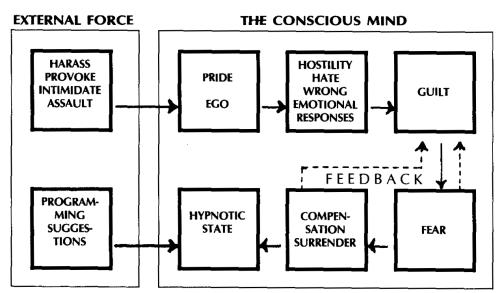
[Figure 1. The Hypnotic Process]
Fear and terror are the principles which are used. Ideas are implanted into the mind through the medium of fear. As long as a victim responds with hate, hostility, resentment—any aggravated emotional response—he becomes fearful, he becomes conditioned. Increased emotional excitement disables the discerning, conscious mind thus causing the exposed subconscious mind to assimilate gross or subtle suggestions that are hurled at it. The angry, upset, frightened, clouded mind then acts upon the accusations converting them into reality. Later, when the tension is removed, the implanted suggestions remain.
During those dreadful weeks in basic training I couldn't do anything right. There was my way and the "irrational" army way. I was damned if I did and damned if I didn't. I could not escape the wrath of the sergeants. I was hounded, intimidated, assaulted, screamed at day and night. Believe me, I was one overwrought, frightened recruit. I had no idea that all this duress was for the purpose of setting me up, to manipulate my mind, to destroy my discipline, and to obey orders without question.
The constant harassment and my excited emotional state clouded whatever little perception that I had and I fell under the law of the sergeants who prodded me. I was compelled to act out their unseen intent, and I eventually became a part of the system.
The methods used to upset, to hypnotize and to control me were numerous and diabolically clever. I shall illustrate a few examples. Place yourself in the shoes of a new recruit; how would you react under similar circumstances? Remember, we cannot fight back. To fight back can lead to some very serious consequences: courtmartial, jail with forfeiture of all pay, dishonorable discharge just to name a few. We cannot go "over the hill," that is, quit, because we signed a contract stating that we would serve our time and, besides, the police and FBI will go after us. The only course left to us that will diminish our agony, that will reduce, hopefully, the assaults against our minds and flesh is to conform, to surrender.
Example:
Sergeant: Where is the balance of your rifle, private?
Private: Gee, I don't know. This is all the supply sergeant gave me.
Sergeant: Oh, a wise guy. Tuck in your gut, get those shoulders back, stand at attention while I am speaking to you. I don't like smart-ass answers. You are a meathead and I don't take wise cracks from meatheads. Is that clear, meathead?
Private: But, you don't understand...
Sergeant: What have you between your ears, meathead, a blood clot? How dare you call me a "ewe." That is insubordination to a non-commissioned officer. Report to me after drill, meathead; I have a special detail for you.
Barrack life was no different. We were rudely awakened very early each morning by the sudden turning on of the bright barrack lights, by obscene screams, by the pounding of clubs against the metal trash containers. What a rude awakening! Actually, this type of awakening really put us to sleep; it is hypnotic. And, this sets the tempo, sets the atmosphere for the rest of the day.
The endless inspections, the details, the drills, the parades, the salutings the screaming took their toll. We were no longer civilians, we became soldiers. We were destroyed as individuals and given new births; we were "born again" into the system. Once we capitulated to stress, that stress became a life supporting mechanism. We needed it, we were loyal to it. We defended the system; we needed the system to support our new identity. To be ostracized from the system, from the army, was a fate worse than death. We were soldiers who feared the sergeants, who feared the captains, who uncritically obeyed orders. We were completely hypnotized.
To sustain the hypnotic conditioning, to prevent deviation, the soldiers must be continually subjected to many rituals: Saluting, inspections, parades, bugle calls, reveille and retreat ceremonies, uniforms, medals, awards, flags, the reading of the Articles of War; the list is endless.
The military academies where officers are made are not different from the basic military training camps. Everyone must be made to obey orders without question, without criticism, from generals on down to the privates.
But, the military is an extension of the political system. The military system must obey the whims of the politicians, the whims of the bureaucrats without question. It is for the "good" of the State. The politicians, the armchair strategists brought about meaningless human and material waste, suffering and destruction, and our defeats in Korea and Vietnam. These defeats could have been victories; we had capable generals, but the military had to obey orders.
VII.
The devil has a firmer hold on men in high places because of their pride in their ranks, and through them he keeps hold on many more because of the influence they wield.
- St. Augustine
Confessions, Book VIII
Labor and government are in a conspiracy against the laity.
- George Bernard Shaw
Hypnosis is an "equal-opportunity employer." Ambitious, greedy, psychopathic*
company executives who wish to enslave and normally destroy those in their
employ have an established auxiliary in government agencies.
* Psychopaths are those who deliberately and consciously aspire to do evil. They are directed by a demonic spirit that dwells within them.
Based on my experience and ones you have probably had, I suggest that we should be very cautious of employers who do not offer the company's benefit package (dental, medical, life insurance, stock options, etc.) at the time that we are hired, but postpone it 3 to 6 months after we start employment. We can be certain that they will try to set us up for mind control just prior to the issuance of the benefits. If we succumb to their mind boggling methods and intimidations we will become their slaves, and they become our masters. Our jobs are now secure and we get the benefits. However, if we keep our cool and do not respond, they then become very afraid of us and we will surely be fired. The following are some of the methods that are used against us to hypnotize us:
A word of caution: should you quit as I have, you will be in for further shock when you apply for unemployment insurance. Cohorts in government, co-conspirators in the state unemployment insurance appeals office will deny you insurance. "Unemployment insurance is denied," they will proclaim. "The claimant did not quit for a valid reason. The claimant felt that the employer was treating him unfairly and was trying to subvert his mind... From the evidence, the referee cannot find that the vice-president had been unreasonable in his requirements that the claimant conform to company policies and procedures. The employer does have the right to establish the manner in which the work is to be performed, and unless it is illegal..." (6)
That is right; there is no law against kidnapping and destroying a person's mind; i.e., Charles Manson was tried for murder, not for destroying the minds of his followers. Dishonorable government administrators have turned positions of public trust and confidence into positions of betrayal, of corruption, of power and control.
A corporate executive is not different than the gun-toting hood. In a true sense, both are criminals. The only differences are: one is a successful criminal and the other is a failure who must resort to more direct means. One stays within the "law" and the other outside the law. The corporate criminal has financial resources and education which enable him to rob more massively, more subtly, often with the aid of the government who "legally" deprives us of our income.
Employees who blow the whistle on their employers because they want to warn the public of a dangerous product or condition often find themselves in conflict with existing laws of most states that, by exposing their employers, they subject themselves to liability and in technical violation of what is termed an employee's "duty of confidentiality." To add insult to injury, no state law now recognizes an employee's right to sue for "malicious discharge," if he is fired for refusing to participate in immoral or unethical conduct. Needless to say, nor can he get unemployment insurance.
Modern industrialism and government have polluted humanity with evil and have brought into existence organized brutality and slavery. With 20th century technology and material "progress" there wont be anything left for the meek to inherit. There won't be any meek remaining either, only poisoned, conditioned, hypnotized animals. Welcome to America, where toxic industrial waste is choking rivers, poisoning cities and killing the people.
I am certain that there is a satanic conspiracy to enslave humanity with hypnosis, with economic dependence and domination. We are all chattel slaves of Satan. We all must labor to the sweat of our brow; we all must turn stones into bread.
A man who has never gone to school may steal from a freight car; but if he has a university education he may steal the whole railroad.
- Theodore Roosevelt
As through this world I've rambled
I've seen lots of funny men;
Some will rob you with a six-gun,
Some with a fountain pen.
- Woody Guthrie,
Pretty Boy Floyd
The captured pirate when asked by Alexander the Great why he infested the sea, replied boldly: "I do my fighting on a tiny ship, and they call me a pirate; you do your fighting with a large fleet, and they call you Commander."
- St. Augustine,
The City of God, Book IV
The underworld is comprised of dropouts who could not make it in government.
- Roy Masters
VIII.
If a ruler hearkeneth to falsehood, all his servants are wicked.
- Proverbs 29:12
Knowledge of the mechanism of the human mind, like fire or explosives, can be
used for good or for evil. Since evil prevails in this world, it is quite
understandable that the totalists, the hierarchy, the State, the military, the
law enforcement agencies, the courts, should use this knowledge to their
advantage and profit.
"Law" and lawlessness have become comparatively safe and profitable enterprises for both the overworld (establishment) and underworld. The costs have been reserved for the victimized, the American people. The hypnotized citizenry experiences the most abominable things, and they remain asleep to them, or impotent in frustration. When we suffer tamely at lawlessness, we encourage it.
Dr. Edward Shev, a psychiatrist who has screened and counseled thousands of police officers says that 35% of all police are "really dangerous." (7) If some of our police officers are dangerous it is because we have brought into existence dangerous bureaucrats, dangerous politicians, ruthless authoritarians. Like the military, the police is an extension of government.
It is interesting to observe that the police were once our guardians, friends of all good citizens. They later became soldiers, a paramilitary, armed, vehicled and sequestered, presumably trained to look and act fierce. The bureaucrats have given the police the widest discretionary authority to issue traffic citations, deserved or not, to intimidate us, to crowd-control us, to arrest us, to shoot us. Now, instead of reassurance and respect, the police inspire hate and fear—a very hypnotic combination. (8)
It is not necessary to speak to induce hypnosis. It can be done with symbols and the mind does the rest. The mind interprets the meaning of the symbols and then acts accordingly. Words are weak suggestions because a word is already processed data. A word is an idea, a meaning that has been processed for the purpose of communications. The mind will more readily process symbols, interpret their intended meaning, and being your "idea" carry out the intended suggestion. (9)
The American police officer has a great many tricks up his Sam Brown belt. He is generally equipped with the regalia, the symbols necessary to induce a hypnotic trance: the big pistol, the big belt with all those big bullets, the badge, the hat or helmet, the uniform. His look may be stern, unfriendly, mean. His voice may be gruff, threatening, commanding. The sun glasses, if he wears them, will give his eyes that "hypnotic" look. All of these symbols add to the weight of authority as well as to the fear of authority. By the time a police officer saunters from his patrol car to where the motorist is stopped, the motorist, in most cases, will already be in a deep hypnotic trance, ready to be programmed, ready to admit to an infraction of the law which he did not commit.
To be falsely accused by a police officer is like being hit with a multiple "whammy." It is a very effective hypnotic technique because it combines surprise, shock, threat, guilt, fear, and authority.
The average motorist is effectively disabled. He does not realize or suspect what is happening to him. In the hypnotic state he loses his reason, he loses control of his mind, he cannot see through the ploy, and he cannot see that he is being programmed. Under hypnosis he is made to believe that he committed the stated infraction. He offers no argument, he offers no resistance.
I was once signaled to pull off the road and was given a trumped-up citation for speeding. I was expected, like countless other motorists, to fall under the "hypnotic spell" of the officer. How ever, since I did not respond to his provocations, I did not become hypnotized.
While I was still searching for a reasonable counter argument to the officer's first charge, going 75 miles an hour in a 55 mile an hour zone, he assaulted me with another, also false, charge; he accused me of going in excess of 60 miles an hour. The citation was issued on the basis of the second lie.
Another principle of hypnosis was invoked with the second lie: people cannot cope with rapid change. It throws them into a hypnotic state and they become more manageable. It took me some time to realize that this police officer could have been under a compulsion, under a system of fears, pressures and conditioning. He could have been robotized by those in power; programmed into the system, programmed into the "chain of command"—a zombie doing the will of his master.
Since law enforcement is a tool, an extension of government, we must make sure that the government be held strictly accountable for the action of the police. We must make certain that the police in discharging their duties and dealing with crime and the public is as impeccable as we can possibly make it. The police of Britain now enjoy more public confidence and respect than any other public institution because of this consideration. The English people profess love for their kindly, unarmed police officers. (10) The Canadian police officer is also respected. He is armed but his weapon is concealed. His uniform is also nonoffensive. He may resemble a tour guide to the visitor. Neither the British nor the Canadian police provoke the type of dislike or hate that the Americans have towards their police.
The American people have actually become hate-filled and fearful of their servants, of their government, of their Frankenstein. Behold, big brother is here. Big brother does not have to control the populace with drugs, electrodes or with brain implants. He merely has to intimidate; to create hate, hostility, fear and we then become cowering puppets.
Hating the psychopaths will then cause the people to seek refuge with them because of the fear that hating and hostility create. See Figure 1. They will kiss their rings, kiss their feet, "crawl on their bellies" for the "security" they get. The people surrender their lives to a greater force, to big brother government. An all-encompassing fear is an absolute necessity to get and to maintain power and control. The quest for power by these madmen perpetuates the system, perpetuates the kingdom of hell on earth.
IX.
The enemy held my will in his power and from it he made a chain and shackled me.
- St. Augustine
Confessions, Book VIII
The trial of Patricia Hearst sent shudders of fear through the Establishment.
There was grave concern by the hierarchy that the techniques of hypnosis would
be exposed. Patricia Hearst had to be sacrificed in an effort to downplay, to
conceal the truth about hypnosis. The stakes were great, an entire nation was
watching the court proceedings.
The secret government that controls this country is extremely powerful. The position and wealth of Patricia's parents could not save her. The eloquence, persuasion and skill of her attorney, F. Lee Bailey, could not save her. Patricia Hearst was found guilty; not for her involvement in the bank robbery nor for the hold-up at Mel's Sporting Goods Store, or for remaining a fugitive at large (and did not seek escape from her captors), nor because she was a wealthy Hearst; but because the truth had to be suppressed, because the truth about hypnosis and all its implications had to be withheld from the watching public. She was the scapegoat. If she were punished as the villain, hopefully, no one would look further for the real villain.
Prior to her ordeal, Patricia Hearst had been a normal 19-year old with a stable life situation and a responsible orientation to society. She had no predisposition whatsoever toward crime, and had no antisocial or revolutionary inclinations. On February 14, 1974, Patricia Hearst was forcibly kidnapped at gun point, gagged, bound, blindfolded and tossed into the trunk of a waiting car. On April 15, 1974, some sixty days later, she emerged as a "revolutionary" and participated in the Hibernia Bank robbery.
Now, what did really happen to this "normal" young American girl? Suppose we take the blinders off, separate ourself from our prejudices and conditioning and sincerely desire to see the truth. We are confronted with two things: The facts and the truth. First, what are the facts? They are:
Patricia Hearst was convicted upon the undisputed facts, by the soulless, mindless, heartless machinery of the letter-of-the-law. These are facts. The facts conveyed reality, certainly, but the lesser part of reality. The truth is also a part of reality, in this case, the greater part of reality. What, then is the truth? The truth is:
There is a great deal more truth:
Like most Americans, they believed, egotistically, that they could not be hypnotized against their will.
* Most judges are incompetent by constitutional standards. If the judge informs the jury that they can decide only the facts, he is breaking the law. The jury has "an unreviewable and unreversible power... to acquit in disregard of the instructions on the law given by the trial judge." U.S. v Dougherty, 473 F 2d 1113, 1139 (1972).
No one has ever been free of the weaknesses of the mind. The bravest can be turned into criminals and murderers through deprivation, brutality and terror tactics. Individuals who survived the terror of Buchenwald and other torture camps in Nazi Germany—and many had high moral ideals—when starved and terrorized became snarling animals, obedient to their masters, the SS.
We have seen strong, resolute, trained military soldiers, prisoners of war, turn against their country and their comrades under the frightening pressures, duress, anxieties, fears and terror brought upon them by their Korean, Chinese and Vietnamese captors.
When brainwashing became a major issue during the Korean War, it was frequently charged, and often proven, that U.S. prisoners of war were subjected to prolonged interrogations and brutalities which were calculated to capture their minds and produce "confessions." These treasonous acts were performed under great duress and without free will or malice. Court martial proceedings against returned prisoners of war were sympathetic and lenient. The military tribunals understood coercive persuasion and its ramifications.
Patricia Hearst was captured by a "revolutionary army" and early SLA writings literally called Patricia Hearst a prisoner of war. The trauma of her capture disabled her reasoning, conscious mind and she fell under the law of her captors. She became a mindless robot who uncritically obeyed the will of her master, Field Marshall Donald (Cinque) DeFreeze. She had become a soldier.
What an awful experience for a young girl to go through! The trauma of her captivity had transformed Patricia Hearst almost beyond recognition and had made her capable of committing a crime, of killing if necessary, on orders.
Patricia Hearst's trial was the first of its kind. Since we have no law against the use of destructive, hypnotic mind control techniques, a brainwashing defense is not common in our civilian criminal trials. Unlike the military, the court was not sympathetic towards the defense; it couldn't be. Too much was at stake; the people had to remain ignorant of their hypnotic proclivity, of their hypnotic enslavement to the conspiracies of their own government.
This is the truth that had to be suppressed. This is the reason why Patricia Hearst was sacrificed. Thus it has often happened that the suppression of the truth turns into tragedy and disgrace for the innocent party.
The trial and subsequent imprisonment of Patricia Hearst is an indictment against our judicial system, against our "democratic" government. It shall always remain a disgrace—a wound in our national honor and integrity.
Evil is imbedded in our law and order system. Alexandr I. Solzhenitsyn stated in an address before a Harvard University graduating class: "It is impossible for any of us to stand through the trials and tribulations of this threatening century with only the support of a legalistic, letter-of-the-law structure... life organized legalistically has thus shown its inability to defend itself against the corrosion of evil." God help us; we need the full armor of God to protect us from both the "law" and the lawless.
Our courts oppose the righteous man; fairness is unknown. Truth falls dead in the streets, and justice is outlawed.
- Isaiah, 59:14
The Living Bible
X.
Take heed that no man lead you astray. For many shall come in my name, saying, I am the Christ; and shall lead many astray.
- Matthew 24:4-5
Recent estimates place more than 2 million Americans, mostly between the ages of
18 and 25 (the cream of the crop of our youth) to be in some way affiliated with
cults, which number over 2500 in the United States today. Some are more
successful than others. The Church of Scientology boasts of having 5.5 million
members worldwide. The Unification Church of "Reverend" Sun Myung Moon claims to
have over 30,000 members in the United States alone. The "Reverend" Jim Jones'
People's Temple had a following of about 3,000. (11)
To infiltrate educational institutions the cults often misrepresent themselves. For instance, the Unification Church has established numerous campus centers under the name of CARP, the Collegiate Association for the Research of Principles. The Science of Creative Intelligence / Transcendental Meditation (SCI/TM), with Maharishi Mahesh Yogi as its founder, used to be called Spiritual Regeneration Movement Foundation. By changing its name and deleting from its vocabulary the words "religion" and "God" and substituting the words "science" and "creative intelligence," it has been able to circumvent the separation of church and state, (12) obtained governmental support, (13) infiltrate and establish a foothold in high schools and colleges. The infiltration is so thorough that SCUTM is presently being taught as a fully accredited course in some schools. (14)
Why do we have so many cult groups? Because it is a very profitable business. When the victims, our captive youths, are placed in a condition of involuntary servitude and forced to work 16 to 18 hours a day, seven days a week for nothing; when a business can masquerade as a church behind the First Amendment; when no accountability has to be made of the earned money; when no taxes have to be paid; when our legal system sanctions and protects this form of criminal activity; when concerned parents are sued by the cults for interfering with the religious choice of their children; when parents and "deprogrammers" are fined and jailed by our courts for rescuing the helpless children from the clutches of the cults; when no law exists that prohibits the use of destructive, hypnotic, coercive persuasion techniques; when laws governing involuntary servitude, such as the Thirteenth Amendment, are not enforced; then cults will, and do, flourish without limit.
It appears that our laws are born out of a belief that there is no evil inherent in human nature. The truth is that human nature is decadent, evil beyond description. It doesn't take much intelligence to see the magnitude of human exploitation, destruction, the mockery of "justice," the genocide that is happening daily around us.
We have no defense against the abyss of human decadence that is inflicting violence against our young people in the guise of religious freedom. Our laws encourage the perpetration of certain crimes and violence against our trusting, naively innocent young people. If we complain to the authorities we are told that this is a free country, that our young people have "the right and the freedom not to get involved with the cults." Therefore, again, the real villains remain free to continue to plunder, to destroy, to perpetuate the kingdom of hell on earth.
Unfortunately for all of us, we have become a nation without a divine center. We have become a nation with no other authority than its own amoral laws. We have become a nation where a concept of religion is what anyone chooses to claim it to be.
The climate in the United States is ripe for the growth of cults. Our culture is responsible for the existence and perpetuation of cult groups. Our materialistic society has preconditioned youths to be come unwilling victims to the lures of the sirens; they are lured to their enslavement and destruction on the reefs of the pseudo-religious cults. Our culture does not prepare the young for life, but for commerce and industry, for capitalism. Our young people are seeking for a meaning to life; in their seeking they often fall prey to the lurking cults. They hunger for truth only to find "truth," the big lie, consuming them.
Yes, there are many dangers and pitfalls for the seekers; the quest for truth is a perilous journey. Only sincere, aware seekers will sense the dangers along the way and escape the snares. Unfortunately, today, the young are blindly groping for answers to life, answers that society has failed to give them. They see utter chaos, plunder, carnage; the destruction of good, the triumph of evil; a world in flames. Dear God, what is this life all about?
Despair sets in. Escape from despair then leads to drugs, alcohol, sex, crime, suicide, TM and the cults. Artificial bliss, stupor, slavery and eternal damnation become the answers to the purpose and meaning of life.
Cults capitalize upon human weaknesses and miseries. Herbert Hendin, a Columbia University psychoanalyst who studies youth movements for the Center for Policy Research, says: "I've never seen one of those young people who didn't have some kind of serious failure in family life. They are turning desperately from the pain of the outside world to the childlike support and structures of a make-believe family." (15)
Cults are represented on almost every college and even in some high schools. College campuses and high schools are lucrative recruitment areas because:
The student is disarmed when he is approached by a cult recruiter, usually a person of the opposite sex, who strikes up a friendly conversation, is all smiles, sincere, tranquil and affectionately holds his/her hand. The display of affection and attention raises a sense of question and curiosity.
The student perceives the recruiter to be a contrast to the chaos he feels within himself and he senses a need to find out what the other person has that he doesn't have. When he is invited to visit the "family" and to have dinner, he gladly accepts, thinking that his life will be enriched by the experience and that he will find new friends.
The "family," he learns, is a group of people, approximately his age, who appear to have a camaraderie that is fulfilling. There is a feeling of joy, happiness, and tranquility that he has never seen before. Everyone is so friendly. They look at him with approval, affection, and admiration; they shake his hand and hug him. The contrast created between the joyous "family" and his own feelings creates doubt about his state of mind. What have they got that he doesn't have? Subconsciously he desires to be a part of this very happy family.
The initial experience with the family was pleasant and the dinner enjoyable. There were some philosophical discussions and lively games. When he is invited to spend a weekend retreat at a nearby farm he accepts eagerly. He doesn't know it yet, but he has taken the enticing bait. Phase one of the indoctrination process is a success. Phase two, the closing of the trap, must now be implemented.
A van waits for our friend at the campus parking lot. He and many others are driven to the farm. When the van arrives some hours later, the occupants are greeted by a jubilant crowd of cheering youngsters. The warmth and friendship overwhelm him. He dismisses the thought about the farm being isolated, being further away than he had imagined. He didn't have time to wonder about the armed guard at the entrance.
Each newcomer is assigned a constant companion, a "spiritual" partner, usually of the opposite sex, who will never leave his side. The job of this companion is to keep his mind busy, to persuade, to pressure the newcomer not to leave. Even when going to the bathroom there is someone there, eager to engage in a discussion, to keep the thoughts flowing. As long as the newcomer is submerged in his thoughts, submerged in the "computer" of his mind, he cannot be aware, he cannot reason, he remains oblivious to what is really going on.
At the farm every minute of the day, and much of the night, is consumed in an endless round of singing, games, lectures, calisthenics, group discussions, more games, more lectures, more group discussions. The lectures are vague and repetitious. The speaker is tireless, he cites scripture and harangues for hours. His long deliveries are given in a well-rehearsed rhythm that is carefully structured to create emotional excitement and release. Sometimes there are several speakers and the listener has no choice but to sit and take it all in. At this time going to the bathroom is forbidden. Discomfort mounts which keeps his conscious mind preoccupied while the subconscious mind accepts uncritically what is being preached.
The newcomer is caught up in a whirlpool of force-fed, "logical," believable, and convincing pronouncements. His tired, agitated, preoccupied mind accepts the strange doctrine without question. He cannot check his information. He sees himself agreeing with concepts that he does not understand. When he finds that the other members are accepting the same doctrine all his doubts vanish.
There is no time for introspection, to question or to doubt. If he argues, they will descend on him. If he agrees, they will smile and love-bomb him. Self reflection has no value in the collective body. Blind obedience, blind faith is justified and glorified. To displease the group is to displease God. Learn to trust the elders, the sages; leave negativity at the entrance; internal conflicts should be ignored, (they are the work of Satan); open your heart, participate with the group, share your thoughts and experiences, you are among friends. And so on it goes. Pressure, pressure, pressure.
Systematically, the newcomer is worn down both mentally and physically. He is constantly badgered, pressured—pressured to join the group. The planned regimen which requires the newcomer to submit his individuality to the demands of the group pressure—the activities, the games, the calisthenics, the singing, the lectures and discussions—is having its effect.
Peer pressure is overwhelming; resistance is diminishing rapidly. Where else will he find such friendship? To resist their demands creates pangs of guilt. His guilts are played upon by the manipulation of the fear of God and Satan. He misidentifies with his guilts and becomes afraid. Then, suddenly, surrender occurs. The struggle is over. He submits to group pressure, submits to something that is greater than himself. He is hypnotized. The trap is sprung. Now for phase three, the conditioning process.
Once the new recruit has been snared into the cult, the induced hypnosis must be sustained because there is a strong likelihood that the victim will regain his reason and flee. There are a great many ways to sustain hypnosis once it has been induced:
Blackmail, illegal, immoral, and debasing acts appear to be common, although not exclusive, to the cults. Reverend Jim Jones insisted that his followers sign statements incriminating themselves for misbehavior, child molestation, rape, drug trafficking, and other offenses. (16)
David (Moses) Berg, founder and leader of the Children of God (COG) sect, instructed his followers to participate in bizarre sexual activities, to urinate in public, to perform sexual acts before an audience. One former Hare Krishna member testified at a Queens County, New York, grand jury hearing that she drank cow's urine during one of the group rituals.
Charles Manson held his family together with drugs, sex and murder. The Symbionese Liberation Army forced Patricia Hearst to help rob a bank.
These illegal, immoral, debasing deeds are extremely effective hypnotic devices because the victims sin against society, sin against God. They become ashamed, guilty and afraid—afraid of the law and afraid of God. The pain, the shame, the agony is too excruciating. They cannot wake up from their hypnotic trance; they cannot return to reality; they are effectively trapped.
What has been described is based on information obtained from those who have managed to escape the cults. They also believe that their involvement with the cults seemed to be by their own choice. How this came to be a rational decision they cannot explain. That is what makes hypnosis so insidiously dangerous; the decisions they made, the "ideas" they had were not their own—they only seemed like their own.
It is difficult for the ex-cult members to put themselves back together once they have left the group. They are debilitated both in mind and in body. They have had a harrowing experience and it will take them a long time to recover. Parents can help by not blaming them, by not making them feel guilty, and by not rejecting them for what has been done to them.
Life is full of hazards. We are preyed upon and exploited by both the "law" and the lawless, by the overworld and by the underworld. It is up to the parents to remain aware, alert, informed to what is going on. They are the ones who must protect their children from the snares intended for them.
Section Four: Psychic Countermeasures
XI.
... Through intense suffering our country has now achieved a spiritual development of such intensity that the Western system in its present state of spiritual exhaustion does not look attractive... we have been through a spiritual training far in advance of Western experience.
- Alexsandr I. Solzhenitsyn,
Exiled Russian dissenter
Humanity needs the manure of evil, in order to attain spiritual growth... This is the mission of evil.
- Rudolf Steiner,
Mystic Investigations in Occultism
There are two kingdoms on this earth, the kingdom of Satan and the kingdom of
Jesus Christ. We are all born into the kingdom of Satan. We are his property,
his slaves. Satan's kingdom with all of its wars, destructions, miseries,
sicknesses, blind unquestioning hypnotic obedience is necessary for several reasons:
Anyone who is not dazed or stupefied by drugs and drink can see the course of evil weave its influence upon the world. Anyone who is not escaping from the agonies of life can see the moral outrages being perpetrated against a naive populace by the media, by business, by industry, by government. Anyone who wishes to see can see the decay, the erosion of moral principles, the increases in pornography, illicit sex, abortions, drug addiction and alcoholism; the wanton exploitation and destruction of the people by their appointed authorities.
The authorities we have selected as our guides and protectors have failed us and have brought upon us wars, racism, unrest, deprivation, poverty, high taxes, inflation and decay. They have given us economic difficulties with their mismanagements. They have caused national and political division and spiritual impoverishment. They enact thousands of new laws every year, yet justice and freedom are rapidly disappearing from the American scene. Laws, more often than not, are enacted to serve one special interest group over another, to intimidate, to control. The authorities are more vigilant in creating unjust "laws" by which they can control the people, than in preventing predatory practices by some people over others. By the enforcement of such laws, the government itself is the biggest predator. The government has no power over the innocent. The only power it has is against criminals. By making innocent people break its unjust laws it is able to create criminals. They then inflict cruel and unusual punishment in the guise of correction. The victims then rise in rebellion in an attempt to destroy what is destroying them thus unwittingly giving more power to the government.
Because of internal strife we have become a country where old age and decline have set in before the bloom of maturity—and this country is only about 200 years old.
The stresses of modern life have made us into a nation of neurotics. One out of ten, in this country, has a severe mental problem because he doesn't know how to cope with life. The neurotic goes to a psychiatrist for help only to find that the psychiatrist is just as nutty as he is, and he doesn't have the answers to the riddles of life either. The neurotic is given pills and drugs to lower the level of his consciousness so that he no longer sees what is bugging him. The neurotic then lives in a state of suppressed awareness, in a state of artificial bliss; unable to deal with reality, unable to deal with his problems, and unable to cry out to God.
Yes, the higher we rise materially the lower we sink spiritually. Our fall brings on a host of mental and physical illnesses. Modern, materialistic, sick, 20th century man is in a steep moral decline; he is rapidly sinking into the morass and pollution of the carnal, physical, material world. This decline is destroying humanity, is making man into a cipher. This decline was not meant to sicken man but to awaken him. The pain, the agony of life is designed to awaken man from his hypnotic sleep; to awaken him to the Christ influence that will then show him the way out of the trap, and upward to a spiritual life.
Until the time of maturity, until the time of salvation we can do little about our dilemma except to desire not to be influenced by these evil forces. A cry must rise up to God in a moment of need, in a moment of agony, in a moment of helplessness: "God, please help me." It is a cry in the wilderness; it is a cry heard by God.
We should be grateful that we were obliged and able to cry out to God, otherwise we would have remained in bondage to Satan's kingdom both in life and in death.
We must not hate evil. Flowers do not hate the manure that is so essential for their growth and beauty. We must not associate with evil. We must not support evil; if we expose evil in the light of truth we can see it shrivel and flee from us. There is a great deal of danger when we are tempted to hate evil: we take on its identity, we take on its character, we become like it.
A soul that is submerged in the turbulent ocean of the physical world can never become free of that world if it remains subjective to its emotions and does not aspire to remain tranquil under trying circumstances.
We must learn to maintain inner calm and confidence when faced with difficult circumstances. If someone affronts us we must not rise up with anger against the wrong-doer; we must meet such affront with calmness and composure. It is equally spiritually injurious to hate a fellow being as to strike him. He may need to be belted one but we must not do it with hate and hostility. We must not condemn the wrong-doer; we must try to understand his personality; we must try to understand the demon that possesses him. He has a destiny to fulfill, so that we can fulfill our own destinies. We cannot develop our character, our godly nature without evil. To repeat an old adage, a bullfighter cannot develop his skills without the bull.
We must watch our words, actions and thoughts; evil can be combated by the creation of good. We must learn to face dangers calmly. We must understand that fear is useless and stems from a lack of faith. We must concentrate on what must be done; we must overcome difficulties unswervingly. If we control our emotions and other negative qualities we are removing the shackles that imprisoned our souls in the dungeon of the world.
There was a time in our lives when our emotions were necessary for growth; however, if these emotions are sustained beyond maturity, they become deadly to us. Emotions which are necessary for animals because of the evolutionary process will now direct us to our doom because of another process—the "evil-utionary" process.
To summarize, during the first part of our lives we are plunged into hell on earth to develop and strengthen our soul and character. During the second part of our lives our matured souls then ascend to higher spiritual realms. The trials, tribulations, and stresses which were essential for our spiritual development are left behind or minimized as we progress along the spiritual path. "We are first of nature, then of Spirit."
XII.
Be still and know that I am God.
- Psalms 46:10
And be not fashioned according to this world: but be ye transformed by the renewing of your mind, that ye may prove what is the good and acceptable and perfect will of God.
- Romans 12:2
...(C)ast down imaginations... and bring every thought into captivity to the obedience of Christ.
- II Corinthians 10:5
But thou, when thou prayest, enter into thine inner chamber, and having shut the door, pray to thy father who is in secret... And in praying use not vain repetitions as the Gentiles do: for they think that they shall be heard for their much speaking.
- Matthew 6:6, 7
The lay person does not understand what meditation really is. To him meditation
is sitting in a lotus position and repeating certain "sacred" words or mantras
as is the case for Zen and Transcendental Meditation (TM). There is a great deal
of publicity concerning TM: that it lowers the blood pressure, lowers the
metabolic rate, relaxes the body and provides a host of other temporary physical
benefits. Although TM does bring about some physical alterations, it does not
heal the spiritual sickness of man.
Warning
Transcendental Meditation is, in reality, a prayer to a demonic deity. The meditator may find himself obligated to the point where he has hell to pay, a retribution to make, for the "benefits" and escape from reality that TM provides.
There is no doubt that repeating a mantra or certain words, sacred or not, quiets a disturbed, agitated mind and provides some temporary relief. A mantra, like a drug, dulls the mind, it slows down the thought process. It is a "spiritual" tranquilizer that provides temporary escape from anxiety, from reality, from the agent of disturbance. A mantra is an aid to achieve self-hypnosis, which is what TM really is. The mind goes into neutral with the constant repetition, starts to "freewheel," the consciousness is impaired, and hypnosis ensues. Self-hypnosis does not help anyone. As a matter of fact, that is what is wrong with the whole world, it is already in a state of hypnosis.
Repeating mantras, "sacred" words, affirmations, Ave Marias as is done by the Catholics, dulls the mind and a dull mind is called a "quiet" mind which, obviously, it is not. Repeating such words as: Hare Krishna, Rama, Rama, O Lord Jesus, Coca Cola, spaghetti and meat balls, liver and onions, A-umm-m-m, etc., will have the same effect. Drugs, alcohol, marijuana will do the same—they provide escape, relief from an agitated mind, they are hypnotic. Zen and TM advocates are not different from the drug advocates; they are all trying to escape from a harsh, turbulent, cruel life.
In the following paragraphs I shall be describing a counter-hypnosis exercise commonly known as a Judeo-Christian meditation-observation exercise.* This exercise, when performed diligently and with the right attitude, will enable us to awaken from our hypnotic trance and to regain full control over our minds and bodies. This meditation exercise differs from Zen, TM and other worldly meditations in that the mind is not preoccupied with repeating stupid mantras or Sanskrit words.
* The meditation-observation exercise is a long forgotten Judeo-Christian meditation that was formerly taught by the ancient Jewish kabbalists and Christian mystics. Roy Masters, founder-director of the Foundation of Human Understanding (an educational, not-for-profit institution), "rediscovered" it several years ago. The meditation is taught in detail by the Foundation of Human Understanding. The meditation exercise is available in cassette form called The Basic Meditation. It can be obtained by writing to: The Foundation of Human Understanding, 8780 Venice Blvd., Los Angeles, CA 90034. Several books written by Roy Masters that discuss the meditation exercise and emotional problems are listed in the bibliography.
The Judeo-Christian meditation-observation exercise enables us to rise out of our thinking, fantasies and daydreams. It enables us to become aware, conscious, alert to what is going on around us and within us. We begin to deal with our thoughts as if they were aliens in our minds, aliens that are in control of our bodies, in control of our conditioned-reflex responses.
There are five ingredients necessary if we wish to overcome our hypnotic proclivity, to overcome our enslavement to the world, and to acquire control of our lives and destinies:
The meditation exercise is very simple but the simple is very hard to do. There will be a strong tendency to want to quit, to "climb the walls," or to run. This is because reality and anxieties are catching up with us; the very things from which we have been running. If we resolve to stick it out, not to be deterred, if we devote ourselves to the exercise as if life and death depended on it, if we persevere with patience and endurance, when we let the truth catch up with us, the rewards will be exceedingly great. Those who lack patience and endurance, who cannot persevere with the regimen required with the meditation exercise, will achieve nothing at all.
A million and one things will happen as a result of the exercise. It will not only awaken us from our hypnotic slumber but new dimensions, heretofore unseen, will open to our sight and understanding.
Caution
This meditation-observation exercise is not for the squeamish; some very ugly things will be revealed: the kingdom of Satan and all its horrors will first come into focus.
Much of what happens as a result of the meditation-observation exercise is beyond the scope of this book. The purpose of this book is simply an expose on hypnosis, what we must do to return to the center of our dignity and to overcome the conspiracies and enslavement of the world.
To begin, set aside periods in your daily activities in which to withdraw into yourself, to be quiet and alone. Meditate where there are no distractions. Go into the "closet" and shut the door to outside activity. This Judeo-Christian meditation is really a prayer, a prayer without words, it is a prayer that consists of silence. The soul must be still to allow the Spirit within to pray to God. (Romans 8:26, 27)
In the beginning you will not be able to perform the meditation exercise for more than a few minutes at a time. Consequently, it should be done several times a day. As you progress, as you become more disciplined, more patient, you will be able to meditate for twenty, thirty minutes or longer at a time. When this stage is reached a meditation upon getting up in the morning and another before retiring may be sufficient.
Let us now proceed with the exercise: sit in a straight-backed chair, one preferably without arms, and place your feet squarely on the floor. Do this in the privacy of your room. There must be no distractions such as a blaring radio or TV. Place your hands in your lap and close your eyes. Bring your attention to the middle of your forehead—this is your thought center.
Be aware of your thoughts. It will be as if your head is in a beehive and your thoughts are buzzing to and fro, undisciplined and out of control. This is the reason why you are not in control of your life, your thoughts are out of control and they are controlling you. Have you noticed how your thoughts tend to speed up in ever increasing spirals when cruel people intentionally or unintentionally nag, aggravate, and upset you? Have you noticed how your thoughts race when you are sick? Do you see how your thoughts create feelings and how feelings create reaction and how your reactions enslave you and how you give in, surrender, in order to minimize your agony which only brings on more fear, more thoughts, more resentment and more despair? Upsetting you, making you afraid is the secret of hypnosis. To become a whole healthy person you must acquire control of your thoughts and emotional reactions.
Now place your right hand by your side. Let it dangle. Become aware of your right hand as you remain aware of the center of your forehead. Notice the blood flowing down into your hand. Be aware of the fingers—the first finger, the second finger, the third finger, etc. Do it slowly, there is no reason to rush, be patient. Notice how your hand tingles, and you may even feel a slight warmth in your hand. Don't worry if, at first, you don't notice these things. The purpose of the hand is to provide a focal point, an anchor in the present when the mind is caught up in the stream of thoughts and daydreams.
As you are doing the exercise notice how your thoughts pull your attention away from your hand. When you find yourself occupied with thought simply and gently pull back and return your attention to your right hand. Be very aware of your hand. Repeat as before, feel the blood flowing down into the hand, be aware of each finger, going from one to the other. Don't rush, do it gently as if you were doing it for the first time. This is also an exercise in patience.
The meditation exercise will allow the mind to oscillate back and forth between your thoughts and your hand as you remain aware of the center of your forehead. Become as a bystander on the shore and watch your thoughts stream by; do not become involved with your thoughts. Your thoughts, your fantasies, your daydreams are escapes from the present into the future or the past. Your thoughts are nothing but electro-chemical noises that are fermenting in your mind. Your thoughts have no value. There is no creativity, no realization in thinking. Every time you pull back from being involved with your thoughts you sever a "thread" that held you captive to your thoughts. There are thousands of such "threads" that must be broken. And, in time, you become free of your thoughts.
Look at yourself without judgment. Be aware of your thoughts without becoming involved with them. Don't suppress unpleasant thoughts, don't chase them away, don't struggle with them; they are you; they are your conditioning, your experiences. Just watch, don't try to correct.
Observe your fears. Observe how your fears are sustained by memory and by thoughts. Observe how your fears of the present and your fears of the future cause you to shy away from experience. Observe how thinking of past dangers and incidents sustains fear. Observe how fear causes you to capitulate, cripples and cramps your lifestyle; how fear makes you into a recluse.
Bring into subjection your thoughts, feelings, fantasies and daydreams. Become quiet and still by observing your thoughts as if you were at a distant point. Be patient, don't expect immediate results. Observe without condemnation. Be aware without choice. Look at hell straight in the face.
Notice that with this meditation exercise thinking and daydreams are not suppressed. You simply separate from them when you find yourself involved with them. Try to remain in the present; try to remain aware of your hand. This detached "distant" observation method often brings out of the subconscious mind painful memories, traumas, psychic injuries. The release of these emotional injuries and poisons is often accompanied with involuntary crying or vomiting. Don't resent what you see or what happens. THIS IS YOU. You were mangled by life and didn't know how to prevent it.
As you become more objective, as you learn to separate yourself from your thought processes your worries, hostilities, fears will gradually lose their hold over you. Your mind will begin to clear and you will begin to live and respond from a higher consciousness, from divine impulses, instead of from conditioned-reflexes like an animal. After you persevered for a time in meditation you can resume your daily routine. Don't discuss the meditation with anyone just yet. They may not understand and they may try to discourage you. Remember, this is your trip. It should be emphasized that a person who devotes himself to inner spiritual development need not change his everyday occupation, nor neglect his daily duties. Quite the contrary, if he neglects his responsibilities while attempting inner development he would soon become antisocial and an outcast.
As you progress in privacy, in tranquility and in seclusion with the meditation exercise, gaps will start to occur between thoughts. It is in these gaps, in these brief periods of silence, when the light begins to enter the mind and reveal the secrets, the realities of life.* As the gaps become wider, when your thoughts become less active, bliss enters, the hypnotic spell is broken, and you are no longer a slave to worldly influences. You will grow calmer, you will attain serenity in all your actions and you will cease to be perturbed by all manner of incidents and aggravations. You will go through life steadily and you will let things act upon you in all tranquility.
* At this point, when the light begins to enter into the mind, the creature of darkness that had its abode in the mind, will let out a scream and flee from you. You may actually get to see it. It may try to frighten you, to deter you from your meditation exercise. Don't be afraid, it is only a spirit and cannot harm anyone.
As you go about your daily tasks you must guard and maintain discipline over your thoughts and feelings. To vent hostility would be damaging to your progress. It is equally injurious to hate a fellow being as to strike him in anger. Be angry and sin not. (Ephesians 4:26) If others have the power to make you react with hostility and resentment you are not the master of yourself. The meditation exercise, if performed correctly, will enable you to resist the impressions, cruelties and assaults of the world. Formerly a personal affront would have filled you with hatred, with revulsion, now you will remain cool and level headed.
Your ego must die. You must die to yesterday, today and tomorrow. You must die to ambition, to wants and needs. You must die to the world. Shed your burdens every day; let God rule in your life. It is only when you die to everything does the mind become renewed, refreshed, cleared, bright and tranquil.
Memories will fade away. Only a mind that is unencumbered with the past is capable of bliss; not a mind that is over-burdened with experiences. You will cease to worry about things that formerly kept your mind occupied. You will acquire a new outlook on life; you will be happy.
You will begin to steer your ship with a firm hand, secured on a straight course among the waves and reefs of life, which formerly had been a stormy, perilous journey. Bon voyage.
References:
Recommended Reading:
For nothing is secret, that shall not be disclosed; neither anything hid, that shall not be known and come out into the open. (Luke 8:17)
Know the Truth and the Truth shall make you free. (John 8:32)
The Beginning
I passed through a deep crevice at twilight,
And saw a narrow vista of trees,
Magical in the mists—
Vocal to the hush of meaning,
Whispering to the wisdom of shades,—
Of degrees,—
Before a backdrop of eternity....
And I had a friend...
Whose dust with mine was not the bond,
Whose love with mine was not the bond,
Whose teaching with me was not the bond.
Both of us had been to this same place,
To the twilight in the narrow crevice,
And because of this place, we are eternal.
—from Carillon, Poems, Essays and Philosophy of Richard Rose
© 1984 TAT Foundation. All rights reserved.