The Forum for Awareness
Full Index of Issues 1 thru 14
Number 10
1980
Contents
Europeans have mistaken the Aborigines for primitives. In fact, they built a mental rather than a physical civilization to survive in a cruelly barren land.
A journey to Chartres, where the Gothic builders wrote a mysterious book of stone and glass.
A thorough survey of Frankl's Logotherapy, which goes beyond behaviorism and points the way to a study of the human soul.
A dream of humanity's progress.
"I am a mirror that madness looks upon, and sees a hope surmounting foolishness..."
A clear explanation of the basic symbolism of the Tarot cards and how to learn their meanings.
Compare your own characteristics to the keywords for your sun sign.
Part 1 of a series of practical advice on getting your head on straight.
Turn off the T.V. and stretch yourself to sleep.
All about herbs to eat, drink, and rub for nutrition and healing.
The Psychological Society by Martin L. Gross, The Castrated Family by Harold M. Voth, M.D., The Aquarian Conspiracy: Personal and Social Transformation in the 1980's by Marilyn Ferguson, and Conscience—The Search for Truth by P.D. Ouspensky.
Science has yet to probe the amazing effects of sound on physical objects and on human emotions.
A non-profit, tax-exempt organization founded in 1973.
TAT Journal is published by the TAT Foundation, a non-profit, tax-exempt corporation, that was established to provide a forum for philosophical and spiritual inquiry, based upon the principle that cooperation with fellow inquirers expedites one's own search. The TAT Foundation supports workshops, seminars, study groups and related services. The views and opinions expressed in the TAT Journal are not necessarily those of the editors or of the TAT Foundation. Address all correspondence, including manuscripts, to: TAT Journal, P.O. Box __________. Manuscripts will be returned only upon request and when accompanied by a stamped, addressed envelope.
Editor: Louis Khourey;
Contributing Editor: Mark Jaqua;
Advertising and Circulation: William Weimer;
Subscriptions: Doron Fried;
Production: Robert Cergol.
© 1980 TAT Foundation. All rights reserved.
Omnivore or Herbivore?
TAT Forum:
The gropings of Jonathon Miller to justify a vegetarian diet are filled with erroneous and distorted bits of scientific information, presented in such a way as to petrify the layman from eating anything but grains and nuts. His sensational approach to dietary problems is unfounded in fact and common sense.
He attempts to correlate man's anatomy and social behavior with those of herbivores. Man's teeth and intestines are intermediate in shape and size to the extremes of strict carnivores and strict herbivores. Man, like the pig, is an omnivore. His teeth are capable of both shearing motions for tearing flesh and grinding motions for physical digestion of plant food. Meat is relatively easily and quickly enzymatically digested in the stomach and small intestine. Plant food is more difficult to digest. Grinding in the mouth is essential to break down the cellulose wall of plant cells, which all vertebrates (including herbivores) are incapable of chemically digesting. Enzymatic degradation of plant food starts in the mouth and is completed within the small intestine.
The length and complexity of our digestive tract is intermediate to that of carnivores and herbivores. Man has a simple, sac-like stomach. Herbivores have huge stomachs, often with multiple compartments. The cow, for example, has a four-part stomach, each part with a specific digestive function. The intestine of herbivores is extremely long, approximately 30 times the length of the body. Furthermore, the surface area is increased from that of a straight tube by multiple foldings of the gut tissue by a factor or 600 times. Most importantly, herbivores have commensal populations of bacteria which feed on the cellulose fraction of their food. The by-products of bacterial degradation - fatty acids, amino acids, and vitamins - are then digested by the herbivore. Although the intestinal tract of humans has bacteria, none degrade cellulose.
Miller also attempts to correlate social behavior, emotions, and diet. He generalizes that herbivores are social animals and that carnivores are solitary. Studies of the social behavior of such diverse animal groups as baboons and wolves have shown important social interactions and group behavior in both herbivores and carnivores. Herbivorous baboons are highly aggressive and violent, being one of the few non-human animals that fight to the death among their own species.
The general consensus from the work of anthropologists and archaeologists indicates that the first human societies were formed as hunting groups. It was the co-operative effort among humans that enabled them to successfully hunt and kill swifter and larger animals for food. From these early hunting associations, more diverse and sophisticated cultural associations developed.
Miller continues to mislead the layman by pointing out supposed harms of meat-eating. Each point he makes is tainted with distortion. Meat is not difficult to digest. True, it requires an energy expenditure for digestion, but meat contains the amino acids necessary to replace naturally decaying cells. Amino acids provide the building blocks for replenishing the body's immune system, blood system, and skeletal system. Many plants contain amino acids, and these require the same metabolic expenditure as do meat amino acids. As is widely known, meat contains all the necessary amino acids, whereas plants contain only a portion of the necessary amino acids. This necessitates complex and time-consuming juggling of plant protein complementarily to achieve a nutritionally balanced protein fraction of the diet. Unfortunately, many vegetarians are either uninformed on this important aspect of nutrition or simply don't always "bother" with it.
Meat and dairy products are important sources of vitamins and trace minerals. Meat is a good source of vitamins B-1, B-6, B-12, and Biotin, and of the minerals phosphorous, sulfur, potassium, iron, zinc, copper, iodine, selenium, manganese, molybdenum, chromium, and cobalt. Dairy products and eggs are valuable sources of the vitamins choline, B-12, A and D, and of the minerals calcium, phosphorous, potassium, iodine, and cobalt. Only five vitamins and minerals are provided solely in plant food: folacin, vitamins C, E, and K, and magnesium.
The significance of saturated fats and cholesterol in initiating or potentiating cardiovascular disease is still uncertain. Current research in this field has not yet disclosed any definite relationships. The cholesterol scare of several years ago is now being questioned by many scientists who have done more specific and better controlled research in this health area. It is now speculated that animal fat is of two different types - high density lipoproteins and low density lipoproteins. The former are necessary in fat metabolism and hormone synthesis. The latter is the component now believed to be involved in disease processes.
The contaminants mentioned by Miller, arsenic and DDT, are as prevalent in plant food as in animal food. The healthy individual has specific proteins in the body, such as metallothionein, which are capable of isolating heavy metals, thus shielding the body from toxic side effects.
Miller's emotional depiction of slaughterhouse techniques and egg production does not alter the effectiveness of the body's metabolism of meat and eggs. Enzymatic degradation, or "putrefaction" as Miller prefers to call it, is an integral and essential mechanism of all living creatures, whether plant or animal, herbivore, carnivore, or omnivore. It is through these degradative processes that our bodies receive nourishment, grow, and reproduce. Decay is as much a part of our existence as growth.
I challenge Miller to substantiate his unfounded claims of meat causing cancer and of depleting the body of nutrients. I also question his sources of information on dietary sources of specific nutrients and on the metabolic mechanisms of the body.
Jonathon Miller's Response
Claudia Bowers claims that my "gropings" are erroneous, distorted, unsubstantiated and emotional. As is often true with people who react to others, the criticisms apply as well to the person who makes them.
The human being is much more than the body and intellectual mind. There are also the emotional and intuitional aspects of mind or "soul," and there is the spiritual dimension. The fragmenting approach of scientific rationalism wants to exclude that which it cannot control in its intellectual aggressiveness. It does not realize that it cannot and should not try to separate itself from the emotional and other aspects of human nature. The holistic approach attempts a fuller perspective.
The power of emotion is required to effect change in one's life. It is better that one be "up front" with emotion and aware of it so that it may be used for positive growth. The alternative of banishing it to the unconscious generates a condition of fear which is ready to erupt in anger and other negative emotions.
Other comments:
Claudia - you do have some good and interesting points. However, I don't think you controvert what I have written which is based on a good deal of research and consideration. I do appreciate your responding, and I am sorry if you were offended.
Abbreviated Bibliography for Vegetarianism Has Its Reasons:
Airola, Paavo. Are You Confused?
Aihara, Herman. Milk: A Myth of Civilization.
Allen, Hannah. Homemaker's Guide to Foods for Pleasure and Health and Handbook for Hygienic Living.
Ananda Marga. What's Wrong With Eating Meat.
John, Da Free. The Eating Gorilla Comes In Peace.
Klass, Jethro. Back to Eden.
Kulvinskas, Viktoras. Survival Into the 21st Century.
Miller, Jonathon David. Nutrition, Health and Harmony: A Handbook of Natural Health.
North American Vegetarian Society. Facts of Vegetarianism.
Shelton, Herbert M. Superior Nutrition.
Also: Vegetarian Times and Vegetarian World periodicals.
Kundalini Power TAT Forum:
I wanted to tell you how much I liked the last issue. I will rarely read something cover to cover. I was especially interested in the article on kundalini. I practiced kundalini yoga for a while back in 1970. I became interested after my kundalini was raised accidentally while sitting around in a dorm room at the University of Arizona. It basically felt like a very high voltage stream of cold electric water rushing up my spine. During the experience I was also aware of a blockage of the energy flow in the area of my heart. Some of the energy did make it past the heart center to the third eye - which was immediately opened - allowing me to see with extraordinary clarity on the astral plane. Though fascinated and excited, I realized almost immediately that this was a force that could be extremely dangerous to me - since it offered all kinds of negative temptations in terms of power. I was able to repress the force fairly easily with an effort of will. In all the time I practiced kundalini yoga the experience never occurred again, though some of my chakras were opened in an isolated fashion.
The only other person I have ever met who has had this experience, also had it occur to him accidentally. It caused him to lose his mental balance almost immediately. While radiating intense charismatic power he went around proselytizing an insane theory which came to him in a flash at the moment the kundalini was raised. With him it lasted three days. When he "came down" he was perfectly normal and recalled everything with clarity.
Since those days of reckless experimentation I have basically decided that the higher centers have to be developed substantially before anything should be done with the basal or navel chakras.
The Magical World of the Australian Aborigines
by Mark Jaqua
"Why change our sacred myths for your sacred myths?"
—Aborigine poet Kath Walker
The outback of the Australian desert is the most other-worldly terrain as can be found on this planet. For hundreds of thousands of square miles there is nothing but desolation in scorching heat. Early explorers - those who survived - told tales that could scarcely be believed. They were constantly plagued by mirages in their treks, sometimes two or three at a time. Trees or mountains would be suspended upside-down in midair before them. Some areas of the land looked like tremendous graveyards with row upon row of towering anthills. New species of wildlife were encountered everywhere. There were "ventriloquist doves" that with a slight movement of their throats could make a noise seeming to come across the plain. An ugly bird, later named the cracticus destructor, could imitate any sound it heard and would linger around the campsites learning new calls. There was the emu, which looks like a large feather-duster with legs, and the unusual kangaroo. The most unique creatures of all were the people that inhabited this stark land.
The Aborigines have a culture that is the most unusual of any known people. Today, unfortunately, they have been all but destroyed as a distinct society. Within a hundred years of the immigration of Europeans into Australia there were virtually no Aborigine tribes that were uncontaminated by the white man's ways. Occasionally today, a small band is discovered in the outback that follows its ancestral path but none of these are ignorant of the white man and his culture.
According to the 1966 Australian census there are some 80,000 half and full-blooded Aborigines living. When European immigration first began in the 1780's it was estimated there were 300,000 natives composing 500 tribes. By many of the invaders the Aborigines or "abos" were seen as subhuman and were hunted and killed like animals. The supposed "dispersal" of the natives was a euphemism for genocide for many years. Thousands were given poisoned food and a typical Saturday night adventure would be to go out and shoot "abos" for fun. The Aborigines also received smallpox and other diseases from the whites and their numbers rapidly declined. (Strangely, they were immune to syphilis which was imported by Europeans elsewhere.) Contact with whites curiously resulted in a large share of the Aborigine population becoming barren. In nearby Tasmania the entire population became infertile and extinct within a hundred years of the invasion by Europeans.
The native culture was at total odds with the Europeans. Neither could understand the other. Aborigine culture is very possibly as subtle and intellectually complex as our own but unfortunately the Europeans could only see the superficial Stone Age appearance. The Aborigines were neither competitive nor violent. Occasionally a group would attack a band of whites but usually this resulted in three or four charging the whites while the rest of the Aborigine men stood back and joked and laughed at their leaders being repelled! When treated kindly they were very friendly to the explorers, even to the point of offering them their untidy wives. The Aborigines dark skin turns white after death and upon seeing their first whites they were believed to be the dead arisen. Later the whites came to be called "unreal" since they definitely were unreal and unnatural to a stable culture that had existed in Australia for at least 16,000 years.
Aborigines constitute a unique physical type and have been classified as a distinct race - the Australoid. There are only four recognized races of people, the others being the Caucasoid, Negroid and Mongoloid. The Aborigine's skin is copper-gray in color, his eyes are yellowish and red-veined and he has wavy hair.
When young, many of the children have blonde or red hair. Many have raised scars or keloids which indicate levels of initiation or just simple decoration in less austere tribes. D.H. Lawrence wrote that Aborigines had an incomprehensible depth in their eyes that reached "across gulfs of unbridged centuries."
The social grouping of the Aborigines is complex and suggests a comprehensive mind to develop such a system. Aldo Massola, in his book As They Were, has described their basic social organization in as simple a manner as possible:
"In actual practice, the members of most, not all of the Aboriginal tribes of south-eastern Australia were divided into two moieties (from French 'moietie' - half). These were generally named Eaglehawk and Crow. Each of these two moieties were divided into a number of phratries (from Greek 'phratria' - a clan). The names for the phratries or clans, as they were sometimes called were taken either from animals or from inanimate natural objects. Each of the phratries were further divided into totems (a North American Indian name for a similar relationship) named after animals, plants, heavenly bodies, or the elements.
"From time immemorial, the law was laid down that Eaglehawk people had to marry Crow, and vice versa, but in so doing they also married into different phratries and different totems. At the same time, they could not just marry into any of the other totems: it had to be of the right phratries."
The elders of the smallest groups or "totems" were the actual leaders. There was a great respect of old age in both men and women. It was believed that if a man survived the bewitchments of his enemies and the evil spirits for such a long time then he must have a great deal of power.
Among the different tribes there were nearly 700 different languages. A different speech was used for different aspects of tribal life. There was a special language for ceremonial rituals and initiations and as well even a "mother-in-law language" which women must use in the presence of their daughter's husband. Initially, perhaps, these languages all stemmed from a common tongue since there are similarities between the tribal dialects. Tribe A can understand and interpret tribe B, B interpret tribe C, and C tribe D, but tribe A cannot understand tribe D. To complicate matters far more is the taboo against mentioning a man's name after he had died. Since people are named after animals, insects and plants, this means that the name of these must be changed every time their namesake dies! Some of these languages are very complex, numbering up to 40,000 words.
The Aborigines had no permanent dwellings but roamed over the land in groups of fifteen or so winning their living off the barren land. Most groups used no clothing and during the cold nights would sleep with dog front and back to keep warm or else build a small fire on each side of their body. In the morning they would roll in the dead ashes of the fires to get the last bit of warmth. Women would gather grass-seed, yams and insect grubs during the day while the men would hunt animals with boomerang and spear. Animals were cooked by building a fire in a hole in the ground. The animal was thrown in the hot coals of the fire and covered with ashes and sand. When the emu was cooked his head was kept above ground and when steam issued from his beak he was ready to be eaten.
In The Two Worlds of Jimmie Barker an Aborigine man recalls the remarkable powers of telepathy that existed among his people before being westernized by the British. As a small child in the early 1900's he would occasionally travel with the older men on hunting parties away from their mission settlement.
"White people find telepathy hard to explain but probably recognise that it exists. The gurungu of the Muruwari seems similar. Gura means string, and the literal meaning of gurungu is 'magic string.' This communication of thought was used and discussed frequently during my first years at the Mission. I still believe in it and expect other Aborigines of my age to have strong feelings about it. Men and women talked about getting news from others who were far away: it might be of an impending visitor, or of a death. This gurungu was the magic way in which a message could be sent to another camp. It might be sent to disturb a person who had done wrong, and might come in the form of a bird thought or dream. My first experience of it was when I was about eight years old and we were camping in the bush. On this occasion the old men said we must return immediately: a young child had died and the men were needed. These old people seemed to know when a friend or relative had arrived at home or if someone was ill or in trouble. It has happened so often it has been difficult to believe that it was coincidence. When we returned in this way some unusual event had always occurred. I am sure these messages were genuine.
"One night when we were camping there was an exceeding loud noise: it sounded as if a tree had crashed and fallen. There had been loud talk, and when this happened there was an eerie silence. In the morning the men walked round and round our camping area, gradually enlarging their circles. When they came back there was real concern, as no fallen tree could be seen. Within minutes we were on the move and returning to the Mission. When we arrived we learnt that a young child had died and there was great distress. This event remained in my mind for a long time. When an unusual or unexplained noise occurred like this the Muruwari called it Dinagunda, meaning "a visitor from afar." This also referred to an evil spirit which could appear in the form of a bird or animal: it might just be a solitary emu or kangaroo running across the plain. The indication that one of these was a Dinagunda was the bird or animal would stop and look at a person."
Totemism is almost impossible for us to understand through our modern concepts and beliefs. There was a prescribed mode of conduct for every aspect of life - even to the stance the man would take while urinating. These "rules" did not come from outside but were an inner directive strengthened from constant repetition. The totem system was a totally absorbing state of mind and way of living. The Aborigine was in constant rapport with the "Two Brothers" who made and created the world. The Two Brothers were simultaneously everywhere and in every time. By being in rapport with these transcending essences the Aborigine was able to perform feats we find incomprehensible.
"Dreamtime" was the ever-present state in which the Two Brothers created the world and into which the Aborigine must enter to become one with the Two Brothers. It is a sort of parallel universe to the "here and now" that he once again enters to eat his meals and speak to his fellows. To enter Dreamtime the Aborigine must be totally unambiguous and totally absorbed into the trance state. In The Crack In the Cosmic Egg, Joseph Pearce related the scene of an Aborigine absorbed in Dreamtime trance standing on one leg in the desert with flies crawling unnoticed across his open eyes. The complete reorganization of thought processes that is necessary for Dreamtime is first obtained through a terrifying series of initiations during adolescence.
At about seven years the boy was separated from his mother and the rest of his family and sent to live in the desert in a "bachelor's camp." After a short while he and other boys had their heads covered and were taken to a ceremonial site in the desert. For several days and nights he was not allowed to sleep. After days of no sleep the boy was informed that the ancestral spirits were in the bush and he was intentionally terrified by various noises. The bull-roarer, a specially carved stone swung on a string, was one of the instruments used to make unworldly noises. After several tormenting and sleepless days the boy is held to the ground and all hair except for the head is plucked from his body. Circumcision and subincision, cutting the penis to the urethra from end to end, then follow. If the boy utters a cry during this ritual he is either later killed or at best refused initiation. In some cases, each day the boy is covered with blood from the arm of his father. In other ceremonies one or two teeth are removed with a crude hammer and chisel.
These rites were so terrifying that the boy would literally become "mindless" under the strain and become totally open to an indoctrination and "reprogramming" into Dreamtime and the totem system. Since his former world-view was totally disorganized through shock and terror he was completely open to absorb a new view of the nature of the world. He was shown the secret symbols and sang the sacred songs that were the Aborigine's heritage from the spirits of Dreamtime. A new meaning was given to life and a new mental organization was achieved. These ceremonies were repeated several years in a row and at end the Aborigine adolescent achieved a rock-like stability in the alternative universe of Dreamtime.
Aborigine culture was permeated with what are to us very strange customs. Sometimes the bodies of great old men were mummified by fire and carried about for months by the tribe. It was done as an act of reverence and, as well, because it was believed these men had special powers. Other customs were even more gruesome. Sometimes an especially loved man would be eaten after his death by his relatives. This was not an act of true cannibalism but was looked upon as an act of devotion and reverence. By eating his body it was felt that the relatives became one with the man. This custom was not observed towards those that died of old age or sickness. Another shocking custom is related by Lorimer Fison and A.W. Howitt in "Funeral Ceremonies in Australia":
"When an individual of the Kurnai tribe died, the relatives rolled the corpse up in an opossum rug, enclosed it in a sheet of bark, and corded it tightly. A hut was built over it, and in this the bereaved and mourning relatives and friends collected. The corpse lay in the centre, and as many of the mourners as could manage to find room lay on the ground with their heads upon the ghastly pillow. There they lay lamenting their loss. They would cry, 'Why did you go?' 'Why did you leave us?' Now and then the grief would be intensified by the wife uttering an ear-piercing wail - 'Penning I turn!' (My spouse is dead); or the mother - 'Lit I turn!' (My child is dead). All the others would join in, using the proper term of relationship; and they would cut and gash themselves with sharp instruments, until their heads and bodies streamed with blood. This bitter wailing and weeping would continue all night; the less closely related persons and the friends alone rousing themselves to eat, until the following day. This would go on for two or three days, when the corpse would be unrolled for the survivors to look at and renew their grief. If by this time the hair had become loose, it would be carefully plucked off the whole body and preserved by the father, mother, or sisters in small bags of opossum skin. They then again rolled up the body, and it was not opened until it was so far decomposed that the survivors could anoint themselves with 'oil' which had exuded from it."
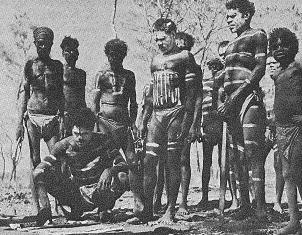
[Illustration: Men taking part in a sacred religious ritual. Great effort is put into these rituals and they involve a large share of the Aborigine's time. In addition they are kept completely secret from the women. If a woman should happen to see part of the rituals or the men's religious ground paintings or artwork - she is most frequently put to death. Modern Aborigines are much less secretive about their rites than their ancestors.]
Of the 80,000 Aborigines in present day Australia probably no more than a few thousand live in scattered groups following a similitude of the ways of their ancestors. In the 1960's Eugene Burdick happened upon a man, his lubra (wife) and two children. The man was six feet tall and incredibly skinny. The clan reeked of musk and had flies crawling across their bodies and even across the man's open eyes. Burdick asked them to perform a few "tricks" if they would. The young boys placed a dead rodent on a bush, gathered up a few stones and began pelting the rodent with pinpoint accuracy. Burdick asked for another "trick" and the man said he would miss the rodent with his boomerang. He hurled his boomerang and it skimmed the surface of the ground for a number of yards before shooting up into the air. It reached a few hundred feet away and seemingly hovered in mid-air only to come speeding back, missing the dead rat by an inch. The man stepped sideways and grasped the instrument out of flight. When asked for another feat the man trotted into the plain and came back in minutes with a dead kangaroo which he and his family tore apart and ate raw. The Aborigine bid Burdick farewell by crunching a bone between his bloody teeth.
The Aborigine could survive in a land where most westerners would die in a few days and yet he was without any clothing, shelter or instruments other than crude spears and the uncanny boomerang. They are a great anthropological mystery. It is uncertain where they came from or when, although it has been determined by excavations by D.J. Mulvaney that they have been on the continent at least 16,000 years. This would make them the longest surviving single culture in the world. It is peculiar that the Aborigines superficially only attained a primitive Stone Age culture while their religion and customs are so exceedingly and intellectually complex. It has been maintained by some, including Joseph Chilton Pearce and French anthropologist Claude Levi-Strauss, that the Aborigines intentionally stayed at a Stone Age level of development. Perhaps the Aborigine's culture was a mental culture rather than a technological one. Their view of the world is as entirely complex as our own but it is also an entirely different kind of viewpoint. Materiality and possessions were eschewed because it encumbered their mental involvement in Dreamtime and made impossible all the uncanny abilities and mental plateaus they could achieve.
Thomas S. Kuhn coined the term "paradigm" in his book published in 1962, The Structure of Scientific Revolutions. Briefly put, our paradigm is the composite of mental concepts according to which we believe the world operates. In it is defined what is possible and impossible. When we turn on the tap we believe water will come out and not oil and when we jump into the air we expect to come right back down and not go sailing off into space. The accepted scientific paradigm is of a more abstract nature which we don't normally think about in everyday life. This consists of the simplest mechanical laws to the most abstruse sub-atomic physics.
The Aborigine has a different paradigm than we do. To him it is possible to communicate telepathically with his fellows and to have knowledge of a kangaroo in the bush two miles distant. To him this is no sort of magic but something taken in stride within Dreamtime. An air conditioner would be quite a magical thing to the Aborigine because he has no possibility of such a thing in his paradigm. Everyday telepathy is quite magical to us because we have no place for such abilities in our paradigm.
The "way the world works" does not seem to be so much "out there" as "in here." Man's mind may have an effect on the environment to an equal degree as the environment has on man's mind. In The Crack in the Cosmic Egg Pearce postulates that thought is part of a continuum, the lower extreme of which is matter. Our most basic assumptions about the nature of the world are "converted" into or are matter.
If some of our most basic assumptions about the physical world such as that fire burns, prove to be arbitrary - then it could indicate that these basic assumptions are synthetic and do not represent an absolute physical reality "out there." The primitive fire-walker is an instance of supposed physical law being violated. In numerous places the world over primitives demonstrate the ability while in religious trance to walk barefoot over hot coals. This fact has been validated by many observers yet it is "impossible" since it violates our physical law. The Aborigine also performs feats that must be described as impossible according to our physical laws. Joseph Chilton Pearce relates an incident of this Dreamtime ability:
"To test their proverbial tracking skill, a single man traveled on foot for many miles over widely different terrain, sandy desert, marsh, rocky country, following no trail, leaving no detectable trail. The route was nevertheless followed unhesitatingly a year later by a cooperative aborigine. Their ability for ;ground reading' is famous, but here the contemporaneousness with the Two Brothers was called on. The Aborigine had to have an article of clothing from the man leaving the original trail. This he held while going into Dream-Time. The Two Brothers, of course, were contemporaneous with the original event itself. Having made his connections with the Two Brothers, the tracker connected with the event which was then contemporaneous with himself as well. He followed the trail rapidly, unerringly, and without pause, never giving any indication of looking for signs, should any have conceivably remained."

[Illustration: The old ways and the new. A full-blooded Aborigine woman and child living in the ways of their ancestors. The "keloids" or raised scars on the woman's shoulder are from an initiation rite. Women go through only one initiation rite during puberty while men may pass through any number and stages of initiation.]

[Illustration: The picture is of a modern half-blooded Aborigine woman working in a supermarket. While many Aborigines are unable or find it undesirable to integrate into modern society most have entered fields of mining, construction and livestock raising. The Aborigine men are especially noted for their skill in mechanics.]
The Aborigine is able to perform this feat because within his Dreamtime philosophy he has belief and an entire explanation of how it is possible and perfectly natural. This could be compared to our technological paradigm. Our air-conditioners work because we have belief and an entire explanation of how they work and that it is also "perfectly natural." What is believed and can be explained is physically possible. It could be that when we can explain theoretically and thus believe in an anti-gravity principle - we will discover anti-gravity. This is certainly no more an amazing thing than the development of nuclear energy which was stimulated by a simple three letter equation, E=mc2.
The Aborigine in Dreamtime trance lives in a different world from our own. This world is as alien as the utterly desolate terrain upon which he spent his last 16,000 years, unscathed by other polluting minds and allowed to create his own adventure. His story is over, however, and we are lucky to have caught its last chapter and to have gained an insight into the working of Mind itself.
The Cathedral of Wisdom—A Journey To Chartres
by Louis Khourey
Fodor's Guide to France described the sight of the great cathedral of Notre-Dame at Chartres, when seen from miles away across the wheat fields of the farm district of La Beauce, thirty miles west of Paris. Sitting in my Paris hotel room, I thought it a tourist attraction that I would not want to miss, along with the glamour of the French capital and the opulence of Versailles. So as the SNCF train, crowded with commuters, came into the vicinity of Chartres, I peered at every possible angle out of the windows, hoping for a momentary glimpse of the view memorialized in every tourist guide to France. It was a pleasure denied me; at most places, tall trees lined the right-of-way and where the fields appeared open I saw nothing that did not remind me of the farms of northern Ohio.
Pushed out of the train and loaded with luggage, I persisted in looking for that first dramatic view of the cathedral considered to be the greatest example of Gothic architecture in the world. Nothing but platforms and smoke and baggage, grease and grayness. Through the station and into the parking lot that faces the town of Chartres, still nothing. At this point, practicality took over and the necessity of finding a hotel room to drop my luggage. The mandatory check of three hotels to find the best price had a satisfactory result, and the ritual collapse onto the bed followed.
Refreshed, I went out to see what I had come to see, what everyone comes to Chartres to see. Only two blocks up the street from the Hotel de l'Ouest I turned to the left and saw the famous twin spires high above the town's uniform, three-story construction. Another two blocks brought me face to face with those two giants, flanking the West - the "Royal" - Portal. And I knew immediately that I had not come here as a tourist but as a pilgrim, not just to look but to experience.
The doors were locked on the evening of my first visit, perhaps fortunately, for it gave me the chance to explore the exterior without feeling the need to see the inside. This church is the fifth that was built on this site, and the West front is the oldest part because it is the only remaining part of the fourth church that burned in 1194, less than fifty years after it was built.
After the fire that destroyed the Romanesque church, that of Bishop Fulbert, the entire community of Chartres - noble and common - joined in a single-minded effort to raise the most magnificent shrine that had yet stood on the ancient Druidic site, the cathedral of Notre-Dame that stands today. From the earliest Christian times, the site had been a shrine to the Blessed Virgin and the church of Fulbert was said to contain a relic, the tunic worn by Mary at the time of the Annunciation. The loss of such a wonderful object would have been a disaster to the town, and an apocryphal story has it that on the day after the fire, the relic was found unharmed and the town resolved to build an even greater shrine to the Virgin. The building was roofed in 1220 after a remarkably rapid construction to which many attribute its unique unity of design.
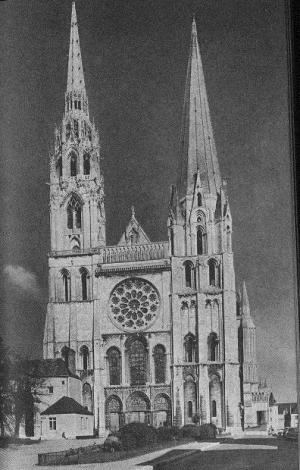
[Illustration: West Front. This wall, including the Royal Portal and the South Steeple (right) is all that remains of the Romanesque church that burned in 1194. The old spire, made all of stone without any timberwork, is widely praised for its combination of simplicity, beauty and strength. The North Steeple, over 111 meters high, was built between 1507 and 1513 by Jehan de Beauce in a flamboyant Gothic style. The large rose window above the three lancets was added during the reconstruction of the 13th century.]
The cathedral at Chartres is, above all, in honor of Mary, whose cult was at an apex in the twelfth century. But the symbolism carved into its stone and pieced into its windows is complex and subtle, reflecting a marriage of religion and philosophy that has long been broken, but whose brilliance can be viewed in this monument of the Middle Ages. Besides being a place of pilgrimage for the devout, Chartres was the center of a school of philosophy devoted to Plato and especially to his dialogue, the Timaeus, which deals with the generation by God of the physical universe in a mathematical and geometrical order. The Timaeus itself is, at once, scientific and mystical:
"What is that which always is and has no becoming, and what is that which is always becoming and never is? That which is apprehended by intelligence and reason is always in the same state, but that which is conceived by opinion with the help of sensation and without reason is always in a process of becoming and perishing and never really is... Now that which is created must, as we affirm, of necessity be created by a cause. But the father and maker of all this universe is past finding out, and even if we found him, to tell of him to all men would be impossible."
The carefully designed proportions which give the cathedral its harmonious and serene character have been linked by some to this Platonic preoccupation with the divine geometry. But the influences of secular philosophy are even more clearly written on the face of the building. Over a door of the Royal Portal are carved seven figures representing the seven liberal arts, including Ptolemy, Pythagoras (from whom Plato derived many of his ideas about number), Cicero, Euclid and Aristotle. Nearby are the signs of the Zodiac, which can also be seen on a beautiful window within. The minds that created this masterpiece for the glory of God and his Mother were not guided by orthodox tenets of Christianity, as we know it today. They understood the role that philosophy plays in developing the deepest religious experience.
This "esoteric" interpretation of the cathedral has been developed by Georges Charpentier in The Mysteries of Chartres Cathedral (Avon Books, 1975). Charpentier seems to be reaching a bit far for an all-inclusive explanation in his stories of the Knights Templar and their return from the Crusades with the Ark of the Covenant for which they needed an appropriate home, but his book is full of fascinating observations about the unusual proportions in the cathedral. He maintains that in pre-Christian times the site was the center of Druidic rites because of certain telluric forces - energy from the earth - that had their focus there. The cathedral, he says, was designed to hold and resonate these forces, to aid the spiritual development of those who entered.
Charpentier's fantastic theories gained credence with me when I returned the morning after my arrival in Chartres. Few tourists had yet arrived when I went in through the West doors and looked down the nave to the choir beyond. The immense height and length, a huge enclosed space bathed in light filtered through windows of color that can be described as profound, put me in a different world. A tourist's state of mind is tinged with unreality and confusion, but this place dissolved the fog instantly, and drew me into a contemplation of the clarity and beauty that the mind of man is capable of conceiving and representing.
My first inclination was to just stand where I entered at the head of the nave and look, not merely with my eyes but as an effort of my whole being to absorb the meaning of this place. Many must be equally disappointed by their inability to fathom the message of Chartres in one, intense moment and, like me, move on to study the one hundred seventy-six windows with their different stories, their multitude of symbols.
The iconography of Chartres is everywhere noble and beautiful, never morbid. Most notable for a Catholic church, as Charpentier points out, is that the crucifixion is nowhere depicted, either in stone or glass. Christ is shown either in his heavenly glory or as the serene child on the lap of Mary. The saints and the prophets do not remonstrate, but communicate an inner peace.
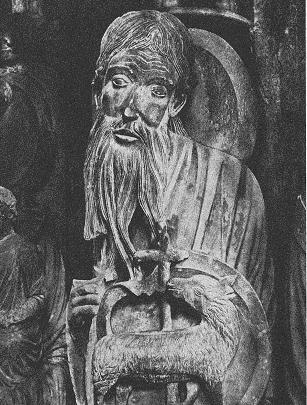
[Illustration: St. John the Baptist. The figures carved on the North Portal are the prophets who foretold and prepared for Christ, including John the Baptist who is depicted as emaciated from fasting and clothed with camel's hair. The South Portal shows Christ surrounded by his Apostles and other teachers of the early church.]
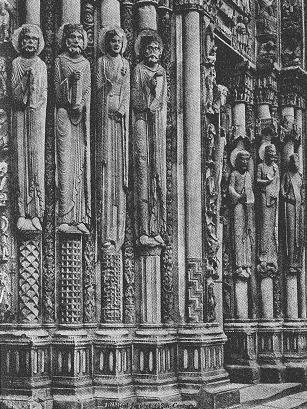
[Illustration: The Royal Portal. The doorway of the West Front is so named for the statues of the kings and queens, presumably the Judaean ancestors of Christ. Their elongated figures and serene faces suggest a joyful transcendence of the body in favor of a heavenly peace.]
The glory of the cathedral is not in the parts, though all seem perfect, but in the whole. The American author and historian, Henry Adams, was enthralled by it from his visits in the 1880's, and wrote in Mont-Saint-Michel and Chartres:
"Like all great churches, that are not mere storehouses of theology, Chartres expressed, besides whatever else it meant, an emotion, the deepest man ever felt - the struggle of his own littleness to grasp the infinite. You may, if you like, figure in it a mathematic formula of infinity - the broken arch, our finite idea of space; the spire, pointing with its converging lines, to Unity beyond space; the sleepless, restless thrust of the vaults, telling the unsatisfied, incomplete, overstrained effort of man to rival the energy, intelligence, and purpose of God."
That inchoate emotion brought me back to the cathedral when I returned a rental car to Chartres after six days touring the Loire valley and Brittany, and it seemed stronger than the first time I stood before the Royal Portal. Now I had a full day to take two guided tours, explore the crypt with structures that date back to Gallo-Roman times, and look - at the deeply colored windows with innumerable stories, at the awesome reach of the vault, at the dramatic sculpture that covers every inch of the doorways, at the transcendent thrust of the two towers.
It seemed as if I could not consume enough of the spiritual food that Chartres offers to the visitor, despite my greedy explorations of every corner. I had been somehow transported from modern Europe to the Middle Ages of Louis IX and Blanche of Castille, from the secular world to a land of faith, and I wanted to stay longer, to learn what I could from this Bible in stone and glass. But my historical, esthetic and religious reverie was not deep enough to extinguish the memory of excursion fares and exchange rates, and I returned to Paris knowing that there was a truth in Chartres that I had failed to glean, and that I might never again visit a place with such a power to transform the ordinary mind and to lead it into a search for the divine.
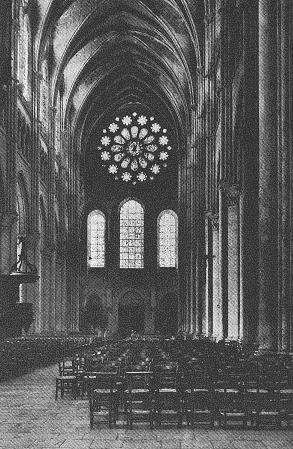
[Illustration: The Nave. Looking back from the transept toward the West, one sees the great rose window surmounting the three lancets. If you turned left or right from this position, you would see rose windows shining into the South and North transepts, each above five lancet windows. The West rose is over 15 meters in diameter.]
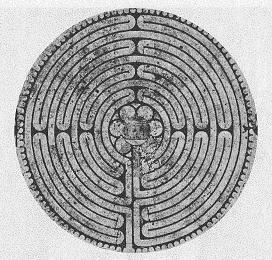
[Illustration: The Labyrinth. Now partially concealed by chairs in the center of the nave is this circular pattern, almost 13 meters in diameter. Mazes of identical design are found in other Gothic cathedrals, through which pilgrims would follow the only path to the center. According to Charpentier, a walk into the labyrinth would not only be symbolic of one's spiritual aspiration, but would move one through a magnetic field and lead to "an opening of the intuition to natural laws and harmonies."]
Viktor Frankl and the Psychology of Meaning
by John Kent
A new syndrome of mental illness is being found in psychology today. As many problems that confront the physician are mental rather than physical ones, psychotherapists are becoming more frequently confronted by their patients with essentially human, philosophical, and spiritual problems than simply neurotic symptoms. They are asked to solve problems concerning the questions of: what is life?, what is suffering? and, why am I here? - rather than emotional and interpersonal conflicts alone.
Logotherapy is a form of existential analysis developed by Viktor Frankl, a Viennese psychiatrist - enriched by his experiences in the Nazi concentration camps during World War II - that includes much of the content of previous psychotherapies, but also goes beyond them into an area seldom touched in psychology: meaning, purpose, and values in life. Logos, in its most basic original definition, is that of its Biblical usage as "the Word" or "idea" of God that initiated the Creation. Frankl also expands the definition of the term to include "meaning" and "spirit" as well. The Logos is in Man, and finding this will make him free.
Psychology has often considered the spiritual distress of a man who is looking for a meaning to his existence to be a pathological symptom, and that the answers he succeeds in finding are mere self-delusions. Such a search is often traced by psychologists back to unconscious roots and sources: that meanings and values are nothing but defense mechanisms, reaction formations, and sublimations, that morality is just a product of the super-ego, that God is just a projection of a father-image, and religion itself is just a neurotic obsession - thus regarding it in pathological, instinctual terms and missing the point of the authentic phenomenon. Closed-system concepts of homeostatic tension - reduction or pleasure - principle motivation are no longer adequate to explain the workings of a man's soul. "The will to meaning is more than an irreducible need; it is man's primary concern," was Maslow's belief. It must not be explained away as a psychodynamic "nothing but." Other drives, such as for power, pleasure, vanity, or security are all false; they hide it and distort it; they are compensations for one's emptiness of meaning. But this yearning is the core of our humanness. Frankl's critics are correct in claiming that such values and striving are really defense mechanism, reaction formations, conditioning, super-egos, etc., to the extent that this is probably true for many people. But they overlook that when true, this is aberrant and the genuine phenomenon must not be ignored.
The frustration of this will is the root of all mental illness, and psychological reductionism only serves to perpetuate it, thus contributing to the mass neurotic triad: depression, addiction, and violence. If meaning and values are denied by psychologists, reasons and motives are replaced by pan-deterministic conditioning processes - man becomes a robot, a sleepwalker, a sophisticated rat, and through the aid of psychotherapy can at best become a socially efficient, emotionally well-adjusted, and harmless one. The very existence of spiritual angst is proof that the myth of "normalcy," the traditional goal of therapy, is not enough, as one could still be empty and aimless, vainly seeking for satisfaction in a sane but spiritually bankrupt environment. Attaining such normalcy by coaxing unconscious drives into social respectability is not sufficient, nor even necessarily desirable. Freedom from psychodynamic disorders is only part of the process of moving toward true health, which is that of being conscious of and fulfilling meaning. What moves a man is not a cause, but a reason. What is the difference? "If you cut onions, you weep. Your tears have a cause, but you have no reason to weep," is how Frankl explained it. It is not Eros, but Logos that is repressed. But once repressed, even the existence itself of meaning is no longer perceived as possible. The psychology of religion becomes the psychology as religion in that psychology is sometimes worshiped and made an explanation for everything. Religion is not considered by Logotherapy to be just another impersonal psychological force or a function of some other process that drives one on, but is a personal choice. Religion does not "affect" a man - he chooses to be religious. Religion is existential or not at all.
Some consider truth and value to be mere extensions of the relative human self, but this is to deny that one can transcend himself to find the true reality beyond. A meaning to one's existence is not invented by a man himself but rather detected. Logotherapy uses this search for meaning as a way of maintaining or recovering one's mental health; this goal is held before one's eyes as an impetus to climb out of one's pathological pit. At present, when so many people are becoming psychological hypochondriacs always looking for childhood traumas, rejections, repressed sexuality, and conflicts between different drives or between the Id, Ego, and Super-Ego, they find strength in the message that their feeling of meaninglessness is not a symptom of sickness but proof of their humanness: only Man can feel the lack of meaning because only Man is aware of meaning.
Not every conflict is necessarily neurotic; some amount of conflict is normal and healthy, especially the tension involved in a man's struggling for a goal worthy of him, or for a game worth playing with all his soul, as De Ropp put it in his The Master Game. In a similar sense, suffering is not always a pathological phenomenon. Rather than being a symptom of neurosis, suffering may well be a human achievement, especially if the suffering grows out of existential frustration. One's search for a meaning to his existence, or even his doubt of it, is not in every case derived from, nor results in, any disease. Existential frustration is in itself neither pathological nor pathogenic. A man's concern, even his despair over the worthwhileness of life is a spiritual distress - and one of integrity if one forsakes the Garden of Earthly Delights and related vanity of vanities because of this yearning - but by no means a spiritual disease. In fact, religion is not a form of diseased neurosis; neurosis is the result of diseased religiousness. "When the Angel in us is repressed, He turns into a Demon."
The Special People - What Makes Them Special?
Abraham Maslow had studied an assortment of whom he believed to be genuinely self-actualized people to find out what their qualities were that distinguished them from being merely "normal" or "okay," as current psychology jargon calls it. He found these individuals - artists, philosophers, statesmen, scientists, and the like - to be somehow more "alive." These were the aspects he found of this special quality:
A Zen Buddhist text described a sage in these same "inner-directed" terms: "He walks always by himself, goes about always by himself. Every perfect one saunters along one and the same passage of Nirvana; his tone is classical, his spirit is transparent, his airs are naturally elevated, his features are rather gaunt, his bones are firm, he pays no attention to others."
Fundamental Principles
However, while acknowledging that Man is not totally rational, Logotherapy does not go to the extreme of psychoanalysis in claiming that the core of a man is instinctual and irrational. It rather says that his core is intuitively linked with the Divine. The view of Man called pan-determinism is considered false in that it denies his ability to take a stand toward any conditions whatsoever. Man is ultimately self-determining. He does not only exist, but always decides what his existence will be, what he will become in the next moment. He has the freedom to change at every instant. "What one is, he has become through that cause which he has made his own." - Karl Jaspers. While he is, of course, influenced a great deal by instinctual, environmental, psychological, and societal factors, his very humanness - "the defiant power of the human spirit" - is in his freedom to accept or reject and transcend these factors that direct him.
But the emphasis is not on freedom from conditions but freedom to take a stand toward the conditions; not just freedom from something negative but freedom to move toward something positive. Existential analysis cannot directly analyze the ultimate nature of a man's existence, as the genuine inner un-divided self cannot truly reflect back upon itself, as that would still imply duality; it can only be experienced as the final state of being. This final observer, as the eye, cannot directly see itself - Logotherapy can only be an analysis of the attitude of the self toward its existence. As such, it is applicable not only to existential crises, for people who are looking for spiritual answers. It applies on the more primary levels too in terms of the attitude one assumes toward a non-spiritual problem - such as adverse living conditions or personal grief; of arriving at a mature philosophical perspective on it. Frankl gave the example of the old man who grieved at the death of his aging wife and saw no purpose in it. Frankl asked him how his wife would have felt if the husband had died first and left her alone. He replied, "She would have deeply grieved." Frankl suggested that perhaps the purpose of her dying now and leaving him alone was to spare her the later grief of having to endure his death instead; thus the man's suffering was now seen to have a purpose and he could carry his burden with dignity, courage, and gratitude, for the sake of his wife.
Meaning is not a Rorschach Test
While meaning is considered to be unique to each person at each moment of his life, it is a serious mistake to consider meaning as being purely arbitrary. One must find not merely a relative, subjective meaning, but find objective values instead. As extreme examples of the dangerous errors that are possible in this pursuit, Adolf Hitler, Charles Manson, and Howard Hughes all had a dynamic sense of meaning and purpose to their lives, with no nagging doubts about the meaning of it all. But obviously that alone was not enough, as all were insane and out of touch with reality and their own higher selves. Values must be of self-transcending substance if one is to be genuinely sane and healthy. Meaning must be subjective, in a sense, yet nonetheless objectively found; it cannot be given, and must not be invented. James Crumbaugh considered that the will to meaning "can be comprehended in terms of the Gestalt psychologist's laws of perceptual organization" and he "relates it to perception - the will to perceive, to read meaning into the environment, to interpret and organize stimulous elements into meaningful wholes." The Logotherapist presents life to the client not as a Rorschach ink-blot test but rather as an Embedded Figures test (as in testing for color blindness) - the meaning is already there; we must find it.
This also brings to mind one aspect of Carl Rogers' phenomenological philosophy of therapy: that what is important is the client's subjective point-of-view of his world around him and guiding him to a state of well-being within his own Weltanschauung - even if his perception is false. As just pointed out, this attitude, while of understandable ethical value in terms of promoting therapeutic change, is not sufficient. To be "well" within one's own - perhaps false - concept of reality is a dangerous tangent, maybe even worse than being consciously unwell, in that one may think he is already healthy and comfortable and then stop growing toward health, as the suffering would no longer motivate him to keep looking for anything better. To be really sane means to find true reality, and concurrently, one's true Self; only thus can one distinguish this true Self from one's perceived, artificially created ego.
To avoid the negative aspects of his humanness, Man must accept his responsibleness in the three ways in which meaning may be discovered:
The first way is obvious - the necessary value judgment and accompanying responsibility are up to each man. The second way is love - it is the only way to grasp another human being in the innermost core of his personality. In a relationship, the other person is not used as an object, but is encountered and his humanness is recognized; then if one can become fully aware of the unique essence of another person: that is love. By accepting Frankl's "tragic triad" - unavoidable suffering, inerasable guilt, and death - with dignity, is to actualize the highest value, to fulfill the deepest meaning; for what matters above all is what attitude we choose to take toward unalterable fate - this is our final freedom. Suffering ceases to be suffering in some way at the moment it finds a meaning on some higher level. Logotherapy cannot stop suffering but it can stop despair - which is suffering in which the sufferer sees no meaning - by showing him the meaningful attitude he can assume if he so chooses, thereby showing his profound and unconditional faith in his convictions.
"He who has a why to live for can bear almost any how."
—Nietzsche
Noos and the Unconscious God
Logotherapy emphasizes the dimension in Man called noos - his spirit, his soul, the "I" in the I-Thou relationship. It is this very human dimension that makes a man different from an animal. But noos is not something Man has; he is noos. It is his innermost core, his personal self, his spiritual fingerprint. Man is trapped in the dimension of his body, driven in the dimension of his psyche, manipulated by his environment; but in the dimension of his noos he is free. Here he not merely exists, but actually influences his existence; here he is not driven, but is the driver. In his noetic dimension Man decides what kind of a person he is and, more importantly, what kind of a person he is going to become. It is to this dimension of freedom Man must turn in his existential despair and to this the Logotherapist must direct the patient's attention.
Perhaps the most essential belief inherent in Logotherapy, the one on which its entire theory of change is based, is that Man has not only a repressed Libido but also a repressed "Religio." Frankl believes that deep inside everyone, even if not conceived of strictly in theological terms, is an "unconscious God," which when contacted provides the impetus to move toward health. This inner core is the source of all value, meaning, and identity. Because of this fundamental principle, Logotherapy, while usually categorized as one of the Third Force of Humanistic / Existential psychology, can in fact be considered to be instead a "Fourth Force," related to the general area of pastoral counseling. Simply stated, Logotherapy's job is to make this unconscious God conscious, because in truth it is this "God" that heals the man's distress, not the therapist. The psychological techniques are used only to get the man to the point of awareness, self-responsibility, and intuition where this God can then help him to heal himself. The power and freedom inherent in his noos is latent and inert until he awakens to it in himself. Related to this is Maslow's assumption that "this inner nature, this active will toward health, is not strong, overpowering, and unmistakable as are the instincts of animals. It is weak and delicate and subtle and easily overcome by habit, cultural pressure and wrong attitudes toward it. Even though weak, it rarely disappears in the normal person - perhaps not even in the sick person. Even though denied, it persists underground forever pressing for actualization."
One of Frankl's favorite maxims is "Be the master of your will and the servant of your conscience." One's conscience is self-transcendent; it is the link to one's spiritual unconscious. This can be recognized by understanding the nature and meaning of responsibility. Man is responsible for himself but not to himself. Responsibility means "the ability to respond" - but to what? To the unconscious God within which the individual can contact if he seeks it, and it is the Logotherapist's job to help him seek it, culminating with a relationship between the immanent "I" and the transcendent "Thou." Man thus finds his unique meaning gestalts dormant in his life through the interpretation of his conscience; his conscience is what leads him to this Thou. The Logotherapist merely serves to wake up the individual's conscience. When this unconscious religiosity is awakened, it is childlike in the truest sense of the word: pure and faithful. But there is a further step. The Logotherapist not only seeks with the client to make conscious contact with this inner guide; this guide must then be followed "unconsciously"; meaning regaining the spontaneous, innocent faith in one's own true nature, rather than living in a forced, deliberate, unnatural manner from cognitive over-regulation which would stifle all creativeness. But now, by being in contact with this guide, one is free and no longer manipulated by unconscious neurotic forces. However, there is still room within this faith in oneself for healthy doubt of anything that may be false or misleading.
Despite the Logotherapist's emphasis on spiritual matters, he is not a preacher - the therapist does not force an image of God onto the client, but only clears the way of neurotic obstacles and blindness for their spontaneous meeting. However, as responsibility means being responsible to answering the question of how to interpret one's life, Logotherapy leaves it up to the client whether he chooses a theistic or atheistic philosophy within which to live. Essentially, what the Logotherapist does is lead the client up a flight of stairs to a plateau of relative health and freedom where he opens the door to another dimension at the top of the stairs for the client, but does not push him through it. That is each man's choice for himself and it can be no other way. It is important to note here that Logotherapy does not consider religion and meaning as just another psychotherapeutic tool to promote mental health: the "unconscious God" is not to be summoned and embraced for His utilitarian value on our level, but for spiritual salvation, if the client wishes to consider it that way.
The Existential Vacuum and Noogenic Neurosis
What many people complain of today is the feeling of the total and ultimate meaninglessness of their lives. They lack the awareness of a meaning worth living for. They are haunted by the experience of their inner emptiness, a void within themselves. They are caught in the "existential vacuum," the collective neurosis of the modern age, the deep unfulfilled need that cannot be satisfied by a busy schedule, sensual pleasures, egotistical joys, the acquisition of power and possessions, or even the fanatic running away into mindless irresponsibility. Frankl coined the term "abyss experience" to describe this feeling of utter futility, as opposed to Maslow's concept of "peak experiences" at the other extreme. Man no longer has animal instincts to tell him what he has to do, no traditions to tell him what he ought to do, he will soon not even know what he wants to do; more and more he will be governed by what others want him to do. This existential vacuum manifests itself mainly in Man's boredom of the spirit, guilt from knowing that in his freedom he could choose differently than he does, and anxiety because the burden of his freedom is great. All this goes along with the insecurity accompanying the growing realization that despite - and also because of - our growing knowledge concerning the mind, consciousness, mankind, life, the universe, and the exposing of false gods, we are in search, not in possession, of Truth. This "collective neurosis" has four main symptoms on a social scale:
All four symptoms are caused by a refusal to accept personal responsibility and thus constitute a voluntary escape from freedom. This encourages the existential vacuum. A person cannot find individual meaning if he does not believe it is worth finding, or thinks it is impossible to find, or accepts someone else's meaning as his own. A common phenomenon here is "Sunday neurosis" - that kind of depression and ennui which affects people who become aware of the lack of content of their lives when the rush of the busy week is over, and the void within themselves becomes manifest. This frustrated will to meaning is vicariously compensated for by an egotistical will to power, including the more sophisticated form of this primitive urge in modern society - the will to money - as well as the frantic will to pleasure, sexual excess, and intoxication. Suicide is the most extreme expression of one's lack of meaning, so Logotherapy is especially appropriate to deal with this as it goes directly to the source of the problem. It is also particularly useful in working with juvenile delinquents and prisoners who also obviously are without a healthy purpose to their lives. The call of one's will to meaning is a major reason for drug use among many young people who experiment with their minds hoping to find some profound reason to live. Drug abuse is then often the result of the consequent failure to find it.
Logotherapy has coined the term "noogenic neurosis" in contrast to psychogenic neurosis. The former have their origin in the noos - Greek for "mind." But sometimes neurotic symptomology invades an existential vacuum wherein it continues to flourish. So, Logotherapy is needed in psychogenic cases also. In order to be fully effective, every form of therapy, no matter how restricted in its intent and methods, must also be Logotherapy. It was once said about Freud, as compared to a therapist of the Third Force of psychology, that he "goes down deeper, stays down longer, and comes up dirtier." (Yet it is curious that Freud went "deeper" into a man's sickness than any other therapist, but his direction of depth never touched a man's soul.) Frankl was right in claiming that what is needed in response to this depth-psychology is "height-psychology"; the dirt is still to be investigated, but to a different end. In this way, Logotherapy incorporates the aims of traditional psychotherapy and supplements them; it is not meant to be a substitutive panacea. As the cure for existential anxiety is knowing the meaning of one's own life and the task of existential analysis is to lead men to consciousness of their responsibility to decide on this, therapy and education in general must be training toward the ability to decide. The de-neuroticizing of humanity requires the re-humanizing of psychology.
Frankl is the answer to the current behavioral, deterministic, cynical, nihilistic, atheistic, reductionistic, hedonistic, narcissistic pseudo-science which modern psychology is. The Second Force (Behaviorism) inherited one of the First Force's (Freudian) main errors: "Unfortunately, the reductive philosophy is the most widely acclaimed part of psychoanalytic thought. It harmonizes so excellently with a typical petit bourgeois mediocrity, which is associated with contempt for everything spiritual." With his explanation of "dimensional ontology," Frankl is one of the few psychologists who acknowledge that there are higher levels in man, beyond the primitive animal or conditioned robot levels, and by extension, that there can be different levels of men according to the level on which they primarily exist. However, to be realistic about it, studying and working with the noetic dimension in Man is applicable only to those who are consciously in touch with it in themselves and who wish to develop on that level. To those who are unaware of this dimension in themselves, the lower psychological principles apply. These processes function in the spiritual man too - he isn't cut off from his roots - but he uses them to a higher purpose, rather than as ends in themselves to perpetuate the process of Nature. Frankl is right in condemning pan-deterministic behaviorism, not because it isn't true in many people, but because it doesn't have to be true.
The Movement Toward Meaning
Logotherapy does not claim to have found answers to the many crucial questions which modern man faces, nor is it the only school of therapy trying to find answers. It moves in a definite direction, however - away from adjustment and toward individual responsibility. It emphasizes mental health rather than mental disease, total man rather than psyche only, man's freedom rather than his limitations, values that beckon rather than drives that push, and the challenges of the future rather than the traumas of the past.
Logotherapy is absolutely ontological in its approach to mental health: one's very being must become the true state of health it is seeking and not merely be externally shaped into simulating it, however effectively this can be done; and any part of the person outside of his noos, his spiritual essence, even the innermost part of his psyche, is outside of his true being. Because of this, Logotherapy is critical of the behavioristic philosophy of therapy which, while "curing" the client of his presenting problem to an extent, may result in iatrogenic neurosis - one that is caused by the doctor - by taking away his awareness of himself as a free and responsible, self-transcending being.
Logotherapy helps to illuminate the way forward, step by step; and not for mankind as a whole, but for the individual. It tells him that he cannot change his past, but that he is not its slave either; and that he can change his present and influence his future. It tells him that he has limitations but also great freedom within these, and that the use of this freedom can make the difference between a full and an empty life; that, if not used responsibly, freedom will turn into meaningless arbitrariness. It tells him he has choices to make, at every moment, and that he must make them in the face of constant uncertainty; that he can never wait until all the answers are in. It tells him that each person is alone, yet participates in a reality that far transcends him and his understanding; that success in life does not depend on the obvious; and that individual life is geared to ultimate meaning. It tells him that he can never grasp the reality of the Ultimate in his present state, whatever name is given to it, but that everything depends on how he responds to its demands on him, as he is able to perceive them.
Life is Asking You
But what if, after all this theorizing, the desperate client turns to the Logotherapist and bluntly asks, "What is the meaning of life? What is it all about? Why am I here?" - what does he answer? In dealing with these questions, the Logotherapist does not try to supply him with a meaning for life in general but rather the specific meaning of a person's life at a given moment, as this changes and evolves. Logotherapy does not emphasize finding an abstract meaning for all of life. Everyone has his own specific mission or assignment to carry out, a destiny that demands fulfillment, if one can but recognize it in oneself. Therein he cannot be replaced, nor can his life be repeated. Thus everyone's task is as unique as is his specific opportunity to implement it.
In this process of inquiry, Man should not just ask what the meaning of his life is, but rather must recognize that it is he who is being asked. Each man is questioned by life; and he can only answer to life by answering for his own life. To life he can only respond by being responsible. One's personal existential commitment to the search for Truth is itself the answer to the question of life's meaning. The sum total of his whole life is his prayer for salvation. Thus Logotherapy sees in responsibility the very essence of human existence. Logotherapy tries to make the client fully aware of his own responsibility; therefore it must leave to him the option for what, to what, or to whom he understands himself to be responsible. That is why a Logotherapist is least tempted of all therapists to impose value judgments on the client, for he would never permit the client to pass on to the doctor the responsibility of judging. Logotherapy is neither teaching nor preaching. It is as far removed from logical reasoning as it is from moral exhortation. His role consists of widening and broadening the visual field of the patient so that the whole spectrum of meaning and values becomes conscious and visible to him. Logotherapy does not need to impose any judgments nor direction on the client, for actually, Truth imposes itself and needs no intervention on its behalf.
Logotherapy, or "medical ministry" as Frankl calls it, differs from most other forms of psychotherapy in that the others aim at restoring one's capacity to work, to enjoy life, and to be happy with oneself, while Logotherapy includes all these, yet goes even further by having the client regain his capacity to suffer, if need be. This form of therapy also differs from religious counseling in that its task is not to save the soul, as in religion, but to keep the soul healthy; and the soul is healthy as long as it remains true to its humanhood, meaning: conscious and responsible, and moving sincerely toward fulfilling its destiny. The individual can them decide for himself what form this movement is to take. One may wonder, however, how Truth in life could be found without one then being "religious," even if not conceived as such.
Self Commitment and Paradoxical Intention
In working on the noetic level, the Logotherapist does not tell the person what the Truth concerning his life is, but rather draws this inspiration or goal out of him, thus moving him toward a higher level of health, pulling him rather then pushing him. The removal of psychological problems is thus only a part of the over-all process toward self-transcendence and is not held up as the ideal for its own sake. The aim of the Logotherapist is to re-orient the client in his attitude toward life itself. Only when the typical self-centeredness of the neurotic is broken up can the focus of striving be shifted from the psychic conflicts crippling him to the confrontation of the selfless goal of finding the meaning of his life instead. The truly neurotic individual does try to escape the awareness of his life task, and to bring him to full consciousness of it contributes much to overcoming his neurosis. The pivotal curative factor is self-commitment.
It is believed that mental disorders are expressions of this fundamental philosophical ignorance and that they are self-perpetuating entities. As soon as a person stops fighting with his neurotic obsession - not by giving in to it, but by applying Frankl's technique of "paradoxical intention" and seeing beyond himself - the vicious cycle is cut, the symptom diminishes and atrophies, and one's energy is freed to work on his life-goal. This philosophy of therapeutic change is best contained in the ancient Chinese "finger-trap" toy: the tube woven in such a way that when one places a finger into the opening on each end, it traps him. The more he struggles, the more tightly he is caught. But when he stops struggling and loosens up, he becomes free of the trap by artfully slipping out of it. It may not be too pretentious to claim that the essence of much of psychotherapy as well as religious teachings is contained in this toy, if one really understands its meaning.
Logotherapy can guide the mentally ill client to the point of normalcy or adequacy, yet still stimulate in him the awareness of the true higher goal, and instill in him the hunger to continue onward, if that hasn't already been a motivating force in his seeking of therapy. Also, by relentlessly emphasizing the importance of meaning in life, he reinforces the person's capability to be an efficient, whole, sincere, and determined seeker on his own, using all of life as a form of therapy, and everyone he encounters as a partner in mutual growth. By awakening the unconscious God within the center of his being, his intuition is cleansed, which then directs him toward the right way in which to go.
The Wisdom of the Heart
In dealing with the problem of noological distress, Logotherapy appeals to what Frankl calls one's "pre-reflective ontological self-understanding" or "the wisdom of the heart" in finding meaning. This is a blend of
If both are repressed, nihilism results, followed by the reaction formation of cynicism. Logotherapy is not the value judgment of facts but rather the making of factual statements about values. It is the phenomenological analysis of the valuing process itself in its three main aspects: attitudinal, experiential, and creative. The business of Logotherapy is to trace the neurotic mode of being to its ultimate ground by examining the foundation, or lack thereof, on which the individual bases his life. Through such analysis one finds his way to the existential ground on which direction and vision of values take place when he realizes that one is himself the direction and vision - this is where being and meaning merge. This phenomenological analysis means translating "the wisdom of the heart" into scientific-psychological terms, and then Logotherapy means the re-translating of this into plain words from which the common man can benefit.
The main technique used throughout this entire process is interpretation. Frankl was originally trained as a psychiatrist in Vienna before developing his system of Logotherapy, so he is no stranger to Freudian thought and techniques. However, this is not an interpreting of the client's material by reducing it into the mundane psychodynamic components of his instinctual unconscious, but rather identifying the latent universal search for meaning and values hidden within these psychodynamics and the glimpse seen through them - when worked through - of his spiritual unconscious. Every man looks for some form of truth in his life, even though this desire is usually misunderstood by him, the nature of the aim misconceived, and the effort made to realize it inadequate. The function of Logotherapy is to facilitate this process by touching the man's noos and bringing it to self-awareness.
Searching and Becoming
Frankl believed that the finest maxim for any kind of psychotherapy was given by Goethe: "If we take people as they are, we make them worse. If we treat them as if they were what they ought to be, we help them become what they are capable of becoming." Love helps the beloved become as the lover sees him.
Logotherapy simply states: Man is searching; but it can never decide for him if he is searching for a God he has invented, for a God he has discovered, for a God he cannot find, or for himself. This is the task of the Logotherapist: to illuminate, to let meaning "shine forth."
Toward a Psychology of Being and the Peak Experience
Man needs more than an intellectual understanding of the relationship between the human and the Divine - he needs an actual experience of transcendence. Such a mystical, or "peak" experience, gives one an intuitive understanding of the nature of reality, of one's true identity, one's relation to or within reality, and the values and meanings inherent in it. Although Frankl didn't specifically teach how to have such an experience - as they cannot be deliberately willed: they are spontaneous and subjectively seem to "happen" to the person, as an act of Grace - Logotherapy does work to lead one in that direction. In other words: if such an enlightenment is an accident, then one must strive to become accident-prone.
If the statement, "The fully human person in certain moments perceives the unity of the cosmos, fuses with it, and rests in it, completely satisfied for the moment in his yearning for oneness" is considered a highly amplified version of, "This is a fully human person," then with his work, Frankl has indicated the direction toward true health; toward a psychology of Being. The stale, hollow, sober ordinariness of normal, mundane reality by which life has become desecrated, and which is usually considered to be an indication of proud adult maturity, ends. Such a mystical experience can provide a man with an element of ecstasy, a feeling of the mystery of existence, of participation in the whole, a glimpse of assurance, a fleeting awareness of a plan of which he is a part, a meaning. It can give a man the courage to "say YES to life in spite of everything."
What is the Void Saying?
Frankl quotes a stimulating statement by Freud: "The moment a man questions the meaning and value of life, he is sick." I have often wondered if this striving for answers to life is a sign of special health or is actually a sign of sickness. I believe it is both. It is a sickness in the sense that we are in the state of being fallen from Grace, from our original state of innocence, unity, and clear intuition with the higher realms. It is a sign of health in the sense that, in our blind and lost condition, some realize the predicament they are in and feel the urge calling them to return home, and they follow it. The search actually should not be necessary because we are already home; but it is necessary because we don't really know it. The ones who assume they are already there and so don't think there is anything to look for may be the ones who are really sick.
The atheistic existentialists claim there is no meaning to this drama; that it is all empty and absurd. Until we know for certain, we must accept that this may be true even though we would prefer to believe that it isn't. Actually, it may well be true in a sense, on a certain level of understanding, and may reflect genuine integrity and insight, as far as they can see. I believe they sense the ever-presence of the Void, but greatly misinterpret its meaning, perceiving only one extreme of the paradox, with the common man of the world perceiving only the opposite extreme. We don't know definitely what the truth is in any case; we must find out for certain for ourselves. We do have one clue to remember along the way: many existentialists were stuck in their heads, blinded by their own intellectual egos. Frankl reminds us that "Logos is deeper than logic."
Modern psychology mirrors and simultaneously promotes the chronic American zeitgeist of materialism, conditioning, hedonism, homogeneity, and externalization of essences. "In the country of the mindless, the blind man is king." I believe psychology began its modern era with Freud, reached its shameful nadir with Skinner, and is fulfilled with Frankl; to go beyond him means to enter another dimension.
Tension and Resolution
Frankl is right about the tension aroused by the "demand quality" of life: demanding that a man find his true meaning and orientation to life. It is this tension that leads to its resolution. Premature peace of mind while one is still separated from the truth is dangerous. He is right in identifying this tension as being between "what he is and should become, existence and essence, being and meaning:" or in other terms, the tension of the process toward the state of detached-involvement, until the process is completed. But Frankl is short of the whole truth in one way, although as far as he went, he is brilliantly right. Although, as he said, homeostasis is an inadequate ideal, unending tension, pursuit, change, drama, fulfilling meaningful tasks, etc., is not quite true either; closer to it, but not exactly right. The problem, basically, that he did not see is that we are all still stuck in duality, and no complete answer to life can be had until this duality is transcended. Yes, tension is necessary while we are still stuck and working to free ourselves, but he wasn't aware that there is a state beyond even this healthy tension between a man and what is outside of him; that this quest can ever find what it seeks; that it can ever attain what it is reaching for beyond the duality that hides the answer from us. Tension does not have to be a never-ending, an "ineradicable" process, like a carrot in front of a donkey's head, dangling from a stick tied to his back - just to keep him moving on. We may be programmed by nature to fulfill this process on the physical, emotional, and even mental levels, but our essence can escape this wheel and be free. An over-emphasis on involvement in the meaningful drama of life may turn out to be a wasteful tangent beyond a certain point of understanding.
Duality and the Paradox
The paradoxes created by the state of duality cause confusion with the terms: subjective and objective. I believe that the fundamental source of error in Frankl's entire teaching - one which does not render false what he teaches up to a certain level, but does limit its overall validity by falling short of the whole truth and denying there is anything beyond where he leaves off - is expressed in his assumption about "the insurmountable finitude of being human." This is not true. Neither is the gap between what is and what should be unbridgeable, nor does the subject-object dichotomy have to exist. There is a state in which being / subjectivity / existence and meaning / objectivity / essence are identical. Many of the principle philosophical concepts upon which he bases his whole orientation are half right and half wrong because of his seeing from the point of view of duality, without realizing how it is only a partial truth - and thus partially misleadingly false too. Much of his emphasis is the opposition to the dangerous modern trend toward the "objectification of existence" and "subjectification of Logos," and this is justly so. But his error is that the inverse he advocates is also - while in a sense closer to the truth than is the position he condemns - false, due to his operating from the mistaken either-or duality. The truth must be a synthesis and transcendence of them both.
The criticism he makes of the humanistic-existential ideal of self-actualization is astute. He gives the analogy of the boomerang: that when cast away, it only returns to the thrower if it misses its target. In other words, one comes back to focusing on the ego-self only when the will to meaning is unfulfilled. This is the story of modern Western civilization. His criticism of the current ego-centered utilitarian attitude toward the world as being only the passive object to one's subjective, self-expression or an instrument for our gratification is also apt, although perhaps true in some form on another level. But Frankl should have distinguished between focusing on the ego-self in a narcissistic-subjective way (as he criticizes) and that of going through the false ego-self to find the true Self behind it all; behind all duality.
This is the "other" to which he always points. This is the transcendental point where subjective and objective become the same. The former process is self-actualization; the latter is Self-Realization in the true meaning of the term. The ego needs to reach out not to the world for salvation but to his own real Self, and this is not the ego. Meaning must be lived from the inside-out, not the outside-in. "Becoming who we are" means discovering one's essential nature, and not just developing the potentialities of the self-created, or hereditary, or conditioned personality in reacting against the world in a productive manner. This is what the Delphic Oracle meant by "Know Thyself, and All the Gods and the Universe Shall Be Known to You as Well." It is relevant here to make the distinction between psychotherapy being for the utilitarian value of living life efficiently, and that of psychological health being the clearing the way of obstacles to allow for the growth toward spiritual truth, the glimpse of our true nature behind even the healthy ego. This is a significant difference to remember.
The Meaning of the Search For Meaning
My main parting of ways with Frankl is that I believe he misunderstood the true nature of the search for meaning. I consider the essence of this search to actually be the desire for unity with Reality and not only for a personally meaningful life. In all this talk of searching for meaning, Frankl may have made one fundamental error based upon his dualistic presumptions: that there does, in fact, exist an individual entity called a man, encountering an objective world other to himself, and that in their relationship, if properly perceived, some meaning is to be found. This line of philosophical enquiry may well be founded upon an erroneous presumption to begin with, thereby invalidating the intent of the entire process, however sincere. Perhaps no such division actually exists, the perception of that condition being the monumental, tragic illusion of our race, and thus the problem itself being false. If this thought is kept in mind, then one must have the integrity and honesty to acknowledge the possibility that life has no true meaning as we would conceive such a thing, that all relative meanings found or created are illusions, or illusions within an illusion, and that no fulfillment for the ego - for which it longs - is ever really possible, as it is itself a false condition. Self-transcendence is not from the ego to some meaning in the external relative world which demands processing and promises a false fulfillment (as Frankl thought), but rather to the higher reality somehow beyond this entire scenario from which all meaning, values, fulfillment, content, process, relationships, understanding, and identity derive. It may be that the question of meaning is answered ultimately only by one's getting to the state where the question of meaning becomes meaningless, and life, or God, is seen as the question and answer in itself. This is not nihilism: that being is meaningless. It is neither meaningful nor meaningless; it just IS. God only knows why. Meaning requires relationships between others, between figure/ground, or subject/object, and in unity there are no relationships.
This is similar to where, at one point, Frankl says that the meaning of life in general is not important, that it would be like asking in a chess game "what is the best move?", where there is no best move but only a series of separate, individual moves comprising the whole. He concludes that "Logos is deeper than logic." While I agree with this conclusion (who would have the intellectual conceit to deny it?!), I believe he was wrong in denying the value of - not one's asking what the best move is, but - wondering about the point of playing the game itself. In this, he would have been more accurate to substitute "is-ness" for "meaning"; in which case, the search becomes valid, although one is looking for a somewhat different answer than one thinks. Relevant here is the Gestalt psychology notion that meaning is a function of the figure/ground relationship and that that which is called "meaning" can be experienced - and not known - only through the re-uniting of the figure/ground split; duality healed. The paradox in this is that when this is done, the relative meaning which was the individual's goal now ceases to exist, as the Self is no longer strictly relative, and all that remains is the SEEING. The gestalt of all the small relative meanings times being equal the big absolute "meaning," if it could be referred to as such. To the previously quoted line of "Know Thyself..." may then be suffixed "... and the meaning of it all too."
The key is to be fully conscious, to have, what Frankl calls, a basic trust in (or commitment) to being, or that Tillich calls "the courage to be." Frankl emphasizes that in this existential decision of "how" to live one's life lies the answer to its question of "why?" He did seem to doubt, however, that one could ever actually find the truth of existence, and not just a never-ending process of relative meanings, when he quoted the old saying that the finite can never comprehend the infinite. True, but the finite can become less finite, and maybe eventually break through the boundary of finite ignorance to infinity.
Meaninglessness and Meaningfulness
It is difficult to accurately evaluate the validity of Frankl's teaching because of its paradoxical nature: it is true on the level upon which it is presented and yet to go beyond it renders it false. Frankl defined the aim of Logotherapy to be "to make one aware of what he really longs for in the depth of his self." The urge for a personally meaningful life is a high-level - although erroneous - distortion of the fundamental universal impulse toward finding the Truth and is another form of holding on, however sincere and noble. The desire and need is really for one's essence to be firmly rooted in the Ultimate Ground. All mental illness is the failure to perceive this reality correctly and to respond to it appropriately, and correcting this must be the aim of all therapy. This pursuit may be the only legitimate meaning in life. The awareness of this call and the resultant search is the initial step of the non-spiritual man in dealing with the personal psychological obstacles that marks his entering the religious path. If the search for relative meaning stimulates one to look in the right direction, passing through the paradoxical phase of "being in the world but not of the world" (forsaking one's personal claim in all lower meanings while still fulfilling one's duty to them), and keeps going, one might arrive at the true problem and true answer beyond the original apparent problem of meaning; if one goes far enough and follows the inquiry out to the end. With this understanding it is seen that, by stressing even a mature ego-fulfillment, Frankl was really wrong, and yet the process of inquiry concerning perceived meaning in life that he has advocated is actually a necessary intermediate phase of the larger process, and so it is true too. One must have a strong ego and be well-centered in it first before being able to transcend it; the vigorous pursuit of meaning is the best way to develop it and helps one to "know thyself"; and the nature and object of the pursuit itself can serve to continue to motivate one's movements toward the true goal, which may only later be recognized. At that point, the previous relative meanings are seen as having been empty, although functional, half-truths, as steps leading up to what one has really sought all along. Then even these must be given up to really "know thyself. "
Thus, Frankl's teaching could be a dangerously misleading tangent if a person who is hungry for meaning is led toward believing in, and contentedly clinging to, lower meanings in life that are in fact false. One may then fail to recognize how meaningless life really is - on our present ignorant level - and not look for what may be considered the "ultimate meaningfulness" behind the whole relative scenario; in other words: the point of playing the chess game. The existential void inside and outside may well be trying to tell us something. The original feeling of emptiness and futility may have been right all along in its message. One's confronting this void may be more truthful and beneficial in the long run than settling for a lower level of the illusion instead; even an apparently "meaningful" one. Frankl's critics who have claimed that the values and reasons that many people come up with in the guise of a "philosophy of life" are illegitimate, self-deceptive, and not freely and consciously chosen by the individual are thus in a roundabout and inadvertent way correct, although not exactly as they thought. This cynical, materialistic, atheistic psychological community also senses a certain absurdity about modern life, but they are coming from a different viewpoint philosophically than those people who feel this emptiness but believe there is some meaning to be found if they only knew how to find it. The former assume there can be no meaning and so do not try to find it; the latter assume there is but look for it in the wrong place. Neither has understood what the existential void really means and demands of one in response.
The Final Koan
It is difficult to correctly assess the overall validity of Frankl's teaching because the nature of the problem, the search for the answer, and the answer itself are all really koans - like the logically insoluble questions of Zen. Logos is deeper than logic, but one must not merely obey Logos - one must become Logos. The final realization demands a change in the being of the one doing the seeking and is not the direct linear outcome of the process itself on that same level. One must not hold fast to the process but, by slyly working through it - as one would in escaping from a life-size "finger-trap" toy - fulfill it as far as it goes. One must outgrow even the earlier attained state of health and become free of those values - and egos too. Frankl's teaching is one half of the paradox in the koan and must be understood and worked with as such for it to be of benefit to the Wanderer.
Frankl has the answer to relative, duality-bound life; he has taken us beyond atheistic, behavioral psychology. The next step past him - the other half of the paradox - is the intense attention upon the last question: Who am I? He is wise in stating that the final statement one can make about the truth of life is not "I must" or "I can" (or even "I ought" - still in duality!) but only "I Am that I Am."
We are fallen. We are not just looking for meaning; we are looking for ourselves, for the Truth within us, for our true home. Ideally, as Freud's earlier quote inadvertently implied, one does not need to look for meaning, as meaning is a function of being. You do not need to look for an answer, for you are the answer. But who are you?
Bibliography
Fabrey, Joseph. The Pursuit of Meaning: Logotherapy Applied to Life.
Frankl, Viktor. Man's Search for Meaning: An Introduction to Logotherapy.
Psychotherapy and Existentialism: Selected Papers on Logotherapy
The Unconscious God.
The Unheard Cry for Meaning.
The Doctor and the Soul: From Psychotherapy to Logotherapy.
The Will to Meaning: Foundations and Applications of Logotherapy.
The Convocation
The shimmering hues of pink and violet are slowly fading upon the horizon. Darkness is approaching, though the twilight is upon us. I turn my gaze upwards into the heavens. My eyes wander at first, and then pick out stars in the deepening, widening silence that is unfolding. First one and then another, their twinkling beckons with promise and anticipation. Only the murmur of voices near to me gradually eases my hypnotic gaze.
On the hillside, all around me, I can sense them, and see the gathering groups to this open-air convention. All are delegates, I suppose, to this scientific convention, to this evaluation of humanity's progress. My two companions and I are, perhaps, delegates of sorts here, if one is to call us anything. The oldest of us three is now beginning to speak to others who have come from nearby. I listen in total agreement, and know his knowing, though his name or face escapes me now.
"Science has its limitations," he begins. "For all science is based on rational thought, and thoughts derived from the earth, and its ideas that are nurtured and grown. These are exclusive and temporal, and based on occurrences and their things."
I nod to myself, in complete agreement, for I am beyond doubt.
"How can one strive with science to pierce the mysteries of the universe, the meaning of all life, with such tools of substance that can never discern?"
Those gathered around us murmur with discontent, for they have brought with them philosophies and theories that are the culmination of a lifetime of work. They say that the convention must follow scientific lines, and several of these delegates depart down the hill. The youngest of us three has ignored this gathering and is looking off into the valley below, now covered in darkness except for the lighted amphitheatre to which many delegates are proceeding. He is pondering our exclusion, I sense. Yet all is as it is, so no anger or remorse is within him, or me.
The oldest of us continues speaking: "Take, for instance, the strange abilities available to man."
I cannot see his face, but already know the direction of his thoughts. No words are needed to ask what follows.
"We can know by direct mind," he begins, "know the thoughts and the minds of others."
His words rivet in unison across consciousness like a flash, as I speak them to myself, though I hear his voice. He, I and the younger are thinking now as one.
"Man has the ability to think as one, to feel as one, to be as one."
I turn my head towards the darkness and close my eyes, to increase and sharpen this feeling, to fathom this oneness without impending thoughts or words to distract. Therein the clarity increases, and our rapport pervades uninterrupted.
"Man can directly apprehend, and needs no logic, no tools."
I am charged now with anticipation as I feel a revelation is unfolding.
"For we are as a living human computer, being as one, probing the unknowing, becoming one with the secrets of all that is or shall be."
Thoughts leave my awareness in the oneness of our presence. No word rolls from my lips, no shadow of myself is necessary. I am an open vehicle to transcendence. I am the vessel of the way. All else of me is meaningless.
"Our uniqueness is that we are a living, electromagnetic power of mind. Only this can equal the energy that holds the veil before our eyes. Only this can pierce the mysteries and become what is beyond."
The older is now silent, the gathering has diminished. Visions flash before us of faces of previous pioneers of twos and threes. Their faces and minds are locked in our eternal oneness, in the revelation of our destiny, beyond the confines of the world around us as it is. My presence is before me, but I experience only our oneness into which I am dissolved.
The Mirror
by Richard Rose
Who is it that speaks to you?
Who is it that listens to me?
If all is God. . .
Can we pretend to be the soliloquy of God?
Can we pretend for a moment that we are all particles of God,
Enjoying his divinity?
A bird in the tree sings, saying,
I am here now, I am here now,
O the glory of being here now. . . .
O the glory of being here. . . .
O the glory of Being. . . .
O the glory of. . . .
O the glory of meeting a predator. . . .
And he meets a worm, which like manna
Is a delicacy, a divine aspect,
A gift of God's own body in particle form.
And he eats the worm joyously. . . .
God victorious and God experiencing destruction. . .
God sadistic and God masochistic. . .
God organic and God as fertilizer. . . .
Changing
Ever changing
As decaying bird-food, as fertilizer,
Revitalizing less organic soil,
Creating a cradle for millions of microscopic organisms.
All singing the praises of life,
With songs of exultation, anger, despair, and fear.
All singing about orchestral soil,
And echoing the desire of God to experience all.
Do we not hear the voice of God
Howling with funereal sullenness,
Through the forest in the winter. . . .
Roaring in cascading rivers,
Piercing his own sensitivities in lightning and ocean gale,
Feeling cosmic pain in the explosion of planets,
In the quaking of planets. . . .
Or in the divine breath of a hurricane?
Are we not more fortunate than those
Who are "being there then,"
Caught and frozen in a winter wilderness. . . .
Swept over the falls of a treacherous river. . .
Swallowed by an earthquake,
Or incinerated by lightning. . .
Or flung to their death by the winds?
Should we rejoice that God
Through tiny human nerves
Experiences all forms of horror and pain,
Despair and fear?
But the God within all, in all now. . .
Witnesses that not all freeze,
Not all are drowned or torn to pieces. . .
He witnesses this only through human nerves,
In and through his audience of millions,
Through his millions of eyes, ears, and noses
That watch others die, butchered a million different ways,
That watch others suffer
That watch others hope and lose hope
That witness instilled courage change. . .
To instilled despair and terror.
Can we imagine the glories of a God
So self-watching, so identified with us,—
Who are so identified with this pointless game?
Unless we visualize God as infinitely introspective
That watches the eater and the eaten
The beater and the beaten,
Watches the millions uneaten observing
The ones being eaten,
Watches the millions unbeaten,
Observing the ones being beaten,—
There seems to be no point to this drama.
And now he watches another group of observers,
Less numerous than the simple observers,
Those who watch the watchers,
Those who study madness and record madness in a way
that pretends to be orderly and sane,
Who study observers
And have millions of reactions
Singing the praises of God by a thousand different names,
While they train themselves to act as rescuers,
Digging out God's victims,
From hurricane, earthquake, or typhoon,
From freezing, burning, or drowning,
From terror and desire and fear,
From thinking about origins and destiny,
From the anguish of loving,—
Doing God's work and believing,
That God likes observers acting concerned,
Acting as though God as the victim needs rescuing,
That God as insanity needs explanation. . .
That God as the destroyer needs apology,
Or needs humans taking on God's sins. . .
By acts of pious asceticism.
For God now breaks into many parts,
Observers watching observers,
And observers of observers of observers,
But which of these billions is really here now. . . .
Which of these particles, among God's infinite number of particles,
Is watching God???
Is he alive to all who watch death and life,
Is he alive to God. . .
Who rejoices in seeing God particularized?
Or is he alive who is not among the myriad observers,
The myriad eyes that sleep or remain less asleep?
Is he alive who hears through millions of ears,
Of greater or lesser dependability,
Or is he alive. . . . . .
That turns his back on madness,
On rejoicing and despair,
On pleasure and pain,
On Gods and God-particles,
And who looks on nothingness with apathy and indifference,
Who laughs at the thunderings of Hell
And the shrill insanity of Heaven,
Who feels with feelinglessness,
As only God can feel. . . .
But who turns once more back to his fellow man
Saying
I have become a mirror,
Look beyond my beauty,
Look beyond my ugliness,
Look beyond my wordlessness,
My inarticulateness, My fractured mentality,
For I have been back there freezing and exploding,
burning and drowning,—
I have been the insanity of those observing,
I have lost all my particles except that which is a mirror,
Which is nothing of me,
But which gathers other particles
Which are inarticulate, And which identify with other
infinite articulations of madness.
I am that which gathers other particles,
Saying,
Let us be mirrors.
I am not a mirror of moaning and misery,
I am not a mirror of praying and pleading,
I am a mirror of the process called seeming,
I mirror the seeming. . . .
Watching the watching of seeming and dreaming.
The puppets of the Absolute have broken their strings,
Have formed agreements to dream dreams,
Have agreed to pretend to create other puppets,
And have agreed upon madness together,
Until madness has become to them as reality,
While unconsciously they hunger for
The comfort of the guiding hands of their puppeteer.
I am a mirror that madness looks upon,
And sees a hope surmounting foolishness,
I am a mirror that reflects no madness
And seeing nothing but a seeming of madness.
I am a mirror that looks not to reflect love
For I perceive no love but a seeming of love,
And I see no justice, divine or human,
But a seeming of justice.
I am a mirror that was not made and remade to
Reflect only seeming. . . .
I am a mirror also of myself,
Watching myself, watching myself, watching myself
ad infinitum.
I am a mirror alive and aware
Aware of being aware of being aware of being aware. . . .
ad infinitum. . . .
Untimed and unspecialized,
Dreamless forever,
Not dreaming of life or dreaming of death,
Not dreaming of Gods or demigods.
I am a mirror with my back to humanity,
Vainly lighting a direction,
For puppets to pick up threads and contact,
Strings to the Absolute.
I am a mirror facing the Absolute,
There is nothing to face, until we turn our backs
Upon the void. . . . Upon projections. . . .
Upon particularization, Upon seeming. . . .
Until we realize we are not turning away
From a void or from confusion or meaninglessness,
Until we realize that we do not realize. . . .
Except that the Absolute has a mirror
Which it turns upon itself,
Saying
I have had enough of my adventure,
Into endless possibilities of my self. . . .
Two Autos
Two autos were talking in the shed
With comments emerging from the head,
The black sedan had learned of God
For God revived him now and then,
And healed him of a knocking rod,
And kept him from the evil men.
The yellow coupe was something more,
Psychology was his affair,
He learned that 'neath the motor's roar,
Conditioned nerves were there.
His left headlight worked from a lobe,
Within the right side of his battery,
And hanging in a plastic globe,
Synaptic points were thinking laterally.
With thinking came decisions on the road,
And God now smiled for He could sleep,
While traveling with a heavy load
Of nectar from the keggy deep.
Synaptic shorts occurred that flamed and blew
Out both the Potted and his Pots,
The coupe was torn apart and never knew
If God had really known his thoughts.
By Richard Rose
Why the Tarot Works
by Robert Cergol
A Basis for Studying the Cards
Much has been written about the ancient pack of cards known as the Tarot. The vast majority of the books available on the subject deal exclusively with the history of the cards or with the meanings of the symbols contained in the cards. It is rare to find any books which explain how the Tarot functions - the basis for the ability of the cards to reveal the fortunes of people and at the same time to give insights into the nature of a specific personality. A basic understanding of how the Tarot functions is the best foundation for learning to read the cards. Without such understanding the learning of the various symbols can become a difficult task in rote memorization without furnishing the understanding to relate the symbols into a meaningful interpretation. The study of the Tarot should be approached systematically. After outlining a brief basis for the functioning of the cards I will give a simple, yet effective, method by which to learn the symbolism of the Tarot.
The Tarot is an alphabet of symbols. The symbols themselves depict events, the individual and the cosmos. They also depict the physical world, the individual mind and the universal mind. The nature of the symbols themselves, i.e. their universality, and the near infinitude of possible combinations is what makes the Tarot adaptable for divination. The intuition of the person reading the cards coupled with his skill in holding a multitude of symbolic meanings in his head and relating them is what enables the cards in a spread to render relevant meaning. There is also a third factor which causes the cards to be dealt in an arrangement specific to the person shuffling and to his query. Of this more will be said later.
The symbolic alphabet of the Tarot can be divided into four major categories. The major arcana or trump cards represent profound philosophical truths and deal with spiritual ideals. They also represent archetypes on a psychological or mental level. The four suits of the minor arcana, or pip cards or pips, correspond to the four elements, i.e. wands/fire, cups/water, swords/air and pentacles/earth. These are impersonal forces of creation. The numerology of the cards depicts the progression or evolution of these forces. The court cards, King, Queen, Knight and Page, provide a bridge between the major and minor arcanas. These cards in the four suits inject a psychological or personal aspect into the impersonal forces of the four suits. Thus the connecting point of the minor with the major arcana is the mental aspect or psyche. The impersonal forces, with a personal element superimposed, take on a psychological aspect and thus relate to the universal archetypes of the trump cards.
The spread is the special arrangement the cards are dealt in when doing a reading. The spread is the structure which allows these various symbols to be interrelated for interpretation to an individual. There are various spreads and it is conceivable that new spreads can be invented, provided there is a consistent conceptual basis for the spread. This allows the symbols to stand in relationship in an intelligible fashion. The most widely used spread is that of the ancient celtic cross (pronounced keltic). The design of this spread provides great flexibility for interpreting the cards. Without the spread, the Tarot pack taken as a whole is a complete symbolical representation of God, man and the universe; or the Universal Mind, the individual mind and the physical world.
The Tarot can be viewed and interpreted on two levels. Phenomenal and noumenal, the world plane and the mind plane, the tangible and the intangible, objective and subjective, physical and psychological. The use of the cards in a spread for readings has two levels likewise: divination and/or self-understanding. The exoteric use of the Tarot pack by the majority is that of fortune telling. The esoteric use of the cards by those interested in philosophy and psychology is self-understanding through understanding of the universal forces common to all of mankind, which symbols are embodied by the Tarot.
The actual process of reading the cards in a spread for another person involves two primary approaches. First, the cards can be interpreted literally in accordance with their symbolism comprised of suit, number and position in the spread, in the case of the pip cards. In the case of the trump cards the position in the spread qualifies the special meaning of each card. In addition, patterns of cards in the spread and relations between cards must qualify interpretations. Second, the cards can, and for effective readings must, be interpreted intuitively. This process involves "picking up" the person for whom you are reading and utilizing the readily adaptable symbols of the cards to translate and verbalize these otherwise intangible perceptions. However helpful this is, in readings of a strictly predictive nature with regard to events it is not necessary. The cards do not lie. Interpretations of the symbols may be inaccurate or incorrectly related to the querent or query - but the symbols in the cards are not to blame. They are merely a vehicle.
Reading the cards for oneself is another matter altogether. In fact, the following applies equally to any reading which is for another person for whom we have any emotional attachments or to whom we react emotionally. This is a crucial point. You are dealing here with symbols. Symbols readily lend themselves to coloration. Simply put, if you view symbols through rose-colored glasses, you will perceive rose-colored symbols and misinterpret them accordingly. To the degree that you can be dispassionate, wholly detached and totally centered, you will interpret the symbols with the same degree of accuracy. This applies to all occult symbolic systems such as astrology. This involves the phenomenon of mental projection. It is the key by which the Tarot works as well as the reason for its failure to work. Herein also lies the key to the truly esoteric use of the Tarot. The contemplation and understanding of this will enable you to utilize the cards for a higher purpose than that of divination. That higher purpose eventually leads beyond the Tarot itself and transcends all objective means of finding the source of the spiritual truths contained in the Tarot. For those interested in the Tarot, the most valuable use of the cards is for self-study. This can be done by either meditation on the symbols of the cards by themselves or in a spread, by considering them in relation to yourself.
I have not yet dealt with one aspect of the Tarot for which I have no explanation other than to say that occult forces are responsible. This is concerning the shuffle and dealing of the cards into a spread. Why should the cards thus randomly dealt have any relevance to the person shuffling or dealing? Seemingly, they shouldn't. Factually, they do - almost always. One explanation is that the symbols are entirely flexible in their possible meanings so that it makes no difference which cards are in the spread. This is not true. The symbols have somewhat fixed meaning and are only partially flexible. Nor is the answer random chance. Given a set spread, can any rearrangement of the cards yield a reading which is equally relevant? You will find the answer is no. If there are occult forces at work, then the use of the Tarot for divination purposes may not be free - that is, there may be some form of payment for the information obtained. Giving a reading for someone can be a very tiring activity. Why this is so I can only speculate. For this reason, I would not advise using the Tarot to divine trifling matters or for play.
Learning the symbolism of the Tarot is a good mental exercise and can help sharpen your intuition. But given all the facets which comprise the possible meanings of the symbols in using the Tarot, it should be obvious that the complexity increases geometrically. I said before that symbols are readily suited to accept our mental projections, projections which may represent a false view of the world on our part. The complexity of multitudinous symbols itself becomes a powerful thing. We can get lost in the complexity. If you are not capable of a good amount of objectivity and of a controlled emotional nature, then the complexity of symbology can be a vehicle that will ensnare your mind. Fanaticism is the result at best. At worst, the result can be mental aberration. As in all occult and psychological work, you must protect yourself by being in control of your lower nature. If you are capable of this, then the study of the symbolism of the Tarot can lead to mental power, and beyond this to a greater self-understanding.
Learning the Symbolism
The best approach for learning to read the Tarot cards is also the simplest and most effective. Given the basic categories of the Tarot's symbolical alphabet, the method for studying the symbols is determined. The meaning of the four suits and their numerology is the starting point. The aces of each suit should be laid out side by side for comparison. You can follow this with the twos of each suit and so on. By simply contemplating the symbols in front of you, you will begin to comprehend their meaning. If you are especially intuitive you can start out skipping some of the numbers and lay out the tens of each suit above the aces of each suit. These eight cards will show you the nature of each suit and the end result of its progression. The next step is to study the court cards. This is more difficult because the symbols take on the personal psychological aspect. In place of the pure symbol of numerology you now have symbols of human relationships. The study of the major arcana cards should not be attempted until you are comfortable with the minor arcana cards. These trump cards require a keen intuition to decipher. It is best to simply look through all of them until the strangeness of the symbolism becomes more familiar. After that, relaxed contemplation of the cards along with some readings from some text on the subject should gradually illumine their meanings. As mentioned, there are numerous books available concerning the meanings of the symbols. However, my recommendation is that you spend a little time in studying the cards themselves before reading about them. This will give your intuition freedom to work, and then, when you begin to read about the cards your intuition and intellect will be better able to assimilate the ideas. The final step is to learn a spread and be so familiar with its basic structure that it is second nature to you. Following is a brief explanation of the meanings of the suits and their numerology. I have also given the best description of the ancient celtic cross spread with which I am familiar. It was given to me by Mr. Jeff Hill, an authority on the Tarot and its design, and is here reproduced with his permission.
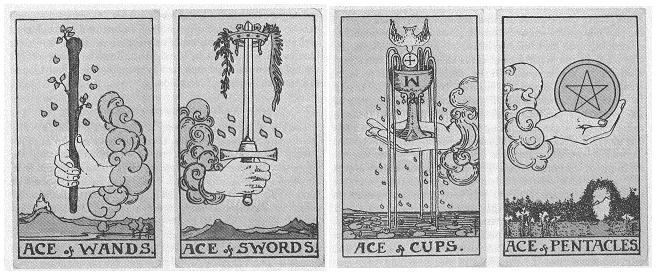
The Symbols of the Four Suits
The Wand (Fire) A crude staff. The staff is sprouting leaves - it is alive. It is the staff of life. It multiplies itself by its own force. It is a symbol of life energy, the energy of instinct and passion. It is a force which begins the manifestation of a plane and it is the fuel which keeps it in motion. This is an active energy. The wand represents the world of creation. The energy of the wand manifests itself in form and the multiplication of form leads to complexity. It is for this reason that the culmination of wands in the tenth card depicts a burden. Virility. Intensity. Enterprise. Growth. Animation.
The Sword (Air) Again, strong force, as in wands, only the sword is refined and therefore implies consciousness added to the force of wands. The sword is a weapon, both of aggression and defense, a symbol of violence, implying intensity rather than violence per se. The symbol implies excess, whether good or bad, as seen in the gold jeweled crown in the ace. It is a sword of reasoning and discrimination - but a double edged sword! An active energy, the sword represents the world of action and manifests itself in motion. But motion, once initiated, leads to reaction and more action. Again, the resulting complexity is depicted as a final burden in the tenth card. Intellect. Action. The power to utilize life energies.
The Cup (Water) Both a vessel of containment and dispensation, the cup represents both grace and the capacity to receive grace. A manifestation of the spiritual energy, the water flows both into and out of the cup. The flow is the presence of the Holy Spirit. Cups represent the world of the non-material and the intangible. The energy of cups manifests itself as a flowing force, therefore the force is never really contained in form, unlike wands, and is passive. The culmination of cups depicts great happiness because as a flowing force independent of form it does not lead to complexity and implies a deeper permanence. Emotion. Intuition. Sensitivity. All that is higher in the nature of things.

The Pentacle (Earth) The wealth of two worlds as symbolized by the occult symbol of the pentagram engraved on a golden coin. As swords imply consciousness by the refined instrument of a sword, pentacles imply consciousness by the wealth symbolized being both a result and a possession. Pentacles represent the world of resultant effects. The energy of pentacles is therefore passive and manifests itself as the "fruits of labor." For this reason pentacles in its culmination, depicts great bounty and success. Material wealth. Gain. Effect. Wisdom.
While it appears that wands and swords are "bad" suits, and cups and pentacles are "good" suits, this is not exactly true. It depends on your perspective. The Tarot symbolism transcends the realm of good and evil. In the context of the Tarot, "good" and "evil" are themselves symbols. Remember, the Tarot is an alphabet of symbols and the symbols must be interpreted in relation to each other. These four suits represent pure symbols, but nothing in this world is pure. In each thing and person there is contained a little of the rest of the world.
The Symbols of the Numerology of the Suits
The numerical evolution of the energies symbolized by each suit is a cycle in which each point in the evolution, depicted by a number, implies a meaning specific to that particular point. In other words, the energy of each suit follows an evolutionary manifestation into greater differentiation. The end points of this cycle are the point of initial manifestation from non-manifestation, and the point of completion or the manifestation of the full potential inherent in the particular symbol. The individual numbers depict a point in the progression of the suit. While each point implies a meaning, the progression is not static. Each number should be viewed in terms of that which preceded it and that which is to follow it. Approached in this manner, the meanings of each number become more alive, fitting into place in the flow of the entire cycle. If you can integrate the symbols of the numbers with that of the suits, then you will have a solid basis for interpreting the pip cards. Here then are brief descriptions of the numerical points of the cycle.
One: The first point of manifestation. The non-manifest becomes manifest. As such, the aces are cards of great power. Beginnings. New Directions.
Two: The non-manifest in becoming manifested creates its own opposite - juxtaposed. This is a transitional state demanding resolution in synthesis. Duality. Polarity. Balance.
Three: The relationship between any two things or ideas gives rise to a new thing or idea which is more encompassing than the original two (synergy). The resolution of polarity in synthesis. The fruits born out of partnership. Cooperation.
Four: The synthesis in three becomes a reflection of one, but at a more differentiated stage. This is most apparent in the suit of wands. Prosperity. Celebration. Repose.
Five: The symmetry is broken in further manifestation and differentiation. But it is an impetus which brings about change. Adversity. Strife. Upheaval. Disruption.
Six: Symmetry restored in a solid and stable form, this is the number of the cube and of the mind. Stability. Harmony. Integration.
Seven: This number closes the initial cycle of manifestation. It implies a shift in viewpoint. It is a "plane" above the cube. Contemplation. Reevaluation. New Perspective. Plateau.
Eight: The cycle now continues with transition. All the meanings that this implies pertain. Progress. Regeneration. Uneasiness. Justice.
Nine: The manifestation of the forces in each suit is being summed up, on the verge of completion but not yet complete. Success, completion - not yet pervading the whole.
Ten: The cycle completed, ten is a reflection of one, but with all potentialities manifested. The essence of each suit manifested in its fullness. Pervasive completion. Final manifestation.
Concerning the court cards, as mentioned before, they take on a psychological and personal element. For this reason I am not giving any specific meanings for them here. The symbols of the king and queen, the man and woman are familiar to most everyone. The knight and the page may not be so familiar. The knight is a servant of the court. He represents employment of personal energies or a focusing of energies. He also represents the youthful aspect of the king. The page, likewise a servant of the court, represents the physical body. The knight and page stand in somewhat similar relation to each other as the king and queen, which is to say they are complementary. The court cards in a reading can refer to other people or to aspects of the querent himself.
The cards of the major arcana require an entire article devoted exclusively to themselves. I shall forego attempting any short meanings in writing here and end with a description of the celtic cross spread, furnished by Mr. Jeff Hill.
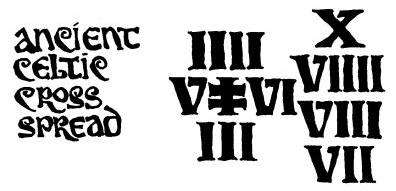
[Illustration: Ancient Celtic Cross Spread]
Using this spread, a card is selected from the deck in accordance with the person's character, to represent the querent. For a man, one of the four kings is selected; for a woman, one of the queens. This card is referred to as the significator, and is removed from the deck before the cards are shuffled and placed in the center of the spread. The first card is dealt on top of this card. See accompanying illustration for the positions of the cards.
Thinking Astrology—Signs of Personality
by Michael Whitely
This article is part of a new series. Each future article will include a brief astrological essay, Sun-sign readings on the same topic and step-by-step instructions to cast your own Horoscope, plus original insight exercises to help you get the most from these astrological tools.
All of us with an interest in astrology have come to our interest through different doors and with varied reasons and expectations. Because of its universal scope, astrology has a chameleon-like quality as it quickly takes on the coloring of its environment. Your purpose in using this astrological tool will determine the kind of benefit you can receive from it.
Astrology, as a symbolic language, has an almost unlimited number of applications. Its range encompasses anything which began in Time and Space. Its many uses reflect the gamut of human desires, fears, hopes, and wishes. The many astrological books and magazines express this by featuring articles that apply astrology to personal and philosophic problems and areas of life that require additional insight. Astrology has its foot in a few other doors as well: in the diagnostic clinics, on Wall Street, and in the psychologist's office. But if you're not a broker, a doctor, or an analyst (we all are to some degree), of what value is astrology for you?
The standard uses of astrology are:
Agricultural Astrology - Use of the Sun/Moon cycles to plant and cultivate crops.
Judicial Astrology - Charting and predicting social trends, wars, and the affairs of State.
Meteorological Astrology - Charting natural disasters and upheavals, floods, earthquakes, etc.
Medical Astrology - Used to aid in diagnosis and treatment of illness.
Horary Astrology - Seeking guidance, or an answer, for a question of immediate concern.
Natal Astrology - Casting the horoscope for the birth of an individual.
The last three are by far the most popular and the last one, the most significant for our purposes.
The basic components in astrology consist of the planets of the solar system as active forces in Nature, the zodiac of signs as phases or functions in a wholistic process, and the astrological houses, symbolically containing all areas of life experience - what the Buddhists call the "ten thousand things" that make up the mundane world. The relationship of the three is interpreted from the wheel of the horoscope chart. And there, at the center of the chart, you are.
Born into a world of forces and processes that science admits it does not fully understand, subject to influences of all kinds, involved in the affairs of living, you act out a part in a drama that you neither started nor control and yet must make the best of. Fortunately, it is not all chaos and confusion. Much of our experience quickly falls into orderly, habitual patterns: work/play, live/grow, the sun rises, seasons rearrange, and in the midst of this constant change there is order in Nature.
Science boasts an orderly study of natural laws governing matter, energy, and life forms. The history of science reveals the past acceptance of many incomplete ideas. These theories were held as true only to be replaced by a new "paradigm," a better theory free of the past error and closer to the Truth.
Astrology is also a study of the forces at work in Nature, meaning the influence of our external environment and our internal world of experience. We are, after all, products of Nature. Our bodies, temperament, character, sex, and even mind, are results of these same energies. And while the cell structure, the mountain peak, and the starry spaces are being meticulously explored and mapped, the nature of our inner world remains relatively uncharted, although theories do exist here too. Man has always hoped for, believed in, and searched for, some aspect of his Being which lies beyond the birth/death cycle of Nature. Spiritual yearnings or esoteric research may also have a place in the natural order of things.
It remains for each of us to gather whatever tools we can find and begin our own research, starting with our own world of experience. The questions and problems that find their way into our lives, combined with a close exploration of what and who we are, would be the place to start. Even as the laws of physics are incomplete, skyscrapers are built and atoms split. Likewise, astrology does not claim to be a stairway to heaven; it is an available tool to help give perspective and insight so that each may come to a more complete self-knowledge.
At the heart of astrology is the Law of Correspondences: as above, so below. This law was not legislated, like the law of the land, but in the tradition of science was found to be true. This declaration of unity in Nature states that Man, in all of his complexity and subtlety is made in the image of the Universe (especially the solar system). A direct relationship is made from the solar system to our bodies, i.e. the outer body parts, skin, and skeleton correspond to the zodiac signs which band the Earth and through which each planet must act. The planets themselves correspond to the internal organs and glands. With this direct relationship the reaches of space, our animal/vegetable/mineral world and our "inner" world of thought, emotions, dreams, and all of our subjective experience share the same qualities. They are different expressions of the same thing.
When we speak of "sharing qualities" we begin to venture into a more abstract realm, and rightly so because the eyeball can only see so much! Using words, we think in them; we reason, but the words are never the meaning. For this understanding we rely on a more subtle, wordless ability to perceive meanings. If we could relate directly, exchanging meaning for meaning, an instant communication could take place. But as it is we struggle with words (sound symbols), or hide behind them, and hope we get the meaning across to the other mind. If no communication takes place, if the other person (or reader) can't see the point, he may have to think over what was said until the light bulb goes on, insight dawns, and the meaning behind the words is clear. In astrology, the language of the planets and signs works in the same way.
The planets and their angles at birth indicate the combination of characteristics that we are made of. The signs show the manner in which we express these characteristics, while the houses reveal the related area of life in which it occurs.
The particulars of each person's make-up, how the parts blend or conflict, is difficult to communicate. Here, the astrologer (or the interested reader) must think about the words and study the related symbols (they condense meaning) until we come to see the situation involved or to see our selves. Because we do have the ability to extract meaning from symbols the complexity of juggling all of these factors is greatly reduced by the use of the astrological symbols for the planets, signs, and the wheel of the natal chart. But even without the complexity we can begin to get face-to-face with astrology by using the ideas as a mirror and examining the reflection.
Our Family Portrait
If we view our "family" from the point of view of each Sun-sign manner, starting with Aries and going around the wheel, we get something like this:
(Boldface type indicates keywords for each sign.)
ARIES is the initial creative impulse, a burst of energy, and the manner of acting is aggressively, impulsively, at times with a childlike naïveté about the world; seemingly fearless (because they are not aware of the danger around them) they are geared for action.
Following Aries, the TAUREAN impulse is to stabilize, to become practical and productive, and to act in a more conservative manner, more possessive, deliberate or obstinate.
GEMINI is communication, curiosity, adaptation, and the manner of acting is flexible, with versatility or perhaps in a scattered, nervous, or impatient way.
CANCER is protection and nourishment, the desire to establish a secure base and the manner of working is emotionally, possessively, moodily, or domestically.
LEO brings the need to establish identity, individuality, creativity, and acts in a commanding, radiant, expansive, or egotistical, snobbish, domineering manner.
VIRGO brings the need to analyse, discriminate, and select, with the manner of acting being practical, modest, efficient, or cold, overly-critical, and aloof.
LIBRA brings balance, impartiality, and cooperation, and the manner of action is evenly, thoughtfully, diplomatically or vapidly, indecisively.
SCORPIO is transformation, temptation, or elimination, through emotional intensity and control, and the manner is passionate, secretive, penetrating, and genuine or bluntly and vindictively.
SAGITTARIUS gives expansion and growth, perspective, ideas, and the manner of acting is freely and enthusiastically or recklessly and excessively.
CAPRICORN brings structure and limitation, while the tendency is to establish efficiency through self-control; the manner of working is seriously, orderly, and ambitiously, or ruthlessly, fearfully, and unsympathetically.
AQUARIUS brings a universal outlook, with a tendency to align with groups, to act unconventionally or rebelliously, detached, and in a revolutionary manner.
PISCES brings intuition, sensitivity, and self-undoing, while the manner of acting is emotional, inspired, clandestine, or vague, confused, and self-defeating.
Everyone that you know falls into one of these types and each will have these inner motivations and manners of acting. There are really no good or bad signs per se, as each has a way to add its input into the "family." This insight brings a new understanding to our relationships with people because we realize that we can only judge each other against our ability to work with, perfect, and possibly transcend our own nature.
This has, for the most part, been Sun-sign oriented astrology and for many people these qualities will not dominate the personality. Often you hear people say that they don't act as they should according to their Sun-sign. This is understandable because we are not simple, singular, beings, but are multi-faceted. One of astrology's best features is that it presents a method to examine your various faces and see which are in conflict, which exhibit themselves strongly and which stay hidden. You can also find your motivations and learn to use them to your benefit to live a more vital and dynamic life.
The Sun-sign "face" may be buried by other self-images and personality voices and may remain there, inhibited, until discovered. This is not to say that you should find your sign and imitate the characteristics until you get it right; instead, you begin to think about yourself and how you see yourself in an attempt at really understanding what makes you tick, or unhappy, or dissatisfied. And, of course, a complete natal chart would provide a much fuller picture for you to work with. (Future articles will explain how to erect your own chart.)
Even without a natal chart at hand we can use astrology to get a good look at our "selves." The planets will provide the key to the drives we all share and the zodiac of signs would provide the key to how we express them. So, lacking the planet/sign combinations at the moment, I have substituted an exercise that should help to fill in the blanks. Each set of questions relates to a planet and how you answer them will complete the picture.
So, perhaps we should bring the scale of our questions back to our world of experience and take an inventory of the kinds of insights we can gain with the aid of astrology. It may be helpful to relax and consider each section, jot down your thoughts as you go, and then look at the results; it might surprise you.
Getting Face-to-Face
How would you describe your over-all reaction to life? How do you respond to the changes and problems in your environment? Aggressively? Emotionally? Do you think first? Or act? Much of this has to do with the early years in the home and is a key to our later reactions to life. (Moon)
Do you ever notice how your mind works? When we become familiar with someone it is common to say something like, "You know how her mind works!" There is a conscious (meaning we can be aware of it) thought pattern that our thinking moves in that's fairly predictable by those who know us. What's yours? (Mercury)
What types of people are attracted to you? Who do you find attractive? How attracted are you to possessions and pleasures? Do you have the need for peaceful surroundings? Do you have a strong artistic or romantic bent? If so, what direction does it take? (Venus)
At what kind of energy level do you operate? In what directions does your energy go? Do you drive yourself (or are you driven)? Do you accomplish what you start? If not, what is usually the reason? (Mars)
Is there an area of your life in which you have been very fortunate, seemingly lucky? Or an area that you find in abundance? Have there been periods when you expanded your horizons, in the sense of changing directions? Where do you find waste or excess? Money? Time? Food? (Jupiter)
Is there a recurring problem or obstacle that you have yet to overcome? What are you cautious about doing? When are you serious? What do you take seriously? In which areas do you find self-discipline not to be a problem? (Saturn)
Have you experienced frequent or sudden changes in your life? Are you inventive or original in your affairs? In which areas? Do you tend to be individualistic or eccentric? (Uranus)
Are you basically idealistic? Do you value a set of ideals? With what are they concerned? Are you intuitive? Where do you find this expressed readily? Do you live in your imagination a great deal and dream of what could be? What is a common subject? Is there a topic or situation that makes you overly sensitive? (Neptune)
Have you had many new starts or rebirths in your life. Which area? Are there interests or behavior patterns that are almost obsessive with you? Are you a compulsive anything? Are you a solitary person? Do you like to do things in a big way? (Pluto)
Even in this general form and without applying astrological techniques, this kind of self-inquiry can bring many insights and benefits. The complete natal chart would fill in the blanks by answering many of these questions so that the efforts can be applied to working through the solutions.
There are many self-help tools available today. For the curious and the inspired there are writings and study groups available that never existed sixty years ago (or if they did no one was talking). The availability of information makes it even more important to activate a Virgo quality and discern and select. This also emphasizes the need to start with your self, the center of your world and possibly the source of your troubles and - as well - their final solution.
Coming Face to Face
by Alan Fitzpatrick
What do you see when you look in a mirror? An absurd question to ask, you may say, for we all know that we see a reflection of ourselves. Most of the time this reflection makes us acutely aware of our acne, blemishes, wrinkles and gray hair. But short of facial appearance and perhaps a bit of narcissistic fascination, when you look in the mirror, do you really look to see your self? Most people, having dispensed with identity crisis and soul searching with the passing of adolescence, have gone on to the business of life, and would find looking in a mirror to see who you are to be a foolish proposition. For we all know who we are, or seem to think so. What could we find in a mirror?
Plenty I think. For I believe that a great deal of insight into human nature and our own intimate psychology can be gleaned from such experiences. Just watch someone who is looking at himself in a mirror and you'll see what I mean. Recently I had an opportunity to do so unobserved. The fellow next to me in the locker-room began combing his hair in a mirror. After several moments I became aware of him, as he was still standing in front of it, combing his hair and cocking his head methodically from side to side. A trance-like gaze in his eyes gave me a clue that his mind was very occupied with something to keep his attention so fixed. At what was he looking? What was he seeing in the reflection? Was he identifying himself with only the body or did he see the thinker too, with all the moods and states of mind that shape his thoughts and direct his personality. Were the two one and the same? Or was he seeing an entirely different picture? Was that reflection a certain character possessing traits of courage, pride, and honor, with charm, wit and good looks that made him a hero of other men and a lover to all women? Was he deluded by a reflection that he projected from false reveries, a character in fact that doesn't exist except in his fantasies? I wondered for a moment who he was seeing from a multitude of possibilities, and if he were observing them all, and much more. For I believe that what you see in the mirror can raise important questions about how well we really know ourselves. And of the many reflections that we might see or take for granted, what is in fact the real one, and how do we come face to face with this enigma?
It is easy for most of us to reply to such questioning that we know who we are and the identity of the real self. For we are that man or woman who is now thinking or talking, the one whom we have physical evidence of. Yet is there not more to the self than just physical evidence? If you stop and think for a moment about your past and the memories of your youth or childhood, you can see evidence of a mental self, and a series of changing identities that had certain moods, goals, and beliefs at different times. And if you sit and think about just your moods of the previous weeks or days when you felt happy one day or moment and depressed the next, you can't really claim to be a singular thinking self with such evidence of changeability. For those who think that we know all there is to know about ourselves, try to remember what happened the last time you came face to face with criticism received from a friend, family member or spouse. Did you immediately reject the criticism because you believed the information about yourself to be grossly incorrect? Or did you discredit the critic as being incapable of challenging you? You might have agreed with the criticism and added a "yes, but" to it, thus cleverly diffusing its impact. Criticism of one's personality, attitudes and beliefs by others is only another way of looking in the mirror, if we choose to do so. For no matter what corner it may come from and even though it may be off base, criticism might have some value. Why then is it so hard for most people to take even mild criticism? If we have a choice then why choose to see only what we want to, rather than what is? Neither alternative is entirely painless.
For the proof to all this is, of course, in the pudding. If one thinks he knows who he is definitively as the one who is in charge of his destiny, then his actions will show it. If one has really come face to face with himself and knows who he is in the mirror, then he should be able to live a trouble-free life, with no hang-ups, complexes, or irrationality, unless he believes such irrationality is willfully planned, which would be masochism. If one finds that he does not understand himself clearly, then he had better go back to the mirror, for the reflections he has seen might only be dangerous pretensiveness. Can one wise himself up if he found that he were indulging in make-believe, or a lie? I think most of us would resist such a confrontation if we had the choice to do so. We might not ever get around to it, if we sense the elusiveness of the problem.
The point is that most of us do not have a clear-cut choice. I believe that our false faces eventually get us into trouble, just as a little girl who is told how pretty she is, grows up to believe it, capitalize upon this belief, project it upon others, and suffer the harsh consequences if she does not receive the admiration or attention that she believes is due. A poll of humanity, I think, would reveal that most people are unhappy and unfulfilled because of contradicting traits in their natures that can be traced to unreal reflections in the mirror. Such evidence of unhappiness can mean only one thing if we equate happiness with self-understanding. Most of us don't know who we are and have not come face to face. Rather we live lives of suffering and uncertainty, being tossed about on the horns of the dilemma that we face each hour of the day between real self and unreal self. This becomes most apparent when we find ourselves troubled and in need of self-help.
Everyone, at one time or another in his life, finds himself in such a bind. The predicament may be in external situations where things aren't going right in our commerce with others. We may have failed to get or keep a job, or lost an opportunity that was important. We may have alienated a friend or mate by a fit of anger. Maybe we just feel lonely, depressed, fearful or anxious about circumstances. We may be wrestling with a habit that has tied up our time or finances. Whatever the case may be, we find that our lives no longer make sense, because we don't make sense to ourselves. We may ignore the irrationality of others when we hear about someone else's problems, but the awareness of our own irrationality during times of conflict is a real personal agony. Whereas we may previously have had little time or interest for self-speculation or inquiry in the mirror, when troubled we find that we are automatically moved into a new area of thinking. For when you are troubled you want to know why and how to relieve the situation, and the degree of desperation that you find yourself in may dictate how determined you are to find an immediate and lasting answer.
Now this little formula doesn't mean that everyone who has problems will automatically find answers to them without a struggle. We need only look around us to see the contrary. Mental illness is on the rise, if we can judge so from the increasing populations of mental institutions, clinics, and prisons, as well as the rising number of people participating in therapies and counseling. We can just ask any number of our friends and relatives as to how happy or fulfilled they really are with their lives, if we can catch them in a moment of candidness. It seems apparent that most people live lives that fall far short of their hopes and dreams. Everyone starts with good intentions but things change along the way. Most people are troubled to some degree, but few seem to find a real way out. Why is this so?
First of all, I believe most of us rarely see clearly just what is at stake with our lives. We seem to be able to focus a great deal of our attention outwards in applying our mentalities toward survival and recreation, but in the most important, a priori area of our lives - our own mental world - we seem to be blind. We are born with clean slates, so to speak, and before long acquire experiences with the world that affect us and change us both without and within. And as often as we think that we profit from experiences we suffer from them, for some experiences like drugs, alcohol, and sex can take us beyond our control and result in traumas that leave marks upon our minds. We are like windup toys that first bump into one obstacle and then another in a wild fashion. The bumps and knocks accumulate in the form of complexes and hang-ups, like barnacles on the hull of a ship, and our wholesome, unified mind of childhood becomes fragmented by kinks in our personality and patterns of thinking. So that while we indulge haphazardly in the experiences that life has to offer without checking the mirror periodically to see who, if anyone at all, is running the show, we risk losing the high stakes we begin with, namely our sanity.
What happens when we begin to lose this precious commodity? When the problems are small, we tend to overlook them, and make excuses for the fact that we are troubled or have found ourselves to be irrational to a small degree, such as the discomfort that arises when we experience unfounded fear or anxiety. Yet we may continue to live with our problem, and still refuse to come face to face with ourselves because of pride and vanity. Often people in such situations deny that they have problems, because they really believe that as long as they can manage their affairs, nothing is really wrong. And many individuals who profess to be interested in self-help are really not in the market at all, if it involves real work on their part. Rather they seem to learn to accept their troubles and get by with them, blending the good and ill in their lives until it is tolerable enough, if not agreeable. We adjust ourselves to our misery, fears, conflicts and complexes that are at the root of our troubles, and that rob us of real happiness and success. So that we can say that the reasons most people do not seek or find a real way out is because we lie to ourselves at nearly all stages of the game, and justify or rationalize our limitations that erode our sanity and eventually cripple us. Our refusal to look in the mirror is the reason we are unable to free ourselves. We first have to want to look in the mirror badly enough.
There is really only one time when a person will struggle to look at himself and his situation, and that is when he is desperate. And he only becomes desperate when he finds himself in such big trouble that he can no longer keep up the pretense by any means. His problems are serious and he knows, like the alcoholic who is drinking himself to death yet cannot stop, that he must find help now or risk going under. His health, sanity, and survival hang in the balance. He is desperate, and is one of the few people who is really willing to change himself because he has little ego and vanity to lose, for they too have been whittled down. Thus, he recognizes that he must cure the head not only of its external diseases but of its internal ones as well, such as the inspired rationalizations in his head that moved him to actions that placed him in jeopardy. Such an individual possesses the desire, the humility, and the commitment for change that most others do not, because he is beginning to face himself, and divorce the unreal from the less foolish, whereas others have not tried or will not attempt such a self-scrutinizing process.
The sad part of what I am talking about is that it is only when a person is desperate enough about his situation that he will be moved to do anything about it, and sometimes by then it is too late. For he may have already impaired the mind or debilitated the body which is the vehicle necessary to carry him back to mental health, and thus is unable to make the trip. This is usually the case with drug abusers, alcoholics, and institutionalized patients who have had their nervous systems obliterated by combinations of chemotherapy and shock treatments. In my estimation, no one need wait until it is too late before beginning to look at himself to find a way out.
And a way out exists to be sure. Psychotherapy, counseling and self-help groups may be of value to us if they deliver the goods, but we need not trust our money, time, and psyches to modern psychology if we are unsure of the effectiveness of methods that promise nothing for sure in advance. What is foremost in our minds is finding a direct proven system of psychology that will work beyond a shadow of a doubt, for we have little time for experimentation. As with all the relative polarities of human feeling and expression that we find in life, such as pain and pleasure, so the states of mental uncertainty, conflict, and dichotomy preclude for us the existence of subjective mental clarity, unity and peace of mind. This sanity, that we once experienced as a child, can be our only goal.
What is the first step? We must go back to the mirror, whatever form it may be, and come to grips with our self, face to face. No therapy will work without this, even though many may claim to be systems that lead us to the self. The negligible results that they produce prove that an essential element is missing. For dealing with the symptoms of problems may not get us anywhere.
Like a boil on the arm that needs lancing, not salves, to get rid of infection, so the root of our problems will always remain as long as we are unable or unwilling to discover it. Recent studies in psychology by Eysenck, Shapiro, and Gottshalk point to the fact that many people cure themselves of their problems at the same rate as orthodox therapeutic methods, and this gives us the hint that, short of ignoring the problem completely, those individuals who cured themselves must have found some direct method of probing and defining the subjective mind. If we can follow the simple adage, "First Know Thyself" then this gives us the impetus to work. Though no books are written about each of us, detailing the intricacies of our mental lives, we do have tools at our disposal that make us a psychologist capable of attacking the problems that face us, once they are recognized. These tools are intuition, observation, and common sense. Once we have put them to use to observe ourselves both in the mirrors of others and in our mind's own eye, we can compare the reflections that we see, and begin to extract the unreal from our nature. This opening door is the approach to sanity and the real self.
Next issue: Ways and Means to Free Ourselves.
Yoga and Insomnia
by David Gold
Fatigue overcomes you. It is time.
After changing into your bedclothes and performing the evening ritual of face-washing and toothbrushing, the alarm is set, the lights turned off. You crawl into bed, lie down, close your eyes, and relax. Soon the thoughts become jumbled, images without sense appear, and you nod off.
But five minutes later you are wide awake, realizing that you did not actually fall asleep but drifted in, and then out, of some preliminary sleep stage. Now you are definitely not tired. In fact you are irritated, even angry, asking yourself with acrimony, "Why can't I sleep like everyone else?" After a half hour of tossing about you sit up and turn on the light, and curse. Another insomnious night ahead.
For a fortunate few this scenario is pure fiction, a short story tragedy which always happens to someone else. To many others it is a familiar hell which must be occasionally endured. And for a hapless minority, it is a way of life.
Fear not, my sleepless brothers. Help is on the way.
The balm which I offer to you does not come in the form of a tablet or liquid. I do not here suggest the counting of sheep or a warm bath. My answer is not, as was suggested to me by a country barber, a glass of warm milk with a bread, butter and onion sandwich. The help I offer is an ancient art, beautiful both to observe and to perform. The answer to your sleepless nights is yoga.
The preconceptions you have about yoga - discard them. Yoga is not a system of tortuous knots designed by a madman for double-jointed fanatics. Nor is it the contemplation of the mysterious navel with bowed head and crossed legs. It is a direct system of attaining physical, emotional and mental well-being through a harmonization of those respective faculties using exercise, breathing, and the proper directing of mental energy. It can be learned by studying with a teacher or working carefully and patiently with a good yoga manual.
The yoga just described is hatha yoga, which has as its central concepts the purification of the body and enhanced mental and spiritual development. Many other yogas exist, including karma yoga (the yoga of actions), bhakti yoga (the path of devotion), mantra yoga (the science of sound), jnana yoga (the path of science and wisdom) and rajah yoga (the "kingly" yoga, aimed at transcendental awareness). My main concern here is helping a few fellow insomniacs crash the sleep barrier, so I will not detail the various yogas mentioned above.
I started practicing hatha yoga about four years ago, at the advice of a friend who told me that it would help me "unlax." Armed with an old yoga book, resplendent with pictures of a Hindu youth in a myriad of contortions, I began experimenting with some of the postures, or asanas, displayed in the book. Within three weeks I was addicted, a true yoga-junkie, to a twice-a-day habit, regardless of mood, situation, or surroundings. My health has steadily improved, and I have noticed increased skill and resiliency in other athletic pursuits. Perhaps of greatest importance, I have learned how to sleep again.
Insomnia does not only appear in my family, it runs rampant. My father averaged three hours of sleep and was prone to attacks of nocturnal myoclonus or uncontrolled shaking of the legs at night. My mother still listens to talk shows until 3:00 a.m., until she finally nods off from boredom and fatigue. My brothers and sisters are all familiar with various degrees of insomnia, and I have spent entire summers battling the demon of waking nights.
After settling into a comfortable yoga routine I noticed that my sleeping habits improved. When my genetic heritage of insomnia finally caught up with me I began experimenting with various techniques involving asanas (postures), pranayama (breathing), and dharana (concentration). In hopes of liberating others from the long, lonely night, I would like to share some of my favorite sleep-inducers.
It is first important to recognize that insomnia has many causes that can be easily eliminated, once you have gotten in tune with the rhythms of your body. Stress, caffeine, certain medications, late eating or strenuous exercise, and a host of other factors may put you in a tizzy until morning. One beneficial side effect of yoga is an increased sensitivity to upsets in the equilibrium of the body; once you are able to contact daily a place of peace and harmony within yourself you become automatically aware of those habits which traumatize that state of balance. Whether or not you try your hand at yoga, you will probably find it worthwhile to keep a record of those nights that you have trouble sleeping and attempt to pinpoint the common denominators associated with that difficulty.
It is because yoga has the stabilizing effect of allowing the mind and body to arrive at a point of balance that yoga is of such tremendous value in allowing the body to fall asleep. For to understand how we are going to seduce the Sandman we must start with two basic principles:
Yoga neutralizes insomnia by nudging the body and the head out of the box of frustration that causes or accompanies insomnia, and then permits the natural sleep functions to combine with your body's fatigue and drift you into dreamland.
The first techniques to be outlined are the pranayama, or breathing, and dharana, or concentration exercises. Breathing must be first understood because all asanas or postures are done in conjunction with proper breath control. Also, many individuals who lack the ability or determination to get into postures can still attain a measure of relaxation (and sleep) through breathing exercises coupled with mental disciplines.
While every yoga book that I have encountered offers some new breath variation, one of the most effective methods is also one of the simplest. It also forms the breath foundation for all postures that make up my daily routine.
Sit up straight in a chair, with your back supported and both feet planted squarely on the floor. Close your eyes, and turn your attention to your breath. Do not attempt to alter your breathing; just focus your attention so that you become conscious of your breaths, and as you do you will notice that your breathing will become deeper and slower.
Once your attention is firmly focused on the breath you can begin directing it. On the inhale count slowly, internally, 1, 2, 3, 4, 5, then hold your breath, counting 1, 2, 3, 4, 5, then exhale, 1, 2, 3, 4, 5. Repeat for five or ten minutes, keeping your attention firmly fixed on the breathing. Each time your mind wanders, gently bring it back to the counting of the breaths. Regardless of how important the thoughts may seem as they press against your consciousness remember that they can wait, and that you have set these few minutes aside to simply breathe.
You may also wish to try a couple of variations which are especially helpful in combating sleepless stress. Instead of counting 1, 2, 3, 4, 5 on the inhalations, holds, and exhalations, count 1, 2, 3 ,4, 1, and on the next breath 1, 2, 3, 4, 2, then 1, 2, 3, 4, 3 and so on up to 25 breaths, or a hundred, or whatever number it takes to allow you to become drowsy. Attention focused on the sequential number pattern will further occupy your mental processes and assist the breathing in slowing down the entire sleepless machine.
If, after fifteen or twenty minutes of breath control, you lie down and still find your head stuck in sleeplessness, then it is time to unleash the big guns. Drag yourself back out of bed and begin to breathe as before. After you inhale to the count of five, instead of holding to the count of five, repeat out loud, "I AM," then exhale to the count of five. Repeat. When you call out "I AM," do not ruminate about who you are, or what the possible ramifications of "I AM" may be. Just repeat the phrase with each breath, and concentrate all of your attention on those words.
I have found this technique to be extremely helpful in flushing out subliminal tensions which are keeping me awake. The focusing of all mental energy on the "I AM" automatically draws the attention away from those hidden stresses which are blocking sleep. Lest you fear that this is some type of escapism, you will notice at the completion of this exercise both an increased awareness of what's bothering you, and a better perspective from which to later resolve that problem.
Remember, the goal in utilizing yoga as a sleeping aid is to place the body and head in a position where your accumulated physical and mental fatigue will abate in the restfulness of sleep. Breathing and concentration nudge the mind out of that place where sleep has become impossible, and soon, sound asleep is the most natural place for you to be.
Asanas
Certainly breath control and concentration are effective, almost miraculous tools in gaining a measure of control over your body tensions and mental processes. But once you discover how effective yoga can be in relaxing and harmonizing your body and mind, you will no doubt seriously consider the addition of yoga postures to your relaxation repertoire.
Prior to outlining a few basic postures some general yoga tips may be in order.
First, find a comfortable spot and wear comfortable clothing. Any restrictions experienced by the body either in the form of cramped quarters or tight clothes will impede your flexibility and the relaxation processes.
Never be in a hurry. This includes both an overeagerness to master difficult postures and the rush to finish specific exercises. In every yoga class I have taught I've noticed the same tendency: to try and get into and out of various postures as quickly as possible. This will reduce yoga to the level of calisthenics, and greatly increase the possibility of pulled muscles and sore everything. The joy and power of yoga is in its grace and restfulness. As a classic hyperactive I learned the hard way (pulled lats, pectorals, and trapezoids) the truth of the words of the Zen masters: "Do not hurry - you will only be delayed."
Finally, always breathe, using whatever breath control method you find to be comfortable. The second common denominator found in almost all of my students is the proclivity to concentrate so completely on attaining the desired posture that the breathing aspect is forgotten. Asanas without breath control are in the category of sit-ups and push-ups, mere calisthenics. Yoga is a science of interrelationships, and your ability to harmonize breathing and movement will determine the degree of success in harmonizing body and mind.
Three asanas will be detailed, two of them basic and one rather advanced. They are neck rolls, sleeping camel, and the head stand.

Neck Roll
A great deal of tension accumulates in the neck and upper shoulders, especially if you spend much of your day seated at a desk. Neck rolls help dissipate this tension and increase blood circulation to the head.
Find a comfortable space in which to sit. Be it sitting in a chair or on the floor, the back and neck must be straight.
Begin by going through a couple of cycles of rhythmic breathing. Then inhale to the count of five, and slowly allow your head to drop to your chin as you exhale. Inhale bringing the head erect, and continue to inhale as you bend the head backwards as far as it comfortably stretches. Bring the head erect again, exhale and inhale as you bend the head to the right. Then bend the head to the left, and exhale. Return the head to an erect position. Repeat.
Next, roll your head gently in a circle; forward and down, to the right, back, to the left, and then forward. You will again exhale on the bend down, then inhale on the movements to the right and back, then exhale as you bring your head to the left and forward again. Repeat, reversing the motion, clockwise.
The Sleeping Camel
This asana was taught to me by one of my students. I was showing off to my class with a standing camel, a somewhat advanced posture in which one bends backward until the hands clasp the back of the ankles. The student, whom I later learned was a former yoga teacher, informed me that I would probably have a couple of lawsuits on my hands if I put my students through that exercise, and suggested the sleeping camel. I experienced an immediate relaxation effect when I tried it, and generally use this posture if I am particularly troubled or turbulent.
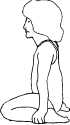
Sit on the floor with legs apart and buttocks resting on heels.
Hold onto your ankles, keeping your back straight.
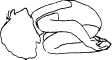
Bend forward until your head touches the floor. Then begin your breathing repetitions, inhaling deeply.
The Head Stand
I can find little correlation between flexibility and the ability to do headstands. Some of my most agile students were reduced to tears upon seeing the class klutzes easily attain and hold the headstand.
Most people do find headstands difficult, and I am including this posture in this article for one reason only: The headstand is undoubtedly the most effective sleeping aid ever devised by civilized man. If you have, or develop, the ability to do a headstand, not only will you have fewer sleepless nights but every night's sleep will be deeper and more relaxing.
If you decide to attempt this asana, always have someone with you to catch you if you fall. Also, learn to fall by relaxing all your muscles, and be sure that you have no furniture within fallout range.
The illustrations will demonstrate the steps in the headstand. No text will accompany them because I have found that if you are destined to get into a headstand you will do so by developing your own variations on the illustrated steps. If you feel you are close to being able to stand on your head, but just can't do it, pick up a book on yoga and study the chapters devoted to headstands.
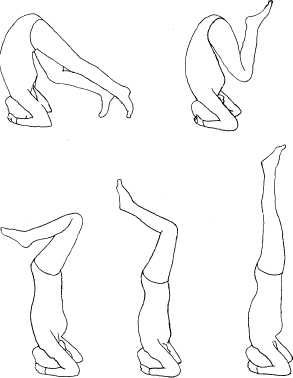
[Illustrations of various yoga postures]
Gurdjieff, the famous twentieth century mystic, was quoted as saying that problems and disabilities are essential to self-improvement and understanding; he believed, in fact, that if life had no problems we would have to create our own in order to rise above them. I have found this to be the case with insomnia. Sleepless nights force us to face our bodies and our beings, to derive some system of self-control that will enable the body's natural balance to take over and carry us into sleep. Yoga can not only conquer the demon of insomnia, but can assist us in more effectively dealing with the traumas and setbacks that comprise both our waking and sleeping lives.
Renewing Health With Herbs
by Jonathon David Miller
Herbs have been used for thousands of years for the purposes of cleansing and healing the body and mind. The use of herbs is more "scientific" than the use of any synthetic chemical for medicinal or nutritional purposes. In other words, there is a huge background of experience in using herbs for restoring health naturally, much more than is true of manufactured products. Many drugs were originally derived from herbs, and there is much modern scientific research going on into what is in herbs and how they work.
What given herbs will help with and what their effects might be is well-documented. The results will vary from person to person, however, due to differing body chemistry. Dissimilar results might occur even with the same person because of chemistry changes over time. So each person has herbs which can be of great benefit arid others that may not help much. For those familiar with it, muscle-testing is one way of choosing those herbs which are best for one at a given time.
An herb will vary in value itself depending on how, where and when it is grown, harvested and prepared. It is wise to obtain herbs from trusted sources, as some companies use chemicals in cleaning their herbs, and others don't clean them well. It is best to use an abrasive substance like dolomite or bone meal to clean dried herbs.
How to Use Herbs
There are many ways to use herbs. Fresh in salads is a very good way. There are many leafy greens that are freely available in field and woods for adding top-grade nutrition to a meal: dandelion, yellow dock, coltsfoot, plantain and violet leaves are only a few very common and easily identifiable free wild foods of value. These are especially good when young and tender in the spring. They aid spring cleansing and are early fresh foods available long before gardens are producing.
Low-heat drying is the best food preservation method. Most herbs are about twice as powerful when dried than they are in their fresh state. The drying concentrates the elements in the herb with little loss as the moisture departs, and the process can actually bring about chemical changes in some herbs that make them distinctly different from their character in the fresh state. Some herbs which are toxic when fresh are not when dried.
It is very important to know when in the plant's growing cycle and what time of day is the best for harvesting a specific herb, for each is different. Weather is a consideration also. Then there is an ideal preparation method. Different parts of herbs are used - with one it might be the leaves, with another the root, with still others the flowers, berries or seeds. With many herbs more than one part may be used. Bad portions must be cut away. Most roots can be dried in the sun. Leaves and flowers are usually hung upside down to dry in a shed with some air circulation. It is best to get these out of the sun quickly when harvested.
There are several ways to use dried herbs. The best known way is to make a tea. Unfortunately, many people do not consider that applying boiling water to the herbs and then letting them stand exposed to the air for several minutes results in a loss of many valuable elements. If making a hot tea, it is better to cover the tea as it steeps for fifteen to thirty minutes or so. This is called an infusion. When there is some air space in the container, the volatile gases released from the herbs will interpenetrate above the liquid and create a fusion of healing virtues. A decoction is the result of boiling roots and/or bark for approximately thirty minutes. The decoction is then cooled and sipped. Any of these methods will bring about loss of some nutrients due to the heat applied.
A "sun tea" is prepared by adding cool water to herbs in a container, covering and placing in the sun for several hours. The sun energizes the mixture and marries its virtues. Some herbalists make a sun tea, strain out the herbs, and then do an infusion of the strained herbs. This way the water-soluble elements that would be destroyed by heat are extracted first, and then the elements that only come out with the heat. Of course the heat still ruins other factors.
A problem with all of the methods of using dried herbs mentioned so far is that if you use cut herbs you probably strain out the leaves and pieces and throw them away. This is like throwing the baby out with the bath water. There are many valuable elements which are not water soluble and are lost when the herbs are removed from the tea. It is important to eat the whole herb.
Powdered herbs are more easily digested and effective than cut herbs. A convenient way of using dried powdered herbs that has grown in popularity tremendously in recent years is to take them in capsules. Sometimes the powder is pressed into tablets, but the pressure involved squeezes out much of the vitality of the herbs.
If you are reluctant to use gelatin capsules because they are made from animal tissues (hooves and connective tissues), there is good reason for avoiding them due to their glue-like quality. The small amount of gelatin ingested in an herb capsule is no great cause for worry, but vegetarians may want to avoid it on principle. The better alternative if you buy powdered herbs in capsules is to open the capsules into water or food. (Capsules purchased in sealed containers protect the herbs from oxidation and contamination.) In any case it is very important to drink plenty of water with powdered herbs. Distilled water is the best water to use as it draws out the qualities of the herbs well. It also helps pull toxins including mineral and chemical deposits out of the body. A tested soft spring water is all right, but it is not as good for cleansing.
A tincture is a concentration of many of the elements of herbs formed by soaking the herbs in a solvent, usually of vinegar or alcohol (sometimes diluted) for about two weeks, shaking the mixture morning and night. The mixture is strained and stored in a dark bottle. There is now an extraction process in which the herb is cold percolated for three days in a menstruum of solvents to extract as many factors as possible. Tinctures and especially these new extracts are considered to be the most effective form of herbal preparation due to the concentration of elements and the ease of absorption, although this may not be the most natural way of using herbs.
Other common uses of herbs are: fomentations - a cloth is soaked in hot tea and applied externally to an afflicted area; cold packs - a cloth is soaked in cold tea and applied for fevers, headaches, etc.; poultices - crushed fresh plants or moistened dried herbs are placed on the skin, the latter perhaps with a warm cloth or mixed with warm flour to aid adherence to the skin; essences - pressed herb oils, usually mixed with alcohol; syrups - herbs boiled in honey, maple syrup or blackstrap molasses and strained through a cheesecloth.
Amounts of herbs to be taken at any one time are recommended by various herbalists. Numerous herbal combinations have been formulated by herbalists. Most often an herbal combination will be more effective than an individual herb due to the "teamwork" involved. Sometimes the exact formulas are published. Each person needs to experiment a bit with the amounts of herbs they take, beginning with a little and increasing gradually until the appropriate level is felt to have been found. Anything but mild nutritional herbs should be used carefully, especially with pregnant or nursing mothers and infants. Children generally could use about half as much as an adult.
With a few exceptions herbs have no conflict with one another, but they should not be taken at the same time of day with medical drugs. Herbs actually aid the utilization of vitamin supplements, however.
Herbs are much more valuable as a source of nutrition than any manufactured vitamins and minerals or most food available commercially. The processing of even so-called "natural" vitamins and minerals fractures the food sources, upsetting the balance nature has provided and releasing much of the Life Energy. Many of these use an herbal base. Vitality is the leading virtue of herbs. Herbs are whole natural foods with the enzymes, organic acids, hormones, vitamins, minerals, etc., intact and in balance. The minerals in an herb are organic in form - bound in an organic molecule by the plant's process of photosynthesis, a dance of the plant with the sun, soil, water and air. Our bodies are designed to assimilate organic minerals far better than inorganic minerals which are often the form used in commercial supplements. Also, herbs are usually grown in places which have not been depleted of trace elements as most of our farmlands have been. As you can see, herbs are probably our most valuable nutritional source.
Cleansing and Rebuilding Health
The road to full health begins with relaxation and an attitude of happiness founded in the power of Divine Love and Life Energy and the company of friends. Exercise and full rhythmic breathing are also indispensable aspects of restoring health. We must upgrade our diet to mild live food, mainly fruits, vegetables and herbs, with soaked and/or sprouted nuts, seeds and grains, best organically grown and eaten raw. Animal fats and proteins and refined flour and sugar are very toxifying and mucus-forming. These and any highly cooked foods are hard to digest and should be avoided.
Food combining considerations are crucial for good digestion. Fruits should not be combined with other foods. Nuts, seeds or other protein foods and grains or other starch foods should be eaten separately from one another. One high-protein food (e.g. nuts or seeds) can be eaten with non-starchy vegetables. One high-starch food (e.g. potatoes or a grain) can be eaten with vegetables.
Stress, of which toxemia is a form, is the only disease, and it must be alleviated for ideal health to be ours. Bowel and blood cleansing is the priority, using herbs that are appropriate to the toxicity and that aid the liver, spleen and kidneys, our blood-cleansing organs. Begin cleansing gradually. You may experience sluggishness or ill-feeling if toxins are brought into the blood too rapidly. It is a good idea to rest every seventh day from taking herbs. On the other hand, best results are obtained with consistency.
Toxic matter must be moved from the bowels in concert with blood purification of toxic chemicals and acids, and the expulsion of excess mucus and parasites. Nearly everyone has bowel pockets created by the pressures of gas and backlogged fecal matter due to poor digestion from overeating, poor food-combining and tension. In other words, you are probably constipated even if you have regular bowel movements.
Enemas and colonics can help temporarily, but these practices do not contribute to the rebuilding of the intestines. Furthermore, they are unnatural activities. If they are used, it is important to restore friendly intestinal bacteria by eating yogurt or other cultured foods, preferably made from seeds or grains.
Psyllium seeds make an excellent bulk and lubricant for the intestinal walls. Psyllium gels and expands into pocketed areas, removing impacted matter little by little. Psyllium also gives exercise to the bowel muscles so they begin to tone up, and it is very nutritious. The psyllium does not impel extra peristaltic action, the wave-like motion that moves matter along the digestive tract, and it can get bogged down in the intestines with the matter it is clearing. Therefore it is wise to use a bowel-moving herb such as cascara sagrada bark with the psyllium. Bayberry bark and buckthorn bark are other choices. All three of these also aid the liver and gall bladder. One or more of these laxative herbs are usually found in bowel or blood-cleansing herb combinations. Sometimes it is necessary to use extra laxative herbs with a blood-cleansing formula and psyllium. Generally, we should have three good bowel movements per day, one for each meal. This will vary as some people may have fewer larger movements. About as much matter as is eaten should be eliminated within twenty-four hours (or more matter if there is a backlog).
Other basic herbs that can be helpful in the intestines include alfalfa [leaf] and wheat grass [juice] which detoxify and alkalinize, comfrey [all parts-root best] and slippery elm bark which soothe and lubricate, and fenugreek seeds and flax seeds which act similarly to psyllium seeds. Again, all of these are very nutritious for the bowel and the body as a whole.
Blood purifiers include burdock [root] which aids the blood-cleansing organs; chaparral which helps dissolve tumors and clean the blood; dandelion [all parts-root best] which alkalinizes, builds the blood, and aids the liver, spleen, pancreas and kidneys among other organs; safflowers which remove acids; and yellow dock [root] which is rich in iron, builds and cleanses the blood, and aids the liver and spleen.
For helping with the removal of excess mucus, fenugreek seeds and comfrey are excellent for the lung and bronchial area. Fenugreek seeds and thyme decongest the head area. The latter combination can sometimes alleviate migraine headaches. Bayberry is also used for clearing mucus from the head and upper respiratory area.
Key herbs for aiding the elimination of the parasites which may be living in the body's toxic mucus are: black walnut [hulls] and white oak bark for herpes and other viruses and ringworm; garlic for pinworms, ringworm and viruses; lemon grass and peppermint for flu and other viruses; pumpkin seeds for various worms and salmonella bacteria, and chaparral for tumorous conditions. Buckthorn, senna, wood betony and wormwood are other deworming herbs.
Coupled with cleansing is the importance of good digestion and nutrition. The former minimizes the inflow of toxins and improves nutrition. Good nutrition, oxygen and Life Energy are required for rebuilding healthy tissue. The herbs that contribute here are of great value. Dried powdered papaya fruit is one of the best aids to digestion of other foods. Its powerful digestive enzyme complex, papain, contains elements similar to pepsin and contributes to the digestion of protein foods, even under alkaline conditions (pepsin requires an acid stomach to function properly). Peppermint stimulates salivation and relaxes the stomach. Fennel seeds are often used for intestinal gas problems and colic in infants.
Because herbs are whole foods usually grown naturally, "organically," they contain a variety of trace minerals, enzymes and other organic chemical elements. These include vitamins, known and unknown, and a range of organically bonded minerals. Thus the value of herbs for the body's rebuilding of healthy tissue is very great. Herbs are Nature's own supplemental foods already prepared in perfect balance.
As multi-vitamin and mineral sources, the herbs alfalfa, dandelion and kelp are fantastic. Every known vitamin and mineral are present in one or more of these three herbs. Everyone should probably be using them.
Alfalfa contains all eight essential amino acids, which are most available in the popular sprouts. There are different qualities in the sprout and the mature plant, so it is wise to partake of both. Alfalfa is especially rich in chlorophyll, vitamins A, B-complex, K and U, and calcium. Among other virtues it has been helpful for problems such as arthritis, acid stomach and toxic liver and bowels.
Every portion of the dandelion is edible and nutritious: the flower (best as an opening bud), the leaves and the root. The root contains the greatest value and is the part that is usually dried for later use. Dandelion is high in vitamins A, B-complex, calcium, sodium and much more. It is a blood purifier which aids urination, and it is good for all internal organs and many health problems. It is ridiculous that people spend so much time and energy trying to eradicate dandelions from their lawns with chemicals when it is more nutritious than anything they have in their kitchens.
Kelp is a sea vegetable. The ocean has not been depleted of its trace minerals as much of the land has, and therefore kelp, dulse and other sea vegetation is our best supply of these minerals. Kelp is especially rich in iodine and can be very helpful in balancing the thyroid and also the pituitary gland. It is high in potassium and is good for the brain, heart, blood and arteries. Kelp aids digestion and the better varieties have an excellent flavor so it makes a great seasoning. Kelp and capsicum [or cayenne], which is high in vitamins A and C and aids digestion and circulation while catalyzing other herbs, can be valuable replacements for salt and black pepper on our dinner tables. (Be sure that the kelp you buy is not very salty for if it has been poorly cleaned there will be much sea salt remaining. Salt, including sea salt, is not used well by the body and tends to form deposits, impairing circulation and contributing to many other problems.) The sodium alginate in kelp actually helps to move poisonous lead and radioactive matter out of the body.
Other herbs that should be mentioned for nutritional purposes include the following: Hawthorne berries contain generous amounts of choline and vitamin C among other active ingredients. They are known to be helpful to the heart in preventing clots, heart attacks and palpitations, allowing the heart muscles to strengthen. Horsetail [shauegrass] is high in calcium and silicon which is good for hair and nails. It has been found that silicon is convertible to calcium by the body. Parsley which is high in vitamins A, B-complex and C, calcium, potassium and many other minerals, is a strengthener for many glands and organs including the pituitary, prostate, kidney and bladder. It also contains an anti-tumorous substance. Rosehips is well-known for vitamin C and the bioflavonoids (vitamin P). Yellow dock is perhaps the richest herbal source of iron. It is also a blood cleanser and is good for the gall bladder, liver and spleen.
Comfrey and aloe are such wonderful herbs they deserve special mention. Not only is comfrey a blood cleanser and very nutritious, but its soothing and healing properties are matched only by those of aloe. It can aid the movement of congesting mucus out of the lungs, stomach and intestines while soothing and nutrifying the irritated mucus linings and destroying unfriendly bacteria. Thus, it is helpful for coughs, ulcers and colitis and also for colds and poor digestion. It reduces pain from other causes as well, such as muscle cramping, arthritis, skin problems, burns, bruises and wounds. Comfrey contains allantoin, a marvelous healing agent that stimulates cell growth and reproduction. Thus the application of comfrey to rashes, burns, bruises, broken bones, wounds and internal irritations brings about a more rapid healing with little if any scar formation. The root is the most potent part of the plant, but the leaves and stems are valuable as well.
Aloe vera's healing power is equally phenomenal. It has been used successfully for various skin problems including insect bites, burns and bruises and to prevent scarring. The juice squeezed from the leaf pulp is most often used for these types of problems. The rind of aloe vera contains elements that are most effective in healing radiation damage, including X-ray burns and tissue destruction from cobalt treatments. Aloe is also helpful for arthritis, ulcers and upset stomach. Aloe vera juice made from the whole leaves can be taken internally while the gel can be applied externally.
There are many other herbs useful for healing and other purposes such as goldenseal and ginseng (which are stronger herbs that should be used carefully and temporarily) which we do not have the space to discuss here. The herbs we have looked at are basic ones and very commonly used with good results.
The reawakening to the wondrous values of herbs for cleansing and rebuilding in our bodies is gathering momentum. It is a grace of God that we have these herbs and are rediscovering their uses in the midst of the technocratic culture of stress, pollution, radiation and toxemia. Herbs and good food, exercise and good company are providing the context for the development of a new culture of health and enlightenment.
Jonathon David Miller is a holistic growth guide. He holds an M.A. in religion with emphasis in psychology and a Master of Divinity specialized in counseling. He is the founder of The Circle of Life, an organization of people providing creative health and growth services.
Jonathon is the author of Nutrition, Health and Harmony: A Handbook of Natural Health which is available for $3.50 at bookstores or from Life Circle Book Service, P.O. Box 631, Kent, Ohio 44240. Other books, tapes and information about seminars and workshops on herbs, natural health and growth are available also. Send a self-addressed stamped envelope for a free list and information.
This article is a condensed excerpt from Jonathon's forthcoming book: Herbs, Iridology and Natural Health.
The Psychological Society by Martin L. Gross. Simon and Schuster, New York. 1978, 369 pp.
In the last twenty years our society has realized a progressive reorientation of its values. Much of what used to be the realm of religion is now regarded as the realm of our new priest-craft - the psychologists. We have begun to place a tremendous faith in psychology, regardless that there is no one system of psychology but a maze of different theories, values and practice. While making us aware of the many different forms of therapy, Martin L. Gross also reveals that there is no evidence that either psychologists or psychiatrists provide any help whatsoever to their patients. In fact, much of the statistical evidence indicates that modern therapy actually does harm.
Gross reports numerous case studies that speak for themselves. In one study Hans J. Eysenck of the University of London compared the recovery rates of 7,293 patients who received various forms of psychotherapy with a comparable number of patients that received no therapy at all. Sixty-four percent of the people who received therapy improved while of those who received no therapy, seventy-two percent realized equal improvement. Spontaneous recovery proved to be more efficient than psychotherapy. Apparently the psychologists prevented eight per cent from getting better who would have otherwise. Eysenck later did an even more comprehensive study which yielded more extreme results in disfavor of psychology.
In the "Cambridge-Somerville Youth Study" 650 underprivileged boys were subjected to a psychological study. These boys were deemed as likely delinquents and by a flip of a coin half were placed in a group to receive preventative psychotherapy while the other half received no treatment. At the conclusion of the study the treated boys were found to have been involved in 264 offenses while the untreated were found to have been involved in 218 - 46 less than the treated. In still other cases patients taking a placebo ("sugar pill" with no medical value) were found to improve at the same rate as those who received psychotherapy.
These and many more studies that Gross cites point in no uncertain terms to the impotence of our modern psychological theory. While modern psychology does not give the results that should be expected this is also no rationale for us to throw up our hands in despair. There undoubtedly is such a thing as valid psychological understanding and it is the duty of psychology to search for this understanding with an open mind and untiring effort. In this aspect modern psychology has taken on the traits of religion in that adherents of different schools cling to their particular dogma and doctrines irrespective of evidence to the contrary and repeated failure. We may look to the past and observe that the theories of shamans and priests were likely as successful in actual practice as those of our psychologists.
Gross would apparently have us turn to chemistry to solve our psychological dilemma. It is true that in our times there is nearly a "chemical for every thought" and that through drugs we have nearly eliminated sociological disturbance caused by the mentally ill. This may, perhaps, be a dangerous short cut. We are dealing with symptoms instead of striving to discover the origin of mental illness. Factors may be involved which psychology refuses to consider because of a narrow state of mind permeated with "hubris." Gross has done us a tremendous service in writing this expose on psychology but he also misses the mark in touting the chemical cure.
The Castrated Family by Harold M. Voth, M.D. Sheed, Andrews and McMeel, Kansas City, Kansas. 1977, 239 pp.
Voth, a psychiatrist at the Menninger Clinic, believes that the American family is becoming "castrated" because men are becoming less masculine and women less feminine. This is one of the lonely books in a sea of current literature on the "benefits" derived from feminism, "open" families and relationships, homosexuality, bisexuality, and every other nature of divergence from traditional family life and morals. Voth maintains that it is impossible to be mentally healthy or to raise healthy children without a man culturing his masculinity and a woman her femininity. A man's proper and biological place is as the strong leader of the family while woman's is a secondary, feminine passivity which is not confused with inferiority. It could be said that there is a biological imperative in each of us that pushes us to fulfill our proper sexual role.
Refusal to follow this inner drive and need will produce unhappiness, regardless of what some may wish to believe.
It is puzzling that in the last ten to twenty years we have begun abandoning the morals and family structure that was integral to making our nation a world leader. We may intellectualize and rationalize to any extent but facts show that our leadership and internal strength have declined during the same period as our change in morals. Voth believes that nature has provided a marvelous psychological harmony between the sexes and our present trend toward intersexual competition will completely destroy this natural gift. An indication of this result is that now over fifty percent of young marriages end in divorce. The results of the unstable modern family can perhaps be seen in children's alarming suicide rate. Now suicide is the second highest cause of death among adolescents.
Voth provides a comprehensive analysis of what the healthy family could and can be. He doesn't pull his punches but states in a forward manner what his observation has revealed over thirty years of medical and psychiatric practice. He sees the social changes in America as a process of increasing moral decadence and draws numerous parallels between our present direction and what occurred in the decline of the Roman and Greek nations. In both of these nations sex roles became blurred and hedonism became prevalent. Perhaps the Greeks and Romans believed they were entering a new era of progress. Retrospectively, we can see that they were wrong. Hopefully, in our own case, we can circumvent the shallow intellectualizing that would have us believe our present direction is leading us into a bright new age.
The Aquarian Conspiracy: Personal and Social Transformation in the 1980's by Marilyn Ferguson, Foreword by Max Lerner. J.P. Tarcher, Inc., Los Angeles. 1980, 448 pp.
"A leaderless but powerful network is working to bring radical change in the United States. Its members have broken with certain key elements of Western thought and they may even have broken continuity with history. This network is the Aquarian Conspiracy. It is a conspiracy without a political doctrine. Without a manifesto.... Broader than reform, deeper than revolution, this benign conspiracy for a new human agenda has triggered the most rapid cultural realignment in history."
So begins a book that will probably become the standard among handbooks of expanding consciousness and the human potential movement during the present decade. The Aquarian Conspiracy "is a book of evidence (circumstantial in some cases, overwhelming in others), pointing unmistakably to deep personal and cultural changes. It is a guide to... asking new questions, understanding the shifts, great and small, behind this immense transformation."
Ferguson's major thesis is that a new paradigm ("a paradigm is a scheme for understanding and explaining certain aspects of reality") is emerging concurrently in all levels of our society. Persons from every discipline and profession, from "all levels of income and education, from the humblest to the highest" are beginning to synthesize Eastern and Western, ancient and modern thought in to a less-fragmented, more holistic worldview. The new perspective, says Ferguson, "respects the ecology of everything: birth, death, health, family, work, science, spirituality, the arts, the community, relationships, politics.
As the author of The Brain Revolution: The Frontiers of Mind Research and the founding editor of Brain/Mind Bulletin, Marilyn Ferguson is more than adequately prepared to discuss the vast amount of scientific data, myriad consciousness movements, organizations and "psychotechnologies" the book contains. While always fresh and enlightening in its presentation of evidence, an equally valuable aspect of The Aquarian Conspiracy is its collection of personal testimony from the conspirators themselves. Ferguson has gathered responses from 185 persons (131 male and 54 female) on everything from their places on the political spectrum and the use of psychedelic drugs, to the acceptance of psychic phenomena. With this testimony the book performs the welcome service of showing the new or unaffiliated conspirator that he or she is not alone but part of a living, growing network of conspirators, "those who breathe together."
The book is roughly divided into two segments. The introduction and first five chapters deal mainly with the concept of transformation for both the person and society. The last eight chapters address key areas of human life where the paradigm shift is taking hold. Political and personal power, holistic health and self-healing, spiritual adventure, and values and vocation are explored in depth. Also included are chapters on new ways to learn and the changing nature of human relationships. These two areas are most basic to growth and success of the Aquarian Conspiracy, the process of social transformation. Regarding education, Ferguson feels that "only a new perspective can generate a new curriculum, new levels of adjustment. Just as political parties are peripheral to the change in the distribution of power, so the schools are not the first arena for change in learning." "Perhaps the back-to-basics movement could be channeled deeper - to bedrock fundamentals, the underlying principles and relationships, real 'universal' education. Then we can reclaim our sense of place." Learning, the author tells us, "is not schools, teachers, literacy, math, grades achievement. It is the process by which we have moved every step of the way since we first breathed; the transformation that occurs in the brain whenever new information is integrated, whenever a new skill is mastered. Learning is kindled in the mind of the individual. Anything else is mere schooling."
In the realm of human relations, fear that a person is changing or will change is often a great source of conflict. "Personal transformation has a greater impact on relationships than on any other realm of life. It may be said that the first impact is on relationships; they improve or deteriorate but rarely stay the same." Again: "the most significant force in changing relationships is the transformation of fear. Beneath the surface, most intimate relationships pivot on fear: fear of the unknown, fear of rejection, fear of loss. In their most intimate bonds, many people seek not just sanctuary but a fortress. If, through whatever medium - meditation, a social movement, assertiveness training, quiet reflection, est - one partner breaks free of fear and conditioning, the relationship becomes unfamiliar territory." For the conspirator experiencing such problems in relationships, the chapter entitled "Human Connections" provides much valuable insight.
If The Aquarian Conspiracy is a celebration of human transformation and dynamic evolution, it is also a celebration of a growing social phenomenon: networks. Networks are relatively loose-knit, leaderless, often interdisciplinary conglomerations of groups and individuals working together for a common cause. Ferguson has supplied a current resource list of networks, periodicals and directories to help conspirators who wish to share their experience and energy. A comprehensive reading list is also included. It is thorough but is in a rather awkward form.
On most accounts The Aquarian Conspiracy does a remarkably good job at what it sets out to accomplish: an overview of the transformative process in today's world. No matter where in that process one may be, when reading the book he or she will get the feeling of being part of a pioneering adventure in consciousness, one in which all of humanity must eventually take part.
Conscience—The Search for Truth by P.D. Ouspensky. Routledge and Kegan Paul, London, Boston. 1979.
In the late 1940's and in the 1950's several books were published (In Search of the Miraculous, The Psychology of Man's Possible Evolution, The Fourth Way) containing a half century of research into Truth by the Russian philosopher, P.D. Ouspensky. These books, which outlined a system and method for the conscious evolution of the individual, would most likely appeal to two types of people:
Ouspensky came in contact with the ideas presented in these books in the midst of World War I in Russia. Here he made the acquaintance and began working with G.I. Gurdjieff, a man who had traveled widely in the East and had studied in various esoteric schools including Sufi and Tibetan ones. For many years Ouspensky had also traveled in Europe, America, Egypt and India searching for the sources of hidden knowledge that he had previously read about. He came in contact with such organizations as the Theosophical Society and well-known gurus as Sri Aurobindo, but returned to Russia disenchanted. Here in his own backyard he met Gurdjieff and his Fourth Way system, the ideas of which answered all the previous questions he had. In Conscience - The Search for Truth he says:
"For me personally the first proof of this school being right was an undoubted and exact knowledge in psychology surpassing everything I had previously heard anywhere, and making psychology an exact and practical science. This was a fact for me incontrovertible and I had a special preparation to judge this fact."
Those interested in Ouspensky's background in philosophy will find his book Tertium Organum of interest.
The strong medicine of The Fourth Way says that man is basically an automaton, with few independent movements. There are four levels of consciousness available to him but he lives in the lower two. Should he desire to raise his own level (though these levels are not necessary to basic existence) many years of effort and what is referred to as work on oneself are required.
The greatest value of this new compilation of Ouspensky's lectures and answers to questions, is as a review text of some of his basic ideas, methods and obstacles to reaching the goals of self-consciousness outlined in the Fourth Way material. As the introduction indicates, there is no attempt to comprehensively redefine terminology, so if one is interested in the system, he is better off reading Ouspensky's earlier works. The book is broken down into five chapters with such titles as Self-Will, Surface Personality, and Memory, and while many of the ideas are more clearly formulated there is not an abundance of new material.
It is hard to judge a book of this type when the basic ideas are, in a sense, priceless. The only thing that can be said is that it is not as complete an expose of his ideas as, say, In Search of the Miraculous or The Fourth Way, so these books are more valuable. Those who have followed Ouspensky's work will find it useful as he provides more fuel for meditation.
In her introduction, Merrily E. Taylor informs us that there is now a P.D. Ouspensky Memorial Collection of his papers for study at the Yale University Library for scholar and layman alike. One would hope for a more personal account of Ouspensky's life and findings similar to De Ropp's The Warrior's Way to learn how Ouspensky himself faired in his quest for Truth. It may be that these answers are included in his papers.
Untapped Powers of Sound and Vibration
by Douglas Hardesty
Probably the most extraordinary invention in the realm of "pseudo-science" was the motor developed by John Keely in the 1870's and progressively improved until his death in 1898. Among the "black boxes," "orgone accumulators," "spirit communicators" and various perpetual motion machines lingering about the borders of science, none are based upon as much comprehensive theory and practical demonstration as is Keely's Motor. Keely claimed to have tapped the "vibrations of the ether" and in front of renowned scientists his motor broke massive ropes as if they were string, propelled projectiles through 12-inch planks, lifted 5-ton weights, caused levitation and, according to one account, disintegrated an ox! With only few failures Keely demonstrated his mechanism hundreds of times. Some of the leading scientists of the day such as Joseph Leidy and Daniel Brinton came to Keely's support in his later years while most of the scientific community declared all to be "humbug" and refused to acknowledge as other than some unspecified trickery what so many had witnessed.
Keely would start his motor by means of bowing on a violin. When the correct vibration was reached the machinery would start in motion. By a complicated arrangement of resonators he claimed to produce the dissociation of water, which was contained in minute quantities in a chamber. A certain amount of "ether,"* according to his theory, was held in bondage at a particular vibration in the water molecule. At this particular vibration rate ether caused the atoms of hydrogen and oxygen to associate into a molecule of water. Another precise vibration caused the molecule to disintegrate and a great deal of ether was resultantly liberated as force. Keely maintained there was enough of this force in single bucket of water to knock the planet out of orbit.
* In 19th century physics, ether was thought to be a tenuous substance that permeated all space. Light and other electromagnetic waves traveled on this ether.
The editor of the "Scientific Arena" magazine described what took place in one of Keely's demonstrations at which he was present:
"The confined vapour was passed through one of the small flexible tubes to a steel cylinder on another table, in which a vertical piston was fitted so that its upper end bore against the underside of a powerful, weighted lever. The superficial area of this piston was equal to one-half of a square inch, and it acted as a movable fulcrum placed close to the hinged end of the short arm of this lever, whose weight alone required a pressure of 1500 pounds to the square inch against the piston to lift it.
"After testing the pressure by several small weights, added to that of the lever itself, in order to determine how much power had already been accumulated in the receiver, the maximum test was made by placing an iron weight of 580 pounds, by means of a differential pulley, on the extreme end of the long arm of the lever. To lift this weight, without that of the lever supporting it, would require a pressure against the piston of 18,900 pounds to the square inch, counting the difference in the length of the two arms and the area of the piston, which we, as well as several others present, accurately calculated. When all was ready, and the crowded gathering had formed as well as possible to see the test, Keely turned the valve-wheel leading from the receiver to the flexible tube, and through it into the steel cylinder beneath the piston, and simultaneously with the motion of his hand the weighted lever shot up against its stop, a distance of several inches, as if the great mass of iron had been only cork. Then, in order to assure ourselves of the full 25,000 pounds to square inch claimed, we added most of our weight to the arm of the lever without forcing the piston back again.
"After repeating this experiment till all expressed themselves satisfied, Keely diverted his etheric gas to the exciting work of firing a cannon, into which he placed a leaden bullet about an inch in diameter. He conveyed the force from the receiver by the same kind of flexible copper tube, attaching one end of it to the breech of the gun. When all was again in readiness he gave a quick turn to the inlet valve, and a report like that of a small cannon followed, the ball passing through an inch board and flattening itself out to about three inches in diameter, showing the marvelous power and instantaneous action of this strange vapour."
Most scientists of the day held the opinion that Keely performed his marvels by trickery and the use of compressed air, regardless of the fact that it was then impossible to produce compressed gas at 25,000 pounds. If Keely were an imposter using compressed air then he would have been far better off patenting his compressor and becoming a rich man instead of simply becoming the object of public scorn.
Keely developed a mass of very comprehensive theory behind his discovery. Unfortunately, but perhaps necessarily, he coined many new words as well. Professor William Crookes said that reading his manuscripts was like trying to read Persian without a dictionary. Keely held that all of manifestation was the result of differing vibrations of a primal substance. The rate and "chord" of this substance determined what object resulted - whether it be air, a tree, a dog, a human or ether. There were seven distinct levels of vibration and the visible world was the result of the lowest of these. Every object has its specific and individual "mass chord" or "tone" and the interaction of these vibrations determines if the people or objects are sympathetic or antipathetic to each other. Perhaps Keely's thoughts were the same as the poet who wrote:
The force which binds the atoms, which controls secreting glands,
Is the same that guides the planets, acting by divine commands.
In the 1700's the German physicist Ernst Chladni invented a method of making sound patterns visible by mounting a metal plate on a violin. Sand was scattered on the plate and when the violin was bowed different beautiful patterns would form in the sand. These different patterns are all geometric and parallel patterns commonly found in Nature such as the geometric and parallel patterns commonly found in Nature such as the conch's spiral, the bee's hexagon (honeycombs), concentric circles (tree rings), radiating spokes (spider's web) and parallel lines (tiger stripes). In all her manifestations Nature repeats and makes variations on these basic forms. The spiral recurs in such widely varying aspects as the DNA molecule, a vine growing up a tree, and the pattern in which hot air rises. Chladni demonstrated that there is direct relationship between vibration and form. Occultists have claimed for thousands of years that all creation is formed according to the differing vibrations of a solitary substance. The spiral of the DNA and the spiral of the tree creeper would be of different vibration rate but of the same "chord."
Hans Jenny of Switzerland has recently been doing work along similar lines to Chladni. His invention of the "tonoscope" converts sound into a three-dimensional representation. It is very curious that when a person speaks the letter "O" into this machine a perfectly spherical pattern is produced. It is uncanny that the circle is the very figure we have chosen to represent this sound. Hindus claim that the ancient tongue of Sanskrit was designed by priests so that each letter and sound most accurately represented a principle or basic vibration of Nature. This is the principle behind the supposed magical power of certain Indian mantras or chants. By using his voice the chanter "resonates" himself with beneficent forces and thus focuses this power into himself.
[Illustration: Test of the Keely "vaporic" gun at Sandy Hook, September, 1884.]
We are used to thinking of sound as a simple occurrence and are unaware of the mysteries that surround it. Scientifically, our knowledge of sound is shallow. According to one author, if a single tuning fork is struck in a room that contains 100 tuning forks of the same frequency - then all these tuning forks will begin to resonate with a force that exceeds the total power of the first fork. If true, this simple experiment would violate the most basic law of physics - conservation of energy. If a soprano sings the proper note in the presence of a fine crystal glass then the glass will shatter as if hit with a hammer. The singer's voice represents only a few watts of power yet it does the work of a fifty-pound weight. We see here the principle of resonance. The crystal glass is already vibrating at its own characteristic frequency and a proper note will emphasize this vibration in an extreme manner. Amount of power is not so much the question as is correctly applied power in consonance. Galileo observed this principle when he wrote:
"Even as a boy, I observed that one man alone, by giving impulses at the right instant, was able to ring a bell so large that when four, or even six, men seized the rope and tried to stop it they were lifted from the ground, all of them together being unable to counterbalance the momentum which a single man, by properly-timed pulls, had given it."
There are Indian manuscripts, thousands of years old, which tell tales of whole armies being destroyed by the occult use of sound. Among these is the story of "Kapila's Eye." H.P. Blavatsky writes in The Secret Doctrine:
"It is this vibratory Force, which, when aimed at an army from an Agni Rath fixed on a flying vessel, a balloon, according to the instructions found in Ashtar Vidya, reduced to ashes 100,000 men and elephants, as easily as it would a dead rat. It is allegorized in the Vishnu Purana, in the Ramayana and other works, in the fable about the sage Kapila whose glance made a mountain of ashes of King Sagur's 60,000 sons, and which is explained in the esoteric works, and referred to as the Kapilaksha - 'Kapila's Eye.'"
Blavatsky writes further:
"We say and maintain that SOUND, for one thing, is a tremendous Occult power; that it is a stupendous force, of which the electricity generated by a million of Niagaras could never counteract the smallest potentiality when directed with occult knowledge. Sound may be produced of such a nature that the pyramid of Cheops would be raised in the air, or that a dying man, nay, one at his last breath, would be revived and filled with new energy and vigour."
We must remember here that the word "occult" actually means "hidden" - knowledge not available or as yet discovered, except perhaps by a few. Modern science would be occult science a few hundred years ago in some aspects such as alchemy.
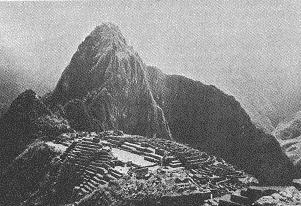
[Illustration: The Inca city of Machu Picchu was built on the crest of a mountain and required mammoth stone blocks to be raised up a 1000-foot cliff. In an amazing modern account Tibetan priests were observed levitating stone blocks by means of specially-placed horns and drums. If this account is true, levitation by sound could be the lost art or technology that enabled the Incas to build Machu Picchu.]
We do not have to go to ancient manuscripts to discover the occult side of sound. There is a seemingly valid modern-day account of Tibetans raising 10-ton blocks of stone by the power of sound. In Playfair and Hill's The Cycles of Heaven we find this most amazing account. The authors state that they hesitated to publish the information except for the very detailed evidence provided by the respectable Henry Kjellson, one of the pioneers of Sweden's aircraft industry. According to Kjellson:
"Blocks of stone measuring 1.5 meters square were hauled up to a plateau by yaks, and placed over a specially dug bowl-shaped hole one meter in diameter and 15 cm. deep. The hole was 100 meters from the sheer rock wall on top of which the building, presumably a hermitage of some sort, was to be built. Sixty-three meters back from the stone there stood nineteen musicians, spaced at five-degree intervals to form a quarter-circle... Measurements were taken extremely carefully, using a knotted leather thong.
"Behind the musicians, about 200 priests arranged themselves so that about ten stood behind each musician. The instruments involved were drums and trumpets of various sizes. (Kjellson gives the exact dimensions of the 13 drums and six trumpets that made up this unusual orchestra.)
"Then, at the command of the chief priest, the music began. The beat was set by a gigantic drum weighing 150 kilos and slung from a specially built frame so that it was off the ground. Two monks took turns at each trumpet, blowing a total of two blasts per minute. All six trumpets were pointed towards the stone of its launching pad, and after about four minutes of what must have been indescribable racket (since the meticulous Kjellson fails to describe it), the stone rose into the air, wobbled slightly, and then, as the noise from the trumpets, drums and chanting priests increased, followed up a precise parabolic course of some 400 meters up to the top of the cliff. In this way, we are told, five or six blocks were lifted in an hour, although some of them apparently broke upon landing."
Today's science is perhaps stumbling into similar areas. On a new program some weeks ago it was demonstrated how through acoustics scientists are able to levitate small bits of matter such as drops of water. If the ancients had mastered this ability it would explain how such marvels as Egypt's pyramids or Peru's Machu Picchu were built. At Machu Picchu 200-ton blocks of stone had to be raised up a 1000-foot vertical mountainside. Modern science has also developed sonic cannons which are reminiscent of the powers of "Kapila's Eye." During World War II the Germans developed a "whirlwind cannon" similar in principle to the laser in that it concentrated a beam of coherent sound on a target. This instrument was powerful enough to knock over a brick wall at 500 yards. In the Bible we find that the walls of Jericho were brought down by ram-horn trumpets fashioned by the priests.
Sound also has a profound effect on man's emotions. There is a story about Pythagoras that illustrates this. Pythagoras observed a disillusioned lover feverishly gathering wood and piling it in front of his girlfriend's door, intending to burn her house down. A musician nearby happened to be playing a stirring and forceful melody. Pythagoras induced the musician to change his tune and play a mellow and soft song. Shortly the angered man stopped gathering wood and made his way sadly home. Man instinctually knows the effect music has on his emotions. If there is a fight or other trouble at a public gathering the band is always instructed to start playing in hopes of soothing the crowd. Different forms of music induce different moods. A story is told about Gurdjieff in which the modern philosopher/ psychologist accurately predicted that a particular woman would begin weeping when a certain chord was played on the piano. Gurdjieff apparently had the emotional effects of music down to a science.
There was some experimentation using music with mental patients before the use of drugs became prevalent and destroyed most therapy in favor of "chemical confinement." In the late 1930's Dr. Ira M. Altshuler made such experiments on over 800 patients at the state institution in Eloise, Michigan. He found that soft music was 35 per cent more effective in calming manics than such treatments as the wet sheet pack. In another instance of music therapy psychiatrist Dr. Lauretta Bender was unable to get a 15-year-old Jewish girl to speak for over five months. When she happened to hear the Hebrew folk song "Eli, Eli" it produced an immediate effect on her. In a psychiatric journal Dr. Bender cites another case in which a woman became deranged after childbearing and would have nothing to do with her baby. After being played Brahms' "Lullaby" she returned to her normal self. Hindu shamans used to require their patients to rock to and fro in beat with special music that was played. This would have a curative effect and also loosen the person's tongue so that he could talk more freely about his ailment.
We and everything about us are intimately affected by vibrations. Music can sometimes elevate us to ecstatic heights while other sounds can put us "on edge," make us sad or angry and even destroy our sanity. It seems that the realm of sound, music and vibration holds answers to questions in areas from physics to metaphysics. In this age where many feel that man is running out of new frontiers, sound may be the passage to a new world of discovery.
TAT is a non-profit, tax-exempt organization founded in 1973 with the express purpose of providing a forum and meeting place for inquirers into the mystery of ourselves; Where do we come from? Who are we? Where are we going? TAT welcomes all inquirers, adventurers of the mind, laymen in search of truth, seekers of knowledge, the self and the unknown to meet others of like interest. Philosophers, psychologists and scientists, both professional and laymen, are on equal ground at TAT.
TAT is non-sectarian and non-denominational; there are no secret oaths, dogmas or rituals in TAT. Its membership, open to all of serious intent, from all walks of life, is united in friendship of dialogue and fellowship of human spirit.
TAT believes that you can expedite and intensify your investigation of life's mysteries by working with others who are exploring, perhaps down a different road, so that you may share your discoveries, exchange ideas and "compare notes" in order to come to a better understanding of yourself and others. It is for this reason that TAT provides a unique mountain retreat where its members can meet informally, a Journal as a forum for readers and writers of esoteric subjects, symposia, as well as small open-forum study groups in several cities. Your TAT Membership helps support these functions and gives you access to friends you might not otherwise have contact with.
There are two types of TAT membership: participating and associate. The annual fee for participating members is $20.00, entitling them to attend the four quarterly meetings at the TAT Farm Mountain Retreat in West Virginia, and to obtain a 50% discount on the prices of all TAT-sponsored events, including the two summer Chautauquas. Associate membership is $10.00 per year and is for those who wish to support the work of TAT but who are unable to come to the meetings or to take advantage of the available discounts. Requests for memberships or further information should be sent to: The TAT Foundation, c/o TAT Journal, P.O. Box _______.
© 1980 TAT Foundation. All rights reserved.