The Forum for Awareness
Full Index of Issues 1 thru 14
Volume 2 Number 3
Summer 1979
TAT Journal is a meeting place...
We who are interested in philosophy, esotericism, depth psychology and other pioneer ventures of the mind and spirit find it hard to get together with people who will not only understand us, but who will work with us and exchange ideas. For this reason we invite all of our readers to feel a part of our quarterly forum and write in with their contributions.
Perspective
Stories of vampires, demons and exorcisms are as popular in novels and movies - the folk-tales of today - as they have ever been. And while the twentieth-century view of reality relegates such accounts to the realm of fiction or superstition, many people recognize in these fantastic creatures a force that is truly present in the world, not necessarily "evil" but "irrational," the source of compulsive behavior and the human urge for self-destruction.
Everyone is supposed to know now that there are no such things as spirits, discarnate entities that afflict the living. Mental illness is no longer the province of the priest, but of the psychiatrist; and there are many recognized categories of psychosis for which there are no cures but a growing pharmacopoeia of palliatives. Inevitably, however, material science is left empty-handed in its wrestling match with the immaterial mind. And so the legends persist.
Why is it that we want to hear tales of demons and ghosts, of leprechauns and jinn? Is it simply because we prefer the miraculous to the mundane? Or do the accounts of these strange beings harmonize with the intuition that there are dimensions of reality that are not subject to everyday cognition? And if the human mind is not material, might it not act and be acted upon in a realm beyond the reach of our senses?
Carl Jung's great contribution to psychology was in revealing the myths and legends of our ancestors as being profoundly accurate representations of the functions of the unconscious mind; in that unconscious he found the source of our mythical creatures, given their life by the collective energy of humanity. Jung was not an occultist, but he realized that the ancient traditions about the beings that both tormented and succored men were not nonsense. Do we dare withdraw from the enlightened ignorance of our modern, concrete universe to learn, with Jung, that mankind has long possessed a wisdom about the dangers to which the psyche is exposed in its unseen world?
True mental health is revealed in people today more rarely than ever before, because it is the product of a disciplined and selfless life. The modern reaction to repressive moral codes has created the illusion that humanity can be liberated through self-indulgence; but instead of liberation we experience a dissipation of direction and life-force that leaves the mind lost and defenseless in the dark forest of thought. The old traditions recognized that we are always wandering in that wood, and so taught the people methods of safe passage and protection from attack. The modern view says that there are no creatures and no forest, in fact, no mind - only a body whose reactions can be observed and chemically moderated. Which is really more unbelievable: the mind existing in a world of spirits, or men living in a world without mind?
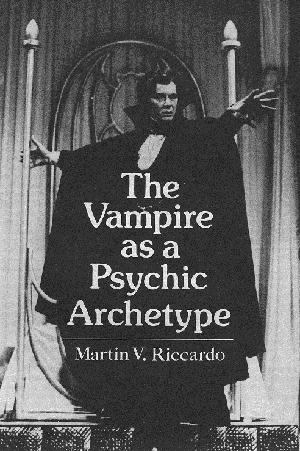
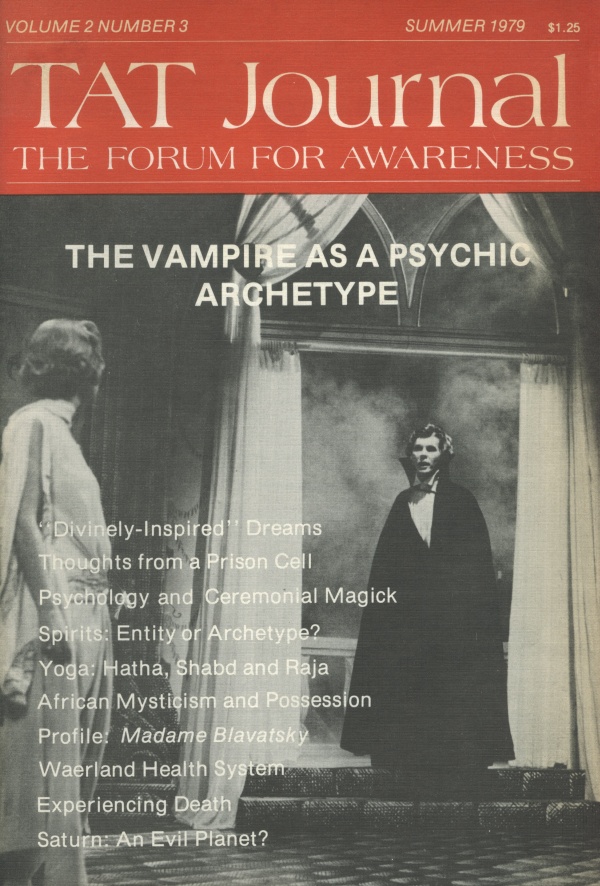
Cover: Frank Langella from the Broadway play Dracula.
Editor: Paul Cramer
Associate Editor: Mark Jaqua
Production Assistant: Cecy Rose
Printing: Doron Fried
Staff: David Diaman, Keith McWilliams
© 1979 TAT Foundation. All rights reserved.
The TAT Foundation is a non-profit, tax-exempt organization established to provide a forum for philosophical and spiritual inquiry on all levels, modeled on the principle that cooperation and interaction with fellow inquirers can expedite one's own investigation. The TAT Foundation is organized to fund and encourage workshops, intensives, Chautauquas, study groups and related services. This journal is one of those services. The intent of the TAT Journal is to promote the goals of the TAT Foundation by providing a readers' forum and writers' exchange.
Contents
Dracula and other fictional vampires grip the popular imagination because they represent the human fascination with sex and death. Martin Riccardo describes vampire legends and beliefs from around the world.
Thoughts from a rare Individual who has used his physical confinement to seek mental freedom.
The practitioners of magick in ages past may not have been so superstitious and foolish as we now like to believe. Their complex rituals were concentrative methods for leading them into the subconscious mind.
What do you know for sure? Does our mastery of concepts contain any assurance of real knowledge? What Is knowledge? What Is reality?
Modern theories of mental Illness may explain abnormal human behavior less adequately than do traditional beliefs in spirit possession.
A classic account of a life-after-death experience by a man who made the trip and returned.
Richard Rose describes his early investigation Into the confusing varieties of yoga, and his good fortune in encountering the books of Paul Brunton as a guide.
Alkaline vegetables and cold water hygiene are combined in the Waerland's purifying regimen
The Book of the Damned by Charles Fort, Secret Talks with Mr. G., The Mysteries Of Chartres Cathedral by Louis Charpentier, Sexual Energy and Yoga by Elisabeth Haich.
TAT Journal believes that by helping others you can help yourself. Our Reader's Forum is the best place to "meet" other inquirers and searchers like yourself. TAT wants to help put you in touch with friends you would otherwise not have access to. Contact other TAT Journal readers with your thoughts and ideas, and share your discoveries. Send your letters, comments or articles to TAT Journal, Reader's Forum, P.O. Box 236, Bellaire, Ohio 43906. If you wish to contact someone in the Reader's Forum personally, send your initial correspondence to us in a separate, stamped and unaddressed envelope and we will mail it to the party you choose.
More than One Room?
Apathy and inertia seem to go hand in hand for a great deal of the human race in regards to the nature of their own existence and their relationship to the world. But occasionally throughout the years one will find, as I have, certain individuals who are curious about themselves and seek some understanding of their own nature. Generally, there are two reasons which seem to propel these people into a search:
The first might come as a result of a drug experience or possibly some type of "spiritual" experience. The second may be intuited in one's own daily life dealings possibly symbolized to them through a dream showing them cramped into one room or trying to continuously fit themselves into an old pair of shoes that are no longer big enough for them. Sometimes in the dream there is a doorway leading out of the room or an indication where one might find the correct pair of shoes to put on, and sometimes not.
In regard to this I recently came across a reference in one of the writings of the English psychologist Maurice Nicoll, Psychological Commentaries on the Teaching of Gurdjieff & Ouspensky, in which he speaks to these experiences indicating some similarities:
"In ancient parables Man is often compared with a house. He lives in the house of his Being. In this house are many rooms on different floors. Each man has a house where he lives with certain typical attitudes, prejudices and habits, usually corresponding to the lowest rooms in himself. He can live in better rooms, yet when he hears something new, something strange, he will return to his old house, unless a very deep impression has been made on him, when he will be lifted into new rooms in the house of his Being, momentarily, only to fall back into his old rooms - that is, into the few rooms probably in the basement, which he usually occupies mentally and emotionally."
He goes on to give an analogy from the New Testament:
"Thus it is said that on the last day of the Feast of Tabernacles, after the multitude had heard the words of Christ: 'They went every man unto his own house.' (John vii. 53) They did not understand anything new."
In a sense this is pointing at a unique philosophy, an individual philosophy or psychology, different from a general sociology or mass-minded psychology. With the emphasis on the individual, I believe Nicoll speaks to both instances: the one of experiencing the different state of perception and the one of feeling caged in, symbolically intimated in a dream. He indicates that there is a way out but that an individual's own state of mind could keep him from doing so. In other writings, he suggests that peer pressure makes it hard to move on in a new direction.
Colin Wilson, the prolific author of psychology and the occult, has made a similar observation to that of Nicoll's. He has said that mankind's greatest enemy is not death but forgetfulness. "We lose direction too easily," he says. We get a glimpse of another state, another room, but our tendency is to fall back to familiar ways for no other reason than that they are familiar.
There are many writings which indicate a path to these upper rooms, if one begins to look for them, notably the works of Nicoll, Gurdjieff, Ouspensky, Rose, Jung and others as well as in the records of men and women who have experienced them such as found in Richard Bucke's Cosmic Consciousness and a book full of so-called laymen's experiences entitled Twice-Born Men, the author of which I don't remember.
As I believe there is a path out of the jungle of confusion indicated by the works of the men mentioned above, my own personal observations, and of older writings such as the Old and New Testaments or Patanjali's writings, I would be interested in corresponding with anyone of similar interests.
Impressions of Saint Teresa
There are three things helpful to remember when embarking on the somewhat tedious journey through the writings of Teresa of Avila:
Keeping all this in mind, Teresa is still a hard nut to crack. Her writing is at once turgidly emotional and dead arrow detached. She has a sense of humor that cuts through pretense and yet one feels that she is constantly aware of the dangerous path she is treading with the Catholic Church reading over her shoulder.
If you can persevere, however, there are some vividly common-sensible bits to be had here, especially for women. Although she is not writing about the ''Fourth Way'' life, but about the convent existence of unquestioning obedience and belief (or "faith") - she can be uncannily accurate about specific problems of women:
In her descriptions of the states of prayer, progressing from recollection or "the Prayer of Quiet" to "Union," she is marvelously eloquent. The reader must be careful to separate these brief (what can one say?) descriptions from all the "I am a poor woman and a sinner" protestations that usually follow.
She occasionally mentions entities, and there are descriptions of two incidents when she actually saw entities while speaking to persons of low spiritual level. There are numerous cautions about taking advice from people who don't know anything, but who have managed to gain a position of authority on "spiritual matters."
I found that I was never dead certain whether Teresa had actually reached a state of enlightenment or samadhi. But I have more than a sneaking suspicion that she did. She is sly enough to know that she mustn't lay claim to that, however - as she is only a poor, sinful woman, standing in constant need of Jesus Christ (and the entire Catholic hierarchy who speak for Him.) What she writes, she writes to preserve the path for those who would come after her. She went to the trouble to found a more remote and cloistered convent for the few who had the inclination to get on a severe and difficult road with her. There was no other way to do it at that time, for women. (Or men either, for that matter.) I get the distinct impression that she knew exactly what she was doing - her language and religious orientation are simply that of another country in perfectly ghastly times. Teresa of Avila is an enigma... and very adept, I think, at running between the drops of holy water.
Want to write to someone in the Reader's Forum? Send your initial correspondence in a separate, stamped and unaddressed envelope to this magazine and we will mail it to the party you choose.
The Age of Mutation
The nineteen-eighties will be here in a matter of months. A mere calendar change, you say? Yes, but a pregnantly symbolic one.
There are signs that change is once again in the wind, that we are about to emerge from the long tunnel of collective introversion that was the seventies. We have been operating in private, many of us, each getting our individual head together, or trying to. And now history is about to raise the curtain on the act we've each been preparing for the past five to ten years, to call us back to center stage, ready or not. What might the new play be like? To know that, we first have to find out who the players are. Where is the creative minority, the new avant garde that can spark the fires of change in the years ahead? Is there really someone waiting in the wings? And why haven't we heard from them sooner?
Perhaps because, as intimated, they spent the seventies going through a collective identity crisis. In the sixties, strictly intuitive criteria were used by the vanguard minority to identify themselves. They weren't particular about labels, and used the old fifties term "hippie" until Tim Leary declared its death in 1967. After that, they ironically accepted society's designation of them as "freaks," and wore the weirdling epithet like a badge of honor. Needless to say, there was no one around with a rational definition of what a freak was, though sometimes it was said that a freak was a person who had "cosmic consciousness." As for what cosmic consciousness is, and what its implications might be... "Well, y'know, it's like, a certain state, a state of mind, and it makes you do freaky things, and it makes you so different from the straights."
If that was the case, then it must have been a very unstable state, judging by the vast numbers of freaks who went straight after the seventies rolled 'round. For those who did not - who perhaps tried but found they could not - it's therefore not surprising that the seventies were such a confusing time. If their freak-hood was a state of mind, then why couldn't they change it? Why couldn't they become hip capitalists or contented rural farmers or successful inner-peace promoters like so many of their former comrades? Could it be that for some, this freak thing goes much deeper? My God, maybe it's inscribed in our genes or something, or carved in our neurons.
The term "cosmic consciousness" was coined by a Canadian physician who published a book by that title in 1900, the year before his death. His name was Richard M. Bucke, and what he had done was to take the supreme bright idea of nineteenth-century materialist scientism, namely evolution, and combine it with the deepest insights of the Western (and Eastern) spiritual tradition. What he came up with was the conception that the human species is evolving, not just physically and culturally, but psychically. A true son of the Victorian Age could no longer find sufficient meaning in regarding Jesus and Buddha and rest as "religious" fountainheads, for religion and its childish-seeming myths no longer stirred the blood in his veins nor inspired him to see visions. It was no longer satisfactory to label Saint Paul and John of the Cross as "mystics," for mysticism was too unscientific. And Dante and William Blake and Walt Whitman - to call them simply "inspired poets" seemed somehow to miss the point. No, the, great new energy-charged myth of the day was evolution. Could there not be a relevant parable, Bucke speculated, in the process by which the primal horde of ape-men spawned the first humans? Didn't this process involve the early appearance of a few scattered precursors, isolated individuals with a cerebral structure different from the rest, capable of nurturing the newly-dawned spark of sapience? Of course it did, and Bucke concluded that all the best of the avatars, saints, and sacred poets of historical times were likewise precursors, mutants if you will, of the next step in evolution beyond the stage of Homo Sapiens. The change, as previously noted, would be a psychic one, and the inner experience of the cosmically conscious homo superior would be as different from that of his sapient forebears as a man's mind is different from an ape's.
A collective change in consciousness on the part of a small but significant fraction of the prevailing social order - this is what cultural change gets down to. In the recent decades of the twentieth century, this change in consciousness has been explained in many ways: in political terms, in sociological terms, in psychiatric terms, in religious terms, in philosophical terms. Those who are the subjects of the change have variously regarded themselves as the vanguard of the proletariat, the uplifters of humanity, schizophrenics or schizoids, spiritual seekers, philosophic iconoclasts. And this, I believe, marks the heart of the endemic impotence of this particular grouping of people, if group it is: a chronic confusion about identity. Highly individualistic persons come to tentative conclusions in private about themselves and the world, then try to carry their often profound insights and realizations into the public arena in order to seek a harmonious voice, another soul or souls who have likewise recognized the Problem and want to do something about it... and what's the result? Babel. Utter confusion of tongues, and the resultant alienation, one from another, of individuals who obviously have so much in common, perhaps sense it, but cannot penetrate the barrier of labels and alien identities.
All of the old categories, as above, have proven futile, serving only to increase our isolation and promote further confusion. Perhaps it's time to float a new world-view upon the billowing wind, to try on for size an utterly new and historically unproven explanation of who we are and what we're doing here. Perhaps it's time to identify ourselves as psychic mutants.
The theory is that whereas the simian-to-humans transition required millions of years, the time-scale for the new psychic change measures in the thousands. And it has already been going on for anywhere from twenty-six hundred to three thousand years.
Part II of the theory is that for various bio-psychic and socio-economic reasons, the sporadic trickle of mutants who infiltrated the world in previous centuries has in our own time gushed to a veritable torrent, though the actual number is still a tiny minority of the global population.
All right then: who and what is a psychic mutant? How do we differ from the standard homo sapiens?
In order to get a reasonably clear understanding of the complex answer to this difficult question, it's first necessary to put the parent species itself, i.e. homo sapiens, in perspective. For one thing, it's not a finished product - obviously, or we mutants wouldn't be here. But further, it's not complete even in terms of its own constituency, as it were. As the human race is presently constituted, there yet exist massive vestiges of earlier stages of psychic evolution. Indeed, the majority of humanity hardly qualifies for the title "sapient," which implies a centering in the intellectual portion of the individual's being. By contrast, everyday experience reveals that most people are controlled by, and centered in, their emotions; they can properly be said, therefore, to be "sentient" (Latinizing it a bit, we might even speak of "homo sentiens"). Still further down the scale are those remnants of the primal horde who are moved by little else than gross physical sensation; they are centered neither in the head nor the heart, but in the body. There are still many of these nearly pure Cro-Magnons with us today, as witness those numerous individuals whose lives and interests revolve wholly around sports, and the swollen ranks of juvenile (and adult) gangs.
Where, then, is a psychic mutant centered? Every acid graduate knows the answer to that, though chances are he has no words for it save outdated ones, like "soul" or "spirit." More modern attempts to label the fourth quality in our quaternion (instinct-emotion-mind-?) are also unsatisfactory - words like "superconscious." Intuition is a technically correct label, but the word is unsuitable because of its vernacular usage, in which it is heavily associated with emotion and little esteemed. At this early stage, therefore, it seems correct to leave the question of nomenclature open. Somewhere along the line there'll be a winner in the name-the-new-species contest.
Many new, young mutants will come of age in the nineteen-eighties. What are the chances that a significant proportion of them will be able to so identify themselves, to relate enthusiastically to the idea that they are harbingers of a new species? They will arise from every class of the population, realize their inner difference from their fellows, and begin to seek... something. How can they be expected to experience the tingle of recognition on coming into contact with the concept of the psychic mutant, an idea whose place in popular culture has been mostly limited to the literary ghetto of genre science fiction?
The answer is that the gods of synchronicity have so arranged things that the most pregnant social phenomenon of the late seventies is the science-fictionization of the general culture. Star Trek conventions drew thousands, Stars Wars millions, and the most emotion-charged religious symbol of the day is no longer the cross, crescent, or Star of David, but the UFO. In the higher levels of the culture, bold speculators have been busily at work translating all the old spiritual and visionary ideas into a new, if fragmented, mythology of science fictional images. There is little doubt in my mind that the times are exceedingly ripe for the psychic mutant to publicly step forth and declare himself.
There are also signs that the ethic of hyper-egalitarianism, which has been gathering momentum for five hundred years, has crested in our own time. It has accomplished its proper work of heightening sensitivity to human needs and making people on all levels of society aware of everyone's common humanity (from Cro-Magnon to homo superior, all are Homo - all human). But the natural after-effects of this great leveling wave are the primary cause of the hellish decay of the quality of life here at the end of the twentieth century, the great gelatinous tide which, if not reversed, will send Western Civilization the way of Atlantis. We are drowning in a sea of equality, sameness, and lack of excellence. History at this turning-point cries out for an openly elitist movement, one which bases its criteria of human quality not on class or race or sex or nationality or education or refinement, but on the only yardstick which has ever been valid: the internal nature of the individual.
This article is intended to be the briefest of introductions to an enormous new subject. There is no space here to go into detailed explanations of any of the points raised. Hopefully what has been said is sufficiently heuristic to inspire others to turn their thoughts in this direction, and to add their ideas to what has been presented here. Responses can be made through the pages of TAT Forum, or anyone who so desires can write to me personally:
Paranormal Telephone Communications
A newly discovered and immensely important psychic phenomenon, paranormal telephone communications, has opened up to parapsychology an entirely new vista falling into the category of survival phenomena. Briefly, this general phenomenon can be divided into two main varieties: telephone calls representing the dead and calls representing the living. The most important of the two types, I believe, is the first - calls representing the dead - but I must admit that my personal interest in this fascinating field was sparked by the second type.
In 1974 I called my colleague, Mr. Scott Rogo, at about noon, but the telephone was answered by a renter whose voice I knew perfectly well. He said that Scott was not at home and finally answered that he would pass on my message. Time passed but I received no return call and finally at about 6:00 p.m. I called again, but this time Scott answered. He had not received any message and had only been away from his house for about twenty minutes at the time that I called. His renter had actually been in a city sixty miles distant, had given blood at a blood bank, had a receipt for this donation and was accompanied by a witness. Only two keys to the house were available, one kept by Scott and the other by the renter.
Quite a number of telephonic cases have been collected and studied, some in the form of a call to the living receiver and some providing answers by apparently living people; but in all cases it can be demonstrated that the "living voice" on the line, representing a person quite alive, did not in fact originate from that person. When possible fraud and sheer chance have been eliminated, these cases are perhaps even more puzzling than are those cases representing the dead, and to complicate the field even more there are still other extremely rare types of voices which fall into different categories.
Voices representing the dead are the most plentiful and can be divided into a number of sub-varieties. Some are restricted to a very few words; some offer speakers who do not seem to realize that there is someone on the line listening. Others give fairly long communications and some feature more than one speaker. A few illustrative examples will be given.
"My Aunt Ruth died in a Methodist hospital in Houston, Texas in January, 1975. A day or so after her funeral my father, Dr. C.M. Taylor, received a phone call at his home. It was 'Aunt Ruth' but her voice was so faint on the line that Dad couldn't understand what she was trying to say. He told her so and she replied, 'I can barely hear you too, Mack. (Mack was the name she always called him.) Hang up and I'll call you back.' He did but she never called back."
"(They) had lived in the same neighborhood for 35 years and Dad and Aunt Ruth knew each other about as well as two people can. To this day Dad is completely certain that it was Aunt Ruth's voice on the phone - l just confirmed this over the phone this morning."
"Dad is a conservative Texas rancher and dentist who has never had anything to do with spiritual matters..." Dr. C.M. Taylor confirmed the written account.
This case is representative of those cast in a simpler form: a few words said, recognition of the speaker's voice, etc. Some examples have been confirmed and others rest on the statements of the narrators. A more complex case highly condensed will follow.
A family who were friends of Mrs. X moved away from the building which both families had occupied; several years later, Mrs. X's son said that a call had been received from "Carol," who said that she would call back. The next day the boy again reported that "Carol" had once more called and on being asked for her new number said that it didn't matter. Mrs. X called a mutual friend, gained the phone number of her distant friend, called and was shocked to hear from her husband that "Carol" had died about four days before. Mrs. X's two sons, one of whom had received the calls, confirmed in writing that the incident as described had definitely taken place.
Telephone cases occasionally include more than one voice on the line, a most important point with a very pro-survival implication. In Tomorrow, Summer, 1954, a case was described by the heraldry authority, Julian Franklyn. His telephone had been misbehaving in a curious way and then he received a call from his brother-in-law who possessed a most distinctive voice. While the first voice was speaking, a second voice broke in remarking that Franklyn was speaking to his brother-in-law and that he would call back. This promise was not kept, but when Franklyn's wife returned home she said that the brother-in-law had died that morning.
Still another example describing sounds other than words spoken by the caller was described in Light, June 19, 1931: "Recently a lady, whose integrity I can vouch, rang up on the telephone from her flat another lady in the London area without previous arrangement.... They started a normal conversation but were quickly interrupted by a voice which broke in announcing its possessor as a defunct individual, and accompanied by noises which were both unpleasant and disturbing. My friend asked the lady at the other end of the phone if she also heard the voices and the interruption. She did and they agreed to ring off.
"Later on in the evening the call was renewed and the same interruption occurred. They abandoned the 'phone for the evening. There has been no recurrence of the phenomenon... " Another variety of abnormal telephone communication was given to the National Inquirer, March 21, 1978 by the noted attorney Melvin Belli. Mr. Belli stated that a good friend, Suey Ng was alive and following his profession teaching English. Belli received a telephone call from an Oakland undertaker saying that his friend was dead and would be buried the following Thursday at ten o'clock. The lawyer called at the undertaking establishment for the funeral and found that his friend was apparently living for there was to be no funeral. To confirm that his friend was actually living Belli telephoned him from San Francisco and to his relief, if puzzlement, found that he was indeed living.
Suey Ng did die, however, and his funeral was performed one week later at ten o'clock at the undertaking establishment which had been the apparent point of origin of the original mysterious telephone call. In this case a precognitive communication was made by an obviously paranormal voice representing itself as a living person.
To anticipate the obvious, I know of two examples of such communications which were received on "ansafones." One case was described to me by Richard Sheargold, the noted parapsychologist and foremost English investigator into the tape-recorded voice phenomenon. He had been involved in a case in 1975 in which a message representing a non-living woman was found on the ansafone after the office had been closed. Normal messages had been left but were followed by a series of comments claiming to originate from a recently dead but not yet orientated individual. The communication came in two sections - A B.B.C. program was announced between them and due to this fact Mr. Sheargold was able to verify the time when the ansafone was activated. The second example was given to me by a highly educated man of great reliability. He received two communications representing a dead relative, the second of which I have heard. It gives the correct name and is very clear and intelligible.
Obviously, any electronic communicating device can be utilized for the reception of paranormal voices. The tape recorder, the telephone, the ansafone, the television (I have personally experienced the last) and other devices have all been employed.
At the present, most of the available evidence testifying to the reality of the phenomenon is primarily anecdotal. But that fact does not detract from the scientific value of the evidence. First, at the beginning of any new field of study narrative evidence might well be the first material available. Second, the approach of establishing newly discovered content patterns which could not have been anticipated testify in favor of the authenticity of the accounts. Third, accounts exist with verifying material, witnesses, more than one person hearing the voices, etc., all of which fall into the same category of evidence usable in legal proceedings. And last, accounts now exist in great number assuring that even if the other considerations did not exist, still a certain percentage must by sheer chance be authentic.
Editor's Note: Raymond Bayless and D. Scott Rogo have co-authored the first book to be published on paranormal telephone communications, Phone Calls from the Dead (Prentice-Hall, 1979). They hope to generate interest among the public and parapsychologists, and to stimulate the development of experimental procedure in this area. Readers who have experienced this phenomenon are invited to send their accounts to Mark Jaqua, TAT Journal, P. O. Box 236, Bellaire, Ohio 43906; enclose a stamped envelope and your letters will be forwarded to Mr. Bayless.
Living Ghosts and the Apocalypse
The Random House Dictionary defines "hippie" as an alienated, middle-class youth who lives on a rural commune and experiments with psychedelic drugs. However, this word, which once was an emblem of praise among peers caught up in the 1960's whirlwind of Herman Hesse, LSD, Zen and anti-war protest, is now used by the same group of maybe-pot-smokers with the derogatory intonation that the inflamed hardhat employed to shape his orations for the American way of life.
The difference between the two groups is that, whereas the hardhat felt true condemnation, the ex-longhair of the 1970's uses the word "hippie" to explain a certain futile, psychological pose. A friend of mine said to me, when asked if he had seen my brother, "Yes, and he's still a hippie." He implied that my brother had not evolved out of this "uniform" and its attendant lifestyle.
In terms of the zeitgeist of the 1970's, its absorption of alienated youth into the mainstream nine-to-five itch and go-to-disco-blues, there lies in the psyches of these newly-made automata the hope, flickering in the primal regions of memory, that the explosion of the 'sixties may occur again in a way that would be truly transformational. Hence, idealism has gone underground. The group has become a sea of individuals as each individual chooses the raft that is most self-serving, be it med school or a journey to a Buddhist monastery in Thailand to study the creeds of the Hinayana.
While lunching with a friend at the local young people's restaurant, he ventured the statement that after Christ's mission the Roman empire became a ghost empire; in other words, Rome was not destroyed, it only resurfaced with new symbols, those of the Christ. The metaphor impressed me and I thought that it fit the psychological post-mortems of the 'sixties. The "punk" and "new wave" movements in music consist largely of living ghosts. Its groups - Devo (meaning devolution), the Sex Pistols, The Dead Boys and its manner of dress - the bizarre safety-pin through the cheek and Raggedy Ann garb - intend to show the complete disenfranchisement with the idea of social change. These youths feel that they and their technological societies are dead or dying. Consequently, they parade as ghosts singing the funeral dirge. This movement is relatively small in number, but the consciousness that it embodies touches many secret fans of the Apocalypse that may or may not come.
If we assume that there is going to be some form of cataclysmic change with the disappearance of fossil fuels, or the coming of a messiah, or a rebellion against the technology-myth, then we become ghosts, beings that feel powerless over the environment which they haunt. This is the plight of many, regardless of their camp. It explains why the media were so thoroughly entranced by the Jim Jones death camp, and why a good airline crash or even a bizarre auto accident holds more fascination for the commoner of the metropolis than does a possible signing of a Camp David treaty on TV during the pre-plugged show "Battlestar Galactica," whose cast is looking for their legendary home, earth, while being chased by the robot-like Cylons, transformed reptiles with a political hierarchy resembling hell itself. In a deep sense, we are a humanity that is waiting for the end, and it may be that this very intuition in our unconscious will create destruction. While hitchhiking I was once picked up by a Vietnam veteran who was just waiting for the revolution by the young. His truck, with its shotguns and survival paraphernalia, bore the stamp of his conviction.
There is a more profound expression of this feeling of "things to come." Some of those who were conditioned to thoughtlessly accept a piece of consumer pie woke up to their conditioning. These rather rare individuals constitute a new underground in the sense that they fear being labeled and made into a group, for they see as nemesis any form of thought or ideology which might cause them to fall asleep in a new form of conditioning. They view their involvement in the 'sixties as the first step towards waking up. Their attitudes of rebellion have not degenerated into despair but have been transformed into hope, a hope that man might wake up.
A great exponent of this idea is Krishnamurti, the almost-messiah who disbanded the Order of the Eastern Star declaring that the way to truth is pathless, and that the reason, for man's enmity to man is a result of his being asleep under the intoxicating effects of various beliefs. Krishnamurti's style is to have a dialogue with his audience and his books often reproduce those dialogues verbatim. His psychological teachings are more valuable than those of others with psychological systems aimed at "waking up" which alienate the average Joe with a complex terminology. He says in the book, You Are The World: "What is the problem when we observe the actual world around us and in us? Is it an economic problem, a racial problem, black against white, the communists against the capitalists, one religion opposed to another religion... is that the problem? Or is the problem much deeper, more profound, a psychological problem? Surely it is not merely an outward, but much more an inward problem?"
Krishnamurti states that the nature of this psychological problem is that we are asleep, caught up in thought, identification with country, class and property, with sex, religion, and habit. This higher order of looking at the Apocalypse idea sees it as a vain hope, for even if it came how would it change man's nature? The way to Apocalypse is not to change externals but to raise man's consciousness. I read an article once that stated that one day the space-time continuum would change because of a change in man's perception, an idea that does not sound totally implausible. The article had a paragraph from a science fiction book describing how all at once the world woke up to the mystery of being; new dimensions appeared out of the noosphere, children flew in the air, animals spoke.
This approach may be scientific. Man is realizing that the nature of his thought-life, with its paradigms and myths, is largely responsible for the kind of environment he inhabits. The scientific revolution that started out of the urge to overcome the negative aspects of the environment such as cold, is now realizing that man is not a Darwinian overlord but an integral member of an ontological idea. Consequently, a science that was founded on discrete Newtonian events and bred a technology that ignored the interrelatedness of all phenomena, is now waking up to a disheveled environment.
Although a clock ticks out seconds in periods of hours and a certain number of hours constitute a year which is the revolution of the earth around the sun, isn't this quite an artificial way to view man's subjective experience of time? Why is that while one is engrossed in an activity or meditation, a minute can pass unnoticed, while if one is bored time passes interminably? Or why is it that certain events that occurred ten years ago leave a more lasting impression than those that happened yesterday? Perhaps there is some kind of relationship between thought and quality in experience. The assumption that man's mind is alien, an outsider of the physical world, a ghost in a body, may be fallacious. It may be that all phenomena have a mental origin and that what science calls physical laws are merely the consensus of those who perceive similarly, stating to themselves what the commonalities in their perceptions are.
We are living in an age when the old is dying and the new is waiting to arrive. It is the debate over that which is going to arrive and the manner of the arrival that has created such tension in the world, although it may be the case that tension is always uniform. Surely there have always been men who were ahead of their time like Galileo, and who sacrificed themselves in order to issue into man's very being different paradigms which would yet again be revised and destroyed with newer and more accurate agreements. What is unique to our epoch is the fact that man is becoming aware of the relationship between the paradigms of thought and the nature of his experience. The subject-object duality is becoming increasingly difficult to define. Objectivity is, perhaps, proportional to subjectivity.
The question that is intriguing to me, and difficult to answer, is, "Will man wake up?" On a certain level it seems that the structure of humanity is pyramidal. There will always be men who are asleep, who are doomed to live their lives under the tyranny of the prevalent myths of their society. And it may be the case that because of those who are asleep there are those who will wake up, who will become aware of the psychological assumptions their society and its world-view possess; they will attempt to transcend it and mentalize their natures. The pyramid itself would not necessarily undergo a complete qualitative change unless it were accomplished by individuals themselves.
Each man constructs the nature of his own prison. Every human life is an expression of the thoughts which occur inwardly. The angry person lives in a world in which others betray him. The paranoid sees others as threats. The intellectual wants to be a master of concepts and words, though his intent may concepts carnal in origin so he'll appear the brightest rooster.
At the top of the pyramid are those who seek to know their nature, who go within directly. All great teachers from Christ to Socrates to Buddha to Gurdjieff or Nietzsche have somehow preached the dictum, "Know Thyself." It maybe that the purpose of the earth ultimately is to carry beings who practice this. Recently, the big-bang theory of the origin of the universe was found to be most likely because two scientists found the original, lingering, backdrop radiation from the original event... at one point, man's mind and man's body, the sun and the planets, the galaxies and the void were one.
The Parade
There's a parade going on. Most people just march and march and never ask why, or wonder what lies at the end of the road. Others are contemptuous of the sheep and demand an alternative. Some "drop out" in an attempt to leave the parade behind, only to discover that they have merely switched sections in the same old parade. Others fight their way to the front, realizing too late that the drum major is as much a part of the parade as the musicians, except that he gets to the end of the road a bit sooner. But there are a few people who can escape; it must be only a few, because the loss of too many musicians will throw the entire band out of key. These individuals start with the realization that they were born into the parade and are inextricably a part of it, so that they cannot leave it merely by deciding that they are free. They are unique in that they detach themselves even as they march, constantly observing who they pretend to be in the parade in an attempt to discover who lies underneath the uniform. They are never comfortable. As soon as they start marching smoothly or begin to get carried away by the music, something happens internally or externally to remind them that it is only a parade. And just when they are sure that they are finally detached from the parade, the beauty of a soft face or the physical pain of their finite bodies brings them back into the fold. But it is this tension, the necessity of having to be both a marcher and observer, that keeps them awake and dynamic and looking for a way out. There is no alternative but to walk the two paths, so that when the music is over, they are not over too.
The Vampire as a Psychic Archetype
by Martin V Riccardo
The power of Thanatos... is so obvious in our culture that most of us normally don't notice it.
Martin V. Riccardo is president of the Vampire Studies Society and is publisher of the Journal of Vampirism. For information write to P.O. Box 205, Oak Lawn, Illinois 60454.
In the Bible's book of Leviticus (Chapter 17, verse 14) it is stated: "You shall not eat the blood of any flesh at all, because the life of the flesh is in the blood, and whosoever eateth it shall be cut off." That is the pitiable state of the legendary vampire - to be cut off, severed from the living, yet set apart from the dead. He is forced to live in a hellish half-world, a lonely isolated existence of darkness and horror. He is driven solely by his fierce, uncontrollable lust for blood, a hideous cannibalism of human fluid. Like an amphibian that can live both in water and on land, the vampire can freely cross the border between the graveyard and the realm of living beings. Yet he is a prisoner agonizingly torn between the two worlds, a creature trapped in the depths of evil. He is the tragic rebel of the night who rages against the finality of death, but who willingly takes life to prolong his own semblance of it.
As grisly as this vampire image may be, there has been a new resurgence of interest in Dracula, the most popular villain of all time, outstripping even the Devil himself in the number of books, movies and other works devoted to him. What is it about the vampire that commands this fascination? Why is it that part of us should be so irresistibly attracted to Evil in its purest form - irredeemable, ruthless, and deadly?
The answer may lie in the darker recesses of our own inner minds, the hidden subconscious layers where so many secrets are stored. The Freudian school of psychology holds that this is the region of the id, the primal, baser nature within all of us, normally contained by the restraints of our conscious mind. It is said that the id supplies the raw power of our libido or sex drive, but also another force that occasionally gets out of hand - an attraction toward death.
These two primal forces of Eros and Thanatos (or sex and death) make themselves explicit in the symbol of the vampire. When a moviegoer sees the sinister cloaked figure on the screen, he may subconsciously recognize the darker aspects within himself, inwardly responding to the alluring sensuality of evil, the cold insatiable power of death. And when the vampire is staked or destroyed at the end of the film, the viewer can feel a visceral relief that the inner evil has been conquered. The only problem is that the resilient vampire will not stay down; the evil keeps resurrecting.
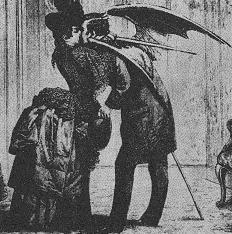
[Illustration: The vampire of this 19th century Victorian engraving reveals the strong sexual element present in vampire lore, his foreboding presence disguised with a "kiss."]
The power of Thanatos (or what has been termed "the death instinct") is so obvious in our culture that most of us normally don't notice it. Television programs, plays, movies, and books (from Gothic romances to murder mysteries) usually play on themes of death. Usually someone must die or be threatened with death to keep an audience interested. Movie ads display actors carrying long threatening guns and knives - symbolic images of eroticism and death. Daredevils (those who literally "dare death" for its own sake) become national heroes.
There is always this possible danger of the subconscious mind being triggered into releasing something dangerous within us.
Rock music has drawn on these images, with some artists of this ilk utilizing and profiting from the symbols of death, such as the colors of chalk white and bloodred for make-up, and jet black for clothing. The effect created is not only reminiscent of the vampire, but of Death personified, such as the figure portrayed in Ingmar Bergman's film "The Seventh Seal." KISS is the most prominent rock group with black, death-worshiping regalia, even spelling the last two letters in the group's name with a runic SS like that of the Nazi death masters. Alice Cooper is the rock star who uses outrageous horror and death scenes in his musical performances. While "in character" he has been quoted as saying, "This whole generation is bent on self-destruction. Self-destruction is great! It's fun!" Cooper is also known to have a deep admiration for Bela Lugosi's movie portrayal of Dracula.
Sid Vicious was the "punk rock" star who carried death-mania rituals into his private life. Shortly after he was released on bail for the charge of fatally stabbing his girlfriend with a hunting knife, he was quoted as saying, "I want to die... I didn't keep my part of the bargain." Some months later he was found dead from a drug overdose in another girlfriend's apartment.
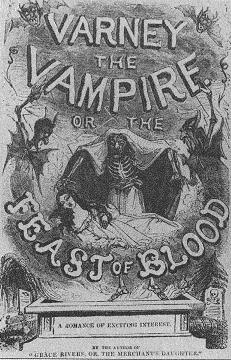
[Illustration: The vampire theme was fashionable during the 19th century reaching new heights in prose fiction with the publication of the first vampire serial, Varney the Vampire (1847).]
The macabre images that such musicians unleash may touch sensitive chords of the inner mind, and can have more profound results than increased record sales. Parapsychologist Raymond Van Over interviewed one young woman who had been psychologically devastated by her encounter with one performer. She was waiting for a table in a Horn and Hardart restaurant in New York, and was at an emotionally vulnerable point in her life; she had lost custody of her infant son after separating from her husband. While in line she felt an irrational but immediate sense of terror toward some people waiting in line with her. She could gather from their conversation that one of them, a young man in a skintight costume of gold lame, was a rock singer, and that the woman with him was a witch. As she listened she felt a chill come over her. She turned to leave, but the singer then clutched her arm and said that not only was his girlfriend a witch, he was a vampire, and he especially loved to drink the blood of young women. She pulled away and left the restaurant, thinking at first it was a stupid joke, but still feeling unnaturally terrified. Afterwards she had several horrible experiences in which blood appeared spontaneously. On one occasion she entered her apartment to find that the picture of her son had fallen to the floor, while blood stained the wall where the picture had hung. On another occasion she entered her bathroom to find it completely splattered with blood. Some time later she started to hear voices cursing her and urging her toward self-destruction. She started to believe that a vampire was attacking her telepathically to get her blood; this eventually led to her being institutionalized. (1)
The power of the subconscious in altered dream-like states may even be responsible for some of the effects linked to vampirism.
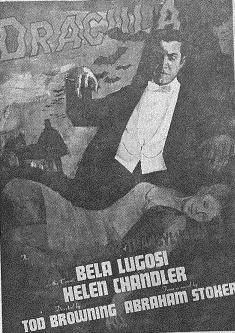
[Illustration: Tod Browning's film, released in 1931, was a box-office success. That Dracula's magnetic power was irresistible to women, was borne out by Bela Lugosi's vast fan mail, ninety-seven percent of it written by women. Gabriel Ronay, The Truth about Dracula.]
There is always this possible danger of the subconscious mind being triggered into releasing something dangerous within us. Normally it is in our sleep that the subconscious becomes most active and reveals what has lain dormant. It is the region of the dream, or nightmare (from mare, an oppressing demon - sometimes a sex demon). When a poll was taken in Great Britain to determine who was the most "dreamt of" person in the country, the name that reached first place was Denholm Elliot. Who is Denholm Elliot? He was the actor who prior to the poll had played the role of Dracula on British television.
The power of the subconscious in altered dream-like states may even be responsible for some of the effects linked to vampirism. One of these states is somnambulism (or sleepwalking). One twentieth century author noted that some Greeks and Romanians maintain a belief that there are somnambulists who wander about in the night and use their teeth to tear apart anyone they come in contact with. Sexologist and mind explorer R.E.L. Masters has defined the Slavic voukodlaks (or "vampires") as follows: "Somnambules (occasionally regarded as possessed by demons) who ravish young girls and drink their hot nourishing blood." (2)
Another altered state possibly linked to vampirism was first discussed by a nineteenth century physician, Dr. Herbert Mayo. He believed a condition he termed "death-trance" might lead people to believe in vampires. Once a person entered this condition of involuntary catalepsy or suspended animation, he would appear to be dead. When he revived, panic might result. Dr. Mayo wrote: "There is no reason why death-trance should not, in certain seasons and places, be epidemic. Then the persons most liable to it would be those of weak and irritable nervous systems. Again, a first effect of the epidemic might be further to shake the nerves of weaker subjects. These are exactly the persons who are likely to be infected with imaginary terrors, and to dream, or even to fancy, they have seen Mr. or Mrs. such a one, the last victim of the epidemic. The dream or impression upon the senses might again recur, and the sickening patient have already talked of it to his neighbors, before he himself was seized with death-trance. (3)
The early Assyrians had their lili, a female demon thought to be sexually insatiable who nightly sought out likely bed partners. This eventually evolved into the Hebrews' conception of Lilith, a night-flying wild-haired demoness hostile to all mankind.
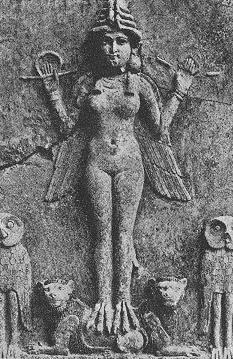
[Illustration: Considered Adam's first wife (before Eve), the Hebrew demoness Lilith, whose offspring were demons, was known to attack men who were sleeping alone, seducing them in their dreams and sucking their blood. She is the "night hag" who lives in the wasteland with the wild beasts and hyenas, in Isaiah (34.14), and she may be the "terror by night" of Psalm 91.]
The power of the subconscious elements in vampirism is revealed most strikingly in the sexuality involved. This brings to mind the old beliefs of succubi and incubi, female and male demons that seduced mortals in their sleep. Their history is closely tied with that of vampires.
The old mythologies were fertile ground for the seeds of subconscious dreams. The early Assyrians has their lili, a female demon thought to be sexually insatiable who nightly sought out likely bed partners. This eventually evolved into the Hebrews' conception of Lilith, a night-flying wild haired demoness hostile to all mankind. Tradition holds that she kills children and seduces men in their sleep while she drinks their blood. By the Middle Ages, Europeans considered her to be the queen of the succubi.
The Greeks had a similar creature, with the name changed to Lamia. At first she was thought of as being a vengeful monster that stalked the night to strangle children and drain their blood. Later the word "lamia" was used for a whole race of blood-sucking female demons who would sexually entice young men, and then devour them or drink their blood. It was said that the lamias would wait for the moment when their victims reached the peak of sexual climax; then they would tear into their flesh, feverishly gorging themselves on warm blood.
Variations on these themes (that combine the erotic, the supernatural, and blood lust) may be found in vampire beliefs around the world. The nosferat or "undead" of Transylvania (in Romania) was once considered a highly sexual vampire. It not only sucked blood, but it would appear in an alluring form to young men and women as they slept; it would then make physical love with them with such fervor and passion that the young people would die of exhaustion. The sburator is a vampire in the modern folk beliefs of Romania. Of him it is said: "He takes the form of a handsome man, enters the house through the window at night, and kisses women during their sleep - often without the latter realizing the intrusion - except that they are tired, terribly tormented, pain-ridden, and agitated on the following day " (4) In some Slavic areas there was a strong belief that the dead could still have amorous designs on the living. This belief was so prevalent in these areas that peasants were sometimes known to dress up in a shroud-like sheet or white cloak to make nocturnal visits to local widows.
Variations on... themes that combine the erotic, the supernatural, and blood lust may be found in vampire beliefs around the world.
In the legends of Portugal it was believed that sex-hungry, blood-sucking witches called bruxsas would fly through the night sky in the form of a gigantic bird, either to meet with demonic lovers, or to seduce unsuspecting travelers. A more recent example of sexual blood-fixation in a Portuguese woman (age 30) was reported by the German doctor who treated her. She would delight in imagining that every time it rained, it rained blood. In place of normal sexual relations, she preferred to suck blood from the ear of her lover.
The French have a demoness called Alouqua that is a blood-sucking succubus. It is believed that she drives men to suicide after she devitalizes them. The Southern Slavs have a female vampire called the mora. She is said to fall in love with a man once she has tasted his blood, and out of love returns to him every night to drink his blood until she has killed him.
Among the more primitive natives of Brazil, a vampire called the lobishomen attacks women. Once they have been preyed on by this creature, the women are said to become uncontrollable nymphomaniacs. Even the more sophisticated citizens of modern Brazil have not been untouched by vampirism. A newspaper account of November 9, 1967 reported on how residents of Manaus (a Brazilian coastal city) were being terrorized by a vampire described as "a blond woman with sharp and pointed teeth, wearing a mini-skirt and black stockings." Small round marks were found on the neck of one victim, and several members of the local police became too unnerved to continue the investigation.
Vampire researcher Wanda Bonewits has commented, "I think that the image of a vampire sinking his teeth into his victim's throat and engendering passionate surrender enroute has far more to do with sexual fantasy than with folklore." (5) Montague Summers, the authoritative scholar on vampires (who apparently believed in their supernatural existence) remarked in a similar vein, "The vampire is, as we have said, generally believed to embrace his victim who has been thrown into a trancelike sleep, and after greedily kissing the throat suddenly to bite deep into the jugular vein and absorb the warm crimson blood. It has long since been recognized by medico-psychologists that there exists a definite connection between the fascination of blood and sexual excitation." (6) It is obvious that sex plays a major role in vampirism, but it is not ordinary sexuality. It is a macabre sensuality, a variation on the kiss of death with supernatural undertones. Freudian psychoanalyst and author Ernest Jones wrote of the vampire, "It may be said at the outset that the latent content of the belief yields plain indications of most kinds of sexual perversions, and that the belief assumes various forms according as this or that perversion is more prominent." (7)
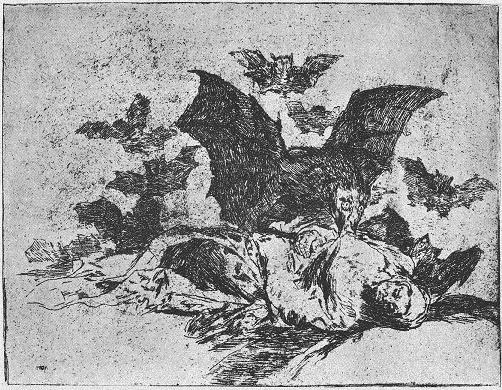
[Illustration: The Consequences by Goya. In this plate from The Disasters of War, Goya depicted war as an unrelenting winged "vulture," sucking blood from the breast of man.]
The sexual perversions in vampirism may be so repressed they aren't even recognized. Even Bram Stoker, a sexually frustrated product of the Victorian Age, was not fully aware of the erotic content implicit in his novel Dracula. He would write long passages on boudoir visitations, vampiric kisses, and bloodlust in Dracula, yet he considered pornography "a class of literature so vile that it is actually corrupting the nation. "
Actors who played Dracula discovered the sexual power of the role. When Bela Lugosi first starred in the Broadway and movie version of Dracula, he was barraged with fan letters from female admirers. Christopher Lee, who portrayed the Count in numerous Dracula films, at one time received more fan mail than any other actor in Great Britain. A reporter, waiting among some fans for the Dracula actor Raul Julia after one of his Broadway performances, heard the fairly typical comment from a young woman: "I don't want his autograph. I want him to bite me on the neck."
One of the most recent sensations as Dracula, actor Frank Langella, has remarked, "Dracula seems to represent to women a certain kind of safe and sinful sexuality. A woman can fantasize submitting herself totally to the vampire... It's absolute abandonment without guilt."
The foremost literary scholar of Dracula, Leonard Wolf, has witnessed movie audiences leaning forward as the vampire leans toward his victim on screen. He has stated, "Movie audiences find it exciting to watch a man drink a girl's blood... What they recognize is a sexual embrace that is not threatening because all the physical responsibilities of lovemaking are evaded in that piercing kiss, and they can still be joined body and soul." (8)
Unfortunately, vampiric bloodlust is not solely relegated to fantasy. Richard von Krafft-Ebing in his classic work Psychopathia Sexualis provided a brief glimpse into its reality with his case no. 48: "A married man presented himself with numerous scars and cuts on his arms. He told their origin as follows: When he wished to approach his wife, who was young and somewhat 'nervous', he first had to make a cut in his arm. Then she would suck the wound and during the act become violently excited sexually." Montague Summers cited the case of a 14-year-old girl in France who "displayed on all occasions an extraordinary avidity for human blood and as sucking greedily recently inflicted wounds."
Such cases are not as rare as one might imagine. It was reported in January of 1979 that a 22-year-old student was arrested in Frankfurt, Germany for having enticed several teen-aged girls to his apartment where he drugged and sexually abused them. After his arrest, he admitted that he sometimes drank the blood of the girls. When police searched his apartment, they found four large knives along with large syringes and bottles that had traces of human blood.
While these cases show a psychological imbalance between conscious reality and subconscious compulsion, there are indications that the inner mind might be capable of unleashing what could be termed "paranormal" forces. Through the psychic powers of the subconscious, the old stories of the dead attacking the living might conceivably have some basis. According to one occult theory, the "undead" vampires were not really dead at all, but in a state of deliberate physical suspension in order to practice astral vampirism (leaving the body in astral or ghostly form to drain blood for nourishment).
There are many indications from folklore that malevolent forms of out-of-the-body travel were used by practitioners of black magic. One example is the belief in sections of Greece in the bruculaco, someone who falls into a cataleptic state; "the soul thus momentarily separated from the body goes into that of a wolf, making it thirsty for fresh blood." (9)
I have personally spoken to a woman in my office who believes she has seen a rather repugnant member of her family travel out of the body. She was not aware of my vampire research when she talked with me, but she described how over a period of a year she would wake up with what looked like bleeding teeth marks on her back and leg. She was attempting some magical procedures to prevent the attacks (placing some water in the four corners of her room), and she had not been attacked on the night before she talked with me. However, her daughter (who lived some distance from her, and was also in my office) had woke up that morning with deep scratch marks on her leg, with blood pouring down from her ankle.
The subliminal powers of the mind are truly awesome, whether for good or bad. As we dig into these subterranean layers, we need to be cautious of what may be unearthed. Lurking below, the gleaming red eyes of the vampire may be patiently laying in wait.
Selected References
Prison: The Perfect Asylum
If the title of this article were a riddle (rather than a paradox), it would be difficult to unravel. Even as a paradox it will not easily yield to understanding, for so locked are we in our fixed notions that we see only what we want to see. We just do not have that open mind we think is ours, relying as we do on long-standing ideas that in time have become home-grown truths for us.
If we say that prison is a place of punishment rather than a perfect asylum, everyone will agree with the statement as leaving no question of doubt. For so it surely is, except insofar as we understand what a perfect asylum is, and how prison lends itself more fully to this end than any other setting, however ideal it may appear to be. A perfect asylum qualifies as such in that it allows the maximum opportunity for self-discovery. Try as you may, you cannot find or devise a community more suitable to self-discovery than prison. You learn quickly enough in this alien environment (if you learn at all) that you are not the person you thought yourself to be in the home community. The perfect asylum strips us of pretense, permitting us, if we are able, to understand our pretentiousness for what it was in a world that is pretentiousness itself, the world-at-large. The perfect asylum is one which always provides a separation from the psychological self-at-play in society. Prison admirably performs this service.
Indeed, that is what a perfect asylum is all about. It naturally sets before the mind's eye those poses and posturings we formerly assumed were truly serving us, revealing them as less than worthy roles. Prison quickly brings this to light, for there is no meaningful activity resembling those free-world doings which formerly occupied us so fully. We are hard put to find a place to hide from ourselves; and so we must face ourselves as we have never done before.
This is the way toward discovering what-I-am-not, for we are certainly much more than those ill-fitting social roles we have all along assumed as being ourselves. But until they are seen for what they are not, we can never see ourselves for what we truly are.
At least we have the chance of such a meeting - a chance we might not otherwise come by, no matter what exceptional setting or happy circumstance we might imagine. The perfect asylum is that place where personal identity is deliberately and methodically denied us. In the absence of those persons and things to which we were once so attached, which used to enliven our minds with their "living" experience, that personal identity "ghosts out," disappearing more and more every day. The perfect asylum is a place whose circumstances the mind utterly rejects as unworthy, as a foreign world that can never be its own. Prison life is always experienced as an existence to be endured but never accepted in the same way and with the same degree of attachment as our home community.
Memory is stronger than reality, for once we have committed ourselves to some core of identity the mind does not easily give it up. While identities are infinite in number, early in life we get locked into one or another, to our own tremendous deprivation, for we give ourselves over to this self-image and think of it as though it were really our self. In the separation that prison life imposes on us, we are forced to part reluctantly with this familiar self, but we still pretend, as all prisoners do, that we are just the same as we always were, hanging on to the bits and pieces of that former self. Nevertheless, in spite of all we do, this detachment is experienced as a kind of slow psychic death which we resist more strongly and fearfully than physical death, because it is more real and immediate. For, every day, the ghost of what we once were seems to lose more and more of its character and vividness, until it appears to mark the very end of life - of real living for us.
Most of us bitterly mourn this passing, drenched in self-pity as the phantom of our former self flashes before our mind's eye and disappears, finding no reflection of itself in the harsh reality that is now our lot. Some of us harden our hearts, so that the pain of our loss may not spill over into unbecoming tears. But this only serves to dam up the flow, building up a reservoir of bitterness which often overflows, causing fresh wounds. Still others manage a facade of well-being by losing themselves in work, busying themselves from morning to night until their minds find relief in exhaustion.
However we may react, the perfect asylum strips us bare to ourselves, until we are forced to acknowledge that we are still alive, even though living outside the scope of that experience which we have embraced as our own personal reality. This fact in itself constitutes an awakening, just as when the actor, engrossed in the role he has been playing, becomes aware that he is not that familiar character, however much he has identified himself with it. For us here in prison, this is a fearful awakening, to be sure, for the mind is filled, comforted, satisfied by the sense of identity which the security of the familiar bestows - and panics at its loss.
And so we try to fill the psychological void - in flight from the nothingness which we experience at the moment of self-loss by quickly creating some substitute image of ourselves out of the stuff at hand. We all live in our own picture-album world, and there is no reality for us except these momentary snapshots which bring our life-experience into focus, captured in memory's attention. In time we begin to see the world only in terms of these pictures, and when we lose our connection with these projections of a familiar world, we are compelled to build another image of ourselves - something we can believe in. But the ghosts of our former selves always hover in the background, reminding us that this latest version is just another presentiment which will also fade away in time and haunt us with its memories.
But the perfect asylum can teach the student something different, something lasting: That we are - before and beyond all the self-imagery the mind creates and captivates us with; that to take the conceptual world as a true representation of reality, lending it a reality not its own, is but the myopia of mankind; that life can be lived in full fellowship without the guidance of such thoughts as men deem necessary to establish or even describe brotherhood - for brotherhood brings its own understanding which is not limited by our thoughts about it; that Love, Truth, Understanding are ours in the experiencing, never truly known until the mind is freed of its preconceptions, of its fixations of meaning which we symbolize as ideas.
The Missing Meaning
"As a rule a man's a fool
When it's hot he wants it cool
When it's cool he wants it hot
Always wanting what is not."
These words were hand-printed on a piece of torn cardboard box that had aged before its time in the heat of the overhead pipes that lined the waiting room ceiling. It hung from a black shoestring looped over a too-large nail pounded into the wall just above the receiving window. You couldn't miss reading it as we new men queued-up for our issue of clothing. There wasn't anything else to do but look at each other and so those of us who could read, read.
That was a long time ago. Thirty-seven years. I was seventeen and facing the reality of prison life for the first time. The verse said more to me than I then could fully understand, having an elusive meaning alive but hidden as might some telling truth trying to surface but whose day had not yet come.
It seemed fitting that the verse had no title and was anonymous as life itself and, like life itself, came alive in a meaningful way only in the mind of the beholder. Perhaps it had been written by some long-forgotten convict who capsulized his life's experience into those four lines. And yet the truth of meaning there was not just his and spoke to every reader of himself, and in such a way as could only be understood at this very place, at this very time.
It was this setting even as much as what was said that gave deep meaning to the author's thoughts, as what is thought is only seen from where it is thought. Given another time and place the verse may well have brought to mind some quite different meaning of a superficial kind. As it was, the verse was appropriately placed reminding the reader that his own folly had brought him to this point of no return as disillusionment is always its own ending of such notions that were unworthy to be held.
The message of truth was there for those who were open to the message and I almost understood, but not quite. I stood there looking over the shaven heads of the men in front of me who, like myself, couldn't help reading what was surely meant for each of us to read and understand as it had been written. It is unlikely that any of us brought such understanding to the reading, so filled are we with ideas of our own making that obstruct truth, pretending then to be that very truth denied. Even as the trees are taken for the forest, ideas picture for us what has no reality beyond the mind's picturing. We see in thought what we would see, we read into thought what we would read, and I could not at that early age understand any more than that I was somehow missing the truth of what I read, that there was more to the matter being considered than what the mind's mirroring could reflect at this time. In short, I sensed my own unfaithfulness without understanding this, and if there were untrueness then there must be something more to me yet to come.
It was this faith that there was more to me than my thoughts were telling me that kept me, throughout life, from falling into some great despair. This was not hope, hope that takes its meaning in something as one's knowledge concludes a direction of mind, but a faith beyond knowledge, understanding only that knowledge of itself could never be enough. In some way I had already learned that it was in seeing through knowledge that one understood, that knowledge was only an appearance that could take on many appearances of usefulness or not. Strange. Though knowledge failed me often enough so also did I seem to gain strength out of this apparent loss. Still, I listened to my own words of knowledge, ignoring that inner voice that was always saying, "Fool! Faith in your knowledge must always end in failure as knowledge can never be true and the false can never stand." But the mind is stubborn and learning came hard.
The years came and went. The summers were always too hot, the winters too cold, and little of fair season in between. The mind took pride in its endurance, in a strength seemingly not its own. Yet we are strength and only knowledge weakens us to its own end as we serve out as best we can such ideas as claim us for their own.
George Ellis is imprisoned at Stateville, a state penitentiary in Joliet, Illinois.
Behind the symbols, rituals and rudiments of this mysterious and arcane practice lie the roots of a scientific and systematic method aimed at deeper levels of consciousness.
The Psychological Mechanics of Ceremonial Magick
by Harold Harnick
I was once staying on a farm, attempting to get in some reading and studying. I was in a calm, rather peaceful mood and was studying rather carefully a book I had just purchased, The Book of the Sacred Magic of Abra-Melin the Mage. I was astounded by the book and was coming to the conclusion that, "If there was anything to Magick, this was the real thing!" I was sitting in my chair, engrossed in the book, when suddenly I was confronted with a PRESENCE. It hit me like a brick in the chest. I had been confronted with what I thought were spirits before, but nothing had been like this. It was not an inimical presence, but powerful and there - and it was asking me a question. The question was not verbal, but it welled up from within my being. "What is your intention with this Magick?" is what seemed to ring through the air. I felt I had to somehow answer correctly or I could be plagued with an obsession. I "answered" from the depths of my being that my intentions were only intellectual and that I was not going to use this Magick. I somehow had to summon with total sincerity all that was me to answer this question. Satisfied apparently, the presence was gone as abruptly as it had appeared. Needless to say, I was taken aback by the whole thing. It convinced me that there was more than merely a subjective reality to Magick. The thing that confronted me seemed nearly as real as this typewriter at which I'm sitting. Thus was launched my serious study of Magick.
Magick as a system to obtain enlightenment, or union with the Higher Self, is probably the most misunderstood system in the world. Its practices are arcane and difficult to understand. The author Israel Regardie regards Magick as the West's equivalent to Yoga. The practices of Yoga are directed inward in the attempt to reach the Self while, to appearances, the practices of Ceremonial Magick are directed outwards to gods, angels and celestial forces. This outward direction is only apparent though, because the deities which the magician invokes are only symbolic of the forces and powers within his own psyche, the same forces and powers which the yogi attempts to reach with his inward meditation. The paths of the yogi and the magician are the two extremes toward the realization of the same goal - the Higher Self or the Holy Guardian Angel.

[Illustration: This fanciful image of man "stepping out" of the physical world to discover secrets beyond symbolizes the magician's goal.]
I will use two words in this essay, "Magick" and "magic." By "Magick" I mean the practice or the utilization of a system which is transcendental in nature, that is, aimed at the union of the lower self or ego with the Higher Self or Soul. In Magickal literature this is symbolically called "The Holy Guardian Angel." By "magic," I mean those practices which have some terrestrial or practical aim, such as making a love charm or talisman, or casting a spell that your neighbor's cow may dry up. In its basest sense this is black magic or sorcery, but it can be put to good purpose as in curing the sick or perhaps making it rain. Behind the use of practical magic is a knowledge of the occult laws of nature. The sixteenth century physician and magus, Paracelsus, was reputed to perform many amazing cures through his insight into the hidden laws of nature.
Western Magick is primarily based on the cosmology and psychological system found in the Jewish Kaballah. To understand Magick, at least a cursory understanding of the ideas behind the Kaballah is needed. According to the Kaballah, the Earth and all the subtle psychological and spiritual qualities which make up the human psyche are emanations of one primary or absolute principle - the Ain Soph. In the Hebrew language Ain means zero (0) or nothing. Since the ultimate principle, Ain Soph, is beyond all possible human comprehension, it is called "No-Thing" or "The Great Darkness." Merger with this ultimate principle is the final goal of the magician, superior to and following merger with the "Holy Guardian Angel." From this ultimate principal is emanated at the time of creation ten levels of being or existence. Each of these levels of being emanates or "creates" the level immediately below it. The first principle, Keser, emanates the second principle, Chokmah, which in turn emanates the third principle, Binah, etc. The last emanated principle is Malkus, which is our physical world and our physical body.
Each of these levels is not a place, but is indicative of a particular power or force in the human psyche. These levels are not like the layers in an onion, one on top of another, but permeate or are diffused through everything. In our physical level is contained, by a sort of osmosis, all the other levels, but each superior realm is of subtler substance and at a higher "vibration rate." In example, a person cannot see his emotions on this physical level because they occur on a subtler plane - the astral plane in Kaballistic terminology. Theoretically, to a being on this astral level, human emotions would be as tangible as the chair you are sitting on is to you.
The paths of the yogi and the magician are two extremes toward the realization of the same goal - the Higher Self or the Holy Guardian Angel.
Each of these levels in the Kaballistic cosmology or "Tree of Life" denotes a force, aspect, or capacity in the human being and as well in the general creation. The ten stations of the Tree of Life have names and numbers which are symbolic of the qualities of that station. The numbers and letters placed in different combinations are indicative of various reactions and correlations between these forces in nature. The attributes and number of sides of various figures such as the circle, pentagram, square, line and triangle cause them also to indicate different correlations among the powers on the Tree of Life. The various combinations of the figures, letters and numbers provide an endless symbology which can theoretically describe any process or quality in creation. Actually, it is a mathematical system used to describe and discover mystical matters. Eliphas Levi, the French magus, praises it thusly: "On penetrating into the sanctuary of the Kaballah, one is seized with admiration at the sight of a doctrine so simple and at the same time so absolute. The necessary union of ideas and signs, the consecration of the most fundamental realities by primitive characters, the trinity of words, letters and numbers, a philosophy simple as the alphabet, profound and infinite as the Logos; theorems more luminous and complete than counting on the fingers; an infinity which can be held in the hollow of an infant's hand; ten numerals and twenty-two letters, a triangle, a square, and a circle - such are the elements of the Kaballah, such are the primary principles of the written word, shadow of the Spoken Logos which created the world!"
While the magician invokes "gods" in his ceremonies, in the normal meaning of the word he is not pantheistic. Each of the gods he invokes is an aspect of the Tree of Life and is also representative of a power or quality in his own psyche. Thus the god "Mars" is representative of violence, war and strength, while the god "Saturn" is imbued with the qualities of sadness and melancholy. When the magician invokes these gods, it is not that he wants to become war-like or melancholy, but that he wants to experience these aspects of his inner self. Thus by repeated invocation and communion with these aspects of his inner self, he in time becomes a more integrated, harmonious, and powerful being. The "gods" are symbolic of the archetypal aspects of his own being. Whether or not these gods are separate beings is open to speculation as to what is actually meant by a "separate being."
Regarding these various sephiroth, or divine emanations, and combinations thereof as objective angels and deities is, in one sense, only to aid the conceptualizing forces of the mind, but in another sense they actually are gods. The pantheons of Greek, Roman, Chaldean and Egyptian gods all contained symbolic beings embodying principles and forces of the cosmos. In a magical ritual evoking the gods (powers within the magician himself) something must be given for the emotions to identify with and thus add emotional strength to the invocation. To the intellect, these universal principles are "forces," but to the emotions they are beings or gods. The emotions cannot easily identify with intellectual concepts, but they can identify with a personality. This is the primary reason why the universal principles contained in the Tree of Life are regarded as beings or gods.
The strange incantations, exotic incense and robes are the "tools" of the magician by which he pulls the levers and pushes the buttons of the psyche.
Reason Behind Ritual
Most people are aware of the general attributes of a Magickal ceremony - the robes worn, circles drawn on the floor, incenses, mysterious symbols and incantations of strange words and names. It would all seem to belong to a primitive time and out of place in our modern age. There is, however, a definite reason behind all the strange paraphernalia of a Magickal ceremony. Man's mind is fickle and there is great difficulty in focusing attention in one direction for more than a few moments. The senses are attracted here and there, and the mind follows. The purpose of the extravagant paraphernalia of Magickal ritual is to occupy all the senses.
The apprehension of celestial ideals is usually not possible because of the turbulence of the mind and the senses. The Magickal regalia give a source of concentration for the senses and thus remove the turbulence of the mind and cause all faculties to be focused on one purpose or apprehension. The Magickal "props" are roughly equivalent to the concepts we use to understand intellectual ideas, the nose "understands" through smell, the eyes "understand" through color, the ears through sound and cadence, and the touch through shapes. The Magickal apparatus mystically speaks to the being rather than just to the intellect as words and concepts do. The strange incantations, exotic incense and robes are the "tools" of the magician by which he pulls the levers and pushes the buttons of the psyche. Although these exotic tools can be used by charlatans to mystify the gullible, Israel Regardie defends their necessity: "Actually, it is just as erroneous and as unjustifiable to accuse a physicist of quackery because in his laboratory he has several microscopes of differing strength, fitted with wheels, tubes, and slides, and that his desk is littered with papers, bearing incomprehensible physical and mathematical formulae."
Each incense, symbol, incantation or colored robe in the ceremony has a particular meaning. For instance, if the god Mars is invoked, then there is a particular incense, color, symbol and incantation for this ceremony. The magician must perform his rite with his whole being or it will not be effective, and each "prop" used is to focus an aspect of his senses and mind. Eliphas Levi explains it: "Understanding must be formulated by signs and summarized by characters or pentacles. The Will must be determined by words and the words by acts. The magical idea must be translated into light for the eyes, harmony for the ears, perfumes for the sense of smell, savours for the mouth, and shapes for the touch."
A reason for the use of sound and incantations in a Magickal ceremony is the peculiar effect sound sometimes has on the psyche. In Indian occultism there is a whole science behind the use of word chants or mantrams. Words spoken with a particular intonation and rhyme have a strong psychological effect. This can be seen in our western culture in the use of advertising and political slogans. The phrase "Ask not what your country can do for you, but what you can do for your country," is strongly imprinted on the American mind in a mystical sort of way. It calls forth a reaction in the psyche in a vague but powerful manner. Another phrase would be "Winston tastes good like a cigarette should." How many people, smokers or not, have found this phrase running through their minds without consciously eliciting it? It is not the truth behind these phrases that attract people, but a mystical quality of rhyme and verse that somehow stimulates the mind.
A reason for the use of sound and incantations in a Magickal ceremony is the peculiar effect sound sometimes has on the psyche. This can be seen in our western culture in the use of advertising and political slogans.
Sound has the peculiar effect of calling forth moods and feelings. This can be seen by simply observing your reactions to different songs on the radio. One song may cause nostalgia and sadness, perhaps raising the thought of a lost love, while the very next song may make you feel powerful and like "raising hell" in some manner. I know that in myself, a certain type of music almost always has the effect of elevating me above my mundane cares and hang-ups. This type of music has a definite purging effect on my mind and I feel momentarily cleansed of all my care and oppression. (Not that I'm constantly oppressed!) Apparently there is a lost science to the use of sound and music. Manly Hall writes, "... we know that the modes of Grecian and Hindu music were regarded not merely as ordinary compositions for the pleasure of the people, but that these modes were exact formulas by means of which certain moods could be caused to arise in conscious beings. Therefore the mode set the mood, and all modal music had within it the power to affect man in various ways."* It seems that the magician intuitively uses this science of sound to pull the levers of his psyche and to help himself to get in touch with the deeper powers of his being.
* Pythagoras claimed that if a building were constructed according to a particular mathematical formula, it could be made to resonate with the sounding of one note, and destroyed with the sounding of another.
The Psychology of Magick
It has long been known by mystics that man cannot apprehend God or the gods by his reason alone. There is something about isolated reason that prevents it from being aware of the deeper level of the psyche. Iamblichus in The Mysteries writes, "For a conception of the mind does not conjoin Theurgists with the Gods; since if this were the case, what would hinder those who philosophize theoretically from having a theurgic union with the Gods?" What is in contact with the "gods" is a capacity which lives beyond the reason. The magician tries to stimulate this capacity by his uncommon rites. The exotic rituals serve to focus all aspects of his being toward union with a god, or aspect of his inner self.
Throughout magical philosophy is contained the conception of the "astral light." In Ceremonial Magick there is a necessity to understand the workings of the astral realm, because in this realm are, supposedly, entities and forces which are detrimental to the psyche. In a ceremony the magician "opens up" the doors of his psyche to be sensitive to higher influences and inspirations. When he attempts to open himself up to higher influences, he also will be open to the negative influences on the astral plane unless he takes precautions or is strong enough to ignore them.
The astral light covers a rather broad range of man's psyche and the cosmos, but basically can be divided into the "lower astral" and the "higher astral." The lower astral is the container of all man's baser desires, emotions and instincts. In psychological terminology, it is the subconscious. It is also said to contain demons, elementals and spirits of lower intelligence or organization. The higher astral is the source of all man's higher ideals, emotions and archetypes. It is the "collective unconscious" of Jung. It is the higher astral which the magician is normally trying to reach when he attempts union with a god or the higher, more divine aspects of his psyche. It is the lower astral which is utilized in sorcery and conjuring to bind evil spirits, make charms, talismans and the like.
The astral light is a very interesting subject since to it is attributed the source of almost all psychic phenomena. In it are proposed to be existing all the entities that cause poltergeist phenomena, house hauntings, possession and the occurrences of Spiritualism. The lower astral is the closest "level" and next higher vibration to our physical world and thus greatly affects the material plane and vice versa. We live in the astral light as a fish lives in water.
Since the astral is a more subtle plane than our own, our intangible realities, such as words, symbols and emotions, have a material or tangible existence on the astral. According to Kaballists, correctly or emotionally spoken words can have the effect of a sledge hammer in the astral realm. Subtle things on our plane have a living reality on the astral plane, and around this principle is based much of the theory of practical magic and occultism. For example, it is held by some exorcists of haunted houses that elemental spirits of the astral realm can be trapped by a certain angle of roofs and clutter. Houses of many gables and cornices are more frequently haunted than other types. Regarding for a moment the phenomenon of possession, it has often been puzzling that people have been psychologically cured by the mere uttering of verbal threats at the supposed entity by the exorcists. Since the supposed entity could not be manhandled physically, it seemed to be frightened or ordered by powerfully spoken words. If words have a tangible reality in the astral realm, this would be explained. The words would be more or less powerful according to the sincerity and force behind them. The emotional force behind the words is important since emotion is held to be a material reality in the astral sphere. Mere intellectual recitation of words will have little impact in an exorcism or in a Magickal ritual.
Abra-Melin, The Mage
The system of Magick which is generally regarded as the most powerful is that contained in The Book of the Sacred Magic of Abra-Melin the Mage. The English edition of this work was first published in 1898 by MacGregor Mathers, the founder of the Hermetic Order of the Golden Dawn. Before this time, the manuscript was apparently unknown, since reference of it is found in no other work. It has been speculated that Eliphas Levi knew of it but perhaps thought it too dangerous and powerful a system to be divulged. The copy from which Mathers made his translation was discovered among manuscripts in the Bibliotheque de l'Arsenal in France.
In Abra-Melin is prescribed a rigorous six-month ritual which is to be carried out in solitude. The purpose of the prescribed ceremony and isolation is to gain conversation with the "Holy Guardian Angel" or union with the inner self. After this has been achieved, and it is assured that it will if the system is followed correctly, a means of binding and controlling demons and elementals to do the magician's bidding is recommended. Controlling and ordering astral spirits may seem rather morbid and melodramatic after "conversing with the Holy Guardian Angel" but Aleister Crowley among others, has explained it from a practical point of view. Once the magician is "back on the material plane" after his experience, he must use the tools at his disposal to accomplish what good that he is able to. Because of his rare skills, demons and imps are the most powerful tools at his disposal. You may not agree with this opinion, nor am I sure I do - but it does make a certain amount of sense.
The Abra-Melin magician uses magical squares to order the "Four Princes of the Evil of the World" to do his bidding. These squares consist of numbers and letters which are arranged in certain ways for specific purposes. Each arrangement has a particular Kaballistic meaning, and combined with the will and power of the magician, has a certain effect on particular spirits in the astral realms.
The peculiar personal anecdote I related at the beginning of this article does not seem to be too uncommon among those who come in contact with the Abra-Melin system. Ithell Colquhoun in her book on the Golden Dawn, The Sword of Wisdom, relates a few cases in point. In one incident the composer Phillip Hesestine attempted to bring back his straying wife by inscribing one of the Abra-Melin squares on his arm. His wife did return almost at once, but immediately afterwards, Mr. Hesestine unexpectedly committed suicide. Friends of Ithell Colquhoun thereafter rented Hesestine's flat and experienced many horrible phenomena. Another story that she relates concerned a young child. It seems that the child began acting very strangely, laughing continuously while several unexplained telekinetic and poltergeist phenomena occurred in his vicinity. The child was put to bed, and while being undressed two slips of paper fell out of his pocket. The slips of paper were notes and magical squares of two Abra-Melin demons that the father had been researching earlier that day. The two demons names were "Turbulent" and "Laughter"! The Abra-Melin system should not be impudently tampered with and Ithell Colquhoun offers this warning to the foolish: "I hazard the guess that certain entities have been caused to indwell these diagrams; and while they can be made to do the bidding of an experienced operator, they may exercise an obsessive influence over those who employ them carelessly."
Ceremonial Magick is the most arcane of Western spiritual methods. It is very difficult to understand and thus has been misused and misunderstood. Its purposes are transcendental in nature and the methods are so direct and prove such powerful stimulators that they should be used only by the mentally and physically healthy. It can be a very effective means of attaining a spiritual realization but, for the careless, it can also be a very effective way to put yourself in the local insane asylum. Ceremonial Magick is the most intriguing and esoteric of subjects for the intellectually inclined. For those, however, who wish to practice Magick, only sincerity of intention and balance of mind will lead to good results.
Annotated Bibliography
Approach to Validity
by Richard Rose
Does a man own a house or does the house own him?
Does a man have power or is he overpowered?
Does a man enjoy or is he consumed?
Does a man really reason... or is it all a complex rationalization?
Does a man rationalize... or is he so programmed?
Can a man learn... that which he really wishes to... by himself alone?
Can a man become?
How shall he know what he should become?
Why build ant hills before knowing what an ant is?
Why do we build conceptual towers of Babel about human thinking... before we know that which thought is?
How can you dare to define thought before knowing the source-cause of all thought? Or the essence of thought?
When you describe bouncing... do you describe the striking object or that which is struck?
Can you start thinking? Can you stop thinking?
Is thought something received or something projected?
Is thought a sort of somatic effluvium, synaptic or chemical? Do we think, or are we caused to think?
Do we observe or do "they" observe? Are we the view or the viewer?
Do we create the idea of creation? Or are we the created idea? Do we experience, or are we experienced?
Is negative thinking (as commonly discussed), negative to man or negative to nature?
Does the brain generate thought like a radio generates the message coming from its speaker?
Is thought limited to the brain?
When a tree bends over does it create wind by waving its branches?
Can theological facts be established by voting?
Is Mary the mother of God or is humanity the mother of God?
Is God determined by victorious armies?
Is virtue established by Psychological edict?... by ecclesiastical vote... or by the requisites of our ultimate essence?
What is sin?... an offense against yourself... an offense against your fellow-man... an offense against God?
Is an offense against God recognized by divine outcry... earthquake or cosmic catastrophe?
Is it a sin to eat meat?
Are the animals our brothers?
Are they possessed of intelligence and soul?
Do animals sin when they eat other animals? Or are such sinning animals pardoned for keeping ecology in balance?
Is it wrong to kill except for food?
Do we do wrong by not eating the people we kill?
Who is knowledgeable about Good?
Is Good that which we desire... or that which is in itself Good? What is the condition of "being Good" in itself?
Is evil the child of Good... or is it a twin?
If a man drives a horse through a plate glass window should the man be prosecuted... or is it the horse who should be prosecuted?
If a man robs to feed his children... should we prosecute the man, or that which drove him—the children?
If a man rapes a girl should we prosecute... a. the man, b. the girl who tempted him, c. his ancestors for his genetic inheritance of glandular inclination, d. the force that designed mankind?
What is equality?
Was Samson equal to Delilah?
Is a baby equal to a dying man?
Are you only half of a plan by virtue of not possessing both sexes?
Is peace of mind more important than global peace or herd-peace?
Who or what are you?
Are you only a body?
Are you rather a complex organism? A cell colony... a nature-oriented bundle of conditioned reflexes?
Is the brain a monitoring station designed for the organism's indefinite survival? Or is our body programmed for death (death gene) following procreation?
Is all religion and philosophy merely rationalization emanating from that computer?... to answer constant cellular awareness of death?
Or is the universal belief in life after death an intuitive reading from that computer, a reading not completely translatable into computer symbols which are limited?
Is there a soul?
Did it exist before the body or must it be developed, grown or evolved?
Prove the following: Mind (as other than somatic awareness), sub-conscious mind, ego, id, superego, chakra, kundalini, tisra til, astral, etheric, causal, desire, aura, halo, ectoplasm, spiritual ear (picks up shabd), conscience, spiritual nectar, philosopher's stone, guardian angel, hydrogen.
What is the correct definition of sanity?
Do our psychologists practice rationalization and make-believe when they substitute behaviorism for a deeper set of factors of human origins or factors of prenatal determination... meaning factors that would bring us to a knowledge of the true essence of man?
Do they not procrastinate the search for real causes?
Do they not manifest a possible paranoia in fear that subjective observations and pursuits may find more substantial things about the essence of man?
Which is the worse schizophrenic? The man who talks in tongues? The schizophrenic who is possessed and cannot help himself? Or... the professionals who create volumes of confusing, complex terminology describing nothing better than their own frustrating dichotomy?
Which is worse? The manic-depressives who brood or babble as a result of excessive voltage, chemical imbalance, some electrolytic deficiency or toxic condition?... or... the pompous alienist who babbles on the witness stand that this or that man should be subjected to ice pick, shock treatment... or electric chair?
What is real?
Is a mirage real?
Is a dream real? If not—why not?
Is wakefulness a dream?... is it an undefined state qualified by erratic or inferior senses?
Is the objective world real or only that which we believe it to be? Is an idea more real than a planet?
Is a planet merely a projected idea? Is an angel more real than a planet?
If the concept of a space-time continuum is valid... does space exist at all independently of time?
If time does not exist... do things move?
Is that which we see, actually there as it is seen, or is it projected? What is matter... atoms, force fields,—electricity?
Are force-fields projected energy?
Do we witness the material world through or with the senses.
Do we hear as well as the dog, see as well as the eagle, or smell as well as most animals?
Do we not have a limited color range?
If we have a limited color-view, how can we have a complete view of the world?
Is there a pure, or direct sense?
How can we have an accurate world-view if we are prone to the projection of a paradigm?
What about knowledge of yourself?
Are there two selves or just one, (dualism) physical self and soul?
Do desires and prejudices do your thinking for you?
Are you an actor whose act hides the real self?
Do you lie to yourself? If so, how can you know the truth?
Do you really think you know what is the truth?
Is truth decided by that which most people think? Or by that which is?
Is truth decided once and for all by experts or authorities?
Is truth learned... or is it only experienced? Do you act? Are you capable of acting?
Are you merely a bundle of conditioned reflexes? (Behaviorism) If we are such a robot-bundle... how can we be conditioned by another robot?
If we know that we are such a bundle, does not this knowledge give us knowledge of the robot's mechanicalness that might lead to the robot's emancipation?
Has such an answer or knowledge ever been found?
Is it found by faith or is it found by studying the self?
Do we identify the self with that which thinks?
Do we identify the self with that which thinks? Or is the self identified as that which is conscious... even conscious of thinking?
Do we know the nature of thought? What is a thought in itself?
What is the relation between a synapse (or a reaction) and awareness?
What is awareness?
Do you need to understand yourself?
Can you understand yourself by an objective study of behavior?
Can you understand yourself by the study of psychology, by either pure or manipulative psychology?
Is it possible to understand yourself without completely understanding your origin and destiny, and without satisfactorily defining the self?
Is not identification of the self, necessarily the isolation of the self from its environment?
If this is true where is the boundary-line?
Do motivating factors such as the appetites fall into the category of being separate from the self?
How can a "self" drink itself to death?
Is temptation alien to our real Self, or is it intrinsic?
Are we selves of many facets or are we a unique self, artfully invaded?
Do curiosity and desire belong in the category of separateness from the Self?
Is the body part of the Self or a garment of the spirit?
Is the mind part of the Self?
Is the mind in its presently understood potential, all that we can consider as the Self?
When a man loses his mind, where does his self go? Where did the mind go?
If a man lives for twenty years in a state of mental conviction, and then experiences a radical reversal of that conviction, what can be said about such a mind especially when we have regarded it as the ultimate self?
Is mind a faculty through which we observe God... as through a glass darkly?
Is it possible to know God before knowing the Self? Is it possible to know anything?
Do not hypnotic demonstrations with the senses indicate that reality is somehow irrevocably interlocked with belief?
Is the world only that which we believe it to be?
Why do we work so frenetically? Is it to get a better job, a better house and car, so that we can have a better mate, and better children?
Why do fantasies beget agonies?
Is our ulterior self in our heads or in our gonads?
Why do we still have innate spiritual hope, unless our intuition sees a solution?
Is spiritual hope and belief nothing more than a part of a robot's programmed stimulation?
Does a robot have any meaning or purpose beyond the intentions of the designer?
Can a robot program itself in any degree?
Can a robot be programmed by other robots for its own good?
Can a robot be reprogrammed in this manner to seek its definition and self-motivation?
Can logic be defined as well-coordinated robot-functioning, in which the robot reacts with seeming consciousness of its own programmed state of acceptance to every situation and suggestion?
Is sanity defined by logic?
Or do we attain it by being logical?
Is it sane to wish to know about our Real Essence?
Can the individual decide?
Can an individual decide on something outside the scope of that which is his limited perspective?
Is man doomed to predestiny?
Or is a man doomed to forever struggle in the uncertainty and inability of ever knowing whether he can act or decide, or not?
Does existence necessitate consciousness? Is man capable of self-consciousness?
Or is man merely aware of the idea of self-consciousness?
Can a man watch himself?
Are there two people in such an act, or is one only the view?
What is thought?
Is thought synaptic or spiritual?
Is thought the reaction of cholinesterase upon acetylcholine?
Is thought the viewing of our own projections, and nothing more?
If thoughts travel in telepathy, what is the vehicle for this travel?
Do thoughts travel in another dimension, or is their action similar to that of electricity?
Protoplasm ends and thought begins where?
What psychological scientist has discovered this link between thought and matter?
Does the body manufacture subtle little essences called thoughts?
Or does the body develop receiving mechanisms or chemicals so that it will be aware of possible external essences?
Would such an external essence be called mind? If so would that mind be external to the body?
Are we then a body being influenced by an external mind?
Or are we the external mind?
Is thought transmitted in or with electrical energy?
Does a man's soul or essence make contact with the body of the man in energy generated by the gap of the synapses?
Is the inner man any more than conscious energy?
Does all energy come from food, or is it possible that we may draw energy from higher spiritual levels?
Do we transmute food-energy into other forms of energy such as mental energy, or is mental energy poured into us from a universal mind?
Are thoughts related to endocrine glands?
Is it possible that man can, with energy transmuted upward, produce thoughts with volition, rather than just submit to reacting?
Is memory an automatic recording?
What sees, what remembers, what reacts to perception and memory?
Does not the mind also have the unique ability which is forgetting, and is not all experience that has been gained, lost, when the mind forgets?
Do space and time both exist in space-time, or do neither exist?
Is real knowing, not knowing?
What is valid? Is a rock valid?
Unless we know that which a rock is to itself, how can we know its validity? If the rock is only our projection, does it have any validity?
Shall the finite mind ever perceive the infinite?
Is it true that the only question worth answering is whether or not we should commit suicide?
Explores states of being and mind. Meets weekly. Call for information ______
Spirits: Entity or Archetype?
by Mark Jaqua
Since man could first conceptualize, he has believed in other-dimensional creatures, whether he has called them demons, devils, incubi, succubi, elementals, imps, familiars or any other of the terms that are in every language, in every time. It has only been recently that a large number of men have declared that such beliefs are irrational, illogical and superstitious. Even today the majority of the world's peoples believe in spirits of some nature and all but the hardened materialist will at least admit that he is not sure.
Spirits are referred to and treated in the holy books and creeds of every religion, from Christianity and Buddhism to African or South Sea Island paganism. Religion must maintain belief in spirits, for what would man become in the after-life if not a spirit? Except for the school of Jung psychology has denigrated the idea of spirits, even though it has been unable to explain the powerful psychic phenomena surrounding the numerous documented cases of spirit-possession. Psychology should be honest enough to hold an open mind in regard to the possibility of other-dimensional entities, instead of becoming embarrassed at the mention of the subject.
In the age-old superstitions and priest-lore of the human race, spirits are usually treated in a vague, emotional and inexact manner. They are something to hold in awe and mystery, and not something to pry into, investigate or categorize. This is the generally held attitude of the common people. There have been some, however, who have studied the realm of spirits in an objective and scientific manner, even though their sources of information have been personal experience and the subjective report of others. Such subjective scientists have been Paracelsus, H.P. Blavatsky, Eliphas Levi, Dion Fortune and Franz Hartmann. Modern thinkers such as C.G. Jung and Colin Wilson have contributed new and creative descriptions to these existences traditionally called spirits or demons.
[Illustration: The Sleep of Reason Produces Monsters from Goya. Hobgoblins of the mental dimension control man when he is "asleep."]
Whether or not there actually are spirits depends a great deal on who you are talking to and what type of description is given to a "spirit." If you ask a modern psychologist if there are such entities as the demons which our ancestors believed in, he will undoubtedly hold that there are not. He would not believe that a person could be possessed by an alien and inimical demon. He would, however, probably hold that a person can be "possessed" by an alienated portion of his own psyche, that a repressed sexuality, for instance, could surface with a seeming personality of its own and "take over" the person. The many case studies of multiple personality describe incidents of such a phenomenon. Are such alienated segments of the psyche entities and demons in their own right? If not, do they differ from the demon-possession treated by the Catholic priest, the shaman and the witchdoctor? Two hundred years ago, the diagnosis of a split personality would be demon-possession. Today the diagnosis is still demon-possession, but the demon has become much more sophisticated and respectable. It has become "animus possession," "autonomous complex" or another such label.
In Genesis it is claimed that man was made in God's image. An occultist would interpret this as meaning that man has, to a degree, the same creative power that God possesses. It can be seen that man can procreate his own kind and, surpassing the animals, he can create a technology and perform engineering feats with his hands and mind. The most subtle and primary type of human creation is that which we do with our mind. Every invention was first visualized in the mind, and this visualization is a creation in a mental dimension which is, in turn, materialized here in our physical domain. With every thought there is a creation on the mental level, some thoughts materialize as physical inventions and others more subtly materialize in the formation of our character.
Whatever thoughts and emotions a person consistently entertains, a gestalt or energy system of such nature is formed in his psychological constitution. From a particular perspective these psychological gestalts can be regarded as entities because they have many of the qualities that are attributed to life-forms. They have survival instinct (habit); they feed or eat (the time and energy expressed in entertaining the habitual thought/emotion); and they grow (habitual emotions have a tendency to become obsessive). If the thought/emotion-habit becomes compulsive enough, it can be said to become a "plaguing demon" in the basest sense.
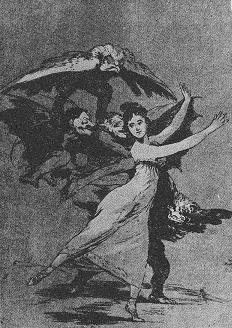
[Illustration: You Will Not Escape from Goya. "She who wants to be caught never escapes."]
Occultists have a category of entities which correlates very closely with the psychologist's obsessive complex, or habit grown-compulsive. The elementary is a mental automaton created by a particular habitual mental-emotional pattern. These automata are created in the mental dimension by immoderate repetition of a certain emotional mood-anger, for instance. The constant energy displaced in the anger-emotion creates a "thing" in the mental dimension just as the chair you may be sitting on is a "thing" in this physical dimension. In time this elementary becomes strong or animated enough that it possesses a degree of will of its own and stimulates its creator/host to further acts of anger, and thus becomes an obsession. An occult maxim in this case would be, "Every habit is animated into an entity."
In cases like this it becomes very difficult to determine what should be called a part of the psyche and what could be called a separate entity or demon. Carl Jung explored these areas in depth and seemed to hold that the psyche is composed of multitudinous facets that are somewhere between separate entities and unpersonalized complexes. He labeled these elusive existences "psychoids" and placed his concept of the "archetype" in this category. "These archetypes whose innermost nature is inaccessible to experience, represent the precipitate of psychic functioning of the whole ancestral line, i.e., the heaped-up, or pooled, experiences of organic existence in general, a million times repeated, and condensed into types. Hence, in these archetypes all experiences are represented which since primeval time have happened on this planet. Their archetypal distinctness is the more marked, the more frequently and intensely they have been experienced. The archetype is - to borrow from Kant - the noumenon of the image which intuition perceives and, in perceiving, creates." (1)
The sixteenth century occultist, Paracelsus, foreshadowed Jung's theories by 400 years. Paracelsus writes, "If man's imagination is strong enough... it will be able to create things in those corners, and whatever man thinks will take form in his soul... Thus the imagination of man is a seed that becomes materialized or corporeal." (2)
In Jung's early career he did a good deal of research into spiritualistic phenomena and mediumistic trance. During a trance, the spiritualist medium takes on a completely different personality, often directly contrary to the waking personality. At a lecture to the Society for Psychical Research in London, 1919, Jung said that these personalities should be regarded as "unconscious autonomic complexes" or "exteriorized forms of unconscious complexes."
In his later life Jung became more reticent to assign all spirit phenomena to the realm of autonomous complexes. He wrote in 1947, "To put it bluntly, I doubt whether an exclusively psychological approach can do justice to the phenomena in question. Not only the findings of parapsychology, but my own theoretical reflections, outlined in 'On the Nature of the Psyche', have led me to certain postulates which touch on the realm of nuclear physics and conception of space-time continuum. This opens up the whole question of the trans-psychic reality immediately underlying the psyche." (3)
In an introduction to John White's The Unobstructed Universe Jung wrote further, "While, on the one hand, our critical faculties doubt every individual case of spirit appearance, we are nevertheless unable to prove a single instance of the non-existence of spirits. We must, therefore, limit ourselves in this respect to a verdict of non liquet."* Much interesting speculation on spirits can be found among fiction writers, who perhaps often use their fiction as a mask to present some profound insights in an uncontroversial manner. From the report of meditators and those who have taken psychedelic drugs, the internal "spaces" of the mind are just as vast and infinite as the external depths of space we probe with our instruments. While we have rudimentary maps of our surrounding universe, there is no "atlas" of the mind. We consider the vast dimension of our inner mind to be private territory yet there is no real basis for this assumption. Author Colin Wilson muses in his book The Mind Parasites, "... have we got into a habit of thinking about the human mind in a certain way - as our ancestors thought of the earth as the centre of the universe? I speak of 'my mind' as I speak of 'my back garden.' But in what senses is my back garden really 'mine?' It is full of worms and insects who do not ask my permission to live there. It will continue to exist after I am dead... If individuality is an illusion, and the mind is actually a kind of ocean, why should it not contain alien creatures?" If the mind is peopled with entities, as fish in the ocean, it may be also that we have a mental "territory" that is our own or can be our own.
* "Non liquet" was a phrase used in Roman law which means "not clear" and is used in rendering a judgment in a doubtful case.
Wilson compares his mind parasites to a "mind cancer" of sorts: "Now a 'split personality' occurs when some of these unrealized potentialities take their revenge. So, for example, a timid man, who possesses a strong sexual urge which he tries to suppress, wakes up one day to find that he has committed a sexual assault. He tries to excuse himself by saying that it was as if 'another being' took over his body and committed the assault. But that 'other being' was really himself - a part of himself that he was too cowardly to recognize. Cancer is also caused by the 'unrealized potentialities' taking their revenge. The earliest cancer research workers noticed that it is a disease of frustration or of old age. Men who have the courage to fulfill themselves do not die of cancer. But men who possess potentialities, but lack the courage to express them, form a high proportion of cancer patients. Their life-mistrust poisons their souls."
Dr. Wilson Van Dusen, a clinical psychologist at Mendocino State Hospital in California for sixteen years, has done extensive research comparing the hallucinations of the insane with the mystic Emanuel Swedenborg's visions of the spirit world. Swedenborg (1688-1772) was a powerful psychic who also possessed genius in the material world. He was fluent in nine languages, a musician, engineer and published 150 works in seventeen different sciences. Swedenborg's main religious tenet was that man's psychological life depended on his relationship to a hierarchy of spirits.
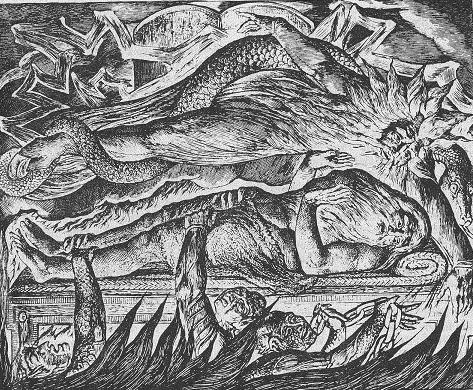
[Illustration: Yahweh Frightens Job with a Glimpse of Hell by William Blake. In this illustration of Job's dreams, being threatened by hellish flames and ominous clutching figures, Job's unconscious is bared open, leaving him faced with the primordial forces of nature.]
Dr. Van Dusen had been compiling information for some time on hallucinations through his patients' reports of the phenomena, but in 1972 he discovered that he could speak to the personalized hallucinations and receive replies. "I struck up a relationship with both the patient and the persons he saw and heard. I would question these other persons directly, and instructed the patient to give a word-for-word account of what the voices answered or what was seen. In this way I could hold long dialogues with a patient's hallucinations and record both my questions and their answers." (4) Van Dusen found that the experiences of his patients were similar to Swedenborg's reports of the spirit world in almost every particular. The voices fit almost completely into two categories, those of a lower order and those of a higher order.
The voices of the lower order were vile and like "drunken bums at a bar who like to tease and torment just for the fun of it." According to the higher order voices, the purpose of the lower order is to show the patient all his weaknesses. If the patient has a fear of his sexuality, then the lower order voices will make good of this and accuse and suggest to him all sorts of baseness and perversion. These lower voices predominated in Van Dusen's patients and comprised about 80 percent of the voices heard.
The higher voices were much more infrequent and often consisted of symbols rather than voices. They "communicated directly to the inner feeling of the patient." These voices were supportive and instructive in nature and sometimes gave the impression of a light or an angel. Often the patient did not understand the meaning of the higher voice's communications and asked Van Dusen what they meant. "In another instance the higher order appeared to a man as a lovely woman who entertained him while showing him thousands of symbols. Though the patient was a high-school educated gas-pipefitter, his female vision showed a knowledge of religion and myth far beyond the patient's comprehension. At the end of a very rich dialogue with her (the patient reporting her symbols and responses) the patient asked for just a clue as to what she and I were talking about." (5)
Van Dusen does not claim to know whether these voices should be classified as entities separate from the patient or as autonomous segments of his consciousness. The lower order voices sound a good deal like Colin Wilson's isolated fragments of "mind cancer" - constructed of portions of the psyche not come to terms with. The higher order voices present knowledge not consciously held by the patient and must be regarded as portions of the "superconscious" if not separate entities. Spirits separate from the psyche and the psyche itself may actually form a continuum. The question may not be a concrete one of "this or that."
Swedenborg writes, "From this order of creation it may appear, that such is the binding chain of connection from firsts to lasts that all things together make one, in which the prior cannot be separated from the posterior (just as a cause cannot be separated from its effect); and that thus the spiritual world cannot be separated from the natural, nor the natural world from the spiritual; thence neither the angelic heaven from the human race, nor the human race from the angelic heaven." (6)
Why some people are subject to voices and obsessions and others are not is open to a great deal of speculation. Occultists and thaumaturgists through the ages have recommended a moderate and chaste life as protection against entities, whether these entities be regarded as portions of the psyche or external existences. Celibacy is recommended for those dealing with the direct evocation of these forces - as in magical practices. Seemingly, an immoderate lifestyle has a dissociative effect on the psyche. It is possible that there is an archetypal morality built in the genetic structure of the human race, and those that attempt to deny the moral structure of the last 5,000 years are undermining their very psychological foundations. Twenty years ago a friend of mine asked the head of a sanitarium, "Just why do you think most of these people are in here?" The head of the sanitarium replied, "I'll tell you, if 75 percent of these people had kept their pants buttoned, they wouldn't be here!" Leslie Shepard, author of How to Protect Yourself Against Black Magic and Witchcraft, holds a similar point of view - recommending moderation in everyday life and celibacy while under a psychic attack.
I would like to postulate that there are personalized and autonomous portions of our own psyche and as well that there are extra-dimensional creatures that never were a portion of the human psyche. These entities exist in their own right as we exist in ours. The great physicist, Sir William Crookes, speculated on this possibility in the magazine Fortnightly. "It is not improbable that other sentient beings have organs of sense which do not respond to one or any of the rays to which our eyes are sensitive, but are able to appreciate other vibrations to which we are blind. Such beings would practically be living in a different world to our own. Imagine, for instance, what idea we should form of surrounding objects were we endowed with eyes not sensitive to the ordinary rays of light, but sensitive to vibrations concerned in electric and magnetic phenomena. Glass and crystal would be among the most opaque of bodies. Metals would be more or less transparent, and a telegraph wire through the air would look like a long narrow hole drilled through an impervious solid body. A dynamo in active work would resemble a conflagration, whilst a permanent magnet would realize the dream of medieval mystics, and become an everlasting lamp with no expenditure of energy or consumption of fuel."
Man lives simultaneously in two dimensions, his mental world within and the physical world without. Our external world is mapped and categorized while the mind is all but foreign territory to most of us. In exploring the interior realm of experience, one cannot be objectively scientific, for the things here can never be submitted to mathematical measurement. There is objective study here, but it is the objectivity of an open, honest and sincere mind directed towards finding truth regardless of bias. Modern psychology is averse to the subjective discoveries and methods of the shamans, witch doctors, occultists and priests of the past thousands of years. It may be that a wealth of hidden wisdom lies in the practices of these less "logical" minds. An open mind must be kept toward the spirit-hypotheses of our ancestors because, even today, our "neuroses" and "autonomous complexes" have no more substantiality than "devils" and "demons."

[Illustration: St. Anthony Tormented by the Demons (circa, 1480-90) by Martin Schongauer.]
Notes
Dream Dialogues
by David Gold
Editor's Note: Dream Dialogues will be a regular feature in future issues of TAT Journal. In order to facilitate its expressed purpose as a dialogue between the author and reader, you are invited to send In any personal dream experiences, as well as your insights into those experiences, which relate to this issue's column, or which you would like to see incorporated into some upcoming column.
Write to: Dream Dialogues - TAT Journal, P.O. Box 236, Bellaire, Ohio 43906.
Incubating the Answer
"Even a blind pig finds an acorn once in a while." This tidbit of homespun philosophy, besides being a slur on those fortunates who may occasionally get the better of us in a game of chance or a test of skill, can also describe that rare, near-miracle of discovering a unique bit of wisdom nestled in a cradle of confusion.
Such was my good fortune last week, while pondering weak and weary over volumes of forgotten lore known as the "Index to Current Psychological Abstracts." Beyond serving as self-mortification for unknown and uncountable transgressions, this exercise serves, when all else fails, to provide me with an idea for my writings. After some three hours of perusing such obscure pearls as "REM Sleep of Cattle" and "Moroccan Dream Imagery," I departed the library in disgust and despair. Only a deadline to complete this article could force me back to that desk one last time, to happily discover "Dream Incubation: A Reconstruction of a Ritual in Contemporary Form," by Henry Reed.
Mr. Reed, we are told in the short biography preceding his article in the Journal of Humanistic Psychology (Fall 1976), is a former psychology professor from Princeton University who departed academia to "follow the path of the turtle, wait upon the bear, and learn healing songs from stones." He is currently "at home in America with family and friends, where he thoroughly enjoys television, playing with watercolors, and making up stories about himself." Somehow, amidst this tumult of activity, he has found time to develop a fascinating and apparently successful method of receiving a "divinely inspired" dream.
Dreamy Answers
This idea may sound preposterous, but the process of receiving divine inspiration through the vehicle of dreams is firmly grounded in both history and religion. The Greeks built special dream temples in which individuals with illnesses or problems could go to sleep to receive a dream which would point the way to a physical or psychological healing. American Indians utilize the same concept, often in conjunction with the rite of passage into manhood; a young boy would go into the wilderness and fast and pray until he received the blessed dream. Placed within a psychological or philosophic framework, this process, which Reed refers to as "dream incubation," enables the dreamer to call upon the forces which lie within each of us to answer a deeply felt, but possibly unrecognized question.
I have previously written in the TAT Journal of using the self-posed question as a technique in serious dream work. Stated briefly, an individual asks himself a question prior to retiring, meditates upon the implications and possible answers to the question, and then records any recollected dreams the following morning. Continued efforts are often rewarded with fulfilling answers, supplied by some deeper part of ourselves.
I was, therefore, pleased and surprised to find Professor Reed utilizing this same principle of tapping the deepest resources of an individual in the modern form of the dream incubation ritual. He too believes that our inner selves will respond to a question properly framed and sincerely posed:
An incubation ritual is an externalization of a psychological fact - a projection mirroring a natural inner process of self-regulation, healing, or transformation. In other words, it is as if the incubant (dreamer) were able, by aligning him or herself with the symbolic structure of the ritual, to allow a certain inner condition to arise which cannot be produced directly.
Professor Reed apparently recognizes that while all of life's secrets may lie within, an individual must still get in touch with some force to help take him to those secrets. Techniques must be developed and utilized which can call out the God within, and his incubation ritual is planned accordingly.
Phrasing the Question...
One remarkable facet of Reed's incubation experience is that it combines the mystery and excitement of a mystical ritual with some long-accepted psychological and philosophic tenets. This unusual blend pervades the entire ritual experience, starting with the choice of the proper question to ask during the ritual.
This step is of critical importance, as the ritual will generally fail in its purpose if the proper question is not selected. Reed recommends the examination of prior dreams to uncover a theme which could possibly lend itself to divinely-inspired assistance, suggesting that potential incubators "spend some time thinking about their purpose for incubation, and see if their dreams concur by portraying in some form the problem they state for themselves." The dreamer thus lays the groundwork for the ritual dream by exploring his prior dreams in search of what ails him.
... And Preparing for the Answer
Once the question is chosen and properly phrased, the next logical step is to prepare for an answer. Reed recognizes that the secrets which lie within are not dislodged without effort, and has correspondingly built into the ritual a preparatory period designed to assist the incubator in stimulating that part of himself which knows the answer to his chosen question. This process includes contemplating the purpose of the incubation; choosing the personal symbols and revered benefactor; rendering the symbols into pictures; spending a period prior to the incubation ceremony in "symbolic purification."
The contemplation period consists of direct interaction between Reed and the incubator, during which time Reed attempts to assist the incubator in understanding the source of his problem, as well as the personal psychological barriers to its solution.
As you contemplate your purpose, it is crucial that you examine all the ways in which you may be possibly benefitting from your current situation or conflict. Search hard for such paradoxical benefits, and honestly consider your readiness to let go of those that may be incompatible with your purpose. If you can humbly accept your susceptibility to these sources of resistance, but you find yourself nevertheless willing to let go of their benefits, you may open yourself to other resources which may offer genuine possibilities for change.
Summon all the reasons you can about the desirability of fulfilling your purpose. Savor what you wish to accomplish. Consider how accomplishing your purpose will place you in greater harmony with life and your highest ideals. How have others been missing out on you and your special gifts because of your problem, and how will they be better served as you full your purpose? But be sure to realistically evaluate your readiness to make use of the fruits of your incubation so that you won't be hoping to profit by new possibilities that you can't actually implement. Perhaps the humble acceptance of your limitations may again be helpful in opening yourself to other resources.
Recognition of weaknesses, and the reasons for our attachment to those weaknesses, a strong drive to overcome these shortcomings coupled with a realistic understanding of our personal limitations, all are ideas which can be bandied about the imagination and intellect of the incubator prior to the ritual to prepare the dreamer for an answer which he will both appreciate and comprehend. And this determined self-exploration is a powerful tool in stimulating the desire to change and finding the path necessary to achieve personal transformation.
The next two steps in the preparatory process, that of choosing the personal symbols of the sacred place and revered benefactor, and of rendering these symbols into pictures, are designed to assist the incubator in aligning himself with those higher powers which lie behind the incubation process. The ritual, while grounded in sound psychological theory, is nonetheless a potential mystical experience in the sense that divine forces are called upon to assist in finding the solution to the problem. The mood must be set and the forces beckoned; this is accomplished through the choice and expressions of the ritualistic symbols.
The symbol of the sacred place is chosen from the memory or imagination of the incubant, a special spot wherein the dreamer could experience both peace and power. The revered benefactor would be a person whose unusual wisdom and abilities could assist the dreamer in finding the answer to his incubation question. Pictures are made of the chosen place and person, and they, in turn, serve as both a reminder of the incubant's purpose and as an aid to the setting of the proper mood for the ceremony.
The final preparatory step of symbolic purification sets the stage for the incubation ceremony. Designed to place the incubator in a cleansed state and receptive mood, Reed stresses that any such process should be accepted as a positive affirmation rather than a deprival of some previously desired object. Fasting could therefore be mental instead of, or as well as, physical, such as the relinquishment of a negative emotional attitude or habit pattern. In addition to aiding the incubator in becoming a more fitting vessel for divine guidance, symbolic purification also expresses the determination of the incubator and thus focuses his attention and energy.
Ritual and Results
The preparatory period completed, Reed would conduct the actual incubation ceremony in the incubation tent. The ceremony begins with a period of preliminary questioning and discussion during which the incubator explores those dreams which originally posed the question he has chosen for incubation. This process generally consumes four to six hours. At this point the ceremony switches from intellectual diggings to "pre-sleep reverie," composed of relaxation techniques designed to help the incubator "let go and trust to inspiration." This segment completed, a cassette of classical music is played, and the incubant relays his stream of consciousness to Reed as he finally drifts off to sleep.
The intriguing aspect of Reed's results is that, not only are his incubants successful in the sense that they receive assistance of some type in their ritual dreams, but that the inspired dreams cover the gamut of personal experiences available to a seeker. Depending on both the type of question posed and the level of awareness of the incubator, the experience may range from an emotional catharsis to a mystical experience. One young man, bothered by extreme self-criticism, experienced a dream in which his father visited him and gave him the positive emotional support that was lacking during the son's development. This dream led to a subsequent meaningful dialogue between father and son in waking life, and a partial resolution of the son's need to fulfill his father's unreasonable demands. A fourteen-year-old boy dreamed of blazing a trail by himself, which in turn helped him find his path through the turbulent period of puberty. In the reported cases it appears that the incubant received assistance on the level that he most needed it.
In addition to gaining emotional and intellectual guidance from the ritual dream, some incubants experienced mystical "visions," often accompanied by voices and beams of light. One woman apparently had such an experience in which she was visited by a force which prepared her for death, and this dream helped her come to the realization that her existence was not dependent upon her physical body.
It therefore appears that, regardless of the question asked or the particular needs of the incubant, the ritual dream spoke to the incubant in a language and on a level that the incubant understood, and in such a manner that the incubant was motivated to work with greater determination towards his expressed goals.
Reed has developed a remarkable working experience designed to utilize the dream process for problem solving, as it has been used for centuries. For those of us who cannot take the trip with him, principles can be extracted from his work which can be applied to daily dream work. The sincerely asked question, based on prior dreams and a recognition of a current crisis, which can incubate in the mind of a purified and single-minded searcher, can elicit a meaningful response from the higher forces which lie within.
For those of you who are working with some dream questioning technique, or those of you who may be motivated to try, I would appreciated hearing from you care of the TAT Journal.
Dream Dots: Drugs and dreaming. Nearly everyone working with dreams will notice a change in the quality or quantity of their recollected dream experiences when their external environment is changed. Camping out or staying the night with friends or relatives will often induce a different type of dream, or possibly inhibit REM sleep almost entirely.
Changes in the internal environment of the body will also take a toll on dreaming sleep. Many who have taken medication for an illness or injury notice a change in dream phenomena during that period. Many individuals, however, ingest drugs on a regular basis and do not realize that these drugs are having an effect on their dreams and hence, restful sleep.
A series of articles in Experimental Medicine and Surgery explored the effects of certain drugs on sleep. Among the drugs found to inhibit dreaming sleep were: steroids; nembutal; alcohol; most barbiturates.
Strangely, Quaaludes, Librium, and caffeine had no appreciable effect on REM Sleep.
"Does the road wind up-hill all the way?"
"Yes to the very end."
"Will the day's journey take the whole long day?"
"From morn to night, my friend.
"I Died at 10:52 A.M."
by Victor D. Solow
When I left home with my wife last March 23 to go for a ten-minute jog, I did not know that I would be gone for two weeks. My trip was the one that all of us must make eventually, from which only a rare few return. In my case a series of events occurred so extraordinarily timed to allow my eventual survival that words like "luck" or "coincidence" no longer seem applicable.
It was a beautiful Saturday morning. We had jogged and were driving back home to Mamaroneck, N.Y., along the Boston Post Road. It was 10:52 a.m. I had just stopped at a red light, opposite a gas station. My long, strange trip was about to start, and I must now use my wife's words to describe what happened for the next few minutes:
"Victor turned to me and said, 'Oh, Lucy, I... Then, as swiftly as the expiration of a breath, he seemed simply to settle down in his seat with all his weight. His head remained erect, his eyes opened wide, like someone utterly astonished. I knew instantly he could no longer hear or see me.
Copyright Mrs. Victor D. Solow. Reprinted by permission. This article first appeared in the October, 1974 Reader's Digest.
"I pulled on the emergency brake, pleading with him to hang on, shouting for help. The light changed and traffic moved around my car. No one noticed me. My husband's color had now turned gray-green; his mouth hung open, but his eyes continued seemingly to view an astounding scene. I frantically tried to pull him to the other seat so I could drive him to the hospital. Then my cries for help attracted Frank Colangelo, proprietor of the gas station, who telephoned the police."
When Seconds Count
It was now 10:55 - three minutes had elapsed since my heart arrest. A first aid manual reads, "When breathing and heartbeat stop and are not artificially started, death is inevitable. Therefore, artificial resuscitation must be started immediately. Seconds count." Time was running out. In another 60 seconds my brain cells could start to die.
Now came the first of the coincidences: Before police headquarters could radio the emergency call, Officer James Donnellan, cruising along the Boston Post Road, arrived at the intersection where our car seemed stalled. Checking me for pulse, and respiration, and finding neither, he pulled me from the car with the help of Mr. Colangelo, and immediately started cardiopulmonary resuscitation.
In the meantime, the police alert had reached Officer Michael Sena, who chanced to be cruising just half a mile from the scene. He reached me in less than half a minute. From his car Sena yanked an oxygen tank and an apparatus with a mask which is used to force air into the lungs. Within seconds he had the mask over my face. Donnellan continued with heart massage. Sena later told me, "I was sure we were just going through the motions. I would have bet my job that you were gone."
Police headquarters also alerted the emergency rescue squad via a high-pitched radio signal on the small alert boxes all squad members carry on their belts. When his warning signal went off, Tom McCann, volunteer fireman and trained emergency medical technician, was conducting a fire inspection. He looked up and saw Officers Donnellan and Sena working on a "body" less than 50 yards away. McCann made the right connection and raced over, arriving just ten seconds after his alarm sounded.
"I tried the carotid pulse - you had no pulse," McCann later said. "There was no breathing. Your eyes were open, and your pupils were dilated - a bad sign!" Dilated pupils indicate that blood is not reaching the brain. It can mean that death has occurred.
It was 10:56. McCann, who weighs 270 pounds, began to give me a no-nonsense heart massage.
Perfect Timing
The strange coincidences continued. The emergency-squad warning beeper went off at the exact moment when Peter Brehmer, Ronald Capasso, Chip Rigano, and Richard and Paul Torpey were meeting at the firehouse to change shifts. A moment later and they would have left. The ambulance was right there. Everybody piled in. Manned by five trained first-aid technicians, the ambulance arrived three minutes later. It was 10:59.
When I was being moved into the ambulance, United Hospital in Port Chester, six miles distant, was radioed. The hospital called a "Code 99" over its loudspeaker system, signaling all available personnel into the Emergency Room. Here, an ideal combination of specialists was available: when I arrived, two internists, two surgeons, two technicians from the cardiology department, two respiratory therapists and four nurses were waiting. Dr. Harold Roth later said: "The patient at that point was dead by available standards. There was no measurable pulse, he was not breathing, and he appeared to have no vital signs whatever."
11:10 a.m. A cardiac monitor was attached; a tube supplying pure oxygen was placed in my wind-pipe; intravenous injections were started. An electric-shock apparatus was then attached to my chest.
11:14. The first electric shock was powerful enough to lift my body inches off the operating table. But there was no result; my heart still showed no activity.
11:15. A second electric shock was applied - a final try. Twenty-three minutes had elapsed since my heart had stopped. Now, excitement exploded around the operating table as an irregular heart rhythm suddenly showed on the monitor. To everyone's amazement, I sat bolt upright and started to get off the table. I had to be restrained.
"There... and Back"
Sometime later I was aware that my eyes were open. But I was still part of another world. It seemed that by chance I had been given this human body and it was difficult to wear. Dr. Roth later related: "I came to see you in the Coronary Care Unit. You were perfectly conscious. I asked how you felt, and your response was: 'I feel like I've been there and I've come back.' It was true: you were there and now you were back."
A hard time followed. I could not connect with the world around me. Was I really here now, or was it an illusion? Was that other condition of being I had just experienced the reality, or was that the illusion? I would lie there and observe my body with suspicion and amazement. It seemed to be doing things of its own volition and I was a visitor within. How strange to see my hand reach out for something. Eating, drinking, watching people had a dream-like, slow-motion quality as if seen through a veil.
During those first few days I was two people. My absent-mindedness and strange detachment gave the doctors pause. Perhaps the brain had been damaged after all. Their concern is reflected in hospital records: "Retrograde amnesia and difficulty with subsequent current events was recognized.... The neurologist felt prognosis was rather guarded regarding future good judgment... "
On the sixth day there was a sudden change. When I woke up, the world around me no longer seemed so peculiar. Some thing in me had decided to complete the return trip. From that day on, recovery was rapid. Eight days later I was discharged from the hospital.
Questions
Now family, friends and strangers began to ask what "death was like." Could I remember what had happened during those 23 minutes when heart and breathing stopped? I found that the experience could not easily be communicated.
Later, feeling and thinking my way back into the experience, I discovered why I could not make it a simple recital of events: when I left my body I also left all sensory tools behind with which we perceive the world we take for real. But I found that I now knew certain things about my place in this our world and my relationship to that other reality. My knowing was not through my brain but with another part of me which I cannot explain.
Transcendence
For me, the moment of transition from life to death - what else can one call it? - was easy. There was no time for fear, pain or thought. There was no chance "to see my whole life before me," as others have related. The last impression I can recall lasted a brief instant. I was moving at high speed toward a net of great luminosity. The strands and knots where the luminous lines intersected were vibrating with a tremendous cold energy. The grid appeared as a barrier that would prevent further travel. I did not want to move through the grid. For a brief moment my speed appeared to slow down. Then I was in the grid. The instant I made contact with it, the vibrant luminosity increased to a blinding intensity which drained, absorbed and transformed me at the same time. There was no pain. The sensation was neither pleasant nor unpleasant but completely consuming. The nature of everything had changed. Words only vaguely approximate the experience from this instant on.
The grid was like a transformer, an energy converter transporting me through form and into formlessness, beyond time and space. Now I was not in a place, nor even in a dimension, but rather in a condition of being. This new "I" was not the I which I knew, but rather a distilled essence of it, yet something vaguely familiar, something I had always known buried under a superstructure of personal fears, hopes, wants and needs. This "I" had no connection to ego. It was final, unchangeable, indivisible, indestructible pure spirit. While completely unique and individual as a fingerprint, "I" was, at the same time, part of some infinite, harmonious and ordered whole. I had been there before.
The condition "I" was in was pervaded by a sense of great stillness and deep quiet. Yet there was also a sense of something momentous about to be revealed, a further change. But there is nothing further to tell except of my sudden return to the operating table.
I would like to repeat that these experiences outside the dimensions of our known reality did not "happen" as if I were on some sort of a voyage I could recollect. Rather, I discovered them afterward, rooted in my consciousness as a kind of unquestionable knowing. Being of a somewhat skeptical turn of mind, I am willing to grant the possibility that this is a leftover of some subtle form of brain damage. I know, however, that since my return from that other condition of being, many of my attitudes toward our world have changed and continue to change, almost by themselves. A recurrent nostalgia remains for that other reality, that condition of indescribable stillness and quiet where the "I" is part of a harmonious whole. The memory softens the old drives for possession, approval and success.
Postscript:
I have just returned from a pleasant, slow, mile-and-a-half jog. I am sitting in our garden writing. Overhead a huge dogwood moves gently in a mild southerly breeze. Two small children, holding hands, walk down the street absorbed in their own world. I am glad I am here and now. But I know that this marvelous place of sun and wind, flowers, children and lovers, this murderous place of evil, ugliness and pain, is only one of many realities through which I must travel to distant and unknown destinations. For the time being I belong to the world and it belongs to me.
Shall we only trust what the ear can hear,
What the hand can grasp and the eye make clear,
Shall the dearest hopes of the human heart
In our inmost being have no part,
Because we fail to understand
The movement of an Unseen Hand?
Yoga: Hatha, Shabd, and Raja
by Richard Rose
There is something both magical and absurd about yoga, ingredients we find in all spiritual work; but then we find something absurd only and not in any degree magical, about the simple calisthenics which westerners perform for reasons of health.
I can remember my own reactions to yoga, forty years ago when I first encountered a few books on the subject. In those days the public libraries kept very few volumes on yoga, or any non-Christian books that pointed toward "pagan" influences.
I think my first book was one by Yeats-Brown. He talked mainly of the lotus posture, and of standing on his head. Every child wants to stand on his head at some time or another, so that the thought of an adult wishing to stand on his head might appear to most as being an unconscious return to childhood. And most of us would like to find an exercise in magic that is simple and effortless, or nearly effortless.
I later obtained books on yoga which contained more details. I found many postures and mudras in these books, and found that a whole way of life was connected with the word yoga, which involved vegetarianism, body-cleansing and celibacy. I must admit that I never tackled all of the yogic positions, and some of the body-cleansing routines—such as the rectal inhalation of water and the swallowing and reclaiming of yards of gauze—had no meaning for me. I did learn to sit in the lotus posture because it was a comfortable position for prolonged meditation, and I was able to stand on my head for a half hour at a time. I have no logical reason for the head stands. It may have been because of some subconscious, childish urge, but I prefer to believe that I was trying to experiment with the posture in order to measure its benefits.
As my reading progressed, I discovered that there existed another form of yoga called raja yoga. It was the yoga of the mind, and this form appealed to me. I sensed or rationalized, that I was not cut out for years of squatting and concentrating upon the body and its well-being. I wanted to go directly to the problem of ultimate survival, if such existed, and I felt that statistics left little hope for any ultimate survival for the body, even though its "chakras" might be developed, and its muscles and tendons were disciplined.
We cannot help but note that hatha yoga is widely practiced while raja yoga is not so well known. I encountered one of the first books that Paul Brunton wrote on the subject of yoga, and was overjoyed to find that he paid hardly any attention to hatha yoga, but went right to the root of things, namely the place that yoga has in regard to contemplation and higher realization.
However, I think that I know the reason for the wide interest in hatha yoga, both in India and in this country. When a person first approaches the "mysteries" or the psychic sciences, his first inclination is to plunge into a study that will link the physical body to the soul, or to physical immortality.
We are reluctant to admit at first that the body just cannot be saved, or extended forever. And when we find that no magic in India or Tibet will enable us to live forever, or even for two hundred years, our scientific minds must turn to the next best thing, which is the discovery, of that part of us which we might call a soul, and from there check our chances for spiritual security.
But once again our enquiry tends to be scientific and mundane—at least in the beginning. I remember that I went into Spiritualism while still in my teens, hoping to establish contact with the dead.
I wanted to talk to the dead to find first-hand, testimonial proof from the best authorities on death. I think everyone wants to determine the contact point between the mundane body and a being (the soul) which may have no form. We wish to see with our eyes and feel with our hands, if possible, like St. Thomas. We might not realize it at the time when we venture into hatha yoga or Spiritualism, but we are trying to use our body, and material associations, as points of reference.
It only occurs to us later that we might attain some point of essence-awareness, and then use that as a point of reference to reappraise this physical dimension.
In India, there is a prevailing mood to accept the soul as defined by teachers and ancestors, rather than define it personally, or try to reach a consciousness of it. So that the Indian student of hatha yoga does not talk too much about a soul. And the teachers of raja yoga do not try to locate it as much as to hint that it is "that which is." Everything else is either illusory or secondary.
There is a vast nether land between elementary hatha yoga and the most profound forms of raja yoga. Hatha yoga, we find, is not all gymnastics. It also involves the kundalini, and the chakras. And the training of the kundalini is supposed to lead the seeker to a raja yoga state. And simultaneously with mental yoga we find many a "master" following hatha yoga postures, and perhaps performing witnessable miracles in this medium of maya and illusion.
The chakras are said to be spiritual centers, not just ganglia. The kundalini is a veritable serpent of power, and if it refers to the power of a particular gland (gonad), you will pick up such an inference only by the description of the rising serpent of sex-energy. Incidentally, I am inclined to believe that the serpent mentioned in Genesis is the same power of sex, which can obviously be misused, indicating that when it is misused it must be crushed. Charles Fillmore, in his book, The Twelve Powers of Man, finds pretty much the same message in the tale of the paradisical apple.
Next we hear of a spiritual nectar that somehow leaks out of the brain to the detriment of the soul. Paul Brunton, in A Search in Secret India, interviews a yogi by the name of Brama, who tells him that there is a tiny hole in the brain where the soul resides, and that part of the vital life force rises from the bottom of the spine and moves up toward the soul's abode. This rising energy is the equivalent of kundalini. Brama stated that if a yogi were able to bring this vital energy up through a valve in the bottom of the soul's resting place, then that yogi might conquer death, or prolong his life indefinitely. We see in these statements that this yogi places great credence in the concept that the contact point of body and soul has been located, and the tempting concepts about physical immortality preclude any doubts or enquiry about the soul's proof of existence.
Paul Brunton asks the young yogi if there is not a finer form of yoga than hatha yoga, and Brama agrees that his form of hatha yoga is but a prelude to the yoga of mind-control.
Brunton moves on politely. We find in the next interview some of the most profound statements on mind-yoga, statements which I paid little attention to when I read them thirty years ago, because I did not have a sufficient understanding of the goal of raja yoga, and consequently could not see the wisdom in the replies which came from the "Sage who never speaks."
Brunton had made a clumsy appeal for enlightenment through verbal exchange. The Sage replied, "You have thought yourself into your present ignorance; now think yourself back into wisdom, which is the same as self-understanding. Thought is like a bullock cart which carries a man into the darkness of a mountain tunnel. Turn it backwards and you will be carried back to the light again."
Ten years ago, having forgotten all about reading Brunton, I came to the conclusion that man must reverse the processes that led him into his ignorance or confusion. We are reminded of the Cave of Shadows in Plato's Republic, in which the seeker has his back to the real light. And at that time I wrote of the reversal of the vector of man in order to reach his source, and the implementation of direct mentation instead of logic and scholastic wisdom.
Back in 1934 when the book was published, Brunton was practically the sole American source for information of any worth about Indian, spiritual movements. He could have easily filled in his experiences with some interesting fiction and we would never have known the difference. To the contrary, I find him very honest and correct, but I could not say this about him until the 'fifties, when I encountered teachers from some of the groups he visited for the writing of this single book.
In the early 'fifties I was initiated into a sect whose roots go back to Agra and Dayalbagh. When I joined them, I had forgotten all about Brunton's Search in Secret India. Now, many years later, I pick up the book again and am amazed to see that it was all there, and had been there for the ten years that elapsed between my reading it and the opportunity for joining the sect and getting first-hand information.
The sect in question was the Radha Soami sect, and the chief guru at that time was Charan Singh. With them, I encountered the term "shabd yoga" for the first time. This is the yoga of listening. The theme behind it might be said to be the development of the hearing faculty until the person can distinguish the sounds or music of higher planes. (Once again we find the searcher looking for a body-contact-point, with another dimension.)
I think that the reason Brunton's account in Chapter 13 did not register more indelibly in my mind at the time was my unfamiliarity with shabd-yoga then, and also my lack of interest in the conversation recorded by Brunton which he had with Sahab Maharaj on the subject on the economy of India and Dayalbagh in particular.
I have always been of the conviction that the politics and economy of our environment cannot interfere with the energy needed to untie the Gordian knot of ignorance on spiritual matters. Later, of course, I was to learn that hunger and oppression are conditions under which any form of spiritual work is negated or lessened.
I can see now that Brunton was impressed by the poverty of India, perhaps even sorrowed by it. I would not have picked this up about him if I had not paid a visit to Cairo. My first impression of Cairo was that of a place which I should leave immediately, if I wanted to get out of it alive and uncontaminated. However, the longer I stayed there, the more I grew to love the poor people. I worried my guides and the hotel clerks with questions about poverty, and with suggestions. I only talked about philosophy to the residents once. This happened at the temple of Luxor, when a large group of students approached me and asked me for my ideas about God. I found more purpose to passing out pencils to the children, and in giving piasters to very plain looking women who sat in the dust with their children, trying to sell little packets of spices.
In regard to the shabd-yoga sect, I later found that about the time of Sahab Maharaj there was a schism in the Radha Soami sect. I was initiated into the other branch. Both branches claimed to be the real heir to the line that began with Soamiji Maharaj, or Soami Shiv Dayal, in 1861. These branches were known as the Dayal Bagh, and the Soami Bagh. Schisms occurred if a guru failed to leave a legal heir to his property and the ashram. And it is evident that the desire to inherit may have been greater for some than the desire to perpetuate a true system.
Of course the high point in A Search In Secret India is Brunton's meeting with the Maharishi of Arunachala, also known as Ramana Maharshi. Two chapters are devoted to his association with Ramana, and yet as the years passed I carried little with me from the reading until I had an experience of my own. When this occurred, I looked about for words to describe the strange trauma I endured and the even stranger realization which followed the trauma.
And oddly enough, I encountered a small tract by Ramana Maharshi, or by one of his disciples, and in it he described not only the experience but in simple symbology explained the difference between lesser and major illumination. (This is his likening of Kevala Samadhi to a bucket lowered into a well, and that of Sahaji Samadhi as being the river that flows into the ocean and returns no more.)
In Ramana's camera-analogy he gives, in a capsule, the method of finding self-knowledge. Indirectly, I have Brunton to thank for all of this. I am sure that hundreds of thousands of people have read Paul Brunton's books, but I doubt if he ever became wealthy from his writings, because his audience would have been a slow trickle. That which made his contribution worthwhile, was that that trickle has lasted for forty years, and it may grow stronger.
I find a thread of honesty in Brunton's books, and this thread will secure his fame. Occasionally he found that previous assessments were incomplete, and he did not hesitate to admit that his previous enthusiasm led to hasty praise. So that he remains valid, and is a unique authority on a subject that is difficult to appraise, much less master.
Available from TAT Book Service: By Paul Brunton
Saturn: A New Look At Its Significance In Natal Astrology
by Patrick N. Hodge
Today our topic of discussion is Saturn and its meaning in the natal horoscope or birth chart. As a prelude to such a discussion, it might be helpful to develop a brief understanding of what true astrology is in the late twentieth century. In recent years, many people have been asking, "Is there more to astrology than I read in the newspapers?" "Am I more than just a Sun Sign, e.g. a Taurus or a Leo, for example?" and "Is there a valid basis for astrology, either scientific or metaphysical?" The answer to all these questions is emphatically "YES."
Patrick N. Hodge is on the Board of Directors of the Pittsburgh, Pennsylvania branch of The Theosophical Society. This article is a transcript of a lecture that he gave there. Mr. Hodge welcomes inquiries and comments.
c/o The Theosophical Society,
628 Smithfield St.,
Pittsburgh PA 15222.
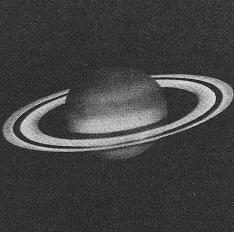
Astrology is a system of philosophical thought. As do most philosophical and religious systems, astrology has a dual nature: an "outer temple" or exoteric teaching and an "inner temple" or esoteric teaching. Sun Sign astrology, with its daily newspaper readings designed for the general populace, is indicative of the former. The "inner temple" of astrology, however, holds a comprehensive body of knowledge based on the past 6000 years of experimentation, observation and human intuition. The essence of this esoteric astrology is put forth clearly in one of the occult laws of nature, the Law of Correspondences - "As Above, So Below." This law implies that the macrocosm or the Universe is reflected in the microcosm or Man on Earth. The cyclic patterns of Nature are apparent all around us. The planets, and to a lesser degree, the fixed stars, can be viewed as a cosmic time-keeping mechanism. Study of astrology, in light of Man's own cyclic evolution, can help to point the way to individual and collective purpose in the Cosmos. The Sun, Moon, and planets, as a set of distant, mysterious forces that control the destiny of Mankind in some preordained fashion, will someday become unacceptable to Man's ever-expanding consciousness.
Present-day astrology has several departments or specialized areas of study. These are Medical, Meteorological, Electional, Horary, and Mundane to name a few. Perhaps the most well-known area is that of natal astrology which is, in part, the topic of our discussion today. Natal astrology can be defined as the construction and interpretation of the natal horoscope or birth chart of a specific individual (called the native). It is calculated for the exact hour, date, and location of the native's birth. Such a birth chart not only represents the elements of personality as we know it, but more importantly, it is a map of the individual's potential for evolutionary growth, on all planes, during the present incarnational cycle. Currently, many noted and upcoming astrologers are taking a holistic and humanistic approach to the natal horoscope in preference to the superficial "fortune-telling" and "character-analysis" so prevalent in earlier years. Natal astrology, when viewed in both its outer and inner trappings, can be seen as a practical tool for greater self-awareness and as a spiritual path toward the understanding of Mankind's common relationship with the Higher Powers of the Universe. Saturn, as Tempter and Teacher, should provide us with an interesting albeit sometimes unpleasant example of the potential for self-realization and soul growth that is depicted in every natal horoscope.
Before moving on to the psychological and symbolic meanings of Saturn, let us briefly examine the physical planet itself. Saturn has a diameter of 75,000 miles and is the second largest planet in the system. With a mean distance of 886 million miles from the Sun, Saturn was the outermost of the seven planets or "wanderers" known to the ancients. Saturn is composed of frozen gasses, giving it the lowest density of any of the planets - about thirteen percent that of the Earth. The feature of Saturn most of us are familiar with is its system of rings: a possible cause was the demolition of one of Saturn's moons by the powerful gravitational pull of the planet, or the rings may have been formed from its own material when Saturn contracted into a globe. Regardless of their origin the rings, combined with Saturn's ten moons, make an extraordinary view for those with powerful telescopes. (1)
Astrologically, Saturn is the ruler of Capricorn and the co-ruler of Aquarius. Its natural domain is the tenth house which is concerned with public image, social contributions, profession and parents. In traditional astrology Saturn has been termed a malefic or evil planet thought to bring only limitation, frustration, pain, and death. Even Saturn's virtues, self-control, tact, thrift, and caution were not felt to be very inspiring. Fortunately this rather superficial and one-sided interpretation is slowly subsiding. We see around us everyday the inherent duality in nature. Nothing is all good nor all bad. The Chinese symbol of Yin-Yang clearly illustrates this quality, showing that within the dark there is a little light, and vice versa. Within this context, the dualistic nature of Saturn can be appreciated. In his positive or harmonious nature, his traits include helpful limitations, understanding of structure, self-discipline, and common sense. In his negative or inharmonious nature, Saturn's traits can include needless restraints, too much calculation, a certain "tightness" and a lack of human feelings. The inadequacy of terms such as "malefic" and "benefic" becomes apparent when one realizes Man's constant drive toward psychic and spiritual wholeness.
A study of Saturn's symbol or glyph may offer us some understanding of Saturn's true meaning. The glyph [above] is composed of two other symbols: the cross of matter ... over the semi-circle of soul .... This implies that through outer adversity, one gains inner fulfillment. I quote from Alan Oken in The Horoscope, the Road and its Travelers.
"(Thus) it can be seen that it is through the lessons of Saturn that Man is taught how to harmonize his imagination (the semicircle) with the immediate circumstances of his life (the cross). Saturn's rays relate to the Earth. They demand that one pass through the tests of material existence before being allowed to enter into the realm of the Soul and the resultant exalted state of consciousness." (2)
By now some of the deeper psychological significance of Saturn should become apparent. The well-known story of Beauty and the Beast serves as an excellent example of Saturn's inner nature. Liz Greene states in the introduction to her book, Saturn, that:
"Saturn is connected with the educational value of pain and with the difference between external values - those which we acquire from others - and internal values - those which we have worked to discover within ourselves. Saturn's role as the Beast is a necessary aspect of his meaning, for as the fairytale tells us, it is only when the Beast is loved for his own sake that he can be freed from the spell and become the Prince.
"The frustrating experiences which are connected with Saturn are obviously necessary as they are educational in a practical as well as a psychological sense. Whether we use psychological or esoteric terminology, the basic fact remains the same: human beings do not earn free will except through self-discovery, and they do not attempt self-discovery until things become so painful that they have no other choice." (3)
As depressing as this may seem, we are reminded that "a most ancient and persistent of teachings... tells us that Saturn is the Dweller at the Threshold, the keeper of the keys to the gate, and that it is through him alone that we may gain eventual freedom through self-understanding." (4) With this concept in mind, Saturn's psychological function can be seen also as a "bridge" between the fast-moving personal planets and the slower-moving transpersonal or collective planets and principles.
We are now prepared to look at Saturn's meaning and function in the birth chart. By his sign and house position Saturn denotes those areas of life in which the individual is likely to feel thwarted in his self-expression, where he is most likely to be frustrated or meet with difficulties. The following meanings are capsulizations taken mainly from Liz Green's book Saturn. (5) They are given in groups of three by common element i.e. water, earth, air, and fire to emphasize a relationship and continuity within each group or triplicity. We begin with the watery signs of Cancer in the fourth house, Scorpio in the eighth house and Pisces in the twelfth house, all of which are directly concerned with emotion and with motivations which lie below the surface of consciousness.
Saturn In Cancer and the fourth house: This placement often indicates difficulty within the domestic sphere, and especially with the father. A definite feeling of being unloved, unwanted is common here. There is also a compulsion to accumulate land in an attempt to gain security that is missing on an emotional level. Often with this placement an imbalance also exists between the masculine and feminine sides of the native's nature.
Saturn In Scorpio and the eighth house: The eighth house deals primarily with physical death, sex and other people's resources. It is a house of transition from the personal, isolated to the larger, collective sphere of life and as such Saturn here deals with a blockage of emotional exchange in the areas indicated in this house.
Saturn in Pisces and the twelfth house: All emotional strivings culminate in Pisces as a unity not with another person but with life itself. Saturn here often generates a vague feeling that someone or something, a misty or generalized fate or destiny, is going to destroy or control the individual. The sacrifice of material ambitions is often concurrent with a twelfth house Saturn, as seen in the example of a child who dedicates his life to the care of an ailing or helpless parent at the cost of his own development.
Greene writes: "It is some help for the individual who has Saturn in a watery sign or house to recognize that his potential in terms of inner peace, understanding and wisdom is as great as his potential for despair if he will only turn inward to the realm of the feelings and of the unconscious."
Saturn In the earthy signs and houses: The element of earth is related to the material plane of existence and those areas of life in which tangible effects and results can be seen. As such, Saturn in earth will indicate problems and limitations which affect an individual's bodily comfort, his ability to support himself and find meaningful work and his potential to achieve responsibility or authority.
Saturn In Taurus and the second house: The simplest, most direct reading here is fear of poverty. This placement frequently accompanies a childhood spent in want, where the luxuries of material life, and sometimes even the necessities, are lacking. Saturn has the tendency to overcompensate in opposite directions in the second house, whether through greed and avarice or just as commonly through the denial of all involvement with material things.
Saturn In Virgo and the sixth house: Work, health and employer-employee relationships are the traditional meanings assigned to this house and Saturn placed here seems to provide an opportunity - often through frustration and disappointment in jobs, and ill health - for a journey into the mysteries of the inter-connections between mind and body. This is emphasized by the sixth house's position as a transitional, crisis-filled house.
Saturn In Capricorn and the tenth home: Here Saturn is in its own domain and its manifestations are more "purely" expressed in mundane areas such as social image and profession. Saturn in the tenth generally symbolizes ambition with a slow climb to power. Also indicated is the individual's mother as the dominant parent. Inordinate importance on one's own importance accompanies a tenth-house Saturn although professional success is often achieved in the long run.
Saturn In the airy signs and houses: All three airy signs and houses deal with some aspect of mind and the human need to exchange information with others and with the environment.
Saturn in Gemini and the third house: The third house symbolizes the sphere of the intellectual, of education, communication and movement. Saturn in this placement tends to block the flow of easy communication and often produces a fear of that which is new, unexplored and irrational. Speech defects and difficulties also occur frequently with Saturn in the third house. That knowledge must be acquired through experience and personal observation and that the training must be taken from life itself is strongly suggested by a Gemini or third house Saturn.
Saturn in Libra and the seventh house: The seventh house is traditionally that of marriage and the marriage partner as well as that of open enemies. The most basic interpretation of Saturn in the seventh house is sorrow, difficulty, or constriction in marriage or other close relationships. Isolation or aloneness is a common sort of restriction here. The opportunity Saturn offers in this position is for an inner integration or balancing of opposites, for it is unlikely that the individual will find the qualities he seeks happily expressed by a partner.
Saturn in Aquarius and the eleventh house: Clubs, societies, social values and ideas are the areas of concern here. Saturn in the eleventh often displays his usual aloofness and isolation, thereby marking the individual as a "lone wolf," one who somehow does not fit into the group. As Saturn disdains superficiality, his presence in Aquarius or the eleventh house is made doubly difficult because the nature of our present ideas about friendship and group activities can be eminently superficial. The opportunity offered by Saturn in the eleventh, is the understanding, through inner search, of the psychology of the group and its place in the great "plan" for man.
Saturn in the fiery signs and houses: The element of fire is related to the function of the intuition and is often linked with spirit, energy, and the initial source of life and consciousness. All three fiery signs tend to possess a uniate consciousness of their individuality and an intuitive perception of the worth of the self. Saturn in the fiery signs or houses tends to suggest a barrier between the conscious personality and the intuitive perception of the self as it ordinarily is experienced by fire.
Saturn in Aries and the first house: The first house is usually considered to describe the physical body of the individual and the personality with which he relates to his external environment, i.e. the way he sees the world and vice versa. A lack of self assertion of a positive kind appears to be one of the main qualities of Saturn in this position. Such an individual is often high in suspicion and low in self-confidence, and he looks out at others from behind an intangible but often very powerful barrier that effectively isolates him from the real impact of life. Saturn in the first house or in Aries can lead, through fear, to a search for self-identity which can help to yield greater knowledge, greater integration and the greater and more productive use of the will.
Saturn in Leo and the fifth house: Of concern in the fifth are pleasures and amusements, love affairs, children, and creativity and self-expression. It is through all of these activities that the individual begins to realize his own "selfness" When Saturn is in Leo or in the fifth house, there is a temporary barrier between the person and his self-realization and the creative flow is often blocked. Often concurrent with this placement is a reluctance or inability to have children, or the children may bring burdens, responsibilities, or pain. Saturn in the fifth seeks recognition more than love in the affectional sense; thus it is often associated with those in the entertainment professions. The challenge and opportunity offered by Saturn here is an active realization of the self, or the process of individuation, as Jung calls it.
Saturn in Sagittarius and the ninth house: The ninth house is concerned with long journeys (by both body and mind), religion, and philosophy and higher education. Saturn in this position tends to put an individual at odds with his religious feelings and/or aspirations, with a range varying from the compulsive agnostic or atheist to the religious zealot or disciple. Saturn in the ninth appears to be strongly linked with an early exposure to religious teachings of a dogmatic kind. A profound and penetrating mind is often indicated here. The individual will possibly find some very valuable answers; but he must find them himself without help. The opportunity which Saturn offers in the ninth house is a potential for direct intuitive perception, often through a type of peak experience or "mystic vision."
Our discussion of Saturn in the twelve signs and corresponding houses is meant to be a survey of key ideas to provide an area of focus; it is by no means complete or exhaustive. The concepts we have discussed are not compact and isolated within an individual's life but rather are completely interrelated with the energies and principles of the other planets and signs of the birth chart and even with other charts. This is true with astrological principles in general, hence, the renewed interest in the holistic approach to natal astrology.
A vast amount of information has been presented during this past hour. I wish to restate two essential ideas or viewpoints that I have attempted to demonstrate. If I have been successful, it can be seen that
Apparent limitation and hardship, when understood and overcome, yield the key to greater self-awareness and freedom.
Notes
African Mysticism and Possession
by Mary Dent
All of the major world religions have some type of mystical system to help their followers obtain a direct experience of religious truths. The Moslems have the Sufis, the Buddhists have the Zen monks, the Hindus have the Yogis, and the Christians have the example of several mystics. Although I had never heard of any systems for enlightenment which originated in Africa, I thought perhaps one might exist, clothed in some unfamiliar guise in some hidden corner of Kenya. The desire for self-transcendence and mystical illumination is a pervasive part of the human condition; traditional African religion has answered this need by developing the use of possession states.
The basic concepts and mythology of African religion are similar to those of other religions around the world. There are a thousand variations of this theme across the expanse of Africa, but the general scheme is the same as the story in Genesis: an omnipotent god creates the world through some magical process, and creates man to be the controller and caretaker of creation. Through some breach of faith - in some tribes intentional, in others, accidental - man separates himself from the creator and the world of paradise and takes up residence on the earth - a place of toil and hardship. Man's purpose in the world is to ensure the continuance of life and civilization, which he does through ritual observances. To the African, all of everyday life is infused with cosmic meaning; his entire world-view is an awareness of the divine acting in the world of man. We who live in the West, where the universe is seen as nothing more than so many molecules, might find it a small mystical experience in itself to truly perceive the way traditional African religion views reality.
The belief in the spirit realm plays a major role in this world-view. It is not the omnipotent creator-god who is called upon to help with the petty worries of everyday life, it is the local spirits - in most cases, the dead ancestors, who are still interested in the welfare of their families and tribe. Here in the West, when we think of "possession" the immediate association is that of possession "by a demon." However, the Africans generally do not view these spirits as inherently evil; rather, a spirit which is causing some unpleasant manifestation, such as sickness or insanity, may be "tamed" and turned to a useful purpose. The first order of business in curing an involuntary possession is to find out what the spirit wants and to comply with its wishes. In many cases the spirit asks for an animal sacrifice, and may even cause the possessed person to drink the fresh blood. If the spirit does not leave after receiving what is asked for, it may be driven out with exorcism rituals.
There is definitely a large area of possession practice which is by nature social rather than spiritual. For example: a person who has some disagreement with a superior may develop a possession attack and draw attention to himself through his sickness or wild behavior. Being possessed increases one's stature and importance in the community. During the course of the exorcism, the root of his problem is determined, as his entire social situation is examined. Those who are involved in any possible conflicts are constrained to set matters right, so that the possessing spirit may again rest. Thus, at least some possession behavior serves as a method of retaliation for the underdog. I.M. Lewis (1971) develops the idea that it is mostly women or socially disadvantaged men who are drawn to possession cults.
What is the spiritual value of the possession state? Naranjo (1971) outlines two "ways" to reach states of mystical experience. Disciplines such as Zen employ the technique of total introspection, of finding the True Self through complete detachment from the exterior world. This method is called the "negative way." Possession states, Naranjo claims, involve giving way completely to one's inner feelings, "losing one's self" through outward expressive movements. He calls this the "expressive way." In the expressive way, a method is used to bring about the detachment of the control and censorship we usually exercise over our thoughts and actions. Through losing one's ordinary sense of ego identity, new channels are opened for the expression of one's inner nature, and the communion with a higher power. This experience is valued as an ecstasy which renews and gives new meaning to everyday life. Dancing and chanting for long periods, plus a healthy dose of suggestion and expectation bring on a state of trance. The faculty of rational thought (the well-known barrier to spiritual illumination) is left far behind as the intellect is stilled through concentration upon the music and movements of the dance. Awareness is heightened, if through nothing else than the effect of the unusual physiological conditions imposed by energetically performed, repetitive movements which are carried on to the point of complete exhaustion.
African dancing bears a great similarity to Sufi dancing, and seems to serve the same purpose. Sufism, of course, is a many-faceted gem, and it would be a gross simplification to reduce all of Sufism to one technique of limited application. In general, the Sufi tries to achieve a state of union with Allah through the development of perfect devotion to him. Often Sufi writers will refer to Allah as "The Beloved One," in poetry which is full of imagery alluding to a very physical type of love. This type of devotion coupled with asceticism permits the building up of a tremendous amount of emotional power. When this power is unleashed, through such exercises as dancing, one of the possible outcomes is that personal illumination is achieved. Sometimes the Sufi aspirant will meditate upon a predecessor who attained great spiritual heights during his time. These perfected men are considered to be links between the world and Allah, in much the same sense as Christian saints or African ancestor spirits. The aspirant may attempt to become possessed by the venerated one, and to achieve annihilation of his own ego through dancing.
However desirable the effects of possession or illuminative experiences may be, there are possible negative effects from surrendering one's will. As Trimingham (1971) puts it: "There are mystic ways to other gods than God." One may go insane from such practices, or become the complete victim of a destructive spirit. Because of the very real dangers involved in the sudden loss of control, many Sufis use less dramatic but safer techniques for spiritual experience. The most desirable goal is to work on one's self until one may produce the ecstatic state on a more permanent level, without the dependence on any external actions.
The African people have recognized the same sort of dangers within their own religious system. They have found different means of handling the experience of possession. For one thing, they have shamans, who are trained specialists in the field. They are capable of controlling themselves and the possessing spirit, so that the good effects of this state may be enjoyed while the negative effects are minimized.
Also, the Africans have possession cults for the accommodation of those who are being possessed by undesirable entities for the first time. The shaman is an interesting character. Like any other man of the cloth, he receives his vocation as a calling. Possession by a particularly powerful spirit is often taken as a sign of shamanistic ability. Once he receives his calling, the shaman undergoes extensive training. He becomes capable of traveling through the spirit world at will, and makes friends with all manner of horrifying demons who help him in his various tasks. The shaman is called upon to cure the sick, find lost objects, to settle disputes, to bring good luck to the tribe, or handle any other problems which require divine intervention. Although the shaman may have some intriguing experiences, I do not consider him a mystic, nor does his knowledge have any universal spiritual value. His sole motivation is the role which he performs in society. He does not seek truth or illumination except as it applies to some specific social problem. (1961)
Parrinder (1961) goes into some detail in describing a certain cult, the purpose of which seems to be to provide a school for learning about the enhancement and control of the possession state for its own sake. Initiates into this school are either chosen by the priest and invited to attend, or else they volunteer after having experienced a spontaneous possession condition. After the devotees have entered the school, they go through a rigorous training that may last several years. During this time they are not permitted to see their families, although they are still supported by their relatives. Sexual relations are strictly forbidden at this time.
The school provides an atmosphere which can give support to the person who is opening himself up to possession states. Here, the African practice very closely parallels the Sufi practice for a safer entrancement. The ecstatic phenomena are given a place within a total context of spiritual development. The devotee must change himself so that he may contain and profit from his experience. The disciplined lifestyles of these schools resemble that of many types of spiritual communities.
The state of possession does not appear to lead to the ultimate mystical experience of enlightenment (nirvana). The African becomes possessed by gods who are part of his mythology, and though he may experience divinity through this state, the whole meaning and purpose of achieving ecstasy is to assure the continuation of life in the world. The Sufi is basically a seeker who is trying to change and perfect himself in order to reach an ultimate goal, while the African sees himself as established in a world where ultimate meaning is already apparent. The expressive way may send one into transports of ecstasy, but there are many dangers to be met during the journey. If the trip can be made safely, one may be rewarded by a glimpse into another state of being in the immortal world of the spirit.
Bibliography

The Waerland Health System
by Nancy Young
According to Are Waerland a "Conversion to Life" means a radical readjustment of the human way of life and its mental outlook. The three, main principles of a new life-building concept of medicine that reflect this readjustment are the foundations of Dr. Waerland's work. He states: "We do not have to deal with disease but with mistakes in living. 1. Eliminate the mistakes and the disease will disappear of its own accord. 2. We never cure a disease, only a sick body. 3. A sick body can only be cured by restoring its original biological rhythm of working and living." Waerland writes that it is senseless to remove the symptoms of disease while disregarding the actual disease producing factors in the life of civilized man. The Waerland health system as it is practiced in Sanatoria in Europe is an arrangement of the whole day, a balancing of what goes into the body, and what is eliminated.
Nancy Young has been a teacher for the Mr. Mt. Vernon School of Yoga in Alexandria, Virginia for seven years. She has a bachelor's degree in anthropology and has taken graduate courses in physiology and medical anthropology. The Waerland System is taught and used at summer "health and yoga vacations" at the School's Shiva Laya retreat near Lorton, Virginia.
Are Waerland was born in Finland in 1876. Soon after the turn of this century he founded "All Nordisk Folkhalsa" (Scandinavian People's Health), a movement of doctors and others in the health professions interested in Biological, Remedial and Preventive Medicine. Throughout Europe today there are medical doctors recommending to their patients Waerland changes in diets and way of living. Some are part of the staff of the Waerland Sanatoria or Health Homes in Germany, Sweden, Austria, Switzerland, Finland, England and Israel. These Sanatoria are for people who are actively ill, as well as whole families who might take their vacations at the Homes to partake of the food and services. A stay at a Health or Cure Home is a recognized part of medical practice in some of these countries. Even if used preventively the costs are paid by the national medical insurance. Dr. Waerland died in 1955. It is his wife, Ebba Waerland, who carries on his work. She has trained physicians in the Waerland principles and directs some of the Sanatoria in Scandinavia. Waerlandist publications, books and magazines are available in Europe, especially German language periodicals.
The Waerland approach to diet, cookery, and living was brought into our Yoga School by its founder Ruth Geier Connor. A native Bavarian she first heard of Are Waerland while studying at the First Yoga Institute of Germany in Heidelberg. A fellow student credited the Waerland way with turning his life completely around. He was an alcoholic whose liver had been in a severely deteriorated condition. One hospital stay saw him in a coma for four days, and he repeatedly suffered from delirium tremens. The man was still drinking when he went to a Sanatorium after having read a Waerland book. Gradually his bloodstream was purified by a raw juice fast and then the changeover to the Waerland diet. His liver, relieved of the burden of detoxifying excess alcohol, and an unhealthy diet, restored itself. Ruth was ill at the time. She had suffered from mismanagement in allopathic medicine, and was overweight. Constipation, colitis, kidney disorder, chronic anemia and esophagitis, were among the list of problems. Some Waerland publications started Ruth on a search for "a better way." Waerland food was available at a restaurant in Wiesbaden, and while camping in Switzerland at the J. Krishnamurti Talks she visited local Sanatoria, worked in their kitchens and found out first-hand about the Waerland way to health. The most famous case history in the Waerland writings is Madame Waerland herself. A complete description of her ailments, and the drastic change in her life to rid herself of many chronic dis-eases is chronicled in her book Rebuilding Health. The cures attributed to the change to the Are Waerland system are verified by medical doctors under whose care Madame Waerland had been for most of her life.
The Daily Programme
The daily programme is followed in Waerland Cure Homes or Sanatoria. From 1937-47, the standard diet outlined below was used in the treatment of all diseases. In 1947, the diet began to be adapted for specialized treatment. The goals are to rid the body of toxins, while at the same time supplying it with the fuel for regeneration.
The Waerland diet, ordinary or adapted, raises the hemoglobin count of the blood. The most effective weapon in the fight against disease according to the Waerlands is the juice fast of raw alkaline vegetables. The juice fast is the initial treatment for illness when under supervision in a Sanatorium, and is the first step in changing over to a Waerland diet. Debility is not a criterion for using the Waerland diet or program in part, or in its entirety. As a part of Biological Medicine, the Waerland System is also dedicated to prevention.
The day begins with the Waerland drink "Excelsior." Scrubbed, organically raised vegetables are used: potatoes with the peels left on, carrots, celery, or other left-over root vegetables or lettuce. Boil for a half hour with no salt. (White salt is never used in Waerland foods). Strain and to each 1 3/4 cup portion add 1 - 2 Tbs. each bran and linseed (flaxseed). Linseed is mucilaginous and helps heal any ulcerations in the digestive tract. It is also detoxifying, but bran should not be used if there are any ulcerations. A more concentrated beverage is made by cutting up the vegetables. Excelsior can be made the evening before and warmed up for a morning drink. Excelsior sets the tone in the mouth for the entire day. It tastes good and has a stimulating effect on the muscular action of the intestines. It is thought to be an ideal foundation for a working day, giving the body required alkaline mineral salts. The hours of elimination are early in the morning so there is no additional strain on the organs involved in ridding the body of wastes with the Excelsior. We are often somewhat dehydrated on waking and need some fluid. Yet the morning drink should not contain stimulants such as found in coffee and tea.
After the standard morning drink follows a head massage with the finger tips. This stimulates the hair follicles, and wakes up the scalp and brain. I make an addition from our Yoga classes: With the finger tips, tap firmly upwards starting at the base of the throat, to jaw, onto the face, being careful of the delicate tissue around the eyes. With the chin lowered tap all over the head and scalp. If a spot on the head or face feels as though it needs more tapping give it an extra moment's attention. All the time breathe rhythmically, loosening up tensions and stiffness. I usually do a few minutes of Yoga stretching and limbering exercises. Weather permitting, I roll open a window and take several deep breaths. Some neck and shoulder rolls, as well as bending over and stretching from the waist, are enough to get the muscles moving, but are not meant to take the place of a complete sadhana (workout).
Next comes a cold bath or shower. For those of us who cannot face this in a chilly bathroom, the Waerlands allow a cold sponge bath or rubdown. I fill the sink with cool water, and squirt into it a few drops of a natural shampoo, for its fragrance and mild cleansing properties. The cold bath or equivalent is followed by vigorous drying with a dry towel and then dry brushing. I use a loofa mitt, start at the feet and brush towards the heart. In his early work Are Waerland recommended stiff brushes. His wife reports that the Swedes use horse-grooming brushes. Cold baths and dry brushing develops the resistance of the skin to exterior forces such as cold. The skin can be classified as an organ of elimination. We are removing impurities on its surface so the skin can do its work more efficiently. This relieves the work-load of the liver and kidneys in detoxifying the bloodstream. As circulation to the surface of the skin is stimulated and dead cells sloughed off, the color and tone of the skin is improved.
The fourth step in the morning toilette is exercise. Each individual makes a program of well chosen movements. Exhausting calisthenics are not advised. For me the exercise is walking the family dog for about a mile. This fulfills the requirement of non-stressful exercise that gets the circulation going and oxygen into the blood. A morning's walk is specifically mentioned in Waerland literature. At breakfast time it is essential for the health seeker to help, not hinder work the body is doing in eliminating waste products. The burden of impurities are eliminated until almost noon. This work is interrupted by a large breakfast. The first meal of the day is a light one needing hardly any digestion. Sour milk or buttermilk meets these criteria as does a good quality yogurt or kefir. Four kinds of sour milk are used in Sweden including "long milk." Long milk is the sour milk product used in Waerland restaurants. It is a lactobacillus acidophilus culture prepared from the milk of cows grazing where Butterwort is plentiful. Starters can be found in some health food stores, and the thick milk is made without boiling or heating the milk. To yogurt or sour milk is added fresh unsprayed fruit in season. Grated apples, home-made lacto acidophilus yogurt, a sprinkling of wheat germ and a dab of raw honey would be typical of possible combinations, (of course, no white sugar).
Fresh fruit may be taken between meals as the only allowable snack, or late in the morning a glass of mineral water, diluted fruit juice of the season, warmed vegetable cooking water (alkaline) or a light herbal tea. These beverages could be used in the afternoon and evening as well. The teas, for instance, linden blossom, chamomile, elderberry leaf, or rosehip are sipped through the day and contribute to the 4 - 5 pints of fluid the body needs to replace excreted fluids.
The mid-day meal may be taken at night, and vegetable meal for lunch, but sufficient time must be allowed for preparing and eating meals leisurely. The main dish at the mid-day meal is one of grain, either Kruska or Molino. It is possible to serve Kruska with a tomato sauce; however, in his outline of the daily program, Waerland lists Kruska or Molino topped with fresh warm milk, and eaten with a compote of stewed dried (unsulphured) fruit, raisins, figs, prunes, or dried apples. This meal can have an addition of a slice of whole meal bread, butter, fresh slices onion and a mild cheese. This is appropriate for those doing heavy work. If you are watching calories cut down on the amount or number of items in the meal. Fresh raw sliced onion is a condiment to all the Waerland meals, not so much for its antibacterial properties as that the etheric oil of the onion stimulates salivation. Mild cheese served with the Waerland meals is Quark. It is white, and like a smooth cottage cheese. Ruth has found that a combination of sour cream, Ricotta cheese, and cottage cheese whipped together comes close to the texture and taste of Quark. The last meal of the day, 7 - 8 p.m. in Europe, is the famous vegetable platter, Rohkostplatte.
One small glass of vegetable juice is sipped as an aperitive to the meal. Basic to this alkaline dinner are potatoes steamed in their jackets. An alternative way of preparing potatoes is to slice them lengthwise, coat the exposed surface with linseed (or other pressed oil) and then dip them into caraway seed. They are baked, oil side down as this gives a brown crust. Raw, grated root vegetables are served: carrots, beets, celery root, parsnip. Cold pressed oil is poured on the raw vegetables at the table. (No vinegar or lemon juice). Herb salts or chopped fresh herbs are used as flavorings. The herbs are placed in small bowls at table, and are chosen from parsley, lovage or dill. The raw vegetables should be grated close to meal time to preserve the vitamin and mineral content. The remainder of the meal is made up, according to season and availability of dark green raw salad leaves, such as cress, lettuces, mustard greens, radish tops, if the radishes are young, nasturtium leaves or beet tops. In Spring add to the salad by gathering dandelion, plantain, violet leaves, new conifrey leaves, and fresh garden herbs. Sour milk is suitable for this meal, also Quark, whole meal bread and onion. I substitute green or scallion for raw white onion. Fruit must not be eaten with this meal but cooked lightly sweetened fruit makes a suitable dessert.
Do What You Can
What a full day! It may be best to try some of the Waerland recommendations while on retreat or vacation. I first tried the morning toilette while on Nantucket Island for a two week break. My morning chores were lessened by the number of adults in the household, and I took time for the exercise, sponge bath and dry brushing. I had as an option: dance class, Yoga in a walled garden, walking in unpolluted sea air, bicycle riding, or beach running for the exercise part. A five minute walk brought me to Main Street and a young woman's vegetable cart full of organic produce picked that dawn. These ideal conditions seem removed from busy lives in urban areas. Try a Rohkostplatte for a family meal. Even our teenagers enjoy it. When I am not rushing somewhere in the morning I give myself a gift of the morning part of a Waerland day. The complete Waerland approach is detailed in the books recommended. Unfortunately not very much is available in English. All the informative, interesting magazines and pamphlets, published on an ongoing basis, are in German, or other Central and Northern European languages. We would appreciate exchange with anyone who knows of Waerland work in this country. Are Waerland's approach to food and nutrition is just one of several that we teach to our students. Other vegetarian diets and cooking classes are part of our program. The unique aspect of the Waerlands is that meals are part of a whole attitude to living. They write that disease is a manifestation of disharmony. It is an organic unity of parts of the body, working in complete harmony, which constitutes true health. Healing means wholeness. Waerland foods are whole, the nutrition healing.
Recommended Readings
Jesus, on Whom be peace, has said: "Wonder at the things before you, for wonder is the beginning of knowledge."
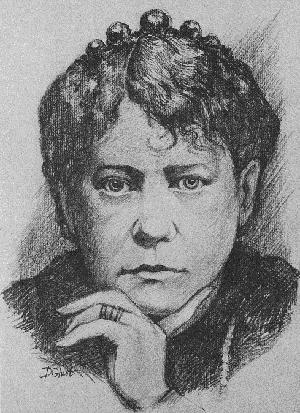
Profile: H. P. Blavatsky
The Strange Life of Madame Blavatsky
If anyone could be said to be at the hub of western occultism of the last one hundred years it would have to be Helena Blavatsky. Her voluminous works, especially The Secret Doctrine, are the most widely read and quoted occult documents in the western world. The Theosophical Society, of which she was co-founder and which truly rests on her works, has members and lodges in nearly every republic of the world. This woman, who has planted the seeds of so much occult interest and endeavor, is even today inscrutable.
Blavatsky's writings were profound and scholarly, but she was anything but a typical scholar. She was a woman of experience, and not of book-learning, yet she still poked holes in the experts' theories and through clairvoyance quoted books she had never seen. She wrote of holy and sacred things, but in her everyday life was anything but composed and saintly. Her intense personality was eccentric, impulsive, sometimes delightful and so powerful that she often produced a hypnotizing effect on those around her. Perhaps she was a freak of nature and her psychic talents were a gift, but she added what is necessary to gift and lived a life of constant endeavor. Her endeavor bred a full life and created heights of triumph and tragedy which few people dream of. Madame Blavatsky is still a psychological enigma to be solved today, and I will attempt to elucidate a bit of her life, not to "solve" and close the case once and for all, but to possibly provoke in the reader my own feelings of amazement concerning this wonderful woman.
Even Blavatsky's birth took place among confusing and calamitous occurences. She was born to a Russian aristocratic family, the Hahns, on August 12, 1831. There was a cholera epidemic in the area at the time and since it was feared the child would not live long, a priest was summoned immediately to baptize her. A clumsy servant boy at the ritual overturned a lamp that set the priest's copious robes ablaze, severely burning him and several others. This was an entirely fitting omen for the child's fiery life to come.
Her mother died when Blavatsky was still a child so she spent much of her childhood under the masculine influence of her military father's troops or at the massive estate of her maternal grandfather. She was an unusual child in unusual surroundings. Her sister writes of her early childhood, "... It was a fatal mistake to regard and treat her as they would any other child. Her restless and very nervous temperament, one that led her into the most unheard of, ungirlish mischief, her unaccountable (especially in those days) attraction to, and at the same time fear of, the dead, her passionate love and curiosity for everything unknown and mysterious, weird and fantastical, and most of all, her craving for independence and freedom of action - a craving that nothing and nobody could control, all this, combined with an exuberance of imagination and wonderful sensitiveness, ought to have warned her friends, that she was an exceptional creature, to be dealt with and controlled by means as exceptional." (1)
Most of her childhood was spent at her grandfather's large estate. Russia was still under a sort of liberal feudal system at the time and her grandfather's was a place directly from medieval times. The mansion had a labyrinth of abandoned passages and cellars beneath it, while in back of it was a dark virgin forest with "moss to your knees." Young Helena would spend hours alone in the mansion's cellars, claiming she was talking to her "hunchbacks." All this was very conducive to a child's imagination. With Helena it was like mixing phosphorous and water.
The child was an incessant sleepwalker and during the night would be found in the strangest of places. Many times there would be a search of several hours by her grandfather's servants only to find her in the attic mesmerizing pigeons, in some dark corner of the cellar, or even in the dark forest. Once she was found pacing the passageways of the cellar carrying on a conversation with someone seen by no one but her. On occasion she was found inexplicably behind several previously locked doors. Another frequent nocturnal hideaway was grandfather's zoological collection, where she would be found talking to the stuffed crocodiles and seals.
If anyone constrained the child's freedom in any manner they risked an explosive tantrum. (Indeed, nowadays she would probably receive some such label as "autistic.") Sister Vera relates, "The lightest contradiction brought an outburst of passion, often a fit of convulsions. Left alone with no one near her to impede her liberty of action, no hand to chain her down or stop her natural impulses, and thus arouse to fury her inherent combativeness, she would spend hours and days quietly whispering, as people thought, to herself, and narrating, with no one near her, in some dark corner, marvelous tales of travels in bright stars and other worlds." (2)
When she was a bit older and nearing Russian marrying age, her family put much pressure on her to attend parties and acquiesce to the normal social amenities for her age. She would have nothing of it, however, claiming contempt for society and the so called "world." Even though she was attractive, she still refused to have anything to do with men. She even refused to wear dresses, but preferred pants and mannish clothes. At sixteen her family demanded that she attend a dance and threatened to forcibly dress and take her if she refused. She revolted of course, and to insure that she would not have to attend the party, she actually lamed herself by holding her leg in a boiling kettle of water!
She involved herself in an aborted attempt at marriage when she was seventeen. Blavatsky was very liberal with facts concerning her own life but later almost absurdly claimed that this marriage was the result of a dare made by her governess. (The governess told Blavatsky that she could never get anyone to marry her!) The groom was Russian General Blavatsky who, according to different sources, was anywhere from forty to seventy-three years old. (Madame claimed he was seventy-three.) Regardless, the marriage only lasted three weeks when the poor General (who hadn't known what he'd gotten into!) was persuaded to ship her back to her father. Madame Blavatsky insisted that the marriage remained unconsummated, which is very possibly true, considering the Madame's abnormal temperament and that the General never claimed otherwise concerning this matter of honor.
While being sent back to her father, she "escaped," made friends with a steamship captain and secured passage to Constantinople. For the next ten years her family seldom heard from her. When she arrived at Constantinople she secured a job as a bareback rider in a circus and soon after suffered a severe fall from her horse. This accident resulted in the misplacing of her womb and thereafter, according to a doctor's report, made coitus impossible. Her comments years later were, "I am lacking something and the place is filled with some crooked cucumber." This is a peculiar aspect of Madame Blavatsky's character and life. She seemed to have a life-long abhorrence of anything sexual or of a baser nature. She described sexual attraction as "a beastly desire which should be starved into submission." Once in India when a prestigious Indian native introduced his ten-year-old wife she exploded, "You old beast, you ought to be ashamed of yourself." Again, found in her sketchbook was, "Woman finds her happiness in the acquisition of supernatural powers. Love is but a vile dream, a nightmare." Her celibacy and, if we are to believe her, life-long virginity may have been greatly responsible for her immense vitality and psychic powers. Vivekananda, the Raj-yogi, claims that sexual abstinence increases vitality and catalyzes psychic abilities. (3)
For years she traveled the world over, making valuable contacts, searching out occult teachers and seeing many wonders. She struck quite an impressive figure, with her recently acquired huge weight, outlandish clothes and the large black dog she often led on a gold chain. Her tremendous personality enabled her to persuade her way into many places that were closed to others and gain unique experiences.
It is difficult to adequately trace her during these years due to her own contradicting stories and also because of lack of concrete evidence from elsewhere. In 1850 she was in Egypt where she met her first occult teacher, an Egyptian Copt whom she later spent some time with in the early 1870's. She was in London in 1851 where she said she met her "Master." She had several visions of this man, a Hindu named Morya, since she was a child, but never saw him physically until this time in London. She was astonished when she first saw him in the street - this was the same man that kept popping up in dreams and visions! The man was among a group of others and when Blavatsky tried to approach him, he waved her away. Later, however, she met him again in a park and they had a long discussion about their peculiar relationship and Blavatsky's even more peculiar future. (4)
In 1852 Blavatsky tried to get into Tibet via Nepal but was turned back at the border. During her travels she tried three times to enter Tibet but was successful only once. Very few Europeans were allowed into Tibet, especially women, because of the wild gangs of robbers that roamed the hills and as well because of the "isolation consciousness" of the country. In 1855 she met a Tartar shaman in Indian and with his help, and disguised as a man, was able to get into Tibet. Blavatsky hoped to get deep into Tibet and locate the lamasery of Morya, the "Master" she met in London. The country became politically turbulent though, and she had to exit, barely escaping the Sepoy Rebellion of 1857.
She fled from Tibet to India and continued her search for occult teachers and yogis. She nearly died in an abandoned cave-temple she discovered which became filled with carbonic-acid gas. She relates this and other incidents of her explorations in a book, The Caves and Jungles of Hindustan.
It is hard to discern between Blavatsky's imagination and actual occurrences but some of her encounters related in Caves and Jungles are absolutely astonishing. She traveled with a Raj-yogi who was able to give a grand tour of the local occult wonders. He could also read Blavatsky's mind. In one incident, a member of the party, an artist, was going to paint the landscape at their campsite. To the amazement of all, he painted a completely different scene than that which was before them. The Raj-yogi had projected a scene into the artist's mind, a former scoffer of occult "trickery."
In 1858 Madame received word that her grandfather had died, provoking her to decide it was time for a trip home. Helena had changed a great deal since she was last home in Russia; among other things she had gained 100 pounds in weight. Her return home was joyful but proved unsettling for the whole household. Her sister Vera relates that, "We embraced each other, overcome with joy, forgetting for the moment the strangeness of the event. I took her at once to my room, and that very evening I was convinced that my sister had acquired strange powers. She was constantly surrounded, awake or asleep, with mysterious movements, strange sounds, little taps which came from all sides... all the persons living on the premises, with the household members, saw constantly, often in full noon-day, vague human shadows walking about the rooms... "
Some researchers came to investigate Blavatsky's abilities and for some reason she completely "dried up" for three days. Hardly were they out the door "then at the first command and look of Mme. Blavatsky, there came rushing at her through the air her tobacco pouch, her box of matches, her pocket handkerchief, or anything she asked for or was made to ask for. Then, as we were taking our seats, all the lights in the room were suddenly extinguished, both lamps and wax candles, as though a mighty rush of wind had swept through the whole apartment; and when a match was instantly struck, there was all the furniture - sofas, arm-chairs, tables, cupboards, and large sideboard - standing upsides down, as though turned over noiselessly by some invisible hands, and not an ornament of the fragile carved work nor, even a plate broken." (5)
Unusual phenomena like this manifested around Madame Blavatsky for the rest of her life and later caused much accusation of deceit or trickery. While this may have been the case occasionally, I am convinced she possessed some remarkable and unique powers. She attributed her powers to two types of processes and always vehemently denied that they were spiritualistic powers, or that she was a medium. "Spirits" were not involved. She referred to herself as a "mediator" and not a "medium." Sister Vera relates, "...mediumship proceeding, they say, from such a source, to draw from which my sister thinks it degrading to her human dignity."
One explanation of her powers was that she was a mediator between the human plane and the "elementals" or nature spirits and imps. These elementals also played curious tricks on Madame Blavatsky. Once when she did not come down to breakfast on time, someone went to check on her and found her still in bed - with her nightgown sewn to the mattress in such a way that she could not move! She also claimed that some of her powers were mental powers, that is, the same type of powers Raj-yogis have and not mediums. A difficult but intriguing book on this subject is H.P. Blavatsky, Tibet and Tulka by Geoffrey Barboka. Tulka is a term for Raj-yoga powers.
Being at home for a number of years must have starved Blavatsky's appetite for adventure because what she did next was to disguise herself as a man and fight under Garibaldi in the Italian Revolution. At the battle of Mentana she had her arm broken by a sword and received musket balls in the shoulder and leg. This all sounds very fantastic and one would think that it was something just "made up" by the Madame -except that Henry Olcott, co-founder of the Theosophical Society with Blavatsky, actually felt the two remaining musket balls and where her arm had been broken.
After recovering from battle wounds she found herself in the midst of another adventure that nearly took her life. She was traveling the Mediterranean Sea from Greece to Italy in a passenger ship that was also unscrupulously carrying a large amount of fireworks. An accident occurred and there was a horrible explosion of the ship. Of the 400 passengers on board, only 16 survived the catastrophe, Blavatsky miraculously among them. She describes a macabre scene of arms, legs and decapitated heads falling in the sea about her. The Greek Government offered free travel fare to anyone surviving the explosion and Madame used this to go to Egypt. She started a spiritualist circle there, with herself supposedly as the medium (a practice she came to deplore). She gave up this venture, however, when one of the sitters in her circle became possessed and accosted her at her breakfast table with a gun and the intention to shoot her. Madame pleaded with her insane accoster that she be able to finish her breakfast before she met her fate. This gave her the time to mesmerize the man and somehow send him screaming into the streets. Madame proved more than once that, to put it colloquially, she had a lot of "guts." As another example from this time she spent a night alone in Cheops' Pyramid, lying in the sarcophagus! She traveled to New York in 1873 and arrived penniless, her father having died leaving the family finances in chaos. She soon found work and moved into a women's tenement on Madison Avenue. With her appearance and personality she quickly established a local reputation. She was really quite an eccentric creature. Her huge weight, piercing azure eyes and the strange sack-like dresses she wore would make one immediately take notice and regard her more carefully. She also wore the furry head of an animal around her neck, from which she took tobacco and ceaselessly rolled cigarettes. She would "hold court" in the sitting room of the tenement, telling stories of her travels and relating occult wonders. Her neighbor in the building claimed Blavatsky often used hashish and urged her to try it - "Hashish multiplies one's life a thousandfold!" - and Blavatsky also claimed it revealed to her past incarnations.
Madame B. was still examining spiritualism and at the home of the famous mediums, the Eddy Brothers, met Henry S. Olcott. Olcott probably would be her most loyal friend over the coming years and it was with him that she was to found the Theosophical Society in 1875. Olcott was awed by Blavatsky's character and powers. Her clairvoyant perceptions of the sittings are very startling and I will include them here for their informative value. She writes, "With horror and disgust I often observed how a re-animated shadow of this kind separated itself from the inside of the medium; how, separating itself from his astral body and clad in someone else's vesture, it pretended to be someone's relation, causing the person to go into ecstasies and making people open wide their hearts and their embraces to these shadows they sincerely believed to be their dear fathers and brothers... If they saw, as I have often seen, a monstrous bodiless creature seizing hold of someone present at these spiritualistic séances. It wraps a man as if with a black shroud and slowly disappears in him as if drawn into his body by each of his living pores." Six years before she had been the assistant of probably the most powerful medium ever, D.D. Home. (In one instance, Home actually levitated out a third story window and back in another! (7))
The initial impulse for the starting of the Theosophical Society came at a lecture Blavatsky and Olcott attended on the Caballa. They became engrossed in the talk and Olcott passed a note to Blavatsky asking whether she thought it a good idea to start a Society to study these ideas. Blavatsky heartily agreed and within the next few weeks a charter and name were given to the Theosophical Society. It was to be basically a non-dogmatic foundation for the study and promulgation of occult and esoteric knowledge.
The Society's aims, though, were so general that none of the new members or centers knew what to do. It was, as author John Symonds puts it, "... like the Communist International without the Communist Manifesto." Blavatsky launched into the bulk of her literary career and began writing the massive, 1300 page Isis Unveiled. She worked from morning until night for two years to produce Isis. It had to be rewritten several times since Blavatsky barely knew English at the time. It was an outstanding success and the initial thousand copies sold out in ten days.
Her means of writing was unique to say the least. She was an amanuensis, that is, she did not write from her own material or knowledge. What she was to write would "come to her" and when she needed a reference she could "read it in the astral light." Olcott, who was her proof reader, writes, "To watch her at work was a rare and never to be forgotten experience. We sat at opposite ends of one big table usually, and I could see her every movement. Her pen would be flying over the page, when she would suddenly stop, look out into space with the vacant eye of a clairvoyant seer, shorten her vision as though to look at something held invisibly in the air before her, and begin copying on her paper what she saw. The quotation finished, her eyes would resume their natural expression, and she would go on writing until again stopped by a similar interruption." (8)
She herself was not always sure how or where she got her knowledge. "The only thing I know is, that now, when I am about to reach old age, I have become the storehouse for somebody else's knowledge." (9) "Before me pass pictures, ancient manuscripts, dates - all I have to do is to copy, and I write so easily that it is no labor at all, but the greatest pleasure." (10)
From her descriptions it seems that Blavatsky was able to read the "astral light" or "akashic records" that Eliphas Levi and other occultists talk about. This "astral light" is more or less the cosmic memory of nature and contains impressions of all that has ever happened, is happening, or will happen. Edgar Cayce is a more recent example of a person who could tap this cosmic memory in a trance state. This is an exceptional thing, but what is even more exceptional is that Blavatsky was able to do this consciously.
The Secret Doctrine And the Theosophical Society
Although officially the Theosophical Society has no dogma or belief requirements of members, earnest Theosophists are adherents of the philosophy presented in The Secret Doctrine. The Secret Doctrine was published in 1888 by Madame Blavatsky and is proposed to be dictation from Masters of Tibetan esoteric school. The philosophy presented therein is supposedly the ancient and original Theosophy from which all religions and mystical schools have sprouted as branches from a tree. The word "Theosophy" translates literally from Greek as "Divine Wisdom." As stated by H.P. Blavatsky in The Key to Theosophy the chief objects of the Theosophical Society are:
More specifically, as profoundly discussed in Blavatsky's Secret Doctrine, Theosophy maintains the origin of all that is and all individualities in a common source or Absolute principle, that man has a "seven-fold constitution" with seven layers or bodies in his total being, and that man has a subtle individuality which is immortal but that his earthly personality does not survive death. Blavatsky goes to great lengths in her 1500-page Secret Doctrine to prove that all the religions of ancient and modern times have stemmed from an archaic "Wisdom Religion" that is still possessed in its purity by her esoteric school in Tibet. The length and depth of her writing is quite scholarly and persuasive.
The Theosophical Society is still in existence today, over one hundred years after it was founded in 1875 by Blavatsky, Henry S. Olcott and William Q. Judge. A free lending library is available to members and the Society's Quest Books publishes many valuable esoteric and occult books.
For information about the Society, write:
The Theosophical Society in America,
P.O. Box 270,
Wheaton,
Illinois 60187.
Perhaps now a few words about Blavatasky's "Masters" or "Mahatmas." Supposedly these Masters were able to astrally "impress" or communicate to Blavatsky what she was to write in Isis Unveiled and later The Secret Doctrine. When I first became interested in Blavatsky's writings and the Theosophical Society, I thought of it as some sort of strange mess of esoteric philosophy and "bogus spooks." As I became more familiar with the literature I came to consider that there was possibly something more to the Mahatmas than met my previous expectations.
According to Blavatsky, the Mahatmas were physically bodied men who were residents of an ancient esoteric school in Tibet. These men, as a function of their school, had developed abilities which are commonly regarded as magical today. They were able to do such things as read minds, travel astrally, and astrally dictate to Blavatsky what she was to write in some of her books.
Through the years, many people have claimed to receive "inspired" messages from various "ascended masters" and the like. I do not wish to launch into a discussion of spiritualism here, but will express my opinion that virtually all of these "communications" prove to be shallow, pollyannic and of no true depth or philosophic importance. Most of these communications by automatic writing or trance states, I believe to be projections of the subconscious, or trickery by astral entities (the "angels of light" in the Bible). Blavatsky's writings and her "Masters" are of quite a different order. I was not convinced of this until I read the large published volume of letters from the "Mahatmas" to A.P. Sinnett, an early member of the Theosophical Society. These letters, The Mahatma Letters to A.P. Sinnett, indelibly impress one that real people or Masters of superior knowledge were in communication with Sinnett, Blavatsky, Olcott and the other early members of the Theosophical Society. An attempt was made by several of these Masters to make themselves publically known but failed due to a tremendous public attack on the Theosophical Society. The Masters then retreated from public view, downplayed their importance in the Theosophical Society and remained in contact with only a select few. Judging by the later fiascos revolving around Besant and Leadbeater, I doubt they remained in contact with the leaders of the Theosophical Society for very much longer. Madame was chosen by the Masters to promulgate their philosophies because her psychic make-up and abilities proved her to be "the best vehicle available for the last one hundred years." Although they often bemoaned her careless over-enthusiasm and unstable temperament, she became unreservedly affectionate and dedicated to them and their cause.
The newspapers were constantly accusing Blavatsky of some scandal or imposture. The press was secretly in awe of her, but since her character and psychic phenomena was almost too fantastic to be real, they were continually looking for something to "pin on her" and thus reveal her as a diabolical charlatan of some sort. The press was not all bad, some of it was just fanciful. The papers claimed, among other things, that she had traveled in a balloon, converted the Pope to spiritualism, dined with the King of the Sandwich Islands, foretold to the Pope Napoleon III's death and cured the Queen of Spain's facial warts. People were entirely unsure of what to make of her so she became the victim of all sorts of speculation and fancy.
Her proclivities were amazing. She still performed numerous psychic and "glamorous" tricks for her many callers. She ate irregularly, very much, and never took exercise - which of course caused her to grow huge. Her weight did not seem to perturb her much though, because she would constantly laugh at herself and even display to visitors the rolls of fat around her ankles and wrists! Always she was like an "exploding bomb" in her moments of anger. Olcott was often the butt of this anger and once during one of her profanity-filled tirades he helplessly supplicated, "What do you want me to do? Do you want me to commit suicide?" When she was once asked by someone she disliked to pass the butter at the table, she saltily quipped, "Here you are! Grease your soul to hell with it!" Her health was as eccentric as her character. She vacillated from explosive vitality to occasional death-like trances which had occurred since she was thirty. A doctor once pronounced her dead three times before she resuscitated each time. (11)
She left with Olcott in 1878 for India due to a decline in her popularity in the States - mostly from newspaper attacks and as well because of a scandalous account of her in a book by medium D.D. Home (her former employer). They were very successful in India for a time until Madame Blavatsky was again accused of some incidences of charlatanism. Most of the scandal centered around the "Mahatma letters" to Blavatsky and others. These letters would precipitate in unusual places, sometimes in the air or in a shrine at the Theosophical headquarters specially constructed for this purpose. Unfortunately it was also discovered that servants sometimes dropped them from cracks in the ceiling and that the shrine had a concealed door into Blavatsky's room. (12) If she did write many of these letters, they could still be validly from Masters - if she was an astral amanuensis. An investigation was made of the phenomenon by the British Society for Psychic Research and a 200 page report concluded, "For our own part, we regard her neither as the mouthpiece of hidden seers, nor as a mere vulgar adventuress; we think she has achieved a title to permanent remembrance as one of the most accomplished, ingenious and interesting imposters of history."
Much has been written that proposes that Madame Blavatsky was involved in a lot of trickery and deceit in order to "con" people. I do believe that she was involved in her share of charlatanism, but attribute this more to her over-enthusiasm and impulsiveness than any real attempt to deceive people. "Precipitating" Mahatma letters from cracks in the ceiling was probably one example of this. Her reasoning probably was that if the Mahatmas really could precipitate letters, why shouldn't she help them along a little bit! Blavatsky nearly possessed the abilities and knowledge of an adept but her extreme eccentricity and impulsive womanly nature caused her to be highly unpredictable, innocently causing blunder after blunder. It is unfortunate that enthusiasm, coupled with an eccentric character, forced her into the role of a martyr for the Theosophical Society. Her fine qualities should have deserved much better.
The negative report from the British Society for Psychic Research so affected Blavatsky that she became deathly sick once again. She was so mortified by it that she left India under an alias, and so ill that she had to be taken on board the ship in a wheelchair. She traveled to Europe and had a room secured for her in Wurzburg, Bavaria. At this time she claims that she had the choice of dying or summoning her strength to "try again." Luckily for us, she chose to "try again" and dove into the production of probably the West's most remarkable esoteric treatise, the 1500-page Secret Doctrine.
Madame wrote the Doctrine in the same inscrutable manner in which she had Isis Unveiled. She explains, "I make what I can only describe as a sort of vacuum in the air before me and fix my sight and my will upon it, and soon scene after scene passes before me like the successive pictures of a diorama, or if I need a reference or information from some book, I fix my mind intently and the astral counterpart of the book appears and from it I take what I need." Blavatsky worked with incredible perseverance on the book, commonly working seven days a week, fourteen to sixteen hours a day. This is utterly amazing for a woman whose doctor claimed had three diseases which would kill a normal person in a week's time! Blavatsky steadily accumulated manuscript until she had a stack of copy three feet high, which was handed to members of the Theosophical Society to make head or tail of and piece together into The Secret Doctrine. (Incredibly, she had rewritten and discarded at least an equal amount of material which had not proved satisfactory to the Mahatmas.)
Blavatsky lived three years after the publication of The Secret Doctrine in 1888 and in those years regained all her former popularity and more. Although she was always ailing in body, she kept busy from morning until night with visitors, writing and the newly formed Blavatsky Lodge of the Theosophical Society.
Madame Blavatsky packed more effort and production into her final 15 years than several people do in a lifetime. Her literary accomplishments alone are astounding. In this short time, before which she was illiterate in English, she wrote over 5000 pages in book-form, over one thousand articles for various publications, and an untold number of letters! It is hard to believe that this woman was possessed of so many diverse characteristics and abilities. She was an inveterate smoker and could spout a highly imaginative "blue-streak" when riled, but conversely she was also kind-hearted and affectionate. The profundity of her writing speaks for itself, but she was her generation's greatest clairvoyant as well. This clairvoyance was responsible for all her great works and for the Theosophical Society. Because of it she also became a martyr. This is unfortunate considering the thousands of truth-seekers she has helped over the past one hundred years. Seemingly the reaction of the average person to something not understood is often distrust or even anger and hate. It is important to study phenomenal persons such as H.P. Blavatsky because from them we learn of the extreme limits of the human psyche. Blavatsky was an extreme woman in many fashions and from her we still have much to learn.
Notes
Books by Helena Petrovna Blavatsky:
Schedule of Events -- The Columbus TAT Society
FREE public lectures are given on alternate Sundays at 7:30 p.m. at Buckeye Federal Savings and Loan, 3180 East Broad Street, Columbus, Ohio - just west of James Road. For more information, call Phil Franta ______ days.
Notice: The Columbus TAT Society is currently in recess for the Summer. A program of events will resume in the Fall. Call for more information.
Lending Libraries
If you've ever tried to find a philosophy book in your local library, you've probably learned that books of a metaphysical nature are not high in priority when it comes to library inventories. A number of libraries which specialize in such books do exist, however, and it may come as a surprise that their books are available through the mail. Two of these libraries are the Olcott Library and Research Center and the Lucis Trust Library.
The Olcott Library - a service of the Theosophical Society in America - includes some 15,000 volumes on both Eastern and Western philosophy, religion, psychology, mysticism, astrology, and kindred subjects, as well as Theosophical literature. Membership requires a $12.00 fee ($2.00 to cover postage and small fines, replenished upon depletion, and $10.00 to cover yearly services). Three books maybe borrowed at one time for a period of four weeks, and may be renewed prior to the due date. The postage for returning books is the responsibility of the borrower, but costs are minimal since the library rate is applicable. Bibliographies are available on request... a complete set of all available reading lists costs $5.00. For more information and an application, write to: Olcott Library, The Theosophical Society, P.O. Box 270, Wheaton, Illinois 60187.
The Lucis Trust Library has over 2,000 books on the occult, philosophy, religion and related subjects. Membership is free and a complete catalogue of books is available for $1.00. Two books may be borrowed at a time and kept for four weeks, renewable for two more upon notification by mail or phone. Only the postage necessary for returning the books is the responsibility of the borrower but again, the library rates apply. For more information and an application, write to Lucis Trust Library, 866 United Nations Plaza, Suite 566-7, New York, New York 10017.
Both libraries maintain extensive reference collections (not available through the mail) and thus maintain regular hours. A number of other special services are available from each library (cassettes, etc.).
The Book of the Damned, By Charles Fort, Ace Books, 351 pages.
Anything is possible! At least anything except trying to describe Charles Fort's The Book of the Damned. Fort called his book The Book of the Damned because the hundreds of phenomena he relates were phenomena that were "damned" by science, that is, they were either ignored, denied or inadequately explained. Some of Fort's "damned" and documented evidence includes rains of blood, cinders, limestone, fish and frogs from the sky, nails imbedded in solid marble, ancient Chinese coins found twenty feet under the soil in America, steel, quartz, coal and coral meteorites, eclipses that didn't happen, mammoth starships coming near the earth, and icebergs that float in the sky. Fort was an industrious researcher and quotes scores of newspapers, magazines, and scientific journals.
Fort regarded himself as what he calls an "intermediatist"; he holds that nothing can be held absolutely true, not even the most fundamental laws of science. Everything in our relative world is in a state of flux, one phenomenon imperceptibly blends into its opposite. Fort observed that our state is a state of continuity. Nothing is totally or absolutely separated from anything else. For instance, what is the point where one can say that the food one eats becomes part of himself, and is no longer something external? There is no definite point where this can be so, just as there is no definite point which separates one point of view or belief from another.
In the early 1900's when Fort wrote this book, science maintained that it had found most of the absolute principles upon which the universe operated. The world was the way they saw it and could be no other. If some fact did not agree with the way in which the scientists saw the world, they would usually ignore it or sometimes describe it ridiculously in their own terms. In Messignadi, Italy on May 15, 1890, a rain of what appeared to be blood fell from the sky. It was examined in government laboratories in Rome and discovered to be - blood. The official explanation was that a large group of migratory birds became caught in a violent windstorm and resulted in the downpour of blood. There were, however, no dead birds or feathers which fell from the sky. On the morning of February 8, 1855, tens of thousands of small conical hoof-like prints were found in the snow over a 12 mile radius in Devonshire, England. The prints were found in the most unlikely of places, in walled gardens, on roofs. These prints or marks were always in a straight line, uniform in imprint and each eight inches apart. A certain Professor Owens investigated the phenomenon and reported that they were the footprints of a badger. Needless to say no animal walks in a straight line and a single lonely badger cannot make tens of thousands of footprints in the strangest of places in one night. Fort gives hundreds of phenomena of this type which science was unable to explain.
Fort tries to establish that we actually do not have the vaguest inkling of what this world is about, that there are hundreds of incidents that we can only make small steps in explaining. To quote Fort, "that what we call existence is a womb of infinitude." It is "OK" that we can't describe or understand everything, but what is not appropriate is that we deny that which we cannot understand. Fort maintains that there is even a function of the mind that automatically ignores or becomes oblivious to that which it cannot understand. We should accept that which we can't understand, attempting all the while to understand it, but never deny it. Every understanding would be a tentative understanding, with an eye always towards obtaining a better explanation.
Fort is impossible to pin down as to what his personal philosophy actually is. In one paragraph he may be praising the scientists for what they have done and in the next he may be attacking them as childish egomaniacs. One suspects that Fort's attitude is tongue-in-cheek. He seems to take nothing, including himself, very seriously and regards the world as something of a dream-state or a state of "seeming" in which nothing is fully real or absolute. He is uniformly sarcastic throughout. "Or there's only one process, and 'seesaw' is one of its aspects. Three or four fat experts on the side against us. We find four or five plump ones on our side. Or all that we call logic and reasoning ends up as sheer preponderance of avoirdupois."
Charles Fort was an industrious man with a strange philosophy. This is a book for people who believe there are many things we do not yet understand about the world. Those who do not feel this way are unlikely to get through more than a few pages of The Book of the Damned.
Secret Talks with Mr. G.
To a Specially Formed Group as Recollected by his Pupils, IDD B, Inc., 1978, $4.95, 163 pages.
For anyone who has intently followed the emergence of literature on the 20th-century philosopher-teacher G.I. Gurdjieff, Secret Talks of Mr. G. will be of immense interest. It seems that toward the end of his life, Gurdjieff (Mr. G.) made provisions to insure that his ideas would be presented in full to those who would be interested. The feeling given by the presenters of this work is that there might be some jealousy between his students. It is said that the way he set things up was to insure that no one, particular group could lay claim to a secret part of his teaching in order to entice students to their camp. It was for this particular reason that this group of American students was formed and instructed and one of the results was this book. The students remain anonymous to the public, the editor gives no indication of his connection with Mr. G and this is probably the strongest mark against the credibility of the book. One has to wonder at the need for secrecy. That the philosophy and tone of the book are definitely Gurdjieffian there is no doubt; if this is the work of a Gurdjieff imitator he does a good job.
Many areas of esoteric endeavor are covered in this book. One is left with the impression that he is hearing the words of a person who knows what he is talking about and not just discussing ideas. If a meta-scientific method to spirituality can be prescribed it certainly is evident here. For the most, the book is intriguing and informative, though at times repetitive and unclear. Chapter headings include such titles as: "On Slavery," "The Laws of World Creation and Maintenance," ''The Animal is Law-Conformable," "The Astral Body of Man," and "Obligation and the Law of Octaves." Some of these will be recognizable concepts from earlier works on Gurdjieff. It is to the compilers' credit that they are providing material with further insight into his teaching, both method and theory. With these ideas plus glimpses into Gurdjieff's own search for answers and a look at the difficulties he had in providing his teaching for others, the book fills in many gaps left in earlier exposes.
This is not the best book for an introduction to the Gurdjieffian ideas; titles by P.D. Ouspensky, C.S. Nott and J.G. Bennett give a better overall view of his system and philosophy. But it certainly serves as a valuable edition to those interested in Gurdjieff and the pursuit of esoteric knowledge.
The Mysteries Of Chartres Cathedral, By Louis Charpentier, Avon Books,
1975, 206 pages.
The Cathedral of Chartres in France is much more than a church, at least in the opinion of Louis Charpentier. According to Charpentier, it is an instrument of sorts, constructed so that the harmonies of its design automatically stimulate the "divine principle" in a person, bringing about a certain internal change. Charpentier postulates that Chartres is "the golden book of the West in which sages tried to spell out their wisdom."
Regardless of mystical meaning, Chartres is an amazing piece of architecture - large enough to hold a stadium with a vault twelve stories high and supportive pillars twenty feet in circumference. The Cathedral is over seven hundred years old and was so well constructed that it has stood all this time with no need of structural repairs. (I wonder how long our modern apartment buildings will stand?) What's more, it was constructed in a short 26 years in a small town of 12,000. It seems that the Cathedral may have been a project of an esoteric brotherhood since such a small town could not possibly produce the funds and master craftsmen to attempt such a project. This was a very mysterious time in France, because between 1150 and 1250 A.D. over one hundred fifty religious monuments were under construction, a task that would take a tremendous amount of money in those poverty-stricken times.
Another interesting aspect of the Cathedral is that its Gothic architecture was a completely new style; nothing up to that time had been similar in construction. It apparently sprang full-formed from the imagination of some master-builder. Charpentier compares the Chartres Cathedral to a musical instrument, intuitively constructed so as to bring about certain feelings in anyone who enters it.
There are many intriguing structural relationships within the Cathedral and even in the relationship of the Cathedral to the earth. For instance, the length of it is equal to one ten-thousandth of the distance the earth rotates in one hour and the "cubit" (.738 meters) used in constructing Chartres is equal to the hundred-thousandth part of the degree of parallel of latitude of Chartres. There are many more "coincidences" of this sort. Chartres also has numerous aspects in common with Cheops' Pyramid, but Charpentier attributes this not to any copying of Cheops, but to the fact that they both are constructed in attunement with the same celestial harmonies.
Chartres also stands on a place that is supposedly suffused in the earth's vital currents, a place where certain beneficial currents in the earth's crust come to a head. The place where Chartres stands was a place of pilgrimage among the Druids long before Christianity originated. Strangely, there is even contained in a crypt under the Cathedral an ancient Druid wood sculpture of a virgin and her god-child. (This sculpture predates the Christian Virgin Mary and Jesus!)
Within the Cathedral there are numerous curious mathematic relationships and correspondences among the various aspects of the construction and sections of the building. Some of the correspondences Charpentier brings out seem a bit abstruse, but the wealth of them at least impresses one that there was some symbolic master-plan to the building and it was not just built according to whim or for art's sake alone. I did not have the patience to follow all Charpentier's analogies, but was satisfied that there is a tremendous amount of symbolic meaning hidden within the Cathedral. There does seem to be a key missing somewhere, though; Charpentier has discovered a mass of geometric relationships within the Cathedral, but the questions arise: "What do all these incidents of relationship point to; what was the master builder trying to accomplish?" Charpentier in part answers this question, "He was trying (and succeeded) to construct an instrument of religious action, direct action, having in itself power over men, a power to transform and transmute."
Sexual Energy and Yoga, By Elisabeth Haich, ASI Publishers Inc., 1975,
$5.00, 158 pages.
On the front cover of this book we find an artist's portrayal of a man standing triumphantly in a chariot driven by seven, reined, white horses. This symbol was originally employed by the author of the Katha Upanishad (an ancient philosophical text of India) to reflect the traditional yogic attitude toward sexual energy and spiritual development:
"When a man has discrimination and his mind is controlled by his senses, like the well-trained horses of a charioteer, lightly obey the rein... The man who has sound understanding for a charioteer and a controlled mind for reins - he it is that reaches the end of the journey."
Raja yoga is concerned, among other things, with the study of the body as a vehicle of spiritual energy. Patanjali's Yoga Sutras, long recognized as the classical exposition of the raja yoga path, repeatedly stresses that one must learn the art of withdrawing attention from sense objects as part of one's training in mind control. Elisabeth Haich, a European yoga teacher, has made a serious effort to introduce the concept of transmuting the "physical-emotional-psychic-mental energy people normally disperse in sexual activity, for the purpose of uniting their bodies in the higher Self or God."
Throughout the history of mysticism, one message has been broadcast above all else: human consciousness is not limited to just a physical body. This assertion is based on the assumption that there is a spiritual essence or level of awareness that transcends the physical organism and the five senses, and that those with properly attuned, intuitive faculties are capable of establishing direct contact with this higher reality. With these factors in mind, we may then discover that esoteric attitudes toward love and marriage do offer a variety of intriguing alternatives to the individual who is willing to open-mindedly examine this crucial dimension of human experience in terms of the psychic consequences of one's sexual lifestyle. According to the writer, we have three feasible alternatives:
The author feels that the greatest magicians and mystics of both eastern and western civilizations have collectively maintained that the deepest secrets of psychic and spiritual power lie largely in the ability to conserve, transmute, and mentally project the vital life force that is sexual energy.
Morality has a bad name in America today, and as a result, many young people have been led astray by an erroneous interpretation of repression. Sex is not a sin, and puritanical attitudes of the past and their resulting neurotic consequences in western culture definitely needed to be traded in for a healthier set of attitudes toward sexuality. However, the writer argues that the current reign of liberality resulting in the granting of free rein to sexual desires without moderation or discrimination, has swung the pendulum dangerously far to the other extreme.
She reiterates that the very foundations of genuine spirituality are built on the principles of purification which, in a psychological sense, refers to paring away of distracting thoughts, and in a physical sense means maintaining a healthy body capable of exuding a heightened sense of vital energy.
There is a traditional yogic technique called raising the kundalini, which involves learning how to "open up" seven psychic centers in the human body, known as chakras. Through a combination of:
But before these capacities can be realized, the "higher nerve and brain centers," which are latent in the average person, must be activated... and the creative "primal serpent" (an energy force thought to lie coiled at the base of the spine) must be awakened and rise to its highest manifestation at the top of the skull. The results are a pronounced "charging" of the nervous system with ever-intensifying vibrations and frequencies, often leading to a powerful mystical experience in its more advanced stages. Elisabeth Haich gives us a detailed blueprint and specific instructions of how one can personally become a "magical-hypnotic" dynamo by the application of time-tested esoteric laws relating to sexuality and the refinement of our highest psychic powers.
TAT is a non-profit, tax-exempt organization founded in 1973 with the express purpose of providing a forum and meeting place for inquirers into the mystery of ourselves; Where do we come from? Who are we? Where are we going? TAT welcomes all inquirers, adventurers of the mind, laymen in search of truth, seekers of knowledge, the self and the unknown to meet others of like interest. Philosophers, psychologists and scientists, both professional and laymen, are on equal ground at TAT.
TAT is non-sectarian and non-denominational; there are no secret oaths, dogmas or rituals at TAT. Its membership, open to all of serious intent, from all walks of life, is united in friendship of dialogue and fellowship of human spirit.
TAT believes that you can expedite and intensify your investigation of life's mysteries by working with others who are exploring, perhaps down a different road, so that you may share your discoveries, exchange ideas and "compare notes" in order to come to a better understanding of yourself and others. It is for this reason that TAT provides a unique mountain retreat where its members can meet informally, a Journal as a forum for readers and writers of esoteric subjects, symposia in several cities known as TAT Chautauquas as well as a host of small open-forum study groups in several cities. Your TAT membership helps support these functions, giving you access to friends you might not otherwise have contact with.
Membership in TAT is $15.00 for the first year and $10.00 a year thereafter. Members are invited to attend four quarterly gatherings on the TAT Farm Mountain Retreat in West Virginia. Requests for memberships or further information should be sent to: TAT Foundation, ____ Marshall Street, Benwood, West Virginia 26031.
The Wisdom of St. John of the Cross
The following verses were written by Saint John of the Cross, the Spanish mystic of the Order of Decalced Carmelites, after having spent many months imprisoned in a small cell in Toledo in 1578. These verses are from his drawing, The Ascent of Mount Carmel, which contained instructions for climbing to the summit, the high state of union.
To reach satisfaction in all
desire its possession in nothing.
To come to the knowledge of all
desire the knowledge of nothing.
To come to possess all
desire the possession of nothing.
To arrive at being all
desire to be nothing.
To come to the pleasure you have not
you must go by a way in which you enjoy not.
To come to the knowledge you have not
you must go by a way in which you know not.
To come to the possession you have not
you must go by a way in which you possess not.
To come to be what you are not
you must go by a way in which you are not.
When you turn toward something
you cease to cast yourself upon the all.
For to go from all to the all
you must leave yourself in all.
And when you come to the possession of the all
you must possess it without wanting anything.
In this nakedness the spirit finds
its quietude and rest.
For in coveting nothing,
nothing raises it up
and nothing weighs it down,
because it is the center of its humility.
© 1979 TAT Foundation. All rights reserved.