The Forum for Awareness
Full Index of Issues 1 thru 14
Volume 2 Number 2
Spring 1979
TAT Journal is a meeting place...
We who are interested in philosophy, esotericism, depth psychology and other pioneer ventures of the mind and spirit find it hard to get together with people who will not only understand us, but who will work with us and exchange ideas. For this reason we invite all of our readers to feel a part of our quarterly forum and write in with their contributions.
Perspective
Children do not think deep thoughts, we assume. Since most adults rarely condescend to speak with children rather than at them (with no effort to understand the child's mind) they consider their mental world to be purely fantastic, with no relation to the adult's "real" world. A few sensitive people realize, however, that the young boy or girl who has not yet been confused by puberty (or boxed into the packaged world of television) can know things accurately and naturally - especially human character - because he or she has an intuition that has not yet been drowned by the exigencies of day-to-day "rational" living.
Even more rarely recognized than the child's ability to understand is the child's ability to philosophize. The parent, who has learned to turn off the toddler's endless series of "Why?" questions that telescope into seeming absurdity, may not even listen to the child of nine or ten who asks, "If the universe is all there is, then what's outside of the universe?" or "Where was I before I was born?" Do you remember your early efforts to wrestle with the concepts of infinity and eternity, of universe and void? Do you understand those ideas any better today?
Perhaps only some children ask such profound questions, but if you ask your friends you will, no doubt, identify a few who did. What becomes of this natural, philosophical impulse to comprehend the incomprehensible? With adolescence it may have to serve, as do so many of one's qualities, to impress the opposite sex; but there is usually enough food, in the form of new experience and information, on which this curiosity can thrive. If a person goes to college and is so inclined he can speculate and ponder to his heart's content, for this is the time and place that society has established for such irrelevant activities. But if graduation day comes and you still do not have the answer to the ultimate "Why?" you began asking at age three, you may have to wait until your next lifetime, for the age of conventionality is upon you.
If you lived in India as a man of the Brahmin caste you would have the opportunity, once your family had been established and children raised, to return to your philosophic quest as a sannyasin (renunciate). Western society makes no such concession to man's innate urge for meaning, however; you are expected to shoulder social and familial obligations to the day of your death, or at least until you are consigned to a nursing home because you have become useless. For most, the only respite from the goalless rush to nowhere comes at the funeral of a relative or close friend when the meaninglessness of it all is brought into focus for a brief moment, then dissolved into the background of mundane existence once again.
Despite the difficulties, some people manage to keep alive the spark of wonder and inquisitiveness that can become the flame of knowledge, if given the chance. Perhaps these people have no real choice in the matter, since for them an acceptance of the "truths" about the world as taught by science and established religion would mean an intellectual and moral death as final as the grave. Science and religion have their proper roles in the progress and maintenance of society, but the individual who can be satisfied by nothing less than the answers to his childish questions must, like a child, continue to ask, "Why?"
Cover Illustration by John Crawford, from an old illustration.
Editor: Louis Khourey
Managing Editor: Paul Cramer
Associate Editor: Mark Jaqua
Circulation Manager: Eric Hadidian
Production Assistant: Cecy Rose
Printing: Doron Fried
Staff: Michael Baldrige, David Diaman, Keith McWilliams
© 1979 TAT Foundation. All rights reserved.
Contents
Biological scientists are rapidly gaining the ability to control the course of human evolution. Have ancient civilizations also sought such power, only to be crushed by jealous Nature?
As Gordon Broussard succeeded In drawing autistic children out of their Isolation, he also learned more and more about his own Inner nature. In the conclusion of his book, he explains that "miracles" are reality for the fully harmonized individuals who have contacted the source of all energy.
A story of how love and hate weave their fateful compulsion Into the small world of a boy.
Dr. Miller discusses nutrition, weight control, auriculotherapy, arthritis and allergies.
Everyone has had flashes of Inspiration or Insight that help to solve a problem or answer a question; but few realize that these experiences are caused by the same mystical faculty that, in the most unusual men and women, produces the phenomenon known as "cosmic consciousness."
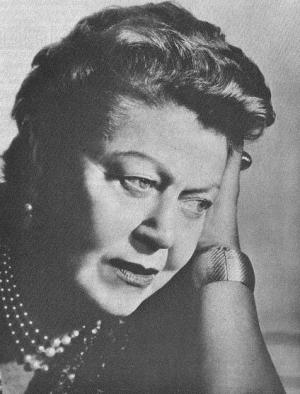
Eileen Garrett, the greatest medium and "psychic" of this century, strove to understand her gifts, and allowed scientists to scrutinize them in countless experiments. She could see ghosts and talk to spirits, but always maintained a respectful doubt about her powers.
The Image of An Oracle by Ira Progoff, Discernment—A Study in Ecstasy and Evil by Morton Kelsey, and A Guide for the Perplexed by E.F. Schumacher.
TAT Journal believes that by helping others you can help yourself. Our Reader's Forum is the best place to "meet" other inquirers and searchers like yourself. TAT wants to help put you in touch with friends you would otherwise not have access to. Contact other TAT Journal readers with your thoughts and ideas, and share your discoveries. Send your letters, comments or articles to TAT Journal, Reader's Forum, P.O. Box 236, Bellaire, Ohio 43906. If you wish to contact someone in the Reader's Forum personally, send your initial correspondence to us in a separate, stamped and unaddressed envelope and we will mail it to the party you choose.
Cosmic Eggs
I have noticed a peculiar thing happening within my own life which relates to Jake Jaqua's article on The Crack in the Cosmic Egg in the Winter, 1979 TAT Journal. The implication of the article is that we live in a world of our own creation. In other words, we do not actually see the world as it is but instead see what we want to see. We generally want to maintain the status quo, which is made up of our beliefs about the way life is. People get out of life what they expect to get.
I have visited more than a few "self-development'' groups in my travels and noticed that they usually have a common denominator - they agree about the nature of reality. Whether they do it unconsciously or not, this agreement sets up an actual force which affects the environment and the people that come into contact with their circle. As I sat in with one of these groups for a couple of months, I gradually saw my views on life change. In the presence of another group of friends, I saw my previous beliefs return.
For instance, one group stressed the potential inherent in all human beings. I began to look at people in a new light, and began to see the uniqueness and life of each person. The other group stressed the self-deception that is so much a part of life. In the state of mind of the latter, I saw people more as hopeless cases.
This is a rough reduction of what I observed. The main point is that our beliefs can actually change our observations. Our thoughts set up a certain vibration around us that fulfills itself. And our beliefs of the people around us affect them. In order to get beyond this projection, I think we have to be willing to say "I don't know," and proceed from there.
Dr. Bissell
I really liked the lecture by Dr. Fred Bissell in the last TAT Journal. I find Dr. Bissell's approach to wholistic health to be quite open and refreshing. It answered some questions for me which I've wondered about for quite a few years, especially about the individuality of nutrition and fasting. I hope to hear more from him in the future.
Frivolity
If I could be free of this black and vapid place
To amble, run and stride thru unfenced fields.
And letting careless breath refresh my face
Leave morbid thoughts behind for laughter's yield
I'd fast unbind my soul, Take my fling full swing
Release my tortured heart to freely sway
Like the sweet open wind unmuzzled sing
Renounce the twisted shadows of my grey
And tragic past, stand dazzled in the sun
Of my uncovered self. Escaped at last!
Disentangled from the web I myself have spun
From the dingy fibres of a gloomy past,
But memory's shackles hold me to this place.
I am a wilted blossom in time's vase.
Cults
I thought Raymond Lieb's article "Cultists and Anti-Cultists'' in the Winter issue of TAT Journal "hit the nail right on the head." It is sad that a few "nuts" or perhaps unfortunate and mentally ill persons like Jim Jones will cast suspicion on many worthwhile groups labeled by society as "cults."
I am familiar with several so-called cults and am quite convinced that most do more good for society than ill, not to mention the right of freedom that cults represent here in America. By choosing to be a member of a cult, a person exercises his individual right of freedom regardless of the good or ill it may do society as a whole.
Cults do generally benefit society as a whole, though. Often they provide a useful place and fulfilling work for those who would fill the role of a social misfit otherwise. Some can simply not live the normal work-a-day life, or find meaning in the traditional middle-class values. Cults often serve as rehabilatators for those who are going through a mentally traumatic and adaptive period of their lives. Many young persons who've fizzled their brains on drugs or other excesses, find a place to work themselves back to health.
Nothing is "for sure" in life and it can not be assured that another Jim Jones incident will not occur. If a harsh public reaction against all cults should ensue, we can be assured that a more subtle, but even worse disaster will occur - loss of our prized American freedom.
About Pain
Nature uses pain as a warning signal to us when there is a pathological condition anywhere in our bodies. The purpose, of course, is for us to take the necessary steps to cure the condition and thus remove the pain. There are other pains such as emotional pains. These actually hurt all over the body and exact a deeper toll from us than physical pain, despite the fact that physical pain can be unbearable at times. I suppose the purpose of this emotional pain is also to warn us to remove or alter the situation which is causing it.
Therefore pain, and the bearing of pain, which almost all of us avoid earnestly, does have a necessary and even constructive role in our lives; since everyone in life must endure pain of many kinds, it is necessary for us to suffer it without going to pieces mentally, emotionally, or physically.
Women in childbirth suffer pain. Everyone, man, woman and child, has illnesses and trouble sometime in his life. The everyday task of running a house, or making a living has unavoidable pains or hardships as a corollary to it. Athletes have to withstand pain and possess great endurance. All people that experience a death in their family or among dear friends suffer a deep pain.
My point in all this is that people who try to avoid every pain, even the minor ones, are doing themselves a great injustice. I refer in part to the "pill-poppers," people who have a large assortment of pills in their cabinets. They take one for a headache, one for stomach acid, one for a tranquilizer, one to go to sleep, one to wake up, one to lose weight, and so on and on. What happens when these people have to face an unavoidable crisis? They may go to pieces because they cannot stand any great pain.
Another very important fact in the area of bearing pain is that we all have to learn to function in our daily experiences, tasks, and responsibilities despite the presence of a small or even of a larger amount of pain. Many people do just that and press onward. The rewards for going on and not quitting are considerable. First and foremost, are the daily achievements and earnings that people make, and also the cumulative achievements of a lifetime, which are precious. This "pressing on" of course requires courage and so we get into the area of "character." When you look at an older person who has lived a full and good life, you can see the character and the lines of experience in his or her face. This is a mark of valor and it reflects inner soul beauty. Examine and look about at the Creator's plan. You will understand how highly courage, and character are valued by Him and how necessary these characteristics would be in the universal experiences we may go through in a subsequent living experience.
Gnosticism
Gnosticism is the name for the teachings of a group of religious sects which flourished from about the first to the fourth centuries A.D. All of the Gnostics exalted knowledge over faith. This knowledge, or gnosis, (Greek for knowledge) was of a special kind. It was the esoteric knowledge of the secrets of existence as related to the Gnostic myth or world view. More specifically, it represented knowledge of the absolute transcendence of the Divine.
Gnosticism was syncretic in that it borrowed from many ancient religious traditions. Among these were: the Jewish Kaballah, Greek philosophy (especially Plato), Egyptian Hermeticism, Zoroastrian myths, Babylonian astrological lore, and most importantly, Christianity. Although Gnosticism was derived from all these sources, it still maintained a peculiar unity and character. No one knows exactly when or how it originated, but it got its major impetus one hundred years after the death of Christ.
Almost without exception, the Gnostics subscribed to a strictly dualistic interpretation of Man's relationship to the world and the Divine.
First, there was the realm of the "Creator," who was considered by them as an evil being who is responsible for this bungled creation (matter). On the other hand was an absolutely trans-mundane presence. The former was called by the Gnostics the Demiurge, and the latter was called the "unknown God," or the "alien God." The ruling Demiurge, like the Hebrew God, Jehovah, was vengeful and would admit to no power higher than himself, hence the great Cosmic struggle between these two rival powers. They presented their philosophy in a grand and elaborate myth, not by means of logical system-building or rational argument. This myth, which encompassed Man's creation, fall, and salvation, parodied the Bible.
The following is a brief account of one Gnostic sect's view of the creation: In the beginning, before Man or anything else was created, there existed two primal principles - the darkness and its twin, the light. The light was sufficient unto itself, and needed no contact with anything. The darkness however, being evil, and envious of the superior light, conspired against his twin, not understanding that the light was divine and could never be ultimately defeated.
So the evil principle proceeded to create the physical universe, including man. He then placed or trapped portions of the light in man and kept it subdued and dispersed because man with his senses, was kept distracted. Therefore we have man as a potentially divine being but whose essence, the light, was kept in a state of subjection.
At this point, the principle of light decides to intervene. He implants gnosis in certain individuals whom he deems are worthy of being saved. In Gnostic theology, this intervention takes the form of Christ, who according to them, was sent to proclaim gnosis to his intimate disciples.
This is an account found in many Gnostic mythological systems. Usually, scores of intermediary powers (angels), or emanations (aeons), are involved in the story-making.
All of this is obviously an attempt at reconciling the opposites and explaining how men who feel themselves being totally alienated in this world can be saved.
As I have mentioned, in Gnosticism the physical world was considered contemptible and inferior to the world of the spirit. The heavens - including the planets and the stars, were the domain of the archons. They guarded the outermost gates of the universe. In the heavens, the cosmic spheres are arranged like concentric enclosing shells. Most frequently, there are the seven spheres or planets surrounded by the eighth, that of the fixed stars. The soul must somehow overcome the power of these archons. Archons are really names for impediments to the progress of the spirit, although they are given an entity-like quality. The collective rule of the archons is called the "heimarmene," or universal fate. They might be analogous to the powers of Nature.
Man is composed of flesh, soul, and spirit (pneuma). But reduced to ultimate principles, his nature is twofold: mundane and extra-mundane. Not only the body, but also the soul is a product of the cosmic powers (archons) which shaped the body in the image of the "primal man," and animated it with its own psychical forces. These are the passions and appetites of natural man, each of which stems from, and corresponds to, a cosmic sphere, and all of which make up the astral soul of man - his psyche. Through his body and his soul, man is subjected to the heimarmene.
Now enclosed in the soul is the spirit or "pneuma." It was also called by the Gnostics the "divine spark," or portion of the divine substance which has fallen in the world. The Demiurge, through the archons, and in turn through the heimarmene, created man for the express purpose of keeping it captive there. Thus, as In the Macrocosm man is enclosed by the seven spheres, so in the human Microcosm the pneuma is enclosed by the seven soul-vestments originating from them. In its unredeemed state, the pneuma thus immersed in soul and flesh is unconscious of itself, benumbed, intoxicated, or asleep, by the poison of the world. In brief, it is ignorant. Its awakening is affected through knowledge (gnosis).
I suppose that what governs whether an individual can achieve salvation is (1) individual intensity or quality, or (2) an accidental short circuiting of the cosmic computer. The former has to do with predestination while the second is a more spontaneous affair.
I have five main criticisms of Gnosticism. The first is that in Gnosticism, there was an obsessive preoccupation with the juggling of abstruse mythological concepts. Mythology may have its place in religion, but the Gnostic systems were all diverse and contradictory. They were basically speculations of highly imaginative and creative minds, but much of what they created was merely confusion. That sort of thing could get to be an endless tangent akin to one of our modern philosophical systems. The Gnostics utilized the imagination, while the latter esteems reason.
Second, to say that the physical world is evil is an over-simplification and a misinterpretation. This attitude hints of some motive in wanting to believe that it is and exalting the self over the world. It may be better to regard the manifested world, or that world as perceived through our less-than-perfect senses, as illusory rather than inherently bad. Being relative, it possesses negative characteristics but in Gnosticism, it was given sentience. In regard to this, Ouspensky says that evil cannot be conscious, only mechanical. One could also discount the idea of a conscious opposition to the progress of the spirit - the idea of Satan, or a Satan-like figure (the former supposedly being an evil genius, while the Gnostic's Demiurge was an incompetent bungler, responsible for creation).
Ritual magic, and secrecy were also incorporated into Gnostic philosophy. There is no mention of any specific techniques to free the self in Gnostic literature other than magical incantations. This does not mean that they didn't exist however. They simply are not known due to the strict secrecy common to most cults at that time.
Lastly, the practice of any foreign religion, ritual trappings and all, seems to me to be highly affected. But today we witness thousands of cultists, and even devotees of Eastern religions taking part in complicated and sometimes ridiculous rituals which rightly belong to another age. Gnosticism was a very "mysterious" religion, and this, in itself, may be responsible for its present day popularity.
Spiritual Suicide: An Observation
The American Indian, when asked about his religion, failed to comprehend the word "religion." The reason for this was that the Indian had no separate time set aside to remember his spirituality. Everyday Indian life incorporated those values modern man would relegate to Sunday. To the Indian, his way of life was his religion and his spirituality. The traditions and customs of the tribe kept him alive and sustained his spirit. They had intelligence behind them and they worked. The Indian survived in the wilderness of America until the coming of the white man with his "superior intelligence." I am not campaigning for Indian rights. I've used the above example to define what I think is the closest approach to some sort of spirituality. In fact, the word "spirituality" doesn't even need to be mentioned. For me, it has no practical value. What does have value though, is intelligent living. How can a man live the most intelligent life possible?
Man has lost touch with his essential nature. Modern psychology attempts to define man's nature in terms of rats and monkeys. At least in this respect they might be on the right track. But when it comes to questions of what is good for man and what promotes a growth of his being I encounter a mish-mash of conflicting ideas all claiming validity. I can't help but wonder when I see a psychologist or psychoanalyst sporting a beard and wire-rim glasses, then another, then another, (and I'm not kidding), what the problem is. My own personal opinion, after talking to many psychology students, is that most of them have some neurosis of their own, conscious or unconscious, which they are trying to cure. The public in turn, always looking elsewhere for guidance because of stupidity or laziness, or simply out of gullibility, looks to these same psychologists for direction and answers, and accepts their edicts of how and what a man is.
In terms of intelligent living and ultimately, spiritual matters, who holds and controls our fate? The psychologist? The Government? The churches? Surely not the churches for they are empty. What has happened to the questions that man has sought answers to since Nature spawned him? Where is the survival instinct of man? Where is his so-called "superior intelligence?" Here I can only give an observation.
It has always been said that today's youth is tomorrow's hope. The young shall be given the chances their parents never had. Wisdom will be passed on.
Not today. Modern civilization is dedicated to the destruction of itself and especially its youth. Ever present in the media, the schools and the streets, and often in the quiet of the home is an ugly, pervading cloud of drugs, dehumanization and sexual degeneracy. At one time I would have read the words I just wrote and laughed at their seeming absurdity and called to mind some old biddy, frustrated and reactionary, reading her Bible and putting her hand on the T.V. when Oral Roberts called for a healing.
Unfortunately degeneracy can become so incorporated into a system that it is unrecognizable until the chips are cashed in. This is the state of modern man, and particularly the young.
I see my own friends moving to distant cities and getting involved with drugs provided by the "professionals" they are working for. They want out but are afraid of losing their jobs because they are "unsociable."
The mass availability of drugs to children without knowledge of their use Is creating an Incredible future-world. It is a fact that burned-out hippies from the 'sixties and probably other "with it" people give their pre-school children LSD and marijuana to "expand their minds." "Everything's cool," they say, "everything's fine."
To college kids, smoking dope is not a special kick, it's part of their matriculation fee. When their grades go bad or life seems somehow hazy, or personal problems increase, it's always anything but the dope.
Among the chic and increasingly among the young every form of sexual degeneracy and debauchery is practiced, even encouraged, by a supportive society which values sex, mediocrity and disco-dancing as the highest forms of culture and attainment this civilization can offer to its young and the yet to be born.
Of course there are exceptions to all of this. But obviously they aren't running the show, are they?
Oh, yes. The gurus and swamis. Man is making a spiritual attempt after all. He now turns to EST and kundalini to save mankind and rescue his soul. The new-age psychologists for us to accept and be gullible to. I've known of people who've been on a spiritual retreat weekend and returned refreshed and invigorated enough to continue their sexual degeneracies with renewed intensity. What's sad Is that there are some people involved in spiritual movements who are looking for some kind of intelligent life but get suckered into the wrong thing. Most, not all, but most spiritual faddists and their followers are, I feel, the horse's ass. I've never seen so many swamis come out of nowhere so fast, for so many American dollars. I'm surprised they don't parachute them down over major cities in crates, there seems to be such a need for them. But what of the intelligent life? Where then, does it begin? I've quickly and sketchily described what I see happening around me. I suspect that I've only seen a part of it. That's quite enough.
So, in this age of freedom to do what you like because it feels good and produces no immediate observable bad effects, and ultra-chic sophistication and knowledgeability, we find modern man, the supreme egoist who looks out upon his creation and says, "It is good."
Man is not outside of Nature. He builds monuments to himself In terms of Taj Mahals and skyscrapers, and litters the streets with cars forgetting that the materials to build and the builder himself are given by Nature. Man looks around and sees himself everywhere, - in the buildings, advertisements, garden arrangements and clothes that others wear. He surrounds himself with himself until he can no longer see himself. He takes pride in his sick vanity.
And pride goes before a fall. Humans are gullible, with little thinking capacity no matter how vaunted they feel themselves to be. Man is not outside of Nature. Like any other animal only the strongest of the species survive. Not all men can fight physically or psychologically. We are not created equal. We have no equality in each other's eyes or the eyes of the Government. Anyone who contests this is a hopeless fool. As to the eyes of God we know nothing. We know not even if there is a God but that someone once told us.
For these reasons it is important that those who lead, lead with the best interest for the survival and growth of the species. In the past, tradition and the family took care of this. The tradition today is one of degenerate dissipation and the family has divorced its members and left the kids to themselves or the street. We can no longer count on the Government to protect us or keep the flames of wisdom burning. Psychology would have us masturbate ourselves into the grave.
Perhaps the solution is simply to stop and really look at ourselves and really think about it. Not for an hour, or a week, but every moment of our lives. The intelligent life is only for those who have the possibility of living it. If a man can find a true path of individual survival and growth, and not be led by the nose out of gullibility or laziness, then that man may create the same possibility for others. Otherwise the course of man is one of despair and spiritual suicide, without reason, without dignity, without hope.
Los Angeles Area
Explores states of being and mind. Meets weekly. Call for information: Woodland Hills ____ ; Culver City ____.
Want to write to someone in the Reader's Forum? Send your initial correspondence in a separate, stamped and unaddressed envelope to this magazine and we will mail it to the party you choose.
Doomsday, Atlantis and Genetic Research
by Mark Jaqua
The story of Atlantis foreshadows today's biological revolution in which scientists seem to be irresistibly drawn to the creation of new life-forms. Perhaps they should resist the impulse.
We have a crisis on our hands. Another one! The last major crisis that affected humanity as a whole was nuclear. We built bomb shelters in case of nuclear attack, and staged gigantic debates as to whether or not to use nuclear reactions to power our electric generators. This has died down a bit, we have become used to living under the threat of the Bomb, and we have decided to use nuclear power stations, at least until something better comes along - or until there is a catastrophe.
Our next major human crisis is already upon us, even before we were warned of it, except for a few sensational headlines, and a few more mumbles on the TV news. The term "genetic research" may bring to mind new breeds of corn, or a faint memory of high school textbooks and Gregor Mendel's experiments with pea plants. It means much more to the informed today. Humans are being conceived in test tubes, artificial life-forms are being created and "clones" are just around the corner.
The greatest fury in scientific circles of late is that centered around "recombinant DNA". DNA is the system of complex molecules contained in the nuclei of each of our body cells that determine heredity. This DNA is the "program" of each of our cells that determines what color of eyes and hair we are born with as well as more subtle things, like if you are "smart" or maybe not so "smart." It determines your individual human characteristics, and that you are born a human and not a frog or some other animal. Your DNA determines that you are born with a nose and not a beak or that you have hair and not feathers.
... plans to create humans who can consume hay or grass (to solve the world hunger problem) are already being researched.
Modern genetic researchers are progressing so rapidly that within a mere ten or twenty years they may have the capability, by "tinkering" with DNA, to create a human with a beak or with feathers. It is hard to imagine why this would be a priority but plans to create humans who can consume hay or grass (to solve the world hunger problem) are already being researched. Dr. A.M. Chakrabarty and staff, of General Electric, are currently working on this unusual proposal. (1) We can see that in genetic research, science fiction is becoming, all too fast, science reality.
Recombinant DNA research entails separating strands of DNA from different life-forms and connecting portions of the alien DNA together so that they form the "master plan" or "program" for an entirely novel form of life. Successes with creating novel viruses and microbes have already been achieved using this method by Dr. Paul Berg (2) and Dr. Stanley Chohan (3), but if success has been reached in creating more complex life-forms, such as plants or animals, it has not been made publicly known.
"Novel" life-forms are being created that are not present anywhere in nature. They are totally artificial, created by combining genetic tendencies of common life-forms. Taken in the extreme, for example, they are "chimeras" such as the mermaid, with the torso and head of a human but the tail of a fish. No such monster has been created in the laboratory as of yet; we are presently dealing only with microbes and other primitive life-forms. The principle, however, is the same. Few authorities deny that our technology may be advanced enough in a few decades to create a mermaid or other chimera. Our biotechnology is advancing so rapidly that it is difficult to say, and frightening to imagine, what will be possible in a short period of time.

[Figure: Half-Human/Half-Animal Chimera]
The most dangerous recombinant research presently going on is that with microbes and viruses. Superficially this may seem harmless and purely of scientific interest, but its dangers can be seen on deeper inspection. Most diseases are the result of bacterial infection, and modern medicine has created and discovered drugs and antibiotics which are effective in combating most of these disease-causing bacteria. Bio-engineering is resulting in the formation of completely new types of bacteria. The effect of these new microorganisms on the human system is completely unknown. If an artificial strain of bacteria is carelessly created which is lethal to humans, it could conceivably escape from the laboratory and result in a plague of vast dimensions. Medicine would be impotent against such a lethal germ until it could perform time-consuming research for an antidote. Such time-consuming research could prove fatal to thousands or even millions of people. Michael Crichton's book, The Andromeda Strain, centered around an imported lethal bacteria from outer space. Unfortunately, scientists do not live in a void and we all may be more intimately involved with genetic research than we would like to believe.
Bacteria are just too small to completely monitor. In the best containment lab in the country, at Fort Detrick, Maryland, there have been 423 known "accidental" escapes of dangerous bacteria resulting in numerous illnesses and three deaths. (They have even been unable to keep out cockroaches at the Fort Detrick lab!)
There are basically two methods used in controlling errant and possibly lethal bacteria created and used in recombinant research: "biological containment" and the use of "environmentally impotent" bacteria. In biological containment, elaborate equipment such as air locks, negative pressure experiment tanks and chemical showers for the technicians are used. All these mechanical gymnastics do not, however, insure absolute containment of dangerous bacteria. Some will get out no matter what the precautions. Bacteria are just too small to completely monitor. In the best containment lab in the country at Fort Detrick, Maryland, there have been 423 known "accidental" escapes of dangerous bacteria resulting in numerous illnesses and three deaths. (4) If this can happen in the best lab in the country, we can't place too much confidence in less exotic labs. (They have even been unable to keep out cockroaches at the Fort Detrick lab!) Since records have been kept, there have been over 900 incidents of infection involving 5,000 people and 100 disease-carrying bacteria. One-third of these have occurred in various containment labs. (5)
A more promising method of dealing with artificially created microbes is the use of "environmentally impotent" bacteria. These are specially created bacteria which are so weak that they can not maintain life outside of specific laboratory conditions. For instance, this special microbe may be able to live only at a temperature of 70-74° F., and thus, if it did escape, it could not live at the human body temperature of 98° F. This seems like a much safer type of "bug" to perform genetic experiments on. Still, as a remote possibility, there is no guarantee that such a harmful bug could not mutate and survive in the human system.
The jeopardies of genetic research emerge from medical perils into ethical considerations concerning "clones" and the potential creations of half human-half ape chimeras to be our garbage collectors and whatnot. The book, In His Image, by David Rorvik, claims that such a clone of a millionaire has already been performed by a private laboratory. Cloning, the asexual reproduction of a human being, has recently captured the imagination of a large number of people, resulting in a plethora of books flooding the newsstands. Rorvik's book may or may not be a factual account, but we are very close to the feasibility of cloning, if not already there. In genetic research, the quantity of information doubles every two years (6) and J.B. Gurdon managed to clone the African Clawed Frog as far back as 1965. It is only a step of finesse from frogs to human.
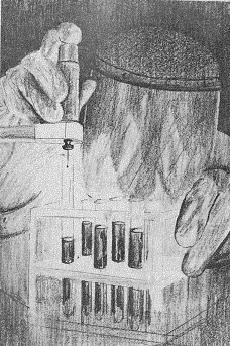
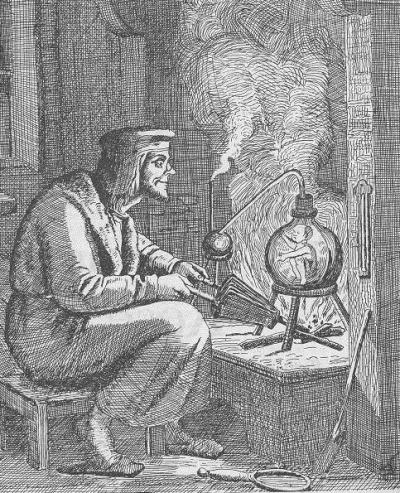
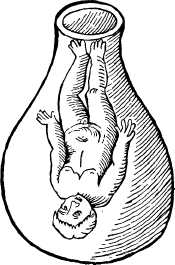
[Figure: Old Age Alchemy vs. New Age Alchemy? An old illustration depicts an alchemist breathing life into the creation of a homunculus, an artificial human, with his bellows. (left) In a modern recombinant DNA laboratory, a technician in a protective suit adds a drop containing trillions of DNA plasmids to a test tube of plasmids centrifugally separated from bacteria cells. With such material, scientists create new genetic combinations. (right)]
Cloning is really nothing new to nature. Plants have been cloning for billions of years, and there are over 200 million human clones (identical twins) in the world right now. There is even a unique and rare process, parthenogenesis, by which a "virgin birth" and an identical clone is produced by a human mother. In this process, somehow a body cell of the mother fertilizes an egg, develops, and she gives birth to her exact duplicate. An expert in genetics, Dr. Helen Spurway, holds that as many as one in two million women are the result of this. (A parthenogenome can only be a woman for obvious reasons.)
Man-created clones will be the result of taking an egg cell from a woman, removing its nucleus, and replacing this nucleus with the nucleus of a body cell of the person to be cloned. Once the egg cell receives its new nucleus, it is placed in a woman's uterus (any woman!) where it will hopefully come to maturity in nine months. Theoretically this does not seem to be a difficult task, but human nuclei are so small that it will take a great deal of skill. Microscalpels and miniscule laser beams are used in operating on nuclei in plants and microbes, but human nuclei are thousands of times smaller than those of plants and microbes so these techniques are too cumbersome. What will be used is "chemical surgery" with enzymes and specially coded viruses. (DNA strands are hardly more than one-dimensional lines to our imagination. If all the strands of DNA in your body were placed end-to-end, they would stretch over 74 billion miles, yet the volume of this material is so small that it would fill only a cubic inch. A single strand of DNA from one cell holds information comparable to 1000 six-hundred page books. (8)
... the technology for breeding animals has "simultaneously made gorilla/man and chimpanzee/man hybrids possible."
While cloning is causing a great deal of excitement, it is doubtful that it could ever have as much utilitarian value as other areas of genetic research like recombinant DNA. The basic problem concerning human cloning is not a technical problem, because we are very close to its achievement, but it is an ethical problem. Should we, or should we not clone humans? It seems that the crux of this problem revolves around the clone himself. One of the major proposals of cloning advocates is the cloning of geniuses. What would be the affect on the clone? Gerald Leach writes in his book The Biocrats, "To aspire to genius is fine, to be the child of genius can be dreadfully difficult, but to be expected to develop into a genius because you are its identical twin could be crushing." There is no guarantee that a clone of Einstein would become another Einstein; he could become a miserable social misfit.
The possible production of human and animal chimeras is of more ethical concern than clones. Such possibilities are speculated about by the most eminent scientists of genetic research. Nobel laureate Joshua Lederberg reflects, "... it may become possible to incorporate part of a human nucleus into the germ cell of some animal, say a gorilla, which might produce various 'sub-human' hybrids." (9) Bruce Wallace, professor of genetics at Cornell, says that the technology for breeding animals has "simultaneously made gorilla/ man and chimpanzee/man hybrids possible." (10) Another scientist sees still more frightening things: "Those of us who work in this field see a developing potential for nearly total control of human emotional status, mental functioning, and will to act." (11) "Gene fixes" have been proposed to increase memory capacity or to improve manual dexterity. Genetic potions have been hinted at that will increase the size and capacity of the brain. Hormone shots have already been given to rats that increase their brain size and learning capacity by 70%. (12) These wild scenarios are not idle science fiction meanderings but have the potential of being realized before the end of the century.
Presently the public would violently resist creation or use of half-animal, half-human chimeras. I wonder though, what would be the reaction if it were discovered that use of "parahumans" could cut our taxes in half, or that one's own personal butler could be had for a few thousands dollars and board? Unless it were outlawed, private industry would undoubtedly jump on such a possibility to use parahumans in menial and dangerous jobs. To what degree we would use parahumans would depend on the opinion of the general population. It all seems highly improbable now, but the zeitgeist can change ever so quickly. It was only a short forty-five years ago that Hitler had a whole nation mesmerized in "racial supremacy" and righteous genocide. It may be that the moral fiber of a nation can change much more quickly than we would like to believe. Only twenty years ago, the morals accepted by much of the country today would be regarded with downcast eyes. Who can speculate on what may be the current opinion in twenty or thirty years?
Deep in the heart of every man there is a vague, indefinable mistrust of science, especially when it intrudes on formerly sacrosanct areas of nature. "If man were meant to fly, God would have given him wings!" may come to mind, or numerous other sayings of apprehension. Prometheus stole the "fire" of the gods and was made to suffer for it. Deep within the archetypal part of man's mind there seems to be a warning or fear of delving in matters that were not meant to be interfered with. Could it be that deep within the racial memory there is a faint recollection of the devastating consequences of foolishly violating some basic laws of nature? In the world's mythology there is such a tale, the tale of Atlantis.
All we have that can support the existence of Atlantis is mythology, the words of psychics, and the massive compilation of circumstantial evidence by such pseudo-scientists as Ignatius Donnelly in his book, Atlantis, The Antediluvian World.
Presently the public would violently resist creation or use of half-animal, half-human chimeras. I wonder though, what would be the reaction if it were discovered that use of "parahumans" could cut our taxes in half, or that one's own personal butler could be had for a few thousand dollars and board.
Personally, I find the fact that the earth is several billion years old to be the most convincing evidence that some civilization has predated our own. That most scientists take as matter-of-fact that our civilization is the first and only in this tremendously long time, has a bit too much hubris in it for my liking.
It is amazing that mythology and psychics the world over agree about many things in regard to Atlantis. It is even more amazing that much of this mythology and psychic report intimates aspects of Atlantean science that could not be speculated about more than a few years ago. For instance, a 1940 "reading" of Edgar Cayce, the famous American psychic, stated: "We find that in those periods there was not a laboring for the sustenance of life... (Atlanteans) were served by automatons, or THINGS, that were retained by individuals or groups to do the labors of a household, or to cultivate the fields or the like, or to perform the activities of artisans. And it was concerning these 'things' about which much of the disturbing forces grew to be factors to be reckoned with, between the children of the Law of One and the Sons of Belial. For these were the representation of what in the present experiences would be termed good and evil, or a spiritual thought and purpose and a material thought or desire or purpose." (13)
If you can read beyond the mystical phraseology, isn't this the very crisis we face today, or will soon be facing? Potentially, we will encounter the creation, through genetic engineering, of parahumans to be used in menial and specialized occupations. When this potential becomes reality, one faction will be morally opposed to it, and another, utilitarian faction will be in favor of it. Hugh Lynn Cayce says further of the Atlanteans, "Some misused.. creative power to reproduce grotesque life forms for their own purposes, interrupting the evolutionary pattern going on in the earth.... They may have been mixtures of man and animal. Evidently they were held in low regard and treated as slaves or machines." (14) That the Edgar Cayce readings were given between thirty and fifty years ago, when only a few were dreaming of the possibilities of genetic engineering, is quite amazing.
Scientists are creating novel life-forms, not really knowing what they will get beforehand. I remember when I was a child, persistently mixing chemicals from my chemistry set, until I could find something that would "blow up."
Madame Blavatsky, in The Secret Doctrine (published in 1888), has some intriguing things to say about the Atlanteans. She claims that they "breeded with animals" which brought about biological monstrosities and the wrath of Nature. Since impregnation of animals by men seems biologically impossible, this myth could be an allegory concerning recombinant DNA experiments by the Atlanteans. In the ancient Tibetan manuscript, The Stanzas of Dzyan, Blavatsky quotes a reference to the Atlanteans: "Having fallen down in godliness they mixed with animal races... Many acquired Divine, more - UNLAWFUL knowledge, and followed willingly the LEFT PATH." (15) If you can interpret the arcane language, "mixing with animals" could refer to genetic experiments, and the "LEFT PATH" would be interpreted as the "path" of utilitarian and material values. In another place in The Secret Doctrine Blavatsky relates an Indian myth about the lost land of "Mu" where "The great lords each had their speaking beast... " I am treading on shaky and highly speculative areas here, but until the most recent science, some aspects of the Atlantean mythology could not be interpreted in even a vaguely sensible manner.
Blavatsky maintains that all processes of Nature and evolution are spiral or periodic in nature, and that we are presently entering the same period of crisis that the Atlanteans went through, and which resulted in their destruction. Edgar Cayce maintained a similar line of thought and held that many former Atlanteans are reincarnating today. According to Edgar's son, Hugh Lynn Cayce, "Many individual souls (or entities) who had one or more incarnations in Atlantis are reincarnating in the earth in this century, particularly in America. Along with technological abilities, they bring tendencies for being extremists. Often they exhibit individual and group karmas associated with selfishness and exploitation where others are concerned. Many of them lived during one of the periods of destruction or geological change in Atlantean history. If Edgar Cayce's prophecies are correct, a similar period of earth changes in imminent." (16)
Interpreting the Atlantean disaster in terms of today's knowledge, Atlantis was not destroyed because the people treaded on the toes of some "wrathful gods," but because they did not fully understand the forces of nature they were unleashing with their science. Similarly today, we are treading in unknown regions and hoping that no disastrous consequences will result. Scientists are creating novel life-forms, not really knowing what they will get beforehand. (I remember when I was a child, persistently mixing chemicals from my chemistry set, until I could find something that would "blow up.")
Myth suggests that the Atlanteans frivolously used the forces of nature and conducted experiments that unexpectedly resulted in geologic cataclysms, the sinking of their continent and even a polar shift. We are approaching such technology today, and may be confronted with side effects of our technology which we do not at all expect. We have the nuclear potential to "crack the core of the planet" and it is a rather minor thing to stimulate an artificial earthquake. For example, recently it was speculated that the Soviets caused a major earthquake in Iran in September, 1978. The Soviets accurately predicted the time and place of this earthquake which destroyed the town of Tabas and killed 25,000 people. Just 36 hours before the quake the Soviets set off an underground 10-megaton bomb 2,500 miles from the earthquake site. It is horribly possible that the Soviets may have caused this quake by a strategically placed bomb, perhaps on a fault line. (17)
It does not matter if Atlantis ever existed factually or not. It is in the least a myth that gives form to deep-seated psychological apprehensions about meddling with the four billion-year-old natural process and evolution of the planet. University of Virginia geneticist Joseph Fletcher has said, "To be civilized, is to be artificial, and to object that something is artificial only condemns it in the eyes of subrational nature lovers or natural law mystics." (18) This may be so, but we should know what we are dealing with before we begin. It takes 10 million years for a mutated gene to become dominant in a species. We can now perform this trick overnight. If God does not play dice with the universe, neither should man. It may be time to question the seeming technological fiat of modern science that says, "If something can be done, it should be done."
Notes
Part II: The Way of the Heart
A transpersonal Approach to the Severely Disharmonized Child
by Gordon Broussard
In the first six chapters of "The Way of the Heart" that appeared in the Winter, 1979 issue of TAT Journal, Gordon Broussard explained that "autism" and "schizophrenia" are labels attached to children who suffer from a severe disharmony of their mental, emotional and spiritual natures. These children can be helped by a "spiritual harmonizer" who understands how to transmit the energies emanating from the Heart center, described by Ramana Maharshi; the harmonizer can engage in a form of silent communication to reach the child who is cut off from normal social contact, and can use play to establish mutual trust and affect the disharmonized energy field of the child. You can use the form in this issue to order the Winter, 1979 issue (Vol. 2 No. 1).
Chapter 7: The Energy of Harmonization
There are many points of focus for the energy present in man. Each of them is said to be the place to concentrate in order to properly utilize the potential of the energy. For certain yogis this place is Sahasrara, the crown chakra; for practitioners of the martial arts, the tan t'ien, a center just below the navel is the focal point; other disciplines focus on the third eye, the heart chakra, etc. It is indeed true that by focusing on each of these centers various things can be accomplished; but always the energy is being focused on at a point not from which it has originated but to which it has traveled.
The source of all the energies of all these methods is the Heart center. (1) I speak from experience in saying that by dwelling in the Heart I am in Sahasrara and the energy kundalini flowing up sushumna and activating the chakras is only in the Heart. Yet again, when dwelling in the Heart I am in the tan t'ien. When doing T'ai Chi in this manner, from the Heart, it is the same as when done from tan t'ien. The energy C'hi is the energy of the Heart manifested in a particular way. Swimming through the air in the flow that is T'ai Chi, one is swimming in tingling energy that is perceptible. Swimming in energy with a different name than prana which is in reality no different from the energy used by the yogi or the healer. It is only how it is used that is different. (2)
The energy of the healer - the harmonizer - is also said to flow from many places but ultimately it too comes only from the Heart. It is for this reason that the way of the Heart goes directly to the source. It is here that the spiritual harmonizer focuses; here he dwells, first unconsciously and then with growing awareness until he is there all the time, becoming totally harmonized if he is determined enough.
Coming into contact with the severely disharmonized child, the harmonizer can utilize the energy of the Heart in an unfocused or focused manner. Generally speaking, the unfocused manner is utilized only in play involving activity such as rough-housing. As this form of harmonization was discussed in the last chapter, only the focused manner will be considered in this chapter.
Harmonization of the focused manner can be done through direct contact (usually with the child's knowledge) or it can be done at a distance (usually without the child's knowledge). In order to know how to proceed with a particular child one must listen within.
Looking at the child, one dwells in the Heart and many ways of proceeding may come depending on the nature of the child's disharmony. Possible techniques are laying on of hands or the variation of this in which the hands remain just above the body, the meditation harmonizing circuit, transmittal through the eyes, or any combination of these methods. From one interaction to the next the method or methods to be used may vary. Methods used may vary even during a single interaction, as conditions can change (they usually don't) from moment to moment. It is important to remember that whatever occurs in one or several interactions is not personal choice but what the harmonizer has been led to do. He is not an experimenter using trial and error to determine how to proceed; rather, he is proceeding according to inner knowledge and direction.
Taking the possible focused methods of working with the child one by one, let us first consider the laying on of hands; a method which is usually done with the child's knowledge unless a particular child is blind or unless he is too wrapped up in his own world to initially notice anything anyone does. When utilizing this method or the meditation harmonizing circuit with an aware child or young adult, it is necessary to explain what one is doing if he feels within that he is going to use the technique frequently and that the child is likely to understand the explanation. I usually tell younger children unlikely to understand or be interested that I am going to "zap" them, demonstrating what I mean in their right or left palm, depending on which is more sensitive. The child generally feels either tingling, warmth or cold. (3)
Explanations aside, one can proceed in a number of ways. It is possible to just know where to place one's hands. Or, some harmonizers may "see" the areas of disharmony. Another method is to move one's hands above the body thus detecting areas on which to focus energy. In this latter detection method one's left hand is usually positioned in one spot above a particular section of the body while the right hand moves in the vicinity of this area. Sensations in the left hand (and possibly the right one) along with an inner feeling indicate when one has found the spot on which to focus. A variation of this utilized by practitioners of polarization therapy is the taking of pulses and "feeling" for blockages of energy. One may also develop a variation which feels best to him. Whatever the method of detection, once a spot of focus has been located energy is allowed to flow to it. When sufficient energy has flowed, inner guidance lets one know that it's time to stop. If that is all that is required, you'll know. If not, reposition your left hand above another section of the body and explore in the vicinity with the right hand.
As given in Chapter 3, the focused energy travels from the Heart out the right arm and hand - the right hand being the positive pole. The left hand, which is negative, may also radiate a little energy, but in my experience it only completes the circuit whether above the body or in contact with it. This makes its primary function - at least in this approach - that of completing the energy circuit from the Heart so that the energy may go full circle.
An important thing to point out at this point is that, as mentioned above, one allows the energy to flow. No effort should be made to send it, for it sends itself. In other words, when referring to the harmonizer as the "transmitter" or "focuser" of the energy it is not meant that he is concentrating on sending the energy or that it is his energy that is being sent. One dwells in the Heart and allows the energy to send itself and no effort is made to send energy, especially the energy sustaining the body. If a harmonizer were to use the energy sustaining his body he would quickly drain himself, getting old before his time. It is true that following each child (I work with eight a day) one may feel tired but this is only because in acting as a channel for the energy of the Heart one puts a strain on the body until he is at or near total harmonization. Short breaks between each child during which I dwell as the Heart allow me to quickly overcome any exhaustion. At the end of the day I am also full of energy, so my energy is not used. The energy which sustains the body also comes from the Heart center but relatively speaking it is of a slightly different sort than that which is "focused" on a disharmonized child. This energy from the Heart is infinite. It is the energy which sustains all things - God's energy.
The meditation harmonizing circuit can only be used with those children who can sit still long enough and who can understand to at least some degree what you are doing. Although inner time limits are the best ones, usual duration of an interaction of this sort is ten to twenty minutes. As explained in Chapter 3, one sits facing the child (young adult) and the two of you hold hands - left palm up, right palm down. The energy then flows in the manner given. Usually everything is reasonably straightforward. Occasionally, however, one may encounter an individual whose energy field is highly unstable, frequently changing polarity as a result. When this occurs - I've had it happen with one of the two young adults with whom I've used this technique - the energy in the right arm becomes so intense either because of a blockage or a short circuit that the arm feels as though it's on fire. One deals with this by either focusing in the Heart to rectify the problem or, if one is a beginner, by crossing hands - right to right, and left to left - without touching arms.
One step beyond the meditation harmonizing circuit is meditation in which one sends energy through the eyes to the meditating individual. The energy from the eyes is much more intense than the energy received through the circuit even though the latter is often much more easily perceived by someone with whom one is just beginning. Energy "sent" through the eyes is not as obvious as energy "sent" through direct contact. For this reason, in addition to being the most effective method of focusing energy it is also the best to use if one needs to work surreptitiously. Unlike the other methods in which the child knows energy is coming from the harmonizer because he can feel it, the method of sending energy from the eyes leaves the child thinking that his good feeling or the tingling that he is experiencing - in the event that he initially feels anything - is coming from within himself (4) and has nothing to do with the harmonizer.
As already emphasized, the harmonizer never sends energy, it sends itself. He does not choose the method or methods to be used with a particular child, they choose themselves. All that is done by the harmonizer with regard to "focusing" energy happens in and of itself without effort on the part of the harmonizer. In the beginning he may visualize the child or levels, etc., but as he himself becomes more harmonized he grows beyond these mental crutches.
As time passes, the harmonizer begins to see how effective what he is doing really is, for results are often quite remarkable. Thus, not only does he have the subjective feel of the energy flow and possible comments from lucid enough children to let him know that he is effecting some sort of inner and outer change, he also has tangible results which are usually far more than could have been expected in a similar interval of time if some other method had been used.
It is no longer necessary, however, for the harmonizer to depend just on this subjective evidence. He may also turn to science for validation, for science has measured the energy of harmonization in various ways and has validated that "impossible" changes which are other than psychosomatic do sometimes occur when living things or organic or inorganic matter is focused on by a healer (harmonizer).
Consider, for example, Dr. Bernard Grad's experiment with skin wounds on mice, which demonstrated that the wounds, "healed faster when the mice were held in (a) healer's hands." (5) How to argue this away? Or, consider the research which has shown that, "unrefrigerated foods radiated by healers hands have kept much better, without spoilage, than comparative samples which the healer did not hold." (6) Unless one can consider spoilage as a psychosomatic disorder of food that the healer (harmonizer) rids the food of with a variation of the placebo effect, this research cannot be explained away either.
Other research (7) which firmly demonstrates that an energy with measurable effects does radiate from the hands of healers (harmonizers) has involved formation of moving wave patterns inside a cloud chamber in response to this energy from a healer's (harmonizer's) hands; demonstration of a different crystalline structure in crystals formed from solutions of copper salts held by a healer (harmonizer); changes in the hydrogen bonding of water molecules in a sample held by a healer (harmonizer). These are only a few of many studies done to show that a harmonizer can emit measurable energies which can effect measurable changes even in substances which have no real mind. Those with open minds must look and acknowledge at the very least that here is something beyond their usual experience, something which cannot be attributed to "belief" or "hysteria." They must also acknowledge that if such changes in response to a harmonizer's energy can occur in inorganic matter and in organisms much less developed than man, then they can almost undoubtedly also occur in man. Perhaps not as quickly or as completely - for man is a complex being - but nevertheless they can occur.
As the harmonizer approaches closer and closer to total harmonization, he finds it unnecessary to "focus" the energy of harmonization. It becomes unnecessary to think of a disharmonized child in order to harmonize him as the spiritual harmonizer moves nearer and nearer to existing always as the Heart. Harmonization then becomes automatic and the harmonizer also finds that one cannot even say that the energy has "sent" itself for, in truth, where did it have to go?
This stage in the "development" of the spiritual harmonizer is considered in the next chapter.
Chapter VII Notes
Chapter 8: The Essence of Harmonization
As the harmonizer grows, he comes to the realization that he is not the one harmonizing the child. Reaching this point, he has come that much nearer to total harmony.
Looking beyond energies, focusing, speaking within, or listening within, one sees that there is no one to send energies to, to speak to or to listen to. One who perceives that there is, is not only perceiving incorrectly, he is dividing the indivisible.
Look at the highest teachings of all the religions of the world - the teachings not of the clerics but of the mystics. In all of them reality is perceived not as man and God - a person and an entity who is worshiped - but as God alone. Those who are not yet able to perceive this truth assign labels to it. Those who have perceived it recognize that it is beyond words. How, then, can one use words to label or describe it? Words are three steps (see Chapter 5) from truth; at most they can be a distorted, fragmented sketch of a reality that simply cannot be captured on canvas. How to paint or verbalize the indescribable majesty that is God?
When the spiritual harmonizer "harmonizes" the severely disharmonized individual, he may at first think - "I am focusing energy," or "I am acting as a conduit for God's energy." At one "stage" of harmonization such an attitude is only natural. Later, as one's perception of reality evolves, it is recognized for the egotistical misperception that it is.
Much reference is made to spiritual evolution, the growth of man as he progresses from lower to higher spiritual states. In actuality, only one's perception of reality evolves, reality is always the same. It is not surprising, however, that persons perceiving others who are either much more or less spiritually aware than they are should believe that it is due to some form of evolution not unlike the supposed evolution of the species. The partial truth that is reincarnation (1) contributes much to this belief.
In actuality, as has already been stated, the only spiritual evolution man undergoes is in his perception of reality. Consider the following analogy:
Think of the process of spiritual growth as one of climbing up a set of stairs which run alongside a highly unusual wall. A person who is near the bottom of the wall is able to perceive only a tiny portion of reality by peering through a tiny hole in the wall, whose function is to obscure the vast panorama that is reality. As an individual progresses up the stairs, he is able to perceive more and more of reality, having gained access to increasingly larger windows. On the next to the last step, although still behind the wall, a person has his clearest perception of reality and is all but totally harmonized. On the last step of all, one goes beyond the wall. No longer separated from the panorama, he becomes an integral part of it.
Like most analogies, this one has its faults. For example, the wall separates individuals from reality while in actuality everyone is always a part of it. Faults aside, however, the wall is the ignorance of people, the increasingly large windows their growing spiritual insight. The stairs their "stages" of evolution or growth. Their absorption into the panorama is the step of casting aside all ignorance to become God.
Individuals who dwell near the bottom of the wall are quite satisfied that their perception of reality is completely right, for they can see the truth and anyone who says otherwise is either a fool, a con man or one who is in league with the forces of evil. (2) As one progresses up the stairs and his perception is allowed to expand he is less unforgiving of other points of view for he is increasingly aware that though he may eventually perceive all of the panorama he will never fully understand it so long as he is separate from it and he will have no need to when he is one with it.
The individual at or near total harmony perceives that by dwelling in his Heart center he is also in the Heart center of everyone, for the Heart is all. Thus, when he "focuses" the energy of the Heart, "sending" it through methods of direct or indirect contact it is NOT GOING ANYWHERE. Where does it have to go? Further clarification is undoubtedly necessary.
Moving from the highest to the lowest level of perception: There is nothing other than the Heart, which is God, the self or Christ consciousness. Anyone who is in the Heart is everything that was, is or will be.
Several steps down, one who dwells in his own Heart is also at the same time in the Heart of every other human being, for they are all the same. However, it is only the harmonizer who knows this; those who are "normal" or severely disharmonized have little inkling of it. Acting from his own Heart center to harmonize the disharmonized child the spiritual harmonizer is also acting from the child's heart. In actuality (skipping up a level) he is none other than the disharmonized child so by focusing the energy all he is really doing is helping the child (who he is) heal himself. At no time does the energy go to a place from a place, for it is always in the one "place" that is really all there is. Even though this is true, the child could not heal himself (from a still lower point of view) without the "help" of the harmonizer, for look where he was when the harmonizer first encountered him.
The explanation may or may not be clear. It is unfortunate that explanations of this sort are made difficult by the fact that to give them one must shift levels of viewpoint. The person with a similar level of view is able to perceive the explanation with a reasonable amount of inner contemplation; the person functioning some steps down from this point of view considers it - rightfully so - as so much mishmash. It is impossible to comprehend more than you can see within through the window beside the particular step to which you have climbed.
If it is indeed true that the harmonizer "helps" the severely disharmonized child heal or harmonize himself why aren't such harmonizations instantaneous and complete? For, unfortunately, some children never go beyond a certain point just a bit beyond where they originally were, while others approach - if not achieve - "normalcy," and the rare few even go beyond it.
This is an excellent question: why aren't all such harmonizations instantaneous and complete? Isn't it so, as pointed out in this book, that as the spiritual harmonizer becomes more and more harmonized he grows closer and closer to oneness with God? Isn't it also true that this book has presented total harmonization as union with God? If this is so isn't anything less than a complete and instantaneous cure a limitation on God's infinite power? Again we come up against the complications of the multi-leveled points of view. Explanations for the limitations on harmonization of severely disharmonized children will be considered in the next chapter.
Chapter VIII Notes
Chapter 9: Limiting Factors
Things are not always as they could be or as one would like them to be. Life is not storybook perfect and few people ever realize their full potential. Consider the likelihood that somewhere in this world is a potential Edison, Leonardo da Vinci, or Shakespeare. Because circumstances may never be right, this individual will probably never express talent which lies dormant within him. Even as this is true for so-called "normal" individuals, so too is it true for the severely disharmonized child.
What is the nature of the factors which limit the development of a severely disharmonized child? To begin with, one can be almost certainly sure that one of them is not lack of proper circumstances, for the dormant potential of the child is usually obscured by more than just lack of opportunity to express it. Possible limiting factors are of two varieties - those associated with the child and those associated with the spiritual harmonizer. As the former factors are the ones more likely to contribute to the child's failure to realize his full potential, they will be considered first and in greater detail.
In Chapter 1 it was stated that all disharmony - illness of whatever sort - is spiritual in nature, having been assumed by an individual as a means of learning a lesson. In order to accept this assumption, one must also accept the premise that man is more than just a body or just a mind. What happens in life must be recognized as more than just coincidence. Instead, one must be ready to accept the possibility that almost everything that happens in life happens for a reason. That there are, in fact, few accidental occurrences.
This brings us to reincarnation - a theory accepted as true by a large portion of the world's population. In actuality reincarnation is only a partial truth, for it only applies to those whose point of view allows them to be reborn. Thus, once again we turn to the analogy of the last chapter.
From the last few steps of the stairway of spiritual development reincarnation is perceived as a false perception because there is only the Self or Christ consciousness, which is always the same. One who has reached this point is no longer subject to reincarnation and he perceives the theory of reincarnation as both true and false - true for those not yet at his point of development because of their incorrect points of view; false for everyone even though they are not aware of it as they are the Self and always have been and always will be. Therefore, repeated birth and death of an individual soul (jiva) can only occur so long as one is behind the wall of ignorance which functions to obscure the fact that there is actually nothing to die or be reborn. Inasmuch as this is not the viewpoint of the greater portion of humanity, however, how does one view reincarnation from their point of view?
The multidimensionality of man makes it impossible to dismiss reincarnation out of hand as an outmoded superstition as one reviewer of a recently released book (1) did. Just because dying individuals who experience death do not perceive reincarnation as a reality does not mean it is not real. An extended explanation of the whole process would be too lengthy to go into here, but suffice it to say that there is no heaven or hell. When one dies, he goes to the plane appropriate to his level of perception (the stair to which one has climbed in the analogy). Considering the fact that a dying man's relatives were probably at about the same point of development when they died, it is not too surprising that such a dying patient would perceive these relatives on the "other side of death" as the patients in the above mentioned book did. (2)
Now in the theory of reincarnation one continues to return to earth until he is at or near total harmony. Such harmony is more rapidly achieved if one is willing to rid himself of the karma (3) which he has accumulated in large rather than small amounts. Therefore, prior to birth individuals can elect to take on certain handicaps from birth or later in life in order to accomplish one of several purposes: (1) to rid himself of a large amount of karma as mentioned above, (2) to teach his parents or others who will be close to him a necessary lesson which will hasten their achievement of total harmony, (4) (3) to accomplish both of these ends. This, then is the basis for saying that illness is spiritual in nature. Here also is the reason why many totally disharmonized children never go beyond a certain point.
Everyone has free will. They are free to choose to have handicaps in life. They are free to fail to learn from the handicaps even though that is the reason they originally elected to have them.
Suppose that before birth an individual elected to be "autistic" so that he could develop and his parents could learn patience and understanding. Once born, everything may go as planned up to a point. The parents may develop as planned, but the child may be so wrapped up in the security that his handicap provides him from a topsy-turvy world - perhaps because of perceptual difficulties - that he does not respond to the harmonizer he knew that he was going to meet and be harmonized by at a certain point in life. But this is only one of numerous possible explanations why a child may fail to respond to a harmonizer's efforts. Perhaps the child knew he would never improve too much unless his parents learned their lesson. If they fail to learn what they should, they stay where they are while the child progresses because he elected (5) to remain as he was even though he could have completely recovered in response to the harmonizer. As a result of this in a future birth he could be much further along.
One could go on and on with reasons why a child might respond only a little or a great deal to the energies from a harmonizer. Each case is unique unto itself and it would take a psychic able to do past life readings, etc. to unwind the chain of events which led to the failure to improve. It might be for one of the reasons given above, or it might be attributable to the harmonizer in some way.
Usually, the harmonizer has something to learn (6) from an interaction too. Almost every significant interaction and many seemingly insignificant ones occur because they were meant to. Learning occurs on such occasions. This learning is not, however, necessarily on a conscious level. More often than not, it is on other than the conscious level. When the harmonizer fails in his efforts to produce any change at all, or he produces only minimal change, it is possible that he has failed because he had a lesson to learn. For instance, perhaps he was becoming too egotistical about his abilities, forgetting for the moment that the only difference between him and the rest of mankind is that they have not yet reached his state. Failure has a way of forcing one to once again face reality - different paths may have stairways with different numbers of steps, but everyone reaches the top eventually. Another possible reason for a harmonizer's failure is that he may have been so overwhelmed by doubts when working with a particular child that he effectively prevented anything major from happening. True, the energy comes from the Self (God) but one can block it by not being open to this infinite source. Then there is the possibility that no matter how unsuccessful an interaction may appear on the surface, it has not been so unsuccessful after all. Who has the right to say what is failure and what is success? As a result of an "unsuccessful" interaction the child may get better over a period of time. Or, perhaps as the result of such an interaction someone else is able to successfully work with the child. In this case, the harmonizer would have been a catalyst, having initiated the inner change which allowed someone else to be effective. In the final analysis, no one is likely to be successful all the time, for whatever reason.
This last statement applies even to the totally harmonized individual. Even such a being as this is not likely to harmonize everyone - instantaneously, completely or at all. This does not mean the totally harmonized being (God) could not instantaneously and completely harmonize (heal) everyone if he wished to. Consider for a moment, however, just what purpose healings of this sort have. When instantaneous healings occur, it is often as much for the benefit of society at large - particularly those closest to the healed individual - as it is for the benefit of the individual. Mankind needs its occasional miracles to remind it that there is a God. That faith can be rewarded in appropriate circumstances. However, if every severely disharmonized individual were completely healed - or to take an extreme example, if every person who had passed away were raised from the dead - think how quickly mankind in general would become blasé about the whole thing. Most people would go from doubting, to believing, to expecting. This is not the proper attitude for growth.
It would be too easy for the majority of people to achieve a sort of "welfare spirituality" state of consciousness - "Why bother to work at it when I can get it for nothing?" This is a large part of the problem attached to belief in reincarnation. The majority of people in India and other countries with a belief in reincarnation have allowed this belief to become a belief in welfare spirituality - why work at growing when I'll have another chance to grow and another and another ad infinitum? Everyone who adopts this kind of belief seems to overlook the fact that things worth having, including total harmonization, are usually most appreciated and most deserved only when won as the result of concerted effort. Things such as this are not handed one on a silver platter just because one says "I believe," or "Praise the Lord," or "Hallelujah!" It is the inner not the outer state of consciousness that is the final measure of man's right to advance up another step. God reads the Heart of man; he does not listen to songs of false praise which have no meaning other than on the surface.
In the next chapter, the manner of progression of two children with whom I worked will be considered. These two cases - successful ones - demonstrate possible routes a disharmonized child might follow on his way to greater harmony.
Chapter IX Notes
Chapter 10: Patterns of Growth
There is another side to the coin of limitations - this is the growth that can take place as a result of harmonization. It is this part of the harmonizer's job that is the most rewarding - so long as he might be motivated by rewards.
No two children move from disharmony to harmony in the same way or take the same amount of time. The most that can be said is that once they reach a certain point they go beyond plateaus and from then until they reach as far as they are going to go they climb at an ever increasing rate. (1)
There is a logic in this difference of rates of progression. People are different, only statistics make them the "same." No two "normal" people are the same; nor are any two totally harmonized beings externally the same. Even two children in the same family grow up as individuals - although some teachers and other adults sometimes expect them to "be the same," insofar as grades are concerned, as siblings who have gone before. Severely disharmonized children are often expected to progress at the same rates too. For some reason people unreasonably expect that if you put in so much you'll get back so much although they don't even expect this from the people with whom they work.
Consider, just for starters, that no two children began from the same place. Two may "seem" the same or quite similar, but as should be clear by now, man is much more than he externally appears to be. To some extent he can be behaviorally restructured but the more harmonized a man is the further beyond conditioning he becomes for, resting as his essential core, he "controls" his body and mind; they no longer control him. Although a disharmonized child can be changed by means of a behavioral approach, his essential core cannot be. This means that the child can never reach the point he could have if he had worked with a harmonizer.
As an example of what sort of growth can take place in response to a harmonizer, the patterns of growth of two children mentioned elsewhere in this book will be briefly considered in this chapter. Those children are the four year old from Chapter 2, referred to as "Ted" throughout the rest of this chapter; and "Joe" (2) from Chapter 6.
Ted came to the institution where I work with a diagnosis of "early infantile autism." As is true for so many of these children, he had been many places and his parents, in desperation, were trying once again.
At four, Ted was moderately abusive of himself and severely abusive of others, especially a sister just over twice his age. The reason for this abuse was that he was able to perceive fear in others and to read the expectations of others. Being intelligent as well as perceptive, he took advantage of fear and expectations using them to intimidate those around him. He would often go out of his way to do just the opposite of what he knew was expected of him and if an attempt was made to stop him, more often than not he'd resort to biting or scratching in an attempt to continue getting his way. In addition to the above characteristics, Ted spun things, he avoided physical contact or show of affection, he avoided talking even though he had a vocabulary of something over a hundred words and he sometimes destroyed things in a fit of rage. In other words, Ted did things that made Dennis the Menace look mild by comparison and the only time he wasn't doing them was usually when he was asleep, sleep occurring only when he ran down from sheer exhaustion. This, then, was Ted when we first got him.
Upon his departure nine months later - he was withdrawn for financial reasons - Ted was a different child as a result of the combined efforts (3) of an excellent speech teacher, his classroom teacher, myself and my associate. Gone was the aggressive attacking, the destruction, and, for the most part, the spinning. Ted now allowed others to hold him and often sought contact. Additionally, he had so come to enjoy being lifted up into the air and being tickled that he willingly said "up" and "tickle." As he was also aphasic, (4) prompting was sometimes necessary to get him to say these things, but despite his aphasia he was correctly asking for things more and more every day at the time of his withdrawal. Ted was well on his way to a point much closer to normalcy.
It had taken Ted almost the entire nine months to reach that point beyond plateaus which I call the take-off point for want of a better name. Before reaching this point, his progress had been gradual with many steps forward and backward as he tested and came to trust those around him. Joe reached in three months the point it took Ted nine months to reach. As Joe was the first severely disharmonized child with whom l ever worked, however, I initially had no idea that such a thing as a "take-off" point even existed.
When I began working with Joe I didn't even know what inner listening was nor inner communication. None of the concepts presented in this book were consciously mine. Even so, I somehow knew that Joe had more going for him than he was showing. It was this feeling that led me to spend time with this eleven year old boy.
In the beginning Joe looked beyond reaching. He appeared totally unaware of the world and early photos taken when I first began working with him showed what appeared more zombie or robot than human - the eyes were vacant and the gait mechanical. Additionally, Joe got frustrated easily, shredding paper when he felt this way. He loved magazines on cars, motorcycles and airplanes. He often stuck his right arm out in a Nazi-like salute. He avoided affection. Attempts to interrupt what he was doing produced a rage. Speech was minimal - he identified things he saw in a whisper. This was Joe when I first met him.
At first, I did little more than sit and rub Joe's back and head, two things that he loved having done - they sent him off to some Never Never Land. Yet, this alone was sufficient to produce a change in Joe; even though in the past it had made him even more withdrawn. What I was doing came to the attention of the medical director and he was sufficiently impressed to "prescribe" me for Joe - one dose of interaction at a specific and for a more prolonged time each day. I began.
For a great while I was groping in darkness. With Ted I knew how to proceed, it was necessary only to look within and do what came to me. Much of what I did with Ted involved the use of harmonizing energy. However, at the time I was working with Joe I didn't know that I was capable of such things. It wasn't until near the end of my relationship with him that I really became aware of what I was doing. Thus, while working with him I was an unconscious harmonizer. I was not sure how to proceed nor did I know just where to turn for guidance.
I was totally unsure of myself and this lack of certainty led me to read a number of books on autism and to try techniques given therein. I quickly found that one couldn't go rushing to a book every time he encountered some new behavior, so I began seeking for a way of proceeding that was uniquely my own. Gradually, as I felt my way step by step I came to the realization that what I did had to come from within me. It was in this way that I began to utilize the way of the Heart - a technique of meditation I had been practicing for nine years - without even knowing that I was doing so until sometime after Joe's death. I knew that I was doing things that seemed right but I was frequently uncertain for what I was doing was so unconventional. Conscious use of energy did not yet exist.
Because I was unaware of inner guidance or solace - although I now realize that I was receiving it - I was frequently stricken by doubts that Joe would even "learn." Daily I was ready to quit, sure that I could go no further. Drawing on some then unknown well of strength I would decide to go on working with Joe for just one more day, one more week, one more month. Almost always, shortly after my greatest despair some new behavior would appear, and remain, and generalize. These changes kept me going until, suddenly, after three months, the dam broke and plateaus became a thing of the past. Joe then began soaring toward normalcy and he never stopped until his unfortunate death.
Magically old behaviors fell away. The Nazi-like salute disappeared; restlessness became less and less a thing to contend with, frustration became more and more infrequent; Joe went from getting up when he saw me to getting up, smiling, saying my name with enthusiasm and bounding toward me. Affection grew - near the end Joe was hugging and kissing people and telling them that he loved them. Thus, the light went on in Joe's eyes, he was there again, and having been made aware of the world once again he moved out into it more and more.
These, then, were two of the children with whom I have successfully worked - Ted and Joe. I have only touched on their patterns of growth, for to properly present nine months work it would take a whole book. I've presented the beginning and the end more than the middle, for it was more important to show where they were and where they got to than to show how they got there. Too often people look to the how as a recipe - take a pinch of this and a dash of that - making a therapeutic method a cookbook sort of thing which always produces certain behavioral and emotional changes. Such people do not look within themselves and find their own way of progressing. They do not realize that there is only the starting point, the take-off point and the end point and that no two paths are the same no matter how similar the starting points. They need to learn that although books have their place they cannot supersede the knowledge of the Heart, which is all knowledge.
Some insight into how I came to be a spiritual harmonizer has been given in this chapter. In the next chapter the way of the Heart as I have come to know it will be briefly considered.
Chapter X Notes
Chapter 11: The Way of the Heart
It has been said again and again throughout the pages of this book that man is none other than the Heart, which is the Self, Christ consciousness (the Christ within), or God; and this is so. Additionally, in Chapter 5 it was said that man's natural state is peace, calm, joy and unlimited love; and this is also so. This is, of course, easy to say, but not always so easy to know. How, then, is one to know either of these things? Most certainly, a depressed individual with suicidal thoughts does not know that he is the Heart nor does he know that peace, calm, joy and unlimited love are his real nature. Most likely, all that he knows is that life is a bummer and he's got nothing worth living for.
Consider the following - man seems to gravitate toward things which give him pleasure. Things such as sex and money, things that are "fun" or that can buy or provide this fun. In this search for fun man feels himself most satisfied when he has "enjoyed" himself and most dissatisfied when he is "bored" and has nothing to do.
If one were to probe beneath the surface of most of these "fun" seekers it would be relatively easy to discover just how shallow their fun is. Most often such fun is sought after out of sheer desperation - although few of the seekers of it would initially be willing to admit this. The go, go, go, don't stop nature of this fun should, however, tell one something. There is a clanger to stopping for one is then so unoccupied that he gains insight into just how little "fun" he is really having.
What is it that man is seeking when he runs desperately after fun? Why is this drive especially so prevalent among the young?
Deep within us all we have memories of our true nature. These memories are in the Heart which is our essential nature. Like a sleeping giant which stirs restlessly, (1) its essence sometimes seeps to the surface of our mind. What is perceived when this occurs is usually extremely brief but nevertheless extremely satisfying. Although like a flicker of light issuing forth from a brilliant but well baffled source (the baffling being one's ignorance, the wall in the analogy) it is enough to set one seeking for something similar. Inasmuch as one is only minimally aware of this essence seeping from the Heart and is completely unaware of the Heart itself, the search is almost always initially both futile and desperate.
The pleasure which man seeks in an effort to emulate the peace, calm, joy and unlimited love which he dimly perceived issuing from the Heart provides sensations which are temporary at best. After all, one can have only so many orgasms before exhaustion sets in; or money runs out or is in such abundance that one discovers being rich isn't all that it's cracked up to be; or, "fun" things like eating, sky diving, surfing, drinking, partying, etc. grow old as one gets too much of them. It is this pleasure saturation point of every "fun" activity which leads many people to turn to more and more unusual activities in an effort to once again experience the thrills less strenuous (or dangerous) activities once brought them. Too few go the other way - toward the Heart, which initially sent them on their wild goose chase.
In the Upanishads the pleasure of one who has realized the Self (the Heart) is described as many, many times the pleasure of any other being. (2) This pleasure is unique in a number of ways. For instance, the totally harmonized being experiences peace, calm, joy and unlimited love all the time. This experience is not the fleeting thing of the man cloaked in ignorance, it is a magnificent thing - the experience of being God. Too few people ever know this experience, however.
Among the seekers after pleasure there are the few who realize the fact that they'll never find what they're seeking by continuing the way they have been going - their desperate search is realized as a dead end. Individuals who have gained this insight almost always turn to some spiritual path or other; where they turn being dependent on the stairway they began ascending in other lives and on how far up they got last time around.
There are many stairways, some having more steps (and thus more windows) than others. The higher a person previously ascended the more accepting he is of the others; the lower down, the more his vision is focused on his stairway alone. This is true no matter which stairway a person is ascending. Be he Christian, Buddhist, Jew, Muslim, Bahai, the person who has climbed all but the last few steps of his own particular stairway is cognizant of the fact that there is really not that much difference between various stairways, as they all lead to the same point. Even though this is so, no one is forced to accept what they are not ready for. It should be obvious, however, that even though they can't accept it, it is nevertheless, no less true.
An unfortunate tendency of people who have not clarified their vision enough to see beyond their own stairway is that of crying out against what they cannot understand and of proclaiming their way as the one and only way to the truth. This tendency might be likened to the tendency of teenagers to form cliques which one must belong to in order to be in; eventually almost everyone grows beyond this stage.
This brings us, briefly, to why the young (in body if not in mind) are usually the ones most likely to be driven by the need for "fun." The drive for fun is a cliquish thing which must also be outgrown.
And now, once again, how does one come to know oneself as the Heart whose natural state is peace, love, joy and unlimited love?
There is but one true test of any of the statements made in this or any other book on spiritual paths. No matter what the source of written spiritual knowledge one adheres to - be it the Bible, the Koran, the Bhagavad Gita, the Book of Mormon, whatever - the only test of the truths contained in any of them is to turn within to the Heart. By turning within to one's core - to God - one can discover for himself what is true and what false.
Of course, one must be at the point where he can do this. Before he reaches this point, however, he does best to abide by what is written in the scripture that he follows; for he is thus able to focus his mind. This allows him to wean it away from more mundane things. In short, one must "grow" away from one's scripture, finally reaching the point where he could write scriptures of his own - though few of those who achieve total harmony have that mission in life.
In the way of the Heart there are essentially two means of becoming aware of your essential nature as the Heart (God) and the Heart alone. These are the ways of Atma Vichara (Self Enquiry) (3) and the way of focusing on the Heart, experiencing the sensation that is the Heart, and then going beyond this sensation as one becomes the Heart.
Briefly, the way of Atma Vichara is that of asking "Who am I? each time one has thoughts, sensations, etc. Utilizing this query, one traces the thoughts to their source - the Heart or Self. Additional information on this method will be found in books referred to in Note 3 above as well as in other notes which refer to Sri Ramana Maharshi.
The second of the two methods can be achieved through the first, i.e., one can come to know the Heart through Atma Vichara; (4) or, one can be shown the way of the Heart by a harmonizer who has that as a part of his mission in life.
Whichever of the two methods or starting points one turns to it is still a truism that it is only when one is ready that he experiences the Heart.
In neither case does the person decide that he is ready. He can proclaim himself ready for all the world to hear but that is not the way things work. No, instead, in the former method the Heart makes itself known when it is time and in the latter the harmonizer shows only those he perceives as ready how to begin that path. Thus, although an individual may go to a particular harmonizer who is said to show the way, he may be told that he is mistaken; that it is some other harmonizer somewhere else who shows the way. This will mean only that the individual is not ready. Protests to the contrary will only prove what the harmonizer already knew - too much ego exists to allow the protester to follow the way of the Heart.
Should one become aware of the Heart through either of the two means given above, he is still not through. One may become aware of the Heart years before he becomes the Heart. This may sound depressing, but during each of those years a person becomes more and more fixed in the Heart. Then, suddenly, one day he finds that he is the Heart and nothing remains to be done or really needed doing in the first place.
In the next chapter what can occur when one becomes totally harmonized is considered.
Chapter XI Notes
Chapter 12: The Ultimate Harmonizers
When, at last, one has ascended to the final steps of the stairway in the analogy in Chapter 8, he has reached that point where he is (or almost is) the panorama or Heart. Where his energy field extends to infinity. No longer is there an "I" and God, nor an "I" and others; there is only "I am." (1) Reaching this point, all things become possible to this now totally harmonized being. (2) The capability of the totally harmonized being to perform "miracles" is easily explained. As the Heart, such a being is the reality underlying all apparent reality. His energy field, which is the Heart, is the universe and he is all matter, all energy, all laws of nature. Because he is all these things, he is also God and he has the ability to supersede these laws. (3)
Not too different from the viewpoint of the Heart as the substratum underlying everything is the view in theoretical physics suggested by J.S. Bell (Bell's Theorem), a physicist who formulated it in response to the potentialities suggested in the Einstein-Rosen-Podolsky experiment. This theorem hypothesizes a subquantal level in which two events, "though happening at distant points in space, must be instantly connected at the moment of their occurrence. Though they are quite separate spatially they must be considered in some sense to be a single event." (4)
The point of connection of these events, the factor which makes them a single event, is the Heart. They are both contained in the Heart in which there is no space. As this is so, they are, in actuality, a single event since they cannot really be separate, there being no location other than the Heart. Not only is there no space (location) in the Heart, there is also no time. Time is relative. It is because these two facts are true (5) that totally harmonized individuals are capable of such remarkable things as an effortless affinity with all living things, conscious bilocation, awareness of thoughts and actions of others, total and instantaneous healings of all diseases (delusions) including death.
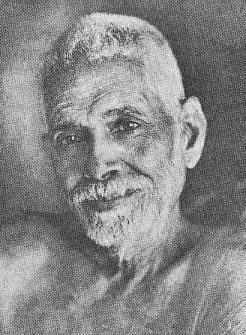
Even the budding harmonizer can achieve some degree of affinity with other living things besides disharmonized individuals. As he becomes more and more harmonized, it becomes easier and easier for him until it is no longer necessary for him to achieve attunement or affinity. He reaches the point mentioned in Note 5 of always being in tune with all things. Recorded examples of this ability - especially in accounts of Hindu saints - are myriad. An example is the experience of Paul Brunton in A Search in Secret India. Brunton tells how Yogi Ramiah, an advanced disciple of Ramana Maharshi, acted upon encountering a young cobra which had Brunton frozen with fear:
"... weaponless as he is, he holds both hands out towards the snake! It's forked tongue moves about in its open mouth but it does not attempt to attack him... the strange visitor stands quite close to the snake which bends its head before him, and then he gently strokes its tail." (6)
Although bilocation, or conscious existence at two or more points at once, (7) is less frequent in occurrence than attunement with all living things, it too is found described in accounts of saints with surprising frequency. Many famous Christian and Hindu saints are known for their ability to bilocate. Examples include Padre Pio, a priest of the Capuchin order presently being considered for beatification, (8) and Swami Pranabananda, the "Saint with Two Bodies" described in Paramahansa Yogananda's Autobiography of a Yogi. (9)
Still another ability of saints - which goes far beyond ordinary telepathy (or beyond the inner listening of a harmonizer who is less than totally harmonized) is that of knowing the innermost thoughts and desires of individuals who have either directed their thoughts toward them or who have surrendered to them as God incarnate. Padre Pio manifested this ability as does Sai Baba. (10)
One of numerous accounts in Samuel H. Sandweiss's Sai Baba the Holy Man and the Psychiatrist tells how a woman requested something for "which she had been praying for a number of months." (11) Sai Baba responded by "stepping back playfully, his eyes twinkling, his face a broad loving smile, and answered her in the very words which she had been using in her prayers to him." (12) The author continues that Sai Baba "simply had no way of knowing what these words had been" and that the lady was "overwhelmed." (13)
One may find examples of how Paramahansa Yogananda knew the most intimate thoughts and actions of his ''disciples" in Swami Kriyananda's The Path. (14) Having surrendered to Yogananda, who was totally harmonized, they had in effect surrendered to God, giving Yogananda carte blanche insofar as their spiritual ''growth'' was concerned.
The ability of the being who is at or near total harmonization to instantaneously and completely heal a disharmonized individual can also be read about in literature on saints. This ability, too, exceeds that of lesser harmonizers.
In such healings, the harmonizer need not even be present nor still "alive." (15) Additionally, the healing - though still instantaneous - may be delayed until a certain symbolic action dictated by the harmonizer is carried out. Such actions are a test of faith in the harmonizer as God manifest. (16) These healings may even be such that they overcome the greatest illness (delusion) of all - death. These are the ultimate healings of the ultimate harmonizers.
One may find accounts of several of these ultimate healings in the New Testament, for Jesus was one of these ultimate harmonizers. One such account is found in Luke 8:49-56:
While he was still speaking, a man from the ruler's house came and said, "your daughter is dead; do not trouble the Teacher any more.' But Jesus on hearing this answered him, "Do not fear; only believe, and she shall be well.' And when he came to the house, he permitted no one to enter with him, except Peter and John and James, and the father and mother of the child. And all were weeping and bewailing her; but he said, 'Do not weep; for she is not dead but sleeping.' And they laughed at him, knowing that she was dead. But taking her by the hand he called, saying, 'Child, arise.' And her spirit returned, and she got up at once; and he directed that something should be given her to eat. And her parents were amazed; but he charged them to tell no one what had happened. (17)
One may also find examples of this ultimate healing in Paramahansa Yogananda's book.
These, then, are the ultimate harmonizers - individuals who have ascended to the last step or two of their own stairway. Abiding as the Heart (God), they are capable of the things given here and of many others.
It is easy to read about "miracles'' such as those described here and scoff. For, unless one sees them it is not always easy to believe. It is for this reason that those who believe without seeing are somehow special. They are more in tune with their Heart even though they do not always even know that it exists. This makes them "closer" to total harmony than those who allow skepticism to so blind them that they would even deny a miracle occurring right in front of them rather than restructure their system of belief; or those who would deny them even though they see the miracle that is life happening around them every day.
At sometime in the future everyone will eventually go beyond belief to knowledge - reaching at last the final step of total harmony. When this occurs there will be no further need for spiritual harmonizers as all individuals will be such. This time is still in the future. When it might be is considered in the final chapter of this book.
Chapter XII Notes
Chapter 13: The End and the Beginning
We are all the Self; there is nothing other than the Heart. Yet, because of the wall of ignorance and the stairways with varying numbers of steps, few people know this.
There is nothing but God manifest. Yet, there is God manifest with knowledge (the totally harmonized being), God manifest in ignorance (one at or near the bottom step) and degrees of knowledge or ignorance between these two points.
Eventually everyone will go beyond ignorance to knowledge-ascending the final step and going beyond the wall. Yet, the time for this to happen for more than a few at a time is not yet.
Some say this is the Kali Yuga-the age of darkness. One who has read Swami Sri Yukteswar Giri's The Holy Science (1) knows that this is a misconception. There is a time - yet to be - when the majority of mankind will climb to the top of the wall. When this time is to be may be found in The Holy Science or in Roy Eugene Davis' The Way of the Initiate. (2)
As one may find by reading either or the above mentioned books, man allows himself to be governed by cycles. Yet, this does not have to be. Ignorance is accepted by man, or it would not exist. The mass of mankind is happy where it is. If this were not so, the time for all to ascend beyond ignorance would be now.
Even though - generally speaking - mankind is adrift in a sea of self made ignorance; there are more and more individuals who are finding their way to shore where they stand on their own feet and become lighthouses guiding others to a safe harbor. When enough sources of light light the shore, all those who are not satisfied with their free drifting trip will find their way to shore.
Man elected his ignorance and man must elect to cast it aside. So long as he is enamored with all the sources of ''fun,'' he has no reason to hunt for anything else.
When, at last, man is willing to grow, to be open, to look to the Heart by whatever name, this will be the end of ignorance and the beginning of knowledge. Until that time, there will be the disharmonized and the spiritual harmonizers. There will be paths and guides. There will be stairways, walls and windows. Until that time, books such as this will have a reason for existing - as signposts indicating starting points for the few.
Chapter XIII Notes

Circle Amaze
by Keith McWilliams
Frank was young, but he could love and hate. In fact, he couldn't stop.
Frank watched intently as the ant scurried back and forth on the cement trying to evade the broiling rays of light emanating from his magnifying glass. He felt a slight pang of guilt inside him. He knew it was wrong to torture ants but it was kinda fun and, after all, it was only an ant. Lisa would get upset and start crying if she saw him doing this because she didn't like anything to get hurt. Frank was watching out for her though. She wouldn't find out.
The ant, frustrated at each attempt to escape, paused for a moment as if in reflection, then darted off again only to be turned back by another barrier of heat. Frank decided to burn the ant, his fifth of the day. With a skillful turn of his wrist he caught the insect in the hot white point of light. The ant spun around convulsively and managed to escape though its tail end was now dragging. Frank observed the creature's painful struggle for a few seconds while debating whether to kill it or not. He let the ant go.
Vicksburg Junior High School, which Frank attended, was two blocks away. Rising from the curb, he brushed the wavy black hair back from his forehead and began walking. The summer sun was high overhead as he sauntered onto the school basketball court clad only in cut-off jeans and sneakers. No one was there though. It must be lunch time, he reasoned, and hurried back to his home, one of the small anonymous brick houses built into a row like dry goods stacked together on a shelf in a poorly swept grocery store.
Lisa, Frank's younger sister, met him at the door. Her eyes bathed him in a look of adoration as he came in. "Hi Frankie," she smiled, taking her brother by the hand, "Come see what I made for you." The gentle way she tugged at his hand filled Frank with the urge to swoop this little creature up in his arms and cover her face with kisses. But guys didn't do that kind of stuff, not the guys he knew. Only his older married cousins and grandmothers and grandfathers did that stuff when they came to visit.
He looked at her hand. It was small and delicate. It reminded Frank of the hands on those expensive Oriental dolls he had seen in the store windows downtown. They looked so fragile that one touch the wrong way would break them beyond repair.
Lisa pulled him into the kitchen where his mother stood at the stove frying some grilled cheese sandwiches. Lisa grabbed a piece of paper off the dining table and held it behind her back while she grinned from ear to ear looking up at Frank.
"Close your eyes," she commanded. "Do I have to?" he replied, pretending to sulk.
"Aw, c'mon Frankie!"
"Well, all right." Frank closed his eyes and Lisa held out the paper in front of her.
"Open your eyes."
Frank's mouth opened in feigned surprise as he looked at the childish drawing of a horse she had made for him. "Wow, that's beautiful!" he said, sitting down at the table to examine it further. Lisa laughed delightedly and jumped up and down sending her brown hair flying about.
"I'm gonna have to put this one up in my room," he said.
"Really?" asked Lisa.
"Sure," he replied, and gave her a hug. Hugging didn't seem as sissified and gooey as some of the kisses he had seen relatives give Lisa. Anyway, the guys couldn't see him here.
"Lisa, clean off the table now so we can eat," said Mrs. Taylor, sliding the sandwiches onto a plate with a spatula. Lisa removed her paint tray and brushes while Frank went to the bathroom to wash his hands. When he came back his mother had finished setting the food out.
"Mrs. Barnes called me again this morning, Francis, and said you've been picking on her Jimmy again." Mrs. Taylor sat down at the table easing her heavy frame slowly into the chair.
"So?" said Frank.
"I wish you wouldn't pick on him, he's never done anything to you, and, well, my God, he's only twelve."
"He's a punk," said Frank, his eyes burning holes through the table. He had a definite dislike for the silent, sandy-haired boy he saw on the basketball courts. Something about his defenselessness sparked Frank's animosity towards him. Whenever he would push him around, Jimmy would just glare at him and run away. It was at these moments that Frank felt his hate peak and his insides would get all tight and he wanted to chase after Jimmy and scream, "Come on, you chicken, fight back! Punk! Punk!" But something - he didn't know what - stopped him. Maybe it was the way his body trembled after Jimmy had run away. That bothered him.
"You know, Francis, he's going to hold this against you and someday when he's older he might try to get even with you."
"Jimmy's so quiet all the time," said Lisa.
"He's just a punk," said Frank, biting into his sandwich.
"If only your father were alive he'd straighten you out." She sighed, "Francis, when will you grow up?"
Lisa tugged at his sleeve, "Frankie, take me to the park this afternoon." Lisa, at least, called him by his right name, his real name.
Most of the boys in Vicksburg went up to the courts after supper to loaf or play basketball. Frank didn't go up right away this evening. He walked through town instead, stopping to gaze idly in the store windows. He thought of the guys at the court playing basketball. Steve would probably be there. Frank admired Steve's skill as a player, and Steve was a nice guy too. He had tried to help Frank improve his skills but Frank couldn't put his heart into it. The game was just too boring. And there were other things to life besides basketball anyway. Reading books and going to the movies were far more interesting than throwing a stupid ball through a hoop hour after hour. And besides, a book or movie couldn't criticize you the way the other guys would if you weren't coordinated. Frank didn't like being called a "jerk" or told, "you're no good!" Some guys just got so worked up over a game. Several times Frank had quit in the middle of a game because he had had enough of the name calling he got. He would leave the courtyard and walk down by the railroad tracks where it was peaceful and he could be alone. The tracks were nice to walk along and pretend you were going on a journey to a different place, anyplace. And you actually were. One time he walked what seemed to be miles along the tracks. They just kept on going as far as he could see. They didn't seem to be going anywhere.
Sometimes Lisa would see him and follow him to the tracks. He didn't mind. Just by wanting to be with him she made him feel better. Often she would pick out plants along the way and ask, "What's that?" And he would tell her, proud in the knowledge that the books he read had given him. She liked to hear him read to her too. Mostly fiction books she found at school which she didn't understand and he could explain to her. Lisa seemed to be the only person who found him and the things he did interesting, and she adored him. A faint smile flickered across his face.
As he approached the courts Steve saw him. "Hey, Frank!" he yelled, "Wanna shoot some hoops?"
"Yeah."
Steve threw the ball to him and he broke out into a dribble, working his way up to the free throw line and taking a shot. It was a swish. Perhaps he wasn't that bad after all. Frank grinned. The boys picked up teams and began to play. Frank's team soon pulled out in front and maintained a steady lead. Frank had control of the ball and was about to shoot when he noticed Jimmy Barnes ride his bicycle onto the school grounds.
Frank missed the shot and the ball went out of bounds. Looking at his watch he announced, "Hey, I gotta be home soon. I'll catch you guys later." He ran off towards the school building.
The school had a dirt road encircling it. Jimmy had entered from the side opposite the courts and planned to ride around the building. Realizing this, Frank ran to the side of the school and waited in the portals of a doorway. This part of the schoolyard couldn't be seen from the courts. As soon as Jimmy came around the corner, Frank leapt out onto the road and blocked his way. The boy swerved his bike and tried to turn around and get away but he was too slow. Frank ran ahead of him and grabbed his handlebars. "Going somewhere, punk!" Jimmy didn't reply. Frank felt a wave of contempt come over him. "Do you always go running to your mommy?" he sneered.
They stood face to face for nearly half a minute without saying a word. Then Frank cleared his throat and spit in the younger boy's face. Jimmy turned red and tears started to form in his eyes. This kindled Frank's hate even more. He pushed hard on the handlebars, sending the bicycle and its rider flying backwards. The bike tipped over but Jimmy managed to catch the ground with his hand. His face was a distorted mask now, and tears flowed freely, down his cheeks. Frank laughed. "Get outa here, punk! I don't want to see your ugly face around here!" The other boy glared at him, then turned around and pedaled away furiously while little high pitched whines came from his throat. Frank picked up a cinder and threw it after him but his arm was trembling enough to send the missile far to the left of its intended target. There was sure to be a call from Mrs. Barnes tonight.
It never came. He didn't go home till late hoping to avoid the inevitable, but somehow he was spared. His mother didn't say a word about Jimmy Barnes.
He went up to his room and undressed, then got into bed. It was a sultry night. Even though he had only one thin blanket it was impossible to sleep. The sheet imprisoned him like a vast barren range from which there was no escape. It seemed to be prodding him where it touched his skin, keeping him awake in a torment of sweat and heat.
He threw off the cover and lay sprawled on the bed. He felt his consciousness drifting. Thoughts forged through his mind without direction. He seemed to be watching his own mind at work. An image formed in his head, one he had seen many times before. It was himself years ago, up at the courts. A short, thin boy, timid and alone, hanging on the fence watching while the older boys played basketball. The older boys picked on him. "Francis," they would say, "Francis. Is that what your mother calls you? That's a girl's name!" He hated them. Why couldn't they be nice to him? He just wanted to be friends. He kept coming back, hoping that they would stop teasing him and be his friend. But each time the taunting grew worse and worse and a smoldering rage would build up in him, but he never said a word. He couldn't defend himself against them. He didn't know how. They called him a sissy and sometimes he wondered if they were right. He was the only boy in the neighborhood who couldn't play basketball. None of the other boys liked to read books like he did. He was strange. Maybe he was a sissy. "Francis!" They always yelled as they chased him away, "Francis... Francis... Francis!"
He awoke to a bright sunny morning. His body ached and he felt like being alone. After a quick breakfast of dry cereal he left, not answering his mother's inquiries as to what his whereabouts would be. There were railroad tracks about a quarter of a mile from his house. Frank walked there and spent the morning sitting by the tracks throwing stones at the crossties. He pretended each crosstie was Jimmy Barnes's face.
It was nearly one o'clock when he came back. He went to the courts to see who was around. Steve came running over to him before he reached the school grounds. "You better go home quick, Frank," he said, "Your sister's been hurt. It looked pretty bad."
"What?" said Frank, "What happened?" His heart began to pound.
"You better go home, Frank." Steve dribbled his basketball and gave Frank a weird look.
Frank ran back to the house and burst through the front door. He heard Lisa crying. He hastened to the bathroom and found her, her face streaked with blood from a gash on her forehead. There were brush-burn marks on her arms and legs as well. His mother was hovering over her, weeping, trying to clean her up.
"You see what you've done now?" she screamed at him when she saw him. "What happened? Lisa! Are you all right?" He knelt down to hold her but she twisted away from him.
"That Barnes boy came up to her on the playground near the courts and shoved her down onto the asphalt. She hit her head! I hope you're satisfied now!"
Frank knelt there on his right knee and stared at his sister's face until her eyes met his, holding his gaze with an ugly accusing stare. He felt his body trembling. "Lisa?" he asked, trying to speak soothingly. She had stopped crying when he came in, but hadn't said a word. "Lisa?" Again no answer. That look on her face! He began to get sick. Something was pounding in his head. He started to cry and turned his face to hide it.
"I should've known you would bring this kind of trouble on us!" his mother sobbed.
"No!" thought Frank. "It's not true!" And suddenly he pushed aside any thoughts that wracked his conscience and filled the spaces with a hate that came from the very depths of his being. He ran from the room and out of the house. "Francis... Francis!" his mother yelled after him.
He had no idea where to find Jimmy Barnes, but even in his rage Frank knew he would not be in the neighborhood, or even at his house. He had to be hiding someplace. Frank ran up the street, looking in each store as he passed by to see if Jimmy were there. This time there would be no escape for that punk.

Frank felt a dryness in his mouth as he ran out of the neighborhood. Only one thing kept going through his mind: that look of accusation on Lisa's face. He had to wipe that image from his mind forever. He'd make things right again. He'd make it up to Lisa... he'd get that punk.
He was tired now, and people kept getting in the way. Suddenly he saw him a block down the street, looking in the front window of a store. Frank ran faster now, his hate feeding his muscles. His footsteps seemed to resound in his brain, jarring him with pain each step closer he got to his quarry. Jimmy's head abruptly shot up as he heard the approaching steps. He started running but Frank was faster. The older boy grabbed him by the back of his shirt and whipped him around, slapping him in the face as hard as he could with his right hand again and again. Jimmy uttered a strange girl-like shriek as blood began to flow from his nose and lips and was smeared over his face by Frank's relentless hand. A small crowd of people began gathering. A man from inside one of the shops came running towards the two boys.
Frank stopped slapping to get his breath and stared at Jimmy, who rolled his head around as Frank looked into his eyes. The accusing face of his sister, covered with blood, stared back at him. He let go of Jimmy, who fell to the ground, and turned away walking slowly, bent over like a tottering old man. The shopkeeper had reached Jimmy and was holding him in his arms. Nearly everyone else was watching the strange way Frank was walking and trembling all over at the same time. Someone from the crowd went to help him when he hit the pavement.
The Wholistic Health of Dr. Jonas E. Miller
At 79, Dr. Jonas E. Miller has spent well over 50 years ministering to the body, mind, and spirit of his patients and other people with whom he comes into contact. Author of the new book, Prescription for Total Health and Longevity, published by Logos Books, Dr. Miller incorporates a basic nutritional approach as well as Acupuncture, Auriculotherapy, Endocrinology, and the Reams Urine-Saliva Test in his practice.
A graduate of The Baltimore Medical College in 1924, Dr. Miller maintained a general practice for five years in rural southwestern Pennsylvania as a "country doctor." Later, while residing in Washington D.C. he served as Medical Director of the Health Foundation Clinic with 14 aides, and has cared for diplomats, members of Congress and Cabinet members. He served two terms as editor of the American Journal for Medico-Physical Research.
Dr. Miller's desire for additional knowledge has led him to personally visit over 60 countries, traveling twice around the world and to Europe 14 times where he has studied at first hand the art of Acupuncture and Auriculotherapy [ear acupuncture]. In 1972, he became the first American to regularly practice Auriculotherapy in this country. Dr. Miller has received personal instruction from Dr. Guido Fisch, president of the Swiss Acupuncture Society, and Dr. Nguyen Ngih, president of the World Acupuncture Society, as well as Dr. W. Limage of Paris, Dr. Roccia of Turin, Italy, Dr. Luke S. Chu of New York, Dr. Buridol of France and Dr. Nakabayashi of Kyoto, Japan. During 1977 and 1978 alone, he attended 22 advanced teaching seminars at home and abroad that dealt with the latest advances in the health sciences. In 1944, Dr. Miller established his practice in Sarasota, Florida and founded the Health Foundation of Sarasota where he maintains an active practice today. Because of his research in all of the fields mentioned, he started to teach other doctors what he has learned and now operates The American College for Studies in Metabolism and Endocrinology where the latest information and techniques are shared during special Symposia-Seminars.
Dr. Miller is also an ordained minister of the Peninsular Florida District of the Assemblies of God. He speaks an average of more than 25 times yearly in churches and before other groups. He has conducted camp meetings, medical seminars, evangelistic meetings and has lectured before professional and non-professional groups. His articles have appeared in religious and other publications.
Dr. Miller was recently interviewed by Craig Smucker about his approach to health and his basic healing techniques. What follows are his comments on balanced eating, Auriculotherapy, weight control, arthritis, allergies and the genetics of dietetics.
[Figure: Dr. Jonas E. Miller with souvenirs of his remarkable cures.]
The Health Foundation and Its System of Balanced Eating
The Health Foundation has a staff of two doctors and a total of six others who are technicians or nurses. While we greatly emphasize Orthomolecular and Preventative Medicine as we think it is better to keep people well than to get them well after they are sick, some of our work deals with problems of Metabolism and Endocrinology. Many of our patients come to us with problems of low blood sugar, diabetes, arthritis, high and low blood pressure, poor digestion, overweight, underweight, as well as migraine headaches and many other kinds of aches and pains.
I have had records of over 50,000 patients we have examined and treated in the past 52 years. I have seen them born and watched them die and know that there are things we can all do that will help us prolong our days and make them more comfortable. This is why I have chosen a way of life that is designed to prolong my life and make me more comfortable as well as able to help people as we go along. This plan has helped me to live, married to my wife for more than 56 years, neither of us having ever had a confining illness; so I am going to share some of the things we do with you to help you stay active longer and enjoy life more.
We have been told that we are, or become, what we eat. This is true. But it is not only what we eat, but how it is grown, prepared and then eaten that counts. For all practical purposes, we can divide foods into three categories. They are proteins, carbohydrates and fats. Proteins are the main source of life. It has been said that we all die of protein deficiencies, regardless of what we die of.
The next category is carbohydrates. This includes all kinds of cereals, corn, wheat, rye, barley and most root vegetables. Also some fruits such as bananas. Carbohydrates are converted into sugar in the process of digestion. The fats come from oils, butter, lard, fat meat, some oily cheeses, cooking oils, etc.
There is yet another category that includes all kinds of vegetables which supply fiber, which is necessary to sweep the intestines and keep bowel action moving. Most constipation is originally caused by lack of fiber in the diet. Many vegetables also supply trace minerals and many other nutrients. Trace minerals are important to health and when we skip them, we may deprive ourselves of these life giving trace minerals.
Each of the food classifications listed is digested under differing secretions of the digestive tract. This means that even though we get a well balanced diet (yet few of us do), the way we prepare these foods and the way we eat them is important.
The moment we eat anything and it strikes the stomach, hydrochloric acid is secreted. Hydrochloric acid digests proteins, so we should always start our meal with some protein. After our protein is ingested we can then start eating other things that are digested in a medium of pepsin. This could be vegetables, and by the way, vegetables are best eaten raw or with the least amount of cooking to make them palatable. Then we should reserve our carbohydrates until last and they should be thoroughly masticated in the mouth with saliva which contains an enzyme called ptyalin. Unless you thoroughly mix the saliva with the starches, they are not completely digested and you have some fermentation causing gas or stomach distress. In short, you should chew bananas and mashed potatoes much longer than you chew your meat, but they should not be eaten together. Even our animals know better than we do about eating. They gulp their meat down rapidly for it is only necessary to chew your meat till it can be swallowed but your starches must be thoroughly mixed with saliva before swallowing, to be completely digested.
Fats and oils are metabolized in the small intestines in the presence of a secretion that comes from the liver, known as bile.
For those of you who are trying to keep your weight down, this must be remembered also. Tests have proven that what you eat by noon is most important if you want to keep your weight down. Here is why. God so designed the body that what we eat early in the day is to build the body and give it strength for the labor of the day. Therefore, you have time to make good use of the energy of the food eaten early in the day and up to noon to supply you with energy the rest of the day. But if you wait to eat until later, you will not be able to make use of the energy from the food you eat and you will gain weight. This means that you should eat a good breakfast and fair lunch and a very light evening meal to lose weight and keep it off afterward. Now you know why we see so many people who are overweight who do not eat breakfast.
Even our animals know better than we do about eating.
To summarize: when eating, eat your proteins first, your salad next and your starches last, after thorough mastication. Eat more at breakfast, moderately at noon and less in the evening for better health and longer life. Be sure to eat fiber foods such as is found in vegetables. Bran is often a good fiber food to keep bowels regular. It is necessary to drink lots of water, up to two quarts per day, as this also helps to keep stools soft, and keeps the kidneys active.
Over 200,000 people die every year of intestinal troubles. This includes anything from gall bladder attacks to gastritis, ulcers, hemorrhoids, and diverticulitis, an infection which may occur in small pocket-like protuberances in the intestinal tract. This is due largely, in fact I believe almost entirely, to the fact that people are not eating in the proper order.
A few words about food supplements and vitamins. It is my opinion that they are essential because many of our foods (so called) are processed to death, leaving very little in the way of good nutrition. It may be raised on poor soil without proper care. If you do want the best in vegetables, get them fresh and as close as possible to the place where they were raised. Some people are vegetarians, that is they believe one should eat only vegetables and not meat or animal products. We know that meat contains more amino acids or proteins than other food substances. You need both animal protein and vegetables for an adequate diet.
As we grow older the digestive secretions are lessened. To assist digestion under these circumstances, you can take a tablespoonful of apple cider vinegar to a glass of water before eating proteins. The potassium in vinegar also helps to stop cramping of the legs and other parts of the body. You can use the apple cider vinegar in water as many times as you want to, especially before meals.
Auriculotherapy
I originally became interested in acupuncture while visiting my daughter who was living in Singapore. Her language teacher was an acupuncturist and even though I was somewhat skeptical at first, I kept an open mind and visited clinics in Singapore, Hong Kong, China and Japan. I studied traditional acupuncture and became proficient at it. But I wasn't quite satisfied. The patient was often uncomfortable, they had to disrobe and long needles were used all over the body. I was getting results but I just wasn't satisfied so I attended the council on Biological Medicine in Lausanne, Switzerland in 1972. It was there that I saw a demonstration of Auriculotherapy. It's really not that difficult to explain.
In the human ear there are nerve endings connected to the brain and to every other part of the body. It's like a relay. The nerves come from the brain and reach the outer part of the ear and they also reach every part of the body.
There are three forms of tissue found in the body, endoderm, mesoderm, and ectoderm. They are also found in the ear. Wherever you find endoderm in the body, you'll find endoderm in the ear corresponding to that area. This is also true of mesoderm and ectoderm. Therefore, by stimulating these points in the ear with a small electrical current, you can reach any part of the body. Nerve energy is stimulated which travels to the brain and then out to the corresponding part of the body. Thus the nerve pathway is restored to its proper function.
In the human ear there are nerve endings connected to the brain and to every other part of the body.
One of our patients was completely paralyzed from the waist down following spinal surgery. Now as long as the nerves have not been severed you can help them. If they've been severed you can't. This patient had absolutely no feeling or control of her functions below the waist. She had no feeling whatever. She got to a point where she could stand on her feet by holding onto the wall and throwing her feet out but she didn't know if her toes were turned under or not, but she couldn't walk by herself. One time she stepped on a lighted cigarette and didn't even know it till she smelled the flesh burning between her toes. Today she does her own housework. She has complete control of her bowels and kidneys and everything. This was following treatments by Auriculotherapy.
Another woman spent ten years on her back in continuous pain. But with a single treatment she was relieved of all pain. This was one of the more miraculous cures but we have had others that are similar.
In the front room of our office is a wheel chair, some crutches, braces and a cane. They once belonged to a man who spent eight years in that wheelchair. But after one treatment he never had any more pain and could work and go about his business. He's brought us over 60 patients from around the country. He was injured in an accident and his spine was very badly crushed. Of course they operated and did all that they could but they were unable to correct everything that was wrong with the nervous system. By using the method of Auriculotherapy you stimulate through and directly affect the nervous system. As a result he was able to get out of that wheelchair.
Not all have had such miraculous recovery. One man was slated for the removal of his leg but still has it three years later. We recently treated a lady who came to us from East Germany for a condition she had not found relief for in her country. Another lady, the mother of three doctors came to us from Ireland for treatment and went home well. Many others have found relief by this method when all else seemed to fail. Unfortunately, we also have failures, for one reason or other. Nevertheless, we believe this science has much to offer the sick and ailing, especially those suffering from pain. Through the human ear we can reach every part of the body to relieve pain, awaken tired and sometimes non-functioning nerves. We have people coming to us from many states and from great distances for this special treatment.
Weight Control
Many of our patients come to us because of excessive weight or fat. We have seen over 6,000 patients for this problem during the past 20 years. I personally lost 75 pounds, down from 235 to what I am today and I have never regained more than a few pounds of it at any time. Even though I have been where there is all manner of food available, such as on board ship, or other tours where we stayed in fine motels with excellent cuisine. I merely select what I wish and eliminate what I don't want.
Through the human ear we can reach every part of the body to relieve pain, awaken tired and sometimes non-functioning nerves.
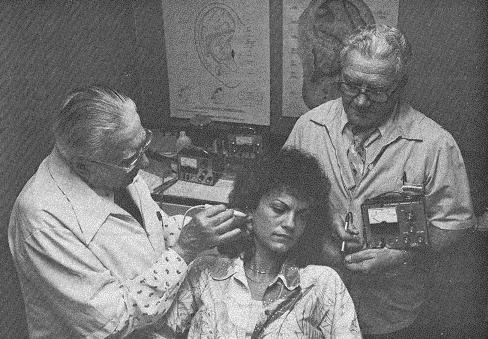
[Figure: Dr. Miller and technician use Auriculotherapy, a form of acupuncture, to treat a patient at his Health Foundation in Sarasota, Fla.]
Our program is based on the work of an English scientist who lived for many years in India and in Rome. I also spent time there to get my own weight down. He pioneered the system we use. I have never seen anything like it. His name is A.T.W. Simonns.
Here is how it works. We make extensive blood tests, measurements, etc. and then prescribe glandulars to help sluggish glands do their work again. Then we use a fat mobilizer to convert fat into nucleoproteins and thus release as many as 2,000 fat calories to be converted into usable protein when eating only the foods we prescribe. Sometimes people will not stick to the regimen; then they become hungry. When we ask them if they are sticking to the program of eating what we prescribe and taking the glandulars, they may reply, "I try to." Then I tell them that this is not good enough, they must stick to it to get results. We have many who have lost pounds and inches up to more than 100 pounds.
Also, it is important to remember that the food you eat in the a.m. usually goes into protein or energy, while these same foods eaten in the evening will go into fat.
Arthritis
There has been a real breakthrough in the field of arthritis. We are equipped to make the tests, and individual treatment for many types of arthritis especially the worst kind which is rheumatoid arthritis, the crippling kind. We have seen patients that were badly crippled, who under this treatment regained the use of stiff joints. While some of the deformities remained, the pains were lessened and in some cases completely eliminated. While we wish we could say that even dislocated joints would go back in place, we cannot. However with proper care, many such patients are now pain free and able to get about again after years of suffering and pain. We know of nothing that completely removes arthritis and crippling but to be free of pain is wonderful, or so we are told by patients who are now pain free.
... the food you eat in the a.m. usually goes into protein or energy, while these same foods eaten in the evening will go into fat.
This new hormone treatment was developed by a Dr. Varon of Dallas. It is based on the premise that a woman who is pregnant does not have arthritis. Dr. Varon studied the role of female hormones during pregnancy. He started giving the person with arthritis the same things that a woman secretes when she is pregnant. To his joy he found out that when given in the proper dosage, the arthritis was relieved and in many cases cured. My first impression was that this is good for women with arthritis but what about men? So we have been working on the premise, so far as a man is concerned, that the male climacteric corresponds to a woman's change of life. The treatment consists of a number of injections of the same hormones that are often lacking when a woman or man has arthritis and their hormone level is low.
It is merely supporting the endocrine system with hormones that the body is not producing and to date no unfavorable symptoms have been observed. I do not believe you can harm anyone by supplying what is missing, due to age or other conditions.
Allergies and the Genetics of Dietetics
An allergy is a sensitivity to some substance one comes in contact with through any of the following:
Skin: As in touching something, or something touching it. May be due to putting something on the skin, such as lotions, deodorants, etc. Or coming in contact with poison ivy, detergents, certain synthetic fibers, fur, the skins of fruit etc. Hives and eruptions may result.
Lungs: Breathing pollen or fumes from paint. Inhaling smoke or other irritants. Exotic odors. Animal dander. Dogs and other animals. Asthmatic and other breathing disorders may result.
Stomach: Eating foods you may be allergic to. Could be a common food such as eggs, bread, tomatoes, etc., or certain fruits and vegetables.
An allergy can be caused by anything you breathe, touch or eat and can result in any of the following reactions: Angioneurotic edema, canker sores, hives, low blood pressure, epileptic seizures, dizziness, tiredness, constipation, gastric ulcers, headaches, depression or any one of a dozen other symptoms.
Technique for determining what one is allergic to:
If the pulse rises more than 10 beats per minute, there is likely to be some allergy present.
If so, then check every item of food eaten, do the same with odors, things touched or fumes inhaled. To screen them, start eating one single item of food alone and recheck.
Consider the spices and seasonings used in their preparation. Check combinations. Check the type of water used, cooking utensils, etc. Some people are allergic to aluminum.
If pulse count does not go above 84 per minute at any time, one is not likely to have come in contact with anything to which he is allergic.
Pulse will be faster during colds, fevers and infections; take this into account. Bee and insect stings cause allergies in many people. Getting close to a Mango tree or even near poison ivy or oak can cause allergic reactions. Many drugs also cause reactions. Severe allergies can result in death from Anaphylactic shock. Also consider tobacco smoke, insecticides and poison sprays.
The pulse test is the most accurate and reliable test for the layman. It requires only a watch with a sweep second hand and some time. When a person is more Alkaline than he should be, there is more likelihood of allergies developing. An acid reaction of the body which is normal, offers resistance to allergies.
I am allergic to any wheat product and I did not know that for many years. I could not understand why this was so. When I went back to where my ancestors were from in Switzerland and Germany I found out they didn't raise wheat at all. So genetically I was still tied in with my ancestors of over 200 years ago. They did not eat wheat and I cannot eat wheat and get along with it. So I found out they were using rye, buckwheat and millet but they were not using wheat. I can now understand why my body was not adjusted to the use of wheat.
Therefore, I always make it a point to find out from my patients what their genetic background is and how the food was prepared by them and what it was. The same food is not necessarily good for all people.
For example, a number of years ago an American crew was captured by the North Koreans. The North Koreans fed these men and the Red Cross investigated to find out if they were getting good nutrition. They said yes they were getting the same as the North Koreans. It almost killed the Americans while the North Koreans got fat on the same food. There is a definite genetic influence in nutrition.
I am convinced that if each of us followed our own genetic dietetic bent, and ate as our ancestors did, we would be much better off.
Dream Dialogues
by David Gold
Dreams Within a Dream
Editor's Note: Dream Dialogues will be a regular feature in future issues of TAT Journal. In order to facilitate its expressed purpose as a dialogue between the author and reader, you are Invited to send in any personal dream experiences, as well as your insights into those experiences, which relate to this issue's column, or which you would like to see incorporated into some upcoming column.
Write to: Dream Dialogues - TAT Journal ________
Nowhere are the limitations of traditional psychology more apparent than in its dealings with the world of dreams, and dream interpretation. By refusing to recognize that man's consciousness is not limited to his physical body, or to this dimension for that matter, psychology is forced to explain all dream phenomena within narrow concept structures which invariably miss the mark.
I am thinking, in particular, of a phenomenon which I experienced last week while staying overnight at the house of some friends. I was dreaming that I was under attack by entities, or demons, and the fright caused by this assault caused me to cry out. My shrill appeals for assistance evidently awoke everyone in the house, including me, for soon I was talking to my hosts about the terrifying dream which I had just experienced. Moments later I woke up, and discovered that everyone else was still asleep. I merely dreamed that I had awakened.
The "dream within a dream" phenomenon is common to anyone who regularly remembers his dreams. These multiple dreams can be as simple as awakening to answer a phone (only to again awaken to the ringing phone, and discover you merely dreamed you had already answered it), or as deep and terrifying as the complete inability to awaken back into this "real" dimension.
What causes this phenomenon? Do we actually awaken into another state of consciousness, or do we merely dream that we awaken? In search of a satisfactory answer, I consulted the granddaddy of dream interpretation, Sigmund Freud.
Freud's basic conception of the nature of a dream readily explains the dream within a dream. Freud believed that the real function of a dream is to protect a person's sleep by integrating potentially awakening stimuli into the sleeping process. Stated simply, if you are sleeping, and a noxious noise or thought is recorded, or transmitted, by the body, the natural response would be to wake up and deal with, or eliminate, the problem. Dreams preserve sleep by reacting to these stimuli for us in the dream while we, or our bodies, continue to sleep.
An example may help: I am sleeping, but while I doze my body is sending me the message that the room is cold. If no dreamer existed to handle this situation, I would be forced to wake up and put on another blanket. Instead, I may dream of being out in the woods on a cold winter night, and of finding a cabin and building a cozy fire. I have thus resolved the conflict without being aroused, and my sleep, albeit a cold one, is preserved.
The dream can be a barrier against psychological as well as physical interferences, we are told by Freud. While sleeping, our minds may remind us of some task we failed to do or some conflict that was left unresolved. Instead of waking to worry about the problem, the dream works out the problem for us. Our unrequited desires are fulfilled, our problems worked to fruition, and still we continue in the sleep which our body demands.
The dream within a dream situation fits easily within the Freudian construct. The seeming awakening from one dream into another represents a compromise between two conflicting forces: the desire to awaken from an unpleasant situation, and the body's simultaneous desire to remain at rest. The resolution consists of awakening from one situation and falling back asleep into another.
To use a Freudian example, an individual may be expressing his repressed homosexual tendencies in a dream. The dream reaches a point where the dreamer is ready to engage in sexual relations with another man, which is basically abhorrent to him. He resolves the problem by awakening into another dream, which allows him to continue to doze yet simultaneously escape from an unpleasant scene.
And that, in a nutshell, is Freud's explanation for the dream within a dream. Do I buy it? Sort of. The theory makes sense - as far as it goes. It is quite logical that awakening from a dream is an escape (though often an unrequested and undesired escape in the case of a pleasant dream), and that "awakening" into another dream falls something short of re-entering this seeming "reality."
But this explanation is, of necessity, restricted by the limitations of the entire Freudian concept structure, in so far as that system refuses to recognize the ultimate possibilities of both man and reality. Freudians traditionally reject the idea that man has a subtler essence which may not be limited to the body, and which may possess the capacity to travel independently of the body during sleep. They also refuse to accept the possibility that dimensions may exist other than those normally visible to us and that these dimensions may be accessible during sleep. Basically, the theory is incomplete because it fails to recognize the myriad of dream phenomena that the dreamer can experience.
I have stated in previous dream writings that it is my conviction, as well as personal experience, that an individual (or his consciousness) can travel, independently of the body, to different dimensions during sleep. For those with a critical, scientific mind, I would recommend, once again, Robert Monroe's Journeys Out of the Body, as well as a perusal of current psychological abstracts that promote a better understanding of out-of-the-body experiences. If you are experientially oriented, you will find that continued personal dream work leads to a greater consciousness during sleep, which in turn leads to a greater awareness of nocturnal visits and visitations.
Inter-dimensional dream travel must be considered as at least a supplement to Freud's dream within a dream explanations. For, quite often, it is the dreamer's uncompromised desire to awaken completely from a terrifying dream experience, and the dreamer simply cannot do so. In the personal case which I previously related, my sole thought was to escape from the entities, and awaken into the dimension which I call home. No room existed for compromise in the Freudian sense; I just wanted to break free. Instead, I found myself in another dimension, fully conscious, very frightened and still under attack.
Freudians could, undoubtedly, explain my experience in mundane terms. But the theoreticians were not there, they did not experience the consciousness, the reality that I found when I "woke up" in that dream. Dreams can be an expression of mental machinations, as psychologists explain. But they may also involve journeys to other dimensions, and when we fail to fully awaken, or to vibrate at the speed of this dimension, then we may wake from one dream dimension into another. This possibility must also be considered in the situation where we awake from a dream not once, but several times.
Dream Dots: Bothered by recurrent elephant dreams? Neither am I. But apparently someone is, because psychologist Rita Rondschoff felt there was sufficient interest to publish an article in the Clinical Social Work Journal entitled "The Elephant in Dream and Myth." Seems as if elephants in dreams represent an anxiety, particularly one related to aggression. That is, of course, unless you are an elephant.... Many people approach me following dream talks and ask about ways of improving their dream recall skills. Few, however, seem willing to take the often tedious steps necessary to start remembering more of their dreams. At last, a glimmer of hope from Flinders University of South Australia. A study of over 2500 females suggests that women taking oral contraceptives are more likely to remember their dreams than those that do not. For you males out there, explaining to your doctor why you need a prescription for the pill may be difficult, but I suppose it beats setting your alarm for 3:00 A.M. in hopes of hitting on a dream...
Astrology and Your Split Personality
by Michael Whitely
How well do you really know yourself? This question may seem obvious, but the answer may not be quite so simple. If you start by being aware of your body, and bit-by-bit include your emotions, thoughts and desires, you will still be hard-pressed to identify that particular something which makes you what you are. The way we see ourselves may be more or less an accurate picture of how we think we are, but can we really see ourselves as others see us? Is it possible that some of the problems and misunderstandings about your own behavior, and that of your family, friends, and co-workers, may be rooted in the assumption that others see you as you see yourself? Hopefully, we can shed some light on this perplexing situation by using the language of Astrology to expose our inner and outer personalities as revealed by the Sun Sign and the Rising Sign.
Throughout the year, the Sun, as seen from the earth, spends approximately thirty days located in each of the twelve Signs of the Zodiac which encircle our globe. Your Sign was determined by your birth during that particular phase of Nature's cycle and names your basic type of Individuality, your inner person. Each day as the earth spins on its axis, it makes one complete rotation within the circle of the Zodiac, moving through one Sign every two hours. At the time of your birth, one of the Signs was directly to your east on the horizon: this is your Ascendant or Rising Sign and shapes your outer appearance and external personality.
Take a moment to reflect and consider the "you" that you are when you're alone, removed from the daily rat race, or the times when you are with close friends. Now take a look at the personality you assume at work; or with people you may not care for; or even when you are feeling great. This surface personality is the image we tend to present to the world, the personality others form their first impressions from.
We have all had the experience of meeting someone for the first time and receiving a distinct impression about them, perhaps from their appearance or bearing, only to find after getting to know them better that they really are not that way at all! We experienced some quality of their Ascendant in making the initial assumption.
Before going on to take a look at all the Signs in detail, here are the main characteristics that explain the difference between the Sun Sign and the Rising Sign:
| Sun Sign | Rising Sign |
|---|---|
| Inner Motivation | Role in Life |
| Individual Type of Ego | Surface Personality |
| Essential Person | Projected Image |
You can use the simplified procedures outlined below to examine the Sun/Rising Signs for your family, your friends and yourself. A close examination of your particular Sun/Rising sign combination will expose the potential harmony or discord between these personality factors.
| Aries | March 21- April 19 |
| Taurus | April 20 - May 20 |
| Gemini | May 21 - June 20 |
| Cancer | June 21- July 22 |
| Leo | July 23 - August 22 |
| Virgo | August 23 - September 22 |
| Libra | September 23 - October 22 |
| Scorpio | October 23 - November 21 |
| Sagittarius | November 22 - December 20 |
| Capricorn | December 21 - January 19 |
| Aquarius | January 20 - February 18 |
| Pisces | February 19 - March 20 |
Sign Meanings Chart
ARIES - The Ram ......... Keyword - I am
The inner aim of the Aries type is leadership in some form or fashion. As an uncomplicated expression of the drive to Be, this sign possesses a strong sense of individuality that can border on pure egotism and a strong sense of independence that can degenerate into rebelliousness. The Sun in Aries gives the capacity to launch a crusade or campaign fueled from the Aries storehouse of enthusiasm and drive. As an energy-generating Fire sign you are impulsive, inspirational, assertive, and at times so straight forward, that you appear naive. The blindside of Aries is a lack of personal insight, or self-awareness.
Appearance: Prominent head and nose, energetic appearance, can have red hair.
TAURUS - The Bull ............ Keyword - I Have
A conscious aim of security derived from a strong sense of values is the hallmark of the Taurian Sun Sign. They strive for this security by realizing the value of people, material, and situations, and then setting out in a determined manner to stabilize their own situation, home, career, or finances. As fixed Earth your Sign works in a conservative and deliberate way that can become simply lethargic and unimaginative.
Appearance: Two types: The Venus influenced, with a beautiful appearance in men and women and an artistic/poetic nature, plus the Earth type with a shorter, stout neck, strong back.
GEMINI - The Twins ........... Keyword - I Think
The conscious aim of the Gemini type is to establish relationships. For this individual ideas, people, things, are all stimuli; fuel for the ever active mental processes. There is a strong sense of awareness as you gather inputs from your environment. As a changeable Air Sign your flexible qualities can result in an unstable and inconsistent behavior. As your energies are directed towards the mental faculties there can be a decided lack of empathy or feeling quality.
Appearance: Tends to have tall, lean look, eyes have an electric quality, you tend to look nervous, agitated.
CANCER - The Crab .......... Keyword - I Feel
Emotional unfoldment with all of its variations and subtle textures is the keynote of the Cancer individual. There is a strong sense of attachment and possessiveness and a tendency to cling to old memories, souvenirs, and dreams. To offset the highly receptive and emotional nature there is a strong desire for self-preservation and protection, (the crab's shell), as well as a sometimes timid, cautious, and shrewd demeanor. As an energy-generating Water Sign, Cancer has an ambitious quality which is directed towards obtaining a safe and secure base from which you can experience life at your own pace.
Appearance: Tendency to be top heavy in men and women, rounded body and eyes and a smooth milky complexion.
LEO - The Lion ........... Keyword - I Create
The conscious aim of the Leo type is self-expression, pure and simple. There is a high degree of awareness of the world as a stage and of all of the people and situations as props for the creative support of Leo's performance. There is a strong sense of dignity in these types which can quickly degenerate into vanity if overly emphasized. Strong Leo types have a knack for enjoying life and can radiate this quality to inspire and ignite others from their exuberance. There is a tendency for your pleasure-loving ways to turn to laziness and your dramatic abilities to become a bore.
Appearance: Well formed features, an air of authority, either an abundant amount of hair or a tendency towards partial baldness (lion's mane).
VIRGO - The Virgin .......... Keyword - I Select
There is a drive for perfection at the core of the Virgo Sun Sign. In an attempt to arrive at a condition free from faults and flaws Virgos will almost dedicate themselves to a critical, analytical, and discriminating approach to life. As changeable Earth, this sign tries to be practical and systematic but can come across to the observer as rather cold and manipulating. Traditionally, Virgo is the Sign of service, where perfection of being is attained through unselfish work and dedication.
Appearance: Wiry build, not tall or robust, alert eyes, expression indicates thought.
LIBRA - The Balance ............ Keyword - We Are
The drive behind the Libra Sun Sign is to find the perfect balance or point of harmony in all things, especially the arts and social relationships. To find this balance you weigh and evaluate people, possibilities and situations. There is a distinctly social focus to your nature as well as a tendency to be susceptible (you waver in the balance) and easily suggestible as you adjust to fit the circumstances. As the Sign of partnership there is a need and a continuous search for the perfect partner. As an energy-generating Air Sign you generate activity in response to your social needs.
Appearance: Graceful well formed body, V-shaped with wide shoulders, a cultured air.
SCORPIO - The Scorpion, The Eagle ......... Keyword - I Desire
The Scorpio has a special place in the Zodiac, as this is a sign of special possibilities. If you could get to the core of your Scorpio nature (this is not easy), you would find a reserve of power available. As the fixed Water Sign you are the bearer of intense emotions and energies, a secretive, possessive nature and an inner conflict to control your powerful drives and the resulting temptations.
Your sign manifests on three levels; the Scorpion who displays the most negative qualities of sexual excess, jealousy, and ruthlessness, the Eagle who has achieved control over his energies and learns to direct them and the Dove who has gained victory over the weak and negative qualities of his character.
Appearance: Dark intense eyes; Eagle is lean with long face and limbs, nose may have a slight hook; Scorpion is thick set, strong build, dark eyes, hair and complexion.
SAGITTARIUS - The Archer .......... Keyword - I Seek
There is a restless quality about Sagittarius, an unnamed, unsatisfied, need that prompts you to seek wider and more stimulating fields of experience. You openly and actively explore new ideas, people, and distant places trying to get the "big picture" concerning life. Your alert, quick-thinking Sign is changeable Fire and you reflect this in your ambitious, outspoken, and at times blunt manner. Yours is a search for satisfaction which you may try to find by indulging your appetites or by following your philosophical inclinations to find an answer that satisfies your needs.
Appearance: Above standard height, will gain weight if indulgent, oval shaped face, almond shaped eyes.
CAPRICORN - The Goat .......... Keyword - I Build
The aim of the Capricorn is integrity or living according to his own strict code. People of this Sign have an aura of depth and seriousness about them, even in their lighter moods. There is a conservative need here to wisely use resources to achieve practical results. Capricorns are always trying to better themselves (the goat must climb), and are very aware of the public image being projected and their status in the group.
While quick to capitalize on an opportunity you move surely and cautiously to build a solid base. This is the Sign where perseverance gives victory over obstacles.
Appearance: Medium build, slender, darker than ethnic group, an air of seriousness.
AQUARIUS - The Waterbearer ......... Keyword - I Envision
Traditionally, Aquarius represents the universal Sign of Man in search of Truth and the instinctive realization of the brotherhood of Man. For most Aquarians however, this urge manifests as a general gregarious, social, and keen interest in human nature, with an interest in science or any of the progressive areas of study. This fixed Air Sign is prone to live in a self-made world of mental visions while being remote and detached from the world of experience. All members of this sign display a bit of unusual, unconventional, or eccentric behavior as they are about one step out of line with the rest of humanity.
Appearance: No distinguishing characteristics, the sign of Man.
PISCES - The Fishes ....... Keyword - I Believe
This Sign represents the accumulated experience of all Signs. Where Aquarius is concerned with knowing, Pisces must understand and be one with. Those with this Sign of changeable Water (emotions), have a strong sense of sympathy and compassion for the sick and troubled and the ability to renounce or sacrifice themselves for what they strongly believe. They have an easy-going, suggestive and imaginative nature, with a tendency to dream, off in a world of their own. The Piscean symbol has two fish tied together and swimming in opposite directions. This Sign of self-undoing can use its sensitivity and refined emotion to understand the deepest mysteries or to retreat into a world of one's own.
Appearance: The whale, big, round body, head, eyes; the dolphin, slender, agile, intelligent.
Rising Sign Finder
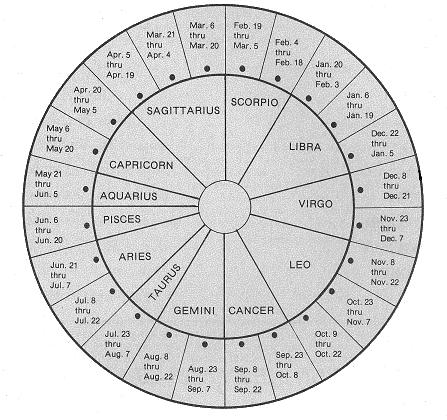
Finding Your Rising Sign
Step 1) Place your forefinger in the two outer rings, covering the dot in the section containing your birth date.
Step 2) Decide how many hours (to the nearest hour) you were born after midnight, and count that number of dots counterclockwise from your finger. The dot you stop at is beside the section containing your Rising Sign!
Example - Born on July 10 at 2:15 p.m. That's 14 hours (and a bit which you ignore) after midnight. Place your finger on the appropriate spot on the lower left of the wheel. Count 14 dots counterclockwise. You land outside Scorpio. So the Rising Sign is Scorpio.
NOTE: This method is approximate and should be accurate in most cases, however it can not match the accuracy of erecting your Natal Chart. If the Sign you locate does not seem to be right, read the one above and below it, you will be sure to find the true sign!
(Courtesy of Reginald H. Taylor, Cosmobiology Consultant, 1817 Garfield #208 E. Cleveland, Ohio 44112.)
Fire - Active
|
Air - Intellectual
|
Earth - Practical
|
Water - Emotional
|
Elements Chart
Fire/Earth - Earth tends to be placid while Fire is active; Fire has difficulty functioning through Earth.
Fire/Air - The Fire expressive nature complements the flexible Air signs; the Air will feed the Fire.
Fire/Water - The Fire signs can be drowned in the Water emotionalism, while the sensitivity of the Water is lost to the Fire.
Fire/Fire - A great deal of energy but tends to lack direction and stability.
Earth/Air - The practical Earth stabilizes the mental qualities of Air and the Air stimulates the Earth.
Earth/Water - The solid Earth lends itself to the formless Water and the Water rejuvenates the dry Earth.
Earth/Earth - Lacks flexibility, self-expression, little stimulus to activity.
Air/Water - Air is out of touch with the deep emotion of Water but can add a capacity to express the range of emotion in Water.
Air/Air - Without stability and feeling quality, can be all talk with little action or achievement.
Water/Water - Great sensitivity but a lack of focus as the waves of emotion are predominant.
Example Combinations
| Sun/Rising | Keywords: |
| Libra/Aries | We are/I am |
This combination of signs belongs to an individual who is seeking balance and harmony especially in his social relationships. In attempting to fulfill his need for interaction (Libra) on his own terms, (Aries) he will find himself playing with people and acting himself to draw people into his type of social activity. Both Aries and Libra feel the need to make things happen socially, Aries as a response to his will and Libra to adjust the situation into his kind of satisfying relationship.
The keywords pinpoint a basic conflict in Libra/Aries; he is really seeking the perfect We are relationship and yet he finds himself going contrary to this by living I Am, asserting his independence.
A look at the element combination pinpoints potential benefits. Air and Fire is a very stimulating mixture and in this Libra can find himself overcoming the Libran tendency to waver and become muddled with indecision by drawing on the Aries energy and determination. As a person who carefully weighs his experiences (Libra) he will also be able to control the Arian impulses to act rashly.
| Sun/Rising | Keywords: |
| Cancer/Cancer | I Feel/I Feel |
The double sign combination will intensify the strengths and the weaknesses of the sign. This double Cancer emphasizes all of the Cancerian qualities because he is a Cancer Individual and he projects a cautious, overly sensitive, self-preserving attitude onto life.
The keywords reveal a basic inner harmony as this Cancer is in touch with both aspects of his being and there is little conflict over his inner needs and outer approach, but he may be aware of the limited range of response as his feelings are his manner of experiencing.
The double Water element gives the impressionable but tenacious quality both within and out front. While Water is not known for its strength, the Cancer compensates by constructing a "shell" of personality from behind which he can function. He also needs a permanent "shell" (his home) where he can retire and recharge his emotional batteries and prepare for another day out in the world.
You are, at least part of the time, a mystic, if you let yourself recognize those subtle experiences that tell you about the hidden side of things.
Mysticism in Everyday Life
by Beaumont S. Cornell, M.D.
Is everyman a mystic? The obvious and common-sense answer is "No." If we regard a mystic as one who spends most of his adult life in meditation, then all the mystics in the world would form a very small fraction of one per cent of the population. But since it is possible to suggest that the majority of people are to some extent influenced by ideas of a mystical nature, our answer to the question needs qualification.
The "everyday" aspect of mysticism is not purely academic. The ingredients of human nature - whatever they are - have a practical bearing on politics, industry, education, religion and the healing arts. If we fail to recognize any important elements in personality we shall do but half a job in social planning, or world planning. One element that has been neglected is the basic mysticism of the average person. Fortunately, there is now less reluctance than ever before to take this feature of human nature into account. Today, enlightened persons are aware that action seldom is based on logical analysis. Emotion inspires much of it. Beyond that, we are constantly influenced by our unconscious minds, and such ideas, seeming to come from nowhere, may be rightly termed - mystical.
Copyright Garrett Publications, reprinted by permission. This article appeared originally in the September 1950 issue of Tomorrow magazine.
What is a mystical idea? It is one which has been gained by some method of thought different from rational thinking. The customary label for such thinking is "intuition," a word rejected by many psychologists on the grounds that it has never been defined in acceptable terms. There would be less objection if it could be shown that intuitive ideas arise in the unconscious mind and are suddenly projected into consciousness by some means. The genius, for example, finds a quick solution to a difficult problem but for no reason that he or anyone else can recognize. He himself usually is satisfied to accept the existence within him of an alter ego, while the public merely regard him as "smart." Perhaps he possesses an unusual facilitation of intercourse with his own unconscious mind. Freud inculcated the doctrine that such intercourse is difficult and occurs only by an unsatisfactory upjetting of symbolic material requiring critical analysis to make sense. The genius would have to have a "flair" for interpreting the upjettings.
Such a theory of genius has in its favor the fact that it omits reference to E.S.P. in all of its forms.
Observation and careful questioning of individuals will persuade anyone that the experience of "sudden lucidity" is not limited to geniuses. Almost everyone has occasionally been surprised by finding the answer to a problem when he least expected to. A business executive of my acquaintance all at once saw the way out of a production bottleneck while engaged in a game of canasta. A housewife went to bed worrying how to accommodate some self-invited guests and awoke with a readymade, effective solution. A church musician, foiled in his attempt to write a suitable arrangement for an offertory, suddenly conceived the entire harmony while drinking beer with some cronies in a tavern. An efficiency engineer, idly fishing from the edge of a dock in the St. Lawrence River, was astonished to realize that unconsciously he had worked out a plan of attack suitable to an important phase of his work. He dropped his rod, drove quickly home, covered a dozen large sheets of ruled paper with figures, soon put his plan into action and, in the course of the next twenty years, became a millionaire. He still is unable to explain what happened that warm summer day, but he preserves a high regard for fishing. A young man was broke in Philadelphia and just as he awoke to face another day, he beheld before him in space the reproduction of a page from a bank passbook. He noticed that the last entry was in the amount of $47.50 and then suddenly remembered a forgotten savings account in another city. A telephone call promptly obtained for him much needed funds.
In these instances, the individuals had brooded upon their difficulties and the solutions depended partly upon resurrected memories and partly upon a type of thinking of which none of them were aware. In the case of the forgotten bank account we find a graphic and creative element for the young man's total faculties were able to present him with a visible symbol of what he needed. In every case the problem was solved either during sleep, at the moment of waking or while diverted from the problem itself. In every case there was a rather strong emotion of frustration. Other instances of sudden lucidity are more complicated, as the following case history will indicate.
A patient, Edward H., aged thirty-five, bond salesman and promoter, a man of sound, logical mind and forceful character, consulted me because of a purely physical ailment. During my conversations with him I learned that upon one occasion when he was extremely puzzled as to a certain contemplated course of action, the problem was successfully solved, but in a dramatic and unexpected manner. While seated alone in his office in full daylight, and as he dwelt upon the decisions which were vexing him, he suddenly noticed what appeared to be a man standing beside him. This man said to him, "Go to New York," and promptly disappeared. It eventually proved to be true that New York provided the specific requirements of which he was in search.
It seems unnecessary to bring E.S.P. materialization or visitation into an attempted explanation of this peculiar case. Edward H. was not a psychic in any sense. The "incident" which so markedly influenced the rest of his life was attended by unusually strong emotion. He did not positively recognize the "man" whom he saw, but said he seemed "something like" his father but not definitely so. He did not see the man's face but only his trousers and the bottom of his coat. His clothing was of an indefinite gray color. Asked if he, the patient, has actually heard the words described, he said there could be no doubt of it - the words were plainly spoken and in a solicitous tone. When asked if the advice of his visitant confirmed his own convictions, Edward H. replied that he had not even considered going to New York, prior to the incident. Why then had he placed so much confidence in a message that had come to him by so bizarre a means? "I couldn't do anything else," he responded, "because I knew this was 'out of the horse's mouth.'" At first he was alarmed and worried about the affair and wondered if he might be losing his reason. For several years he could not bring himself to mention it to anyone. Later, after his fortunes improved, he felt less anxiety about it and confessed the story to a very few intimates. Never before nor since in his life has there been any similar episode.
A Purely Psychological Matter
Can this case be explained without resort to extrasensory perception? To emphasize the emotional energy involved it is necessary only to remark that few things are more intimately interwoven with a business man's being than the achievement of success. Without success there follow want in all its forms, and, particularly, injury to the pride. Edward H. at thirty-five was an energetic fellow at the full height of his psychophysical powers and possessed a great deal of what we term "personal magnetism," yet he had not succeeded in clearly setting his course or getting off on the right foot. He was married to an ambitious girl who expected more than she had thus far ever received. He knew that he was frankly "in a jam." It preyed on his mind. It kept him awake at night and his appetite forsook him. Sexual relationships had been given up and he lived in a state of continence for several months. Perhaps we have here all the ingredients needed for a masterpiece of desperation. He had considered self-destruction but brushed it aside. Finally his emotion of frustration, conditioned by sublimated sexual energy suddenly shook his being and produced a momentary dissociation of faculties. He projected the image of a man who was certainly a symbolization of his father, to whom in earlier days he had turned for advice. He suffered an auditory delusion so that he seemed to hear certain words very distinctly. In that same moment there erupted from the depths of his being an answer to his problem - an answer which unquestionably had been formulating itself for weeks without his conscious knowledge. Nature had played him a trick. His complex personality had staged a peculiar "show" of its own, original from start to finish. To Edward H. it was all something "outside" himself, something vastly impressive and persuasive. It of course gave him complete confidence and that is why he was soon successful and remained so.
Eliminate the abnormal features of this episode and there remains the basic mechanism of the unconscious mind presenting consciousness with a solution of a problem by means of symbols. The idea of "New York" had long been forming in his unconscious mind but it required an emotional cataclysm to break the resistant shell of consciousness. The message received possessed no virtue independent of the man's inner judgment. He might have done as well in Detroit, but certainly he would not have believed in Detroit.
This case of Edward H. would not, of course be acceptable to certain schools as an example of mysticism. The Neo-Platonists who have profoundly affected Western mysticism, would be unlikely to regard it as having anything to do with mysticism. Thus, Dean Inge felt that even the vision of Saint Paul on the road to Damascus was not an example of mysticism. The Platonists hold that true mysticism is a rational and purely mental occupation, logically pursued to its specific goal, which is the attainment of the Unitive Life, Illumination or Enlightenment, whichever term be preferred.
Features of Illumination
Edward H. plainly had no conception of the meaning of any of these terms. If he was illumined, it was in a minor degree; if he was enlightened it was with respect to a single and definite choice; and there is no evidence that his experience in any way lifted him out of the rut of a business career, except this - that the memory of it became in a real sense "holy" to him.
It is equally plain that his bizarre experience possessed some of the earmarks of those reputedly advanced experiences, which, in various personages, have ushered in the psychological state known as Illumination. A study of Richard M. Bucke's book, Cosmic Consciousness, will confirm this for most readers. There is always a problem to be solved, there is always concentration on that problem over a period of time, there is always a strong and sometimes wistful emotional attitude and there is usually sexual continence. Finally at a propitious moment comes a solution of the problem, associated with certain sensory effects, often the perception of physical light. What is learned by the percipient in that auspicious moment is invariably of permanent significance, at least to him. Just as Edward H. could not bring himself to go anywhere except New York, so the Illuminata are persuaded quite beyond reason of the truth of their intuition, whatever its nature. This mountain peak of psychical experience, though of such short duration, inculcates belief resistant to future argument.
We have only to recall Edgerton Ryerson, literally jumping out of bed in the middle of the night under an overwhelming sense of "mission," and then proceeding, as he did, to found the educational system of Ontario. Fred Banting also jumped out of bed in the middle of the night, and he once told me that by the time his feet touched the floor he had the essentials of his famous insulin discovery well arranged in his mind, although for months he was unable to get any light on the subject. Six weeks later he isolated, with the help of Charles Best, the first active extract of the Islands of Langerhans - the portion of the pancreas which produces insulin. Walt Whitman in a mood of wistful emotion while lying on the ground among his "Leaves of Grass" became suddenly and dramatically aware of his inner deity - that astounding alter ego which he regarded as infallible - and hence forth proceeded to become America's foremost literary mystic. Richard M. Bucke, M.D., a Canadian psychiatrist, while driving in a hansom along the streets of London, England, at night, suddenly felt himself engulfed in light. He was astonished and alarmed but after due reflection came to realize that what had happened to him had also happened to many others. Partly to reassure himself on this point he made a study of the "phenomenon" as it had occurred to other men and women and finally concluded that this bizarre episode signified the moment of Illumination. Following it, all his attitudes in philosophy and religion were reshaped into their final form, satisfactory to him, and unalterable. His book, above referred to, is a semi-scientific description of the experience of illumination and Bucke, because of it, is regarded as the most constructive mystic whom Canada has produced. The list of individuals known to have experienced Illumination is one of fair length. One of the most famous was Gautama, reflecting for weeks under his Bo tree, and suddenly realizing that he was no longer a man, or even a god, but specifically a Buddha. His problem had been the sad plight of mankind in general and at once he obtained what he regarded as the solution. It is epitomized in his well-known text, "Behold, I show you two things; suffering, and the ending of suffering." Inasmuch as the avoidance of suffering entails an actual transcendence of personality as we know it, the doctrine has always received short shrift in the West.
The Type-Experience Common to All
Each episode presents elements that do not conform to rational thinking. If they are not mystical, the term has limited meaning. Ordinary people are acquainted with them in various forms. A study of a intelligent person under favorable circumstances will reveal experiences having the same basic elements. A problem, much emotion, pent up energy, sudden lucidity, emphatic solution of the problem. With great man, the problem is religio-philosophical or scientific. With the ordinary man the problem is one of business or personal interrelationships.
The individual is seldom inclined to confess the experience, and in any case he is unable to describe it. The true mystic's greatest predicament is one of communication. The man who becomes a mystic for only a moment finds the same trouble with respect to that moment. His bravest efforts to impart what he intuited fall as flat as new mown hay. We are invariably dumbest with respect to our most brilliant experiences.
By inferring that many of these intuitive episodes are self-contained within the individual and represent essentially a breaking down of the shell of consciousness, we do not imply that E.S.P. is not a reality, because today every sensible person knows it is. It is not, however, necessary to the experience of sudden lucidity. Neither are we attempting to place these potent experiences on a purely humanistic, let alone a clinical basis. Rather, man and his connections with the Universe represent an aggregate of innate powers which have seldom if ever been fully developed.
The unconscious mind appears to be "put to it" to reveal its own conclusions to the unreceptive awareness of the individual. Its only weapon is the symbol, and its only method a sound psychophysical upheaval which often carries with it unpleasant and alarming side-effects. This is one type of intuition which has not been sufficiently recognized. In other types E.S.P. may play a part.
The Nature of Intuitive Knowledge
There is no possibility of proof that what any individual intuits is necessarily final, impeccable, infallible or that it squares with fact as determined by logical methods of enquiry. The truth is that it usually does not. Likewise there is no way to prove that a logically determined fact is infallible. Consequently any argument on either side is of no avail. One thing seems clear, that the episode of sudden lucidity, whether of minor or major grade imparts to the individual an excessive impetus, which in itself has been responsible for many worthwhile accomplishments that might have gone undone under different circumstances. Subjects of Illumination have moulded the opinion of millions of people for centuries. Minor experiences have picked up a failing man and put him forever on his feet, making him adequate where previously he was inadequate. The brain becomes rechanneled by a unique energic influence, and it is in such a psychophysical milieu that people are capable of visions, vivid symbol production, exceptional insight, unusual courage and happiness. Remove emotion and ecstasy from mysticism and - the Platonists notwithstanding - there is little left but arid intellectuality.
Accidental Occultism
Delving into private lives brings up unbelievable facts. I will deal briefly with the chance discovery of occult powers by persons having nothing to do with occultism, and then refer to the prophetic element in night dreams.
A young woman, twenty-six years of age, Gloria B., stenographer by profession, consulted me because of hyperthyroidism (goiter). I was impressed by an uncanny sense which she seemed to possess. She would anticipate questions in a way that her knowledge of medicine did not explain. Once I asked her, "Who can one trust?" She remarked that in my waiting room was a certain lady whom I could not trust. She had never seen this lady before. It was not long afterwards that her estimate of the person proved to be true. Gradually I obtained the interesting story of Gloria B. She had until recently roomed with a girl who was also a stenographer. By some queer and inexplicable circumstance these two girls, without help or provocation, discovered the methods of an occult practice, little known to the public, but technically known as "projection of consciousness." They became involved in exploiting this power of which neither of them had ever read or heard the technical name. It consisted in leaving the body at will. This feat was accomplished while lying in bed before going to sleep. In her "astral" peregrinations Gloria took delight in going to a great many different places. Frequently she claimed to have visited her home, some two hundred miles distant and observed whatever people were doing there at the time. Some of her "observations" were amenable to being checked against fact and she stated that her finding always checked accurately with the facts. For example, she saw her mother doing needlepoint work in the kitchen and later verified this by asking her mother what she had been doing at such and such a time. Suddenly she broke off the habit of "projection of consciousness," and for a fearful reason. Her roommate on one of her own trips failed to come back. At any rate Gloria's friend was found dead in bed one morning for no good medical reason that could be discovered. Gloria, at the time I met her, was very desirous of getting rid of this power, as well as an alleged proclivity for seeing the spirits of the departed at inopportune times. This had become very troublesome to her and appealed too much to her pity. Later she married a minister of the Gospel.
It would be possible to present further episodes gleaned from intimate interviews with more than a score of persons. My selection of those to question may have been biased by some of their preliminary remarks suggesting that they might be profitable subjects. Nevertheless, it is my impression that "ordinary" people may and do become mystical, intuitive and occult, often unexpectedly.
Everyone a Mystic While Asleep
After J.W. Dunne wrote his important book, An Experiment with Time, I tried to prove or disprove his contentions by having various persons follow his instructions and report the results. His thesis was that a considerable portion of night dreams are truly prophetic. One had to write down as many of his dreams as he could remember on waking. Then, during the next few days or weeks, he was to note whether or not any of the dreams could be recognized in actual events. All dreams are symbolic, and some skill is needed to detect the nature of this symbolism and its reproduction in actual incidents, if any. Those who failed to find any connection between night dreams and future events were persons having no faculty for remembering imagery. The others, who formed the majority, succeeded. Space permits the recital of only two dreams and their fulfillment in real life.
A man dreamed that he looked at his coat sleeves and found them covered with snow. He wrote the dream down, but was not at all hopeful of having it matched in actuality, since the season was late spring and further snow falls were almost certain not to occur. The very next evening his living room was unpleasantly chilly and he prepared to make a fire in the grate. He had no sooner opened the draft than a chance breeze came down the flue and blew white ashes over his sleeves and coat. He looked at his clothing and at once knew that the symbolism of the dream had been correct, although he naturally thought it was snow, not ashes on his sleeves.
Another man dreamed that he was in a basement garage standing beside a gasoline pillar used for filling cars. His uncle who was with him (though actually dead for ten years) said to him, "Let's get out of here, that tank is going to explode," and pointed to the gasoline pillar. He wrote down the dream but he did not have long to wait for its fulfillment. At breakfast that same morning his wife said to him, "What is that noise?" There was an ominous sizzling sound emerging from the basement. He ran downstairs and found that the burner under the gas water-heater (which physically resembles a gasoline pillar) had accidentally been turned too high and the water in the pipe system was at steam temperature. Had he not turned it off an accident would soon have occurred.
Several psychiatrists, notably the late A.A. Brill, felt confident in denying any prophetic element in dreams. They explain the seeming plausibility of the experimental findings on the basis that there are so many interpretations possible for any one dream. Dream anything you wish, then merely fit this in, imaginatively, with some of the innumerable incidents and situations of the next few days. Personal experimentation with the method almost always leaves one impressed by the truth of Dunne's thesis, and skeptical of Brill's objections.
A great many persons are ready, as I am, to subscribe to the generalization that a considerable proportion of night dreams contain imagery or action which if remembered and properly interpreted, forecast actual future events involving, or not involving the person having the dream. Thus we are presented with a significant bit of information to the effect that all people are prophetic (psychic, if you wish) while they are asleep. Why then does waking up terminate the faculty? What is sleep? What is waking?
While these questions will not soon be solved, we may at least indicate some of the differences between dreams and waking consciousness. During the daytime we are propelled by purpose and, in order to accomplish our tasks, we must concentrate upon various objects and ideas. To make sure that life makes sense we accept the idea that one event follows another in virtue of a cause-effect relationship. This at least gives movement to life and that movement is always in one direction - forward. Thus we go forward in a swirl of complex events, knowing only the past and the present. We do not know the future because we have not yet come up with it.
In dreams, purpose is lacking and there is nothing to accomplish. We do not concentrate on anything. Cause-effect relationship is nonexistent and motion may be forward or backward, or merely lacking. We are presented in sleep with a mixture of quasi-events, quite displaced from their normal timetable, thus constituting a pool of material into which we may reach and pick out now a past event and now a future event, accidentally or at pleasure.
Time, cause, effect - these form the basis of rational thought. In sleep we are merely not rational. In sleep we are actually mystical, but do not realize it. The psychic position of the medium is half way between the two states - sufficiently asleep to catch the symbolic procession, sufficiently awake to interpret and report it.
The moment we are able to concentrate pointedly upon a sound, a sight or even an idea, we are awake, even though we were sound asleep before the alarm clock went off, or the robin began singing on the window sill, or the rays of a rising sun pried our heavy lids apart. It is concentration that wakes us up. While you are asleep doubt a dream and you at once wake up. Give up all concentration and you fall asleep. By special training, Ouspensky was able to detect and follow, during waking hours, a continuous dream-state in himself, which flowed on along with his rational processes like the second melody in a fugue. Sometimes he could keep track of both elements for hours at a stretch.
While awake, sometimes, while asleep always, everyman is a mystic.
Profile: Eileen Garrett
by Louis Khourey
TAT Profiles are a guide to the life and thought of individuals, past and present, who have contributed to the advancement of human awareness. For those major figures with whom many are familiar, the goal will be to extract the core of their philosophies and present it in a clear and concise manner, along with recommendations for deeper study. Lesser known figures will be dealt with more subjectively, evaluations will accompany the basic information and the reader will, hopefully, benefit from our reviewer's study and experience in deciding whether or not that person's system is worthy of his time and attention. Future installments in this series will feature such teachers, masters and prophets as Madame Blavatsky, G.I. Gurdjieff, Edgar Cayce and P.D. Ouspensky.
Eileen Garrett: The Skeptical Medium
Eileen Garrett knew that the British dirigible R-101 was going to crash on her 1930 maiden voyage and she warned the Director of Civil Aviation. He ignored her warning and died with forty-five others when the giant airship went down in northern France, far from its destinations in Egypt and India. In 1930 the psychic Irishwoman was well known in English spiritualist circles as a trance medium with whom researchers like Sir Arthur Conan Doyle conducted investigations to establish contact with the spirits of the "dead." She was not a modern Cassandra, attempting to achieve notoriety by predicting disasters, but this experience of precognition was too clear for her to keep to herself. Four years earlier she remembered seeing a silver zeppelin floating over London's Hyde Park at a time when none were known to be in operation; then in 1928 she had a more disturbing vision of the same vessel, partly obscured by clouds and upset by winds. Still, she chose to believe that she was witnessing an actual event and was surprised to find no account of it in the papers. Finally, in 1929 the ship appeared a third time, burning and smoking, and she became convinced that she had learned of a coming tragedy.
The R-101 episode was Eileen Garrett's most famous and significant experience of precognition, and it enhanced her reputation as a woman with strange, yet reliable, powers. She was also clairvoyant, able to see things happening beyond her physical presence. She was made dramatically aware of this ability in 1916, one month after she had married a young officer before his return to the war in France. While leaving a restaurant one evening, she suddenly became oblivious of her physical surroundings and experienced the death of her husband in a terrible explosion. A week later she was informed that he was missing and presumed dead.
In 1933 Eileen Garrett was working with the California branch of the American Society for Psychical Research and made a tourist's visit to Hollywood where she was watching Cecil B. De Mille shoot a movie. She saw a small, elderly woman at De Mille's shoulder, making suggestions and criticizing his direction; De Mille seemed to ignore the woman completely. A few moments later, the same little woman appeared behind the large and striking Eileen Garrett and asked her if she could help in conveying her advice about De Mille's work. The medium knew that this woman was from another "sphere," but decided to refrain from approaching the imperious De Mille. Back in California two years later, Eileen decided to contact the great director with her message, and obtained an appointment. She was encouraged by a friend's remark that De Mille was deeply interested in the philosophy of survival after death and in psychical research.
De Mille received her grudgingly at his studio, but she was encouraged to present her message by the "presence" of the little woman. She began to speak about the faults in his work, and as she spoke took on the gestures and intonations of the "spirit." De Mille was visibly moved and recognized the words of his dead mother. As to De Mille's inquiries about Eileen's purpose, she responded: "I am not a woman with a mission though you might not suspect it. I take my work very seriously. I have some reputation as a sensitive, and I am happy that what I have done has been of some use."
The most famous "psychic" of the twentieth century was raised by her Irish Protestant uncle and aunt when her Irish mother and Basque father both committed suicide shortly after her birth in 1893. The pressures of religious and ethnic contrast became unbearable for her parents, but may have created in Eileen Jeannette Lyttle the unconventional and sensitive mind that gave her the determination to cultivate her unusual abilities rather than to suppress them, as many encouraged her to do. She grew up amidst the firm belief in fairies that is part of life in the Irish countryside, but was considered different even by those people who accept the supernatural as natural. She learned to project her awareness into familiar places, and also to withdraw that awareness into herself for protection. Until she reached the age of thirteen she had three young friends that she called "The Children" whose forms consisted entirely of light. Needless to say, her, aunt did not accept the reality of these playmates and often struck young Jeannie for the "lies" she told about them.
Despite the fact that she had always been sensitive to feelings and visions that others did not experience Eileen had no real understanding of her abilities, and as she matured and entered into marriage and London society she began to doubt her sanity. Her first marriage was marked by tragedy when her two young sons died. She had another child, a daughter, before a divorce. After the brief marriage to the young soldier, she married James William Garrett. She could not live the quiet home life that he desired and sought an outlet for her social idealism within the Fabian Society where she met some of the outstanding thinkers of her time like Clement Attlee, H.G. Wells and George Bernard Shaw.
But instead of leading her into politics, the Fabian Society introduced her to a man who could listen sympathetically to her stories of strange experiences and explain that she was not the victim of an uncontrolled imagination but was in contact with a universal consciousness. The seventy-year old man was Edward Carpenter, a friend of Walt Whitman, and one of those rare individuals who had actually been described in Richard M. Bucke's book as one who had experienced "cosmic consciousness." He recommended that Eileen study the works of Madame Blavatsky, Rudolf Steiner, Emerson, Spinoza, Frazer's Golden Bough and the Hindu scriptures; he also advised that she not become addicted to any one cult or religion.
Carpenter gave Eileen the theoretical understanding that she needed to accept her past experiences and the grounding to continue her investigations. Those investigations took a new and remarkable turn one afternoon when she was sitting with a group of ladies who were seeking answers from the dead through table-tilting. Eileen was told that she had gone to sleep and spoke of seeing the dead relatives of the ladies present; they were impressed and referred her to a Swiss theosophist in London named Huhnli. She went to sleep in Huhnli's presence and, while asleep, an entity or "control personality" named Uvani spoke to Huhnli through her. Huhnli later explained to Eileen that while she was in "trance," a sleeplike state, she became the vehicle for the personality of another. Uvani, who claimed to be a Persian from an earlier century, announced to Huhnli that he intended to work through Eileen to help establish proof of life after death.
Eileen was repelled at first by the idea of a foreign personality invading her mind, and her husband urged her to see a psychiatrist. She was finally convinced by her spiritualist friends, however, that she was a genuine trance medium and that she had nothing to fear, but should investigate her abilities. Eileen had no real interest in spiritualism herself; she found it banal and thought most spiritualists to be credulous. But they were her friends, and sources of support and encouragement for her desire to understand what was happening to her. And again, she was directed to a man who could help her: this was Hewat McKenzie, with whom she worked for five years until his death in 1929.
Every Friday night McKenzie trained both Eileen and her control, Uvani. He instructed Eileen to purify her body and mind by moderating her indulgence in sex, food and alcohol, and by living a simple life; this was necessary to maintain a clear and receptive subconscious mind. He would entrance Eileen by hypnotic suggestion and talk to Uvani, leading him into deeper and different areas of the medium's mind. This training enabled Eileen in later years to produce profound ideas while in trance, rather than the trivial meanderings heard from most spirit "controls." McKenzie advised Eileen against the development of physical mediumship - causing movement of physical objects or their materialization - because it could adversely affect the more valuable gift of mental mediumship. Most importantly, McKenzie taught her to maintain objectivity about her own powers, as well as towards the people who would come to her for help.
Hewat McKenzie's primary interest in training Eileen Garrett was in making her a reliable vehicle to establish proof of survival after death, the spiritualist thesis. Eileen never really accepted this central tenet of spiritualism, but she cooperated nonetheless in the experiments of the spiritualists. Nor did she accept the belief of many who spoke with her controls that they were really separate, discarnate entities. Rather, she believed them to be different aspects of her deeper self, a view held by Dr. Ira Progoff, the Jungian analyst who worked with her in 1957. She wrote in her autobiography, Many Voices: "I definitely believe the entities are formed from spiritual and emotional needs of the person involved... The older conception of these personalities as evidence of schizophrenia - would not seem to be true in my case, though there are many who still feel that this may be an answer. On the other hand, those who have known me intimately through the years know that I have continued to meet life on its many levels and that the psychic structure which may have begun very early has learned to deal with symbol and fantasy, thus giving me an appreciation of the meaning of life within and without; yet I have never lost sight of the spiritual goal toward which my whole nature strives."
Eileen Garrett's ability to "meet life" can not be doubted. Although periodically beset by a variety of serious illnesses, she worked actively in writing, publishing, education and research until her death in 1970. She established Creative Age Press which published general titles as well as books on psychic research, and in 1941 she founded Tomorrow magazine which combined literary excellence with an open-minded approach to spiritual and psychic subjects. Her enduring achievement has been her founding and leadership of the Parapsychology Foundation in order to further "knowledge of human responses to psychologically recognized stimuli transmitted by human beings other than sight, hearing, touch, taste and smell" in the areas commonly known as "parapsychology, electrobiology and extrasensory perception." It continues her work today as a leading institution in the field, a significant source of funding in an inadequately funded area of research.
As one of the outstanding mediums and clairvoyants of this century, Eileen Garrett encountered not only scientific researchers like J.B. Rhine and Ira Progoff, but she also met some of the most famous names in modern esotericism. Despite the accusations of charlatanism directed at him, she considered G.I. Gurdjieff to be a great man who was "definitely aware at all times," and she admired his students, Orage and Ouspensky. She viewed Rudolf Steiner as a deep student of the miraculous and the occult, and as a guide to the development of spiritual perception and truth. Aleister Crowley, "the wickedest man in the world," she thought to be less wicked than he liked people to believe, and also less a master of the black arts than he claimed to be; he was, rather, "an excellent poet and an able scholar."
The Parapsychology Foundation was established in 1951 as a non-profit organization to encourage scientific research and study of the laws and principles which underlie paranormal human behavior, based upon Eileen Garrett's awareness that psychical research was ignored by a large part of the academic community and that aid for parapsychological research would not be available from most universities or foundations. The Foundation supports scientists doing such research and has helped to take psychical research out of the field of the unreal and the eccentric. It observes objectively the varying research methods and studies of parapsychology, and offers assistance to scientists and universities engaged in the interdisciplinary approach to a better understanding of telepathy, clairvoyance, precognition, psychokinesis and other paranormal phenomena. A research library is maintained at the Foundation offices in New York. The Foundation sponsors yearly, international conferences in the United States and Europe and publishes a record of their proceedings, as well as a series of Parapsychological Monographs and Parapsychology Review, its official journal. For more information write: Parapsychology Foundation Inc., 29 West 57th Street, New York, N.Y. 10019.
Many of those interested in psychic phenomena, and especially those who are "gifted" with psychic powers, tend to develop a dogmatic conviction that they have found the real meaning and purpose of life in their particular infatuation. Eileen Garrett's talent was supported by a remarkable character that always strove to integrate her discoveries of the unseen world into a commonsense view of life. She wrote: "I am often asked if my psychic experiences 'disturb' my everyday life. On the contrary, they enrich it. I need to understand my own motivations and continually observe what can be the cause of the fantasies and visions that make me forever curious about everything... One simultaneously lives a separate existence, aware of a tenuous level of experience as one rubs shoulders with one's fellows, while underneath there is the pattern that plays unconsciously and perpetually, a web many-colored and delicate, but filled with the awareness of what is happening to each and all below the surface... I am aware of an intermediary field which contains us one and all, to hold our 'signature' so that we, as emotional beings, continue to add our stamp of personality to this unsuspected world within space. Perhaps one day this area within space and time will reveal itself to the scientific mind."
One psychic manifestation that she experienced consistently throughout her life, and which she did not doubt, was the existence around every living thing of an aura or "surround" which changes colors as the creature breathes. She came to realize that it protects the body's action and absorbs the shocks of the external world. A being that is well and happy will have a surround that is brighter in color than one that is ill or predisposed to weakness.
This knowledge, in turn, led Eileen to a study of breath control as affecting her various psychic states. The proper awareness and control enriched her sensitivity and she discovered that a different tempo was suited to clairaudience, clairvoyance, telepathy and precognition. Breath was her channel of communication between the self and the external ocean of life. She stated that her energy came from the conscious use of breath, which helped her to bring a concept into her field of attention and perception.
Her psychic experiences informed Eileen Garrett that there was much more to life than was apparent to most people. This she knew, but the answer to what lay beyond the door of death was not revealed to her and she did not presume to preach on that subject. Instead, she wisely asked the only question that could provide a real answer: "In later years I have had to face up to the thought of parting with the body on many occasions, awaiting what then looked like the inevitable change. I have had to ask myself: What am I? It has been claimed that I am many people - all suspect!... Am I really one individual or many, and what will happen at my departure to the control personalities who have become so intertwined with me? They claim to be 'individualized,' and so do I, and yet I do not feel this to be true. I am unified and drawn into the thoughts and actions of others to a degree not even I can understand... I am a mass of motivations, not independent, not separate, not distinct. I feel a certain sadness that I have not arrived at any answer that would throw light on survival for others; but since I have less knowledge of what is myself than most, I do not even know what might survive."
Eileen Garrett possessed the strength and determination of a pioneer; the country that she explored was her own mind. She avoided the extremes of shunning her unusual gifts as aberrations, and of accepting them as self-evident proof of life after death and communication with the dead. As a young woman who had not yet learned to control her psychic manifestations she was not without self-doubt and could have accepted the verdict of those who considered her to be mentally ill, had she not had the support of those who recognized her potential. Indeed, psychiatry could easily categorize Eileen Garrett as a deviant type, with no regard for the wealth of information about the human mind that she produced as she developed and refined her powers. Dr. Jan Ehrenwald, a psychiatrist and psychic researcher, diagnosed her according to conventional standards in his book Telepathy and Medical Psychology. She suffered, according to textbook medicine, from depersonalization and loss of feeling of reality associated from autoscopic hallucinations; she had systematized delusions and was, in sum, a victim of schizophrenia or paraphrenic psychosis.
Eileen Garrett's life and accomplishments are a direct challenge to psychiatric labeling and mechanical definitions of insanity. Perhaps the difference between the well-balanced psychic and the pathetic schizophrenic is not so much in the character of their visions as it is in their ability to control and understand them. In that case, the help and guidance that she received from Edward Carpenter and, especially, from Hewat McKenzie made the difference for Eileen between a life of confused possession that she could have suffered, and the life of directed action that she lived. She came to develop the conviction that the psychic experiences of people like herself were pointing the way to a truer understanding of human nature.
She wrote: "Did man but comprehend the potential range of his powers, he would be capable of reaching beyond time to a state where past, present and future are one, and beyond conscious mind to an area where the subconscious, the conscious and the superconscious are united. When man comes to recognize such experience as his birthright, he will indeed be able to live with himself at the same time in those states outside of time, which are as yet little known or understood by him." Her hypothesis was that she was able to produce information when in trance that she would have no normal means of knowing, due to the ability of the subconscious to contact the superconscious and receive from it an entire universe of information and knowledge denied the conscious mind. Her control, Uvani, was an entity who interpreted the images that she thus received; or, she felt, the control personality might simply be a dramatic device employed by her own subconscious.
She believed that more study of the phenomenon of mediumship was needed; true to Edward Carpenter's advice, she became addicted to no cult and did not try to start one of her own. Rather, she encouraged research, and would have been just as willing to accept proof of the unreality of the phenomena that she produced as proof of their reality. The intense subjectivity of her psychic experiences never impaired her intellectual objectivity. Her life itself was a prevision of what people might become if they learn to develop a sensitivity to interior experience and to generate the energy and determination needed to understand the mind.
Bibliography
Books by Eileen J. Garrett:
The Image of An Oracle by Ira Progoff, A Helix Press Book, Garrett Publications, New York, 1964, 372 pages.
The Image of an Oracle is presented as a research report that may never become widely popular, but if it falls into the proper hands it will be greatly valued. It deals with a depth investigation into the trance-mediumship of Eileen J. Garrett. This leads necessarily into the subtler dimensions of "mental" existence which are primarily of interest to very sensitive people and to scientists.
What would be the image of an oracle? An oracle is a source of hidden knowledge. The medium for this type of knowledge is usually a priest or priestess (as in ancient Greece) who must act as a receiving station. In some mysterious way, through prayer or meditation, the gods contact the mind or spirit of the priest who then communicates the higher purpose to us. This is the accepted vehicle for an oracle, which still represents an enigma when viewed from the perspective of psychology. In other words, we know that some kind of "higher" wisdom is being received and transmitted, but we do not know the nature of its source within the mind of man.
This deep question became the starting point for research into the psyche of Eileen Garrett, one of the most famous and honest trance-mediums of the twentieth century. Mrs. Garrett and Dr. Ira Progoff met in New York City in 1957. For more than thirty years, she had experienced several "voices" or "entities" which purportedly spoke through her in the trance state. She openly admitted that she did not totally understand the "voices" (nor control them) but had developed a real respect for the knowledge which came through her. Many faithful people in England and America had based their beliefs about the nature of immortality on her experiences. She felt a certain responsibility, therefore, to discover the truth about the voices, and in her conversation with Progoff she brought this out: "Her question, to me, then, was clear and direct; Could I, on the basis of my studies in the field of depth psychology, tell her what was the nature and meaning of the voices that spoke through her? Were they in truth discarnate entities in which spiritualists were entitled to believe? Or did they have some other significance?"
Dr. Progoff enthusiastically took on this task which led to months of close psychological work with Mrs. Garrett and her "control figures." "Control figure" is his designation for the voices which spoke through her. There were four of them, and Progoff listened attentively to these voices, questioning them thoroughly about the nature of their existence and the nature of life In general.
These incredible conversations, which are separated by Dr. Progoff's commentaries, make up the bulk of The Image of an Oracle.
The first of these four control figures was named Ouvani. He introduced himself as the Keeper of the Door and claimed to be "a young Arab soldier of the thirteenth century who died in battle."
In one of the early dialogues, Ouvani describes his function within the psyche of Eileen Garrett:
"Oh, I think I can describe it very easily for you. You see, Ouvani (speaking of himself) is the doorkeeper appointed in the beginning who deals with the various questions of the peoples, all that is of very little importance. What he means, that is as you see it, but let me show it to you as he sees it. Finally we have here what we call something that for the sake of better visual impression I could describe to you as the light through which the life is thrown out to sea. Now if anyone can come in and move this life in all directions, there will be much confusion, not only out at sea, but close at hand. So when Ouvani refers to himself as the doorkeeper, he is not thinking of you, and you, he is thinking of all this that is necessary to keep the equilibrium. For if there is a lighthouse, many people would like to send their message. Very well, imagine what a confusion there would be, if there were not anyone able to stand between confusion of imagery and that part of the impression of the instrument herself. So you see there has to be order and perhaps l am therefore best able to be recognized as he who sustains that order."
As the dialogues continued, it became apparent that the four control figures considered themselves (if we can treat them as real personalities) to be the masters of Mrs. Garrett's evolution and destiny. Each one had a service to perform in helping her to live out her life's plan. Ouvani was the "Keeper of the Door." Abdul Latif was "The Psychic Healer." Tahoteh and Ramah, who were on a deeper level, were respectively referred to as the "Giver of the Word" and "The Giver of Life."
Early in the first chapter, the voice named Ouvani says:
"I think that this whole process, if you look deeply within her life, it is not her life that she lives, that becomes very obvious to you. If you watch this life you will find that it is not a life of a woman but that it is a life that is governed, and in a sense, projected, is it not so?"
Ouvani's statements seem paradoxical in reference to his functioning. For instance, he stated that Mrs. Garrett is, in some way, the engineer or creator of her life, but made this qualifying statement:
"But I am going a little further and saying to you that in the life of this particular woman there is also the mastery of those who, as it were, go ahead and throw out these paths and structures by which she will finally make her way."
By this statement we gain the impression that thoughts are actually being projected into her consciousness.
The second control figure was Abdul Latif, a Persian physician of the seventeenth century who was considered to be the "Psychic Healer." He and Ouvani made the most frequent appearances within the psyche of Eileen Garrett. They were considered to be closest to the surface of her consciousness. Abdul Latif was supposedly responsible for her clairvoyant and mediumistic responsibilities.
"He" described his function to Progoff:
"It had to do always with the healing of the personality and how he is affected by the stars in their courses, by the winds, by the elements and finally by the life which is no more, and the elements... as you, yourself, are no more than the elements. Therefore I have come at a time when the instrument herself needed particular care. It was at a time of great sorrow for her with the loss of her children. I came also to deepen the consciousness. I have my role; to take all that might have grown inward and turn it outward into the compassionate level of experience, not to let that nature exuberant turn in and destroy, neither to let that nature exuberant turn out to flow away, but to also hold it in extremely careful adjustment. Is this a little clear to you?"
Statements like this leave us puzzled as to how the control figures actually operate in the psyche of Eileen Garrett.
Some of the most fascinating conversations were held with Tahoteh, "the Giver of the Word." He apparently worked at a deeper level in the mind of Eileen Garrett, the level that Carl Jung would call archetypal, where universal principles are shown to the personality.
Ouvani, the doorkeeper, spoke about Tahoteh with great reverence:
"Tahoteh is a great teacher, a great life keeper who certainly has greater force, greater power and has walked among men for many eons. So she has personified this one? Well this is exceedingly - uh, interesting to Ouvani who could not hope to ever counsel with her in this area. I hope she treats him with respect. "
The deepest control figure (in the well of the mind) was named Ramah, the "Giver of Life." He is the voice that embodies the "elemental life force." This is synonymous with the energy that manifests to the individual as "desire." Ramah explained that a person's life destiny is, in some way, worked out through his deepest desires and Ramah was the voice of that desire.
In the continuity of these transcripts and commentaries, there is an abundance of esoteric knowledge which demands deep reflection and study to comprehend. The transcripts contain intriguing raw material about a subject that has rarely been dealt with in such an empirical way.
To get a "feel" for the nature of the voices, it is probably best to read the transcripts straight through. The voices sometimes speak in allegories and broken grammar, but once one becomes involved in them, and accustomed to their moods, they draw one into experiencing them in a related way.
Progoff's commentaries highlighted the psychological aspect of the control figures. Instead of exploring the philosophy (which could be a monumental task), he continually brought the issue back to the main focus of the research. What is the reality of these voices? In his summary, he stated, "The phenomena that occur, the voices, the persons, the imagery, are such that we are not at all entitled to assume that they are what they appear to be." Thus we are back to our original question: What is the image of an oracle?
In the final chapter, "In Conclusion: Hypotheses and Intimations," Progoff concluded that the trance personalities were, in one aspect, personifications of inherent capacities and principles within the mind of the individual. He referred to the personalities as "Dynatypes." For instance, he conceptualized about Ouvani, "It may be said that Ouvani is a personification of the self-regulative capacity of the psyche." It seems that an entity is formed around a transpersonal center within the mind, which then uses the available language and imagery of the psyche to communicate. They are symbolic representations of principles, which exist in the mind and in the world as well. This is not implying that they are merely "symbolic" or that they have no value. Progoff describes them as valuable mediators which act as a medium of communications between the depths of the mind and the conscious personality.
These explanations still do not allow us to reduce the reality of the voices to simple psychological mechanisms, but instead encourages us to reconceive of the mind. As the control figures intimated in their script, the mind, as it extends into and beyond that realm which is called the "unconscious," touches upon the great Allness of existence. Thus, it is also appropriate to conceive of the "voices" as dwellers, or depths-spokesmen in the Universal mind of man. Dr. Progoff intimated this in his introduction when talking about the challenge of this sort of research. "... It is the kind of inquiry that does not know how to limit itself. Necessarily so, for it is a journey into the illimitable where the boundaries of personality melt away."
Discernment—A Study in Ecstasy and Evil by Morton Kelsey, Paulist
Press, 158 pp., $4.95.
When a "responsible" member of the Christian community speaks out openly on issues relating to psychic healings, ESP, and the reality of spiritual "entities," we can rest assured that the positivistic assumptions of the age of reason are beginning to stand on shaky footings in the western world. Kelsey is a Professor of Theology at Notre Dame University who has also authored the best-selling book, The Other Side of Silence: A Guide To Christian Meditation. In his latest study, he boldly proclaims the need to recognize and examine those psychic influences which can and do affect our psychological-religious development. He presents a convincing argument that Jesus and the early founders of the Church (such as St. Paul, Origen, Augustine, and Aquinas) all acknowledged the existence of angelic and demonic forces in the human psyche.
The writer explores religious trance and healing by concentrating on the recent evangelical and charismatic phenomenon of "slaying in the spirit," a form of 1) harnessing of group, psychic energy by a priest or healer, 2) the ensuing projection of that current of energy into a willing recipient, often resulting in 3) a "religious experience" of varying degree, which literally knocks individuals off their feet. He notes that the indiscriminate use of such a psychic manipulation is not always positive proof of God's working through us, but may be just a temporary "high" generated by a quasi-hypnotic force that could just have easily been produced by anyone trained in the parapsychological mechanics of the hypnotizing process.
He argues that the New Testament itself offers convincing accounts of the existence of spiritual entities ("a purely mental and not a physical reality... a realm of being which is not material, but which is just as real"); and further, that Jesus' view of human personality distinctly acknowledged that demonic spirits made people sick (physically, mentally, and morally), while angelic spirits often healed and drew one closer to the Holy Spirit. Kelsey's thesis is supported by reference to cross-sections of the history of religious practice, ranging from the earliest shamans up to modern Pentecostalism and the healing powers of Kathryn Kuhlman. In criticizing the myopic world view of much of modern Christian theology and the behavioristic sciences, he flatly states that "we have not done away with angels by treating them with holy neglect, and that the devil's best stratagem is simply to convince people that he does not exist."
In his efforts to assess the dilemma of good and evil in the universe, the author draws from a wide range of sources in the fields of myth, history, religion, philosophy, and psychology - with Carl Jung standing out as a paramount influence. He warns of the dangers of indiscreet exorcism by unskilled clergy, and offers fair warning to those whose curiosity might lead them into excessively deep explorations of the demonic influences to be found in the Pandora's box of the human mind. Kelsey's call to recognition of the reality of the spiritual world is concluded with a section on "discernment in counseling," which examines the pressing need for spiritual advisors who are not only sensitive themselves to the psychic, non-rational dimensions of human consciousness, but also know how to relate such states of mind to the process of psychological-physical healing, and ultimately to facilitate the realization of the highest form of religious experience within the individual.
A Guide for the Perplexed by E.F. Schumacher, Harper Colophon Books,
1977, pp. 147, $3.95.
British economist and author E.F. Schumacher is probably known best in the United States for his book Small is Beautiful. Contained within this work are his theories on the possibilities for a decentralized, non-energy, non-capital intensive society. Evidence of his humanistic orientation is apparent in the subtitle, A Study of Economics as if People Mattered. Governor Brown of California has used Schumacher's ideas as the foundation for his own economic philosophy. Small is Beautiful has been published in fifteen languages; the author was in constant demand throughout the world as lecturer and consultant to voluntary bodies as well as governments.
Schumacher was educated at New College, Oxford, as a Rhodes Scholar, and also at Columbia University in New York. His popularity is due to his synthesis of scientific thinking with compassionate religious commitment; it is said that he combined a remarkable innovating intelligence and rigour of mind with the greatest gentleness and humor.
His last book, A Guide for the Perplexed, was published shortly before his death at the age of 66, in 1977. The primary concern of the book is the development of human potential. In this work Schumacher steps into a realm different than that of economics; in it he outlines what he calls a philosophical "map" for those who are on a spiritual path - that is, on the search for God and Truth.
His dissatisfaction with academia is immediately apparent; university education gave little instruction on the conduct of his life. Rather than leave what cannot be proved out of "maps" of life and knowledge Schumacher felt instead that such principles should be displayed prominently. Provable matters are, in a sense, dead; they constitute no challenge to the living. Even in his youth, and more so in later life, he thought the "maps" produced by materialistic scientism leave all the questions that really matter unanswered. In fact, the very validity of these questions are denied in the name of scientific objectivity. But objectivity does not help us explain our reality; or if it does, human phenomena are turned into mere epiphenomena.
Schumacher's effort at mapmaking, or way of looking at the world as a whole, has as its genesis the motto "ACCEPT EVERYTHING: REJECT NOTHING." Therefore, it is only a beginning, but it is a beginning that attempts to recognize the existence of everything that people notice, including that which is beyond the scope of science. His map does not "solve" problems; it helps to identify them. He feels that modern philosophy, beginning with Descartes, has attempted to exclude a "vertical dimension" of the human mind; that is, rather than seeing it as capable of reaching beyond itself toward higher levels, philosophy has posited that the mind's reach has fixed and narrow limits. The loss of the vertical dimension meant that it was no longer possible to give an answer to the question "What am I to do with my life?"
Schumacher's map recognizes four "Great Truths" that one can always see regardless of where one is on his personal journey. These are:
The four different Levels of Being are mineral, plant, animal, and man. The difference he considers between the levels is the successive gain of qualities or powers as we move from lower to higher, that is, from mineral to man. Inanimate matter is signified by the letter "m." As one moves from this object of study to the plant level a power that might be called the life force, "x," is added, and we say that a plant consists of m plus x. This "x" is something completely new and unexplainable; it presents us with an ontological discontinuity - a jump in the Level of Being.
As we move from plant to animal there is an equally inexplicable jump, the addition of quality "y." This additional power may be called consciousness. Though we are able to destroy it we are unable to create it, so in a very real sense our attempts to explain it are in vain. That it does exist, however, is undeniable. The animal level "contains" the lower two levels, and hence consists of m plus x plus y.
Man evidently is something more than the animal, he has the additional power - albeit very weak in most individuals - of "z," self-awareness. Man is not only able to think but is also able to be aware of his thinking. Consciousness and intelligence are able to recoil upon themselves. There is something able to say "I" and to direct consciousness in accordance with its own purposes, a power at a higher level than consciousness itself. Man, therefore, is m plus x plus y plus z.
There are necessarily lines of clear demarcation between the four levels, and the higher the power the more tenuous its existence. While the higher comprises and therefore, in a sense, understands the lower, no being can understand anything higher than itself. The powers of self-awareness are essentially a limitless potentiality rather than an actuality. They have to be developed and realized by each human individual if he is to become truly human. Physics and chemistry deal with the lowest level, "m." At this level x, y, and z do not exist. Physics and chemistry can tell us nothing about these three powers. Since man contains the three lower Levels of Being, certain things can be elucidated by studying minerals, plants, and animals - everything about him but that which makes him human.
The second Great Truth is that of adequatio, or adequateness. Nothing can be known without there being an appropriate "instrument" in the makeup of the knower. The understanding of the knower must be adequate to the thing to be known. We can only experience what we are adequate to experience; we are not entitled to insist that something inaccessible to us has no existence at all and is nothing but a phantom of the imagination of others.
All knowledge is subjective inasmuch as it cannot exist other than in the mind of a human subject. For example, a person born without sight does not have an organ adequate for visual perception. He will not be able to have knowledge of external objects as they appear to others. The same may be true for the higher faculties of the mind, the difference being that one hopes these powers can be developed. When the level of the knower is not adequate to the level of the object of knowledge, the result is an inadequate and impoverished view of reality. The observer depends not only on the adequateness of his own higher qualities, but also on the adequateness of his fundamental presuppositions and basic assumptions. Through an effort of self-awareness, one must become critically aware of one's particular thought paradigm; that is, how one colors his own perception of reality. In the process of developing insight one gains adequatio, an instrument capable of seeing and understanding truth.
The third Great Truth is that there are four Fields of Knowledge:
1. One's Own Inner World.
It is useless to study anything unless one first knows oneself. An integral aspect of this self-knowledge is self-awareness, which is related to the power of directing attention. The difference between directed and captured attention is the same as the difference between doing things and letting things take their course, or between living and being lived. Without self-awareness man merely imagines that he is in control of himself, that he has a free will and is able to carry out his intentions.
Schumacher does not believe that reality can be found by thought, because thought belongs to the Level of Being established by consciousness and not to that higher level which is established by self-awareness. The programmer cannot be trained by simply letting the computer run more regularly or faster. His requirement is not simply knowledge of facts and theories, but understanding or insight. The processes of gaining insight are quite different from those of gaining factual knowledge. Factor z - self-awareness - really comes into its own when factor y - consciousness - leaves the center of the stage. The mystic gets rid of the empirical ego, whereupon the pure ego, normally hidden, emerges into the light. The empirical ego is the stream of consciousness; the pure ego, or the self, is the unity which holds the manifold of the stream together.
2. The Inner Worlds Of Other Beings.
All traditional teachings tell us that one can understand other beings only to the extent that one knows oneself. There must be adequatio. The precondition to my ability to understand correctly is my own self-knowledge, my own inner experience. For example, pain is not observable by our outer senses. If only that which is observable by our outer senses is real, objective, and scientific, pain must be dismissed as unreal, subjective, and unscientific. There can be no knowledge of the other "inner person" except on this basis of self-knowledge. Yoga is an applied science that finds its material for study not in the appearances of other beings, but in the inner world of the scientist himself. The scientific methods of yoga can be effectively applied only by those who are prepared to put their own house in order through discipline and systematic inner work.
3. Knowing Myself As I Am Known By Others.
Field 1 without Field 3 may be worse than useless. To put myself into another's situation, I must detach myself from my own situation. This is not possible without self-awareness. Mere consciousness only confirms me in my own situation. The essence of the task of Field 3 is uncritical self-observation through relationships so that we obtain cool, objective pictures of what is actually happening. Without this effort one may risk being stranded in a fantasy world constructed by imagination.
4. The Appearance Of The World Around Us.
We can know the most about inanimate matter and the least about human beings. The more mature the object of study, the less mature is the science studying it. The fallacy of modern science has been to assume that the powers of x, y, and z can be studied as the level of inanimate matter, m, is studied.
In attempting to understand the world two kinds of science have emerged within Field 4. The first is descriptive science, which is concerned primarily with the whole truth. It answers the question, "What do I actually encounter?'' Botany is an example. The second type of science is instructional; that is, it is concerned primarily only with such parts or aspects of truth that are useful for manipulation. It answers the question, "What must I do to obtain a certain result?'' Chemistry is an example; it is totally quantified. These sciences necessarily limit themselves to the lifeless aspect of reality; x, y, and z cannot be ordered about. Only m, inanimate matter, can be predictably manipulated.
Since instrumental sciences base themselves only on the dead aspect of nature, they cannot lead to philosophy, if philosophy is to give us guidance on what life is all about. Endless trouble arises when the methodological requirements of the instructional sciences are taken as scientific methodology per se. The distinction between epistemology and ontology, or between what we can know and what actually exists, becomes significant as we move higher up the chain of being.
The fourth Great Truth concerns what it means to live in this world. One encounters two basic kinds of problems in dealing with the world. The first kind are called convergent problems. The more intelligently one studies them, the more the answers converge. An example might be an attempt to construct a two wheeled self-propelled vehicle before bicycles were invented. If a number of people were presented with this problem the solutions would eventually converge and result in the semblance of a bicycle-like machine. Convergent problems may be divided into those solved and those as yet unsolved - though, in principle at least, there is no reason to believe they will not be solved at some point. This type of problem relates to the dead aspect of the universe; convergence may be expected with regard to any problem which does not involve life, consciousness, or self-awareness - only m. The solution of a convergent problem proves something about an isolated system - that which is strictly controlled and allowed for - but proves nothing at all about matters outside and beyond it.
The second type of problem are those that are divergent in nature. They do not yield to ordinary, straight line logic. The more they are clarified and logically developed, the more the answers might diverge and even contradict each other. The moment we deal with problems involving the higher Levels of Being we must expect divergence, because the element of freedom and inner experience enters. Divergent problems cannot be solved; they can, however, be transcended. The opposites of which they are composed are transcended when higher forces - such as love - intervene. Experience has to be admitted as evidence. The real problems of life have to be grappled with, not solved.
It is not Schumacher's intent, in A Guide for the Perplexed, to outline a system for spiritual development. Instead, he has offered a significant contribution by providing sources of orientation that are of use regardless of one's particular path or system. As one gains freedom and becomes self-directed, we can see that there may be no discernable limit to what man can do. Man's essential task becomes a strain toward the highest things, to Levels of Being above his own. The author feels that it is not possible to truly live without religion, that is, without systematic work to keep in contact with, and develop toward higher Levels than those of ordinary life. Only there lies "goodness." I give this book my highest recommendation, and think it highly probable that any individual who was intrigued by J.J. van der Leeuw's book The Conquest of Illusion will be equally fascinated with Schumacher's.
We welcome your participation. TAT membership is $15 for the first year, and ten dollars for each year thereafter. The benefits from the membership are generously out of proportion to the cost of the membership. Members have four meetings at the TAT farm each year during which no charge is set on camping or participation in events on those days. Membership allows participation in any of the inner groups such as the TAT Science Group, the TAT Psychological Group or the TAT Esoteric Group. Write for more information.
The TAT Journal
We hope that you enjoyed this issue of TAT Journal and will choose to become a subscriber if you have not already. Your tax-deductible contributions above the subscription rate will help us improve the quality of the publication, and will be deeply appreciated.
[Membership and/or subscription form]
Esoteric Studies Society Pittsburgh, Pennsylvania
Schedule of Events -- The Columbus TAT Society
FREE public lectures are given on alternate Sundays at 7:30 p.m. at Buckeye Federal Savings and Loan, 3180 East Broad Street, Columbus, Ohio - just west of James Road. For more information, call Phil Franta ______ days.
May 6 - PSYCHOLOGY OF THE SEVEN RAYS, a lecture with a demonstration reading. Anita Hamm
May 20 - "RHYTHM OF LIFE," a special multi-media presentation on human awareness. Lynn Gundersheimer - instructor & facilitator
June 3 - AN INVESTIGATION OF LIFE AFTER DEATH EXPERIENCES - Art Ticknor
June 17 - OPEN FORUM - FUTURE DIRECTIONS
"It's only the Red King snoring," said Tweedledee.
"Come and look at him!" the brothers cried, and they each took one of Alice's hands, and led her up to where the King was sleeping.
"Isn't he a lovely sight?" said Tweedledum.
Alice couldn't say honestly that he was. He had a tall red night-cap on, with a tassel, and he was lying crumpled up into a sort of untidy heap, and snoring loud—"fit to snore his head off!" as Tweedledum remarked.
"I'm afraid he'll catch cold with lying on the damp grass," said Alice, who was a very thoughtful little girl.
"He's dreaming now," said Tweedledee: "and what do you think he's dreaming about?"
Alice said "Nobody can guess that."
"Why, about you!" Tweedledee exclaimed, clapping his hands triumphantly. "And if he left off dreaming about you, where do you suppose you'd be?"
"Where I am now, of course," said Alice.
"Not you!" Tweedledee retorted contemptuously. "You'd be nowhere. Why, you're only a sort of thing in his dream!"
"If that there King was to wake," added Tweedledum, "you'd go out—bang!—just like a candle!"
"I shouldn't!" Alice exclaimed indignantly. "Besides, if I'm only a sort of thing in his dream, what are you, I should like to know?"
"Ditto," said Tweedledum.
"Ditto, ditto!" cried Tweedledee.
Common Sense
We might ascribe common sense to a farmer who can tell us the turns of the weather by a quick glance at the clouds. His sense is common because he uses his own ears and eyes to explain the phenomena of the world, instead of depending on mere theories or belief. Common sense is based on repeated observation and formed in the humility (or wisdom) of recognizing our own ignorance and working with it. It is vitally important in evaluating the steps we must take toward mental and physical wellbeing. We must ask questions, observe directly, and ultimately experiment with ourselves.
© 1979 TAT Foundation. All rights reserved.